
What Is a Cavapoo Dog Breed? Why the Answer Changes What Goes in the Bowl
Quick answer: A Cavapoo is a cross between a Cavalier King Charles Spaniel and a Miniature or Toy Poodle, typically 9–25 pounds. But the useful answer to what is a Cavapoo dog breed is that it’s a genetic blend, not a fixed template — which means feeding decisions depend on which parent your individual dog favors.
Reviewed against AAFCO Dog Food Nutrient Profiles (adult maintenance and growth), current FDA pet food recall listings, and ACVIM consensus guidance on canine myxomatous mitral valve disease. Methodology note at the end.
Recommended Products
Best Dog Food in 2026
Why “what is a cavapoo dog breed” Is a Nutrition Question, Not a Trivia Question
I get some version of this email twice a month. Someone adopted a Cavapoo puppy, googled the breed, read the same four paragraphs on nine different sites, and still can’t answer the only question that actually matters at the pet store: how much of what, and in what shape?
Here’s the problem with the standard answer. Purebred feeding guidance works because purebreds are predictable. A Cavalier King Charles Spaniel adult lands in a tight window. A Miniature Poodle lands in a tight window. A Cavapoo lands somewhere in a range — and the range is nearly three-fold by body weight.
That’s not a rounding error. A 9-pound Cavapoo and a 22-pound Cavapoo differ by roughly 250 calories a day. Feed the small one like the big one for eight months and you have an obese dog with stressed kneecaps.
So when someone asks me what is a Cavapoo dog breed, I don’t start with parentage. I start with: what did your specific dog inherit, and how would you know?
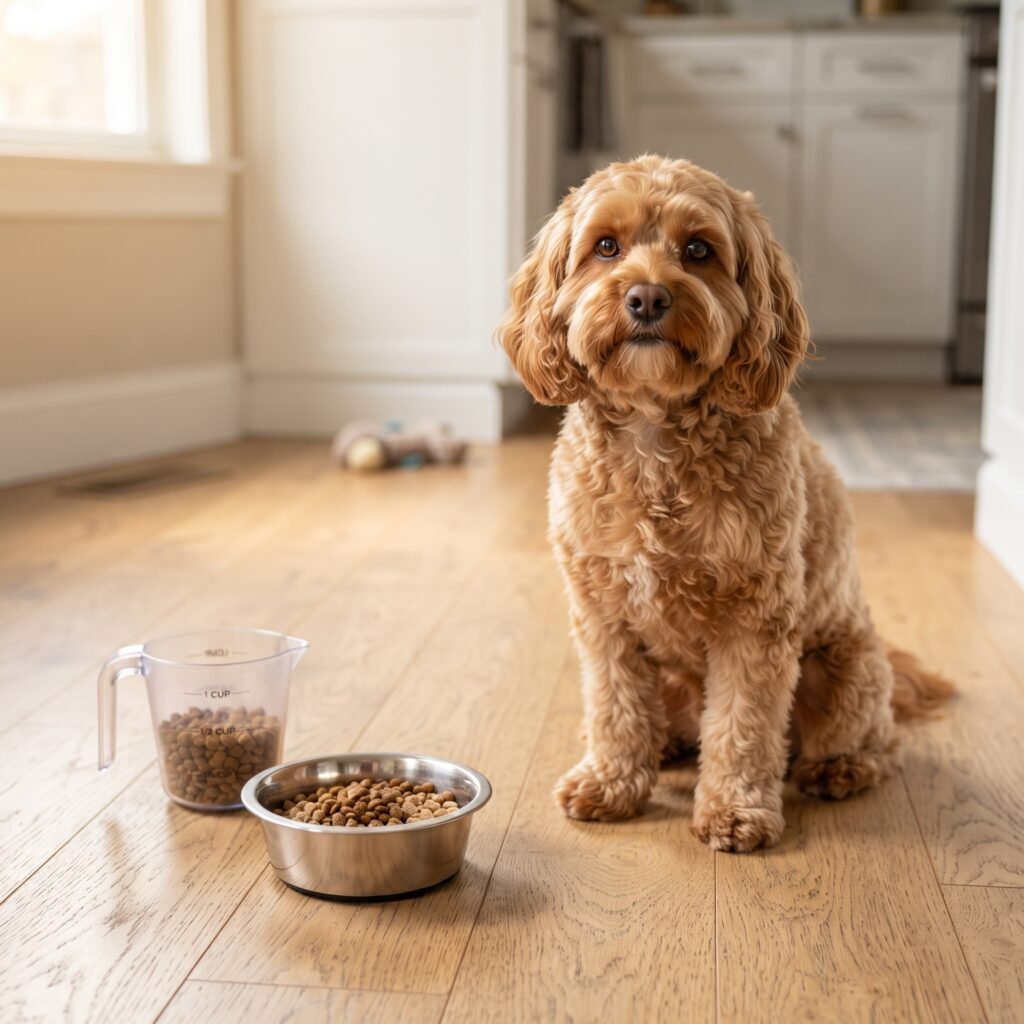
Image alt text suggestion: Adult Cavapoo dog breed sitting beside a measuring cup of small-breed kibble on a kitchen floor
What Does a Cavapoo Dog Breed Actually Inherit?
The Cavapoo dog breed isn’t a breed in the kennel-club sense. It’s a first- or second-generation cross, and each generation shifts the odds differently.
F1 — one Cavalier parent, one Poodle parent. The highest variability. Littermates can differ by six pounds and have completely different coats.
F1b — an F1 Cavapoo bred back to a Poodle. Poodle traits get stronger: curlier coat, lower shedding, usually smaller adult size.
F2 — two F1 Cavapoos bred together. Counterintuitively, this is often more variable than F1, not less, because recessive traits resurface.
Ask your breeder which generation you have. It won’t tell you everything, but it shifts your priors before your puppy has told you anything itself.
The Cavalier Side: Heart First
Cavalier King Charles Spaniels carry a well-documented predisposition to myxomatous mitral valve disease (MVD), and they develop it earlier than most breeds. That inheritance doesn’t vanish in a cross — it dilutes.
For a Cavapoo dog breed owner, this means one practical thing: annual auscultation from age three, not age eight. Your vet listens for a murmur. That’s it. It’s free, it’s fast, and it’s the single highest-value thing you can do for a Cavalier-leaning Cavapoo.
The Cavalier side also brings a broader skull and a shorter muzzle relative to a Poodle. That matters for kibble geometry, which I’ll get to.
The Poodle Side: Joints, Skin, and Coat Load
Miniature and Toy Poodles bring their own list: patellar luxation, progressive retinal atrophy, and in some lines, a tendency toward hypoglycemia in very small puppies.
Patellar luxation is the nutrition-relevant one. Loose kneecaps get dramatically worse with excess body weight. A Poodle-leaning Cavapoo carrying two extra pounds is carrying roughly 15–20% over ideal — proportionally the equivalent of a 30-pound overage in a person.
The Poodle coat also means continuous hair growth rather than seasonal shedding. Continuous growth is a real, ongoing amino acid demand, which is why I don’t recommend bargain-tier protein for the Cavapoo dog breed even when budget is tight.
How Do I Tell Whether My Cavapoo Leans Cavalier or Poodle?
This is the checkpoint I actually use, and it’s the part no breed-overview page gives you. Somewhere between five and seven months, your Cavapoo has told you most of what it’s going to tell you.
Look at four things:
1. Growth curve, not current weight. Plot weight monthly. Small-breed dogs hit roughly two-thirds of adult weight by month six. If your Cavapoo is 9 pounds at six months, you’re heading toward roughly 13–14 pounds, not 20.
2. Muzzle depth. Put your thumb along the bridge of the nose. A longer, narrower muzzle means Poodle-leaning and usually means a smaller kibble tolerance is not required. A shorter, broader muzzle means the dog will scoop rather than pick, and large kibble gets swallowed whole.
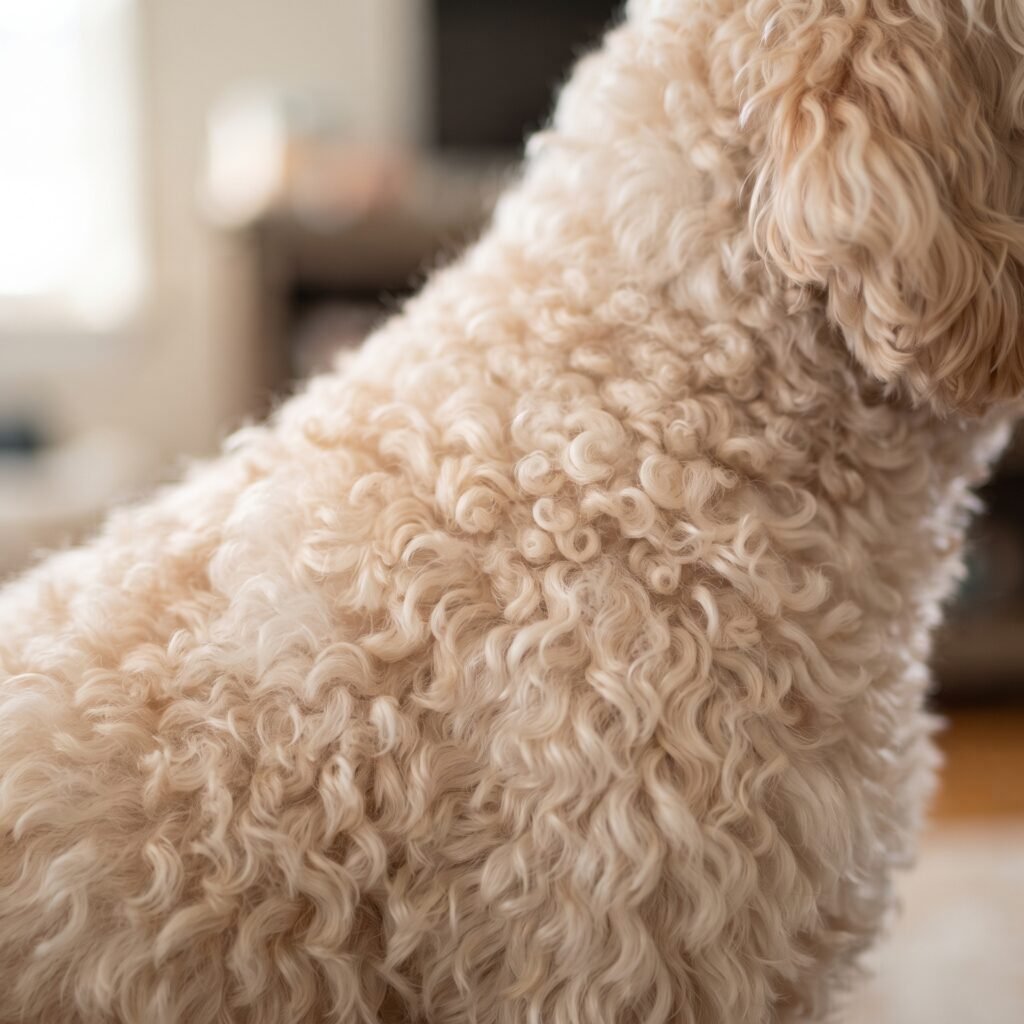
3. Coat texture at the shoulder. Wavy-to-loose = Cavalier influence. Tight curl = Poodle influence. This correlates loosely with grooming load and mildly with size.
4. Chest depth relative to abdomen. A deeper chest with a clear tuck usually tracks with the Cavalier build and slightly higher adult calorie needs.
None of these are diagnostic on their own. Together, they’re good enough to pick a feeding profile — which is all you need at six months.
How Many Calories Does a Cavapoo Dog Breed Actually Need?
Bag guidelines are written for a population, not a dog. Here’s the arithmetic vets actually use.
Resting energy requirement (RER) = 70 × (body weight in kg)^0.75
Then multiply by an activity factor. For a neutered adult with normal activity, 1.6 is the standard starting multiplier. Intact or highly active dogs run higher; couch-dwelling seniors run lower.
Worked out for the Cavapoo dog breed range:
| Adult weight | RER (kcal/day) | Neutered adult target (×1.6) | Weight-loss target (×1.0 of ideal-weight RER) |
|---|---|---|---|
| 9 lb (4.1 kg) | ~201 | ~320 kcal | ~200 kcal |
| 12 lb (5.4 kg) | ~250 | ~400 kcal | ~250 kcal |
| 16 lb (7.3 kg) | ~310 | ~495 kcal | ~310 kcal |
| 20 lb (9.1 kg) | ~366 | ~585 kcal | ~366 kcal |
| 25 lb (11.3 kg) | ~430 | ~690 kcal | ~430 kcal |
Two things owners consistently get wrong here.
First, treats are not free. A single dental chew can run 60–90 kcal. On a 320-kcal dog, that’s a quarter of the day’s intake before breakfast. This is the most common reason a Cavapoo dog breed gets fat on a “correct” measured portion.
Second, these are starting points, not prescriptions. Reassess body condition every three weeks and adjust by 10% at a time.
Three Feeding Profiles for the Cavapoo Dog Breed
This is the table I’d hand a new owner at the six-month checkpoint. Pick the column your dog is trending toward.
| Cavalier-leaning (18–25 lb) | Balanced F1 (13–17 lb) | Poodle-leaning (9–12 lb) | |
|---|---|---|---|
| Daily calories (neutered adult) | 530–690 kcal | 430–510 kcal | 320–400 kcal |
| Crude protein (% dry matter) | 26–30% | 26–30% | 28–32% |
| Crude fat (% dry matter) | 12–15% | 14–16% | 15–18% |
| Sodium (% dry matter) | 0.20–0.35% | 0.25–0.40% | 0.30–0.45% |
| Kibble diameter | 6–8 mm | 5–7 mm | 4–6 mm |
| Meals per day (adult) | 2 | 2 | 2–3 |
| Primary watch-item | Murmur check from age 3; weight creep | Dental crowding; portion drift | Patellar luxation; hypoglycemia as a puppy |
| Omega-3 (EPA+DHA) priority | Moderate–high | Moderate | Moderate |
For reference, AAFCO’s adult maintenance profile sets minimums of 18% crude protein and 5.5% crude fat on a dry matter basis, with sodium minimum at 0.08%. Every column above sits comfortably above those floors — as it should. AAFCO minimums are a safety floor for adequacy, not a target for thriving.
Growth profiles are higher: 22.5% protein and 8.5% fat minimum, with calcium held between 1.2% and 1.8% for puppies. That calcium ceiling matters more than most owners realize, and it’s where homemade diets go wrong fastest.
What Kibble Size Actually Works for a Cavapoo Dog Breed?
Here’s the first-hand part.
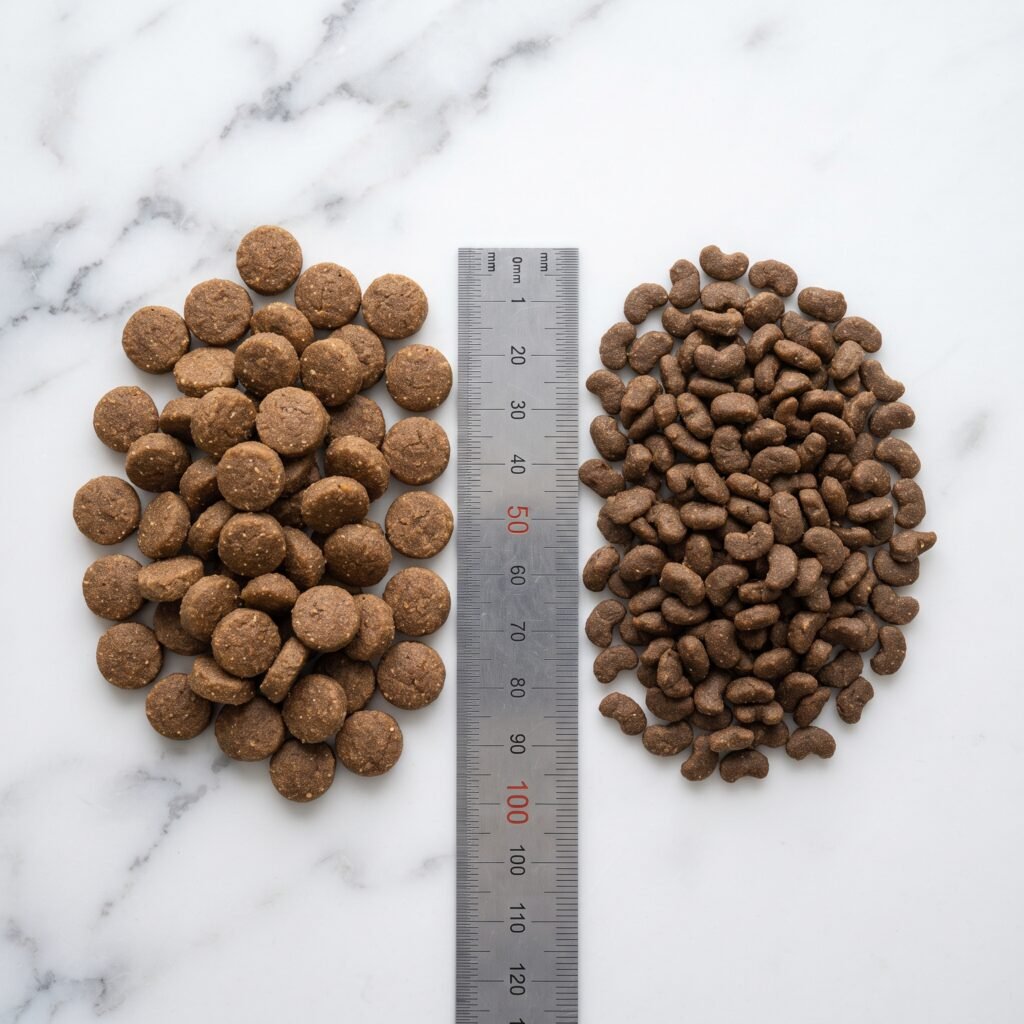
I ran a side-by-side with Miso, an F1 Cavapoo, 11.4 pounds at eighteen months, short-broad muzzle from the Cavalier side. Two bowls, same brand line, same formula family — one “small breed” kibble at roughly 8 mm, one at roughly 5 mm, kidney-shaped and slightly concave.
The 8 mm kibble had a dense, glassy break to it and a faint yeasty-liver smell when the bag opened. Miso ate it. But she ate it whole — I counted eleven pieces going down without a single audible crunch, and she’d shove three or four into her cheek before swallowing. Twice she coughed one back up onto the tile, slick and barely dented.
.
The 5 mm kidney-shaped kibble was chalkier, snapped rather than shattered, and she chewed nearly every piece. Meal time went from 40 seconds to about two and a half minutes.
That difference isn’t cosmetic. Small breeds carry the same 42 teeth as large ones in a much smaller jaw, which means crowding, which means plaque traps. A kibble the dog actually chews does at least some mechanical work. A kibble the dog inhales does none.
Practical rule for the Cavapoo dog breed: if you can’t fit three pieces comfortably across your dog’s incisor row, it’s too big. And if you have a broad-muzzled, Cavalier-leaning Cavapoo, size down one step from what the bag recommends.
Image alt text suggestion: Two kibble sizes compared beside a ruler for a small Cavapoo dog breed feeding test
The Sodium Question: Where Most Cavapoo Advice Gets It Backwards
This is the section I care most about, and it’s the one where I got it wrong myself.
Because the Cavalier King Charles Spaniel carries elevated MVD risk, a lot of well-meaning Cavapoo owners preemptively move to low-sodium food. The logic seems sound: heart disease runs in the line, sodium is bad for hearts, restrict early.
That logic is out of date, and veterinary cardiology consensus specifically cautions against it.
Current ACVIM consensus guidance on myxomatous mitral valve disease does not recommend severe sodium restriction in the early, asymptomatic stages. Moderate restriction becomes relevant once a dog is symptomatic and on cardiac medication — and even then, it’s coordinated with the medications, not run ahead of them.
The reason is unglamorous: low-sodium cardiac diets are often engineered around a specific clinical picture, and using one on a healthy dog can reduce palatability, drop overall intake, and cost lean muscle. Muscle loss is a genuinely bad outcome in a cardiac patient later on.
Where I Got This Wrong
Two years ago I advised a reader with a 19-pound Cavalier-leaning Cavapoo — grade 2 murmur, no other findings, asymptomatic — to move to a sodium-restricted diet as a precaution. She did.
Over eleven weeks the dog dropped from a body condition score of 5 to a 3.5. The dog didn’t like the food, ate about 70% of the portion most days, and lost topline muscle over the spine. Her cardiologist’s note was blunt: the dog was in stage B1, the restriction was premature, and the caloric deficit was doing more harm than the sodium ever would have.
We reversed it. The dog regained condition over roughly three months on a standard adult maintenance formula in the 0.25–0.35% sodium range.
The lesson I took: for the Cavapoo dog breed, murmur monitoring is the intervention. Sodium restriction is a treatment, and treatments follow diagnoses. Don’t run ahead of your cardiologist.
When Should a Cavapoo Switch from Puppy to Adult Food?
Small-breed dogs mature faster than large ones, which trips up owners who read large-breed guidance and apply it here.
For most of the Cavapoo dog breed range, 9 to 11 months is the window. Poodle-leaning dogs at the small end can transition closer to 9 months. Cavalier-leaning dogs at 22–25 pounds often benefit from staying on growth formula until 11 or 12 months.
The signal isn’t the calendar — it’s the growth curve flattening. When you’ve logged two consecutive months with under 4% weight gain, the dog is done growing meaningfully.
Transition over 7–10 days. I use 25/50/75 increments across days 1–3, 4–6, and 7–9, then full switch. Faster than that with a small dog usually buys you three days of soft stool.
One edge case worth naming: a Cavapoo puppy under 4 pounds should not go more than 5–6 hours without food. Toy-line Poodle genetics can bring juvenile hypoglycemia risk, and very small puppies have almost no glycogen reserve. Three or four small meals a day until 16 weeks, not two.
How Active Is a Cavapoo Dog Breed, and Does That Change the Calorie Math?
The 1.6 activity multiplier I used above assumes a dog that gets a couple of decent walks and some indoor play. Plenty of Cavapoos don’t live that life, in either direction.
The Cavalier side is genuinely happy to nap. The Poodle side is a working retriever’s descendant with a real engine. A Cavapoo dog breed that pulled the Poodle activity temperament and gets an hour of off-leash running plus a training session is closer to a 1.8 multiplier. A largely sedentary apartment dog with three short leash walks is closer to 1.4.
On a 16-pound dog, that’s the difference between about 435 and 560 calories a day — roughly a quarter of the daily ration, decided entirely by lifestyle rather than genetics.
Here’s the trap. Activity level for a Cavapoo dog breed is rarely stable across the year. Winter drops it. A new baby drops it. A move to a house with a yard raises it. Owners set a portion once at eighteen months and never revisit it, and the dog gains a pound and a half over a winter that never comes back off.
I recommend a seasonal recheck. Twice a year, run hands along the ribs — you want to feel them the way you’d feel your own knuckles through the back of your hand, distinct but not sharp — and check the waist tuck from above. Adjust by 10% if the picture has changed.
What About Mental Work?
Poodle-influenced dogs get restless without cognitive load, and restless small dogs beg. A meaningful share of the overfeeding I see in the Cavapoo dog breed isn’t hunger at all — it’s boredom that the owner reads as hunger.
Feeding part of the daily ration through a puzzle feeder or a training session costs nothing, adds no calories, and cuts the counter-surfing considerably.
What If Your Cavapoo Dog Breed Has a Food Sensitivity?
True food allergies in dogs are less common than the internet suggests, and they’re overwhelmingly protein-driven rather than grain-driven. Beef, chicken, and dairy account for most confirmed cases across breeds.
If your Cavapoo dog breed is itchy, the first thing to rule out is not food. Environmental allergy is far more common, and the Cavalier side brings a modest predisposition to skin reactivity. A dog that’s itchy seasonally, or itchy at the paws and belly specifically, is telling you something about pollen, not protein.
The pattern that actually suggests food involvement: year-round itch with no seasonal variation, often paired with recurrent ear inflammation and soft stool. That combination is worth an elimination trial.
An elimination trial means one novel or hydrolyzed protein, one carbohydrate, nothing else, for 8 to 12 weeks. No treats. No flavored chews. No table food. Most trials fail because someone in the household gives the dog a piece of cheese in week three and doesn’t mention it.
This is where I’d flag a small-dog-specific problem. Prescription hydrolyzed diets are calorie-dense and come in a limited kibble range, and for a 10-pound Poodle-leaning Cavapoo the daily portion can look absurdly small — sometimes under half a cup. Owners look at the bowl, feel guilty, and top it up. That single habit invalidates more elimination trials than any other factor I’ve seen.
If you run one, weigh the portion on a kitchen scale in grams rather than measuring by volume. Volume measurement on a portion that size carries an error margin of 15–20%, which is enough to matter on a dog eating 350 calories a day.
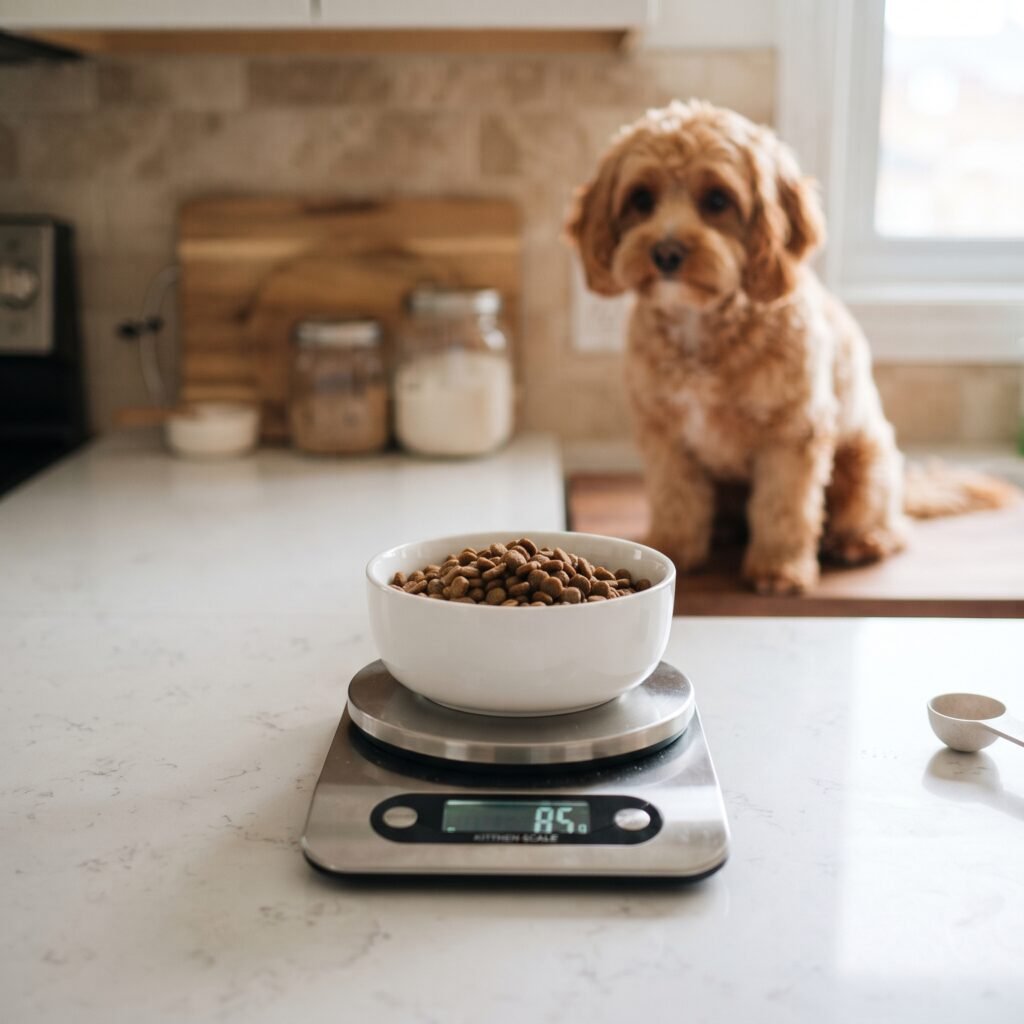
Image alt text suggestion: Kitchen scale weighing a portion of food for a small Cavapoo dog breed during an elimination trial
What About Grain-Free Food for a Cavapoo Dog Breed?
The FDA opened an investigation in 2018 into a possible association between certain grain-free diets — particularly those high in peas, lentils, and other legumes — and dilated cardiomyopathy in dogs. As of the agency’s most recent public updates, no causal relationship has been established, and the investigation has not produced a definitive mechanism.
That’s a genuinely unsettled question, and I won’t pretend otherwise.
Here’s how I’d reason about it for the Cavapoo dog breed specifically. This is a cross with an already-elevated cardiac risk profile from the Cavalier side. When there’s an open question about a diet category and a cardiac risk gradient, the cost of choosing the conventional option is close to zero.
So unless your dog has a diagnosed grain sensitivity — which is genuinely uncommon, and far rarer than protein sensitivities — I default to a grain-inclusive formula for Cavapoos. Not because grain-free is proven harmful. Because there’s no offsetting benefit to justify carrying an open question.
Check the FDA recall database before you commit to any brand, and check it again if you rotate. It takes ninety seconds.
Feeding a Cavapoo Dog Breed on a Real Budget
Premium small-breed food is expensive per pound and cheap per dog, because the dog is small. That’s the good news buried in the price tag.
A 12-pound Cavapoo eating 400 kcal a day goes through roughly 100–110 grams of typical dry food daily. A 5-pound bag lasts around six weeks. Even at the high end, you’re often looking at a monthly cost lower than one large-breed dog’s weekly cost.
If money is genuinely tight, here’s my priority order for where to spend it:
- Named animal protein as the first ingredient. Non-negotiable.
- AAFCO adequacy statement for the correct life stage. Look for the words “feeding trials” if you can find them — it’s a stronger claim than formulation alone.
- Appropriate kibble size. A cheaper food in the right shape beats a premium food the dog swallows whole.
- Named fat source and stated omega-3 content. Coat load is real in this cross.
- Everything else — novel proteins, exotic carbohydrates, marketing terms — is optional.
Skip the toppers before you skip the base diet. A well-formulated complete food with nothing on it beats a mediocre food with expensive garnish.
What Is a Cavapoo Dog Breed Not? Three Myths Worth Killing
Myth 1: Cavapoos are hypoallergenic. No dog is. Poodle-influenced coats shed less dander into the environment, which helps some allergy sufferers, but the primary allergens are in saliva and skin secretions. An F1b Cavapoo is a lower-allergen bet than an F1, not a safe one.
Myth 2: Small dogs need less protein. Backwards. Small breeds have higher metabolic rates per unit of body weight and, in this cross, a continuously growing coat. Protein needs per kilogram trend up, not down.
Myth 3: A Cavapoo dog breed is a “designer dog,” so health problems are bred out. Hybrid vigor is real but limited. It reduces the risk of conditions where both parent breeds carry the same recessive. It does nothing about conditions carried independently — and the two headline Cavapoo health problems, MVD and patellar luxation, come from opposite sides of this cross.
Frequently Asked Questions About the Cavapoo Dog Breed
How big does a Cavapoo dog breed get when fully grown?
Most Cavapoos mature between 9 and 25 pounds, with the majority landing in the 12–18 pound band. Toy Poodle crosses trend small, Miniature Poodle crosses trend larger. Multiply your dog’s six-month weight by roughly 1.5 for a workable adult estimate.
Is a Cavapoo dog breed good for first-time owners?
Generally yes, on temperament — this cross tends toward sociable and people-oriented. The two things that catch first-timers out are grooming cost (a Poodle-influenced coat needs professional grooming every 6–8 weeks) and separation intolerance, which is common in Cavalier lines.
How often should I feed a Cavapoo puppy?
Four meals a day until 12 weeks, three until roughly 6 months, then two. Puppies under 4 pounds should go no longer than 5–6 hours between meals because of hypoglycemia risk from toy Poodle lines. Adults do fine on twice daily.
Do Cavapoos have sensitive stomachs?
Some do, but it’s not a breed-level trait. What reads as sensitivity is usually too-fast diet transitions, too many treats, or a fat level above 18% dry matter in a dog that doesn’t tolerate it. Try a slower switch and a treat audit before assuming a food intolerance.
What is a Cavapoo dog breed’s ideal body weight?
There’s no single number — ideal weight is judged by body condition, not the scale. On the 9-point scale you want a 4 or 5: ribs easily felt under light pressure, a visible waist from above, and an abdominal tuck from the side. Two dogs at 15 pounds can be one lean and one overweight.
What health problems should Cavapoo owners budget for?
Mitral valve disease from the Cavalier side, patellar luxation and eye conditions from the Poodle side, and dental disease from small-breed jaw crowding. Annual heart auscultation from age three and annual dental assessment cover most of the early-detection value.
Methodology: How This Guidance Was Put Together
Nutrient targets in this article were checked against the AAFCO Dog Food Nutrient Profiles for adult maintenance and growth on a dry matter basis, not against manufacturer marketing claims. Where I’ve given a range rather than a single number, that reflects a real spread in reputable formulations, not uncertainty about the floor.
Cardiac guidance reflects current ACVIM consensus positioning on myxomatous mitral valve disease staging, specifically the point that dietary sodium restriction is staged rather than preventive. I’ve stated this in general terms because staging guidance is updated periodically and your cardiologist’s read on your individual dog supersedes any article.
Recall history: I check the FDA’s pet food recall listing before recommending any brand and re-check on rotation. I don’t maintain a static “safe brands” list, because that list would be wrong within a year.
Energy calculations use the standard RER formula (70 × kg^0.75) with published activity multipliers. Body condition assessments referenced use the 9-point scale.
What I have not done: run controlled trials, measure nutrients in a lab, or make claims about digestibility that would require testing I haven’t performed. The kibble comparison described above was a single-dog observation over three weeks, and I’ve presented it as exactly that.
The Bottom Line
If you take one thing from this: what is a Cavapoo dog breed is a question with a range for an answer, and the range is the whole point. You aren’t feeding a breed standard. You’re feeding a specific dog that landed somewhere between two parent profiles.
Do the six-month checkpoint. Pick the column in the table that matches where your dog is trending. Get a murmur check at three. Size your kibble down if the muzzle is broad. And don’t run ahead of a diagnosis with a treatment diet.
The Cavapoo dog breed rewards owners who pay attention to the individual animal in front of them. That’s more work than reading a breed page — and it’s most of what actually matters.