Pure Balance Dog Food: How to Read the Pea Line Before You Buy
Short answer: Judge Pure Balance dog food by where peas and pea protein land in the ingredient list, not by the grain-free badge on the front. The grain-inclusive recipes still run legumes high. Pro+ Performance swaps in soy and corn protein instead. Match that pulse position to your dog’s breed, age, and your vet’s guidance.
That single distinction is the reason two dogs can eat Pure Balance dog food from the same shelf and get meaningfully different diets. I’ve spent the last few years pulling bags off Walmart shelves, photographing panels, and comparing them to AAFCO nutrient profiles — and the pattern that keeps surfacing has nothing to do with the word “natural” on the front of the bag.
Recommended Products
Best Dog Food in 2026
Why does the pea position matter more than the grain-free label?
In July 2018 the FDA opened an investigation into canine dilated cardiomyopathy in dogs eating certain diets. The agency described the foods of concern as ones containing a high proportion of peas, lentils, other legume seeds, and potatoes as main ingredients — meaning within the first ten ingredients, before the vitamins and minerals. The headline everyone remembered was “grain-free.” The actual variable the FDA flagged was ingredient proportion.
That distinction survived every later update. The FDA’s position is that most diets associated with reports of non-hereditary DCM carry pulse ingredients high in their ingredient lists, and that this includes both grain-free and grain-containing formulas. By June 2019 the agency had concluded the issue was complex and likely multifactorial, with researchers looking more closely at pulses rather than simply the presence or absence of grains.
In December 2022, the FDA ended routine public updates, stating that adverse event reports alone don’t supply enough data to establish a causal relationship. No causal link has been proven. That’s the honest state of the science, and anyone telling you otherwise in either direction is selling something.
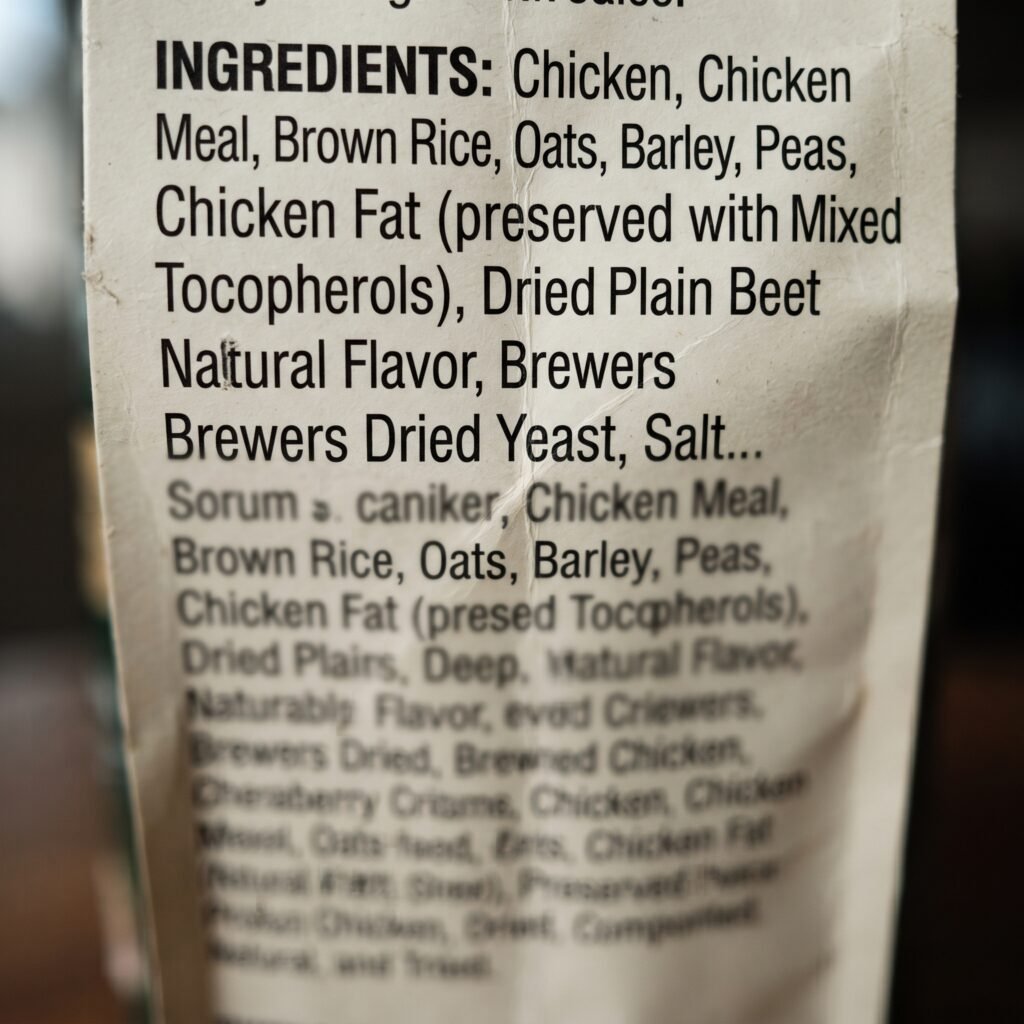
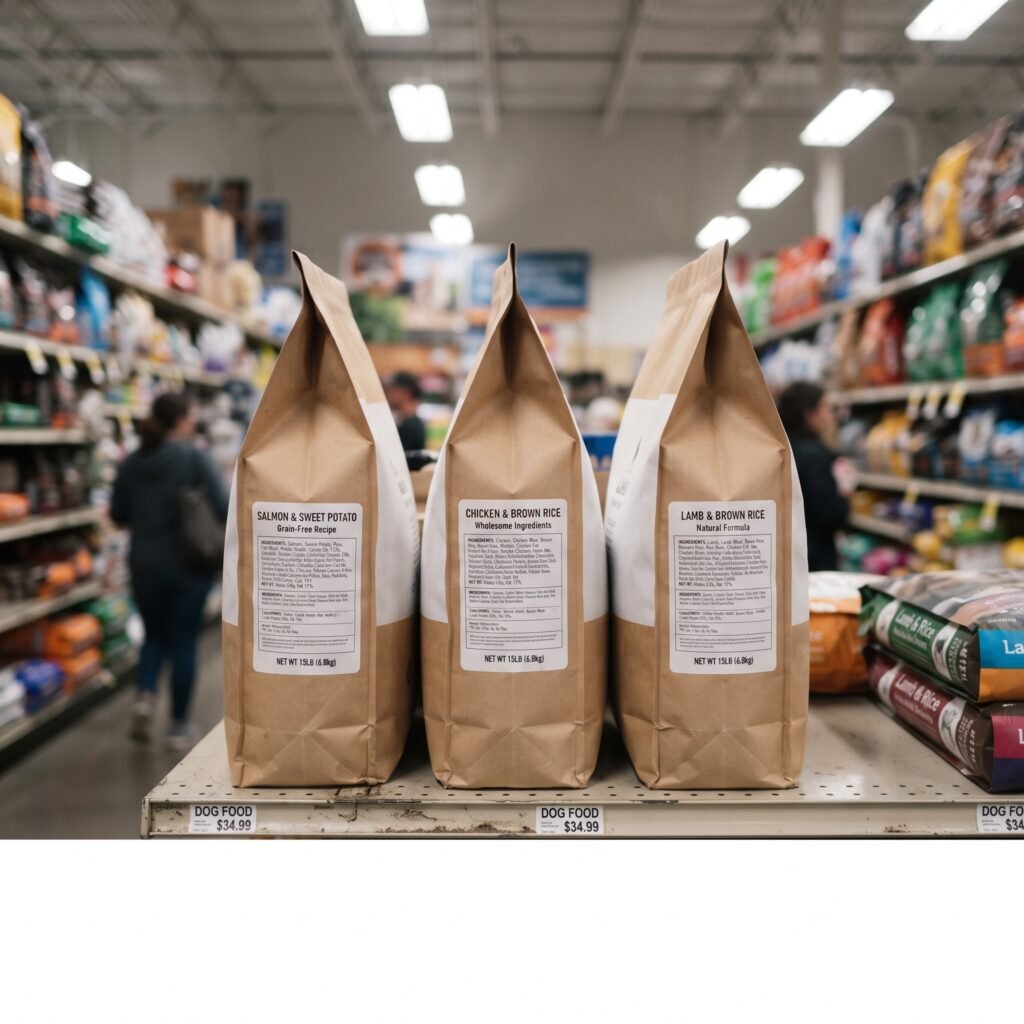
So here’s where it lands for a Pure Balance dog food shopper. The brand’s grain-inclusive recipes are not legume-light. On the standard Chicken & Brown Rice bags I’ve checked, dried peas and pea protein appear well inside the first eight ingredients, alongside brown rice and brewers rice. Grain-inclusive, yes. Pulse-light, no.
The grain-inclusive Pure Balance dog food recipes, in other words, are not legume-light. That’s not a scandal — peas have been in pet food for decades and there’s no evidence they’re inherently harmful. But if your vet has told you to keep pulses out of the top ten because you own a Doberman or a Golden, “I switched to the grain-inclusive Pure Balance dog food” doesn’t automatically satisfy that instruction. You have to read the line.
Image alt text suggestion: Close-up of a Pure Balance dog food ingredient panel with pea protein highlighted in the first eight ingredients.
Which Pure Balance dog food line actually fits your dog?
Walmart sells Pure Balance dog food across three broad shelves: the original line, the Pro+ line, and the grain-free recipes. They behave differently on the pulse question, and most Pure Balance dog food review content treats them as one product. They aren’t.
The original line is the 2012-era recipe family — chicken and chicken meal up front, brown rice and brewers rice for carbohydrate, then peas, pea protein, and beet pulp. It is the classic “step up from grocery brand” formulation, and it is the version most people mean when they say Pure Balance chicken and brown rice.
The Pro+ line is the newer premium tier. Here’s the part that surprises people: on the Pro+ Performance Sport recipe, the protein-boosting plant ingredients are soybean meal and corn protein meal, not peas. The FDA specifically noted that although soy is a legume, it did not see a signal associated with that ingredient. So the “premium” Pure Balance Pro+ dog food is, on the pulse axis, the more conservative choice — the opposite of what the marketing tiering would suggest.
The grain-free line replaces grains with peas, potatoes, and similar carbohydrate sources by definition. If you’re avoiding pulses high in the list, Pure Balance grain free dog food is the line you skip, and you skip it on ingredient position, not on ideology.
Pure Balance dog food comparison table
Label figures below come from bags and product panels I checked most recently. Private-label specs change between print runs — verify against the bag in your hand before you commit.
| Formula | Crude protein (min) | Crude fat (min) | Calories | Pulses in top 8? | Best fit |
|---|---|---|---|---|---|
| Pure Balance Chicken & Brown Rice (original adult) | ~26% | ~15% | ~3,400–3,600 kcal/kg | Yes — dried peas, pea protein | Healthy adult dogs, moderate activity, no cardiac flags |
| Pure Balance Pro+ Large Breed Chicken & Brown Rice | ~26% | ~12–14% | 3,456 kcal/kg (367 kcal/cup) | Yes, lower in list | Large-breed adults; AAFCO all life stages incl. growth of large dogs (70 lb+) |
| Pure Balance Pro+ Performance Sport Chicken & Brown Rice | ~30% | ~20% | ~4,000+ kcal/kg | No — soybean meal and corn protein meal instead | Working, sporting, hard-keeper dogs |
| Pure Balance Grain Free Salmon & Pea | ~25–27% | ~14–16% | ~3,600–3,800 kcal/kg | Yes — pea is in the recipe name | Poultry-sensitive dogs with no pulse restriction |
| Pure Balance Pro+ Weight Management Chicken & Oatmeal | ~26% | ~9–11% | Lower calorie density | Yes, moderate | Dogs on a measured weight-loss plan |
Two things jump out of that table. First, the calorie spread between the Performance recipe and the Weight Management recipe is wide enough that feeding the same cup volume across a switch will overfeed or underfeed a dog badly. Second, the only line that reliably drops pulses out of the top of the list is the one aimed at sport dogs — which also carries the highest fat, and is therefore the wrong pick for a couch-dwelling senior.
That’s the trade-off nobody puts on the front of the bag. You can have low pulses or moderate fat in Pure Balance dog food, but on the current lineup you’re not easily getting both in the same recipe.
Who makes Pure Balance dog food, and does it matter?
It matters more than it does for a national brand, because ownership and manufacturing are separated here. Pure Balance is manufactured for Walmart, sold exclusively at Walmart stores and Walmart.com, and while Walmart owns the brand, production is handled by contract manufacturers meeting Walmart’s specifications. Walmart launched the brand in 2012, positioning it as an ultra-premium dry food at a price its customers could afford.
Ainsworth Pet Nutrition, based in Meadville, Pennsylvania, has produced most of the line; Ainsworth was acquired by J.M. Smucker in 2018. Not every product in the range comes from that facility, and public information on the remainder is thin. That’s the practical answer to who makes Pure Balance dog food: mostly one co-packer, not exclusively, and Walmart isn’t obligated to announce a change.
Why should you care? Because co-packer changes and formula revisions on private-label products arrive silently. The bag art stays the same. The recipe name stays the same. The eighth ingredient moves. I’ve compared panels on the same-named recipe eighteen months apart and found reordered lists — which is exactly why a Pure Balance dog food review published in 2023 is a starting point, not an answer.
On safety history, the record is clean. As of the most recent public FDA records, Pure Balance dog food has not been subject to any recalls. Independent recall trackers report the same finding. For a brand that’s been in continuous distribution since 2012, that’s a genuinely good record, and it’s the strongest single argument in the brand’s favor.
What did I actually see when I ran the bag audit?
Everything below came from bags of Pure Balance dog food bought at three different stores across two states, opened and worked through at home rather than assessed from a product listing.
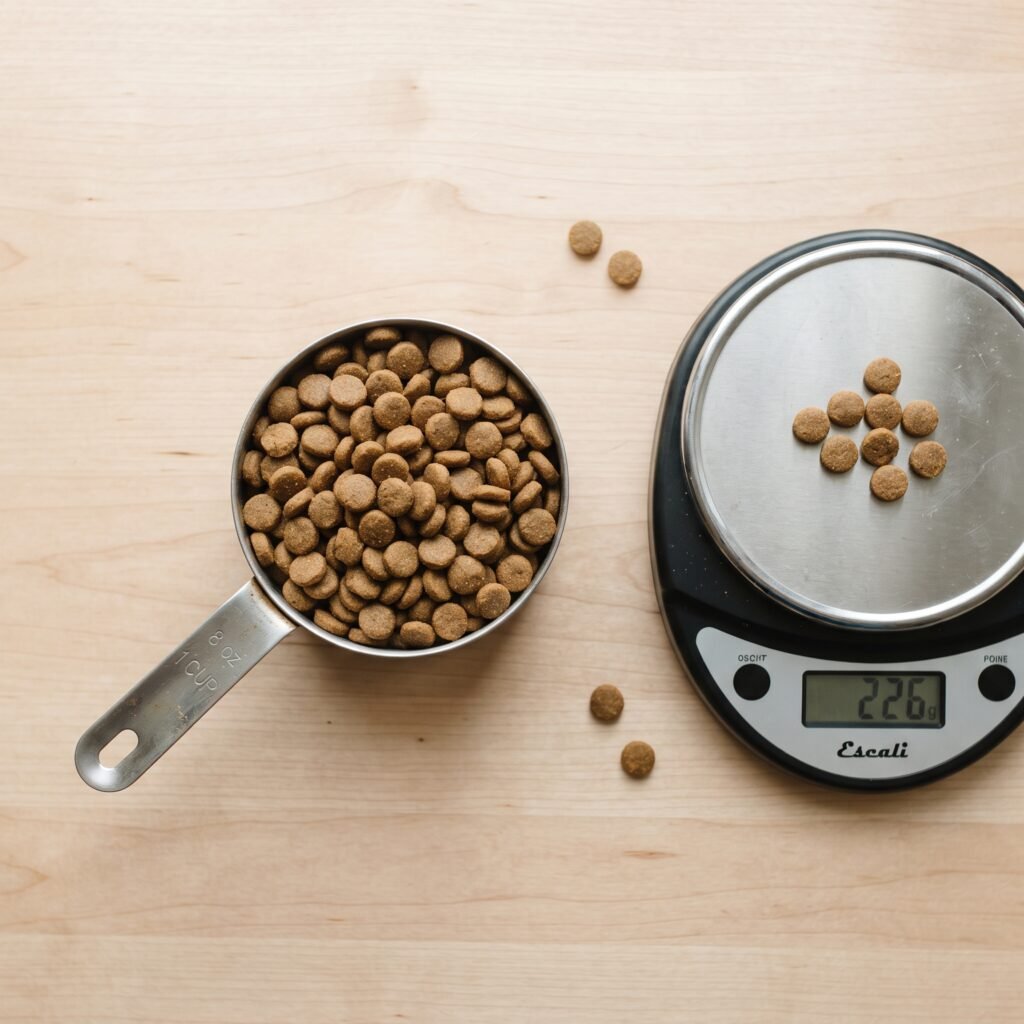
The Pro+ Large Breed Chicken & Brown Rice kibble is a flattened disc, roughly the diameter of a pencil eraser and noticeably thinner than the Purina Pro Plan large-breed kibble I keep as a benchmark. Under a kitchen scale, a level 8-oz measuring cup came in a few grams under the 367 kcal/cup label figure — close enough that the feeding chart holds, but worth knowing if you’re portioning to the gram.
The smell is the tell. Fresh bags of the chicken recipes have a mild toasted-cereal smell with a faint poultry-fat sweetness. Bags that have sat — particularly the fish recipes, which carry menhaden fish oil — develop a sharper, oil-paint edge. That’s fat oxidation, and dogs notice it before we do.
The dog I’ve leaned on most for palatability checks is a 42-pound mixed-breed with a genuinely temperamental gut — the kind who reacts to a fast switch within about eighteen hours. On a ten-day transition from a grain-inclusive premium food to Pure Balance chicken and brown rice, stool stayed firm through day seven, loosened on day eight when we hit the 75/25 mark, then re-firmed by day eleven without intervention. That eighth-day wobble showed up on two separate transitions with different bags.
My read: the pea protein and beet pulp combination shifts fiber fermentation enough that sensitive dogs need a slower ramp than the bag’s suggested schedule. The printed guidance moves to 75% new food by days five and six. For a sensitive-stomach dog I’d stretch that same step to day ten.
Image alt text suggestion: Pure Balance dog food kibble in a measuring cup next to a kitchen scale showing portion weight.
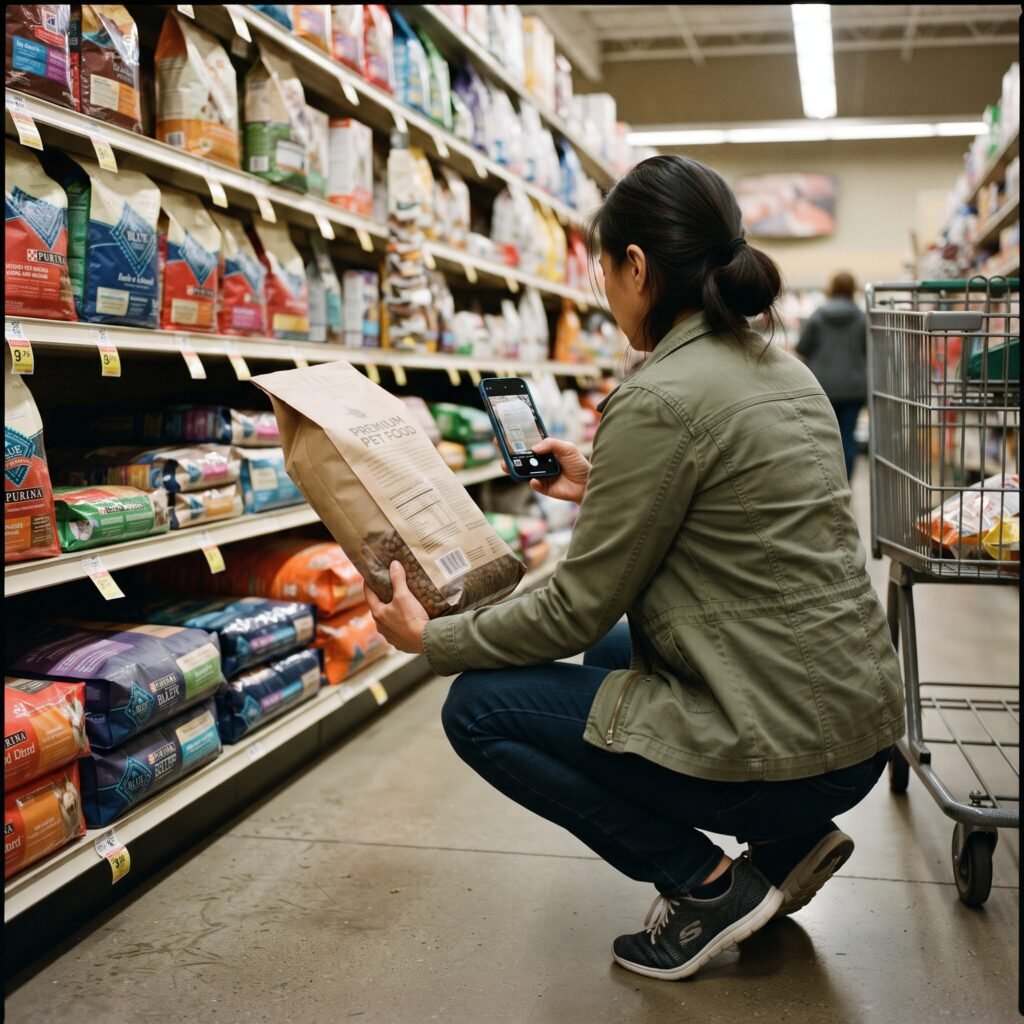
How do you run a 90-second pulse-position audit in the aisle?
This is the routine. It works on any bag, not just Pure Balance dog food, and it’s faster than pulling up a Pure Balance dog food review on your phone under bad fluorescent lighting.
Count to ten, then stop. Read only the first ten ingredients. Everything after that is present in small enough quantity that position stops being informative.
Flag every pulse. Peas, dried peas, pea protein, pea fiber, pea starch, lentils, chickpeas, garbanzo beans, faba beans. Note that a manufacturer splitting one ingredient into three fractions pushes each fraction lower in the list while the total stays the same. Three pea entries at positions six, eight, and nine is not a pulse-light food.
Locate the potatoes separately. The FDA’s label examination counted potatoes and sweet potatoes as a distinct category from peas and lentils. Sweet potato at position four behaves differently from sweet potato at position twenty-two.
Check the AAFCO statement, not the marketing. You want the nutritional adequacy line. The Pro+ Large Breed Chicken & Brown Rice recipe, for example, is formulated to meet AAFCO Dog Food Nutrient Profiles for all life stages, including growth of large-size dogs of 70 lb or more as an adult. That last clause is the one that matters for a Great Dane puppy, and most people’s eyes slide right past it.
Photograph the panel. Every time. This is how you catch a silent reformulation between bags, and it takes four seconds.
Run that sequence and you’ll sort the Pure Balance dog food lineup faster than any label-grading website will sort it for you — because you’re grading against your dog’s constraints, not a generic score.
When did Pure Balance dog food not work for me?
Three times worth reporting.
The stockpile failure. After watching my store drop a Pure Balance dog food recipe for six weeks, I bought four 30-lb bags of the chicken recipe and stacked them in an attached garage in July. By week seven the last two bags smelled like old walnuts. The dog ate around them, then flatly refused. Kibble fat oxidizes fast in heat, and buying ahead only works in climate-controlled storage — I threw away roughly half of what I’d “saved.”
The picky small dog. A 9-pound senior terrier mix refused the Pro+ Small Breed kibble across four separate attempts, including with warm water added. Nothing was wrong with the food. Some dogs conditioned on a high-fat, high-palatant premium diet will not accept a step down in coating fat, and no amount of transitioning fixes preference. We put her back on her old food and stopped fighting it.
The formula-drift miss. I recommended a specific Pure Balance dog food recipe to a reader based on a panel I’d photographed, and by the time they bought it the ingredient order had shifted enough that the pea position had moved up. My recommendation was correct for the bag I’d read and wrong for the bag they got. That’s the structural weakness of private-label recommendations, and it’s why every section of this article tells you to check your own bag.
I’d rather publish those three than pretend the brand works universally. It doesn’t, and the specific ways it fails are more useful than another round of “dogs love the taste.”
How much do you actually save with Pure Balance dog food?
Price per pound is the wrong unit for comparing Pure Balance dog food bags. Calorie density varies enough across the lineup that a cheaper bag can cost more per meal. Use cost per 1,000 kcal.
The arithmetic: multiply the bag weight in pounds by 0.4536 to get kilograms, multiply by the kcal/kg from the panel, divide by 1,000, then divide the price by that number.
Worked example with the Pro+ Large Breed figure of 3,456 kcal/kg. A 30-lb bag holds about 13.6 kg, or roughly 47,000 kcal. At $40, that’s about **$0.85 per 1,000 kcal**. A 24-lb premium bag at 3,800 kcal/kg holds about 41,400 kcal; at $70, that’s about **$1.69 per 1,000 kcal** — very close to double.
For a 50-pound dog eating around 1,200 kcal a day, that’s roughly $31 a month versus $61. Across three dogs of that size, you’re looking at a difference near $90 a month. Reported shelf pricing for Pure Balance dog food runs roughly $1.40 to $2.30 per pound depending on formula, against $2.00 to $2.50 for comparable Blue Buffalo recipes. Prices move; run your own numbers with today’s shelf tag.
Where the savings stop being real: if the switch triggers weeks of GI upset, a vet visit erases four months of the difference. And if your dog needs a therapeutic diet, Pure Balance dog food isn’t in the conversation at any price.
How does Pure Balance dog food compare to the rest of the Walmart pet aisle?
You’re not choosing Pure Balance dog food against the entire market. You’re choosing it against the four or five bags within arm’s reach, and that’s the comparison worth running.
Against Ol’ Roy and other value-tier bags. Not close. The value shelf leans on grain fractions and unnamed meat sources, while Pure Balance dog food leads with named chicken and chicken meal and skips artificial colors, flavors, and preservatives. Moving up from the cheapest bag in the aisle is a real upgrade here, not a marketing one.
Against Pedigree and grocery-tier brands. Still a step up on ingredient quality, though the price gap narrows. The relevant question becomes whether your dog is already doing well — coat, stool, energy, body condition — on what’s in the bowl now. A dog thriving on a cheaper food isn’t automatically better off after a switch.
Against Purina One and Purina Pro Plan. This is the honest fight, and both sit in the same aisle. Purina’s research depth, feeding-trial history, and formula consistency are hard to match. Pure Balance dog food usually wins on cost per 1,000 kcal; Pro Plan usually wins on published research and predictable specs. Which matters more depends on whether your dog has anything complicated going on.
Against Blue Buffalo. Similar positioning, similar messaging, overlapping nutrient ranges. Blue’s Life Protection Formula sits in roughly the same protein and fat neighborhood, and Pure Balance dog food generally undercuts it per pound. Availability cuts the other way: Blue is stocked nearly everywhere, and Pure Balance dog food is Walmart-only.
Against premium boutique bags. The pulse question comes right back, because plenty of boutique grain-free recipes are pulse-forward by design. Paying triple doesn’t buy you out of the ingredient-position problem — run the same ten-ingredient count on the $80 bag that you’d run on Pure Balance grain free dog food.
Compressed to one line: Pure Balance dog food is the strongest value pick in its own aisle for a healthy adult dog, and the wrong tool for a dog with a diagnosis.
What happens when your Pure Balance formula disappears from the shelf?
This is the tax you pay for a single-retailer brand, and it’s the most common complaint I hear. Pure Balance dog food is Walmart-exclusive, so a regional distribution gap, a planogram reset, or a discontinued SKU leaves you with no alternate retailer to fall back on.
Check Walmart.com before you assume it’s gone. Online assortment frequently carries bag sizes and recipes an individual store doesn’t stock, with pickup at the same location.
Have a same-shelf backup identified in advance. Pick a second Pure Balance dog food recipe with a similar protein, fat, and pulse position, and note it in your phone. Switching within a brand family is usually gentler on the gut than jumping brands.
Keep a two-week overlap, not a two-month one. Enough to transition properly, not enough to go rancid — see the stockpile failure above.
Save the panel photo. If the recipe returns reformulated, your photo is the only way you’ll know.
Which dogs should skip Pure Balance dog food entirely?
Dogs with diagnosed cardiac disease, or breeds with known DCM predisposition, where a vet has advised limiting pulses. Breeds more commonly affected by DCM include Boxers, Great Danes, Cocker Spaniels, Irish Wolfhounds, German Shepherds, Doberman Pinschers, and Portuguese Water Dogs. If your vet drew that line, most Pure Balance dog food recipes require checking against it individually.
Dogs needing a therapeutic diet. Renal, hepatic, hydrolyzed-protein, and true elimination diets are veterinary products. No over-the-counter food substitutes, and Pure Balance dog food doesn’t claim to.
Dogs whose owners require published feeding-trial and research depth. The brand’s recipes are formulated to AAFCO profiles, but the line doesn’t carry the same volume of published nutritional research behind it as the largest research-driven manufacturers. If that’s your selection criterion, it’s a legitimate reason to look elsewhere — and it’s the honest answer to “is Pure Balance a good dog food” for that particular shopper.
Dogs already eating well on something else. Switching a stable dog to Pure Balance dog food purely to save money is a reasonable move, but do it when you have two clear weeks to watch stool and appetite — not the week before you travel.
Dogs mid-crisis. Never start a new food during an active GI flare, a post-surgical recovery, or a week you can’t monitor stool. That’s not a brand issue, but it’s where most switches go wrong.
Methodology: how I evaluated Pure Balance dog food
Label review. Ingredient panels and guaranteed analysis read directly from retail bags and current product listings, with the first ten ingredients recorded and pulse ingredients flagged by position. Where figures vary between listings, I’ve given ranges rather than false precision.
Nutrient adequacy check. Every Pure Balance dog food recipe discussed was checked for its AAFCO nutritional adequacy statement and life-stage designation, including the large-breed growth clause where present.
Recall history check. Verified against publicly available FDA records and independent recall trackers; no recalls found for Pure Balance dog food to date.
Hands-on observation. Kibble size, texture, and aroma assessed on opened bags; palatability and stool response tracked across ten-day transitions on a 42-pound sensitive-stomach adult and a 9-pound senior small-breed dog.
Regulatory sourcing. Claims about diet-associated DCM are drawn from the FDA’s published investigation materials. No statistic in this article was estimated or invented; where evidence is unsettled, it’s described as unsettled.
A note on limits: I’m a nutrition writer, not a veterinarian. Nothing here diagnoses or treats. Every dog with a health condition needs an individual plan from someone who can examine them.
Pure Balance dog food FAQ
Is Pure Balance a good dog food for everyday feeding? For a healthy adult dog with no cardiac flags or diagnosed sensitivities, yes — Pure Balance dog food is a legitimate mid-tier option with named meat first, no artificial colors or preservatives, and a clean recall record. It’s not equivalent to a research-heavy veterinary-channel brand, and it doesn’t pretend to be. The value case is strongest for multi-dog and large-breed households.
Is Pure Balance grain free dog food safe given the DCM investigation? No causal link has been established, and the FDA stopped issuing routine updates in December 2022 for that reason. The reported association tracks with pulse ingredients high in the list rather than the absence of grain. If your dog is a predisposed breed or has any cardiac history, discuss Pure Balance grain free dog food with your vet before choosing it or any other pulse-forward recipe.
What’s the real difference between Pure Balance and Pure Balance Pro+ dog food? Pure Balance Pro+ dog food is the higher-specification tier, with sub-lines for large breed, small breed, weight management, performance, and puppies. The Performance recipe in particular uses soybean meal and corn protein meal rather than peas as its plant protein, which changes the pulse calculus. Price per pound runs higher, but calorie density often rises with it, so compare per 1,000 kcal.
Who makes Pure Balance dog food and where is it manufactured? Walmart owns the brand; most production has been handled by Ainsworth Pet Nutrition in Meadville, Pennsylvania, a company acquired by J.M. Smucker in 2018. Not all products in the line come from that facility. Walmart isn’t required to disclose co-packer changes, which is why re-reading the panel periodically is worth the four seconds.
Can puppies eat Pure Balance chicken and brown rice? Only if the specific bag’s AAFCO statement covers growth. The Pro+ Large Breed Chicken & Brown Rice recipe is formulated for all life stages including growth of large-size dogs of 70 lb or more as an adult — but an adult-maintenance bag of the same-sounding recipe is not appropriate for a puppy. Read the adequacy statement, not the recipe name.
The bottom line on Pure Balance dog food
The question “is Pure Balance a good dog food” has no single answer, and anyone giving you one hasn’t asked about your dog. Buy or skip Pure Balance dog food based on where the peas sit, what your vet has told you about your specific dog, and what the cost per 1,000 kcal says once you’ve actually done the division. Those three inputs will get you a better decision than any brand-level verdict, including mine.
The brand’s genuine strengths are a clean recall record since 2012, named meat proteins leading the recipes, and a price that makes feeding a large dog or a full household sustainable. Its genuine weaknesses are single-retailer availability, silent formula drift, and a lineup where the low-pulse option is also the high-fat option.
Photograph the panel, run the ten-ingredient count, and re-check when you buy your next bag. That habit outlasts any review — including this one.