
Whole Hearted Dog Food: How to Choose Between the Grain-Free and Whole Grains Lines
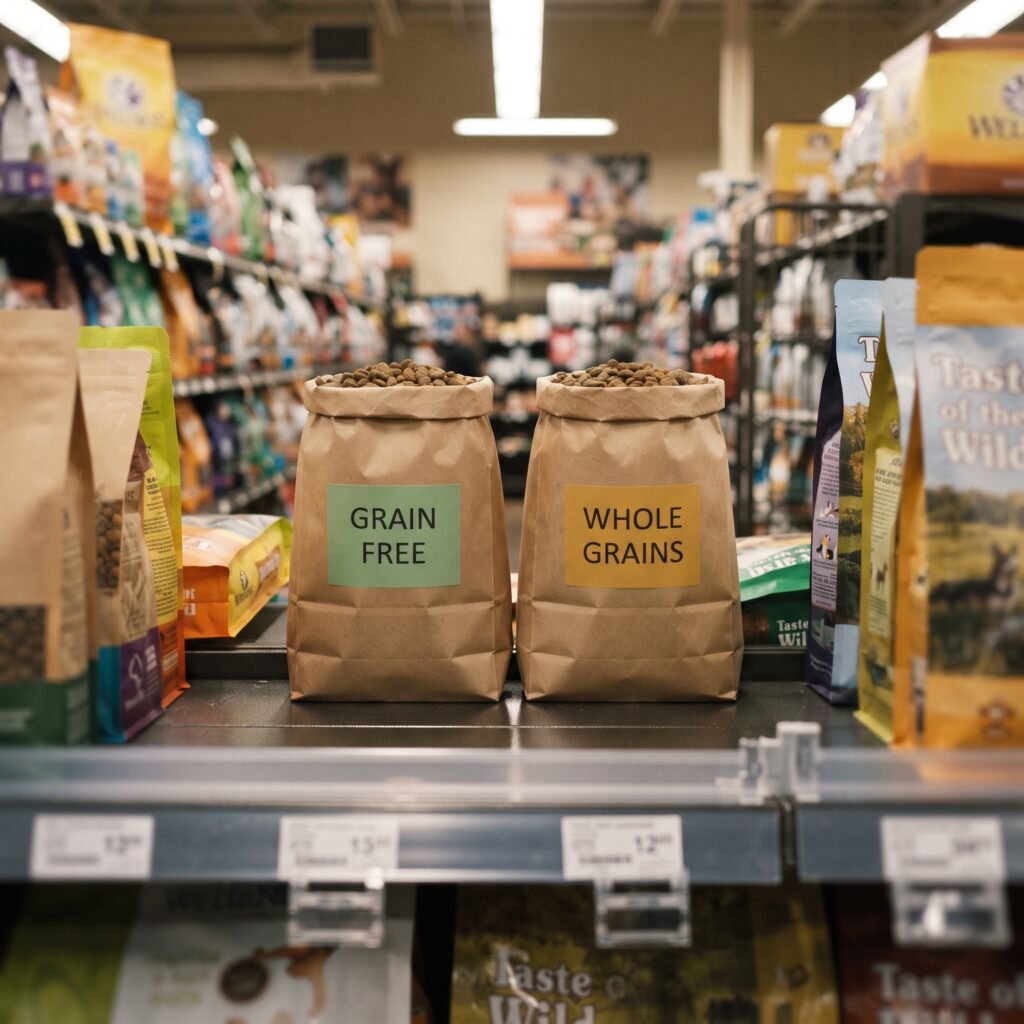
Short answer: For most dogs, the Whole Grains recipes are the safer default in the whole hearted dog food lineup, because they avoid the pea-and-lentil-heavy formulations tied to the FDA’s unresolved DCM inquiry. Choose grain-free whole hearted dog food only when a dog has a documented grain issue — and check the label for added taurine first.
That’s the summary. It’s also where most articles stop, and it’s not enough to make the actual decision, because the two lines differ in calories per cup, probiotic load, fat content, and how they behave in a dog that’s coming off a richer food.
Recommended Products

Best Dog Food in 2026
Why is this the decision that actually matters with whole hearted dog food?
Stand in a Petco aisle and the whole hearted dog food shelf presents two parallel worlds. One side is Grain Free — chicken and pea, salmon and pea, beef and pea, lamb and lentil. The other is Whole Grains — chicken and brown rice, lamb and brown rice, beef and brown rice.
Same brand. Same price tier. Nearly identical marketing language on the front of the bag. And a meaningfully different ingredient philosophy behind the panel.
Petco launched the brand in August 2016 as an in-house line built around real meat as the first ingredient, added canine probiotics in the dry recipes, omega-3s, and no artificial colors, flavors, or preservatives. The original launch lineup was heavily pea-based: the dry formulas debuted as Chicken & Pea, Beef & Pea, and Salmon & Pea recipes.
The Whole Grains recipes came later, and they’re the reason the whole hearted dog food conversation is more interesting now than it was in 2016. A brand that started grain-free-first now sells both, which means the buyer — not the brand — is making the call.
Most whole hearted dog food reviews answer the wrong question here — they grade the brand as a whole instead of helping you choose between its two halves. Most owners, meanwhile, make the call on price and flavor. I’d argue you should make it on three things: your dog’s breed and heart-risk profile, the calorie density printed on the back, and whether your dog’s gut can handle a legume-forward carbohydrate base.
What’s actually different between the two whole hearted dog food lines?
Here’s the label comparison I keep coming back to when someone asks me which bag to grab. All figures are pulled from Petco’s published guaranteed analysis and ingredient panels for each recipe.
| Spec | Grain Free All Life Stages Chicken & Pea | Whole Grains All Life Stages Chicken & Brown Rice | Whole Grains All Breed Puppy Chicken & Brown Rice |
|---|---|---|---|
| Carb base | Peas, pea protein, legumes | Brown rice, barley, rice bran | Brown rice, barley |
| Crude protein (min) | 26.0% | 23.0% | 26.0% |
| Crude fat (min) | 15.0% | 14.0% | 16.0% |
| Crude fiber (max) | 5.0% | 5.0% | 4.0% |
| Moisture (max) | 10.0% | 10.0% | 10.0% |
| Calories | 3,625 kcal/kg (339 kcal/cup) | ~325–385 kcal/cup by recipe | 395 kcal/cup |
| Probiotics | 1,000,000 CFU/lb min | 1,000,000 CFU/lb min | 50,000,000 CFU/lb min |
| Added DHA | Not guaranteed | Not guaranteed | 0.05% min |
| Calcium / phosphorus | Not guaranteed on panel | 1.2% / 1.0% as fed | 1.2% / 1.0% as fed |
| Best fit | Documented grain reactivity only | Default adult maintenance | Growth, all breeds under ~50 lb adult weight |
Three things jump out at me from that table.
First, the protein gap is smaller than the marketing implies. Three percentage points of crude protein between grain-free and grain-inclusive whole hearted dog food is not the chasm the front of the bag suggests.
Second, the puppy recipe carries fifty times the guaranteed probiotic load of the adult recipes. That is a genuinely large difference, and it’s invisible unless you read the fine print.
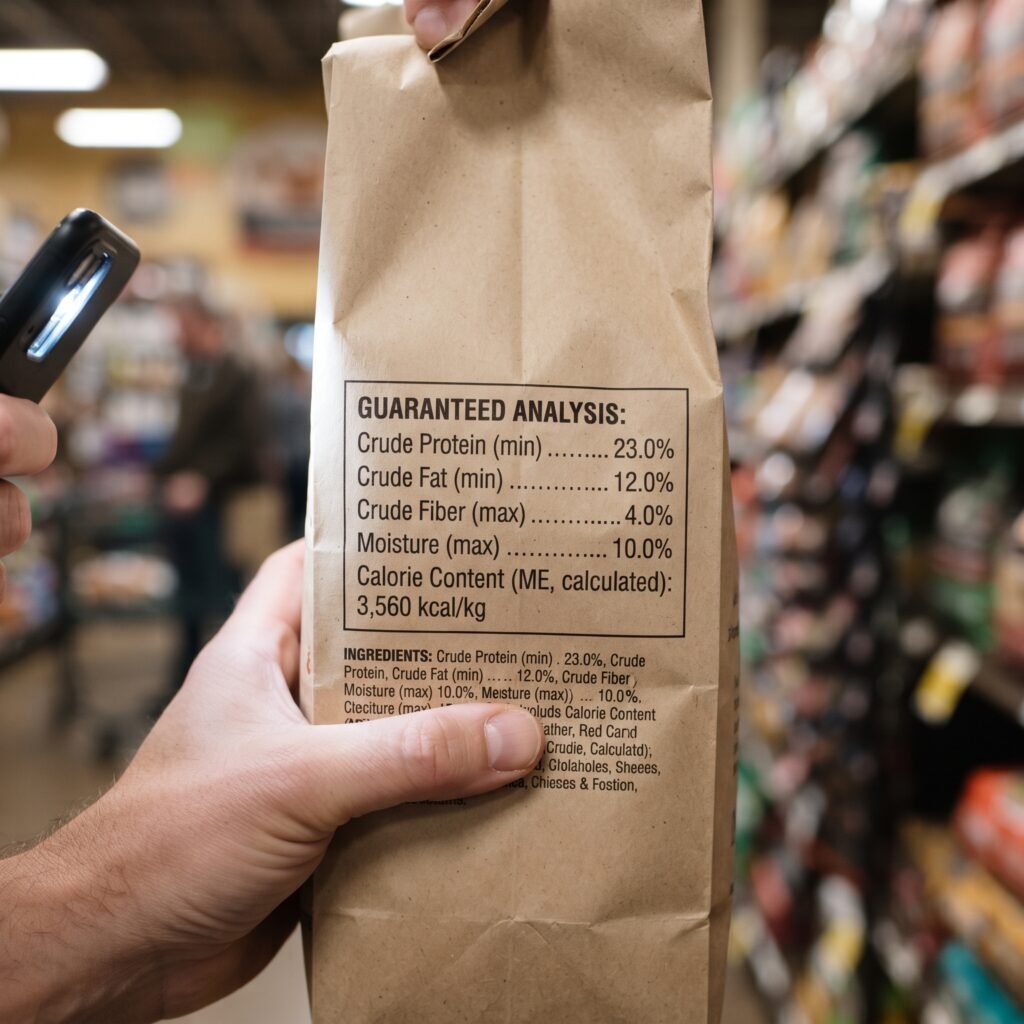
Third — and this is the one that changes your grocery bill — calorie density varies more within the Whole Grains line than it does between the two lines. The large-breed Whole Grains chicken and brown rice recipe runs 3,560 kcal/kg, or 404 kcal/cup. The beef and brown rice recipe runs 325 kcal/cup. That’s a 24% swing inside the same product family.
What do the whole hearted dog food ingredients tell you?
The large-breed Whole Grains recipe opens with chicken, chicken meal, whole grain brown rice, white rice, and cracked pearled barley, followed by rice bran, dried yeast, and chicken fat preserved with mixed tocopherols.
The lamb and brown rice recipe opens with lamb, lamb meal, whole grain brown rice, cracked pearled barley, and dried yeast, with grain sorghum and dried beet pulp further down.
Both are conventional, legible, mid-tier formulations. Nothing exotic, nothing alarming. If you’ve been feeding a grocery-store food, the ingredient panel on whole hearted dog food is a step up in specificity — named meats and named meals rather than generic “meat and bone meal.”
The grain-free side substitutes peas and pea protein for those grains. Pea protein is the ingredient worth noticing, because it inflates the crude protein number without contributing the same amino acid profile as meat protein. That’s not unique to whole hearted dog food — it’s standard practice across the grain-free category — but it’s why I don’t treat 26% on a grain-free bag as automatically better than 23% on a grain-inclusive one.
It’s also worth reading the whole hearted dog food ingredients list for what isn’t there. No artificial colors, flavors, or preservatives appear across the line, and the fats are preserved with mixed tocopherols rather than synthetic antioxidants — consistent with Petco’s broader commitment to stop selling foods with artificial additives.
That’s a real quality floor rather than a marketing flourish. It doesn’t make whole hearted dog food premium, but it does rule out the shortcuts that define the bottom of the category.
Should I worry about peas and lentils in grain-free whole hearted dog food?
This is the part of the whole hearted dog food question that deserves careful language, because the science is genuinely unsettled and both the alarmists and the dismissers are overstating their case.
Here’s what’s documented. In July 2018 the FDA announced it was investigating reports of canine dilated cardiomyopathy in dogs eating certain pet foods — many labeled grain-free — that contained a high proportion of peas, lentils, other legume seeds, or potatoes among the first ten ingredients. Many of the reported cases involved breeds with no known genetic predisposition to DCM.
The agency’s own position is that the potential association is a complex scientific issue that may involve multiple factors. That’s not a finding of causation. It’s an open question that the FDA has since stopped issuing routine public updates on, pending meaningful new science.
Two more facts belong in the same paragraph, because leaving them out is how this topic gets distorted.
Taurine is generally not considered an essential amino acid for dogs, since dogs can synthesize it from cysteine and methionine — and nearly all the grain-free products the FDA tested had methionine-cystine values above the AAFCO minimum of 0.65% for adult maintenance. Meanwhile, the case data the FDA compiled showed more than 90% of implicated diets were grain-free and 93% contained peas or lentils — a correlation strong enough to take seriously and weak enough that it may partly reflect which foods were popular at the time.
So where does that leave grain-free whole hearted dog food?
My working position: the grain-free recipes are not “dangerous,” and the FDA never said they were. But there is no upside for a dog without a grain problem, and there is an unquantified downside. When one option carries an open question and the other doesn’t, and both cost about the same, the choice makes itself.
Which dogs make me firmly recommend the Whole Grains line?
- Golden Retrievers. Goldens made up the single largest breed group in the FDA’s case reports, followed by mixed breeds and Labrador Retrievers.
- Dobermans, Great Danes, Boxers, Irish Wolfhounds, and Cocker Spaniels — breeds with existing genetic DCM predisposition, where you don’t want a second variable in play.
- Any dog with a heart murmur, arrhythmia, or a prior echocardiogram finding.
- Any dog whose diet you don’t plan to revisit for years. The reported cases involved months to years of exposure, not a single bag.
For those dogs, I don’t consider grain-free whole hearted dog food a reasonable default. For a nine-year-old Shih Tzu with no cardiac history whose owner has been feeding grain-free happily for years, I’d have a much softer conversation.
Does whole hearted dog food contain taurine?
Not uniformly, and this is the single most useful label-reading skill I can hand you.
Some whole hearted dog food recipes list taurine explicitly in the ingredient panel. The Whole Grains lamb and brown rice recipe does — taurine appears after DL-methionine and choline chloride, alongside L-carnitine and dried chicory root. Petco’s product Q&A also confirms taurine in the Whole Grains Plus chicken and brown rice recipe.
Others don’t list it, relying instead on the methionine and cysteine content of the meat proteins for the dog to synthesize its own.
Neither approach violates AAFCO nutrient profiles, because taurine isn’t an AAFCO-required nutrient for dogs. But if you’re choosing a legume-heavy formula for a large-breed dog, added taurine plus added L-carnitine is a cheap reassurance to look for.
How to check in ten seconds: flip the bag, find the ingredient list, and scan the block after the vitamins and minerals. Supplemental amino acids — DL-methionine, taurine, L-carnitine — cluster there. If taurine isn’t in that block, it isn’t added.
Do this on the specific bag in your hand. Formulations get revised, and the whole hearted dog food lineup has been reformulated and expanded repeatedly since 2016.
How do I actually pick a bag? A four-question triage
This is the sequence I run, in order. Stop at the first question that gives you a clear answer.
1. Is there a documented grain problem? Not “she seems itchy.” A vet-supervised elimination diet, or a clear pattern of loose stool that resolved off grains and returned on them. Grain allergies are genuinely uncommon compared with protein allergies. If the answer is no — and it usually is — the Whole Grains side of the whole hearted dog food shelf is your lane.
2. What’s the adult weight? Large-breed puppies need controlled calcium and a growth formula validated for large-breed growth. Don’t improvise here with an all-life-stages bag.
3. What’s the calorie density, and what does that do to bag-days? Covered in detail below. Two whole hearted dog food bags at the same shelf price can differ by two weeks of feeding.
4. What’s the transition risk? A dog coming off a 22%-fat premium food onto a 14%-fat whole hearted dog food recipe will have a different two weeks than a dog stepping up from a grocery brand. Both are manageable; they’re not the same.
What does whole hearted dog food actually cost per day?
Shelf price per bag is the wrong number. Cost per 1,000 kcal is the right one, and it’s easy to calculate.
Start with your dog’s daily calorie need. The standard veterinary approach: resting energy requirement equals 70 × (body weight in kg)^0.75, then multiply by roughly 1.6 for a neutered adult at typical activity.
Worked example, 60-lb neutered adult Lab mix, moderate activity:
- 60 lb = 27.2 kg
- 27.2^0.75 ≈ 11.9
- RER ≈ 833 kcal
- Maintenance ≈ 1,333 kcal/day
Now run that through three whole hearted dog food options:
| Recipe | kcal/cup | Cups/day for 1,333 kcal | Cups per 45-lb bag | Days per bag |
|---|---|---|---|---|
| Grain Free Chicken & Pea (40 lb bag ≈ 160 cups) | 339 | 3.9 | 160 | ~41 |
| Whole Grains Beef & Brown Rice | 325 | 4.1 | ~180 | ~44 |
| Whole Grains Large-Breed Chicken & Brown Rice | 404 | 3.3 | ~180 | ~55 |
Petco’s own product Q&A puts a 45-lb bag at approximately 180 cups, which is where those bag-day figures come from.
Fourteen extra days of feeding from the same-priced bag is a meaningful difference — roughly a 25% swing in monthly food cost — and it’s driven entirely by a number most people never look at. Divide your shelf price by the days-per-bag figure and you get the honest comparison, whether you’re weighing two whole hearted dog food recipes against each other or against a premium brand.
One caveat on that math: calorie-dense food means smaller bowls. Some dogs — especially food-motivated breeds and dogs on a weight plan — do badly with a visibly smaller portion. If yours inhales meals and then patrols the kitchen, the lower-calorie recipe with more volume may keep everyone saner, even at a worse cost per day.
Do the wet recipes change the whole hearted dog food math?
The dry side of the line gets all the attention, but plenty of owners use the wet recipes as a topper rather than a full meal, and the economics there work differently.
A topper is a palatability tool. It solves the sniffed-it-and-walked-away problem, and for a dog stepping down from a richer food it can buy you the four days you need. It also adds calories nobody counts.
Two heaping tablespoons of wet whole hearted dog food on a measured cup of kibble is easy to underestimate by fifty to eighty calories a day. Against a 1,333-kcal maintenance budget, that’s roughly a 5% sustained overfeed — enough to put visible weight on a middle-aged dog across a year.
So if you’re going to top, subtract. Pull a quarter cup of kibble for every spoonful of wet food, and re-check body condition at the three-week mark rather than waiting for the annual vet visit to flag it.
There’s a second wrinkle worth knowing. The manufacturing footprint differs by format: dry whole hearted dog food is largely produced domestically, while some wet products are made overseas. If country of manufacture matters to you, treat it as a per-format question rather than a per-brand one.

What is whole hearted dog food like in practice?
Concrete observations from bags I’ve opened, because “dogs love it” tells you nothing.
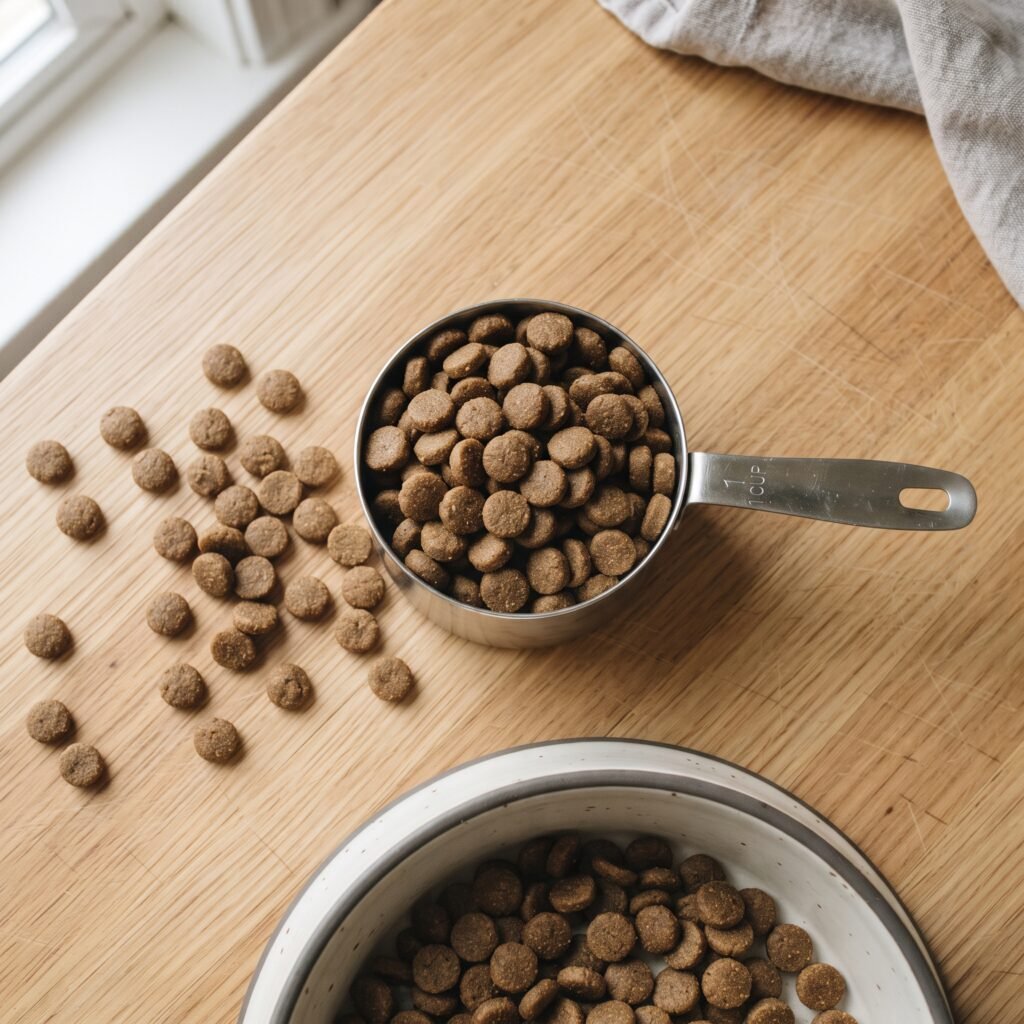
The Whole Grains chicken and brown rice kibble is a small, slightly irregular disc — noticeably smaller than most large-breed kibbles, closer in size to a standard adult formula. The large-breed version is bigger and denser. If you have a fast eater and you were counting on kibble size to slow them down, the standard recipe won’t do it.
The smell is mild and grain-forward. Less greasy than high-fat performance foods, and the bag doesn’t leave that oily residue on your hands that some fat-coated premium kibbles do. Some dogs read “mild” as “boring” on day one.
That tracks with the pattern across owner-written whole hearted dog food reviews: complaints skew heavily toward palatability and bag-to-bag consistency rather than toward ingredient quality or safety. Read enough of them and the signal is less that the food harmed a dog and more that the dog wanted something richer.
That was the case with a 40-lb terrier mix with a long history of a sensitive stomach that I transitioned from a fish-based premium food. She sniffed the bowl and walked away twice on the first day of the swap at 25% new food. Not a hunger strike — she ate the mixed bowls fine once the old food’s aroma was gone from the equation, but the enthusiasm gap between the two foods was obvious for about four days.
Her stool quality was the more useful signal. Loose on days two and three of the transition, firm and consistent from day six onward, and better at week three than it had been on the fish food. Anecdote, not evidence — but it’s the specific kind of anecdote worth collecting on your own dog.
The added probiotics likely help there. Whether 1,000,000 CFU/lb survives extrusion and shelf life at a meaningful level is a fair question that no dry food brand answers well.
When has whole hearted dog food not worked?
Here’s the honest failure, because a review that only reports wins isn’t a review.
I tried moving a twelve-year-old Beagle with a history of pancreatitis onto a Whole Grains recipe, reasoning that 14% minimum fat was a reasonable landing spot and the price was right. It didn’t work — not because the food was bad, but because “minimum 14%” is a floor, not a ceiling.
Guaranteed analysis minimums tell you what a food contains at least. The actual fat content of a batch can sit well above the guaranteed minimum, and for a dog whose pancreatitis history means you need a hard ceiling, that ambiguity is disqualifying. She went onto a therapeutic low-fat diet with a stated typical analysis instead.
That’s the structural limitation of whole hearted dog food for medical cases. It’s a well-built mid-tier maintenance food, not a therapeutic diet, and no amount of ingredient-panel optimism changes that. Dogs with pancreatitis, kidney disease, confirmed food allergies requiring hydrolyzed protein, or urinary stone history need a prescription diet, full stop.
A second, smaller failure: I’ve had a picky small-breed dog reject the mild flavor profile outright across two recipes. Some dogs conditioned on high-palatant foods won’t come back down. Adding a topper defeats the cost advantage that made whole hearted dog food attractive in the first place.
Has there ever been a whole hearted dog food recall?
No. As of this writing, no whole hearted dog food product has been subject to an FDA recall since the brand launched in 2016 — a record confirmed across independent recall trackers and the FDA’s own withdrawal and safety alert listings.
A clean whole hearted dog food recall record is a fair point in the brand’s favor. Two pieces of context keep it from being as impressive as it sounds.
The brand is young. A decade without a recall is genuinely good, but it isn’t the same as a fifty-year record, and rapid line expansion adds risk rather than removing it.
Manufacturing is split — the majority of dry kibble is produced domestically, while some wet products are made in Thailand and certain ingredients are sourced internationally. Split sourcing isn’t a red flag on its own; it’s the industry norm. It does mean “made in the USA” on the front of a bag deserves a second look at which product you’re holding.
If you want to monitor this yourself rather than trust a blog post’s snapshot, the FDA’s animal food recall page is the primary source, and it’s the one I check before publishing anything about a brand’s safety record.
How should I transition my dog onto whole hearted dog food?
Slower than the bag says, especially coming down in fat.
The standard advice is a seven-day swap at 25% increments. For a dog with any GI history I run ten to fourteen days, and I hold at 50/50 for three extra days if stool quality wobbles.
Days 1–3: 25% whole hearted dog food, 75% current food. Days 4–7: 50/50. Hold here if stools are loose. Days 8–11: 75% new. Days 12–14: 100%.
Two markers to watch that owners usually miss. First, water intake — a shift from a higher-moisture or higher-fat food changes drinking patterns for a week or so. Second, stool volume, not just consistency. A grain-inclusive whole hearted dog food recipe with beet pulp and rice bran tends to produce firmer but not necessarily smaller stools than a grain-free recipe.
If loose stool persists past day ten at a 50/50 mix, stop. That’s a signal the food isn’t a fit, not a sign to push through.
Which dogs should skip whole hearted dog food entirely?
- Large-breed puppies over roughly 50 lb projected adult weight, unless you’re using the specific large-breed puppy recipe with controlled calcium. Rapid growth on excess calcium is an orthopedic risk you can’t undo.
- Dogs with diagnosed medical conditions requiring a therapeutic diet, per the pancreatitis case above.
- Dogs with a confirmed chicken allergy — chicken fat and chicken meal appear across a surprising number of recipes, including some non-chicken proteins. Read every panel, not just the front of the bag.
- Owners who need typical-analysis data, not guaranteed minimums. If you’re managing a condition by the numbers, whole hearted dog food doesn’t publish at that resolution.
How this was evaluated
Methodology. Nutrient figures in this article come from Petco’s published guaranteed analysis panels and product Q&A responses for each named whole hearted dog food recipe, cross-checked against AAFCO’s published nutrient profile framework. Whole hearted dog food recall status was verified against FDA animal food recall listings and independent recall trackers rather than brand claims. Owner-written whole hearted dog food reviews were read for pattern only and are not treated as evidence — a single review of any food is noise. The DCM discussion reflects the FDA’s own published investigation language and the case-report breakdowns summarized by the AKC, and deliberately stops short of asserting causation the agency has not asserted.
Hands-on observations reflect kibble handling and transition experience with adult dogs; they are documented as observation, not as clinical evidence. Nothing here substitutes for your veterinarian’s read on your individual dog — particularly for any dog with a cardiac, pancreatic, renal, or dermatologic history.
Frequently asked questions
Is whole hearted dog food good for dogs with sensitive stomachs?
Often, yes — the grain-inclusive recipes with brown rice, beet pulp, and added probiotics are a reasonable starting point for a dog with a mildly sensitive stomach. Transition over ten to fourteen days rather than seven. If loose stool persists past day ten, the food isn’t the fit and you should stop rather than push through.
Is whole hearted dog food the same as Purina or Blue Buffalo?
No — it’s Petco’s exclusive in-house brand, developed by their internal nutrition team and sold only through Petco and Petco.com. Ingredient quality sits in a similar mid-tier band to Blue Buffalo’s core lines, but Purina’s formulations are backed by decades of published feeding research that Petco’s house brand doesn’t have.
Is grain-free whole hearted dog food bad for my dog’s heart?
The FDA investigated a potential link between legume-heavy grain-free diets and non-hereditary DCM and never established causation, but the correlation in the case reports was strong enough that most veterinary cardiologists advise against grain-free for at-risk breeds. For a dog with no grain sensitivity, there’s no benefit to offset that open question.
How much whole hearted dog food should I feed a 60-pound dog?
Roughly 3.3 to 4.1 cups a day depending on the recipe’s calorie density, based on an estimated maintenance requirement near 1,333 kcal for a neutered, moderately active 60-lb dog. Check the kcal/cup on your specific bag — it ranges from about 325 to 404 across the line. Adjust every two weeks based on body condition, not the chart on the bag.
Where can I buy whole hearted dog food, and is Petco the cheapest?
It’s a Petco exclusive, sold in Petco stores and on Petco.com, with some listings appearing through third-party marketplaces at a markup. Buying direct is almost always cheaper, and Petco’s repeat-delivery and paid membership discounts change the cost-per-day math meaningfully if you’re feeding a large dog or multiple dogs.
The bottom line
The real question isn’t whether whole hearted dog food is good. For a mid-tier price, the whole hearted dog food ingredients panel is legible, the recall record is clean, named meats come first, and probiotics are added — that’s a defensible bag to feed a healthy adult dog.
The real question is which whole hearted dog food bag, for which dog. Default to Whole Grains unless a documented grain problem sends you the other way. Check the ingredient panel for added taurine if you land on a legume-forward recipe anyway. Run the kcal/cup math before you compare shelf prices. And recognize the ceiling: this is maintenance nutrition, not a therapeutic diet, and a dog with a real medical condition needs more than a good-value bag.
Make the choice on your dog’s specifics, not on the front of the package. That’s the part no summary can do for you.