
Purina Dog Chow: Which Dog in Your House Should Stay On It?
Purina Dog Chow meets AAFCO adult maintenance standards and costs roughly half as much per calorie as premium kibble, so it’s a legitimate choice for healthy adult dogs with no skin, gut, or muscle-loss issues. Growing puppies, itchy dogs, and thinning seniors are the ones worth upgrading first when your food budget is fixed.
Why is “is Purina Dog Chow any good?” the wrong question?
Search “is Purina Dog Chow good for dogs” and every result hands you a verdict. Good food. Bad food. One star. Five stars.
Which treats the answer as a property of the bag rather than of the dog eating out of it.
That framing only works if you have one dog and unlimited money. Most of the people who email me have three dogs, a foster, and about $110 a month to spend on food.
For them the real question isn’t whether the food is good in the abstract. It’s which dog in the house should be eating it, and which one needs the money moved somewhere else.
Recommended Products
Best Dog Food in 2026
I’ve fostered for a small county rescue since 2019, usually two to four dogs at a time on top of my own two. Purina Dog Chow has been the baseline food in that house for years — not because I think it’s the best kibble on the shelf, but because it’s the food that lets me feed six dogs and still afford the one upgrade that actually matters.
That’s the decision this article is built around. Not “is Purina Dog Chow good,” but “given a fixed number of dollars, where does an upgrade buy you the most?”
The answer is not the same for every dog in the room. It’s usually not even the same for two dogs of the same age.
So before you decide whether to keep it in the bin, you need three things: an honest read of what’s in the bag, the cost-per-calorie math that makes the trade-off concrete, and a way to rank your dogs.
What are you actually buying when you buy Purina Dog Chow?
Pick up a bag of Purina Dog Chow Complete Adult with real chicken and flip it over. The front says “no fillers” and “23 vitamins and minerals.” The back tells a plainer story.
How do the Purina Dog Chow ingredients read once you strip out the marketing?
The Purina Dog Chow ingredients list is where the real information lives, and it takes about ten seconds to read.
The first five ingredients on the chicken flavor are whole grain corn, meat and bone meal, corn gluten meal, beef fat preserved with mixed tocopherols, and soybean meal. Chicken by-product meal comes after that, and depending on which production run you get, the panel may list poultry by-product meal and animal digest instead.
Three things jump out of that list.
First, corn appears twice in the top three — once as whole grain corn and once as corn gluten meal, a concentrated plant protein. That means a meaningful share of the crude protein on the label is coming from plants, not meat.
Second, the primary animal protein is meat and bone meal, which is an unnamed rendered protein. It’s a legal, AAFCO-defined ingredient and it’s nutritionally real, but you don’t know from the label which species it came from. Named meals like “chicken meal” or “lamb meal” give you traceability that “meat and bone meal” does not.
Third — and this is the one that irritates me most — the panel ends with Yellow 6, Yellow 5, Red 40, and Blue 2. Those dyes exist for the human standing at the shelf. Your dog is functionally dichromatic and does not care that the kibble comes in three colors.
The bag says “no artificial flavors.” It does not say no artificial colors, because it contains four of them. That distinction is deliberate marketing, and it’s worth reading labels carefully enough to catch it.
None of this makes the food dangerous. It makes it what it is: a corn-forward, moderate-protein maintenance kibble built to a price.
Do the Purina Dog Chow numbers actually clear AAFCO?
Yes, comfortably. Here’s the guaranteed analysis on Purina Dog Chow Complete Adult chicken flavor, converted to dry matter so you can compare it fairly to anything else.
| Metric | Dog Chow Complete Adult (as fed) | Dry matter basis | AAFCO adult maintenance minimum (DM) |
|---|---|---|---|
| Crude protein (min) | 21.0% | ~23.9% | 18.0% |
| Crude fat (min) | 10.0% | ~11.4% | 5.5% |
| Crude fiber (max) | 4.5% | ~5.1% | — |
| Moisture (max) | 12.0% | — | — |
| Calcium (min) | 1.0% | ~1.1% | 0.5% |
| Phosphorus (min) | 0.8% | ~0.9% | 0.4% |
| Linoleic acid (min) | 1.5% | ~1.7% | 1.1% |
| Calorie content | ~3,469 kcal/kg, ~405 kcal/cup | — | — |
Purina Dog Chow clears every AAFCO adult maintenance minimum with room to spare. The label carries the AAFCO formulation statement for maintenance of adult dogs — which is exactly what it claims to be, and nothing more.
Note what that statement excludes. It is not an all-life-stages food. It is not formulated for growth. Purina Puppy Chow Complete carries the growth statement, including growth of large-size dogs, but the Complete Adult formula does not.
The gap between “clears the minimum” and “optimal” is where the whole decision lives. At roughly 24% protein and 11% fat on a dry matter basis, the food sits well below the 28-32% protein range you’ll find in mid-tier and premium kibble.
For a five-year-old beagle who walks two miles a day and sleeps the rest of the time, that gap is academic. For a lean 11-year-old who’s losing muscle over her hips, it isn’t.
How much does Purina Dog Chow really cost per 1,000 calories?
Bag price is a trap. A 40-pound bag of one food and a 24-pound bag of another aren’t comparable, and neither is a cup of one food versus a cup of another, because calorie density varies by 15-20% across brands.
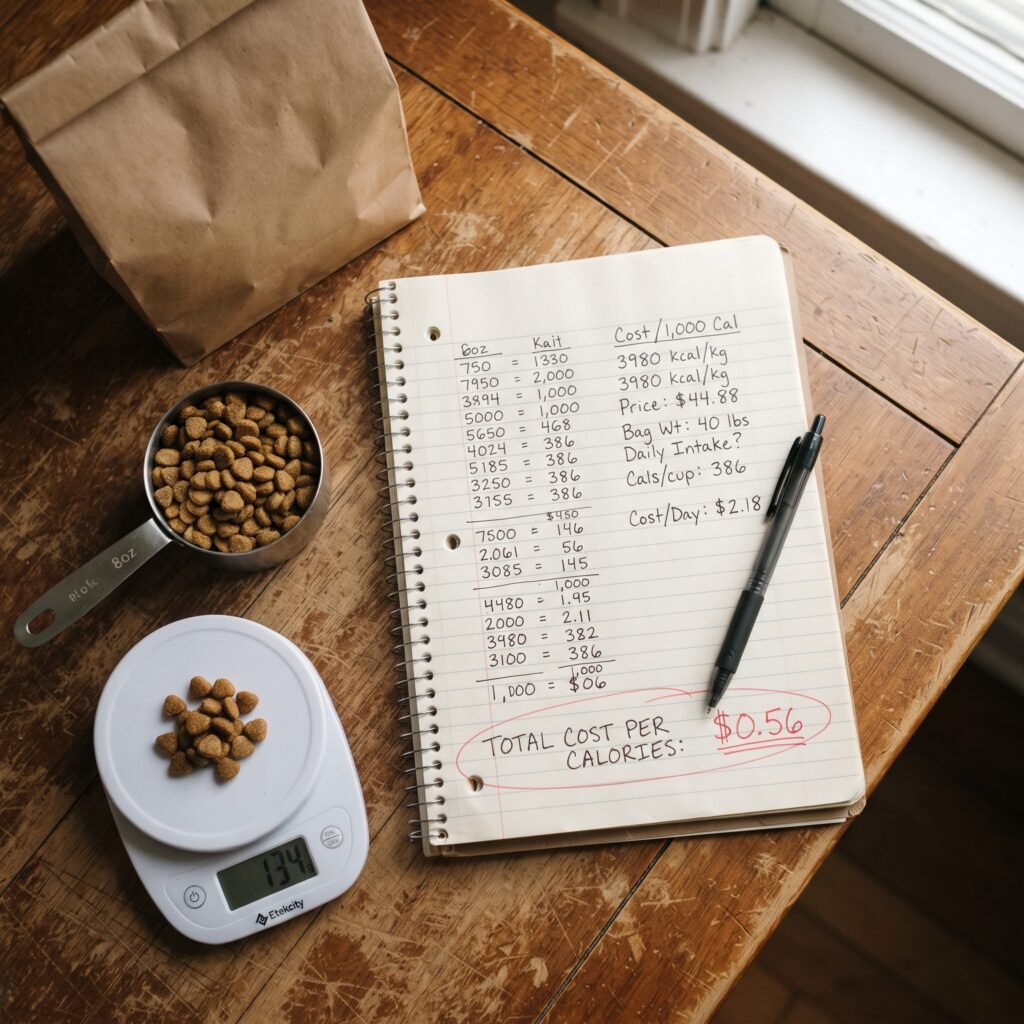
The only honest comparison is cost per 1,000 kilocalories. Here’s the arithmetic, using prices I paid in my area in spring 2026 — yours will differ, and that’s fine, because the method is the part you keep.
| Food | Bag price / size | Calorie density | Cost per 1,000 kcal | Monthly cost, 50-lb dog |
|---|---|---|---|---|
| Dog Chow Complete Adult | $27 / 40 lb | ~3,469 kcal/kg | ~$0.43 | ~$15 |
| Dog Chow High Protein | $30 / 32 lb | ~3,700 kcal/kg | ~$0.56 | ~$19 |
| Purina ONE SmartBlend Chicken & Rice | $42 / 31.5 lb | ~3,660 kcal/kg | ~$0.80 | ~$28 |
| Purina Pro Plan Complete Essentials | $68 / 35 lb | ~4,014 kcal/kg | ~$1.07 | ~$37 |
To run this on any bag: convert bag weight to kilograms, multiply by the kcal/kg figure on the label, divide the price by that number, then multiply by 1,000.
The monthly column assumes a 50-pound adult dog at roughly 1,150 kcal/day, which is a standard maintenance estimate for a neutered dog with normal activity. Sanity check: 1,150 divided by 405 kcal/cup gives 2.8 cups a day, and the Dog Chow feeding chart says 2¼ to 2¾ cups for a 36-50 pound dog. The math and the bag agree.
The Purina Dog Chow vs Pro Plan gap is the one worth staring at, so here’s the number that actually matters. Moving one 50-pound dog from Purina Dog Chow to Pro Plan costs about $22 a month. Moving four dogs costs about $88 a month.
Most people can find $22. Very few can find $88 without something else giving way.
That’s the whole game. You are almost never choosing between budget and premium food for the household. You’re choosing which single dog gets the $22.
Which dog should come off Purina Dog Chow first?
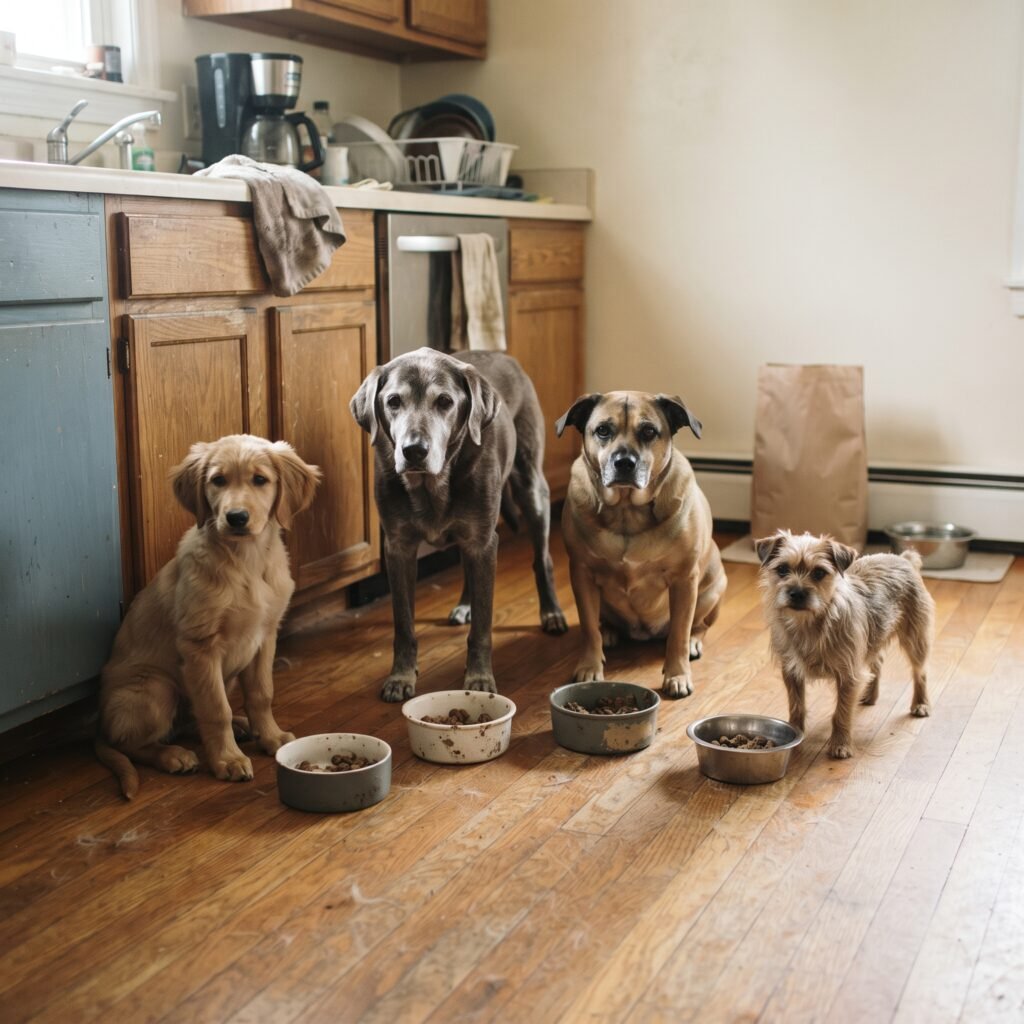
This is the ranking I use, in order. If you can only afford to move one dog off it, start at the top and stop when the money runs out.
1. Any dog who is still growing
This isn’t a judgment call, it’s a label restriction. Purina Dog Chow Complete Adult is formulated for adult maintenance only, so a growing puppy shouldn’t be on it regardless of budget.
The risk is sharpest with large-breed puppies. Uncontrolled calcium during growth is associated with developmental orthopedic problems in dogs projected to exceed about 70 pounds, which is why AAFCO’s growth profile sets a calcium maximum for large-size growth — a ceiling adult maintenance foods aren’t required to respect.
Purina Puppy Chow Complete does carry the growth statement, including large-breed growth, and it sits at a similar price tier. If the puppy is the constraint, that’s the cheapest correct move on this entire list.
I’ve had exactly one foster where I got this wrong, early on. A shepherd-mix pup came in at four months old and I fed him the Complete Adult formula for about three weeks before I caught it. No harm done at that duration, but it’s the kind of thing you only need to fix once.
2. The dog with itchy skin, a dull coat, or recurring ear gunk
Standard Dog Chow contains corn, wheat, and soy, plus four artificial dyes. For most dogs that’s a non-issue — true food allergies in dogs most commonly involve proteins like beef, dairy, and chicken rather than grains.
But a low-fat, low-omega-3 diet shows up in the coat within about eight weeks, and a 10% minimum fat with no meaningful EPA or DHA is on the thin side for a dog whose skin is already struggling.
This is the dog where I’ve seen the fastest visible return on an upgrade. A foster terrier mix with chronically flaky skin went from Purina Dog Chow to a salmon-based formula and had a noticeably softer coat inside six weeks — not a cure, but the dandruff along her spine stopped shedding onto the couch.
Worth knowing: you can make this move within the brand. Purina Dog Chow Complete Adult sits at 21% protein and 10% fat with corn as ingredient one. Purina’s Dog Chow Sensitive Stomach & Skin formula leads with salmon, runs 26% protein, and is made without corn, wheat, soy, or peas. It costs more than the standard formula but far less than the full Purina Dog Chow vs Pro Plan jump.
3. The senior who’s losing topline
Weight and muscle are not the same thing, and this is the mistake I see most often. An older dog can hold her scale weight perfectly while her hips and shoulders hollow out.
Older dogs are less efficient at using dietary protein and generally need more of it, not less, to hold lean mass. A ~24% dry matter protein food like Purina Dog Chow is adequate for a healthy adult and marginal for a 12-year-old who’s already thinning.
Run your hands over the dog’s spine and hips once a month. If the muscle over the pelvis is dropping away while the number on the scale holds, protein is the first thing to change.
Caveat that matters: if your senior has diagnosed kidney disease, do not raise protein on your own. Phosphorus and protein management in renal patients is a veterinary decision, and the 0.8% minimum phosphorus in standard kibble is already higher than a therapeutic renal diet would allow.
4. The hard keeper
Some dogs — sighthound types, anxious dogs, dogs recovering from a rough start — burn through calories and stay ribby no matter how much you put down.
Feeding more of it to a hard keeper mostly produces more stool. At around 3,469 kcal/kg with high carbohydrate content, you hit the dog’s digestive volume limit before you hit the calorie target.
A denser food at 4,000+ kcal/kg gets more calories into a smaller bowl. That’s a genuine mechanical advantage, not marketing.
5. The healthy middle-aged dog who’s doing fine
Leave them on Purina Dog Chow. Firm stools, good energy, glossy coat, holding weight, clean ears — that dog is telling you the food is working.
The honest answer to “is Purina Dog Chow good for dogs” is that it depends entirely on which dog in the room you’re asking about. Upgrading a dog who’s already thriving is the least efficient thing you can do with a limited food budget. Spend it on the dog at the top of this list instead, or on dental care, which will do more for a healthy adult’s lifespan than a protein bump ever will.
I have a nine-year-old beagle mix who has eaten it for most of her life. Clean bloodwork, good teeth for her age, ideal body condition. She is the reason I don’t lecture people about budget kibble.
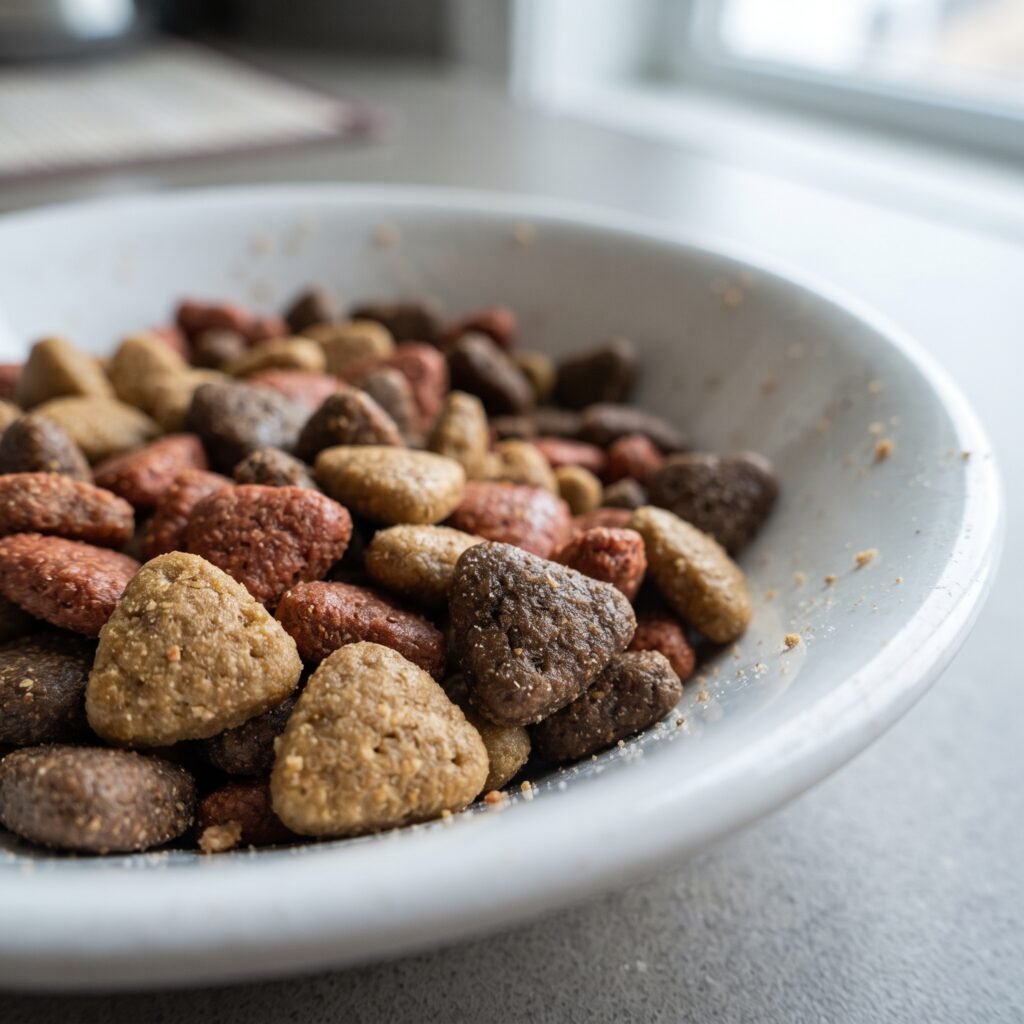
What does Purina Dog Chow actually look and smell like in the bowl?
Reviews skip this and owners ask about it constantly, so: the Complete Adult kibble runs roughly 10-12mm across, in rounded, slightly irregular triangles. Three colors in the mix — pale tan, a rusty red-brown, and a darker brown.
It’s a moderate-size kibble. Fine for anything from a beagle up, genuinely awkward for a 6-pound Chihuahua or a Maltese, which is why Purina makes a small-dog version with a smaller piece. If your toy breed is chewing each piece twice before swallowing, the kibble is too big.
The smell is the strongest sensory signal. Opening a fresh bag releases a heavy toasted-corn-and-rendered-fat smell that fills a small kitchen — noticeably stronger and sweeter than the more neutral smell of higher-meat kibble.
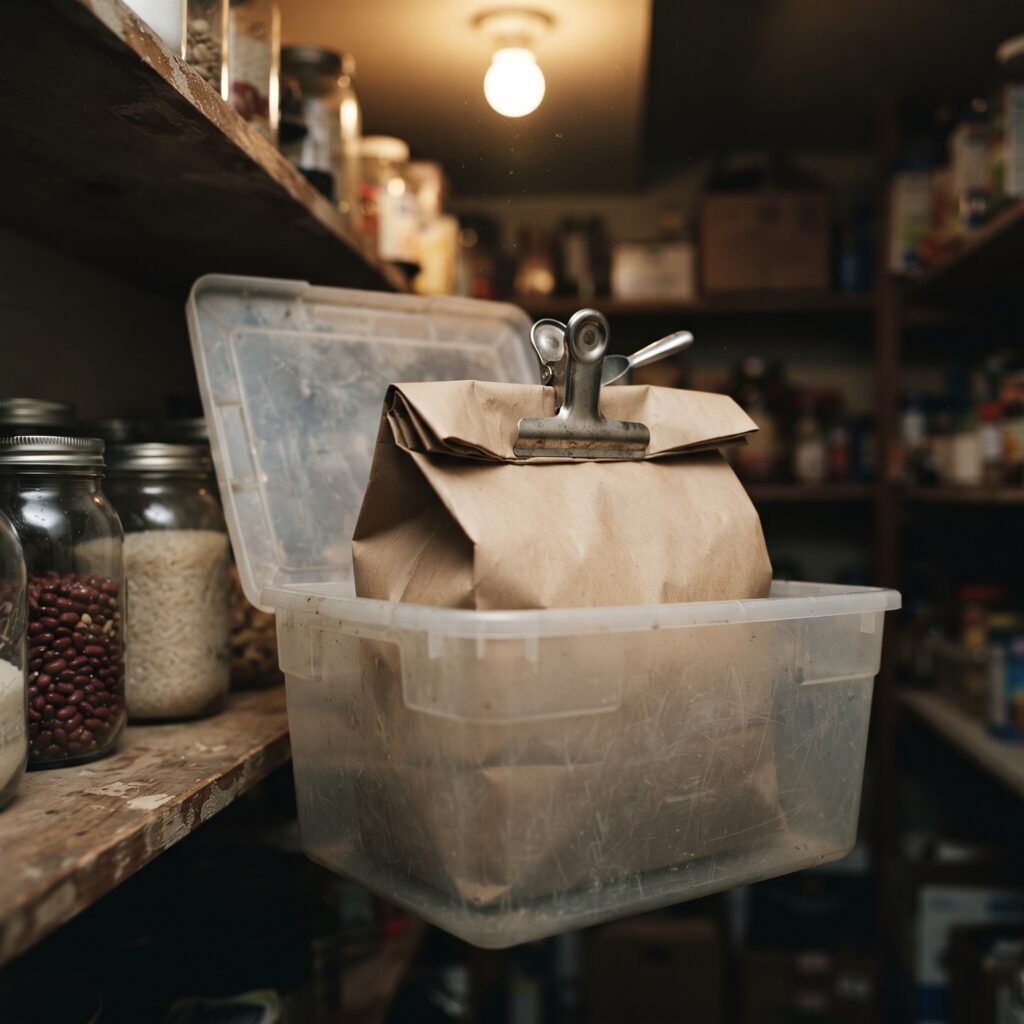
There’s a light greasy film on your hands after scooping, from the beef fat coating. Store the bag rolled shut, or in the original bag inside a bin rather than dumped loose, because that surface fat is what goes rancid first and it goes faster in a humid house.
One small thing nobody mentions: if it sits wet in a white ceramic bowl, the dyes leave a faint pink-orange tint. It washes out. It’s also a fair reminder of what those dyes are doing there.
Palatability has never been my problem here. In seven years of fostering, I’ve had exactly two dogs refuse it, both of whom refused everything for the first 48 hours because they’d just been through a shelter intake.
Where Purina Dog Chow let me down
Here’s the failure, because it’s the most useful thing in this article.
I fostered a 12-year-old lab mix, roughly 62 pounds, who came in underweight after a long stint in a shelter. She ate it enthusiastically and her weight came up nicely — about nine pounds over ten weeks, which is exactly what I wanted on the scale.
But her topline kept getting worse. Muscle over her hips and shoulders visibly wasted while her middle filled out. She was gaining fat and losing lean mass at the same time.
My first fix was the cheap one, and it was wrong. Instead of changing her base kibble, I topped her kibble with a scoop of canned food twice a day, reasoning that I’d add protein without the cost of switching foods entirely.
Two things happened. Her stools loosened within four days, because I’d changed her diet composition daily without any transition. And she started leaving the dry kibble at the bottom of the bowl and eating only the wet — so her actual protein intake barely moved while her calories went up.
I’d bought myself a fussy eater and softer stools and solved nothing. The topline kept receding.
What finally worked was moving her base food to a higher-protein formula over a ten-day transition, and adding a short daily hill walk. Her topline came back over about two months.
The lesson isn’t “Purina Dog Chow is bad.” It’s that the protein level is set for maintenance of a healthy adult, and a senior actively rebuilding lean mass is a different physiological job. Topping a maintenance food with a spoonful of something richer doesn’t change the base — it just makes the base optional.
If you take one thing from this article: when the base food is wrong for the dog, change the base food. Toppers fix palatability, not nutrition.
How do you switch a dog on or off Purina Dog Chow without wrecking their stools?
Ten days, not three. Purina’s own guidance says 7-10 days, and with a dog who has any history of a sensitive gut I use the full ten and sometimes stretch to fourteen.
The ratios I use: days 1-3 at 25% new food, days 4-6 at 50%, days 7-9 at 75%, day 10 onward at 100%. Mix them together in the same bowl rather than feeding them separately, or you’ll get the picky-eating problem I described above.
Watch stool, not appetite. Appetite tells you almost nothing during a transition because most dogs will eat a new food eagerly out of novelty. Soft-but-formed on day four is normal; genuinely loose stool means you moved too fast, so drop back a stage for three days before advancing.
If you’re switching to Dog Chow from something richer, expect stool volume to increase. That’s the carbohydrate load and it’s not a problem in itself — a higher-carb food produces more waste per calorie. It should firm up within two weeks.
Don’t run a transition during any other big change. New home, boarding, a course of antibiotics, or a vaccination week will all muddy the signal and you won’t know what caused what.
Should the Purina Dog Chow recall history change your decision?
Purina Dog Chow recall rumors circulate constantly, usually driven by social media rather than by regulatory data, so let’s be precise about it.
Purina Dog Chow dry kibble is not currently under recall, and the Dog Chow dry line does not have a recent recall in FDA records. Purina as a company has had recalls, and they’re worth knowing:
- February and March 2023: Purina Pro Plan Veterinary Diets EL Elemental dry dog food, for potentially elevated vitamin D. Expanded once, roughly a month after the initial announcement.
- March 2016: a limited quantity of Beneful and Pro Plan wet dog food varieties.
- 2011-2012: several Purina ONE and Purina Veterinary Diets products, for salmonella risk and, in one case, potentially low thiamine.
Notice the pattern. None of those touched the Dog Chow dry line, and the 2023 event was a therapeutic prescription diet, not a grocery-aisle food.
In early 2024 a wave of social media posts alleged widespread illness from Purina foods. The FDA reviewed the adverse event reports and no recall followed. Adverse event reports are self-submitted and unverified — the FDA’s own database carries a disclaimer that a report’s existence doesn’t establish that a product was defective or caused harm.
My honest read: recall history is a real input, and Purina Dog Chow’s is clean relative to the size of the brand. Nestlé Purina manufactures it in its own U.S. facilities rather than outsourcing to a contract manufacturer, which is a genuine quality-control advantage — a large share of pet food recalls trace back to shared co-packing plants where one bad ingredient lot contaminates a dozen brands at once.
Check the FDA recall page yourself before you buy in bulk. Don’t take a TikTok’s word for it, and don’t take mine.
How I evaluated Purina Dog Chow
Methodology. I worked from current Purina label PDFs and retailer-listed guaranteed analyses for Purina Dog Chow Complete Adult in chicken and lamb flavors, cross-checking the Purina Dog Chow ingredients panels across three retail listings because Purina rotates ingredient sourcing between production runs and panels do vary bag to bag.
All nutrient comparisons were converted to a dry matter basis before being compared to AAFCO Dog Food Nutrient Profile minimums for adult maintenance, since as-fed percentages are not comparable across foods with different moisture content.
Cost figures come from prices I paid in-store and online in spring 2026, converted to cost per 1,000 kcal using label calorie density. These are regional and they move — the method matters more than my numbers.
Purina Dog Chow recall history was checked against the FDA’s pet food recall listings and Purina’s own recall announcements, not against social media claims.
Hands-on observations come from feeding it to my own two dogs and to foster dogs through a county rescue since 2019 — roughly 30 dogs, ranging from an 8-pound terrier to a 90-pound shepherd mix.
What this article is not. I’m not a veterinarian and this isn’t a treatment plan. Any dog with diagnosed kidney disease, pancreatitis, diabetes, food-responsive enteropathy, or an active skin condition needs a diet chosen by a vet, not by a budget framework.
[Reviewed by: add SmartPupFood veterinary reviewer name and credentials before publishing.]
Frequently asked questions about Purina Dog Chow
Is Purina Dog Chow good for dogs long term?
For a healthy adult dog with no skin, gut, or muscle issues, yes — Purina Dog Chow meets AAFCO adult maintenance requirements and dogs live full lives on it. The long-term concern isn’t safety, it’s that its moderate protein level gives you less margin if the dog develops a condition that needs more.
What’s the difference between Purina Dog Chow and Purina ONE?
Purina ONE uses a named meat as its first ingredient and runs higher in protein, while Purina Dog Chow leads with corn and uses meat and bone meal. Purina ONE costs roughly 85% more per 1,000 calories in my area. It’s the most common intermediate step for owners who want an upgrade without Pro Plan pricing.
Why does Purina Dog Chow have artificial colors in it?
The Yellow 5, Yellow 6, Red 40, and Blue 2 in Purina Dog Chow are there for human buyers, not dogs — dogs don’t perceive kibble color the way we do. They’re approved for use and not known to be harmful at these levels, but they add nothing nutritionally, and the multicolored kibble is purely a shelf-appeal decision.
Can puppies eat Purina Dog Chow Complete Adult?
No — the Complete Adult formula carries an AAFCO statement for adult maintenance only, so it isn’t formulated for growth. Use Purina Puppy Chow Complete instead, which carries the growth statement including growth of large-size dogs — a distinction that matters most for puppies who’ll finish over about 70 pounds.
Is there a Purina Dog Chow recall in 2026?
There is no active recall on Purina Dog Chow dry kibble, and the Dog Chow dry line has no recent recall in FDA records. Purina’s most notable recent recall was Pro Plan Veterinary Diets EL Elemental in early 2023 for potentially elevated vitamin D — a prescription diet, not the grocery-aisle kibble. Verify on the FDA’s recall page before any bulk purchase.
The bottom line on Purina Dog Chow
Purina Dog Chow is a corn-forward maintenance kibble that clears every AAFCO adult minimum, costs about $0.43 per 1,000 calories, and is entirely adequate for a healthy adult dog who’s thriving on it. It’s not the best food in the aisle and it doesn’t pretend to be.
If you’re stuck on Purina Dog Chow vs Pro Plan, stop comparing bags and start comparing dogs. The decision that actually matters isn’t whether to buy it at all. It’s which dog in your house should come off it first: the puppy, then the itchy dog, then the senior losing muscle, then the hard keeper. The healthy middle-aged dog stays.
Read the Purina Dog Chow ingredients panel on the bag in front of you rather than trusting any review, including this one — panels rotate between production runs. Then run the cost-per-1,000-kcal math on your own bags before you decide anything. In most multi-dog households, keeping the majority on Purina Dog Chow is what makes one meaningful upgrade affordable — and one dog moved to the right food beats four dogs moved to a slightly better one.