Gran Danes Feeding: The Portion Decision That Shapes Their Joints
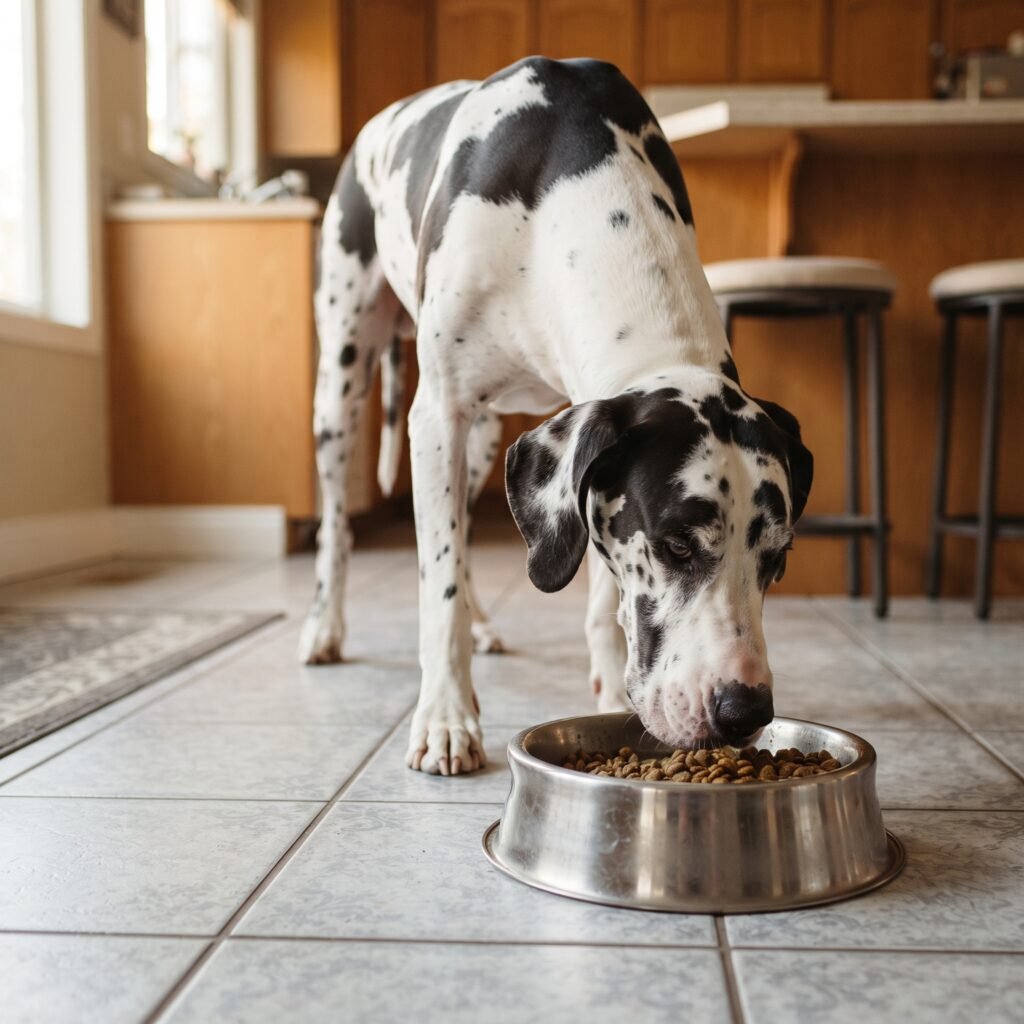
Short answer: With a gran danes, the biggest lever isn’t the brand on the bag — it’s how much you feed between 4 and 14 months. An overfed gran danes puppy grows faster than its cartilage can handle. Keeping it visibly lean, on a food under 4.5 g calcium per 1,000 kcal, matters more than anything else you’ll choose.
Recommended Products
Best Dog Food in 2026
Why does the brand matter less than you think?
The first question that lands in my inbox is almost always “what’s the best food for a gran danes?” It’s the wrong question, or at least the second-most-important one.
Between two correctly formulated large-breed foods, the difference in outcome is small. Between feeding 22 oz a day and 27 oz a day from the same bag, the difference can be an OCD lesion at seven months.
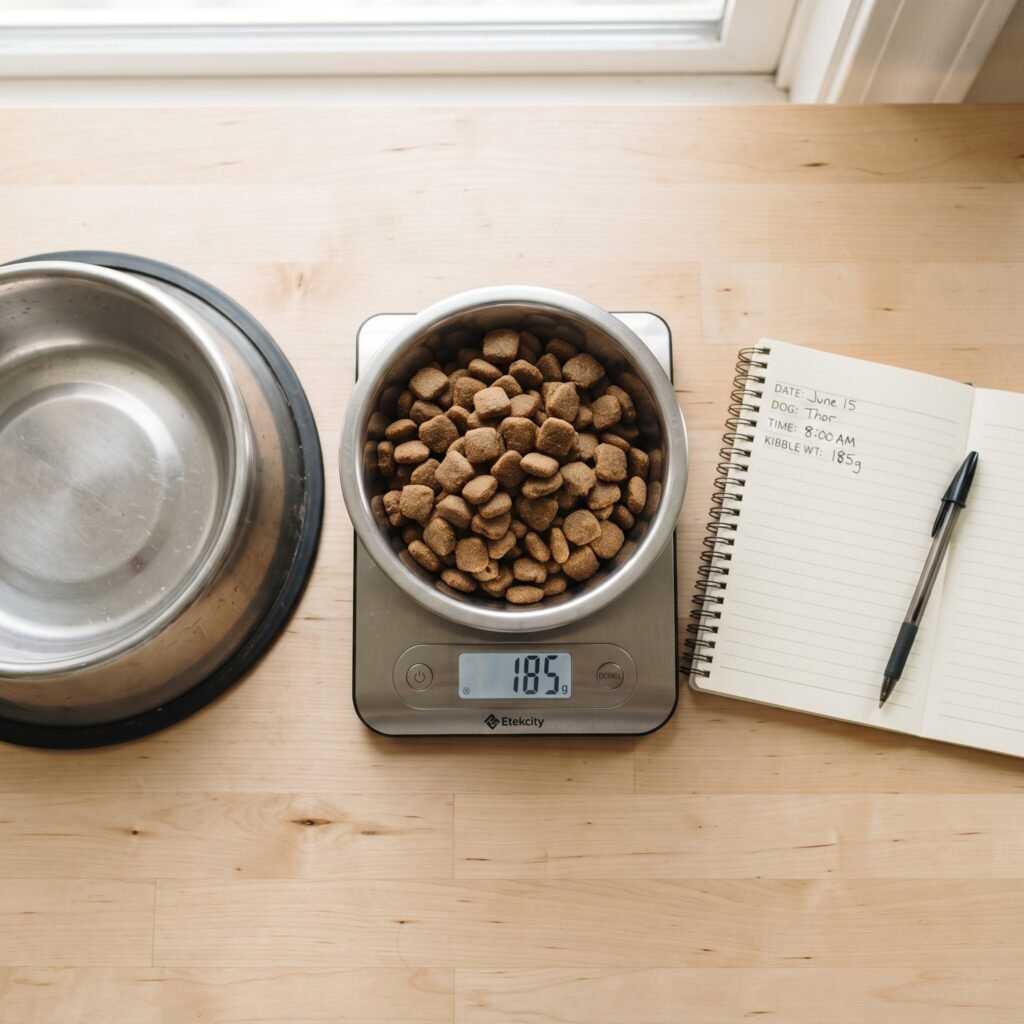
I’ve watched littermates eat the same product and end up in very different places. One went home with an owner who topped off the bowl whenever it looked empty. The other went to a woman who weighed every meal on a kitchen scale.
By ten months, the first dog was limping after long walks. The second wasn’t. Same bag, same breeder, roughly the same genetics.
That doesn’t mean labels are irrelevant. It means the label is an entry filter — some foods simply shouldn’t go near a gran danes — and the portion is the lever you pull every single day.
What happens when a gran danes puppy grows too fast?
A gran danes hits roughly half its adult weight by five months and keeps growing until 18 to 24 months. During that stretch, bone lengthens far faster than the growth plates can stabilize.
Feeding more energy than the puppy needs doesn’t get you a bigger adult. It gets you the same adult, arrived at sooner, with more damage along the way.
The three consequences I see most often in a mismanaged gran danes:
- Osteochondrosis and OCD. Joint cartilage thickens and cracks, usually in the shoulder or elbow, between 5 and 9 months.
- Hypertrophic osteodystrophy (HOD). Painful inflammation at the growth plates, fever, a puppy that won’t get up.
- Panosteitis. Shifting lameness that moves from leg to leg. It resolves on its own, but it hurts and it scares people.
None of these are purely dietary. Genetics and exercise load matter too. But overfeeding is the only one of the three you control completely, every day, with a $15 kitchen scale.
Two things compound the problem, and both are easy to miss. Slick floors force a growing puppy to brace with the shoulders on every step, and repetitive forced exercise — long jogs, stairs, fetch on hard ground — loads joints that aren’t finished yet.
Neither is a feeding issue, but both raise the price of every extra pound. Runners and rugs across the main walking paths are cheap insurance during this window.
Free play on grass is fine and useful. Structured endurance work can wait until the growth plates close, and your vet can confirm that with a single set of radiographs if you want certainty rather than a calendar date.
One more thing worth saying plainly: extra weight on a gran danes doesn’t behave the way it does on a beagle. Every additional pound presses on growth plates that are still soft cartilage, on a skeleton already working at the edge of its design.
How much calcium can a gran danes puppy handle?
This is the second filter, and it’s where most labels mislead without lying.
AAFCO’s nutrient profiles set a tighter calcium maximum for large-breed growth — dogs expected to reach 70 lb or more as adults — than for other puppies. FEDIAF, the European equivalent, sets comparable limits for large-breed puppies.
The trouble is that most owners compare the guaranteed analysis percentages, and those percentages aren’t comparable across foods with different moisture and different energy density.
The right unit is grams per 1,000 kcal of metabolizable energy. It’s the only way to know how much calcium actually enters the dog, because a gran danes eats calories, not percentages.
| Nutrient (large-breed growth) | AAFCO minimum | AAFCO maximum | Approx. per 1,000 kcal |
|---|---|---|---|
| Calcium | 1.2% dry matter | 1.8% dry matter | 3.0 – 4.5 g |
| Phosphorus | 1.0% dry matter | 1.6% dry matter | 2.5 – 4.0 g |
| Ca:P ratio | 1:1 | 2:1 | — |
| Protein | 22.5% dry matter | — | ≥ 56 g |
| Fat | 8.5% dry matter | — | ≥ 21 g |
Based on AAFCO growth profiles for large-size dogs. The per-1,000-kcal equivalents are approximate and shift with the product’s actual energy density.
How to convert a label percentage into g/1,000 kcal
It’s a thirty-second calculation and it prevents most of the mistakes I see.
- Find calcium in the guaranteed analysis (say, 1.4%).
- Find energy density in kcal/kg (say, 3,700 kcal/kg). If it’s not on the bag, it’s on the brand’s spec sheet or you can request it.
- Multiply: 1.4 g per 100 g × 1,000 = 14 g calcium per kilogram of food.
- Divide by the energy: 14 ÷ 3.7 = 3.8 g calcium per 1,000 kcal.
That food is in range for a growing gran danes. If your answer comes out above 4.5, that bag doesn’t come into the house until the growth plates close.
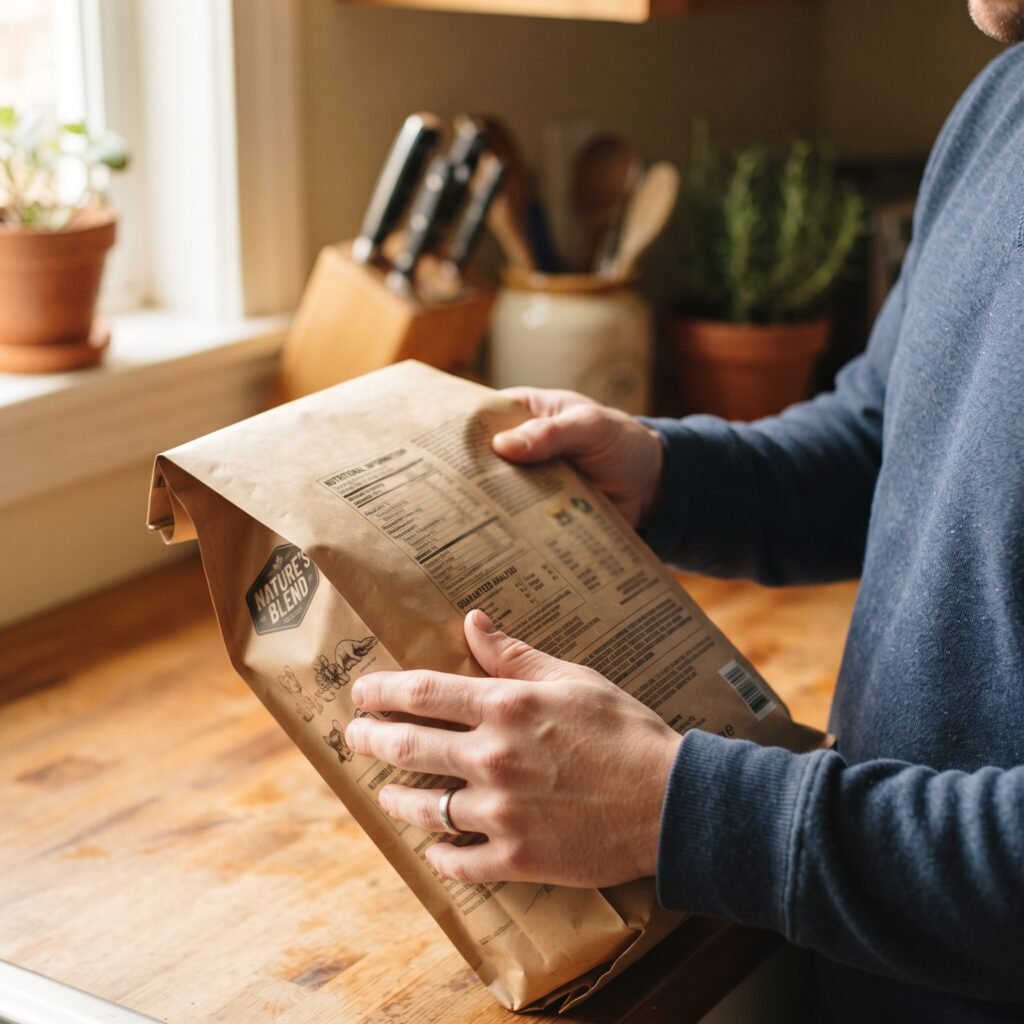
One shortcut I always use before doing any math: read the nutritional adequacy statement at the bottom of the label. If it says the food meets AAFCO profiles for growth “including growth of large size dogs (70 lb or more as an adult),” good sign. If it says “except for growth of large size dogs,” stop reading.
Which type of formula fits a growing gran danes?
There are three common paths, and none of them is automatically right. It depends on the dog’s appetite, your budget, and how disciplined you are with measuring.
| Option | Typical calcium (g/1,000 kcal) | Typical density (kcal/kg) | Main risk | Who it works for |
|---|---|---|---|---|
| Large-breed puppy formula | 3.0 – 4.2 | 3,400 – 3,800 | None, if you measure portions | The default choice for a gran danes puppy |
| Standard puppy formula | 4.5 – 6.2 | 3,900 – 4,400 | Excess calcium and excess energy | Nobody with a gran danes at home |
| All life stages | 3.2 – 5.5 | 3,600 – 4,300 | Highly variable; must verify the large-breed line | Only if the label confirms the large-breed profile |
| Adult food fed to a puppy | 2.4 – 3.4 | 3,300 – 3,900 | Protein and minerals fall short | Almost nobody (see below for why it failed) |
The calcium ranges in this table are what I typically find when I pull spec sheets, not values from any one brand. Always request the exact figure before you commit to a product for a year.
A note on density: a very energy-dense food isn’t worse in itself, but it forces small portions into a very large stomach. A gran danes that finishes dinner in forty seconds and then stares at you is a dog that will start eating your couch.
What about raw or homemade food for a gran danes?
This is where I get serious, and not out of purism. A homemade diet for a gran danes puppy is the single highest-error-margin scenario in dog nutrition.
In a complete commercial food, calcium is already balanced against phosphorus and matched to energy. In a homemade bowl, you’re building that balance yourself, meal after meal, for fourteen months.
The two failures I see over and over:
- Lean muscle meat with no calcium source. A muscle-heavy menu is high in phosphorus and nearly devoid of calcium. The Ca:P ratio inverts and the body starts pulling calcium out of bone.
- Overcorrection. The owner learns about the problem, adds eggshell powder or calcium carbonate by eye, and swings from deficiency to excess inside a week.
If you still want that route with a growing gran danes, the minimum condition is a formulation from a board-certified veterinary nutritionist, calculated in g/1,000 kcal and revised every time the dog gains meaningful weight. Not an internet recipe, not a generic premix.
With an adult gran danes the margin is wider, since growth plates are no longer in play. Even so, Ca:P and trace minerals still need a real formulation behind them.
And a budget note: feeding a 150 lb adult on commercial raw usually runs two to three times the cost of equivalent kibble. In this breed, homemade feeding is a financial decision as much as a nutritional one.
How many cups a day does a gran danes puppy need?
To figure out how much a gran danes puppy eats, the feeding chart on the bag is a starting point, not a prescription. It usually runs generous, because no manufacturer profits from your dog staying lean.
I estimate energy needs first, then correct with the dog standing in front of me.
- Resting energy requirement (RER): 70 × (body weight in kg to the power of 0.75).
- 4 to 6 months: roughly 1.8 × RER.
- 6 to 12 months: roughly 1.6 × RER.
- 12 to 18 months: roughly 1.3 – 1.4 × RER.
Real numbers. A five-month gran danes weighing 66 lb (30 kg): 30^0.75 = 12.8; × 70 = 896 kcal at rest; × 1.8 = about 1,610 kcal a day.
On a food running 390 kcal per cup, that’s roughly 4 cups a day split into three meals. Not 6 cups because the bag says so and the puppy acts starving.
A gran danes puppy almost always acts starving. This is a breed whose appetite bears no relationship to its actual requirement, and that mismatch is exactly the problem.
Redo the math every two or three weeks with the current weight. The number climbs fast at this stage, and underfeeding has its own costs.
How do I know if my gran danes is too thin or just right?
This is the part no calculator solves for you, which is why it gets its own section.
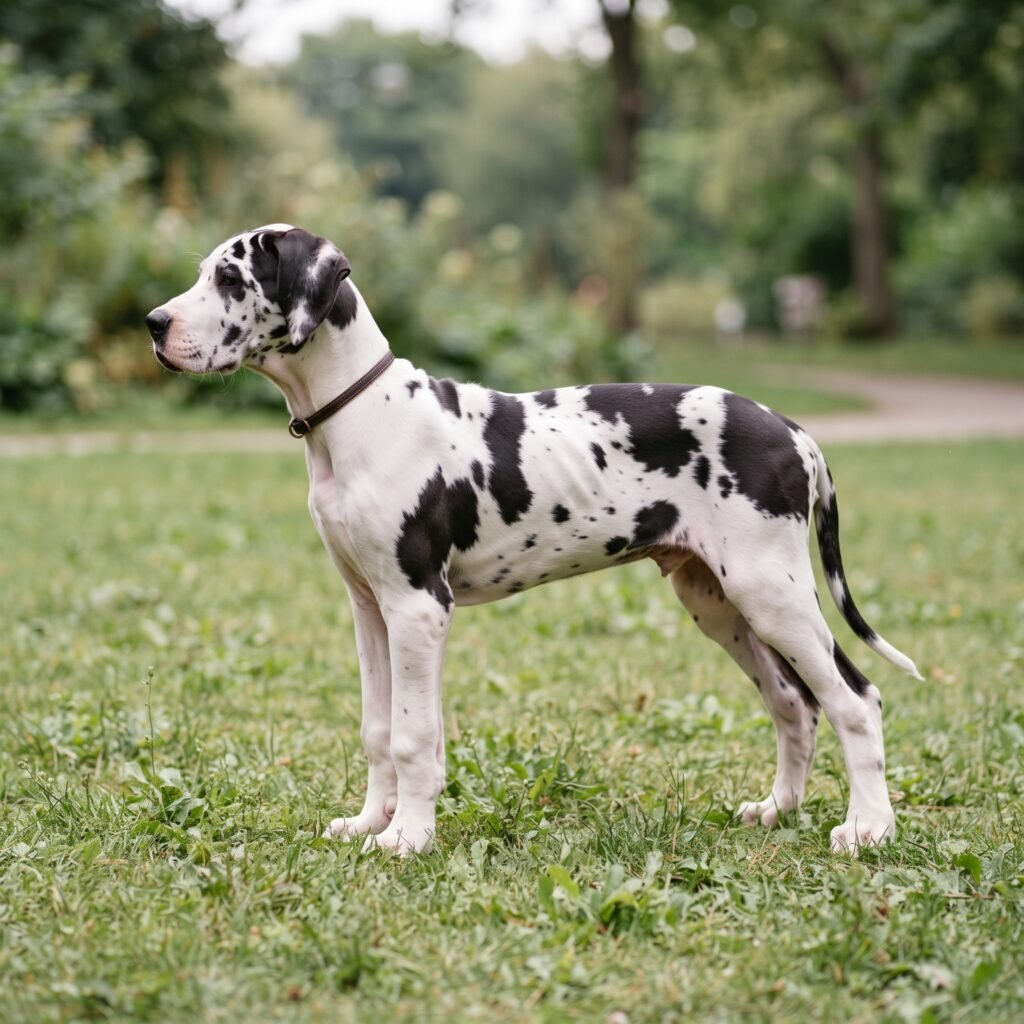
In a growing gran danes I target a body condition score of 4 out of 9, not 5. Deliberately just under the adult ideal.
In practice that means three concrete things:
- The last two ribs are faintly visible when the dog moves, and all of them are easy to feel without pressing — like the knuckles on the back of your hand.
- The waist is clearly defined from above, with an obvious tuck behind the rib cage.
- The hip points are easy to feel but don’t jut out like peaks.
If you have to dig your fingers in to find ribs, there’s too much food. If you can count individual vertebrae from ten feet away, there’s too little.
My routine with the puppies I follow: weigh and palpate on the same day each week, always before a meal, plus one photo from the side and one from above. The photos matter because the change is too slow to notice by eye and too fast to ignore for a month.
Keep the log somewhere dull and permanent — a notes app, the back of the food container, anywhere you’ll actually look. Date, weight, portion in grams, and one word for stool quality is enough.
That log earns its keep at the vet’s office. “He gained eleven pounds in three weeks on 620 grams a day” is a conversation. “He’s growing fine, I think” is not.
It also protects you from your own memory. Owners consistently misremember when a portion changed, and the log is what tells you whether a limp showed up before or after you bumped the food.
When palpation says “too much,” I cut the ration by 10% — no more — and wait two weeks before touching anything else. Sharp cuts in a gran danes puppy buy you a dog that starts stealing food off the counter.
A real-world detail: between 6 and 9 months, a gran danes looks frankly awkward. Knobby elbows, high in the rear, gangly all over. Plenty of owners increase the portion right there out of pure aesthetic anxiety, and it’s the worst possible moment to do it.
When do I switch my gran danes from puppy food to adult food?
The short answer circulating online is “at 12 months.” For a gran danes that’s early.
I make the change between 14 and 18 months, guided by two signals: the weight curve flattens for three or four consecutive weeks, and the dog starts leaving food for no obvious reason.
Make the transition slowly. Ten days minimum: 25% new food for the first three days, 50% through day six, 75% through day nine, 100% on day ten.
An adult gran danes has a digestive tract that forgives very little. Three-day switches produce loose stool for a solid week, and in this breed any drawn-out digestive episode deserves attention.
If stool goes loose mid-transition, don’t abandon the switch. Hold at the current ratio for three or four extra days instead of advancing, and only step backward if it hasn’t firmed up by then.
Skip the temptation to add toppers, broths, or probiotics during the change. Every extra variable makes it harder to tell what caused what, and most transitions settle on their own with time.
If you’re still on puppy food at 18 months, it’s not a disaster — as long as the dog sits at 5/9 and not 7/9. Excess energy is the thing to watch, not the word on the bag.
How much does an adult gran danes eat, and what does it cost?
When people ask how much a gran danes eats, they usually brace for a terrifying number. Here’s the pleasant surprise: relative to size, it eats less than you’d think.
Metabolism doesn’t scale linearly with body weight. A 150 lb dog doesn’t need double the calories of a 75 lb dog — it needs roughly 70% more.
| Dog | Weight | Approx. daily need | Cups/day at 390 kcal/cup | 30 lb bag lasts |
|---|---|---|---|---|
| Adult Labrador | 70 lb | ~1,410 kcal | 3.6 | 38 days |
| Gran danes female | 120 lb | ~2,190 kcal | 5.6 | 24 days |
| Gran danes male | 150 lb | ~2,600 kcal | 6.7 | 20 days |
| Active gran danes male | 150 lb | ~3,100 kcal | 8.0 | 17 days |
Estimates using the standard maintenance formula for neutered adults. An intact, young, or highly active dog may need considerably more.
In dollars: an adult male gran danes goes through roughly 40 to 48 lb of kibble a month. On a mid-tier food at $2 a pound, that’s about $80 to $96 a month in dry food alone.
That math changes how you compare products. A bag that costs more per pound but carries more energy per pound can be cheaper per day, and cost per 1,000 kcal is the only honest comparison.
Divide the bag price by the total calories inside. A $60 bag holding 30 lb at 1,725 kcal/lb costs $1.16 per 1,000 kcal. A $48 bag at 1,500 kcal/lb costs $1.07. Much closer than the sticker price suggests.
If money is tight, my priority order for feeding a gran danes is simple. First, the formula must state the large-breed growth profile. Second, verified calcium. Third, brand and everything else.
A mid-tier food measured properly does more good for a gran danes than a premium food poured by eye. I’ve seen enough dogs in both groups to be confident about that.
One note for anyone running the numbers before the puppy comes home: food is only part of it. Add the cost of parasite prevention dosed for a 150 lb dog and anesthesia for a dog that size, and the budget gets realistic fast.
How does bloat risk change the way you feed a gran danes?
In this breed that’s not a side detail. Gastric dilatation-volvulus (GDV) is a surgical emergency, and the gran danes sits among the highest-risk breeds because of its deep, narrow chest.
Epidemiological research from Purdue on large and giant breeds identified several factors associated with higher risk, and some are feeding habits directly:
- Eating one large meal a day instead of splitting it.
- Eating very fast.
- Raised feeders, which in giant breeds were linked to a meaningful share of cases.
- Being under ideal body condition.
- Having a first-degree relative with a GDV history.
What I do with that in an adult gran danes: two or three meals a day, bowl on the floor, a slow-feeder bowl if the dog inhales food, and no hard exercise in the hour before or after eating.
Watch the practical contradiction here. Keeping a puppy lean is correct, but being underweight as an adult is among the factors associated with GDV. The target shifts with age: 4/9 during growth, 5/9 as an adult.
There’s one sign I ask every owner to memorize: unproductive retching, restlessness, and an abdomen that swells within minutes. In a gran danes, that means going to the vet now, at 3 a.m. if necessary, not waiting until morning.
Find your nearest 24-hour emergency clinic in advance and know the drive time. When it happens, that information is worth more than any food decision you’ll ever make.
It’s also worth asking your vet about prophylactic gastropexy, especially if the dog is being spayed or neutered anyway. That’s a conversation to have early, not the night the retching starts.
What didn’t work: using adult food to cap calcium
Here’s a mistake of mine, because it’s exactly the kind of shortcut that sounds reasonable and isn’t.
A few years back I told the owner of a six-month-old gran danes to move to a large-breed adult food. The logic seemed sound: adult food has less calcium and lower energy density, so growth would slow automatically.
It didn’t work. The dog compensated by eating far more volume to cover its energy needs, and that volume carried in nearly the same total calcium as before. The theoretical benefit evaporated.
Then came what I hadn’t anticipated. Bulky, loose stool for three weeks, a visibly distended abdomen after every meal — precisely what you don’t want in a bloat-prone breed — and a protein intake that fell short for an animal laying down muscle at speed.
We went back to a large-breed puppy formula with the calcium verified in g/1,000 kcal, and controlled growth with the kitchen scale, which is where it should have been controlled from the start. Stool normalized within six weeks.
The lesson: you can’t dilute the food to do the job that belongs to the portion. The dog eats until it covers its calories, and your plan bends to the dog rather than the other way around.
Methodology: how I evaluate food for a gran danes
I don’t review products by their ingredient list. In this breed, the ingredient panel is the least informative thing on the bag.
My filter has five steps:
- Nutritional adequacy statement. For a puppy it must explicitly cover growth of large size dogs. Without that line, the product is out.
- Full analysis, not the guaranteed analysis. I request the nutrient profile per 1,000 kcal from the manufacturer, including calcium, phosphorus, and Ca:P. If a brand won’t share it, that’s information in itself.
- Recall history. I check the FDA recall database for the past five years and look at whether the issue traced to the brand or to a co-manufacturing plant, which are not the same problem.
- WSAVA-style manufacturing questions. Who formulates the food, with what credentials, whether the plant is owned or contracted, and whether they run actual feeding trials.
- Context on the FDA’s DCM investigation. Since 2018 the FDA has investigated reports of dilated cardiomyopathy in dogs eating diets heavy in peas, lentils, and other legumes. No causal link has been established, but in a breed already predisposed to cardiac disease, I’d rather not add an unresolved variable.
Gran danes feeding FAQ
How many times a day should a gran danes eat?
Three meals until six months, then two meals for the rest of the dog’s life. Feeding one large daily meal is among the factors associated with higher bloat risk, so splitting it isn’t just about digestive comfort.
Is it bad to feed adult food to a gran danes puppy?
It isn’t toxic, but it rarely accomplishes what people hope. The puppy compensates with volume, total calcium barely drops, and protein can fall short in the middle of peak muscle development.
How much should a gran danes weigh at 6 months?
The usual range runs 70 to 100 lb depending on sex and bloodline, with males at the top end. More useful than the number is the trend: a smooth, steady weight curve beats hitting a specific figure on a specific Tuesday.
Can I give my gran danes puppy a calcium supplement?
No, unless a veterinarian specifically prescribes it. A complete large-breed puppy food already covers the requirement, and excess calcium is precisely the mechanism that damages growing cartilage in this breed.
What food is best for a gran danes with a sensitive stomach?
Start by ruling out the causes that aren’t the food: meals that are too large, fast transitions, or eating with anxiety. If it persists, a limited-ingredient formula with a verified large-breed profile is the most orderly path, and any weight loss warrants a vet visit.
What actually gets decided every day
You can read thirty food reviews and still make the wrong call, because the call isn’t in the bag.
It’s in the kitchen scale, in the weekly rib check, and in the discipline of keeping your gran danes a little leaner than you’d like for fourteen long months.
Pick a food that states the large-breed growth profile, verify its calcium in grams per 1,000 kcal, and then stop thinking about the brand. The rest of the work is yours, and it happens in grams.
If you remember one thing tomorrow, make it the right question: not “what do I feed him,” but “how much did my gran danes eat today, and what do his ribs say about it?”
A gran danes managed well through that first year and a half won’t thank you with anything visible. He simply won’t be limping at eight months, and that’s the entire goal.