
How to Choose a Raza de Perros Based on What It Costs to Feed
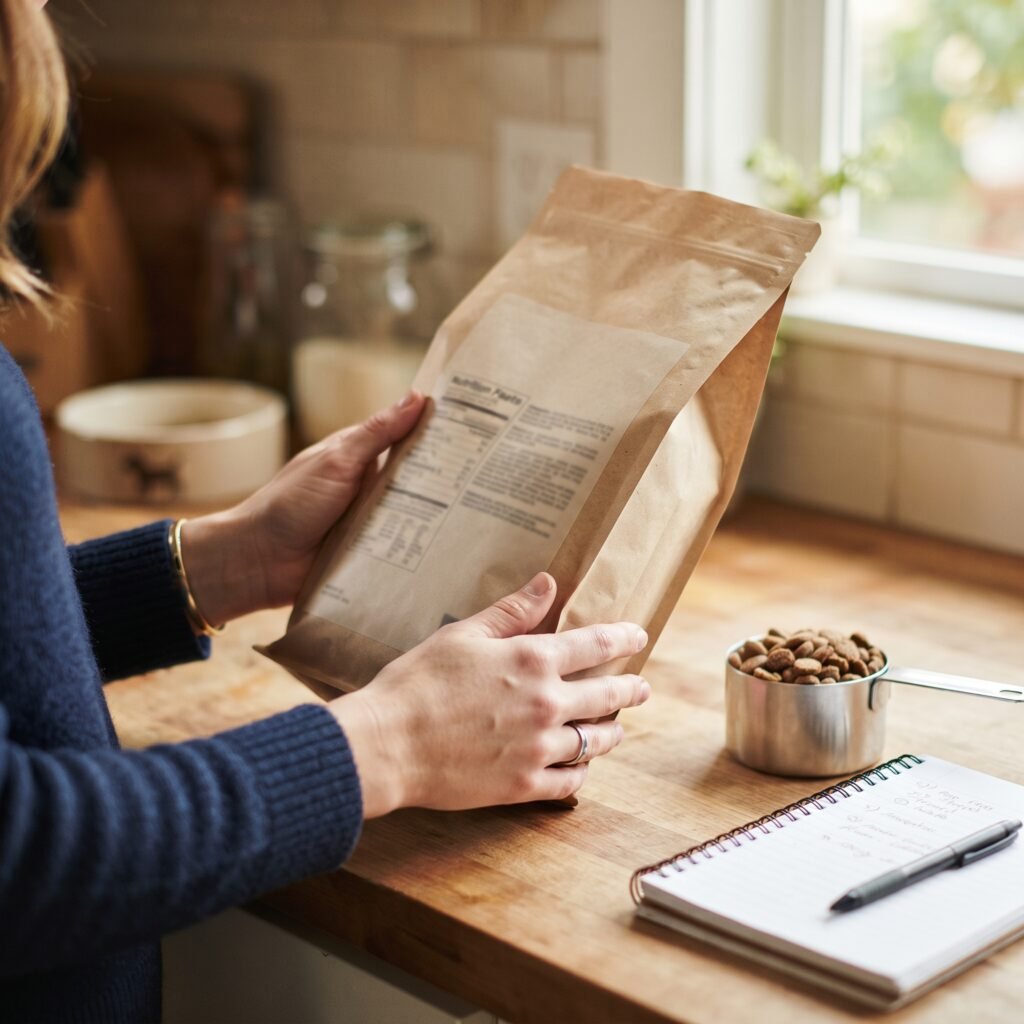
Pick a raza de perros by working backward from the food bowl. Calculate the breed’s adult calorie needs, multiply by your local price per 1,000 calories, then add the breed-specific nutritional risks — large-breed growth limits, bloat-prone anatomy, flat-faced gulping. A Great Dane costs roughly ten times a Chihuahua to feed.
Why Does Nobody Talk About Feeding Cost When Picking a Raza de Perros?
Because it’s unglamorous. Breed guides for every raza de perros lead with personality, energy level, and whether the dog is good with kids — all real considerations, none of which show up on your monthly card statement the way food does.
I’ve spent eleven years writing about dog nutrition and fielding emails from owners who love their dog and quietly resent the budget it created. The pattern is nearly always the same. They chose a raza de perros on temperament, then discovered that the breed came attached to a permanent line item.
Recommended Products
Best Dog Food in 2026
Food is the one cost you cannot defer. You can skip grooming a month, push a dental cleaning, buy the cheap harness. The bowl gets filled twice a day for twelve years.
And the size of that number is set almost entirely at the moment you choose a breed. That’s what makes it worth thinking about before the dog is home, not after.
This isn’t an argument for choosing a small dog. It’s an argument for going in with the real number.
How Much Does Each Raza de Perros Actually Eat Per Day?
Start with the formula vets use for any raza de perros. Resting energy requirement equals 70 multiplied by body weight in kilograms raised to the power of 0.75. That gives you calories at rest.
Then you apply an activity multiplier. Roughly 1.6 for a neutered adult with normal activity, closer to 2.0 for an intact or genuinely working dog, and higher again for a growing puppy.
The exponent is the part people miss. Calorie needs don’t scale linearly with weight — a dog twice as heavy doesn’t eat twice as much. It eats about 1.7 times as much.
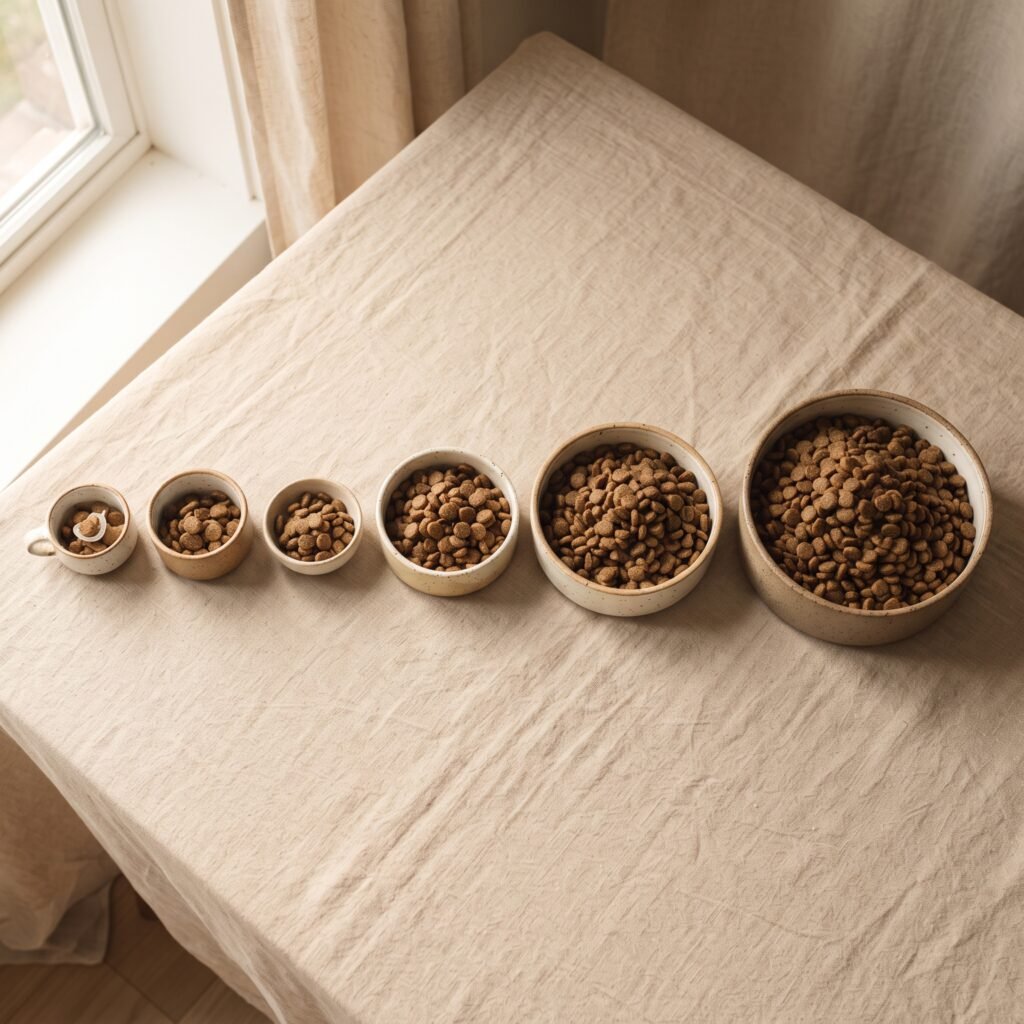
That’s good news at the top end and it still doesn’t save you. Here’s what it works out to across a spread of breeds, using a mid-range kibble at 380 kcal per cup and $3.20 per pound.
| Raza de perros (adult weight) | Est. daily calories | Approx. cups/day | Est. monthly food cost | The bowl-side risk that costs money |
|---|---|---|---|---|
| Chihuahua (6 lb) | ~235 kcal | 0.6 | ~$14 | Dental disease, hypoglycemia in puppies |
| Beagle (25 lb) | ~690 kcal | 1.8 | ~$42 | Relentless appetite, obesity |
| Border Collie (40 lb, active) | ~1,230 kcal | 3.2 | ~$75 | High working load, needs calorie-dense food |
| Labrador Retriever (70 lb) | ~1,500 kcal | 3.9 | ~$91 | Obesity gene (POMC), joint load |
| German Shepherd (80 lb) | ~1,655 kcal | 4.4 | ~$102 | Sensitive digestion, EPI risk in the line |
| Great Dane (140 lb) | ~2,520 kcal | 6.6 | ~$154 | Bloat/GDV, strict growth calcium limits |
Those are my calculations for each raza de perros, not manufacturer figures. Run them again with your own kibble’s kcal-per-cup, which is printed on the bag or the brand’s site.
The spread is the story. Over ten years, the Chihuahua costs somewhere near $1,700 in food and the Great Dane clears $18,000 — before a single prescription diet or supplement.
Notice that the Border Collie, at 40 pounds, out-eats dogs twice its size on a working week. Energy level moves the number as hard as body mass does.
So “small dog, small bill” is only half true. A high-drive raza de perros in the 40-pound range can cost more to feed than a placid 70-pound one.
Which Raza de Perros Has Hidden Nutritional Costs Beyond the Kibble?
This is where the arithmetic stops being simple. Some breeds carry a nutritional requirement that raises the cost per calorie, not just the calorie count.
Large and giant breeds: the growth calcium problem
If your chosen raza de perros will mature above roughly 70 pounds, you cannot feed it any puppy food on the shelf. AAFCO nutrient profiles include a separate maximum calcium level for large-size growth, set lower than the general growth maximum — 1.8% of dry matter versus 2.5%.
The reason is skeletal. Excess calcium during rapid growth is associated with developmental orthopedic disease in large breeds, and unlike adults, large-breed puppies don’t downregulate calcium absorption well enough to protect themselves.
So check the bag for the specific phrase confirming suitability for growth of large-size dogs. It’s a formal statement, not marketing language, and plenty of perfectly good puppy foods don’t carry it.
That narrows your options and usually raises your price per pound. Budget for it if you’re choosing a giant raza de perros.
Deep-chested breeds: the bloat tax
Great Danes, Standard Poodles, Weimaraners, Setters, and other deep-chested dogs carry elevated risk of gastric dilatation-volvulus. It’s a genuine emergency and an expensive one.
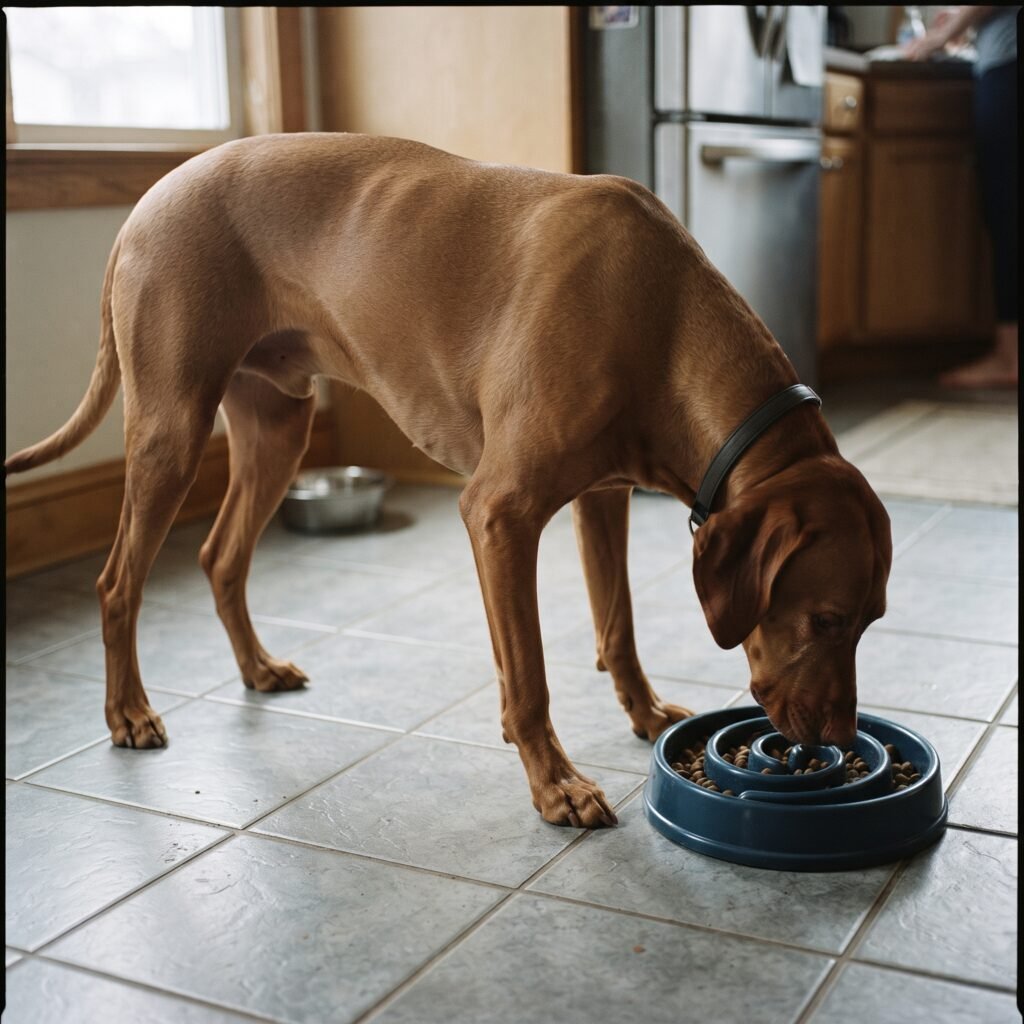
Feeding management is part of the mitigation strategy — multiple smaller meals rather than one large one, and slowing the rate of intake. That means a slow-feeder bowl, sometimes an elevated stand, sometimes a puzzle feeder, and it means someone has to be home at midday.
None of that is expensive on its own. The scheduling cost is the real one, and it’s a reason this raza de perros category suits some households badly.
Flat-faced breeds: the mechanics of eating
Bulldogs, Pugs, French Bulldogs, and Boxers eat differently. The shortened muzzle changes how a dog picks up and swallows kibble, and many of them swallow air alongside it.
I’ve watched a French Bulldog work through a bowl of standard round kibble by essentially shoveling with the underside of the jaw. Brachycephalic-specific kibble shapes exist for exactly this reason — they’re usually shaped to be picked up from below rather than grasped.
Those formulas come at a premium. If you’re drawn to a flat-faced raza de perros, price the specialized food, not the generic one.
Toy breeds: small bowl, small margin
The cheapest raza de perros to feed by volume is also the least forgiving. A toy puppy has minimal glycogen reserve, which is why hypoglycemia is a real risk in the first few months and why frequent small meals matter.
Adults are easier. But dental disease is close to a certainty in small breeds, and the food you choose interacts with it — kibble size and texture matter more here than in a Lab.
What Should I Look at on the Label Before I Commit to a Breed?
Three things, in this order, whatever raza de perros you’re weighing up, and they take about ninety seconds each.
First, the statement of nutritional adequacy. It tells you which life stage the food is formulated for and whether that formulation was verified by feeding trial or by calculation against AAFCO profiles. Feeding trials are the stronger signal.
Second, calories per cup or per kilogram. This is the number that turns a bag price into a real cost, and it varies enormously between brands.
Third, the guaranteed analysis — but convert it to dry matter before comparing anything. A canned food showing 10% protein and a kibble showing 26% are not what they appear, because the wet food is mostly water.
The dry matter conversion is straightforward. Divide the nutrient percentage by the dry matter percentage, which is 100 minus the moisture percentage, then multiply by 100.
Do this once for every food you’re seriously considering. It’s the single highest-value ninety seconds in this entire process, whatever raza de perros you end up with.
How Do I Compare Foods on Cost Instead of Bag Price?
Price per pound is misleading. Price per 1,000 calories is the number that matters, because a denser food means fewer cups per day.
Take the bag price, divide by the number of pounds, then work out how many calories are in a pound. Most kibble runs somewhere between 1,500 and 1,900 kcal per pound. Divide again and you have a directly comparable figure.
I’ve seen a premium bag at nearly twice the shelf price of a supermarket brand come out only 20% more expensive on this basis. I’ve also seen the opposite — a marketed-as-premium food that was simply expensive.
Run this for three candidate foods before you choose a raza de perros, not after. It changes which breeds are actually inside your budget.
Methodology: How I Evaluated This
Every claim about nutrient levels here was checked against current AAFCO Dog Food Nutrient Profiles rather than brand marketing copy, and stated as a range or a threshold rather than a precise study figure where I couldn’t verify a specific source.
Calorie estimates come from the standard resting energy requirement calculation with published activity factors, not from manufacturer feeding charts, which are generally conservative and tend to overfeed.
Cost figures are my own arithmetic at a stated kibble density and price point, both of which I’ve disclosed so you can substitute your own. They are estimates and they will be wrong for your zip code.
For any brand I recommend on this site I check recall history through the FDA’s animal food recall database before writing, and I re-check before updating a post. A clean five-year record is table stakes, and a recall isn’t automatically disqualifying — how the company handled it tells you more.
What Does This Look Like in Practice? A Real Example
Two years ago a reader wrote to me choosing between a Standard Poodle and a Labrador. She’d been told the Poodle was the more expensive dog and wanted to know if that was true at the bowl.
It wasn’t. At similar adult weights, the two dogs land within about $10 a month of each other on food. The Poodle’s cost is in grooming, not nutrition, and she’d been comparing the wrong line item.
What did separate them was the bloat consideration and her work schedule. She was out of the house nine hours a day, which made the split-meal management for a deep-chested raza de perros genuinely hard to sustain.
She chose the Labrador and then hit the problem I’d underweighted — Labs are the most food-motivated breed I’ve worked with, and a substantial proportion carry a genetic variant associated with increased appetite. Portion control became the entire management challenge.
Two years on, the dog is at a healthy body condition score. It took a kitchen scale, a locked bin, and a household rule about table scraps that everyone breaks occasionally.
The First-Hand Bit: What Large-Breed Puppy Kibble Is Actually Like
When I switched my own Lab-shepherd mix onto a large-breed growth formula at fourteen weeks, the physical difference from her previous food was obvious before she’d eaten any of it.
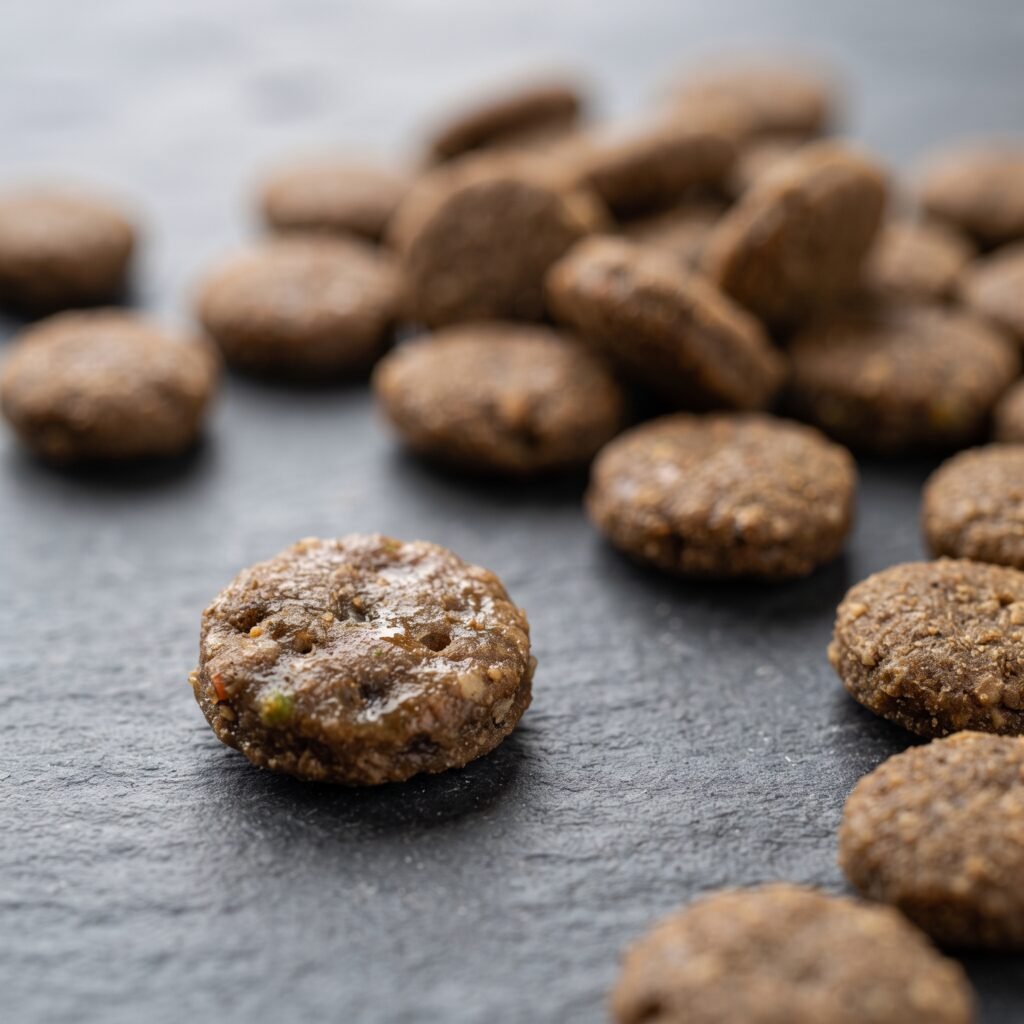
The pieces were flat discs, roughly 12mm across, noticeably lighter than the dense little cubes she’d been on. They had a fine, slightly oily coating that left residue on my fingers and a smell closer to roasted grain than to meat.
She ate the first bowl in about forty seconds. That’s when I bought a slow feeder, and the same meal started taking her four minutes.
The stool change took nine days to settle. Days three through five were genuinely unpleasant, which is normal for a transition and which almost nobody warns first-time owners about clearly enough.
That’s the kind of detail worth knowing before you pick a raza de perros. Every large breed transition looks roughly like this, and knowing it’s coming is the difference between riding it out and panic-switching foods.
Where This Approach Failed
I want to be straight about the limitation, because the cost-first method has a real hole in it.
In 2023 I helped a friend budget for a rescue — a Beagle mix, about 28 pounds, projected at roughly $45 a month on food. The arithmetic was sound and the breed profile suggested no special dietary requirements.
Within six weeks the dog had chronic loose stool that three food changes didn’t fix. We ended up on a veterinary limited-ingredient diet at nearly $110 a month, and stayed there.
The method failed because breed-level prediction says nothing about the individual animal. A raza de perros gives you a probability distribution, not a forecast, and a rescue dog with an unknown history sits at the wide end of it.
I now tell people to add a contingency of roughly 50% on top of whatever the breed math says, and to treat that as insurance rather than expected spend. For a shelter dog of unknown background I’d push it to 100%.
The other honest limitation: this framework says nothing about whether you’ll enjoy living with the dog. Cost is a constraint, not a criterion. A raza de perros you can afford and don’t suit is a worse outcome than an expensive one you love.
Which Raza de Perros Suits a Genuinely Tight Budget?
If food cost is your binding constraint, the shape of the answer is a small-to-medium dog with moderate energy and no known dietary fragility in the breed line.
That points toward breeds in the 15-to-30-pound range with low incidence of the digestive and orthopedic conditions that drive food costs upward. Not toward the smallest possible dog, because toy breeds bring dental and, in some lines, hepatic considerations that offset the volume savings.
Be careful with the very high-energy small breeds. A working-line Jack Russell can eat like a dog twice its size, and choosing that raza de perros for its footprint misreads the biology.
And be careful with mixed-breed assumptions. A rescue of unknown parentage is often the right ethical choice and the right emotional one, but it is not the low-variance financial choice, and pretending otherwise sets people up badly.
What About Feeding a Raza de Perros at Different Life Stages?
Growth is the expensive phase per pound of dog. Puppies need roughly double the calories per unit of body weight compared to adults, and the food itself is usually pricier.
The plateau is long. Adult maintenance runs from about one year — later for giant breeds, which mature more slowly — until somewhere in the last third of life.
Seniors are where cost can climb again. Reduced activity lowers calorie needs, but age-related conditions frequently push dogs onto therapeutic diets that cost two to three times a standard food.
Large breeds hit that phase earlier in absolute years, which compounds with their already-higher volume. It’s a genuine argument for building a reserve when you choose a giant raza de perros, rather than budgeting only for the steady state.
A Practical Sequence for Making the Decision
Write down your realistic monthly food ceiling first, before you look at a single raza de perros. People who do it in the other order rationalize upward every time.
Then use the calorie table above to find which weight and energy bands fit under it, with the 50% contingency included. This usually eliminates a tier you were emotionally attached to, which is uncomfortable and useful.
From the remaining candidates, filter on the bowl-side risks — growth calcium caps, bloat management, brachycephalic feeding — against your actual schedule and household.
Only then bring temperament, energy, and grooming back into the picture. You’ll be choosing among breeds you can actually sustain, which is a much better problem than the one most owners solve.
And check recall history for whatever food you land on before the dog arrives. It’s ten minutes and it occasionally changes the answer.
Does the Raza de Perros You Pick Change How Often You Have to Feed?
More than people expect, and it’s a scheduling cost rather than a money one.
Adult dogs of most breeds do fine on two meals a day. That’s the default, and if your chosen raza de perros falls into it, feeding fits around a normal working pattern without any special arrangement.
Three groups break that pattern. Toy breeds under about six pounds often need three or four small meals, particularly as puppies, because their glycogen reserves are small enough that long gaps carry a real hypoglycemia risk.
Deep-chested breeds need their daily volume split rather than delivered in one sitting, as part of standard bloat risk management. And any dog on a therapeutic diet for a metabolic condition may be on a fixed schedule that doesn’t bend around your calendar.
I underestimated this for years. It seemed like a minor logistical detail next to the money, and then I started hearing from owners who’d built their whole day around a midday feed and were quietly exhausted by it.
If you’re out of the house for nine or ten hours, that’s a genuine filter on which raza de perros works. An automatic feeder solves the mechanics for a healthy adult dog. It does not solve the supervision question for a giant breed at bloat risk, and I wouldn’t rely on one there.
Ask yourself who is home at 1pm on a Wednesday. The honest answer eliminates some breeds before cost ever enters the conversation.
Is Wet Food Ever the Cheaper Option for a Given Raza de Perros?
Almost never on a pure cost-per-calorie basis, but the comparison people run is usually wrong, so it’s worth doing properly.
Canned food is roughly 75 to 78% water. You’re paying to ship and store that water, which is why price per 1,000 calories typically lands two to four times higher than an equivalent-quality kibble.
For a toy raza de perros the absolute difference is small enough to be a genuine choice — going all-wet might add $15 to $25 a month, which many owners consider worth it for palatability or hydration. For anything above 50 pounds it’s a different order of magnitude entirely.
Feeding a Labrador exclusively on canned food can push the monthly figure past $250. I’ve had two readers do it and neither sustained it past a year.
The mixed approach is where most people land. A kibble base with a wet topper gets you the palatability benefit at a fraction of the cost, and for a fussy raza de perros it’s often the difference between a dog that eats and a dog you’re negotiating with every evening.
There is one case where wet genuinely earns its price. Dogs with poor water intake, certain urinary conditions, or dental limitations that make kibble difficult can do meaningfully better on it, and that’s a veterinary decision rather than a budget one.
Just don’t let the topper drift. It’s calories, it counts toward the daily total, and it’s the most common quiet cause of weight gain I see.
What Happens to the Budget When the Raza de Perros Gets a Diagnosis?
This is the scenario the breed math doesn’t cover, and it’s the one most likely to break a household budget.
Therapeutic diets for renal disease, gastrointestinal conditions, urinary stones, or diagnosed food allergies typically run two to three times the cost of a standard food of similar quality. They’re prescription products and they’re rarely discounted.
Scale that against body weight and the picture gets stark. A 12-pound dog moving onto a hydrolysed protein diet might see a $30 monthly increase. The same transition for a large raza de perros can add well over $100 a month, indefinitely.
Certain breeds carry elevated risk for exactly these conditions. Dalmatians have a well-known urate metabolism issue, German Shepherds see disproportionate rates of exocrine pancreatic insufficiency, and several small breeds are overrepresented for hepatic conditions requiring dietary management.
I’m deliberately not putting probabilities on those. Breed predisposition is real, published incidence figures vary widely by study population, and I’d rather you talk to a vet about your specific raza de perros than anchor on a number I can’t stand behind.
What I will say plainly: this is the strongest argument for pet insurance I know, and it’s specifically an argument for checking whether a policy covers prescription diets, because many don’t.
Build the possibility into your ceiling. If a therapeutic diet for your chosen raza de perros would be unaffordable, that’s information worth having in month zero rather than year six.
Reviewed for nutritional accuracy against current AAFCO Dog Food Nutrient Profiles and standard veterinary energy requirement calculations. Cost figures are original arithmetic at disclosed assumptions and are not manufacturer data. Last checked against the FDA animal food recall database prior to publication.
Frequently Asked Questions
What is the cheapest raza de perros to feed per month?
Toy breeds under 10 pounds are the cheapest raza de perros to feed by volume, typically running $12 to $20 monthly on a mid-range kibble. But factor in dental care, which is near-universal in small breeds and often exceeds the food savings over a lifetime.
How much does it cost to feed a large raza de perros per year?
A 70-to-80-pound raza de perros on a mid-range kibble runs roughly $1,100 to $1,250 a year at current prices, and a giant breed above 130 pounds pushes past $1,800. Both figures rise substantially if the dog moves to a therapeutic diet.
Is grain-free food better for any particular raza de perros?
There’s no evidence that grain-free is superior for any particular raza de perros, and the FDA has investigated a possible association between certain grain-free diets and dilated cardiomyopathy without establishing a causal link. Unless your vet has identified a specific grain sensitivity, it’s a premium you’re paying for marketing.
Can I feed adult food to a large-breed puppy to save money?
No. Adult formulas don’t meet growth requirements, and the calcium levels in general-purpose foods can exceed the safe ceiling for large-breed growth. This is one of the few places where saving money creates a genuine orthopedic risk.
How do I know if I’m overfeeding my dog?
Use body condition scoring rather than the bag’s feeding chart, whatever raza de perros you have. You should be able to feel ribs easily under a thin fat layer, see a waist from above, and see an abdominal tuck from the side — if you can’t, reduce portions by about 10% and reassess in three weeks.
The Bottom Line
Choosing a raza de perros on temperament alone is how people end up in a relationship they can’t fund. The bowl is the most predictable major cost in dog ownership and the one most determined by the breed decision itself.
Run the calorie math, convert to price per 1,000 calories, add the breed-specific requirements, then add contingency. That whole process takes under an hour.
Do it before the dog is home. The raza de perros you can genuinely sustain for twelve years is almost always the right one.