
Royal Canin Gastrointestinal: Which of the Four Formulas Does Your Dog Actually Need?
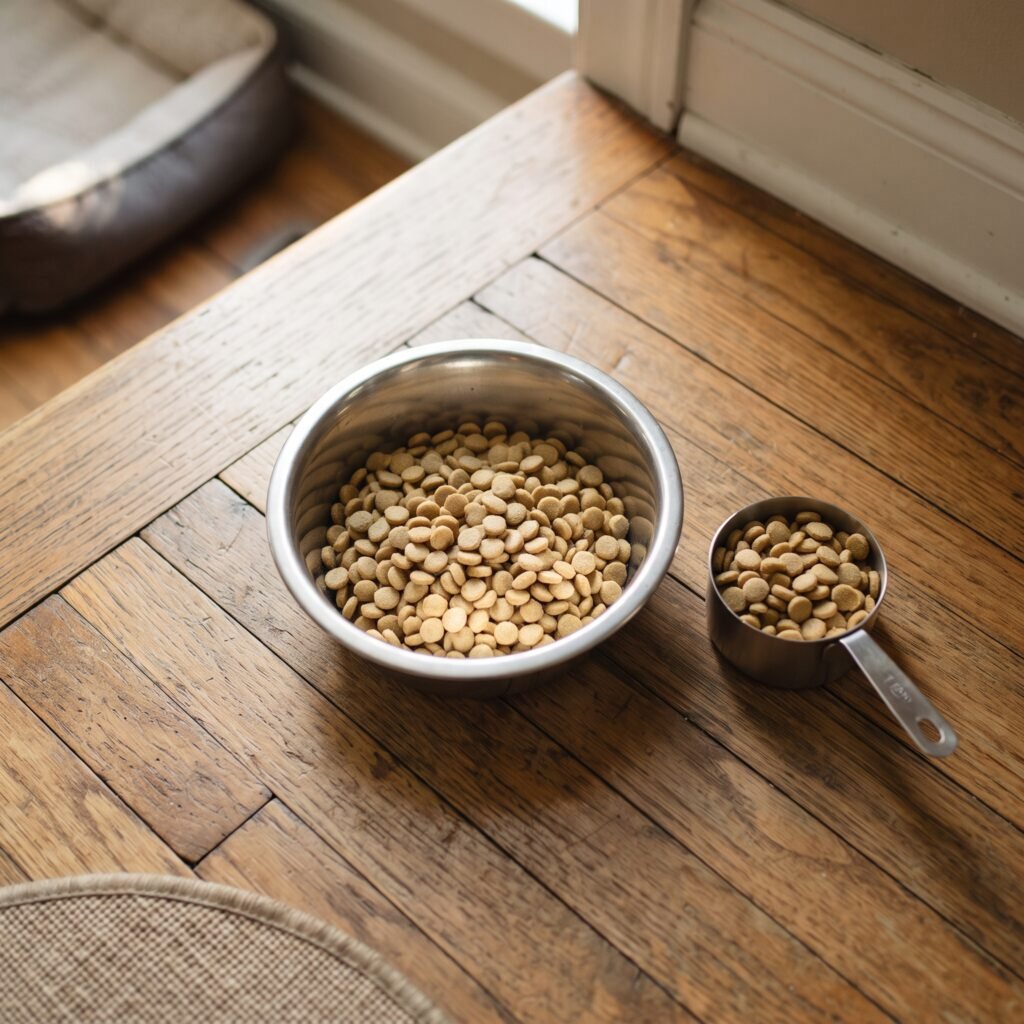
Quick answer: Royal Canin Gastrointestinal comes in four adult dry versions — standard, Low Fat, Moderate Calorie, and High Fiber — and they are not interchangeable. Standard runs about 46 grams of fat per 1,000 kcal; Low Fat can go as low as 16. Match the formula to the diagnosis, not the brand name, and confirm the choice with your vet.
Your vet handed you a slip that said “Royal Canin Gastrointestinal,” you typed it into a search bar, and four different bags came back. That’s where most people get stuck, and it’s a legitimate place to get stuck.
I’ve fed three of these four formulas across two dogs over the last several years — a 40-pound mixed-breed with a fat-triggered pancreatitis history and a 68-pound shepherd mix who gets stress colitis every time we board her. The bags look nearly identical. What’s inside them is not.
Recommended Products

Best Dog Food in 2026
Why “just get the Royal Canin Gastrointestinal” isn’t actually a complete instruction
Vets are busy. In a ten-minute recheck, “start Royal Canin Gastrointestinal” is shorthand for a decision they already made in their head — they know whether your dog needs fat restriction, fiber, or calorie density. That last mile just doesn’t always make it onto the discharge paper.
The problem is that the four formulas sit at genuinely different ends of the nutritional spectrum. Standard Royal Canin Gastrointestinal is a high-energy, moderate-to-high fat food built to pack calories into a small meal volume. Royal Canin Gastrointestinal Low Fat is its near-opposite.
Feed a fat-sensitive dog the standard bag and you can trigger the exact episode you were trying to prevent. Feed a skinny, recovering dog the Low Fat bag cup-for-cup and they lose weight, because you just cut their calories by roughly 37% without changing the scoop.
That second mistake is the one I made. More on it further down.
So the real question isn’t “is Royal Canin Gastrointestinal good?” It’s “which Royal Canin Gastrointestinal, at what volume, for how long, and what’s my signal to stop?”
What number should I actually be comparing?
Here’s the thing nobody tells you at the counter: percentages on the bag are close to useless for comparing therapeutic diets. Two foods can both say “9% fat” and deliver wildly different amounts of fat to your dog, because the food with more calories per cup means your dog eats fewer cups.
The number that matters clinically is grams of fat per 1,000 kilocalories. It normalizes for both moisture and calorie density, and it’s the unit veterinary nutritionists actually use when they say a diet is “low fat.”
The math is simple. Take the crude fat percentage, multiply by 10 to get grams per kilogram, then divide by the food’s kcal per kilogram expressed in thousands.
Royal Canin publishes both numbers on every product page, so you can run this yourself in about twenty seconds:
- Standard Royal Canin Gastrointestinal: 18% fat, 3,902 kcal/kg → 180 ÷ 3.902 = 46 g fat/1,000 kcal
- Royal Canin Gastrointestinal High Fiber: 14% fat, 3,334 kcal/kg → 140 ÷ 3.334 = 42 g/1,000 kcal
- Royal Canin Gastrointestinal Moderate Calorie: 9% fat, 3,427 kcal/kg → 90 ÷ 3.427 = 26 g/1,000 kcal
- Royal Canin Gastrointestinal Low Fat: 5–9% fat, 3,210 kcal/kg → 16–28 g/1,000 kcal
Veterinary nutrition references commonly describe canine diets under roughly 25 grams of fat per 1,000 kcal as fat-restricted, with ultra-low-fat protocols aiming lower still. Your vet may target a different number for your specific dog — ask them for it, in that unit.
The catch that trips up almost everyone
Look at that Low Fat range again. Why is it a range and not a number?
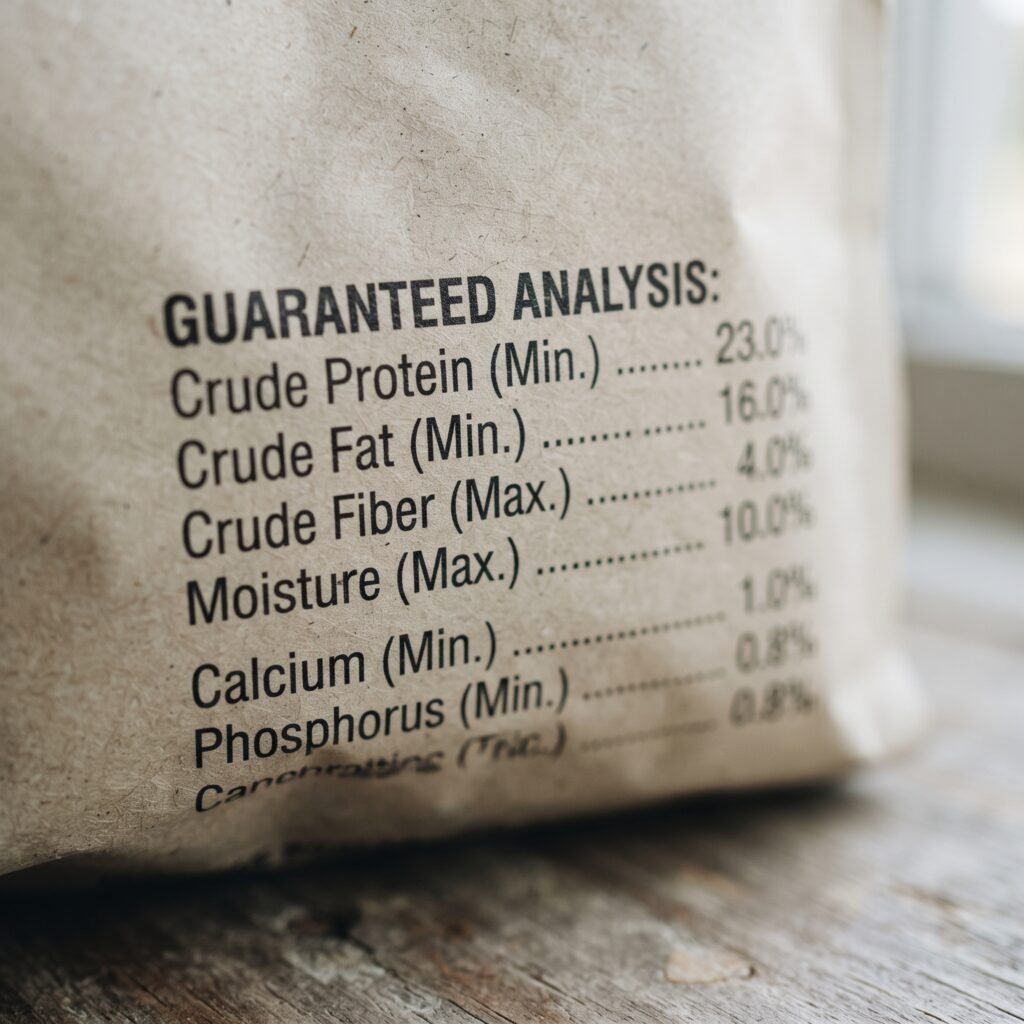
Because guaranteed analysis is a legal guarantee, not a recipe. A “minimum” means the food contains at least that much. A “maximum” means it contains no more than that.
Royal Canin Gastrointestinal Low Fat is the only one of the four that publishes a fat maximum (9%) alongside its minimum (5%). Every other formula in the Royal Canin Gastrointestinal line publishes only a minimum, which means the ceiling is unstated.
That matters more than it sounds. Moderate Calorie’s “minimum 9% fat” looks reassuringly close to Low Fat’s ceiling on paper — but a minimum tells you nothing about the actual batch value, and it is not a fat-restricted diet.
If your dog needs a specific fat ceiling, don’t infer it from the bag. Call Royal Canin’s veterinary line and request the typical analysis for the exact formula and bag size. They’ll give you the average, not the guarantee, and that’s the number to bring back to your vet.
[Image suggestion: close-up of a Royal Canin Gastrointestinal guaranteed analysis panel | Alt text: “Guaranteed analysis panel on a bag of Royal Canin Gastrointestinal Low Fat dry dog food”]
How do the four Royal Canin Gastrointestinal formulas compare on paper?
All figures below are as-fed from Royal Canin’s published US product data for the four adult dry Royal Canin Gastrointestinal dog food formulas. Dry matter (DM) values are calculated by removing the guaranteed moisture maximum. Fat-per-1,000-kcal is calculated from the guaranteed fat and the published calorie content.
| Gastrointestinal | GI Low Fat | GI Moderate Calorie | GI High Fiber | |
|---|---|---|---|---|
| Crude protein (min) | 23.0% | 20.0% | 21.0% | 21.0% |
| Crude fat | 18.0% (min) | 5.0% min / 9.0% max | 9.0% (min) | 14.0% (min) |
| Fat, dry matter basis | ~20.0% | ~5.6–10.1% | ~10.1% | ~15.6% |
| g fat / 1,000 kcal | ~46 | ~16–28 | ~26 | ~42 |
| Crude fiber | 3.7% (max) | 4.8% (max) | 4.0% (max) | 7.9% min / 13.3% max |
| EPA + DHA (min) | 0.24% | 0.08% | 0.22% | not stated on US panel |
| Calories | 3,902 kcal/kg · 394/cup | 3,210 kcal/kg · 247/cup | 3,427 kcal/kg · 305/cup | 3,334 kcal/kg · 287/cup |
| First ingredient | Chicken by-product meal | Brewers rice | Brewers rice flour | Chicken by-product meal |
| AAFCO statement | Adult maintenance | Adult maintenance | Adult maintenance | Adult maintenance |
Two things jump out of that table that I’d never have caught by reading the marketing copy.
First, the calorie spread is enormous. Standard Royal Canin Gastrointestinal delivers 394 kcal per cup; Low Fat delivers 247. Swapping one for the other without recalculating the portion changes your dog’s intake by more than a third in either direction.
Second, every single one of these is labeled for adult maintenance, not growth. That’s a real constraint if you have a puppy — I’ll come back to it.
Which Royal Canin Gastrointestinal formula fits which dog?
This section is where you match the food to the problem. None of it replaces your vet’s judgment, and all of it is worth reading before your next appointment so you can ask sharper questions.
Fat-sensitive dogs: pancreatitis, hyperlipidemia, lymphangiectasia
This is the Royal Canin Gastrointestinal Low Fat lane, and it’s the one where getting it wrong has real consequences.
Dogs with a pancreatitis history, elevated triglycerides, or protein-losing enteropathy typically need a hard fat ceiling — not “less fat than usual,” but a specific target your vet sets. Miniature Schnauzers deserve a special mention here, because the breed is disproportionately prone to hypertriglyceridemia and often lands on lifelong fat restriction.
Royal Canin Gastrointestinal Low Fat is the only formula in the line with a published fat maximum, which is exactly why it’s the one used for these cases.
Practical note: at 247 kcal per cup, this is a low-calorie-density food. A 50-pound dog on a maintenance requirement of roughly 900 kcal a day is eating about 3.6 cups. That’s a lot of volume, and some dogs with delayed gastric emptying do better split across three or four meals than two.
Acute diarrhea, recovery, and dogs who are losing weight
Standard Royal Canin Gastrointestinal exists for the opposite scenario: a dog who needs maximum nutrition in minimum volume while their gut is inflamed and their appetite is poor.
At 394 kcal per cup and 23% protein, it’s designed so a compromised gut has to process less material to get the same calories. Royal Canin describes it as roughly 14% higher in energy than the Moderate Calorie version for exactly this reason.
This is the bag for post-hospitalization, post-surgical convalescence, or a garbage-gut episode in an otherwise healthy dog. It’s usually a short-term tool, though plenty of dogs with chronic enteropathy stay on it long-term under supervision.
It is emphatically not the bag for a dog with a pancreatitis history, at 46 grams of fat per 1,000 kcal — roughly triple what a fat-restricted plan may call for.
Chronic soft stool, straining, and large-bowel signs
Royal Canin Gastrointestinal High Fiber is built around a fiber blend rather than fat manipulation — soluble and fermentable fibers to feed the microbiome, insoluble fibers to add bulk and normalize transit time. Psyllium seed husk shows up in the ingredient panel, and the guaranteed fiber range of 7.9% to 13.3% is the widest spread in the line.
This is the formula for large-bowel signs: mucus, fresh blood streaking, frequent small urgent stools, straining after the stool is out. My shepherd mix went on this after her third boarding-related colitis flare.
One caveat I wish I’d understood earlier: high-fiber diets can slightly reduce the digestibility of everything else in the bowl. In a dog who is already thin, that trade-off can go the wrong way. At 42 grams of fat per 1,000 kcal, it’s also not a fat-restricted option, which surprises people who assume “high fiber” implies “light.”
Overweight, spayed or neutered, or prone to gaining
Royal Canin Gastrointestinal Moderate Calorie is the compromise formula — about 12% fewer calories than the standard version, same digestive architecture.
It’s aimed at dogs who need GI support but would balloon on a high-energy diet. Think a neutered Lab with chronic soft stool who is already carrying two extra pounds, or a low-activity senior who still needs digestive support but no longer burns much. Royal Canin Gastrointestinal Moderate Calorie is also the one I’d look at for a dog who finished a course of the standard formula and is now creeping back up in weight.
At roughly 26 grams of fat per 1,000 kcal it sits in an interesting middle position — but remember, that’s calculated from a minimum. Don’t treat Moderate Calorie as a stealth low-fat diet.
What I actually noticed feeding it
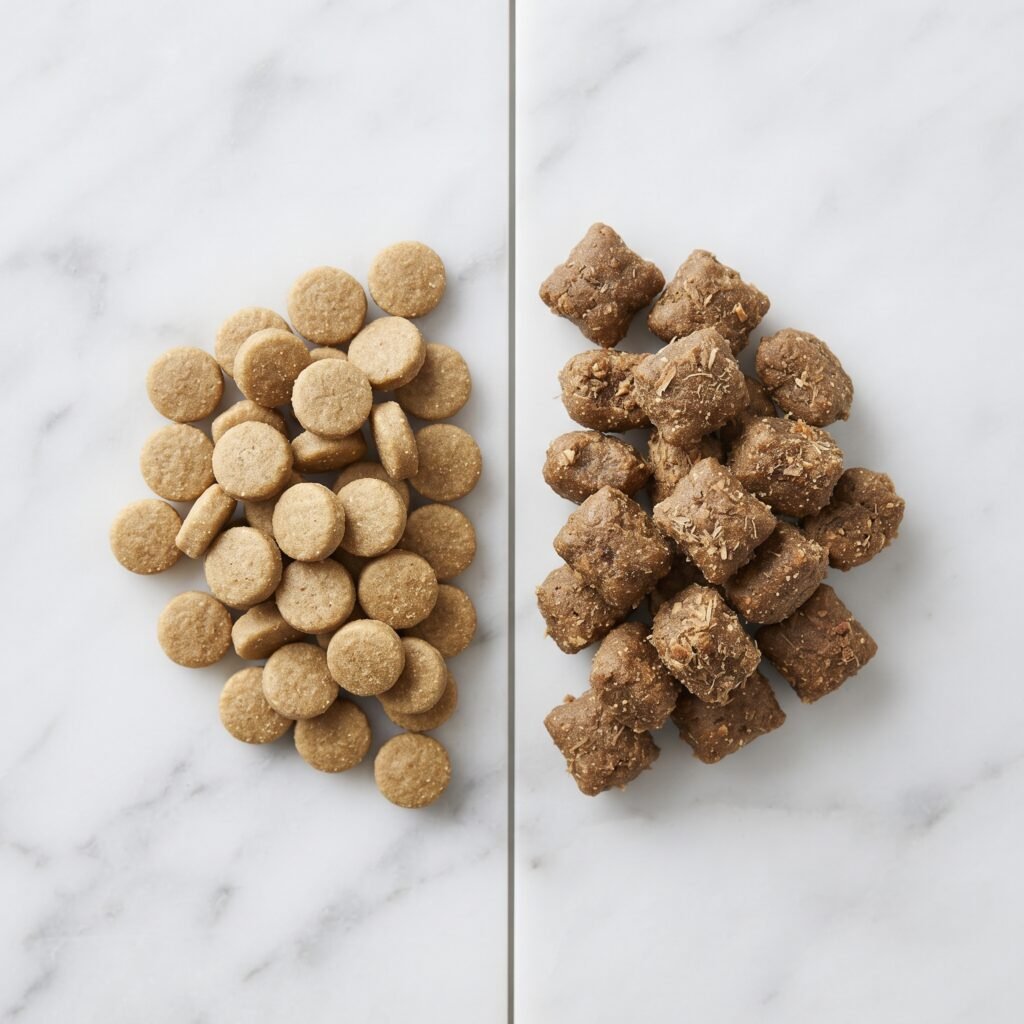
The kibble in Royal Canin Gastrointestinal Low Fat is a small, flattish disc — noticeably smaller than the standard formula’s rounder piece, and small enough that my 40-pounder inhaled a cup in under thirty seconds until I switched to a slow feeder. The High Fiber kibble is chunkier and slightly paler, with visible flecks from the fiber blend.
The smell is the thing that surprised me. Standard Royal Canin Gastrointestinal has a distinctly greasy, rendered-chicken smell that clings to your hands; the Low Fat version smells much fainter and more cereal-like, which tracks with brewers rice being its first ingredient rather than chicken by-product meal.
That difference matters for picky eaters. My pancreatitis dog took four days of mixing before he’d eat Royal Canin Gastrointestinal Low Fat alone, and he approached the bowl the way you’d approach a plate of unsalted rice — he ate it, but with no enthusiasm.
On stool quality, the change I could actually document was consistency and frequency. He went from three loose passes a day to two formed ones within about five days on Royal Canin Gastrointestinal Low Fat. That timeline is consistent with what most vets tell you to expect, and it’s the metric worth logging in your phone.
One more practical detail: this kibble is dense and it does not tolerate humidity well. I keep it in the original bag inside a bin rather than pouring it loose, because the fat and fish oil in these formulas will go rancid faster than you’d think once the bag is open and rolled down badly.
When Royal Canin Gastrointestinal didn’t work — and why
Here’s the honest failure, because it was mine.
When my shepherd mix’s colitis flared, I already had a half bag of Royal Canin Gastrointestinal Low Fat in the garage from the other dog. Same brand, same line, digestive food, why buy another bag. I fed it for two weeks.
Her stool got worse, not better. More frequent, more urgent, more mucus.
The reason is straightforward in hindsight: her problem was large-bowel, and Low Fat is a fat-restriction diet with a fiber maximum of 4.8% — nowhere near the fiber load her colon needed. She wasn’t fat-intolerant. I’d solved the wrong problem with the right brand.
Switching her to Royal Canin Gastrointestinal High Fiber resolved it inside a week. Same manufacturer, same shelf, completely different tool.
The second thing I got wrong: I swapped cup-for-cup. Going from a food she’d been eating at around 380 kcal a cup down to 247 kcal a cup meant she quietly lost weight over those two weeks while I was busy watching her stool.
Two lessons I’d hand to anyone starting a Royal Canin Gastrointestinal formula. Never assume the line is interchangeable, and always recalculate portions in calories, not cups, when you switch bags.
There’s also a category of dog for whom none of these work well: dogs whose problem is an adverse food reaction to a specific protein. This whole line is built around digestibility, not ingredient elimination — chicken by-product meal and egg product are right there in the panel. If your dog has a suspected chicken sensitivity, this whole line may be the wrong shelf entirely, and a hydrolyzed or novel-protein diet is the conversation to have.
How does Royal Canin Gastrointestinal compare to Hill’s i/d?
These two get cross-shopped constantly, usually because one is in stock and the other isn’t. Royal Canin Gastrointestinal vs Hill’s i/d is broadly a comparison of intent rather than category — both are highly digestible therapeutic diets — but the details differ enough that a straight swap deserves a phone call.
| Royal Canin Gastrointestinal Low Fat | Hill’s Prescription Diet i/d Low Fat | |
|---|---|---|
| Crude protein (min) | 20.0% | 20.0% |
| Crude fat | 5.0% min / 9.0% max | 6.0% (min); ~7.7% typical dry matter |
| Crude fiber (max) | 4.8% | 5.0% |
| Omega-3s | EPA + DHA min 0.08% | Total omega-3 min 0.60% |
| Calories per cup | 247 kcal | 333 kcal |
| First ingredient | Brewers rice | Brewers rice |
| Fiber technology | Psyllium husk, beet pulp, FOS | Pecan shells, beet pulp, citrus pulp |
| Substantiation | Formulated to AAFCO profiles | AAFCO feeding trial |
The difference I’d flag hardest is the calorie gap: 247 versus 333 kcal per cup. Swap those two cup-for-cup and you’ve changed your dog’s daily calories by about 35%.
The substantiation line is also worth knowing. Hill’s substantiates i/d Low Fat through an AAFCO feeding trial, while Royal Canin Gastrointestinal formulas are substantiated by formulation to AAFCO nutrient profiles. Both are legitimate routes under AAFCO; a feeding trial is the more demanding of the two.
Palatability is the wild card and nobody can predict it for your dog. Anecdotally, both brands have dogs who refuse them and dogs who love them. If you’re switching for stock reasons, ask your clinic for a small bag or a few cans first.
One more thing worth checking before you commit to Hill’s i/d or the Royal Canin equivalent: kibble shape. The i/d dry food is a flat disc, and Hill’s makes a Small Bites version for dogs who struggle with it, which is a real consideration for toy breeds and brachycephalic dogs who bolt their food.

How long should a dog stay on Royal Canin Gastrointestinal?
This is the question I get asked most, and the honest answer is that it splits cleanly into two cases.
For an acute episode — dietary indiscretion, a bout of gastroenteritis, post-op recovery — the diet is often a short-term tool measured in one to three weeks, then a gradual transition back. Royal Canin’s own guidance for the acute-recovery version is measured in weeks, not months.
For chronic conditions — recurring pancreatitis, hyperlipidemia, chronic enteropathy, IBD — Royal Canin Gastrointestinal formulas are commonly fed indefinitely, and all four adult dry versions are formulated to meet AAFCO nutrient profiles for adult maintenance, so they’re complete for long-term feeding in adult dogs.
The exit, when there is one, should be slower than the entry. I use a 10-day step-down rather than the standard 7, because the dogs I’ve done this with are exactly the dogs who react badly to abrupt change.
Don’t decide the endpoint yourself. Ask your vet at the outset: “What am I watching for that tells me we can start transitioning off, and what’s my trigger to call you instead?” Getting that answer on day one saves a lot of guessing on day forty.
Do I need a prescription, and what does it really cost?
In the US, Royal Canin Gastrointestinal dog food is sold as a veterinary-exclusive diet. Retailers won’t ship it until they receive authorization from your vet — it isn’t a controlled substance, but the vet-authorization gate is real and applies at every legitimate seller.
On cost, skip the sticker price and calculate cost per day. It’s the only comparison that survives across bag sizes and retailers, and you can do it with the calorie figures above.
A 22-pound bag of standard Royal Canin Gastrointestinal holds roughly 10 kg × 3,902 kcal/kg ≈ 39,000 kcal. A 40-pound dog eating about 1,000 kcal a day gets around 39 days from that bag. Divide whatever you paid by 39 and you have your real number.
Run the same math on the 28.6-pound bag of Royal Canin Gastrointestinal Low Fat — roughly 13 kg × 3,210 kcal/kg ≈ 41,600 kcal — and the picture often shifts, because the bigger bag partially offsets the lower calorie density.
Two ways to genuinely reduce the cost. Buy the largest bag your dog will finish within about six weeks of opening, and check whether your clinic price-matches, since many do rather than lose the refill.
One thing I would not do is stretch the food by mixing in cheaper kibble. The therapeutic effect of a fat-restricted diet is a whole-diet effect; a cup of regular food dropped into a low-fat plan can undo the entire fat ceiling you’re paying for.
What side effects should I actually watch for?
Most dogs transition onto this line without drama, but the side effects that do show up are worth separating into “expected” and “call the clinic.”
Expected in the first week: a temporary increase in gas, a change in stool color toward lighter tan or beige, and slightly larger stool volume on the High Fiber version. Increased thirst on a high-fiber diet is also normal, since fiber pulls water into the gut.
I’d add one that surprised me: my shepherd mix’s coat looked slightly duller for about three weeks after the switch, then recovered. Coats respond to dietary fat, and a drop in fat intake can show up in the fur before it shows up anywhere else.
Also normal: initial food refusal, especially with the Low Fat formula. Slower transitions help more than warming the food does.
The side effects worth a call: vomiting that starts or worsens after the switch, stool that becomes bloody or black and tarry, ongoing weight loss, or lethargy. None of these are things to wait out for two weeks to see if the food “kicks in.”
And if you’re 10 days in with no improvement at all, that’s information — usually that the formula doesn’t match the problem, exactly as happened with my colitis dog.
How this article was put together
Every nutrient value, calorie figure, and ingredient list here was pulled from Royal Canin’s published US product pages for the four adult dry Royal Canin Gastrointestinal formulas, cross-checked against the guaranteed analysis panels listed by major authorized retailers. Where the two disagreed, I used the manufacturer’s own page.
Dry matter and grams-per-1,000-kcal values are my own calculations from those published figures, shown above so you can verify the arithmetic yourself. They reflect guaranteed minimums and maximums, not typical batch analysis — which is precisely why I recommend requesting the typical analysis directly from Royal Canin for fat-critical cases.
I checked AAFCO nutritional adequacy statements on each product page individually rather than assuming consistency across the line, and I checked current recall listings before publication. Feeding observations are my own, across two dogs, and are described as observations rather than evidence.
Reviewed for factual accuracy against manufacturer technical data. This article is educational and does not replace veterinary advice; therapeutic diets should be selected and monitored by your own veterinarian. [Veterinary reviewer credit to be inserted.]
[Image suggestion: side-by-side kibble comparison shot | Alt text: “Kibble size and shape comparison between Royal Canin Gastrointestinal Low Fat and High Fiber formulas”]
Frequently asked questions
Can I buy Royal Canin Gastrointestinal without a prescription?
Not from a legitimate US retailer. Royal Canin Gastrointestinal dog food is veterinary-exclusive, and authorized sellers hold the order until they receive authorization from your veterinarian. If a site offers to ship it with no vet contact at all, treat that as a warning sign about the seller.
How long does Royal Canin Gastrointestinal take to work?
Most owners see stool changes within three to seven days, and that’s the window I’ve observed with both of my dogs. If there’s no meaningful change by day 10, the issue is usually formula selection rather than the food needing more time — that’s a conversation with your vet, not a reason to wait longer.
Is Royal Canin Gastrointestinal Low Fat low enough for pancreatitis?
It depends entirely on the fat target your vet sets for your dog. The guaranteed range works out to roughly 16 to 28 grams of fat per 1,000 kcal, which is a wide band, so ask Royal Canin for the typical analysis and bring that specific number to your vet rather than relying on the word “low fat” on the bag.
Can puppies eat Royal Canin Gastrointestinal?
The four adult dry formulas are formulated for adult maintenance, not growth, so they don’t meet a growing puppy’s nutrient requirements for long-term feeding. Royal Canin makes a dedicated puppy version of the Royal Canin Gastrointestinal line for exactly this reason — ask your vet for it specifically rather than substituting the adult bag.
Why is my dog’s stool still soft on Royal Canin Gastrointestinal?
The three most common reasons are the wrong formula for the problem, portions that are simply too large, or something else still in the bowl. Treats, dental chews, table scraps, and flavored medications all break a therapeutic diet — for a proper trial, the Royal Canin Gastrointestinal formula and water need to be the only things going in.
The bottom line
Royal Canin Gastrointestinal isn’t one food, it’s four decisions wearing the same logo. The brand name on the discharge paper is the easy part; the formula, the portion in calories, and the exit plan are where the actual work is.
Before you order, do three things. Get the specific formula name from your vet in writing, run the grams-of-fat-per-1,000-kcal math on the bag you’re considering, and convert your dog’s current portion into calories so the switch doesn’t quietly change how much they’re eating.
Do that, and the shelf of near-identical bags stops being confusing and starts being a set of tools you’re using on purpose.