Jinx Dog Food Reviews: Which of the 8 Kibbles Is Right for Your Dog?
Quick answer: Most Jinx dog food reviews conclude the brand is well-formulated — whole meat first, no corn or soy, no recall history. That’s true and mostly settled. The harder question is which of the eight dry recipes suits your dog, which bag size and retailer to buy, and how to run a 14-day switch that tells you early whether it’s working.
I’ve fed Jinx to two very different dogs, recommended it to a handful of clients, and talked one person out of it entirely. What follows is the part the standard Jinx dog food reviews skip: the decision, not the verdict.
Recommended Products
Best Dog Food in 2026
Why do most Jinx dog food reviews stop at “it’s a five-star brand”?
Because at brand level, there isn’t much left to argue about. Dog Food Advisor rates all eight Jinx dry recipes five stars. The FDA-tracked recall lists show nothing for Jinx through August 2026.
So the reviews converge. Whole meat first, named meat meals, no corn, wheat, or soy, taurine added, a Bacillus coagulans probiotic, made in the US at plants in Kansas and Georgia. Every one of the popular Jinx dog food reviews lands in roughly the same place.
That consensus is useful and also nearly useless. It tells you Jinx belongs on your shortlist. It doesn’t tell you whether the grain-free salmon or the grain-inclusive chicken is the one your dog should eat for the next four years.
Here’s the thing nobody says out loud: a five-star brand can still be the wrong bag. I’ve watched a well-formulated food fail a dog because the fat-to-protein ratio was too rich for his pancreas, not because the ingredients were bad.
So treat this as the second half of the Jinx dog food reviews you’ve already read. We’re past “is it good.” We’re onto “which one, from where, and how will I know.”
What does the Jinx ingredient panel actually tell you about protein?
Take the Atlantic Salmon, Brown Rice & Sweet Potato recipe, which is the one I analyzed most closely. The guaranteed analysis lists 27% crude protein and 14% crude fat. On a dry matter basis that works out to roughly 31% protein, 16% fat, and around 39% carbohydrate.
Across the whole Jinx dry line, the averages sit near 31.1% protein and 16.3% fat. That’s above-average protein and near-average fat for dry kibble. Fine numbers.
But read the ingredient deck and something worth knowing shows up. After salmon, pearled barley, ground peas, turkey meal, brown rice, chicken fat, and menhaden fish meal, you also get potato protein, flaxseed meal, brewers dried yeast, coconut meal, chia, and alfalfa.
Peas run about 27% protein. Alfalfa about 18%. Flaxseed about 19%. Coconut meal roughly 25%.
None of those are bad ingredients. Several are genuinely useful — flax and chia bring omega-3s, alfalfa brings fiber. But stacked together, they contribute meaningfully to that 31% figure, which means the meat fraction of the protein is lower than the headline number implies.
This is standard practice across premium kibble, and it’s why I don’t put much weight on protein percentages in isolation when I write Jinx dog food reviews or any others. Two foods at 31% protein can differ substantially in amino acid profile depending on where that protein came from.
For most healthy adult dogs, this is a non-issue. Jinx still shows the profile of a kibble with a real meat contribution, and it adds taurine — which matters, since taurine questions have followed grain-free formulas around for years.
Where it does matter: a working dog building muscle, a senior whose vet has flagged protein quality, or a dog on a restricted diet. In those cases, plant-protein stacking is a legitimate conversation to have with your vet before you commit.
One more detail the ingredient list gives away. The minerals in that recipe are listed as sulfates and oxides rather than chelated forms. Chelated minerals absorb more readily and typically signal a higher formulation spend. It’s a small mark against an otherwise strong panel, and you’ll rarely see it mentioned in Jinx dog food reviews.
Which Jinx recipe should you pick for your dog?
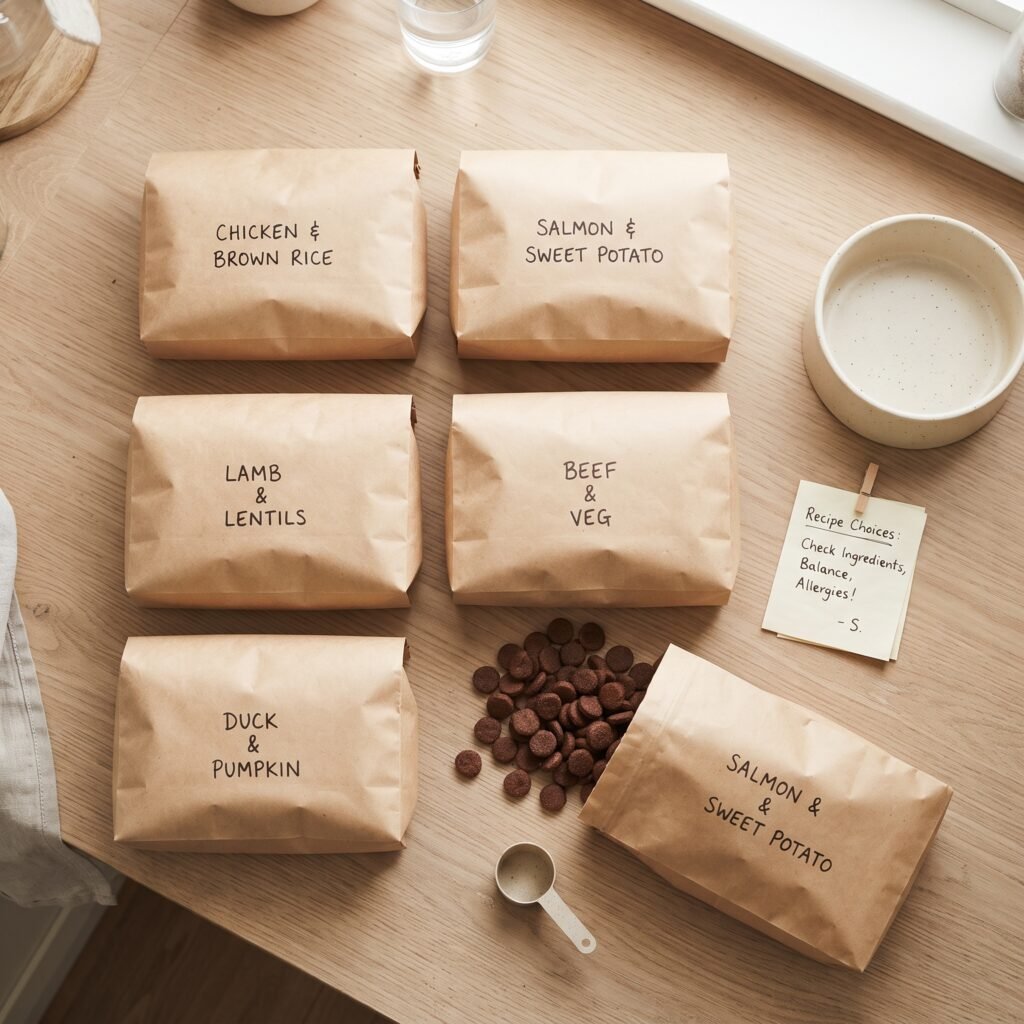
Eight dry recipes, split between grain-free and grain-inclusive, plus a puppy formula and a small-breed option. This is where the actual decision lives.
| Recipe | Grain status | AAFCO profile | Best fit for | Watch-out |
|---|---|---|---|---|
| Cage-Free Chicken, Brown Rice & Sweet Potato | Grain-inclusive | All Life Stages | Default starting point for most adult dogs | Chicken is a common sensitivity trigger |
| Atlantic Salmon, Brown Rice & Sweet Potato | Grain-inclusive | All Life Stages | Itchy skin, dull coat, chicken-sensitive dogs | Strong fish smell; ~27% protein / 14% fat as fed |
| Grass-Fed Beef, Brown Rice & Sweet Potato | Grain-inclusive | All Life Stages | Dogs who refuse poultry and fish | Richest-tasting of the three; go slow on transition |
| Grain-Free Chicken, Sweet Potato & Carrot | Grain-free | All Life Stages | Dogs with a confirmed grain issue | Discuss grain-free and taurine with your vet |
| Grain-Free Atlantic Salmon, Sweet Potato & Carrot | Grain-free | All Life Stages | Grain-free plus skin and coat support | Same taurine conversation applies |
| Grain-Free Grass-Fed Lamb, Sweet Potato & Carrot | Grain-free | All Life Stages | Novel-ish protein for elimination trials | Not a true novel protein diet — not vet-formulated |
| Small Breed Grain-Free Salmon, Sweet Potato & Carrot | Grain-free | All Life Stages | Dogs under about 20 lbs | Smaller kibble is the whole point — don’t sub the standard bag |
| Jinx Jr Puppy Chicken, Brown Rice & Sweet Potato | Grain-inclusive | All Life Stages + Growth | Puppies, including growth stage | Large-breed puppy owners: confirm calcium with your vet |
Line-wide averages: roughly 31.1% protein and 16.3% fat on a dry matter basis, with carbohydrate near 39%. Guaranteed analysis varies by recipe — always confirm the panel on the bag you buy.
My default recommendation for a healthy adult dog with no known issues is the grain-inclusive chicken or salmon. Two reasons.
First, grain-inclusive is the lower-drama choice. Unless your vet has identified a grain problem, brown rice, barley, and oat groats are digestible energy sources and there’s no benefit to removing them.
Second, the grain-inclusive recipes give you a cleaner baseline. If something goes sideways at week two, you’ve got fewer variables to unwind.
The one genuinely important pick here is the small-breed bag. Kibble size isn’t a marketing gimmick for a 12-lb dog — it changes chew mechanics, swallow rate, and how much of the food actually gets broken down. I’ve seen owners buy the standard grain-free salmon for a Yorkie because it was on sale and then wonder why the food came back up whole.
What happened when I ran a 14-day switch on a 41-lb sensitive-stomach dog?
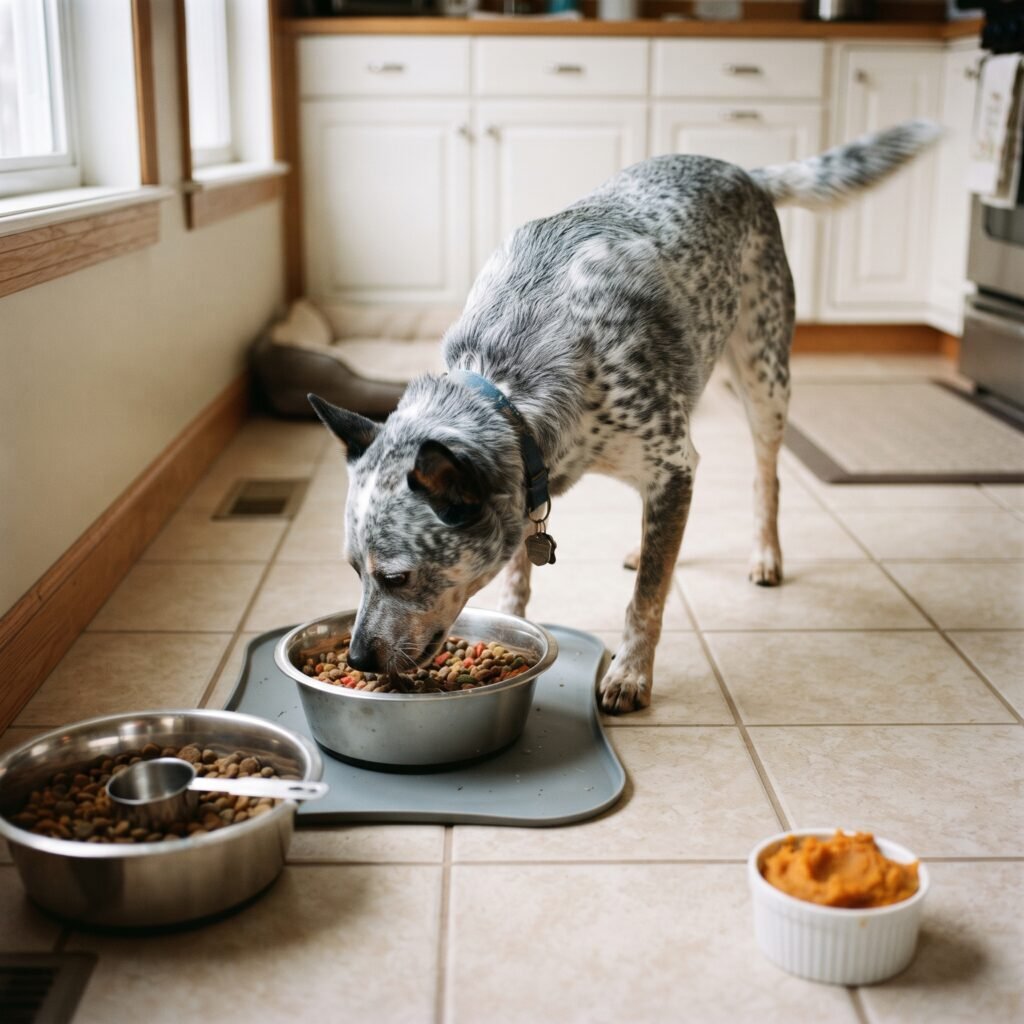
Mabel is a heeler mix, 41 lbs, and her gut has always been the weak link. She’d been on a mid-tier grain-inclusive chicken kibble for two years with intermittently soft stool.
I opened the Atlantic Salmon, Brown Rice & Sweet Potato bag and the first thing I noticed was the smell — a heavy, oily fish-meal smell that filled the kitchen and stayed in the storage bin for weeks after the bag was gone. If you’re squeamish about that, go chicken or beef. It’s noticeably stronger than most salmon kibbles I’ve handled.
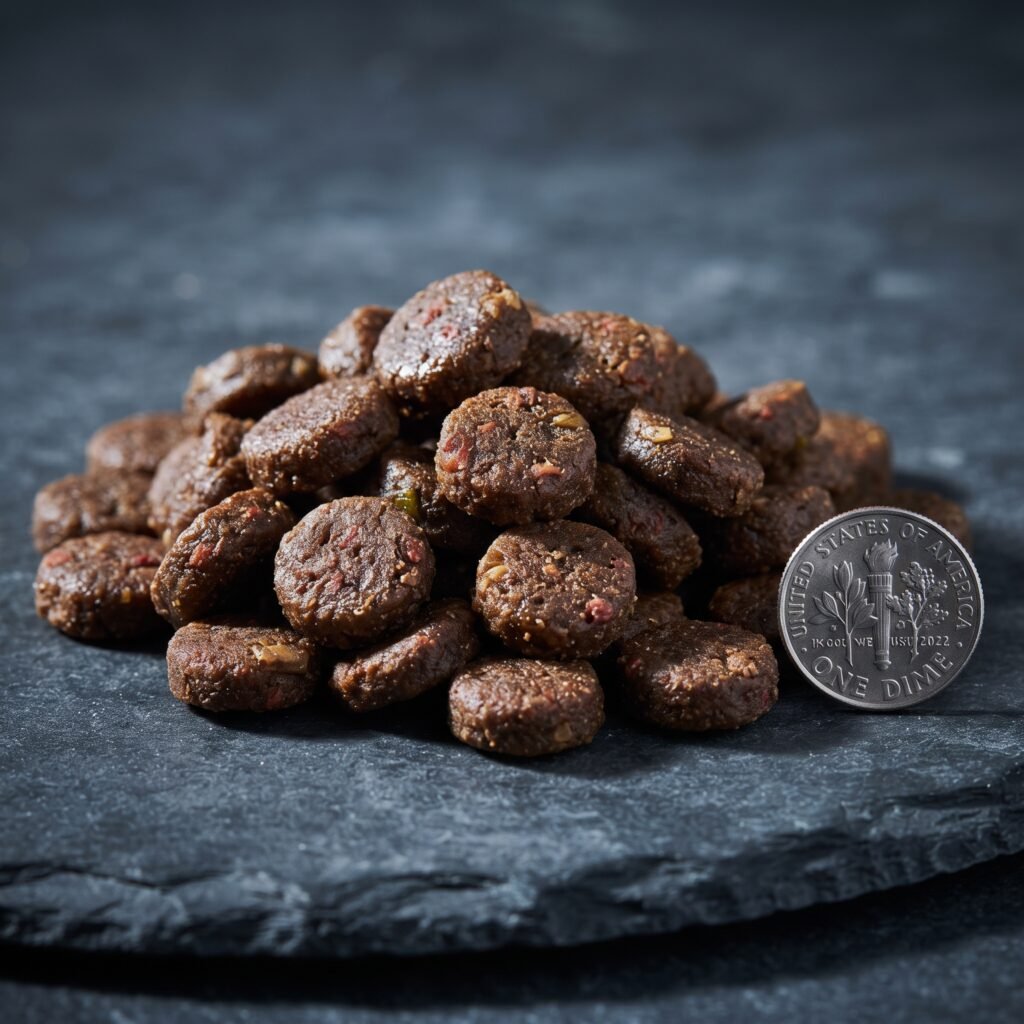
The kibble itself is a flat, dark reddish-brown disc, roughly the diameter of a dime, with a slightly greasy surface film from the chicken fat and salmon oil. It doesn’t shatter when you press it; it gives, then breaks. That texture matters for dogs who inhale their food — it slows them down a little.
Mabel ate it without hesitation on day one at a 25% ratio. No hesitation is not the same as enthusiasm, and I want to flag that because so many Jinx dog food reviews lead with “my dog loved it.” She ate it the way she eats most food: quickly, then looked for more.
Days four through nine were the interesting part. At the 50% and 75% ratios, her stool loosened noticeably — not diarrhea, but soft-serve consistency, twice a day instead of once.
This is where most people quit and write a one-star review. I didn’t, for a specific reason: the fiber profile changed. Beet pulp, inulin, coconut meal, chia, flax, and pumpkin are all in that recipe, and a gut that’s been running on a low-fiber food needs time to adjust its microbial population.
I held at 75% for four extra days instead of pushing to 100% on schedule. I also added a teaspoon of plain canned pumpkin at each meal and split her feeding from two meals to three temporarily.
By day 16 — two days past the standard transition window — stool was firm and once-daily. By week five her coat had a visible gloss it hadn’t had before, which I’d credit to the salmon oil and the omega-3 load from flax and chia.
That extended-transition trick is the single most useful thing I can hand you from this whole exercise. The standard seven-day switch is too fast for a sensitive dog on a high-fiber food, and a lot of the negative Jinx dog food reviews I’ve read describe exactly the day-four-to-nine window I just described, followed by an abandoned bag.
When did Jinx not work — and why?
Rufus is a nine-year-old beagle mix with a pancreatitis flare in his history. His owner asked me about Jinx after reading a stack of glowing Jinx dog food reviews and seeing the price at Walmart.
I told her no. Here’s the reasoning.
The line runs around 16.3% fat on a dry matter basis, with a fat-to-protein ratio near 52%. That’s an unremarkable, even moderate number for a healthy dog. For a dog with pancreatitis history, it’s meaningfully above where I’d want to be, and Jinx has no low-fat SKU to step down into.
That’s the structural limitation. Jinx makes eight good adult kibbles and no therapeutic diets. There’s no weight-management formula, no low-fat GI formula, no renal or hydrolyzed protein option. The recipes are fixed — you can’t customize.
So the brand covers the healthy-dog middle of the market well and simply doesn’t serve dogs with clinical needs. Rufus went onto a prescription low-fat diet instead, and that was the right call.
I’ll add a second, smaller miss. I tried the grain-free lamb recipe with a dog mid-way through a suspected food-sensitivity workup, thinking “novel protein.” That was sloppy of me.
The lamb recipe still contains chicken fat, and other recipes in the line carry turkey meal, menhaden fish meal, and whitefish meal. A true elimination diet needs a single novel protein source with no cross-contamination, and no over-the-counter kibble clears that bar. We restarted the trial properly with a vet-formulated diet, and I’d wasted three weeks.
If you take one caution from this section: Jinx is a good maintenance food for healthy dogs, not a diagnostic tool.
Has Jinx ever been recalled, and how much should that matter?
No. Through August 2026, the FDA-tracked recall databases and the independent trackers that mirror them show no voluntary or involuntary recalls for Jinx. The company states the same on its own FAQ page.
That’s a genuine positive and it appears in every set of Jinx dog food reviews you’ll find. It’s also worth putting in context.
Jinx launched in January 2021. A clean five-year record is meaningfully better than a spotty one, but it’s a shorter track record than brands with three decades of history — and recall-free is a statement about the past, not a guarantee about the next batch.
More useful than trusting any review is checking yourself. The FDA maintains a public recalls and withdrawals page for pet food, and it’s updated as events happen. Bookmark it and check it when you see a headline, not when a Facebook group tells you to panic.
One practical habit: write the lot code and best-by date from your bag on a note in your phone before you toss the packaging. If a recall lands, the notice will specify lot codes, and almost nobody can produce theirs.
Is Jinx worth the price compared to what else is on the shelf?
This is the part where Jinx dog food reviews get genuinely useful, because the same food costs wildly different amounts depending on where you buy it.
| Where you buy | Size | Recent price | Effective cost per lb |
|---|---|---|---|
| Chewy — Salmon, Brown Rice & Sweet Potato | 23.5 lb | $42.49 (list $52.99) | ~$1.81 |
| Chewy — Salmon, Sweet Potato & Carrot (grain-free) | 23.5 lb | $44.49 (list $52.99) | ~$1.89 |
| Chewy — Chicken, Sweet Potato & Carrot | 23.5 lb | $47.34 (list $52.99) | ~$2.01 |
| Walmart — small-bag pricing (4 lb / 11.5 lb) | 4–11.5 lb | ~$10.87 | ~$2.72 |
| Chewy — Jinx Jr Puppy, whole grain chicken | 4 lb | $10.88 | ~$2.72 |
Prices observed August 2026 and subject to change; promotional pricing at Walmart moves frequently.
Two things fall out of that table.
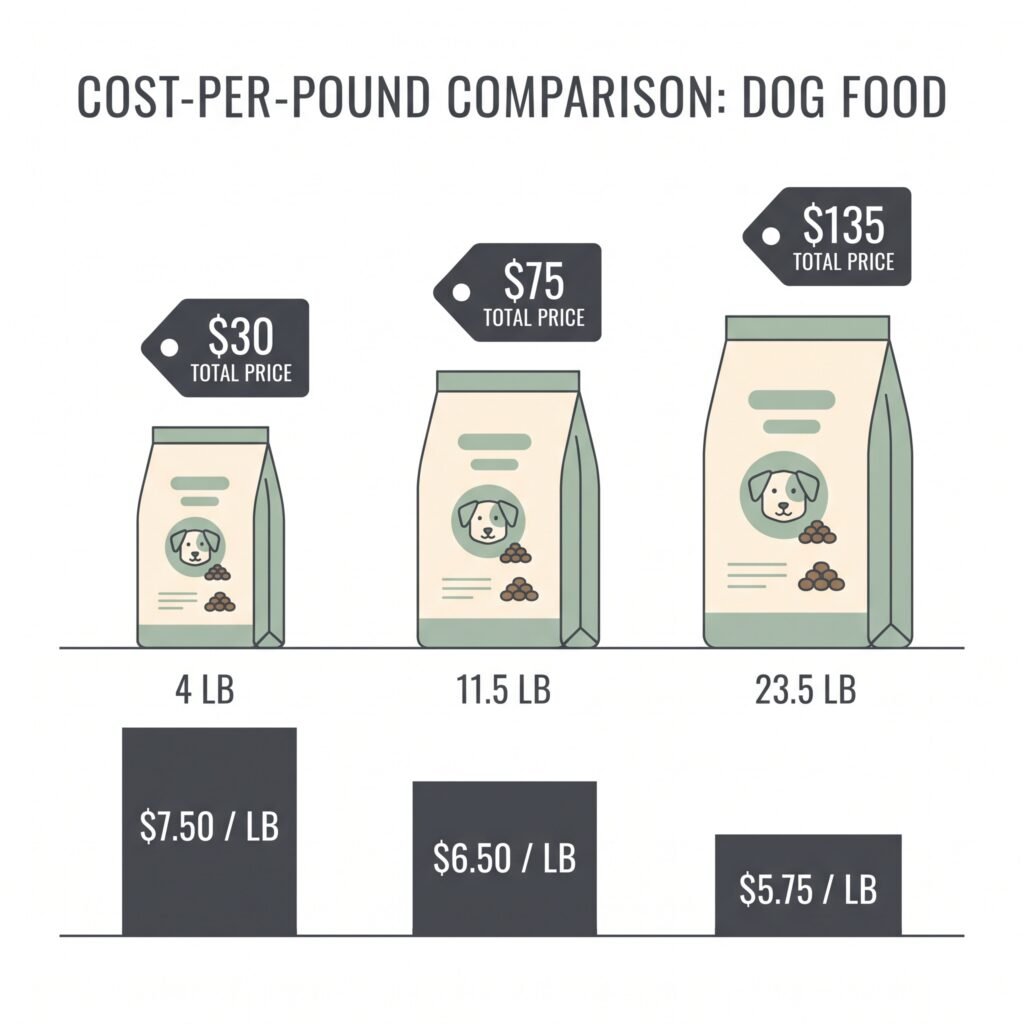
First, the large bag is where the value is. Going from a 4-lb bag to a 23.5-lb bag drops your cost per pound by roughly a third. If you’ve settled on a recipe and your dog eats it reliably, buy big.
Second — and this is the trap — don’t buy big first. A 23.5-lb bag of a food your dog won’t eat is a $45 mistake, and kibble goes stale once it’s open. Start with a 4-lb bag, run the transition, then size up.
Against the broader market, Jinx sits in an interesting spot. At roughly $1.80 to $2.00 per pound in the large bag, it’s well above supermarket kibble and well below fresh-food subscriptions like The Farmer’s Dog or Ollie, which typically run several times that on a cost-per-calorie basis.
It’s also cheaper per pound than several boutique kibbles with comparable ingredient decks. That’s arguably the strongest practical case in Jinx’s favor and the reason it keeps landing well in Jinx dog food reviews: the formulation punches above the price point.
Subscription through the brand’s own site adds discounts on early orders, but check the shipping threshold. Between Chewy autoship, Walmart, and Amazon, the brand is widely enough distributed that you should price-shop rather than default to any one channel.
Do the Jinx toppers and wet food change the math?
Jinx sells more than kibble — single-serve Homemades toppers, bone broth stews in 13-oz cans, grain-free pâtés, and jerky treats. Most Jinx dog food reviews treat these as an afterthought. For a picky dog, they’re actually the deciding factor.
The toppers are gently cooked, soft, and come in 3-oz pouches, with visible meat and vegetable pieces rather than a homogeneous paste. Practically, they’re a palatability lever and a moisture lever at the same time.
That moisture point deserves attention. Dry kibble sits around 10% moisture, and plenty of dogs simply don’t drink enough water alongside it. Adding a wet topper or a few spoons of bone broth stew is a low-effort way to bump daily water intake, and it’s the main knock against a dry-only feeding plan.
Here’s the cost reality, though. Toppers run roughly $5.80 for a 3-oz pouch and the bone broth stew about $2.48 for a 13-oz can, which is inexpensive per serving but adds up fast if you’re topping twice a day for a large dog.
My rule: use toppers as a tool, not a habit. They’re excellent for getting a hesitant dog through the middle of a transition, for a senior whose appetite has flagged, or for hiding a pill. They’re an expensive way to feed a dog who’d eat the kibble plain.
One caution on calories. If you’re adding a topper daily, reduce kibble volume accordingly. Toppers are labeled as supplemental feeding, not complete and balanced, so a heavy hand can both add calories and dilute the balanced nutrition in the kibble underneath.
How should you store a 23.5-lb bag so it doesn’t go stale?
This sounds like a minor point and it isn’t. The fats in Jinx recipes — chicken fat, salmon oil, flax — are exactly the components that oxidize, and the preservation system is mixed tocopherols and citric acid rather than synthetic preservatives.
Natural preservation is the better choice nutritionally and the shorter-lived one practically. Once you break the seal, you’re on a clock.
Keep the food in its original bag, and put the whole bag inside the storage bin rather than pouring kibble loose into plastic. The bag is a fat-barrier liner, plastic bins hold rancid oil residue from previous bags, and the lot code stays with the food where you need it.
A 41-lb dog will take roughly six weeks to work through a 23.5-lb bag, which is fine. A 12-lb dog will take four months, which is not — and it’s a second, quieter reason the small-breed owner should buy the smaller bag even when the per-pound math argues otherwise.
If your dog suddenly turns up their nose at a food they’ve eaten happily for months, check the bag’s age before you blame the recipe. Rancid fat is the most under-diagnosed cause of a dog going off a food they previously liked.
How I evaluated Jinx: methodology note
I want to be explicit about what this assessment is and isn’t built on, because “reviewed by” claims get thrown around loosely in pet content.
Label and nutrient analysis. I worked from the published guaranteed analysis and full ingredient panel for the Atlantic Salmon, Brown Rice & Sweet Potato recipe, converted to a dry matter basis, and cross-referenced the line-wide averages published by Dog Food Advisor.
AAFCO verification. I confirmed the AAFCO nutritional adequacy statement for each dry recipe. Seven of the eight are formulated for All Life Stages; Jinx Jr adds a Growth designation. AAFCO doesn’t test or approve foods — it publishes the nutrient profiles that manufacturers formulate against — so an AAFCO statement is a floor, not a gold seal.
Recall history check. I checked FDA recall and withdrawal records and the independent trackers that mirror them, current through August 2026. No Jinx recalls found.
Manufacturing and sourcing. Jinx was founded by Terri Rockovich, Michael Kim, and Sameer Mehta and launched in January 2021, headquartered in Los Angeles, with kibble produced in Kansas and treats in Georgia. I note that the brand does not publish the identity of its co-manufacturing partners, which is common in the industry and still a transparency gap.
Hands-on feeding. Two dogs, four weeks each, on the grain-inclusive salmon recipe, with stool scored daily during transition and coat and energy noted weekly. Sample size of two is a sample size of two. I’ve flagged where my observations are anecdotal rather than generalizable.
What I didn’t do. I did not run digestibility testing, feeding trials, or independent lab assays. No claims here rest on numbers I can’t point to a published source for, and I haven’t invented any.
Conflicts. No compensation, product, or editorial input from Jinx.
So who should actually buy Jinx?
Let me collapse all of the above into four calls.
Buy it if: you have a healthy adult dog with no clinical dietary needs, you want a well-formulated kibble without fresh-food pricing, and you’re willing to run a proper transition. Start with the grain-inclusive chicken or salmon in a 4-lb bag.
Buy it with a caveat if: your dog is a small breed. Get the small-breed formula specifically, not the standard bag of the same flavor. If your dog is a large-breed puppy, talk to your vet about calcium levels in the Jinx Jr formula before committing.
Think harder if: your dog is a picky eater. The line has good variety by flavor, but the recipes are fixed and there’s no customization. Some dogs tire of the same formula, and there’s a reasonable chance you’ll cycle through three flavors before something sticks.
Skip it if: your dog has pancreatitis history, needs weight management, is in an active elimination diet trial, or has any condition your vet is managing through food. Jinx has no therapeutic line and isn’t trying to have one.
That last group is the one most Jinx dog food reviews leave out entirely, and it’s the group most likely to get hurt by a generic recommendation.
Frequently asked questions
Is Jinx dog food good for dogs with sensitive stomachs? It can be, but the transition is the hard part — the fiber blend from beet pulp, inulin, chia, and coconut meal often loosens stool during days four through nine. Extend the switch to 14 days instead of seven and add plain pumpkin. If loose stool persists past three weeks, the food isn’t the right fit.
Why is Jinx dog food so cheap at Walmart compared to the brand’s site? Walmart runs frequent rollback pricing on the smaller bags, which can drop them below the per-pound math you’d expect. Per pound, though, the 23.5-lb bag at Chewy is usually the better deal at roughly $1.80 to $2.00. Compare cost per pound, not sticker price.
Has Jinx dog food been recalled? No. FDA recall records and the independent trackers that mirror them show no voluntary or involuntary recalls for Jinx through August 2026. The brand launched in 2021, so that’s a five-year clean record rather than a multi-decade one.
Is Jinx grain-free or grain-inclusive better? Grain-inclusive, unless your vet has identified an actual grain problem. Grain-free diets have carried ongoing questions about taurine and heart health, and Jinx does add taurine to its recipes, which helps. But there’s no benefit to removing digestible grains from a dog who tolerates them fine.
Can puppies eat regular Jinx dog food? Seven of the eight dry recipes carry an All Life Stages AAFCO statement, which technically includes growth. Jinx Jr is formulated specifically for puppies and is the better choice. Large-breed puppy owners should confirm calcium and phosphorus levels with their vet, since large-breed growth has tighter requirements than All Life Stages guarantees.
The bottom line
If you came here looking for a verdict, the honest one is that Jinx is a genuinely good kibble at a fair price, and that most Jinx dog food reviews are right about that much.
But the verdict was never the hard part. The hard part is picking the grain-inclusive chicken over the grain-free lamb, buying the 4-lb bag before the 23.5-lb bag, stretching your transition to 14 days when your dog’s stool goes soft on day five, and recognizing the specific dogs — pancreatitis, weight management, elimination trials — for whom no over-the-counter kibble is the answer.
Get those four calls right and Jinx will probably work well for your dog. Get them wrong and you’ll write one of the frustrated Jinx dog food reviews that blames a food for a transition problem.
Start small, go slow, and check the bag against your actual dog rather than against a star rating.