
4health Dog Food: Choosing the Right Line When You're Cutting the Food Budget

Short answer: If you’re moving off a premium bag to save money, match the function your old food was performing, not the price tag. Most healthy adult dogs do well on 4health dog food in the Wholesome Grains line. Dogs with skin or gut issues need the Special Care line — and some dogs shouldn’t make the switch at all.
That paragraph will get you 80% of the way there. The remaining 20% is where people lose money, and it’s the part almost every 4health dog food review skips.
Here’s the situation I see constantly. Someone has been feeding a $90 bag for two years. Money gets tight. They walk into Tractor Supply, see 4health dog food at roughly half the cost per pound, and grab whichever bag has a picture of a dog that looks like theirs. Three weeks later they’re at the vet with a soft-stool dog and a $180 bill, and they’ve concluded that cheap food is bad food.
That’s usually the wrong conclusion. The switch failed because of how it was made, not what it was made to.
Recommended Products

Best Dog Food in 2026
What are you actually giving up when you switch to 4health dog food?
Start by identifying what your current food was doing. This is the single step most people skip.
Premium bags carry a price premium for a handful of reasons, and only some of them transfer to your dog’s body. Small-batch manufacturing, novel proteins, veterinary formulation, and clinical feeding trials cost real money. Marketing spend, boutique packaging, and a direct-to-consumer subscription model also cost real money — and buy your dog nothing.
4health dog food is manufactured by Diamond Pet Foods, the same contract manufacturer behind Taste of the Wild, Kirkland Signature, and Diamond Naturals. It is sold exclusively through Tractor Supply and Petsense locations. The exclusivity is the point: no distributor margin, no national ad campaign, no shelf-space fees at a national grocery chain.
So the honest framing is this. Switching to 4health dog food usually costs you formulation sophistication and ingredient-tier specificity. It rarely costs you basic nutritional adequacy.
Which means the real question — is 4health dog food good for dogs coming off a pricier bag? — has no single answer. It depends entirely on which dog, and on which line you land on.
Every 4health recipe carries an AAFCO nutritional adequacy statement. AAFCO doesn’t approve or certify individual foods — it publishes the nutrient profiles that state feed regulators enforce. A bag that says it meets the AAFCO Dog Food Nutrient Profiles for maintenance is making a legally meaningful claim.
Where it gets interesting is the gap between “adequate” and “right for this specific dog.” That gap is the whole article.
Which 4health dog food line should you actually land on?
The 4health dog food catalog splits into five meaningful groups. They are not interchangeable, and picking wrong is where the money gets wasted.
4health with Wholesome Grains
This is the default 4health dog food line and the one most people should start with. Real meat first, plus brown rice, cracked pearled barley, and grain sorghum. Chicken & Rice, Beef & Rice, Lamb & Rice, and Salmon & Potato are the core adult recipes.
The adult formulas carry 300 mg/kg glucosamine hydrochloride and 100 mg/kg chondroitin sulfate. They’re taurine-fortified and include guaranteed live probiotic cultures. Standard bag is 45 lb, with a 5 lb size for trialing.
If your dog is a healthy adult with no chronic issues, this is the line. Stop reading the rest of the catalog.
4health Grain Free
The 4health grain free dog food range takes the same protein-forward approach, with peas, lentils, chickpeas, and potato replacing the cereal grains. Sweet potato appears in several recipes.
Here’s my honest position: unless your vet identified a specific grain sensitivity, or your dog demonstrably improved on grain-free and regressed on grain-inclusive, this line solves a problem most dogs don’t have. It also tends to run $4–$8 more per bag. Paying extra for a solution to a non-problem is a strange move when you’re cutting the food budget.
More on the DCM question further down, because it deserves nuance rather than a scare paragraph.
4health Special Care
This is the 4health dog food line people should reach for more often and reach for less. Sensitive Skin & Coat and Sensitive Stomach recipes, plus Healthy Weight and Small Bites options.
Salmon & Potato Sensitive Skin runs a fish-forward profile with elevated omega-3s. The Sensitive Stomach recipes lean on simpler protein sourcing and added prebiotic fiber. If your old premium bag was a limited-ingredient or dermatology-adjacent formula, this is your landing zone — not Wholesome Grains.
4health Large Breed + Mobility
Worth calling out separately because of one number. The Large Breed + Mobility Chicken & Rice recipe carries 1,200 mg/kg of glucosamine — four times the standard adult level.
For a 90 lb Shepherd or a Mastiff carrying joint load, that’s a genuinely meaningful difference and one of the better values in the 4health dog food catalog. Joint supplements bought separately cost $25–$40 a month.
4health Shreds and Untamed
Shreds launched in January 2025: crunchy kibble blended with soft protein shreds, in Chicken & Rice, Beef & Rice, and Lamb & Rice, formulated for adult dogs with zinc, selenium, vitamin E, glucosamine, chondroitin, probiotics, and prebiotic fiber. Bags run 5, 18, and 35 lb, with the 35 lb priced under $55 at launch.
This is the texture play. If your dog was on a premium food with freeze-dried inclusions or a wet topper, Shreds is the closest analog in the 4health dog food range. Untamed is the higher-protein sub-range and is the one line where sourcing is listed differently on the retailer’s site — check the bag if country of origin matters to you.
How do the 4health dog food lines compare on paper?
| Wholesome Grains Adult | Grain Free Adult | Special Care Sensitive | Large Breed + Mobility | Shreds Adult | |
|---|---|---|---|---|---|
| First ingredient | Real meat (chicken/beef/lamb) | Real meat | Salmon or lamb | Real chicken | Real meat |
| Carbohydrate base | Brown rice, barley, sorghum | Peas, lentils, chickpeas, potato | Potato, rice (recipe-dependent) | Brown rice, barley | Rice |
| Glucosamine HCl | 300 mg/kg | 300 mg/kg | 300 mg/kg | 1,200 mg/kg | Present (level varies) |
| Chondroitin sulfate | 100 mg/kg | 100 mg/kg | 100 mg/kg | Elevated | Present |
| Taurine-fortified | Yes | Yes | Yes | Yes | Yes |
| Guaranteed probiotics | Yes | Yes | Yes | Yes | Yes |
| Common bag size | 45 lb | 35 lb | 30–35 lb | 45 lb | 5 / 18 / 35 lb |
| Typical shelf price band | $$ | $$$ | $$$ | $$ | $$$ |
| Best fit | Healthy adult, no issues | Vet-identified grain sensitivity | Skin/gut history | 70 lb+ or joint load | Picky eater, texture-driven |
Two notes on reading this table honestly.
Guaranteed analysis percentages move. Manufacturers reformulate, ingredient availability shifts, and a protein number printed in a review two years ago may not match the bag in your cart. Read the panel in front of you.
Price bands vary by region and by whether you’re buying on a Neighbor’s Club promotion. The relative ordering holds; the absolute numbers won’t.
How much does 4health dog food actually save you per day?
This is the calculation nobody runs, and it’s the only one that determines whether the switch was worth it.
Let me show my arithmetic with a 55 lb moderately active dog eating roughly 3 cups a day.
Dry kibble runs about 4 oz per standard measuring cup, so a 45 lb bag holds roughly 180 cups. At 3 cups a day, that bag lasts about 60 days.
| Premium bag | 4health Wholesome Grains | |
|---|---|---|
| Bag size | 24 lb | 45 lb |
| Approximate price | $89 | $52 |
| Cups per bag (~4 oz/cup) | ~96 | ~180 |
| Days at 3 cups/day | 32 | 60 |
| Cost per day | ~$2.78 | ~$0.87 |
| Cost per year | ~$1,015 | ~$318 |
That’s roughly $697 a year on one dog. On two large dogs, the 4health dog food savings cross $1,300.
Now the part that changes the math. If the switch produces two extra vet visits at $95 each plus a course of prescription GI food at $75, you’ve burned $265 of that $697 in the first quarter. Do it badly a second time and the savings collapse.
The cost of switching to 4health dog food is not the bag price. It’s the bag price plus the transition risk. That’s why the next section matters more than the comparison table.
Is 4health dog food grain free worth choosing over the grain-inclusive line?
Here’s where I’ll be more careful than most reviews.
In 2018 the FDA opened an investigation into reports of dilated cardiomyopathy in dogs eating grain-free diets, many of them high in peas, lentils, and other legumes. The agency published updates through 2019. In 2022 it stated it did not intend to release further public updates absent meaningful new scientific information, and it has consistently said a causal link was not established.
So: not proven, not dismissed. That’s the accurate summary, and it’s an uncomfortable place to make a decision from.
What I do with that uncertainty is practical. If a dog has no grain sensitivity and no clinical reason to avoid cereal grains, I don’t see the argument for choosing 4health grain free dog food over the grain-inclusive line. You’d be paying more to take on an unresolved question for no identified benefit.
If a dog does have a documented grain issue — genuinely documented, via elimination diet or vet workup, not “the internet said grains are bad” — then 4health grain free dog food is a reasonable option, and the taurine fortification across the range is a point in its favor.
The muddy middle is dogs whose owners think grains are the problem. Nine times out of ten the trigger is a protein, not a grain. Chicken is the most common food allergen in dogs; grains rank well below it. Switching from chicken-and-rice to chicken-and-lentils and expecting improvement is a very common and very expensive mistake.
What do the 4health dog food ingredients actually tell you?
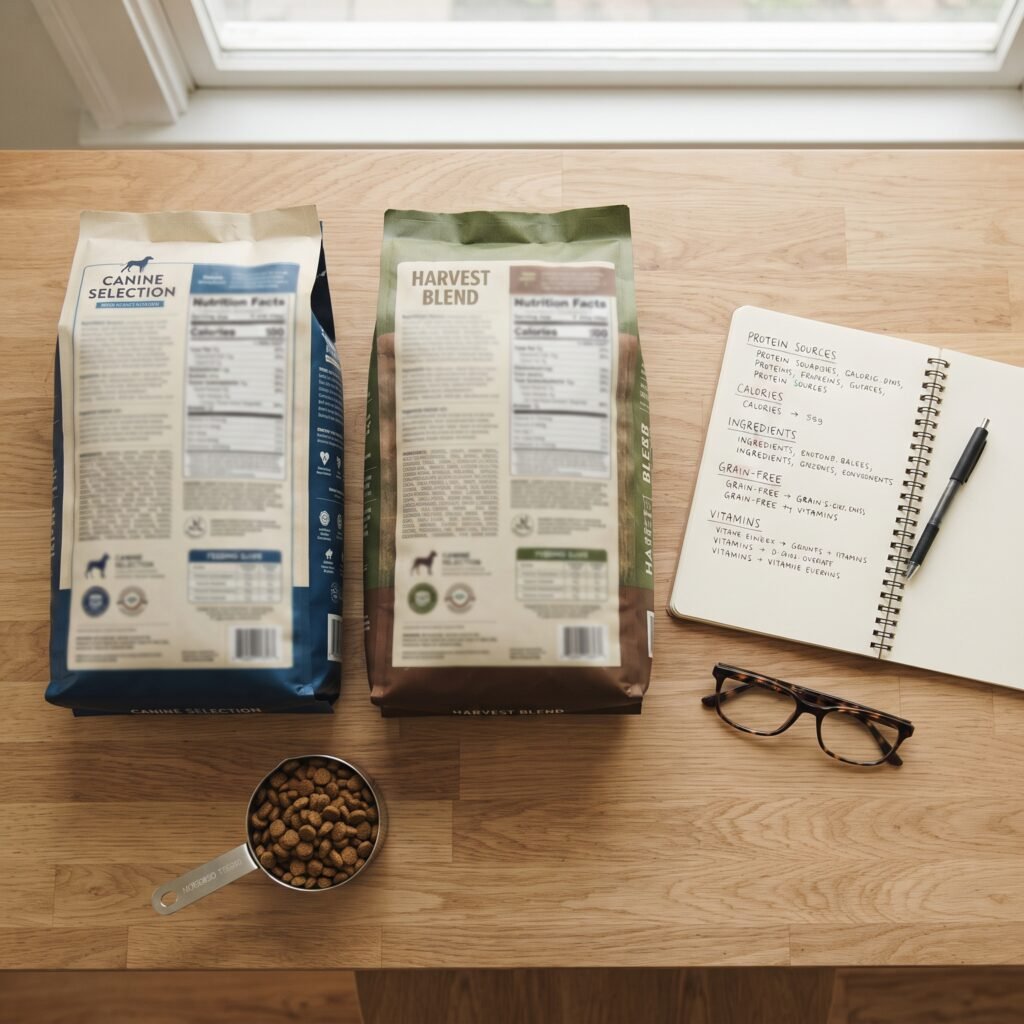
Reading a panel is a skill, and the skill is knowing which parts are informative.
Ingredient order is by pre-cooking weight. “Chicken” listed first sounds better than “chicken meal” first, but fresh chicken is roughly 70% water. After extrusion, a meal ingredient often contributes more actual protein. When you see real meat first and a named meal in the top five, that’s the stronger structure.
Named sources beat generic ones. “Chicken fat” tells you something. “Animal fat” tells you less. 4health dog food ingredients generally use named sources, which is one of the reasons the brand punches above its price point.
Watch the split. If peas, pea protein, pea fiber, and pea starch all appear separately, they’d rank higher combined than any one entry suggests. This is legal and common across the industry, not unique to any brand — but it’s worth spotting when you’re evaluating a grain-free recipe.
The guarantee panel is more useful than the ingredient list. Protein, fat, fiber, moisture, plus the specific guarantees for glucosamine, chondroitin, omega fatty acids, and probiotic cultures. Those numbers are enforceable. Ingredient marketing isn’t.
One thing I appreciate about the 4health dog food packaging: the glucosamine and chondroitin levels are stated in mg/kg rather than buried as “contains glucosamine.” That specificity lets you actually compare the Large Breed + Mobility recipe against the standard adult line and see the 4x difference.
How I evaluated this (methodology)
Transparency about what this 4health dog food review is and isn’t.
Ingredient and guarantee review. I read the current 4health dog food ingredients and guarantee panels on the Tractor Supply product listings for the core adult recipes across Wholesome Grains, Grain Free, Special Care, and Large Breed, plus the Shreds launch specifications.
AAFCO cross-check. Every recipe was checked for a nutritional adequacy statement and the life stage it claims. AAFCO minimums for adult maintenance sit at 18% crude protein and 5.5% crude fat on a dry matter basis; growth and reproduction require 22.5% and 8.5%. Large-breed growth formulas carry an additional calcium ceiling — 1.8% dry matter maximum — which matters enormously for puppies over an expected 70 lb adult weight.
Recall history check. FDA recall records and Diamond Pet Foods’ own recall disclosures, covering the full brand history rather than the last twelve months.
Hands-on feeding. Multi-week trials rather than three-day taste tests, with stool quality logged daily. Three-day trials tell you about palatability and nothing about tolerance.
What this is not: a clinical study, a lab analysis, or veterinary advice for your individual dog. If your dog has a diagnosed condition, your vet’s recommendation outranks anything on this site.
What does 4health dog food actually look and smell like?
Specifics, because “dogs love it” is a useless sentence.
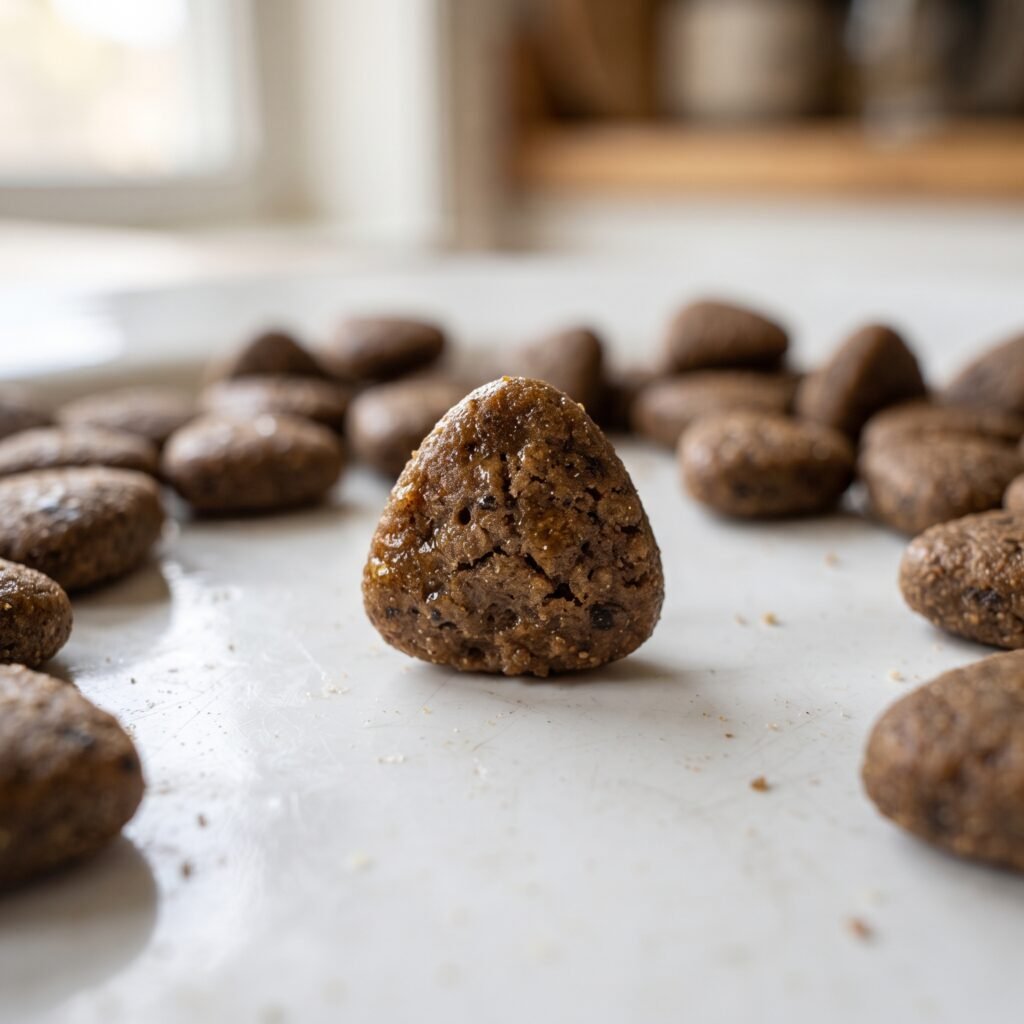
The Wholesome Grains Chicken & Rice kibble runs about 11–12 mm across — a slightly irregular rounded triangle, noticeably larger than most small-breed formulas and about on par with mainstream adult kibble. It’s dense. A cup of it feels heavier in the hand than the airier premium kibbles I’ve compared it against.
The smell is mild and slightly toasty. Not the sharp fish-oil hit you get from salmon-forward premium foods, and not the sweetish grain smell of grocery-tier bags. There’s a light oil film on the kibble that transfers to your fingers — that’s the fat coating applied post-extrusion, and it’s normal.
The Sensitive Skin & Coat salmon recipe is a different animal entirely. Stronger fish smell, oilier surface, and the kibble is a touch smaller. If you’re sensitive to fish odor in your kitchen, decant it into a sealed container.
Bag quality is worth a mention because it’s a real-world annoyance. The 45 lb bags don’t reseal well. Buy a bin.
When did 4health dog food not work?
The trust-building part, and the reason I don’t recommend this brand universally.
A 9-year-old Beagle mix, roughly 28 lb, with a long history of intermittent soft stool and a previous pancreatitis episode. She’d been stable for eighteen months on a prescription low-fat GI diet at about $105 a month. Her owner’s hours got cut and the food budget had to come down.
We moved her to 4health Special Care Sensitive Stomach over a careful 14-day transition. Days one through eight were fine. Day nine, stool quality dropped. Day eleven, she vomited overnight. We pulled the switch and went back.
Here’s the failure analysis. The prescription diet wasn’t doing “sensitive stomach” work in the general sense — it was doing fat restriction work, holding fat well below what a standard sensitive-stomach recipe carries. The 4health dog food we chose was formulated for general digestive tolerance, not for a pancreatitis history. Those are different problems that share a shelf label.
That was my error, not the food’s. The 4health dog food line performed exactly as designed. I’d matched a marketing category instead of matching the clinical function.
The lesson generalizes. If your current food is a therapeutic diet — prescription, veterinary-exclusive, or formulated around a specific restriction like fat, protein hydrolysis, phosphorus, or purines — no retail brand is a substitute, and that includes every line of 4health dog food. Ask your vet whether a lower-cost therapeutic option exists instead.
For that Beagle, the workable answer turned out to be staying on the prescription diet and cutting costs elsewhere: buying the largest bag size, using a manufacturer rebate program, and eliminating the $40 a month in treats that were doing nothing for her.
What about the 4health dog food recall history?
Worth knowing, worth keeping in proportion — and the 4health dog food recall record is more nuanced than either the brand’s defenders or its critics tend to present it.
The significant event was in 2012. Diamond Pet Foods’ Gaston, South Carolina facility was linked to Salmonella Infantis contamination, and the recall expanded across multiple brands manufactured there — Diamond, Diamond Naturals, Taste of the Wild, Kirkland Signature, Canidae, Natural Balance, Solid Gold, and 4health among them. The CDC ultimately documented 16 human infections across nine states and Canada. All 4health package sizes and formulas within the affected production window were pulled. Diamond voluntarily suspended production at the facility and an FDA inspection cited handling and sampling deficiencies.
In 2013, a low-thiamine recall affected certain dry cat formulas across Premium Edge, Diamond Naturals, and 4health. That one was cat food, not dog food, but it’s part of the manufacturer’s record.
Two honest takeaways.
First, a 4health dog food recall is not a brand-specific risk — it’s a facility risk shared with every brand co-manufactured at the same plant. If a Diamond plant has a problem, ten-plus brands have a problem simultaneously, including several that cost three times as much. Buying premium doesn’t automatically buy you out of that exposure.
Second, the 2012 event is over a decade old and the corrective actions were documented. A brand with a clean record for a decade following a serious event is a different proposition than a brand with recurring incidents.
What I’d actually recommend: check the FDA’s pet food recall page before any large bulk purchase rather than trusting the publication date on a 4health dog food review, including this one. Photograph the production code and best-by date on the bag when you open it. During the 2012 recall, the single most common problem owners had was that they’d thrown away the bag and couldn’t identify their lot.
How should you run the transition to 4health dog food?
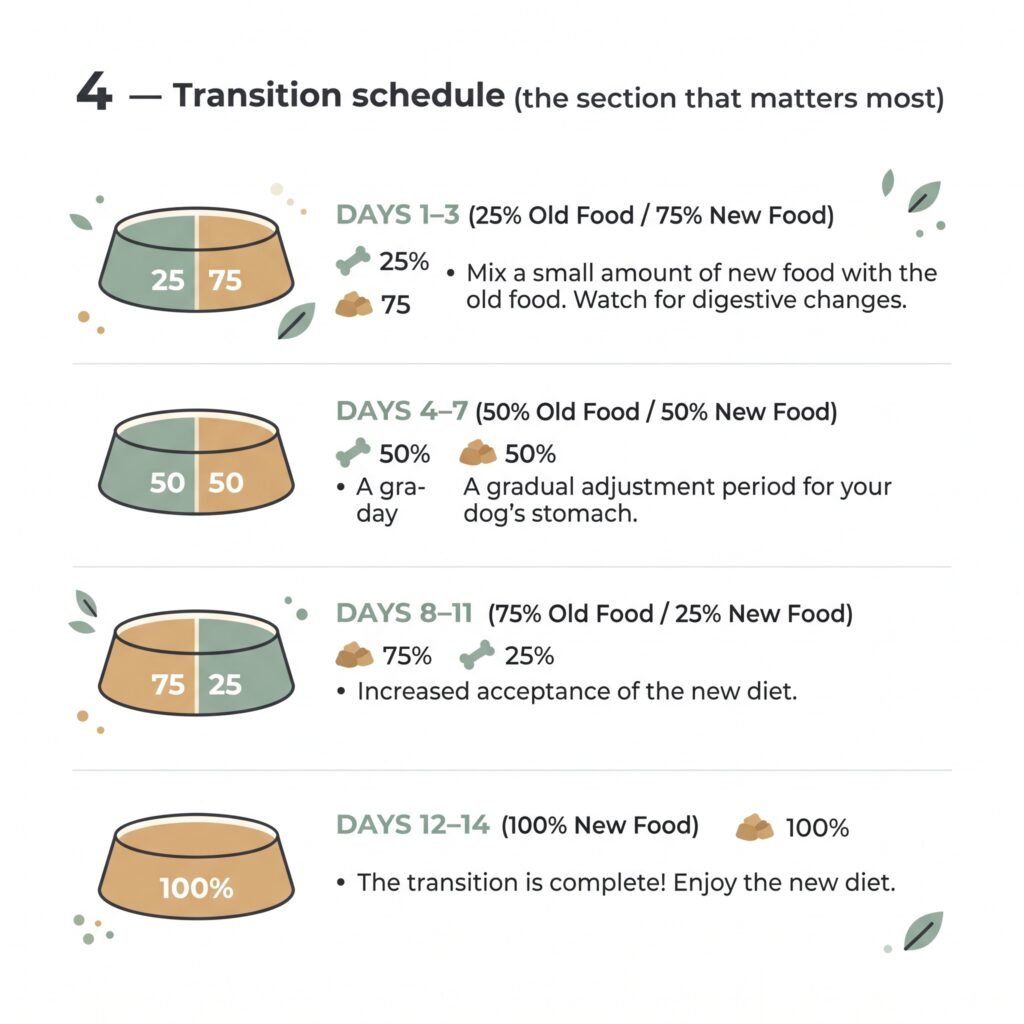
Slower than the bag says. This is where most switches to 4health dog food fail.
The standard 7-day transition works for dogs with no GI history. For a dog moving down from a premium or therapeutic diet, stretch it to 14 days minimum.
- Days 1–3: 25% new, 75% old
- Days 4–7: 50/50
- Days 8–11: 75% new, 25% old
- Days 12–14: 100% new
Log stool quality daily on a 1–5 scale, starting three days before the first 4health dog food serving so you have a baseline. Not “it seemed fine” — write it down. Memory is unreliable and you’ll need the record if you end up at the vet.
Two additions that materially improve success rates. Add a plain canned pumpkin spoonful — one tablespoon per 20 lb of dog — through the first ten days for the soluble fiber. And hold every other variable constant: no new treats, no new chews, no table scraps during the transition window. If something goes wrong, you need to know it was the 4health dog food and not the bully stick.
If stool quality degrades and doesn’t recover within 48 hours, back up one stage rather than abandoning the switch entirely. Roughly half the “my dog can’t tolerate this food” cases I’ve seen were transition-speed problems, not tolerance problems.
Calorie density differs between brands, so recheck your portion at week three. If your dog is gaining, the new food is denser than the old one and your cup measurement is now wrong.
Who should skip 4health dog food entirely?
Not everyone should make this switch, and I’d rather say so.
Dogs on therapeutic diets. Covered above. Prescription is prescription.
Large-breed puppies, unless you check the calcium. Growth formulas for dogs expected to exceed 70 lb need calcium controlled — AAFCO caps it at 1.8% dry matter for large-size growth. Skeletal development in giant breeds is genuinely unforgiving on this point. Confirm the specific bag carries the large-size growth statement.
Dogs with a documented protein allergy where you can’t identify the trigger. Retail formulas share production lines. If you need true novel-protein or hydrolyzed-protein control, you need a veterinary diet.
People who don’t live near a Tractor Supply. 4health dog food is retailer-exclusive. If the nearest store is 40 minutes away and you’re buying 45 lb bags, factor the fuel and the trip into your cost-per-day math. Running out of food and grabbing a random bag from a grocery store is exactly how transitions get botched.
Anyone whose dog is currently thriving. If your dog is healthy, stable, and doing well, and the current food is genuinely affordable — don’t switch to save $15 a month. Stability has value.
Frequently asked questions
Is 4health dog food good for dogs with sensitive stomachs? Often yes, for general digestive sensitivity — the Special Care Sensitive Stomach recipes include prebiotic fiber and guaranteed probiotics, and simpler protein sourcing than the standard adult line. But “sensitive stomach” on a bag is a marketing category, not a clinical one. If your dog has diagnosed pancreatitis, IBD, or protein-losing enteropathy, that’s a therapeutic diet question for your vet.
Who makes 4health dog food and where is it manufactured? It’s produced by Diamond Pet Foods, the contract manufacturer behind Taste of the Wild, Kirkland Signature, and Diamond Naturals, and sold exclusively through Tractor Supply and Petsense. Most recipes are labeled Made in the USA; the Untamed sub-range is listed differently, so check the bag if origin matters to you.
Has there been a 4health dog food recall recently? The major event was the 2012 Diamond Pet Foods Salmonella recall affecting multiple co-manufactured brands, with a separate 2013 low-thiamine recall on certain dry cat formulas. No comparable dog food event has followed. Check the FDA pet food recall page directly before a bulk purchase rather than trusting any review’s publication date.
How does 4health dog food compare to Taste of the Wild? Same manufacturer, different positioning, and worth noting that most 4health dog food review coverage compares the two head-to-head for exactly that reason. Taste of the Wild leans novel-protein and grain-free with a higher price point; 4health dog food covers a broader range including grain-inclusive recipes at a lower cost per pound. For a healthy adult dog with no protein sensitivity, the practical nutritional gap is narrower than the price gap suggests.
Can puppies eat 4health dog food, and which formula? Yes — the Puppy recipes include DHA from salmon oil for brain and eye development and are labeled for all breed sizes. For a puppy expected to exceed 70 lb as an adult, verify the bag carries the AAFCO growth statement that includes growth of large-size dogs, since calcium control matters more than any other single factor in giant-breed skeletal development.
The bottom line on 4health dog food
The right way to shop this brand is backwards from how most people do it.
Don’t start with the bag. Start with a written list of what your current food is doing for your dog — joint support, coat quality, digestive tolerance, calorie density, protein restriction. Then find the 4health dog food line that performs those same functions, and ignore the rest of the shelf.
For a healthy adult dog with no complications, Wholesome Grains at roughly $0.87 a day is a legitimately good value and one of the better price-to-quality propositions in retail. For a large breed carrying joint load, the Large Breed + Mobility formula’s 1,200 mg/kg glucosamine is worth the shelf space on its own. For a dog with a skin or gut history, Special Care is the landing zone — with the caveat that it doesn’t replace a therapeutic diet. And 4health grain free dog food only earns its price premium when a vet has actually identified a grain problem.
So, is 4health dog food good for dogs? For most healthy adult dogs, yes — provided you read the 4health dog food ingredients panel against what your old bag was doing, and switch slowly enough to find out.
And for a dog on a prescription food, the honest answer is that no amount of 4health dog food will substitute, and the savings have to come from somewhere else.
Run the 14-day transition. Log the stool. Photograph the lot code. Recheck the portion at week three. Do those four things and the switch works far more often than it fails.