Alpo Dog Food: When It's the Right Call (and When It Isn't)
Short answer: Alpo dog food meets AAFCO adult maintenance minimums, so it will keep a healthy adult dog alive and well-fed. It runs about 18% protein and 8.5% fat with corn as the first ingredient. For active dogs, seniors losing muscle, or dogs on calorie restriction, that protein level is the real problem — not the corn.
I get a version of this email once a month. Hours got cut, the rent went up, and the $70 bag of kibble is now a $70 problem. The question is never “what’s the best dog food.” It’s “what happens if I switch to Alpo dog food, and what am I actually giving up?”
That’s a different question, and it deserves a real answer with numbers in it.
Recommended Products
Best Dog Food in 2026
Is Alpo dog food good for dogs, or just cheap?
Both things are true at once, and the internet is bad at holding two ideas at the same time.
Alpo dog food is manufactured by Nestlé Purina, in Purina’s own U.S. plants. That matters more than most people realize — you’re not buying from a contract manufacturer with a rotating ingredient supply and no in-house nutritionists.
The formulas are also formulated to meet the AAFCO Dog Food Nutrient Profiles for adult maintenance. That’s a floor, not a ceiling, but it’s a real floor. It means the vitamin and mineral package is complete, the calcium-phosphorus ratio is in range, and the food won’t cause a deficiency disease.
Here’s where it gets uncomfortable. The floor is low, and Alpo dog food sits very close to it.
AAFCO’s adult maintenance minimum for crude protein is 18% on a dry matter basis. Alpo Prime Cuts guarantees 18% as fed, at 12% maximum moisture — which converts to about 20.5% dry matter. It clears the bar. It clears it by a couple of percentage points.
So when someone asks me “is Alpo dog food good for dogs,” my honest answer is: it’s adequate for a specific kind of dog, and genuinely wrong for others. The rest of this article is about telling those two groups apart.
What’s actually in Alpo dog food ingredients, and which ones matter?
Let’s read a label properly instead of reacting to it.
Alpo Prime Cuts Savory Beef Flavor leads with ground yellow corn, meat and bone meal, soybean meal, beef tallow preserved with mixed-tocopherols, and corn gluten meal. Then: egg and chicken flavor, poultry and pork digest, salt, potassium chloride, and the vitamin-mineral pack.
Alpo Come & Get It Cookout Classics leads with ground yellow corn, corn germ meal, beef and bone meal, soybean meal, beef fat preserved with mixed-tocopherols, and pork and bone meal.
Four things in those Alpo dog food ingredients are worth your attention, and two things aren’t.
Worth your attention #1: the protein is split between plant and animal sources. Soybean meal and corn gluten meal are protein-dense and cheap. They count toward that 18% guarantee. A dog can use them — dogs digest soy protein reasonably well — but the amino acid profile is weaker than muscle meat, which is why you’ll see added L-lysine and DL-methionine on the label. Those are there to patch the gaps.
Worth your attention #2: “meat and bone meal” is unnamed. It’s a rendered product from unspecified mammal species. It’s not dangerous. It is variable, batch to batch, in a way that “chicken meal” isn’t. The bone fraction also drags ash and phosphorus up.
Worth your attention #3: the fat is preserved with mixed tocopherols. This is a genuine point in Alpo’s favor that almost nobody mentions. Pedigree’s comparable adult formula uses BHA and BHT. If you’ve been avoiding synthetic preservatives, Alpo dog food is actually the cleaner label of the two grocery-store giants on this one narrow point.
Worth your attention #4: fiber runs 5.5–6% maximum. Higher than most competitors. I’ll come back to this, because I think it explains a stool problem I ran into.
Not worth your attention #1: the artificial colors. Red 40, Yellow 5, and Blue 2 are in there so the kibble looks like meatballs and beef strips to you. Your dog is functionally red-green colorblind and doesn’t care. There’s no established canine safety concern at these inclusion levels. If dyes bother you on principle, that’s a values decision, and a legitimate one — just don’t frame it as a safety decision, because the evidence isn’t there.
Not worth your attention #2: the word “corn.” Corn is a digestible carbohydrate and a real source of energy and linoleic acid. The problem with corn-first kibble isn’t that corn is poison. It’s that corn is displacing calories that could have come from meat, which shows up as a lower protein number — and that’s the thing that matters.
How does Alpo dog food compare to other budget kibbles on paper?
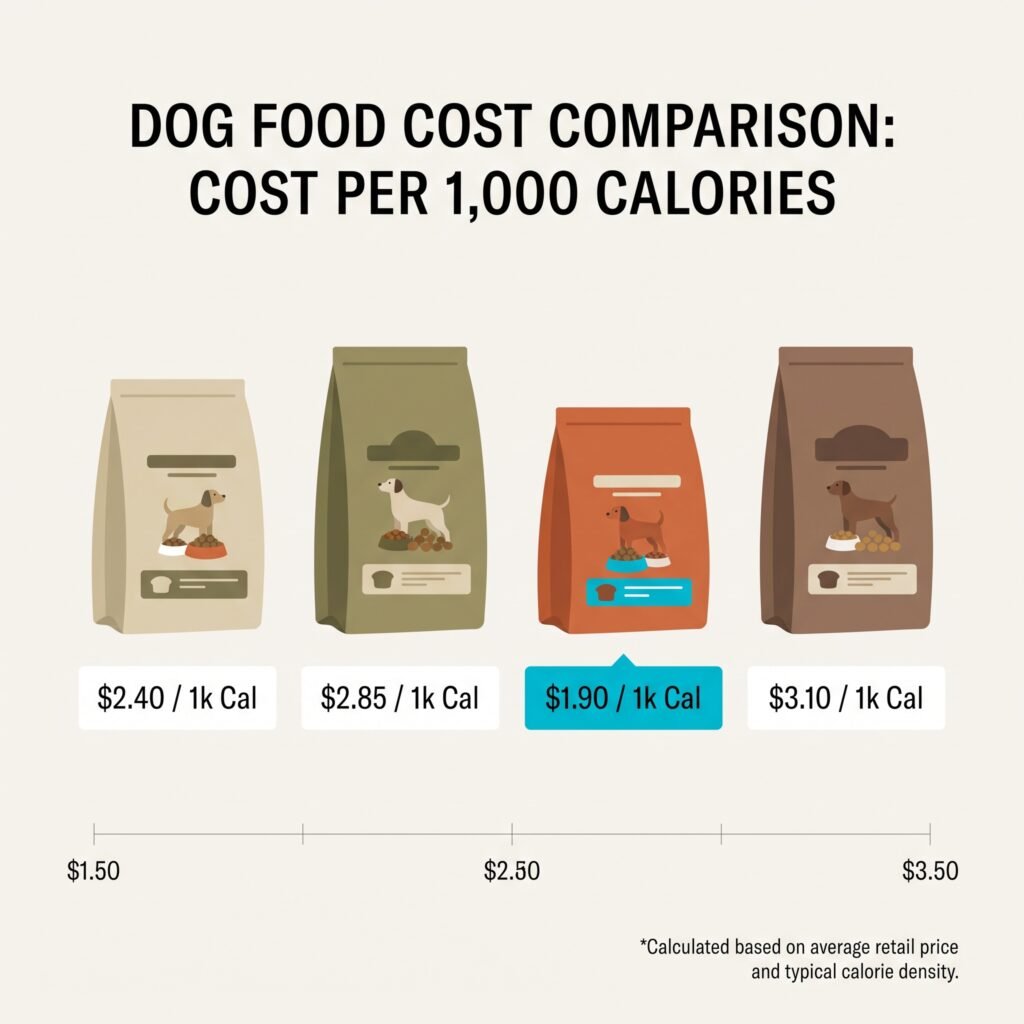
Sticker price on the bag is the wrong comparison. A bag with more calories per kilogram lasts longer. The honest metric is cost per 1,000 calories.
Prices below are what I paid at a big-box store in spring 2026. Yours will differ — the math is the point, not my receipts.
| Alpo Prime Cuts | Alpo Come & Get It | Purina Dog Chow Complete Adult | Pedigree Complete Nutrition Adult | Typical mid-tier kibble | |
|---|---|---|---|---|---|
| Crude protein (min, as fed) | 18.0% | 18.0% | 21.0% | 21.0% | 24–26% |
| Crude fat (min, as fed) | 8.5% | 8.5% | 10.0% | 10.0% | 14–16% |
| Crude fiber (max) | 5.5% | 6.0% | 4.5% | 4.0% | 3–5% |
| Calories | 3,414 kcal/kg (381/cup) | 3,407 kcal/kg (380/cup) | 3,559 kcal/kg (416/cup) | 3,352 kcal/kg (329/cup) | 3,600–3,900 kcal/kg |
| First ingredient | Ground yellow corn | Ground yellow corn | Whole grain corn | Ground whole grain corn | Named meat or meal |
| Fat preservative | Mixed tocopherols | Mixed tocopherols | Mixed tocopherols | BHA / BHT | Mixed tocopherols |
| Artificial colors | Yes | Yes | No | Yes | Rarely |
| Cost per 1,000 kcal | ~$0.45 | ~$0.45 | ~$0.56 | ~$0.56 | ~$0.75–1.00 |
Two things jump out of that table.
First, Alpo dog food is genuinely the cheapest thing in the aisle per calorie — roughly 20% under Dog Chow and Pedigree, not 5%.
Second, and this is the part people miss: the gap between Alpo dog food and a mid-tier bag is smaller in dollars than it looks in percentages.
Run it for a real dog. A neutered, moderately active 50-pound dog needs somewhere near 1,100 calories a day.
- On Alpo dog food at $0.45 per 1,000 kcal: about $0.50/day, or $15/month
- On Dog Chow at $0.56: about $0.62/day, or $19/month
- On a mid-tier kibble at $0.85: about $0.94/day, or $28/month
So the whole argument is about $13 a month for a 50-pound dog. For a 90-pound dog it’s closer to $22. For a 15-pound terrier it’s about $5.
I say this without judgment: for some households, $13 a month is the difference between keeping the dog and surrendering the dog. That is a real trade-off, and a dog on Alpo dog food in a home that loves it is doing better than a dog in a shelter on premium kibble. Anyone who tells you otherwise has never had to make that math work.
Which dogs actually do fine on Alpo dog food?
After feeding Alpo dog food across a handful of dogs and watching what happened, the pattern is fairly consistent.
The dogs it works for
Adult dogs at a healthy weight with moderate activity. A 6-year-old couch-and-two-walks Lab mix has no metabolic reason to need 26% protein. She needs enough, and 20.5% dry matter is enough for maintenance.
Easy keepers who gain weight on richer food. The lower fat level — 8.5% versus 14–16% in mid-tier bags — is genuinely useful here. I’ve seen more dogs harmed by unlimited premium kibble than by measured budget kibble.
Dogs with rock-solid digestion. If your dog has never had a food-related problem in his life, he’s likely to shrug at a switch.
Picky eaters and dogs recovering appetite. Alpo dog food is engineered for palatability, and it works. The poultry and pork digest coating is doing exactly what digest is supposed to do. I’ve used a cup of it as a mixer for a dog coming off dental surgery who wouldn’t touch his usual food.
The dogs it doesn’t work for
Any puppy. Prime Cuts and Come & Get It are formulated for adult maintenance only, not for growth. This isn’t a preference — it’s the wrong nutrient profile for a growing skeleton. Large-breed puppies in particular need controlled calcium, and Alpo isn’t formulated for that job.
Dogs on a weight-loss plan. This is the most underrated problem with Alpo dog food and almost nobody talks about it. When you cut a dog’s calories by 20%, you also cut his protein by 20%. Starting from 18%, you drop below what a dog needs to hold lean muscle while losing fat.
He’ll lose weight, but he’ll lose the wrong kind. Weight loss diets should have more protein per calorie, not less.
Working and sport dogs. An 8.5% fat food doesn’t have the energy density for a dog running real mileage. You end up feeding volume, and the dog runs out of gas anyway.
Senior dogs losing topline. Older dogs are less efficient at using dietary protein, not more. A 12-year-old who’s dropping muscle over the hips is the exact dog who shouldn’t be moved down to Alpo dog food.
Any dog with kidney disease. Alpo dog food guarantees a phosphorus minimum of 0.8% with no maximum stated. If your vet has you managing phosphorus, this is not the bag.
The topper strategy: how to make Alpo dog food work harder for $12 a month
This is the part I actually think is worth your time, because it changes the decision.
If the reason you’re leaving mid-tier kibble is money, you don’t have to accept the protein gap. You can close most of it for less than the upgrade would have cost.
Here’s the math for that same 50-pound dog on 1,100 calories.
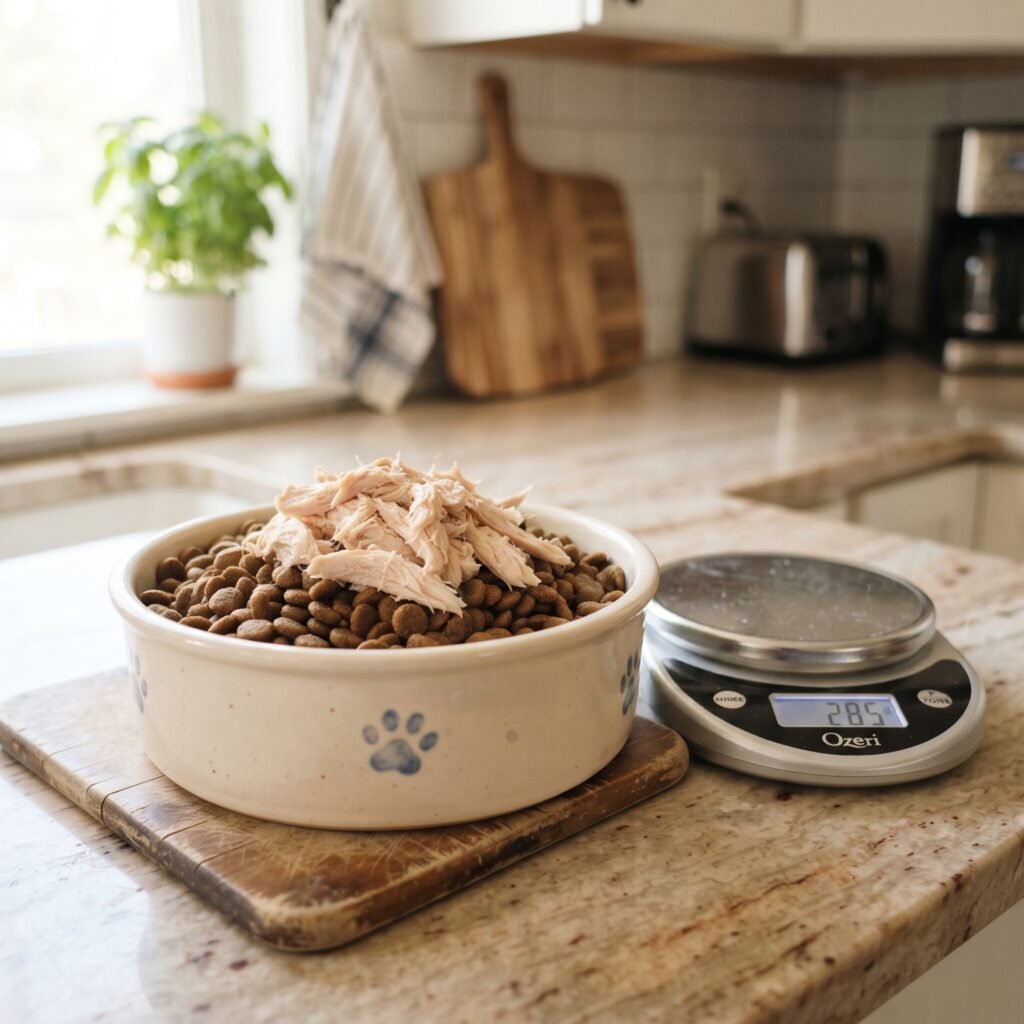
Straight Alpo dog food: 322 g of kibble per day. That’s about 58 g of protein, or 53 g of protein per 1,000 calories.
Alpo dog food plus a chicken topper: add 3 oz (85 g) of cooked, skinless chicken thigh — roughly 180 calories and 21 g of protein — and remove 180 calories of kibble, which is about 53 g.
New daily total: 269 g of kibble plus the chicken. That’s about 69 g of protein, or 63 g per 1,000 calories.
That’s a 19% increase in protein density without adding a single calorie to the bowl. Bought as leg quarters at $1.29/lb, baked in a sheet-pan batch on Sunday and portioned into a week of containers, it runs roughly $0.40/day. About $12 a month — still less than the $13 you saved by leaving mid-tier kibble.
Three rules if you do this:
Keep the topper under 20% of daily calories. In the example above it’s 16%. Go much past 20% and you start meaningfully diluting the balanced vitamin and mineral package that makes Alpo complete in the first place. That dilution is the whole risk of topping a budget food.
Remove kibble calories, don’t just add food on top. Every owner who “adds a little chicken” without cutting kibble ends up with a fat dog in five months. Use a kitchen scale for a week until you can eyeball it.
Don’t do this at all for puppies, pregnant dogs, or dogs on a prescription diet. Growth and therapeutic diets have tight nutrient ratios. Toppers wreck them.
Cheap protein toppers I’ve actually used, ranked by cost per gram of protein: chicken leg quarters, eggs (one large egg is about 6 g of protein for 72 calories), plain canned sardines in water, and cottage cheese. Skip the boutique freeze-dried toppers — they’re priced like premium kibble, which defeats the entire point of feeding Alpo dog food.
Does adding canned Alpo dog food fix the protein problem?
This is the intuitive move, and it doesn’t work. Worth explaining why, because it’s the most common thing owners try.
Alpo Prime Cuts in gravy runs about 1,017 kcal/kg and roughly 380 calories per 13.2 oz can. Purina’s own feeding guidance is about one can per 13 to 15 pounds of body weight daily, and one can replaces roughly one cup of dry.
The problem is water. Canned Alpo dog food is mostly moisture, so while the protein percentage looks respectable on a dry matter basis, the amount of actual protein you’re delivering per can is modest — and you’re paying for the water.
At roughly $1.30 a can, that’s about $3.40 per 1,000 calories, versus $0.45 for the dry. You’re paying more than seven times as much per calorie for something that barely moves the protein needle.
Do the swap on our 50-pound dog. Replace 380 calories of dry Alpo dog food with one can and you’ve spent an extra $1.15 that day to end up roughly where you started nutritionally.
That’s not an argument against wet food. It’s an argument against using it as a protein fix. Canned Alpo dog food earns its place for palatability, for hydration in a dog who doesn’t drink enough, or for a dog with dental pain who can’t manage kibble. Those are real reasons.
But if the goal is closing the gap those Alpo dog food ingredients leave you with, three ounces of chicken thigh does far more for a third of the cost.
When Alpo dog food didn’t work: the case I got wrong
I want to be straight about a failure, because the topper strategy above isn’t universal.
The dog was an 8-year-old, 34-pound beagle mix with a history of “sensitive stomach” that had never been worked up properly. His owner was moving him to Alpo dog food for budget reasons and asked me to help do it right.
We ran a slow transition — 14 days, not the 7–10 the bag recommends. His stool went from a firm 2 to a soft, poorly-formed 5 on the Purina fecal scoring chart by day six and never came back. Not diarrhea. Just persistently soft, three or four times a day, with more urgency than he’d had before.
I assumed the protein was the issue and added the chicken topper. That made it worse — larger volume, softer stool, one middle-of-the-night accident.
We moved him back to his previous food and it resolved in four days.
My best guess is fiber and fermentable plant matter. Alpo Prime Cuts allows up to 5.5% crude fiber and Come & Get It up to 6%, against 4–4.5% in the Pedigree and Dog Chow formulas, and the soybean and corn gluten fraction adds fermentable substrate on top of that. For a dog with an already-touchy colon, that combination seems to be too much.
But I want to be honest about the limits of that explanation: I have a mechanism I find plausible and one dog who didn’t tolerate the food. That’s not proof. What I know for certain is that “it meets AAFCO” and “your individual dog does well on it” are two different claims, and the label can only ever tell you the first one.
If your dog has a documented history of GI trouble, budget your food decision around the vet bill you’ll avoid, not the $13 you’ll save.
Has there ever been an Alpo dog food recall?
Yes — one, and it’s old.
In March 2007, Nestlé Purina voluntarily recalled all sizes and varieties of Alpo Prime Cuts in Gravy canned dog food with specific date codes, after learning that wheat gluten containing melamine had come from the same supplier that fed the massive Menu Foods recall. The affected product carried date codes 7037 through 7053 with plant code 1159.
Two details of that Alpo dog food recall matter for anyone reading this in 2026.
First, the contamination was traced to one of Purina’s 17 plants and to wet food only. Purina stated at the time that no dry products were affected, including Alpo Prime Cuts dry.
Second — and this is the part worth weighing — there has been no Alpo dog food recall since. That’s a nearly two-decade clean run for a very high-volume brand. Plenty of expensive boutique brands can’t say the same.
I check recall status on the FDA’s animal food recall listings rather than on brand-review sites, which lag and sometimes repeat each other’s errors. If you’re evaluating any brand, including Alpo, check the FDA directly and check the date on whatever you’re reading.
How do you switch to Alpo dog food without a week of loose stool?
The bag says 7 to 10 days. For a downgrade in protein and an upgrade in fiber, I’d stretch that.
Days 1–3: 25% Alpo dog food, 75% old food. Days 4–7: 50/50. Days 8–11: 75% Alpo dog food. Day 12 onward: 100%.
A few things that actually help:
Feed two meals instead of one. Splitting the load reduces the volume hitting the gut at once. Alpo’s own feeding chart is written for once-daily feeding, which I think is a mistake for most dogs.
Score the stool daily for the first three weeks. Write it down. Memory is unreliable and a slow decline is easy to miss. A 1–2 on Purina’s chart is ideal; a persistent 5+ means stop.
Don’t add anything new during the transition. No new treats, no topper, no probiotic you started the same week. If something goes wrong you won’t know what caused it. Add the topper strategy in week four, not week one.
Buy the small bag first. A 14 lb bag of Alpo dog food costs a few dollars more per pound, and it’s the cheapest insurance there is against a 47 lb bag your dog refuses.
Is there a point where switching to Alpo dog food stops making sense?
Yes, and it’s worth naming clearly, because “cheapest per calorie” is only the right goal until it isn’t.
If your dog is under 20 pounds, the savings are trivial. A 15-pound dog eating 400 calories a day saves roughly $5 a month on Alpo dog food versus mid-tier kibble. That’s not worth a diet change for a dog who’s doing well.
If your dog has any diagnosed condition affecting protein, phosphorus, or fat tolerance, the food isn’t the place to economize. Ask your vet whether the therapeutic diet has a cheaper equivalent, or whether the clinic has an assistance program. Many do and don’t advertise it.
If you’re already supplementing heavily to make it work, stop and re-run the numbers. Alpo plus $30/month of toppers is more expensive than the bag you left.
If the money is short-term, consider a pet food pantry before a permanent downgrade. Many humane societies and food banks run them, and they exist precisely so that people don’t have to make this choice.
How I evaluated Alpo dog food
Reviewed against: the AAFCO Dog Food Nutrient Profiles for adult maintenance, comparing each formula’s guaranteed analysis on a dry matter basis rather than as-fed, since as-fed numbers can’t be compared across foods with different moisture levels.
Ingredient review: current labels pulled from Purina’s own published product sheets and retailer listings, cross-checked between two sources per formula, since label formulations change without announcement.
Recall history: FDA animal food recall listings and Nestlé Purina’s own 2007 recall notice, rather than aggregator sites.
Cost analysis: calculated as price per 1,000 kcal metabolizable energy using the calorie content printed on each bag, not price per pound.
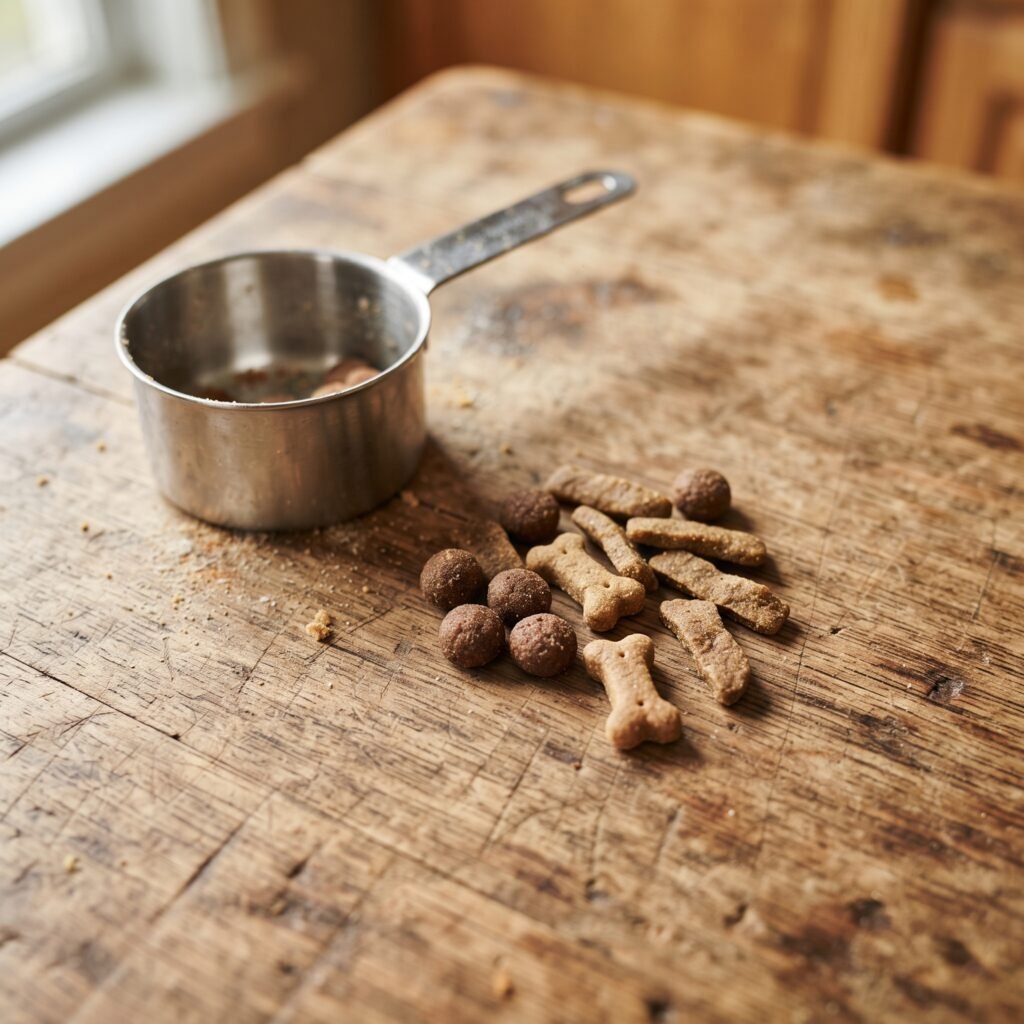
Hands-on: bags fed in normal home conditions, not a lab. Kibble in Prime Cuts comes in three shapes — a meatball, a bone, and a flat strip — and runs noticeably softer and greasier to the touch than a dense mid-tier kibble. It has a strong rendered-fat smell that hits when you open the bag, much more so than Dog Chow. Stool scored daily on the Purina scale, weight checked weekly on the same scale.
What I can’t tell you: long-term outcomes. Nobody has run a decade-long controlled trial on grocery kibble, and anyone who claims to know how any grocery kibble affects lifespan is guessing.
Frequently asked questions about Alpo dog food
Is Alpo dog food AAFCO approved?
AAFCO doesn’t approve foods; it publishes nutrient profiles that manufacturers formulate against. Alpo dog food formulas state they are formulated to meet the AAFCO Dog Food Nutrient Profiles for maintenance of adult dogs, which you’ll find in the fine print on the back of the bag. That’s a formulation claim rather than a feeding trial claim.
Can puppies eat Alpo dog food?
No. The main dry Alpo dog food formulas are labeled for adult maintenance, not for growth or all life stages, so they aren’t appropriate for puppies. Feeding an adult-maintenance food during growth risks nutrient shortfalls, and for large breeds the uncontrolled calcium is a specific orthopedic concern.
Why is Alpo dog food so cheap?
Because the protein comes largely from corn gluten meal, soybean meal, and unnamed meat and bone meal rather than named muscle meat, and because Purina’s scale and in-house plants keep production costs down. You’re paying for adequate nutrition with inexpensive inputs, which is exactly what Alpo dog food is designed to deliver.
Does Alpo dog food cause diarrhea?
Not inherently, but the higher fiber ceiling and plant-protein load can produce soft stool in dogs with sensitive digestion, which is what I saw in the case above. Most transition problems come from switching too fast. If stool is still poor three weeks after a slow, complete transition, the food is a poor fit for that dog.
Is Alpo dog food good for dogs that are seniors?
Usually not the best choice. Older dogs use dietary protein less efficiently and need more of it per calorie to hold muscle, and 18% as-fed sits at the low end. If your senior is bright, holding weight, and doing well, there’s no urgency to switch — but if he’s losing topline, Alpo dog food is the wrong direction.
The bottom line
Alpo dog food is not the best food you can buy, and everyone selling you a rating out of five stars already told you that. What they didn’t tell you is who it’s actually fine for, and what it costs to fix its one real weakness.
For a healthy adult dog at a good weight with normal digestion, Alpo dog food is a legitimate, complete diet that will not harm him. For a puppy, a senior losing muscle, a dog on a diet, or a working dog, it’s the wrong tool.
And if you’re switching for money, spend $12 of the $13 you save on a chicken topper and keep it under 20% of the bowl. You’ll end up with a diet that’s closer to mid-tier than the label suggests — which is a better outcome than either feeding Alpo dog food straight or buying a bag you can’t sustain.
Do the math with your own dog’s weight and your own receipts. That number is the only one that matters.