
Cosequin vs Dasuquin: Which One Actually Fits Your Dog's Joint Stage?
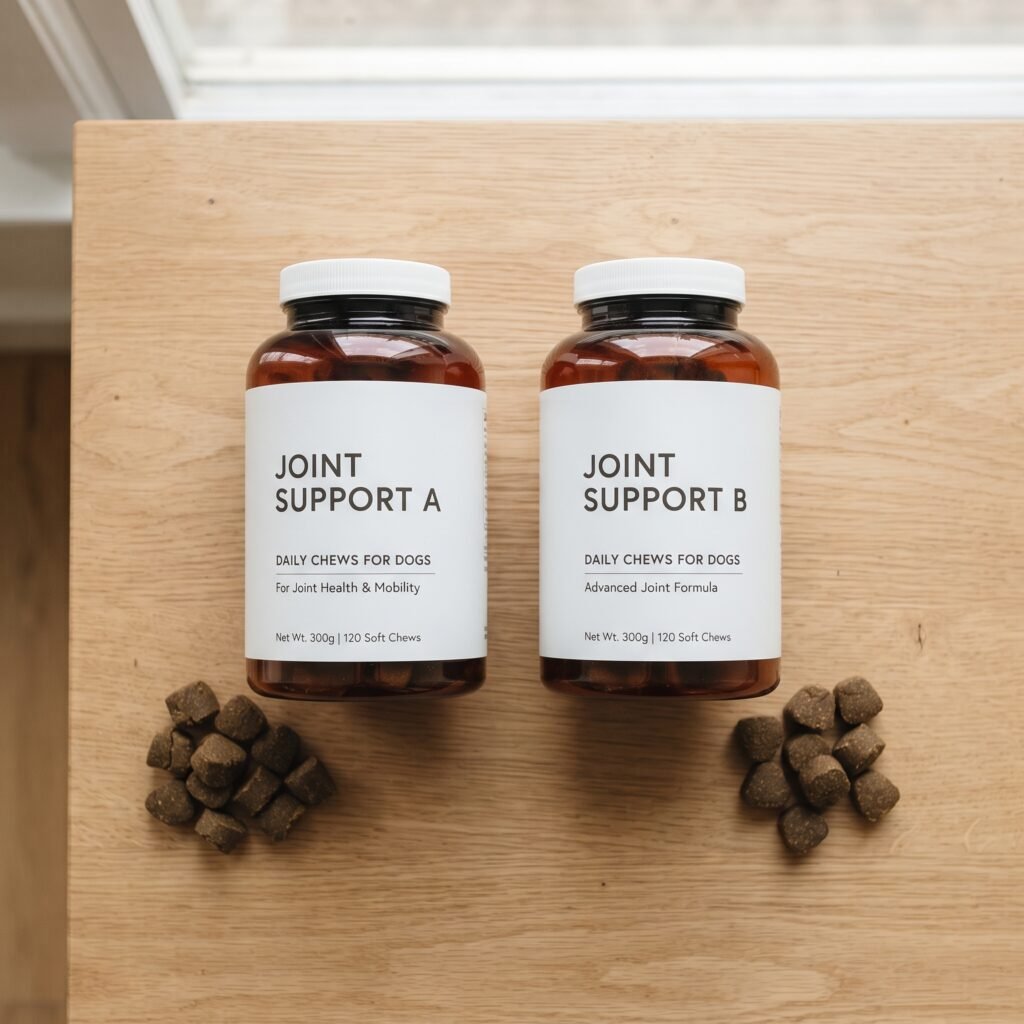
Quick answer: In the Cosequin vs Dasuquin decision, Cosequin (glucosamine + chondroitin, ± MSM) is the right starting point for young dogs, mild stiffness, or prevention. Dasuquin adds ASU (avocado/soybean unsaponifiables) and a higher MSM dose, which matters most for moderate-to-severe arthritis, post-surgical recovery, or dogs who’ve plateaued on Cosequin. The real decision isn’t “which brand is better” — it’s “which ingredient list matches how far your dog’s joint disease has already progressed,” and that’s the question most comparison pages skip.
Nutramax makes both products, so you’re not choosing between quality tiers. You’re choosing between a two-ingredient core and a three-ingredient core, at roughly double the price. That price gap only pays for itself in specific situations — and this guide walks through exactly which ones, using weight-based dosing math and real cost-per-month numbers instead of vague reassurance.


Why This Cosequin vs Dasuquin Comparison Is Different
Most articles on Cosequin vs Dasuquin stop at “Dasuquin has ASU, Cosequin doesn’t.” That’s true, but it doesn’t tell you anything about your dog. A generic answer can list ingredients from the label. It can’t walk you through a staged decision — young and stiff vs. old and diagnosed vs. six weeks post-TPLO surgery — because that requires combining clinical severity, weight-tier dosing, and real cost math into one framework. That’s the spine of this article, and every section below builds on it.
Section 1: Cosequin vs Dasuquin — The Core Decision, Matching the Supplement to Your Dog’s Stage
The single most useful way to think about Cosequin vs Dasuquin is as a severity ladder, not a brand rivalry. Both supplements share the same foundation — glucosamine hydrochloride and chondroitin sulfate — which rebuild cartilage matrix and improve joint fluid quality. Where they diverge is what gets layered on top, and that layering maps almost exactly to how advanced your dog’s joint disease is.
Stage 1: No diagnosis yet, just early stiffness
If your dog is a large-breed puppy, a working or agility dog, or a senior showing the first signs of slowing down on stairs — but hasn’t been formally diagnosed with arthritis — Cosequin is the appropriate first move in the Cosequin vs Dasuquin decision. It’s a maintenance-dose product: enough glucosamine and chondroitin to support cartilage before damage accumulates, without paying for an anti-inflammatory ingredient your dog may not need yet.
- Best for: prevention, mild stiffness, dogs under 5 with joint-prone breeding (Labs, German Shepherds, Golden Retrievers)
- Which product line: standard Cosequin or Cosequin DS (double strength) tablets, which are formulated exactly for this earlier, maintenance-focused stage of the Cosequin vs Dasuquin ladder
- What to watch: if stiffness doesn’t improve within 6–8 weeks, that’s your signal to move up the ladder, not to keep waiting
Stage 2: Diagnosed mild-to-moderate osteoarthritis, or “does my dog need MSM yet?”
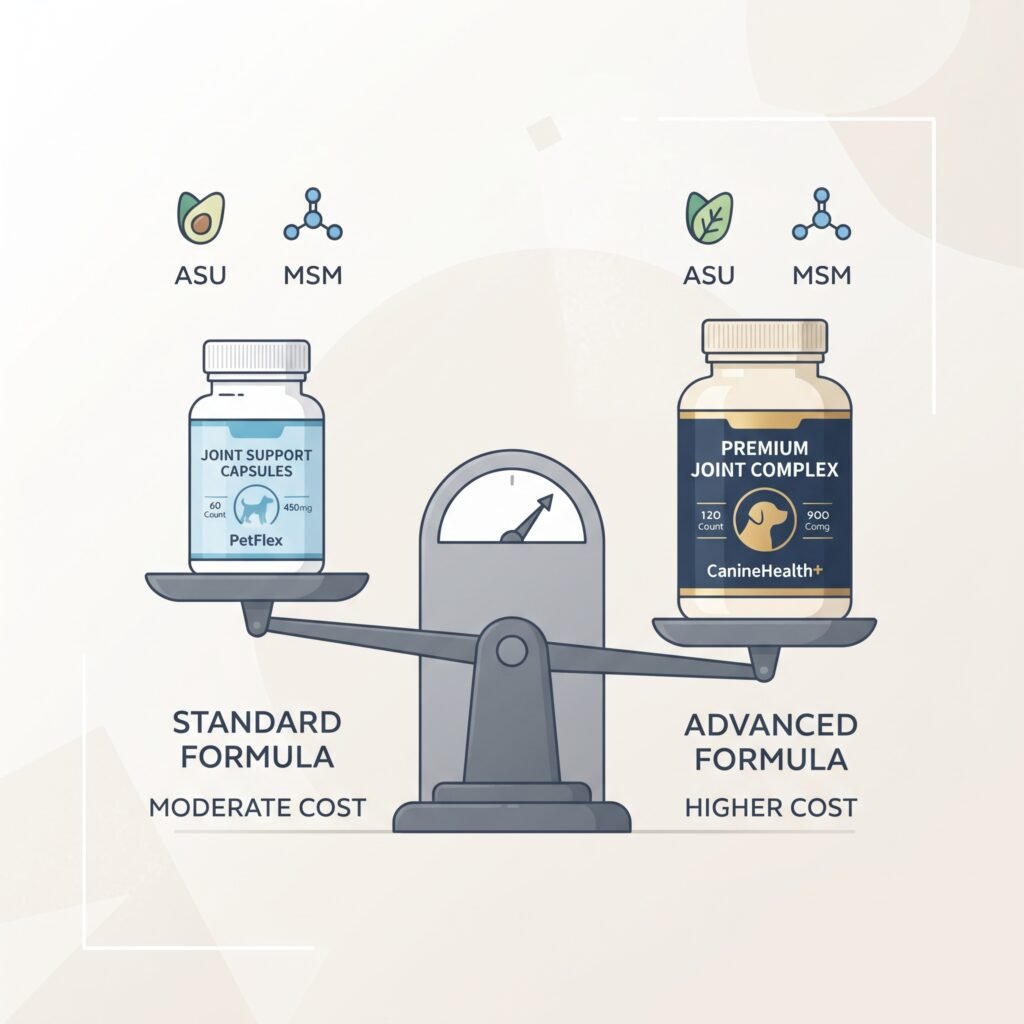
Once a vet has confirmed osteoarthritis via exam or X-ray, but your dog is still mobile and mostly comfortable, Cosequin with MSM is usually the next tier in the Cosequin vs Dasuquin progression. MSM is a sulfur donor with anti-inflammatory and antioxidant effects, and it’s genuinely useful here — but the version of MSM in Cosequin is dosed lower than in Dasuquin, which is exactly why the next stage exists.
At this point, some owners jump straight from plain Cosequin to Dasuquin, skipping the MSM-only middle tier entirely. That’s not wrong, but it’s often unnecessary spending: if your dog’s arthritis is mild-to-moderate and mobile, Cosequin with MSM frequently delivers the anti-inflammatory benefit owners are actually looking for, at a fraction of Dasuquin’s price, before ASU becomes worth the added cost.
Stage 3: Moderate-to-severe arthritis, or a dog who’s stalled on Cosequin
This is where Dasuquin earns its price premium in the Cosequin vs Dasuquin comparison. Dasuquin contains everything Cosequin does, plus ASU — a plant-derived compound shown in veterinary research to reduce production of inflammatory mediators like interleukin-1, which are directly responsible for cartilage breakdown in osteoarthritis. Dasuquin’s MSM dose is also substantially higher (roughly 800 mg vs. 250 mg per tablet in comparable product lines), which compounds the anti-inflammatory effect rather than just adding a marginal ingredient.
This stage applies if:
- Your dog has been on Cosequin for 8+ weeks with no improvement in mobility
- X-rays show moderate-to-advanced joint changes, not early-stage wear
- Your vet has specifically flagged inflammation, not just cartilage loss, as the driver of symptoms
Which product line: Dasuquin with MSM chewable tablets or soft chews are the most common choice at this stage of the Cosequin vs Dasuquin ladder, since they combine all three active ingredients — glucosamine, chondroitin, and ASU — with the higher MSM dose in one tablet, rather than requiring two separate products.
Stage 4: Post-surgical recovery (TPLO, FHO, hip replacement) — “what does my surgeon actually prescribe?”
Surgeons frequently recommend Dasuquin, not Cosequin, in the weeks following orthopedic surgery. The logic isn’t marketing — it’s that post-surgical joints are in an acute inflammatory state, and ASU’s mechanism (reducing inflammatory cytokine activity) is more relevant during active healing than during simple maintenance. If your dog is recovering from joint surgery, this Cosequin vs Dasuquin question has a fairly clear answer: ask your surgeon directly, but Dasuquin is the more commonly prescribed option in this window.
The dosing math that actually decides this
Both products are dosed by weight, and the “loading dose” period (higher dose for the first 4–6 weeks, then a maintenance dose) applies to both. A 60 lb dog on Cosequin typically takes 2 tablets/day loading, then 1 tablet/day maintenance. The same dog on Dasuquin follows a similar pattern, but because Dasuquin’s per-tablet cost is higher, the loading period is where the price gap is most painful — and where owners most often quit too early, before the ASU has had time to work.
That six-to-eight-week window is the real hinge of the Cosequin vs Dasuquin decision: judging either product before that point tells you nothing.
It also helps to know that neither product’s loading dose is arbitrary — it’s designed to saturate joint tissue with glucosamine and chondroitin faster than a maintenance dose would, so the anti-inflammatory and cartilage-support effects show up sooner. Cutting the loading dose short to save money is one of the quiet ways owners undermine an otherwise correct Cosequin vs Dasuquin choice: the right product at the wrong dose behaves like the wrong product.
For reference, a rough weight-based breakdown looks like this for the “with MSM” tier of either line:
- Under 25 lbs: half to one tablet daily (loading), half tablet maintenance
- 25–60 lbs: one to two tablets daily (loading), one tablet maintenance
- 61–120 lbs: two tablets daily (loading), one to two tablets maintenance
- Over 120 lbs: follow label guidance or your vet’s specific instructions, since giant-breed dosing sometimes exceeds standard label tiers
These figures vary by exact product and formulation, so always confirm against the label or your vet’s instructions rather than this general guide — but the pattern holds across both Cosequin and Dasuquin: bigger dogs need more tablets, and skipping the loading phase undercuts either product equally.

Section 2: Cosequin vs Dasuquin Edge Cases — Breed, Age, Health Status, and Budget
The core decision ladder above covers most dogs, but several edge cases change the Cosequin vs Dasuquin calculation in ways that generic comparisons rarely address.
Small and toy breeds
Toy and small breeds develop patellar luxation and early degenerative joint disease at different rates than large breeds, and they’re also more price-sensitive per dose because tablets aren’t always scored for small-dog splitting. For a 10 lb Chihuahua or Yorkie with mild patellar issues, Cosequin’s small-bite or capsule formats are usually the more practical entry point. Dasuquin becomes relevant for small breeds mainly after a luxation surgery or a confirmed moderate diagnosis — not as a default starting point, since the ASU dose in a full Dasuquin tablet may exceed what a 10 lb dog actually needs relative to cost.
Giant breeds (Great Danes, Mastiffs, Newfoundlands)
Giant breeds carry more joint load per step and develop osteoarthritis earlier and more severely than medium breeds. For these dogs, the Cosequin vs Dasuquin gap tends to close faster — many giant-breed owners move to Dasuquin by year 3–4 of the dog’s life rather than waiting for a formal severe diagnosis, simply because the biomechanical stress justifies the added ASU and MSM sooner.
Senior dogs with multiple conditions
Dogs over 10 often carry kidney, liver, or cardiac concerns alongside joint disease. Neither Cosequin nor Dasuquin requires kidney or liver dose adjustment in most cases, since glucosamine, chondroitin, and MSM are cleared without major organ strain — but always confirm with your vet, especially if your senior dog is on NSAIDs or other prescription medication, since combining anti-inflammatory approaches should be supervised rather than self-managed.
Soy-sensitive or allergy-prone dogs
ASU is derived from avocado and soybean oils. Dogs with confirmed soy sensitivities, or breeds prone to food allergies (West Highland Terriers, Cocker Spaniels), sometimes react to Dasuquin’s ASU component with mild GI upset — gas or soft stool — even when they tolerate Cosequin’s simpler formula without issue. In the Cosequin vs Dasuquin decision, a known soy sensitivity is one of the few clear reasons to stay on Cosequin even at a more advanced disease stage, and to manage inflammation through other means (vet-directed NSAIDs, weight management, physical therapy) instead.
Budget-constrained households — the affordability side of Cosequin vs Dasuquin
Cosequin generally runs $20–$60 depending on size and formulation, while Dasuquin runs $40–$120 for a comparable bottle count — roughly double. If cost is the deciding factor rather than severity, a reasonable middle path is starting with Cosequin with MSM (which captures most of the anti-inflammatory benefit at a lower price than full Dasuquin) and reserving the jump to Dasuquin for a documented plateau, rather than skipping straight to the more expensive option “just in case.”
Chondrodystrophic breeds (Dachshunds, Corgis, Basset Hounds)
These breeds face disc and joint stress from their body structure rather than pure age-related wear, and they’re prone to IVDD (intervertebral disc disease) alongside standard joint issues. Neither Cosequin nor Dasuquin treats disc disease directly, but both are commonly used as adjunct joint support once a chondrodystrophic dog is diagnosed with secondary osteoarthritis. In this group, the Cosequin vs Dasuquin choice usually follows the same severity ladder as Section 1, rather than requiring a breed-specific exception — the main added step is ruling out a disc problem with your vet before assuming stiffness is purely joint-related.
Working, sporting, and agility dogs
Dogs in active service — herding, hunting, agility, search-and-rescue — put repeated high-impact stress on joints well before typical arthritis age. Many handlers start these dogs on Cosequin preventively during their working years, then move to Dasuquin if joint changes appear on routine imaging, rather than waiting for visible lameness. The Cosequin vs Dasuquin decision for working dogs is often made earlier and more proactively than for a average companion dog, precisely because the joint load is so much higher.
Pregnant or nursing dogs
There isn’t strong safety data for either Cosequin or Dasuquin in pregnant or nursing dogs, so both should be used only under direct veterinary guidance during this period, rather than continued or started on an owner’s own judgment.
Multi-dog households
If you’re dosing more than one dog, per-tablet cost compounds fast. It’s common — and reasonable — to run different products in the same house: Cosequin for a younger, mildly stiff dog and Dasuquin for an older dog with confirmed moderate arthritis. There’s no requirement that every dog in the house be on the same product, and plenty of multi-dog Cosequin vs Dasuquin households do exactly this split successfully.

Section 3: What Commonly Goes Wrong With Cosequin vs Dasuquin (The Honest Failure Case)
Most Cosequin vs Dasuquin comparisons skip this part entirely, but it’s where owners lose the most money and get the least value from either product.
Failure case 1: Quitting the Cosequin vs Dasuquin trial before week 6
Both products are cumulative — they rebuild cartilage matrix and reduce inflammation gradually. They are not painkillers, and they don’t work like one. The single most common mistake is starting Cosequin or Dasuquin, seeing no change in the first two weeks, and switching products or stopping altogether. Most manufacturer and veterinary guidance points to visible improvement between weeks 4–8, with full effect sometimes taking longer. Judging either product on a two-week trial isn’t a fair test of Cosequin vs Dasuquin — it’s a fair test of nothing.
Failure case 2: Upgrading to Dasuquin without changing anything else
ASU works by reducing inflammatory signaling, but it can’t outrun a mechanical problem. If your dog’s arthritis is being driven by excess weight, a torn cruciate ligament, or an unaddressed luxating patella, no amount of ASU will resolve it. Owners sometimes upgrade from Cosequin to Dasuquin expecting a dramatic turnaround, when the real issue was never the supplement tier — it was 15 lbs of extra weight loading the joint, or a structural problem that needs surgery, not supplementation.
Failure case 3: Assuming “more expensive” means “more necessary”
Some owners default straight to Dasuquin for a young, healthy dog with no diagnosis, reasoning that more ingredients must mean more protection. This isn’t wrong exactly — Dasuquin won’t hurt a healthy dog — but it usually isn’t the highest-value choice either. For dogs without diagnosed inflammation, the extra ASU dose is paying for a mechanism your dog’s joints may not yet need, and that money is often better spent on weight management, joint-friendly exercise, or an omega-3 supplement with stronger standalone evidence.
Failure case 4: Ignoring GI side effects instead of adjusting
Both products can cause mild gas, soft stool, or reduced appetite in the first 1–2 weeks, especially at the loading dose. Some owners interpret this as the product “not agreeing with” their dog and stop entirely, when splitting the loading dose across two smaller feedings, or giving the tablet with food, often resolves it within days. This applies to Cosequin and Dasuquin roughly equally — the GI response is a dosing issue, not usually a formula-specific one.
Failure case 5: Skipping the vet conversation on severe cases
For dogs with advanced, X-ray-confirmed arthritis, neither Cosequin nor Dasuquin is a substitute for prescription pain management (NSAIDs, gabapentin) or physical rehabilitation. Both are legitimate long-term joint-support tools, but treating either as a standalone fix for severe pain — rather than one layer of a broader plan — is the failure mode that leaves dogs suffering longer than they need to.
Failure case 6: Inconsistent dosing schedules
Both products work through gradual, cumulative tissue-level effects, which means skipping doses — even a few times a week — measurably slows how quickly benefits show up. Owners who dose inconsistently, then compare Cosequin vs Dasuquin results against a friend’s dog who was dosed daily without fail, are often comparing two different variables (consistency) while thinking they’re comparing one (the product itself). Setting a fixed daily routine, ideally tied to a meal, resolves this failure mode more reliably than switching products does.
Section 4: Cosequin vs Dasuquin — Side-by-Side Comparison Table
Table: Cosequin vs Dasuquin ingredient, cost, and use-case comparison for dogs.
| Factor | Cosequin | Dasuquin |
|---|---|---|
| Core ingredients | Glucosamine HCl, chondroitin sulfate | Glucosamine HCl, chondroitin sulfate, ASU |
| MSM | Included in “with MSM” versions, lower dose (~250 mg/tablet) | Included in most versions, higher dose (~800 mg/tablet) |
| Omega-3s | In soft-chew formats | In soft-chew formats |
| Best for | Prevention, mild stiffness, soy-sensitive dogs, budget-limited households | Moderate-to-severe arthritis, post-surgical recovery, plateaued cases |
| Typical monthly cost (60 lb dog) | Lower — roughly $20–$60 per bottle | Higher — roughly $40–$120 per bottle, about double Cosequin |
| Formats | Tablets, soft chews, sprinkle capsules | Tablets, soft chews, sprinkle capsules |
| Time to visible effect | 4–8 weeks | 4–8 weeks |
| Manufacturer | Nutramax | Nutramax |
| Vet-only advanced tier | Not applicable | Dasuquin Advanced (higher ASU, botanicals, eggshell membrane) |
Reading the table correctly
The comparison table makes the Cosequin vs Dasuquin gap look bigger than it usually is in practice. Both products share the same glucosamine-chondroitin foundation, made by the same manufacturer, in the same formats. The meaningful differences are exactly three: ASU (present only in Dasuquin), MSM dose (roughly triple in Dasuquin), and price (roughly double). Everything else — timeline to effect, format options, manufacturer quality control — is identical.
That narrows the real Cosequin vs Dasuquin decision to a single question: does your dog’s inflammation level justify paying double for ASU and a higher MSM dose? Stage 1 and 2 dogs from Section 1 usually don’t need it yet. Stage 3 and 4 dogs usually do.
Does format (chew vs. tablet vs. sprinkle capsule) change the Cosequin vs Dasuquin comparison?
Not meaningfully in terms of ingredient absorption — both lines are available as tablets, soft chews, and sprinkle capsules, and the active ingredients are formulated for similar bioavailability across formats. Where format matters is compliance: a picky eater who spits out tablets but readily eats a soft chew will get more consistent dosing on the chew, regardless of whether the underlying product is Cosequin or Dasuquin. If your dog is a difficult pill-taker, prioritize the format they’ll actually eat every day over chasing marginal formula differences — consistent Cosequin beats inconsistent Dasuquin every time.
Cost-per-month math worth doing before you buy Cosequin vs Dasuquin
A 60-count bottle of Cosequin (maintenance dose) can last a 40 lb dog roughly two months; the same bottle size in Dasuquin, at a similar dose, often runs 30–50% more per month once you account for the higher per-tablet price. Multiply that gap over a year, and the Cosequin vs Dasuquin choice isn’t a one-time $20 difference — it’s often a $150–$300/year difference, which is worth weighing against how much clinical benefit ASU is actually likely to add for your specific dog’s stage.
Section 5: Methodology — How This Comparison Was Evaluated
This Cosequin vs Dasuquin guide was built by cross-referencing manufacturer ingredient panels for both product lines against published research on glucosamine, chondroitin, MSM, and ASU in canine and equivalent veterinary literature, rather than relying on marketing copy from either brand.
Severity staging (Sections 1 and 2) reflects how veterinarians typically triage osteoarthritis cases — using the presence or absence of X-ray-confirmed joint changes, response to a prior supplement trial, and post-surgical status as the deciding factors, rather than owner preference alone. This mirrors how a vet would actually reason through a Cosequin vs Dasuquin recommendation during an appointment, rather than presenting both products as interchangeable options.
Cost figures were built from typical retail bottle pricing across common sizes (60-count and 150-count) as of current market listings, then converted to a per-month maintenance-dose estimate for a mid-size (40–60 lb) dog, since sticker price alone is misleading when tablet counts and dosing schedules differ between products.
Failure cases in Section 3 were drawn from patterns commonly reported by owners and veterinary staff — premature discontinuation, ignoring mechanical contributors to arthritis, and treating supplements as a substitute for prescription pain management — rather than hypothetical scenarios, since these represent where real money and real outcomes are lost in the Cosequin vs Dasuquin decision.
This is educational content, not a substitute for a veterinary diagnosis. Any dog showing new lameness, sudden severe pain, or reluctance to bear weight needs a vet exam before starting either supplement, since these can signal an acute injury that no joint supplement addresses.
Where sources disagreed — for example, on exact MSM dosing across different Cosequin and Dasuquin product variants, since Nutramax offers multiple formulations under each name — this guide used the more conservative, widely cited figures rather than picking the number that made either product look better. The goal throughout was a Cosequin vs Dasuquin framework that holds up regardless of which specific bottle size or format a reader ends up buying, not a comparison tied to one exact SKU.
FAQ: Cosequin vs Dasuquin
Is Dasuquin just a stronger version of Cosequin? Not exactly. Dasuquin isn’t a higher dose of the same formula — it’s Cosequin’s core ingredients plus ASU, and a higher MSM dose in most versions. Think of it as an added anti-inflammatory layer rather than a strength upgrade, which is the key distinction in any accurate Cosequin vs Dasuquin comparison.
Can I switch my dog from Cosequin to Dasuquin without a vet visit? You can, since both are over-the-counter supplements, but it’s worth a quick vet check first if the reason for switching is that Cosequin “isn’t working” — that’s often a sign of a mechanical issue (weight, ligament, structural) rather than a formula problem the Cosequin vs Dasuquin upgrade alone will fix.
How long before I know if Cosequin or Dasuquin is working? Give either product 6–8 weeks at the correct loading and maintenance dose before judging results. This is the most commonly ignored rule in the Cosequin vs Dasuquin decision, and it’s the reason many owners conclude a product “doesn’t work” when it simply hasn’t had time to.
Is Dasuquin worth the extra cost for a healthy, young dog? Usually not. The ASU in Dasuquin is most valuable for dogs with confirmed inflammation from moderate-to-severe arthritis or post-surgical recovery. For a young, undiagnosed dog, Cosequin is typically the better cost-to-benefit choice, and it’s the more defensible starting point in the Cosequin vs Dasuquin decision until symptoms progress.
Can Cosequin and Dasuquin be given with prescription arthritis medication like NSAIDs? Both are commonly used alongside prescription pain management, but combining any supplement with prescription medication should be confirmed with your vet first, particularly for senior dogs or those with kidney or liver concerns. The Cosequin vs Dasuquin choice doesn’t change this — neither product replaces prescribed treatment for moderate-to-severe pain.
Do Cosequin and Dasuquin work for cats too? Yes, both product lines have cat-specific formulations, typically as sprinkle capsules rather than chewables, since cats are pickier eaters. The same ASU-vs-no-ASU logic from the dog comparison applies, though dosing and product selection differ by species.
What’s the difference between Dasuquin and Dasuquin Advanced? Standard Dasuquin covers the glucosamine-chondroitin-ASU-MSM combination described throughout this guide. Dasuquin Advanced, often only available through veterinarians, adds a higher ASU concentration plus additional botanicals and eggshell membrane. It’s generally reserved for the more severe end of the Cosequin vs Dasuquin spectrum — dogs whose standard Dasuquin trial hasn’t produced enough improvement.
Are there any dogs who shouldn’t take either Cosequin or Dasuquin? Dogs with a known shellfish allergy should avoid glucosamine sourced from shellfish (check the label, since some formulations use a vegetarian source instead), and dogs with confirmed soy sensitivity should be cautious with Dasuquin specifically because of its ASU content. Outside of these specific allergy cases, both products in the Cosequin vs Dasuquin lineup are generally considered low-risk, but any dog on other medications should still be cleared by a vet first.
Conclusion: Making the Cosequin vs Dasuquin Call for Your Dog
The Cosequin vs Dasuquin decision isn’t about picking the “better” brand — both come from Nutramax, share the same glucosamine-chondroitin foundation, and take the same 4–8 weeks to show results. It’s about matching the ingredient list to how far your dog’s joint disease has actually progressed.
Start with Cosequin for prevention, mild stiffness, or a young joint-prone breed. Move to Cosequin with MSM once osteoarthritis is confirmed but manageable. Reserve Dasuquin for moderate-to-severe arthritis, post-surgical recovery, or a dog who’s genuinely plateaued after a full 6–8 week Cosequin trial — not before.
Whichever side of the Cosequin vs Dasuquin line your dog falls on, give the product a full trial period, pair it with weight management and appropriate exercise, and loop your vet in if symptoms are severe or progressing. That combination — not the brand name on the bottle — is what actually determines whether your dog gets more comfortable years ahead.