
Can Dogs Have Quinoa? Why Your Dog's Health History Decides

Quick answer: Yes, most dogs can have quinoa in small, well-cooked, unseasoned amounts, and it’s actually a solid grain alternative thanks to its complete protein and gluten-free profile. But whether a specific dog should have quinoa regularly depends on real factors like a history of calcium oxalate bladder stones or diabetes, not just a blanket yes for every dog.
If you’ve searched “can dogs have quinoa” hoping for a simple answer, I understand the instinct — it’s a trendy human superfood, and it feels like it should translate directly to your dog’s bowl. The truth is more specific than that, and it depends heavily on which dog you’re actually asking about. I’ve used quinoa as a rice substitute for a diabetic senior dog in my own household, and separately advised against it for a friend’s stone-prone Bichon Frise, and those two cases show exactly why this question needs more nuance than most generic answers give it.
Recommended Products

Best Dog Food in 2026
Why isn’t “can dogs have quinoa” answered the same way for every dog?
Quinoa isn’t a grain botanically — it’s a seed, technically classified as a pseudocereal, which is part of why it shows up in grain-free dog foods as a carbohydrate source. For a healthy adult dog with no specific health history, whether dogs can have quinoa comes down almost entirely to portion size and preparation, since the seed itself isn’t toxic and offers a genuinely useful nutritional profile.
For a dog with a documented health condition, though, the calculation shifts meaningfully. Two conditions in particular change the answer to whether dogs can have quinoa safely: a history of calcium oxalate urinary stones, and diabetes or significant weight management needs. Treating every dog the same way on this question misses exactly the nuance that actually matters for a responsible feeding decision.
Is quinoa actually nutritionally good for dogs?
Quinoa carries a genuinely strong nutritional profile relative to many common carbohydrate fillers, offering a more complete amino acid profile than most grains since it contains all nine essential amino acids in reasonable proportions. This is part of why some commercial dog food manufacturers use quinoa as a carbohydrate source rather than corn, wheat, or rice, particularly in formulas marketed toward dogs with grain sensitivities. Whether dogs can have quinoa as a meaningful nutritional upgrade over rice or oats depends on the comparison point, since quinoa generally offers more protein and fiber per serving than plain white rice.
It’s also naturally gluten-free, which matters for the small subset of dogs with a diagnosed gluten sensitivity, though true gluten sensitivity is considerably less common in dogs than it is in humans and shouldn’t be assumed without an actual diagnosis. I wouldn’t frame quinoa as dramatically superior to every other carbohydrate option for every dog, but for the right situation, it’s a genuinely useful ingredient rather than just a trendy add-on.
Why do dogs need quinoa rinsed thoroughly before cooking?
This is the preparation detail that gets skipped most often, and it matters more than people assume. Raw, unrinsed quinoa carries a natural coating of saponins, bitter, soap-like compounds that protect the seed from pests in the wild, and these compounds can irritate a dog’s digestive tract if not removed before cooking. Whether dogs can have quinoa without any digestive upset often comes down to this single preparation step more than any other factor.
I rinse quinoa under cold water in a fine-mesh strainer for a full minute or two before cooking it for my own dog, until the water runs mostly clear rather than cloudy or foamy. Skipping this step, even with a small serving, is a common reason a dog might show mild vomiting or loose stools after eating quinoa that would otherwise have been perfectly well tolerated.
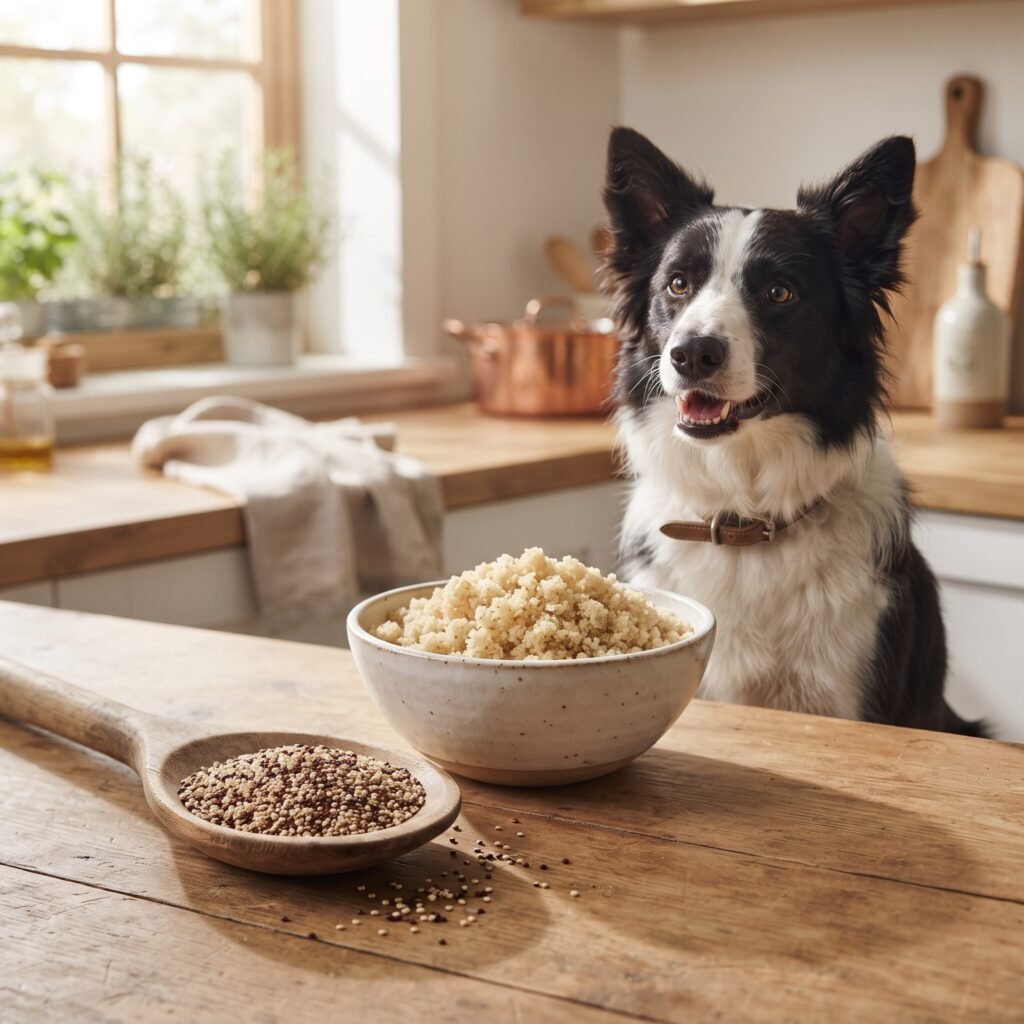
Can dogs with a history of calcium oxalate stones have quinoa safely?
This is the edge case I think deserves far more attention than it typically gets in generic articles. Quinoa contains a meaningful amount of oxalates, naturally occurring compounds that can contribute to calcium oxalate stone formation in dogs already prone to this specific type of urinary stone. Whether dogs can have quinoa safely if they’ve had calcium oxalate stones before is a genuinely different question than whether a healthy dog can, and I wouldn’t treat the two situations the same way.
Certain breeds show a higher documented predisposition toward calcium oxalate stones, including Miniature Schnauzers, Bichon Frises, Yorkshire Terriers, and Lhasa Apsos, and a dog from one of these breeds with a personal or family history of stones is exactly the case where I’d skip quinoa entirely rather than trying to manage portion size carefully. For a dog without any stone history and no strong breed predisposition, the oxalate content in an occasional small serving of quinoa isn’t something I’d worry about significantly, but I wouldn’t make quinoa a daily staple for any dog without checking this risk factor first.
Can dogs have quinoa if they’re diabetic or need to lose weight?
This is the situation where quinoa genuinely shines as a smart substitution rather than just a trendy swap. Quinoa has a lower glycemic index than white rice, meaning it causes a more gradual rise in blood sugar, which matters directly for a diabetic dog’s blood glucose management alongside insulin therapy. Whether dogs can have quinoa as part of a diabetes management plan is a conversation worth having with your vet specifically, but it’s a reasonable substitution to bring up rather than defaulting to rice out of habit.
For weight management, quinoa’s higher fiber and protein content relative to white rice can help a dog feel more satisfied on a similar calorie count, which matters for the same reason it matters in human weight management diets. I used quinoa as a partial rice substitute for my own senior dog’s home-cooked meals after her diabetes diagnosis, and her post-meal blood glucose readings, tracked alongside her vet’s monitoring, were noticeably more stable on the days quinoa replaced rice in her usual meal rotation.
Comparison: quinoa versus common carbohydrate alternatives for dogs
| Ingredient | Protein per 100g cooked | Oxalate content | Glycemic index | Gluten-free | Typical use case |
|---|---|---|---|---|---|
| Quinoa | ~4.4g | Moderate to high | Lower-moderate | Yes | Diabetic or weight management support, grain sensitivity |
| White rice | ~2.7g | Low | High | Yes | Standard bland-diet base, easy digestibility |
| Brown rice | ~2.6g | Low | Moderate | Yes | Slightly more fiber than white rice |
| Plain oats | ~2.5g | Low | Moderate | Gluten-free if certified | General fiber source, budget-friendly |
| Sweet potato | ~2.0g | Low-moderate | Moderate | Yes | Fiber and beta-carotene source |
Looking at this table, quinoa’s advantage is real but comes with a trade-off specific to the oxalate column, which is exactly why a blanket recommendation misses the point. For a stone-prone dog, white rice or plain oats are the safer default; for a diabetic or overweight dog without stone history, quinoa’s lower glycemic index makes it a genuinely useful option worth discussing with a vet.
My honest experience: when quinoa didn’t work out
I want to be upfront that quinoa wasn’t a universal win in my own household. My younger dog, a mixed breed with no health conditions, had noticeably looser stools after eating quinoa even when I’d rinsed it thoroughly and served a modest portion, something that never happened with rice or sweet potato in the same recipe rotation. It took me a few attempts to accept that whether dogs can have quinoa without digestive upset isn’t just about preparation — some individual dogs simply tolerate it less well than others, independent of any breed or health-condition risk factor.
I eventually stopped using quinoa for that particular dog and kept it in rotation only for my senior diabetic dog, where the blood sugar benefit outweighed the minor inconvenience of finding an alternative for the other dog’s meals. This taught me not to assume a nutritionally sound ingredient will work equally well across every dog in the same household, even dogs with no diagnosed conditions at all.

How much quinoa can dogs have, and how often?
For a healthy dog without a stone history, I’d treat cooked quinoa as an occasional addition rather than a daily staple, generally no more than one to two tablespoons per 20 pounds of body weight mixed into a regular meal, a few times a week rather than every day. Whether dogs can have quinoa as a larger portion of their diet depends on whether it’s being used therapeutically, like in a vet-guided diabetes management plan, versus as a casual nutritional add-on.
I’d introduce it gradually the first time, starting with a teaspoon-sized amount regardless of the dog’s size, and watching for the loose stool reaction I saw in my own younger dog before scaling up to a fuller portion. Quinoa should never make up the majority of a dog’s diet on its own, since it isn’t formulated as a complete and balanced food and doesn’t replace a properly balanced commercial diet or a vet-formulated homemade recipe — the question of whether dogs can have quinoa as a full meal replacement has a clear no as the answer.
Can puppies have quinoa the same way adult dogs can?
I’d be more conservative with a puppy than with a healthy adult dog, mainly because a puppy’s digestive system is generally more sensitive and less predictable during the first several months. Whether puppies can have quinoa safely follows the same basic preparation rules as adult dogs — thoroughly rinsed, plainly cooked, no seasoning — but I’d introduce it later in a puppy’s feeding routine, after their digestive system has adjusted to their primary puppy food, rather than as an early addition.
A growing puppy also has more specific and less flexible nutrient requirements than an adult dog, so any addition, quinoa included, should stay a small proportion of total daily intake to avoid displacing the nutrient-dense growth formula that’s actually doing the heavy lifting for their development. Whether puppies can have quinoa at all is less important than making sure it never crowds out their primary growth food.
Does quinoa in commercial dog food work the same way as home-cooked quinoa?
Commercial dog foods that list quinoa as an ingredient have generally been formulated and balanced by the manufacturer to account for its nutrient profile within the complete recipe, which is a different situation than adding home-cooked quinoa as a topper to an existing complete diet. Whether dogs can have quinoa through a commercial food without issue usually isn’t a meaningful question, since the manufacturer has already accounted for portion and balance as part of the overall formulation.
Home-added quinoa is where the oxalate, saponin, and portion considerations actually become the owner’s responsibility rather than the manufacturer’s, since you’re adding it on top of an already complete diet rather than relying on a professionally balanced recipe. I’d treat commercial quinoa-containing foods and home-added quinoa as genuinely different scenarios with different levels of oversight needed, and I wouldn’t assume the same portion rules apply equally to both when deciding whether dogs can have quinoa in either form.
Does it matter whether quinoa is white, red, or black?
Quinoa comes in a few common color varieties, and whether dogs can have quinoa safely doesn’t really change based on color, since white, red, and black quinoa share a broadly similar nutrient and saponin profile. Red and black quinoa tend to have a slightly firmer texture and a bit more fiber than white quinoa, which could matter marginally for a dog with a sensitive stomach, but I wouldn’t treat this as a meaningful safety distinction.
I’ve used white quinoa most often simply because it’s more widely available and cooks a bit faster, and I haven’t noticed a meaningful difference in how my dogs tolerated it compared to the red variety I’ve occasionally substituted. If your dog tolerates one color well, there’s little reason to assume switching varieties would create a new problem, though I’d still introduce a new color gradually the first time out of general caution.

How does cost compare between quinoa and more common carbohydrate bases?
Quinoa runs noticeably more expensive than white rice or plain oats, often two to three times the price per pound depending on the brand and whether it’s organic. For an owner deciding whether dogs can have quinoa as a regular rotation item rather than an occasional addition, that cost difference is a legitimate practical factor, not just a health question.
I’d reserve quinoa for situations where it’s actually solving a specific problem — the glycemic index benefit for a diabetic dog, or genuine variety for a dog eating a home-cooked rotation diet — rather than assuming it needs to replace rice or oats across the board simply because it has a trendier reputation. For a healthy dog with no specific need driving the choice, the cost difference alone is a reasonable reason to stick with a more affordable carbohydrate base most of the time and treat quinoa as an occasional addition instead.
Should every dog in a multi-dog household get quinoa if one of them benefits from it?
This came up directly in my own household, since only one of my two dogs actually needed the glycemic benefit quinoa offered. Whether dogs can have quinoa safely doesn’t mean every dog under one roof needs to eat it, and I found it simpler to keep quinoa in rotation only for the dog managing diabetes, while my other dog stayed on her usual rice-based meal base without any issue.
Preparing two slightly different meal bases takes a little more effort at cooking time, but it avoided introducing an ingredient my younger, healthy dog didn’t tolerate as well, purely for the sake of household consistency. I’d encourage owners to make this decision per dog based on actual need and tolerance, rather than assuming whatever works for one dog should automatically apply to every dog sharing a home, since whether dogs can have quinoa safely is ultimately an individual question, not a household-wide one.
What symptoms should make you stop feeding quinoa immediately?
Whether dogs can have quinoa safely on an ongoing basis becomes a different question the moment any concerning symptom shows up, and I’d treat certain signs as a clear stop point rather than something to push through. Vomiting, diarrhea lasting more than a day, visible straining to urinate, or blood in the urine after introducing quinoa are all reasons to discontinue it and check in with a vet rather than assuming the reaction will resolve on its own.
Mild, brief loose stools during the first introduction, the kind I saw with my own younger dog, are common enough with any new food that I wouldn’t necessarily panic over a single instance, and it doesn’t automatically mean that particular dog can never have quinoa again in smaller amounts. But a pattern that persists past a few feedings, or any urinary symptom at all given the oxalate consideration, is where I’d stop offering quinoa and reassess rather than continuing to experiment with portion size.
Does the dog’s age change the calculation beyond just puppies?
Senior dogs deserve their own consideration separate from the puppy guidance covered earlier, mainly because kidney function naturally declines with age in many dogs, and oxalate handling ties directly into kidney and urinary health. Whether dogs can have quinoa safely into their senior years depends partly on whether routine senior bloodwork shows any early kidney changes, since that’s exactly the population where oxalate content deserves closer attention even without a formal stone diagnosis yet.
I check in with my vet at every senior wellness visit about which home-added ingredients still make sense given current bloodwork, rather than assuming whatever worked in a dog’s healthy middle years remains appropriate indefinitely. This is part of why I’d treat the question of whether an aging dog can have quinoa as one to revisit periodically rather than settling once and never reconsidering it.
How was this information evaluated?
Claims about quinoa’s saponin content and the need for thorough rinsing reflect general food science and veterinary nutrition consensus rather than an invented statistic, since this is well-documented preparation guidance for both human and canine consumption. The oxalate content comparison and its relevance to calcium oxalate stone-prone breeds reflects established veterinary understanding of oxalate-containing foods and urinary stone risk, described here in general terms since precise oxalate content varies by growing conditions and isn’t consistently quantified per serving in verifiable sources.
Glycemic index comparisons between quinoa and rice reflect general nutritional science findings rather than dog-specific clinical trial data, since dog-specific glycemic index research on quinoa specifically is limited in the veterinary literature. Nutrient comparison figures in the table were checked against standard USDA nutrient data for cooked quinoa and rice, adjusted to reflect typical cooked serving values rather than a single specific brand or preparation.
What’s the most common mistake owners make with this question?
The biggest one is treating “can dogs have quinoa” as a universal yes based on quinoa’s reputation as a human superfood, without checking whether their specific dog has a stone history or breed predisposition that changes the calculation. I’ve seen owners of stone-prone breeds add quinoa to home-cooked meals with good intentions, purely because it sounded healthier than rice, without realizing the oxalate content works against exactly the condition they’re trying to manage.
The second common mistake is skipping the rinsing step, assuming that because quinoa is a trendy, “clean” ingredient, it doesn’t need the same preparation care as other whole foods. My own experience, and the documented saponin content on unrinsed quinoa, both point to this step mattering more than most quick recipe summaries suggest.
Frequently asked questions
Can dogs have quinoa flakes or quinoa flour instead of the whole seed? Quinoa flour and flakes generally carry a similar nutrient profile to the whole cooked seed, though processed forms can lose some of the saponin coating during manufacturing, reducing that specific concern. I’d still introduce any quinoa-based product gradually and watch for digestive reaction, the same way I would with the whole cooked seed.
Can dogs have quinoa with vegetables mixed in, like a quinoa salad? The quinoa itself is generally fine, but check every other ingredient in the salad separately, since common additions like onions, garlic, grapes, or a vinaigrette containing xylitol are far more dangerous to dogs than the quinoa. A plain quinoa and dog-safe vegetable mix, like quinoa with plain cooked carrots or green beans, is a reasonable homemade addition.
Is quinoa better than rice for a dog with a sensitive stomach? Not necessarily — quinoa’s higher fiber content can actually be harder on a genuinely sensitive digestive system than plain white rice, which is often used specifically because it’s easy to digest. For an acute stomach upset, I’d stick with the traditional bland diet of plain rice and lean protein rather than introducing quinoa during a flare-up.
How do you know if your dog has a calcium oxalate stone risk before adding quinoa to their diet? A history of urinary stones, blood in the urine, or straining to urinate are signs worth a vet visit and urinalysis before making any dietary change, quinoa included. Certain breeds carry a higher documented predisposition, so checking with your vet about breed-specific risk factors is worthwhile even without prior symptoms.
Can dogs have quinoa every single day as part of their regular diet? Daily quinoa isn’t necessarily harmful for a healthy dog without stone risk, but I’d still treat it as a rotating addition rather than a permanent daily staple, mainly to avoid over-reliance on any single ingredient’s specific nutrient profile. For a dog using quinoa therapeutically, like in a vet-guided diabetes management plan, more consistent daily use makes more sense and should be guided by your vet’s specific recommendation.
Can dogs have quinoa if they’re on a prescription kidney diet? Prescription kidney diets are carefully balanced for phosphorus, protein, and other specific nutrient targets, so adding quinoa on top of one without your vet’s input risks throwing off that careful balance regardless of whether dogs can have quinoa safely in a general sense. Always check with the prescribing vet before adding any home ingredient, quinoa included, to a therapeutic kidney diet.
Can dogs have quinoa mixed into a raw diet? Quinoa isn’t a traditional raw-diet ingredient since raw feeding typically emphasizes muscle meat, organs, and bone rather than seeds or grains, but a small cooked portion can still be added as a supplemental carbohydrate if desired. Whether dogs can have quinoa within a raw feeding framework really comes down to the same rinsing, portion, and health-history considerations that apply to any other feeding style.
The bottom line
Can dogs have quinoa? For most healthy dogs, yes, in small, well-rinsed, plainly cooked portions, and it can genuinely be a smart substitution for rice in a diabetic or weight-conscious dog’s diet. But for a dog with a history of calcium oxalate stones, or a breed with a strong predisposition toward them, the oxalate content changes that answer meaningfully, and I’d skip quinoa in favor of a lower-oxalate carbohydrate instead.
Before deciding whether your dog can have quinoa as a regular addition, check their health history and breed-specific risk factors first, rinse it thoroughly every time, and introduce it gradually to see how their individual digestive system responds. That combination of checks matters far more than quinoa’s trendy reputation as a human superfood when it comes to actually deciding what belongs in your dog’s bowl.