Dog Biscuit Recall: Should You Switch Brands or Stay Put?
Quick answer: A dog biscuit recall is not automatically a reason to abandon a brand. What matters is the trigger — a pathogen caught by routine FDA sampling with no illnesses is a very different situation than a toxin found because dogs died. Check your lot code first, then decide based on the contaminant, your household, and your dog.
I have thrown out a perfectly safe box of biscuits in a panic, and I have also kept feeding a bag I should have bagged up and returned the same afternoon. Both mistakes came from treating every dog biscuit recall as the same event. They are not the same event, and the gap between them is where the actual decision lives.
Most owners hit the same wall. You see a headline about a dog treat recall, your stomach drops, you check the pantry, and the brand matches. Then what? Toss it? Return it? Call the vet? Switch to a different company entirely and never look back?
That last question is the expensive one, because switching brands has costs too — GI upset from a sudden change, a broken elimination diet, a senior dog who finally started eating again on the one biscuit she likes.
The panic is understandable. A dog biscuit recall arrives with no context, no severity rating you can read at a glance, and a comments section full of people insisting all commercial treats are poison. This piece is about cutting through that and making the call well.
Recommended Products
Best Dog Food in 2026
What should I actually do in the first hour after a dog biscuit recall?
Before you decide anything about brand loyalty, you need to know whether you’re even affected. Most people skip this and act on the brand name alone.
Recalls are almost always scoped to specific lots, not entire product lines. The December 2025 dog biscuit recall from Consumers Supply Distributing covered Country Vet Biscuits – Original Meaty Flavor and Heartland Harvest Dog Biscuits – Meaty Flavor with Chicken, both in 4-pound bags, both carrying lot code 40906513 and a 09/06/2026 expiration date. A bag of the same product with a different lot code was not part of that recall.
So, in order:
- Find the bag, don’t rely on memory. Pull it out physically.
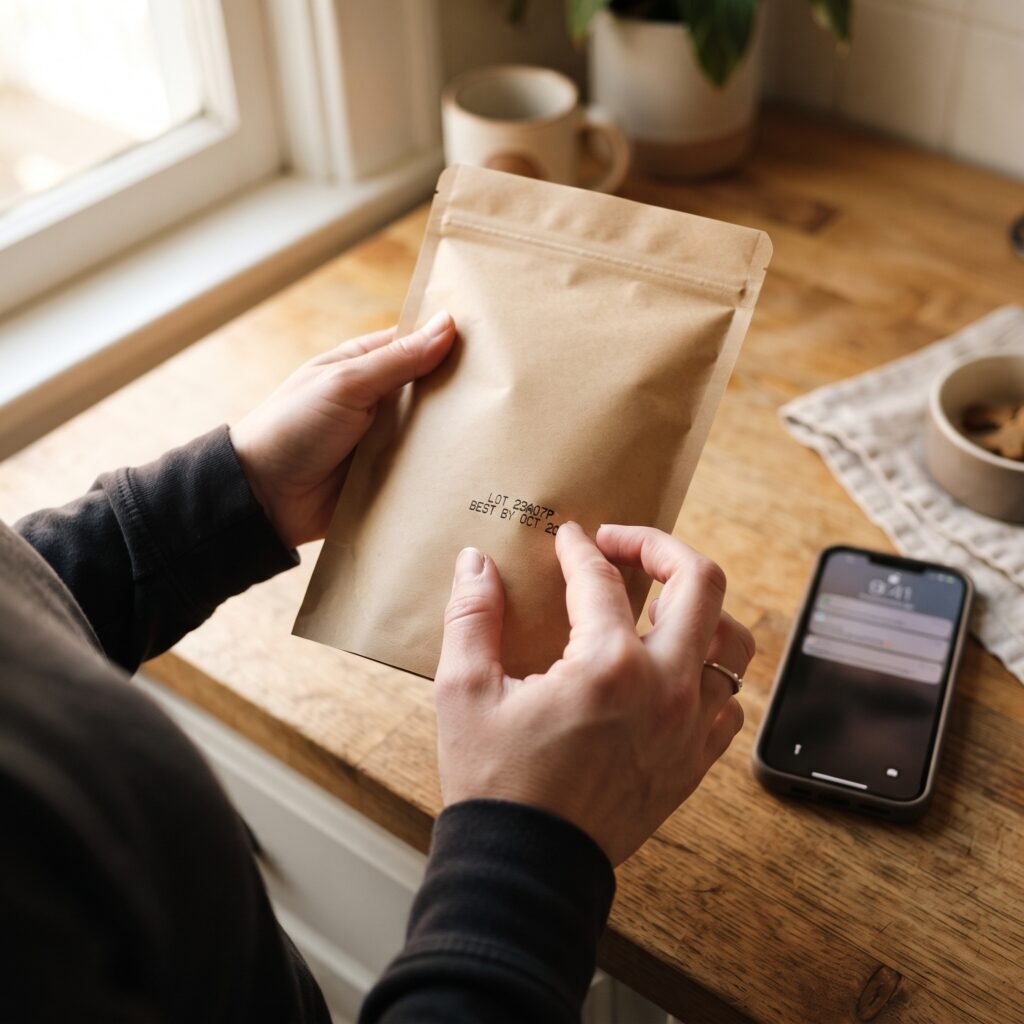
- Locate the lot code and best-by date. On the Country Vet bag it was printed on the front; on the Heartland Harvest bag, the back. Manufacturers are inconsistent about this, which is why photographing the code the day you open a bag is a habit worth building.
- Compare against the company announcement, not the news article. News coverage of a dog biscuit recall routinely drops the lot code or the UPC. The FDA’s own recall page carries the original announcement text, which is what you want.
- Seal it and set it aside. Don’t throw it out yet — most refunds require the bag, and if your dog does get sick, that bag is diagnostic evidence. Every dog biscuit recall notice I’ve read includes refund instructions, and nearly all of them want the product.
- Wash the container, the scoop, and your hands.
That last step matters more than people expect with bacterial contamination. When Salmonella in dog treats is the issue, the biscuit itself isn’t the only exposure route — the storage bin, your hands, and the counter all count. Infected pets can shed the bacteria while looking completely healthy.
Only after this do you have enough information to make a switch-or-stay call.
How do I know if my bag is part of the dog biscuit recall?
The lot code is the whole game, and it’s where most owners go wrong.
A lot code identifies a specific production run — a window of hours or days at one plant, using one shipment of ingredients. That’s why a dog biscuit recall can cover one flavor in one bag size while the identical biscuit made three weeks later is fine. Brand-level panic is almost always wider than the actual dog biscuit recall.
Here’s the part that trips people up: the same physical biscuit is often sold under several brand names. Private-label manufacturing is the norm in this category. In the 2007 melamine crisis, Sunshine Mills recalled dog biscuits sold at Walmart under the Ol’Roy label — the store brand, made by a contract manufacturer, contaminated by wheat gluten sourced overseas.
So when you scan the FDA pet food recall list, don’t just search your brand. Search the manufacturer. If a recall names a company you’ve never heard of, look at the fine print on your bag — “Manufactured for X by Y” or “Distributed by X” — and see if Y appears.
What if I already threw the bag away?
Then you’re working with probability instead of certainty, and you should default to the conservative side.
If your dog ate recalled dog biscuits from a product line within the recall window and you can’t verify the lot, treat it as exposed. That doesn’t mean an emergency vet visit for an asymptomatic dog. It means you watch closely, you know the specific symptoms for that contaminant, and you don’t wait for things to get dramatic before calling.
Where do I check for a current dog biscuit recall?
The FDA pet food recall list is the primary source, and the company announcements posted there are what everything else is summarizing. Sign up for the email alerts. A dog biscuit recall usually reaches your inbox days before it reaches your feed.
Avoid the aggregator sites that republish every dog treat recall with an affiliate link attached. They lag by days, they drop lot codes, and several still show recalls the FDA has since terminated.
Also worth knowing: many large retailers now flag recalled items against your purchase history if you use a loyalty account. It’s an underused safety net.
Why does the reason for the recall change what I should do?
This is the part that generic advice flattens, and it’s the core of the decision.
“Recall” is one word covering wildly different risk profiles. A dog biscuit recall for undeclared cheese is not the same class of problem as a dog biscuit recall for aflatoxin in dog food ingredients. Treating them identically leads to both overreaction and underreaction.
Two variables tell you most of what you need:
What was found, and who found it.
A recall initiated because FDA routine sampling flagged Salmonella in a finished product, with zero reported illnesses, tells you the surveillance system worked as designed. A recall initiated after a wave of consumer complaints about sick and dying dogs tells you the surveillance system failed and the company was the last to know.
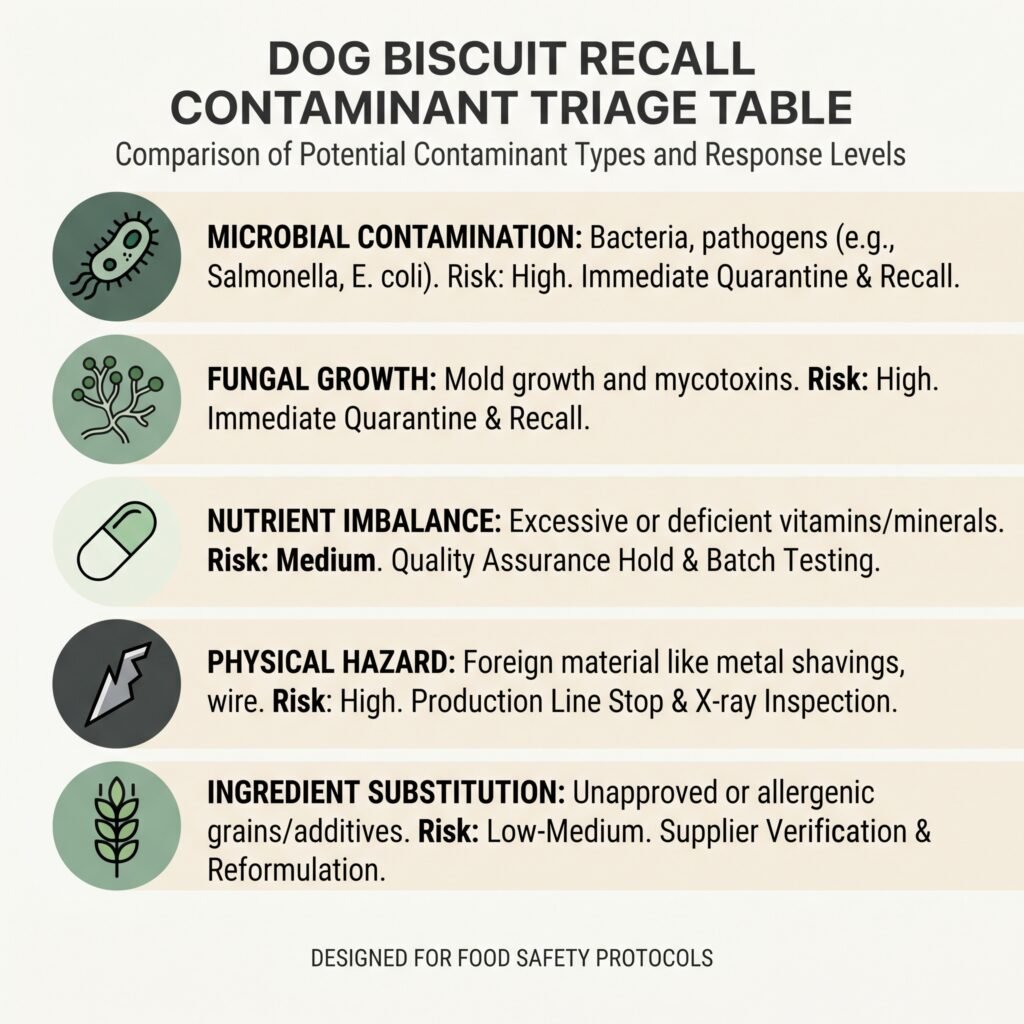
Those two scenarios should produce different decisions. Here’s how I triage them.
| Recall trigger | Typical FDA class | Onset window in dogs | Risk to humans in the home | My default call |
|---|---|---|---|---|
| Salmonella, found by routine FDA sampling, no illnesses | Class I or II | 6 hours–6 days; often asymptomatic carriage | Real — handling the biscuits or bin transmits it; symptoms in people appear 6 hours to 6 days after exposure | Stay — unless there’s an infant, senior, or immunocompromised person in the house |
| Aflatoxin above the FDA action level of 20 ppb | Class I | 24 hours–3 weeks; liver damage may be silent early | Low from handling | Switch, and call your vet even if the dog looks fine |
| Vitamin D excess | Class I | 12 hours–several days; excessive thirst and urination first | None | Switch — formulation errors point to process control problems |
| Foreign material (metal, plastic fragments) | Class II typically | Immediate — mouth injury, or none at all | None | Stay, if the lot is confined and your dog didn’t eat that lot |
| Undeclared allergen (dairy, soy, wheat) | Class II or III | Hours, and only in sensitized dogs | None | Stay — unless your dog is on an elimination diet |
A quick note on that aflatoxin row, because the numbers are worth internalizing. The FDA’s action level for aflatoxin in dog food and cat food is 20 parts per billion. In the 2020–2021 Midwestern Pet Foods event — the worst pet food contamination in recent memory — testing found product as high as 558 ppb, and the FDA was ultimately aware of more than 70 pet deaths and more than 80 illnesses. That is roughly 28 times the action level.
Compare that to the FY21 FDA special sampling assignment for aflatoxins in kibbled dog and cat foods, where the positive samples came in between 0.54 and 6.52 ppb — all well below the action level, none associated with reported illness. The distance between “detectable” and “dangerous” is enormous, and a dog biscuit recall headline never conveys it. Detectable aflatoxin in dog food is common; dangerous aflatoxin is rare, and the gap between them is measured in orders of magnitude.
Is a brand with a recall history worse than one with none?
Counterintuitively, often no — and this is where I break with a lot of the advice circulating online.
A brand with zero recalls in fifteen years could mean rigorous quality control. It could also mean the company doesn’t test aggressively, or is small enough to have never been sampled. Absence of a dog biscuit recall is absence of evidence, not evidence of safety.
I would rather buy from a company that has issued one well-handled dog treat recall than from one that has never appeared on the FDA pet food recall list and can’t tell me who makes its biscuits.
What I actually look at is the pattern:
A single recall, caught early, scoped tightly, announced quickly, with clear lot codes — that’s a functioning food safety program. I’ll keep buying from that company.
Repeat recalls for the same contaminant across multiple years — that’s a systems failure. Sunshine Mills recalled products for aflatoxin in August 2020, expanded it in September and October 2020, and recalled again in June 2021. The FDA later issued a warning letter citing significant violations of Current Good Manufacturing Practice requirements, including a finished dog food sample that tested at 32.7 ppb aflatoxin — above the action level — as evidence that ingredient testing controls weren’t being implemented. That’s not bad luck. That’s a pattern.
A dog biscuit recall that only happened after dogs got sick — the most serious signal of all. It means the company’s own testing didn’t catch what a state lab or a pile of consumer complaints did.
What about the “biggest dog biscuit recall in history” framing?
Historical scale is a poor guide to your personal risk today. The 1998 Doane Products aflatoxin event covered more than 1.3 million bags across 54 brands, with contaminated corn loads testing between 66.4 and 495.3 ppb and at least 25 dog deaths reported. Enormous — and completely irrelevant to whether your current bag is safe.
Use dog biscuit recall history to evaluate a manufacturer’s process, not to rank the severity of what’s in your pantry right now.
The switch-or-stay test I use
Five questions. If you answer yes to any of the first three, switch. If it’s only questions four or five, you probably don’t need to.
1. Was the contaminant a toxin or a formulation error rather than a pathogen? Aflatoxin, vitamin D excess, and mineral imbalances come from ingredient sourcing or formulation control. Those are upstream, systemic problems. Salmonella in a dry biscuit is a contamination event — serious, but more containable.
2. Did the dog biscuit recall come after illness reports rather than before? Reactive recalls tell you the company’s testing regime isn’t catching things. A dog biscuit recall triggered by a state lab or an FDA sample is a company being caught before harm; one triggered by dogs already in liver failure is something else entirely. That’s a reason to leave.
3. Has this manufacturer had a similar recall in the last three years? One is an incident. Two is a pattern. Three, and I’m done regardless of how much my dog likes the biscuits.
4. Was the affected lot narrow and clearly identified? Tight scoping with specific UPCs, lot codes, and dates is a sign of good traceability. Vague scoping — “all products manufactured between March and August” — means they don’t know what they made.
5. Did the company announce it themselves, quickly, with photos? The FDA posts company announcements as a public service; the ones that include product photos and full lot tables are the ones from companies that had their records in order.
What’s the difference between a dog biscuit recall and a market withdrawal?
Owners use these interchangeably. The FDA doesn’t, and the distinction changes how much weight you should give a headline.
Nearly every dog biscuit recall you’ll ever see is voluntary — the company initiates it, and the FDA posts the announcement as a public service. The agency is explicit that posting an announcement isn’t an endorsement or a condemnation of the company. Seeing a brand on the FDA pet food recall list means the company acted; it doesn’t mean the FDA forced them to.
Recalls then get classified by severity:
- Class I — reasonable probability that the product will cause serious adverse health consequences or death. Aflatoxin above the action level lands here. So does a serious vitamin D formulation error.
- Class II — the product may cause temporary or medically reversible health consequences, with remote probability of serious harm. Many undeclared-allergen and foreign-material recalls sit here.
- Class III — unlikely to cause adverse health consequences. Labeling and minor compliance issues.
A market withdrawal is different again: the company pulls product for a minor issue that wouldn’t trigger FDA legal action. Not every product pull is a dog treat recall.
There’s one more status worth knowing, because almost nobody checks it. The FDA marks recalls as completed and terminated once the action is finished. Several of the aggregator posts that scare people are covering recalls that were terminated years ago. If a dog biscuit recall you’re reading about is dated, look for that termination note before you throw anything out.
Does the class tell me whether to switch brands?
Partially. Class I is a strong signal to leave, because it means someone at the FDA concluded that serious harm or death was reasonably probable.
But class describes the hazard, not the company. A Class I dog biscuit recall that a manufacturer caught themselves through internal testing, scoped to one lot, and announced within days tells a different story than a Class II recall dragged out of a company by complaints. Read the class and the conduct together.
Which dogs need a stricter response?
The switch-or-stay test assumes an average healthy adult dog. Several situations override it entirely.
Dogs with existing liver disease. Any dog biscuit recall involving aflatoxin or a hepatotoxin is a hard stop, and a same-day vet call, because the margin for additional liver insult is already gone. Aflatoxicosis presents as lethargy, reluctance to eat, vomiting, jaundice — a yellowish tint to the eyes or gums — and diarrhea, and by the time jaundice appears, damage is well underway.
Puppies and small breeds. Dose is relative to body weight. Three contaminated biscuits in a 6-pound Maltese puppy is a fundamentally different exposure than three in an 80-pound Lab. I get much more conservative under about 15 pounds.
Immunosuppressed dogs. Dogs on steroids, chemotherapy, or immunomodulators for autoimmune disease handle a Salmonella exposure far worse than a healthy dog. For these dogs, Salmonella in dog treats is never a wait-and-see situation, and I switch on any pathogen recall.
Senior dogs with reduced kidney or liver function. Clearance is slower, so the same exposure produces a longer window of harm.
Households with infants, adults over 65, pregnant people, or anyone immunocompromised. This one has nothing to do with your dog. Salmonella in dog treats is as much a human health issue as a canine one — that’s why FDA announcements always address handling. If there’s a vulnerable person in your home, a pathogen recall means switch, full stop, regardless of how well the company handled it.
Dogs mid-elimination diet. Discussed below, because this is where my own framework failed.
What I saw with my own dog, and what I got wrong
My dog Nutmeg is a 41-pound hound mix, eleven years old, with a gut that announces every dietary change within about eighteen hours. She ate recalled dog biscuits — four of them, across two days — before I ever saw the dog biscuit recall announcement.
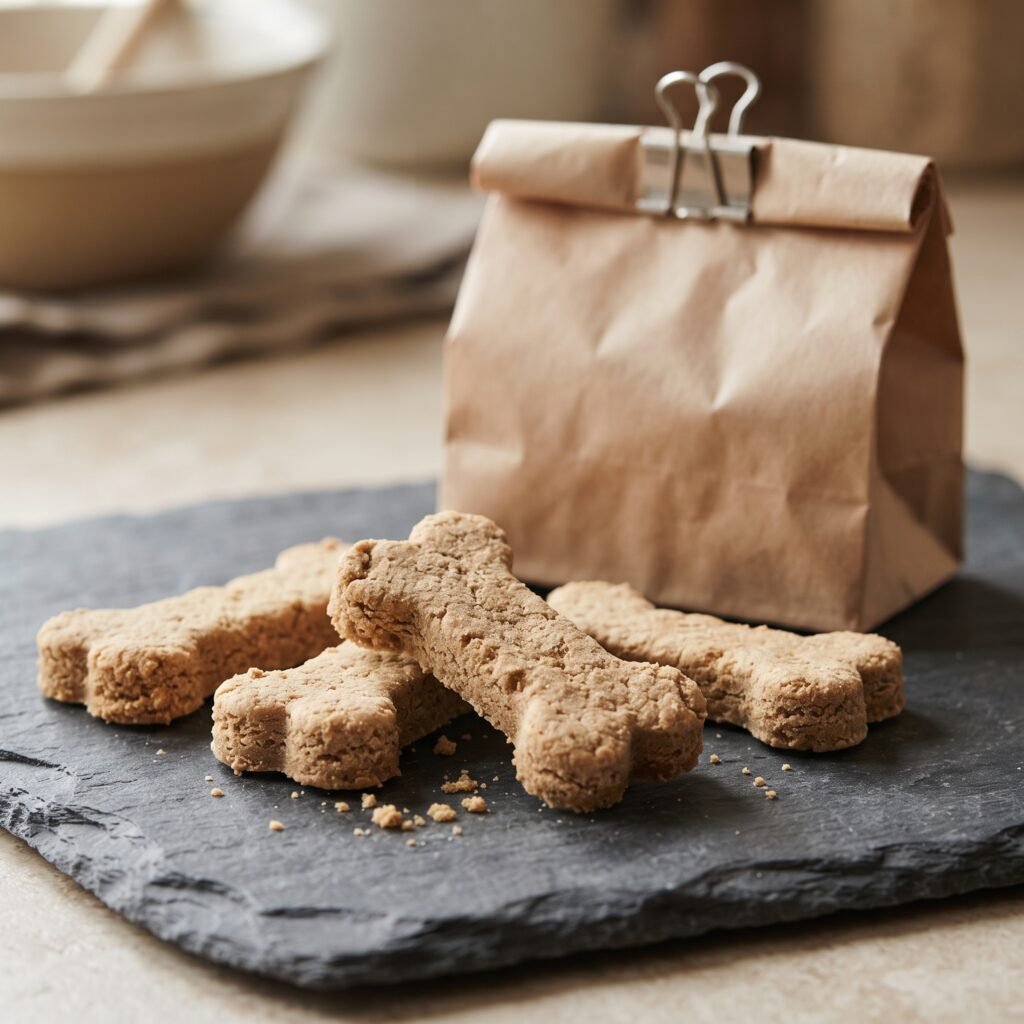
The biscuits themselves told me nothing. They were the standard bone shape, about three and a half inches long, and they snapped clean with a dry crack rather than bending — which is the texture you want, since a biscuit that flexes has picked up moisture and is a mold risk on its own. They smelled like toasted grain and faintly of chicken fat. Completely normal.
And that’s exactly the mistake I made. I sniffed the bag, found nothing off, and told myself it was probably fine for another day while I looked into it.
You cannot smell or see aflatoxin in dog food. It’s a byproduct of Aspergillus flavus growing on corn and other grains, and contaminated product can look and smell entirely normal. I knew that in the abstract and still let a sensory check override a written recall notice. Nutmeg was fine — she showed nothing, ate normally, and a liver panel three days later came back unremarkable. That outcome was luck, not judgment.
The other thing worth naming: the cost of that dog biscuit recall wasn’t the biscuits. It was three days of low-grade dread and a bloodwork bill I didn’t need to spend. Which is an argument for acting decisively at hour one rather than negotiating with yourself.
When switching brands was the wrong call
Here’s the failure case, because the framework above is not universal.
A reader wrote to me about a four-year-old Frenchie six weeks into an eight-week hydrolyzed protein elimination diet for suspected food allergy. His single approved treat — a limited-ingredient biscuit — turned up in a dog treat recall for an undeclared allergen. He did what my test says to do for allergen recalls when a dog is on an elimination diet: he switched.
He picked a different limited-ingredient biscuit with a clean-looking label and kept going.
That was a mistake, and I told him so. Introducing a new protein source at week six doesn’t preserve the trial — it invalidates it. Six weeks of a miserable, hungry dog and a strict household, gone, because the replacement introduced a variable the trial existed to isolate.
The correct move was stop biscuits entirely for the remaining two weeks and use the dog’s own hydrolyzed kibble as treats. Not “switch brands.” Not “keep feeding.” A third option my five-question test doesn’t contain, because the test assumes treats are a fixed part of the routine.
The lesson generalizes. Any time a dog is mid-diagnostic — elimination trial, GI workup, new medication with a monitoring period — a dog biscuit recall should trigger subtraction, not substitution. Adding a new product during a controlled trial destroys the control.
How many biscuits does your dog actually need?
Worth asking during a recall, because the honest answer for most dogs is “fewer than they’re getting.”
The widely used veterinary rule of thumb is that treats should stay under 10% of daily calories, with the remaining 90% from a complete and balanced diet. Most biscuits are labeled for intermittent or supplemental feeding — meaning they are not formulated to meet AAFCO’s complete and balanced nutrient profiles, and aren’t meant to.
| Dog weight | Typical maintenance calories/day | 10% treat ceiling | Medium biscuits (~35 kcal) |
|---|---|---|---|
| 10 lb | ~300 kcal | 30 kcal | Under 1 |
| 20 lb | ~500 kcal | 50 kcal | 1–2 |
| 40 lb | ~850 kcal | 85 kcal | 2–3 |
| 60 lb | ~1,150 kcal | 115 kcal | 3 |
| 80 lb | ~1,450 kcal | 145 kcal | 4 |
These are estimates for a typical neutered adult at a healthy weight; actual needs vary substantially with age, activity, and metabolism, and biscuit calories vary from roughly 15 to over 100 each. Check your label — the calorie content is required to be there.
Two things fall out of this table. First, a dog biscuit recall affects a smaller share of your dog’s nutrition than the anxiety suggests. Second, if you’re at four or five biscuits a day for a 40-pound dog, the recall is not your biggest problem.
How to make the next dog biscuit recall easier
Three habits, ten seconds each.
Photograph the lot code and best-by date when you open a bag. Take the photo, keep it in your camera roll. When a dog biscuit recall lands, you’re checking a photo instead of digging through the trash. This one habit has saved me more time than everything else on this page combined.
Keep the bag, not just the biscuits. Decanting into a nice glass jar destroys your only record. Either keep the bag rolled inside the container, or cut out the panel with the code and tape it to the lid.
Buy from two brands, not one. Rotation means a dog biscuit recall never leaves you with nothing your dog will eat, which is when panic-buying happens. It also halves the odds that any single dog biscuit recall takes out your entire treat supply.
And subscribe to the FDA’s recall alerts. It costs you nothing and it puts you ahead of the news cycle.
Methodology: how I evaluated this
I built this decision framework by working backward from actual FDA company announcements rather than from secondary coverage, and I cross-check every recall claim against the FDA’s own recall pages before I act on it.
For each dog biscuit recall referenced here I verified: the recalling entity, the contaminant, the trigger (routine sampling versus complaint-driven), the scope as published in the company announcement, and whether illnesses were reported. Where a number is cited — the 20 ppb aflatoxin action level, the 558 ppb Midwestern Pet Foods finding, the 32.7 ppb warning letter figure — it comes from FDA documentation, not from an aggregator.
For product evaluation more broadly, I check whether the biscuit is labeled complete and balanced or for intermittent and supplemental feeding, compare guaranteed analysis figures against AAFCO-established ranges where applicable, identify the actual manufacturer rather than the brand on the front, and review that manufacturer’s recall history over the preceding ten years.
Calorie guidance here is general and not a substitute for your veterinarian’s assessment of your individual dog.
Reviewed by: [DVM reviewer name — pending]
Frequently asked questions
Is there a dog biscuit recall right now?
Recall status changes constantly, so check the FDA pet food recall list directly rather than trusting any article’s publication date. The most recent widely distributed dog biscuit recall at the time of writing was the December 2025 Consumers Supply Distributing action covering Country Vet and Heartland Harvest biscuits in seven states, prompted by Salmonella found during routine FDA sampling. No illnesses were reported in connection with it.
Can I keep using the rest of the bag if my dog seems fine?
No. An asymptomatic dog tells you nothing about the safety of recalled dog biscuits, because contamination is rarely uniform across a production run — one biscuit can be affected while the next isn’t. With Salmonella specifically, the bag also poses a risk to the people handling it, not just the dog.
How long after eating recalled dog biscuits would symptoms appear?
It depends entirely on what the dog biscuit recall was issued for. Salmonella typically shows within 6 hours to 6 days, aflatoxin damage can take days to weeks and may be silent until liver injury is advanced, and foreign material injuries are immediate. Match your watch window to the contaminant named in the recall, not to a generic 24-hour rule.
Does a dog biscuit recall mean I should stop feeding that brand’s kibble too?
Usually not, unless the recall names the kibble or both products come off the same line with the same contaminated ingredient. Aflatoxin recalls are the exception worth taking seriously — a bad corn shipment can move through multiple product lines at one plant, which is exactly what happened in the 2020 Sunshine Mills expansions.
Do I need to throw away the storage container?
Wash it thoroughly with hot soapy water after any dog biscuit recall involving a pathogen, and let it dry completely before refilling. Plastic bins with scratched interiors are harder to sanitize, so for a Salmonella-related dog biscuit recall I replace scratched containers rather than gambling on them. Wash the scoop too — it’s the most commonly missed item.
The bottom line
A dog biscuit recall is information, not a verdict. The brand didn’t necessarily fail you; sometimes a dog biscuit recall means the safety system caught something before your dog did.
Check the lot code first. Then ask what was found and who found it. If the answer is a toxin, or a company that only learned about it from sick dogs, or a third strike in three years, leave. If it’s a pathogen caught by routine sampling, scoped tightly, announced fast — and there’s no vulnerable person or vulnerable dog in your house — you can reasonably stay.
And if your dog is mid-elimination diet, remember there’s a third option that isn’t on anyone’s checklist: stop the biscuits, don’t replace them, and finish the trial.