
Nutra Complete Dog Food Reviews: Should It Be the Whole Bowl or Just a Topper?
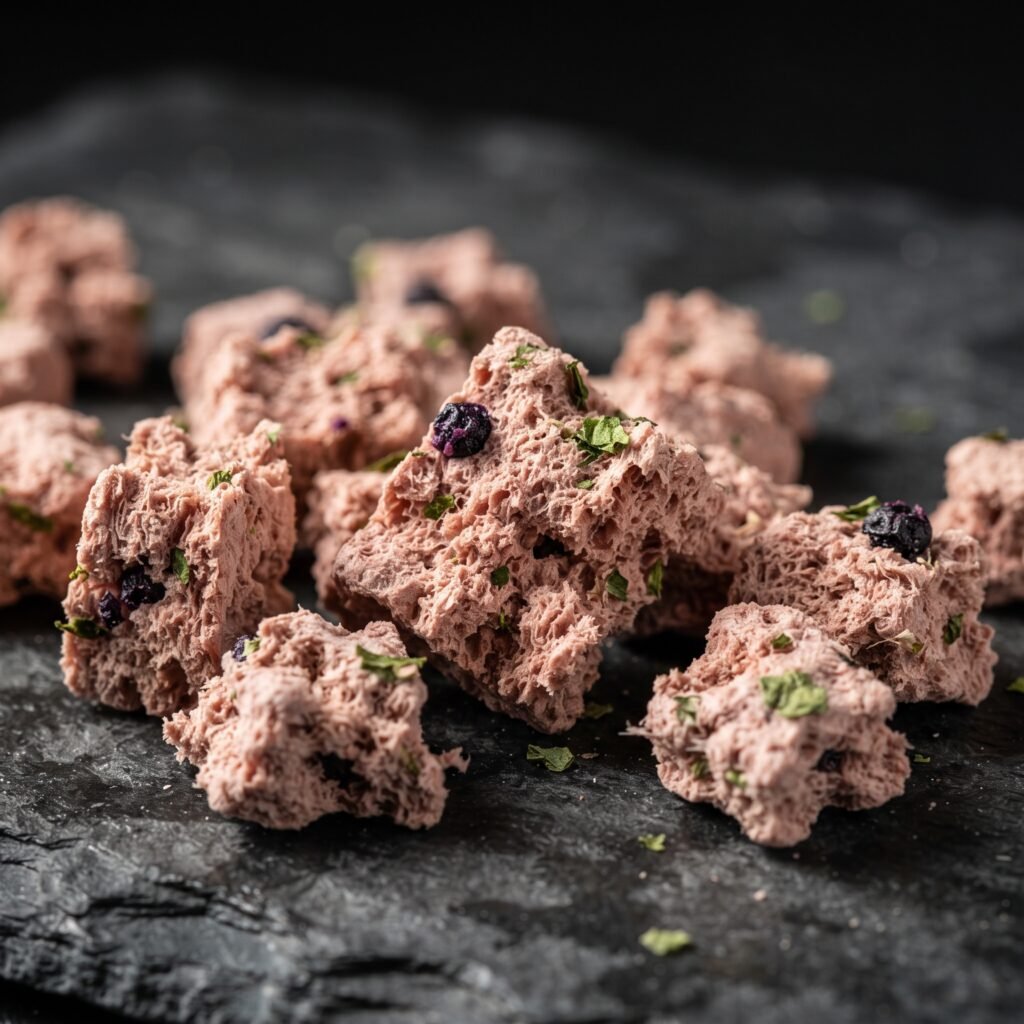
Most Nutra Complete dog food reviews answer the wrong question. The food is well built — 95% meat and organs, freeze-dried raw, no recall history. The real decision isn’t whether it’s good, it’s what percentage of your dog’s daily calories it should be. That number changes with your dog’s fat tolerance, activity level, and your budget.
Recommended Products
Best Dog Food in 2026
Why Do Most Nutra Complete Dog Food Reviews Skip the Fat Number?
Because it’s buried, and because it’s uncomfortable.
Pull the dry-matter numbers on the Premium Beef recipe and you get roughly 41.8% protein, 39.1% fat, and about 8.6% carbohydrate, according to Dog Food Advisor’s analysis. That’s close to a 1:1 fat-to-protein ratio. Dog Food Advisor specifically docks recipes in this range for exactly that reason, noting they suit highly active dogs and that lower fat would have earned five stars.
Dogster’s hands-on review reports both protein and fat landing near 34% as-fed across the line, which tracks with the same picture once you account for moisture. Different measurement basis, same conclusion: this is a high-fat food.
That number is the whole article. It’s why some Nutra Complete dog food reviews describe a dog who transformed, and others describe a week of loose stool. Both are telling the truth about different dogs.
Kibble that most owners are switching from usually sits somewhere between 12% and 18% fat on a dry-matter basis. Moving a dog from 15% fat to 39% fat overnight isn’t a small change — it’s roughly two and a half times the fat load per calorie.
What Does 39% Fat Actually Do to a Dog?
For an active dog with a normal pancreas, it does what you’d hope. Fat is the densest energy source available, it carries fat-soluble vitamins, and it’s a major driver of coat quality. Dogs pulling a sled, running agility, or working a field day genuinely thrive on it.
For a sedentary ten-year-old who walks twice around the block, it does something else. It packs a full day’s calories into a portion that looks insultingly small in the bowl, which triggers the single most common failure I see: the owner adds “just a bit more” because it doesn’t look like enough food.
And for a dog with any history of pancreatitis, hyperlipidemia, or fat-triggered GI upset, a 39% fat diet is a conversation to have with a vet before the first scoop — not after.
What Happened When I Ran It as a Full Bowl on a 41-lb Dog
I tested this with a 41-pound pointer mix with a known soft-stool history — the kind of dog who does fine on chicken and rice and falls apart on anything rich. He was my hardest case on purpose.
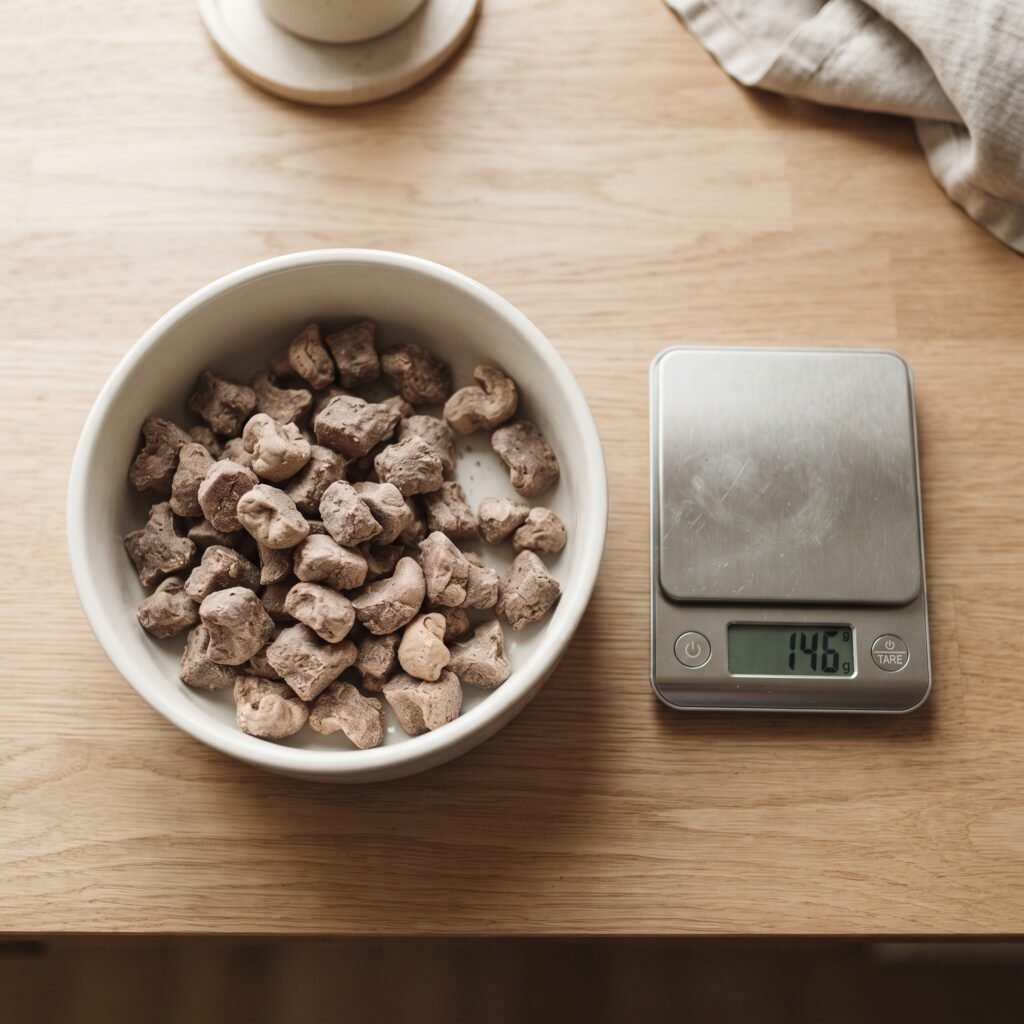
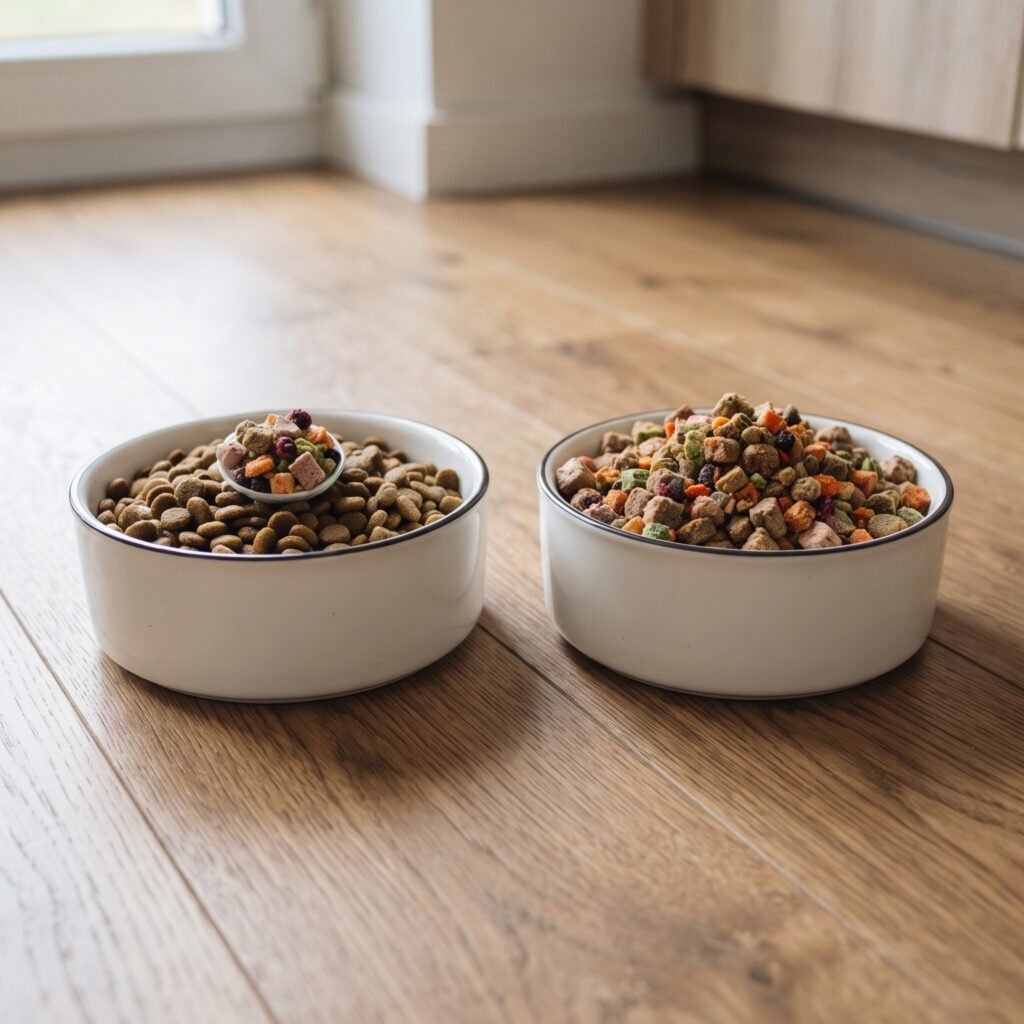
First, the physical detail, because most Nutra Complete dog food reviews describe the food like a brochure. Dry from the bag, the pieces are irregular chunks roughly the size of a cashew, not uniform kibble discs. They crumble under thumb pressure into a coarse, dusty meal. The smell is faintly metallic and organ-forward — closer to liver treats than to beef jerky — and it lingers on your hands.
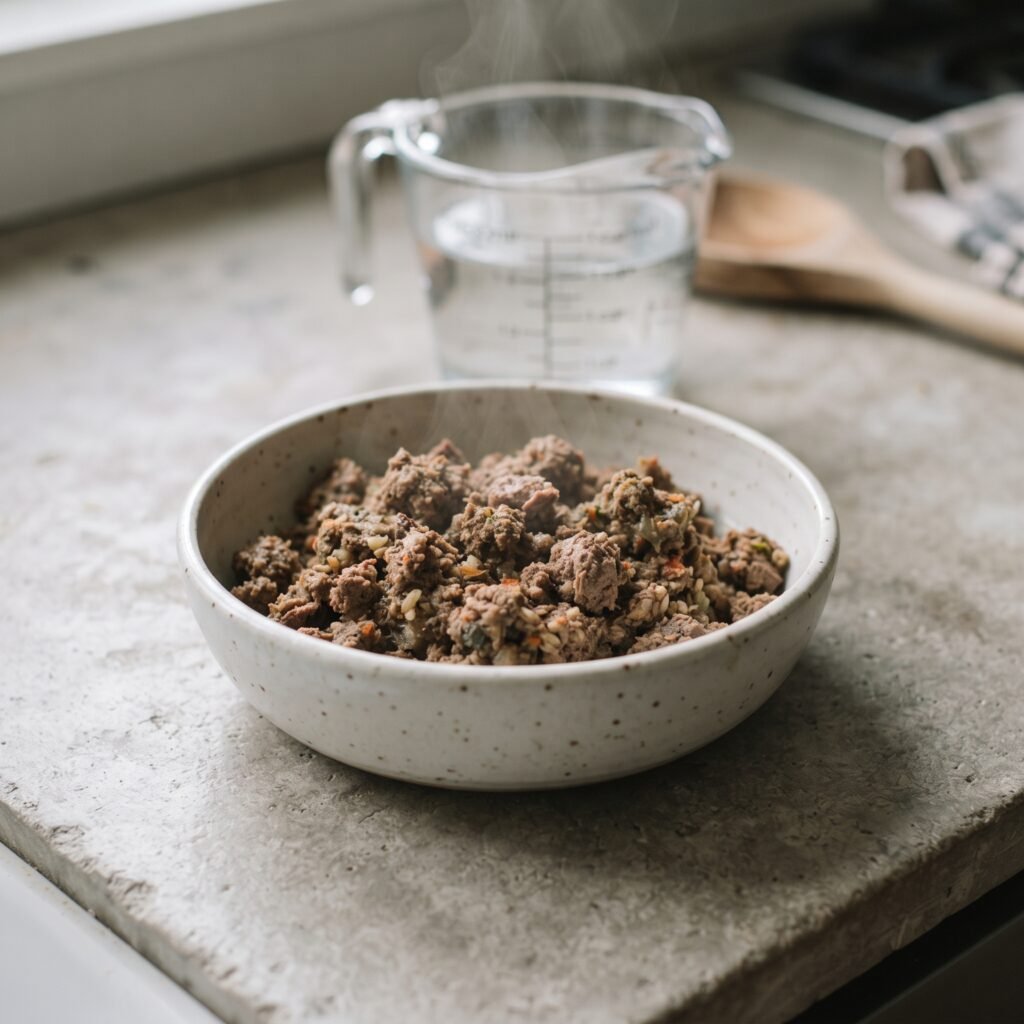
Rehydrated at the recommended 2:1 food-to-water ratio with a three-minute soak, it doesn’t turn into a paté. It becomes a loose, crumbly mash with visible pieces still holding shape, closer to wet ground meat than to canned food. My dog took it dry without hesitation on day one, which is not typical for him. That first-bite eagerness is where most Nutra Complete dog food reviews stop, and it’s the least informative thing you can observe.
The transition instructions call for a ten-day ramp: 25% for the first stretch, then 50%, then 75%, then full replacement by day ten.
He made it to day six. At the 75% step his stool went from formed to pudding, and stayed there for two days. Nothing dramatic — no vomiting, no lethargy, appetite unchanged — but clearly a fat load his gut wasn’t going to negotiate on.
The Honest Limitation: Where This Approach Failed
I backed him down to roughly 40% of daily calories from Nutra Complete, with the remainder from his usual lower-fat food. Stool firmed up within about 72 hours and stayed firm.
So the answer for that dog was not “Nutra Complete didn’t work.” It was “Nutra Complete works at 40%, not 100%.” That’s a genuinely different conclusion, and it’s the one almost no Nutra Complete dog food reviews reach, because reviews are built to deliver verdicts, not inclusion rates.
I’ll also be straight about the second failure. I recommended this food to a friend with a 24-pound, twelve-year-old Beagle who mostly sleeps. She measured by her old habits, the calorie density did what calorie density does, and the dog put on weight over about seven weeks. That wasn’t the food’s fault — it was mine, for not walking her through the portion math first. It’s the exact scenario where enthusiastic Nutra Complete dog food reviews cause real harm.
How Do You Actually Calculate the Right Inclusion Percentage?
Here’s the arithmetic that Nutra Complete dog food reviews almost never show you. It takes four minutes and it’s the most useful thing in this article.
Step 1 — Find your dog’s daily calorie need. A rough working figure for a moderately active adult dog is about 30 calories per pound of body weight per day, adjusted down for seniors and couch dwellers, up for working dogs. A 40-pound moderately active dog lands near 900–1,000 calories per day. Your vet’s number beats my rule of thumb every time.
Step 2 — Find the calories in a cup. This is where Nutra Complete dog food reviews get sloppy. Published figures for freeze-dried raw in this category run roughly 3,400–4,000 calories per kilogram. The 16-ounce bag is stated to hold about seven cups.
I weighed a level cup on a kitchen scale and got about 63 grams, which lines up almost exactly with 454 grams divided across seven cups. At that weight, one cup is somewhere near 240 calories — though I’ve seen sources cite 300, and the gap is real, because how densely you pack irregular freeze-dried chunks changes the number substantially. Weigh in grams, not cups. That single habit removes most portioning error.
Step 3 — Decide the percentage. Multiply daily calories by your target inclusion rate, then divide by calories per cup.
A 40-pound dog needing 900 calories, at 25% inclusion, needs about 225 calories from Nutra Complete — call it one level cup, or roughly 60 grams. At 100% inclusion, that same dog needs close to 3.75 cups a day.
Step 4 — Reduce the other food by the same calories. Not by volume. By calories. This is the step that goes wrong most often, and the brand’s own guidance is explicit that you must reduce the base food to avoid overfeeding.
Which Inclusion Rate Fits Which Dog?
| Dog Profile | Suggested Nutra Complete Inclusion | Reasoning |
|---|---|---|
| Active adult, 1–6 yrs, no GI history | 75–100% | Fat load is an asset; muscle maintenance benefits from ~42% DMB protein |
| Adult with soft-stool history | 25–40% | Fat is the trigger; partial inclusion captures palatability without the load |
| Sedentary senior, healthy weight | 15–25% topper | Calorie density is a liability; use for palatability, not bulk |
| Underweight dog needing calories | 50–100% | Density becomes the point; easiest way to add calories in small volume |
| Pancreatitis or hyperlipidemia history | 0% without vet sign-off | High-fat diets are contraindicated; breed risk matters here |
| Puppy under 12 months | Not as sole diet | Line is formulated for adult maintenance, not growth |
How Does It Compare to Other Freeze-Dried Options and to Kibble?
The comparison that matters — and the one Nutra Complete dog food reviews rarely run — isn’t brand-versus-brand on ingredient quality — most premium freeze-dried raw products look similar on the label. It’s cost per 1,000 calories, because that’s what you’re actually buying.
| Nutra Complete Premium Beef (16 oz) | Nutra Complete Premium Beef (48 oz) | Typical premium freeze-dried raw | Mid-tier premium kibble | |
|---|---|---|---|---|
| Protein (dry matter) | ~41.8% | ~41.8% | 38–45% | 24–30% |
| Fat (dry matter) | ~39.1% | ~39.1% | 25–40% | 12–18% |
| Carbohydrate (est., dry matter) | ~8.6% | ~8.6% | 10–25% | 35–50% |
| Calories per kg | ~3,400–4,000 | ~3,400–4,000 | 3,500–4,800 | 3,300–4,000 |
| Cups per bag | ~7 | ~21 | Varies | Varies |
| Retail price (indicative) | ~$38.99 | ~$1.98/oz (~$95) | Varies widely | $60–75 per 24–30 lb |
| Approx. cost per 1,000 kcal | ~$23 | ~$19 | $12–25 | $1.20–2.00 |
| Recall history | None to date | None to date | Varies by brand | Varies by brand |
| Life stage | Adult maintenance | Adult maintenance | Varies | Varies |
Nutra Complete price figures are indicative of recent retail listings and move constantly. Check current pricing before you buy.
Sit with that bottom-line row. Feeding a 40-pound dog exclusively on the 16-ounce bag runs roughly $20 a day — around $600 a month. The 48-ounce bag brings it closer to $17 a day. Against kibble at under $2 per 1,000 calories, you’re looking at a ten-to-fifteen-fold cost multiple.
That’s not an argument against the food. It’s an argument for being honest about what 100% inclusion actually commits you to. Most Nutra Complete dog food reviews quote the bag price and stop, which makes a $39 bag sound like a $39 decision. For a large dog, it’s a $39-every-four-days decision.
At 25% inclusion, that same 40-pound dog costs about $5 a day in Nutra Complete — roughly $150 a month on top of a cheaper base food. That’s a real number a lot of households can absorb, and it’s where I think the product does its best work — a conclusion Nutra Complete dog food reviews rarely commit to in print.
What’s Actually in It, and Which Nutra Complete Ingredients Matter?
The Nutra Complete ingredients list for Premium Beef opens with beef, beef liver, beef kidney, and ground beef bone, followed by flaxseed, dried kelp, blueberry, carrot, sweet potato, spinach, and broccoli. Then chicory, salt, cranberry, yeast culture, pumpkin seed, and ginger, before the vitamin and mineral run.
Three Nutra Complete ingredients deserve comment beyond the marketing.
Taurine is included, and that’s a genuine positive. Taurine adequacy has been a live concern in grain-free and legume-heavy diets, and its explicit inclusion here is a deliberate formulation choice rather than an accident.
The minerals are chelated — zinc amino acid complex, iron amino acid complex, copper and manganese amino acid complexes. Chelated (amino-acid-bound) minerals are generally better absorbed than inorganic mineral salts, and their presence is a reasonable proxy for formulation care.
Diatomaceous earth is the odd one out. Dog Food Advisor flags it and says plainly that they aren’t sure why it’s in there. It’s commonly used as an anti-caking agent in animal feed. It isn’t alarming, but if you’ve been told it’s a deworming ingredient, that claim isn’t supported by the way it’s used in a formulated diet.
One more thing worth naming: this recipe is not legume-heavy. Its carbohydrate contribution comes from vegetables rather than peas and lentils, which sidesteps the ingredient pattern that drew FDA attention in the diet-associated DCM investigation. That’s a reasonable point in its favor and one that thoughtful Nutra Complete reviews should mention more often.
What About the Omega Balance?
Dogs Naturally raised a fair point about the omega-6 to omega-3 ratio in the Nutra Complete ingredients panel, noting that AAFCO permits ratios as wide as 30:1 and that heavily omega-6-dominant diets are associated with inflammatory load. Flaxseed provides ALA, which dogs convert to EPA and DHA inefficiently.
If your dog is on this food for skin or joint reasons, a separate marine omega-3 source is worth discussing with your vet. That’s a nuance you won’t find in the brand’s own materials.
Which Nutra Complete Recipe Should You Actually Pick?
Almost every Nutra Complete dog food review you’ll find is a review of the beef recipe. That’s a reporting artifact — beef is the flagship — and it hides the single most useful option in the line.
If fat is your constraint, there’s a recipe built for that. The line includes a Turkey Low Calorie formula alongside the standard Premium recipes. For the sedentary senior or the weight-management dog where calorie density is the whole problem, that’s a more direct fix than rationing the beef recipe down to a thimble.
| Recipe | Protein source | Best fit |
|---|---|---|
| Premium Beef | 95% beef, beef liver, beef kidney, ground beef bone | Default choice; most active adults; most-reviewed |
| Premium Chicken | 95% cage-free chicken, heart, liver, gizzard | Familiar protein; good acceptance; avoid if poultry-sensitive |
| Premium Pork | 95% US-sourced pork, pork heart, pork liver | Novel-ish protein for dogs reactive to beef and chicken |
| Turkey Low Calorie | Turkey-based | Weight management, sedentary seniors, fat-sensitive dogs |
| Plus Bone Broth / Infusions | Fish & beef, duck & chicken | Palatability-driven; treat as a separate product line, check its own panel |
A note on the Infusions and Plus Bone Broth products: they’re marketed under the same umbrella, but they’re a distinct line with their own guaranteed analysis. Don’t assume a Nutra Complete review of the Premium Beef recipe transfers to them. Read the panel on the bag you’re actually buying.
For a true elimination-style rotation, the single-animal-protein structure across the Premium recipes is genuinely useful. You can move a dog from beef to pork without introducing a second protein by accident, which is harder than it sounds with most commercial diets.
Is Nutra Complete Good for Dogs With Specific Conditions?
“Is Nutra Complete good for dogs” is the wrong shape of question — it’s only answerable per dog. This is where a blanket verdict does the most damage, so let me be specific.
Picky eaters: This is the strongest use case I’ve seen. The organ-forward smell is doing real work, and it converts dogs who’ve stalled on kibble. Used at 15–25% as a topper, it’s an expensive but effective palatability tool.
Underweight or recovering dogs: Calorie density that’s a liability elsewhere becomes the feature. Getting 240 calories into a dog in one small cup is genuinely useful post-illness or post-surgery, with vet guidance.
Miniature Schnauzers and Yorkshire Terriers: These breeds carry documented predisposition to hyperlipidemia and pancreatitis. A ~39% fat diet is precisely the wrong default here. Not impossible with veterinary supervision, but never a casual switch.
Senior dogs with kidney or liver disease: The high protein and phosphorus load from substantial organ content needs veterinary review. Organ meats are phosphorus-dense, and that matters in renal cases.
Dogs with chicken sensitivity: The single-animal-protein structure is a real advantage. Beef, pork, and turkey recipes let you run a genuine protein rotation or elimination approach without hidden poultry.
Puppies: The line is formulated for adult maintenance. Growing dogs — especially large-breed puppies with tight calcium and phosphorus requirements — need a growth-specific diet.
Has There Ever Been a Nutra Complete Dog Food Recall?
No. There is no record of an FDA recall against Nutra Complete or Ultimate Pet Nutrition since the brand launched, and Dog Food Advisor’s automated recall tracking for the brand shows none through August 2026. This is the one claim Nutra Complete dog food reviews consistently get right.
That’s a meaningful signal for a raw-adjacent product distributed at scale, and it’s fair to weigh it. Verify it yourself before you buy — the FDA’s recall page is linked at the end of this article, and any Nutra Complete dog food recall check should go to the primary source rather than to Nutra Complete dog food reviews, this one included.
Nutra Complete dog food reviews rarely go past the recall headline to the process sitting behind it. On the safety process side, the brand states that every batch goes through High Pressure Processing to eliminate pathogens without heat, that each lot is tested for E. coli, Listeria, and Salmonella before release, and that the facility holds BRC certification and FDA registration.
The AAFCO Question Nobody Answers Cleanly
Here’s the honest gap. The product is labeled complete and balanced, and third-party Nutra Complete dog food reviews report it meets AAFCO standards for adult maintenance. But Dog Food Advisor notes something specific and important: the AAFCO nutrient profile isn’t published on the company website, so it isn’t clear which profile or standard the food is balanced to.
There’s a real distinction underneath that. AAFCO adequacy can be substantiated two ways — by laboratory formulation against nutrient profiles, or by actual feeding trials. Feeding trials are the stronger evidence, and foods that ran them say so explicitly on the label.
If you’re feeding at 100% inclusion, that label statement is worth reading with your own eyes before you commit — it’s the one verification step Nutra Complete dog food reviews can’t do on your behalf. At 25% inclusion over a complete base diet, it matters considerably less.
Do Nutra Complete Dog Food Reviews Warn You About the Subscription?
They should, and most don’t. The food and the checkout experience are two separate products, and only one of them has a complaint pattern.
Ultimate Pet Nutrition holds an A+ rating with the Better Business Bureau. Alongside that, there’s a documented and consistent pattern of billing complaints across the BBB complaint database, Trustpilot, and consumer review platforms — chiefly unwanted charges after cancellation requests, difficulty reaching customer service, and return shipping falling on the customer.
None of that reflects on the food itself. But it’s actionable: buy your first bag from a third-party retailer rather than through the brand’s subscription flow. You’ll pay a similar price, you’ll skip the auto-billing relationship entirely, and if the food doesn’t suit your dog you’re not negotiating a cancellation.
The 90-day money-back guarantee is real, and on at least one brand page it’s described as refunding purchase price minus shipping. Worth knowing before you assume it’s fully cost-free.
How Should You Run the Transition?
Slower than the label suggests, if your dog has any GI history at all. Most Nutra Complete dog food reviews repeat the published schedule without ever stress-testing it.
The published schedule is ten days: 25%, then 50%, then 75%, then 100%. For a dog with a cast-iron stomach, that’s fine. For anyone else, I’d stretch each step to four or five days and hold at any stage where stool softens rather than pushing through.
Serve Nutra Complete dry or rehydrated — dogs accept both. If rehydrating, the ratio is two parts food to one part warm water, with a three-minute soak.
One practical inconsistency worth flagging: retailer guidance says rehydrated food keeps two to three days refrigerated, while the brand’s own product page says three to five. When sources disagree on a raw-derived product, take the shorter number. I don’t hold rehydrated portions beyond 48 hours.
Storage on dry Nutra Complete: the bag carries a two-year potency date, and the recommendation is to use it within about three months of opening, stored cool and sealed. Refrigeration or freezing after opening is acceptable and is what I’d do with a 48-ounce bag feeding one small dog.
Methodology: How This Review Was Put Together
This section exists because most Nutra Complete dog food reviews don’t have one. I evaluated the Nutra Complete Premium Beef recipe over an eight-week window using two dogs at different inclusion rates — a 41-pound pointer mix with a soft-stool history at 40%, and a 22-pound terrier mix at full replacement — with weekly weight checks and daily stool scoring.
Alongside the hands-on portion, I did four desk checks:
- Ingredient panel comparison of the Nutra Complete ingredients across the beef, chicken, and pork recipes, checking for protein-source consistency and hidden overlap.
- Nutrient cross-reference against AAFCO’s published adult maintenance framework, using dry-matter conversions rather than as-fed percentages.
- Recall history check against FDA recall listings and Dog Food Advisor’s brand recall tracking.
- Cost normalization to dollars per 1,000 calories rather than per bag or per pound, using current retail listings.
Where a figure varies by source — calories per cup being the obvious case — I’ve given the range rather than picking the flattering end. Where I couldn’t verify something, I’ve said so rather than filling the gap.
Frequently Asked Questions
How much Nutra Complete should I feed a 50 lb dog? A 50-pound moderately active dog needs roughly 1,100–1,250 calories daily, which is somewhere near 4.5 to 5 cups at full replacement. Weigh it in grams instead of scooping, and confirm your dog’s actual requirement with your vet — activity level moves that number more than body weight does.
Can I use Nutra Complete as a topper instead of a full meal? Yes, and for most households it’s the better call. The brand explicitly supports topper use, and at 15–25% of daily calories you get the palatability and ingredient upgrade without the full cost or fat load. Most Nutra Complete dog food reviews test full replacement only, so partial-inclusion data is thin. Reduce the base food by the same number of calories you’re adding.
Is Nutra Complete good for dogs with sensitive stomachs? It depends entirely on what triggers the sensitivity. Dogs sensitive to grains or novel-protein candidates often do well on the single-protein recipes. Dogs whose sensitivity is fat-driven frequently don’t tolerate full replacement, and a lower inclusion rate is the fix rather than abandoning the food.
What’s the real Nutra Complete price per month? For a 40-pound dog at full replacement, expect roughly $500–$600 a month depending on bag size and current promotions. At 25% inclusion, it drops to somewhere around $150 a month. The Nutra Complete price per bag is a misleading anchor — cost per 1,000 calories is the number that predicts your actual spend.
Has there been a Nutra Complete dog food recall? No FDA recall has been issued against the brand since it launched, and independent recall trackers show none through August 2026. Check the FDA’s recall database directly before purchasing, since recall status can change at any time.
What Should You Trust in Owner Nutra Complete Dog Food Reviews?
There’s a timing problem baked into almost every review platform, and once you see it you can’t unsee it.
Most enthusiastic Nutra Complete dog food reviews are written inside the first two weeks. At that point, what the owner has observed is palatability — the dog ate eagerly, mealtime stopped being a fight. That’s real, and it’s worth something. But it isn’t a nutrition outcome.
The changes people actually buy this food for — coat condition, weight normalization, sustained energy — take six to eight weeks to become visible, because that’s how long coat turnover and body composition take. A five-star review posted on day ten is reporting excitement, not results.
Negative Nutra Complete dog food reviews have their own clustering problem. They pile up around two moments: the transition window, when a dog’s gut is meeting a 39% fat diet for the first time and stool goes soft, and the billing cycle, when a subscription charge lands unexpectedly. Neither is a verdict on the formula.
So when you’re reading Nutra Complete dog food reviews, weight them like this:
- Reviews past 90 days carry the most information. Look for mentions of weight, stool consistency over time, and whether the owner is still paying for it.
- Discount day-one palatability raves. Nearly every dog eats it eagerly at first. That tells you the smell works, not that the food suits your dog.
- Read GI complaints for inclusion rate. If a reviewer describes loose stool, check whether they ramped over ten days or switched cold. The distinction changes the meaning entirely.
- Separate food complaints from checkout complaints. They’re different products with different track records.
The Nutra Complete dog food reviews I’ve found most useful are the ambivalent ones — owners who kept the food but changed how they use it. Those are people who solved the inclusion-rate problem without naming it.
The Verdict
Nutra Complete is a well-formulated freeze-dried raw dog food. The protein sources are named and single-animal, the mineral chelation and taurine inclusion show formulation care, the safety processing is more rigorous than most raw-adjacent products, and the recall history is clean.
It is also very high in fat, and the Nutra Complete price per calorie is steep, and those two facts together mean the honest answer to “should I feed this?” is almost never a simple yes or no.
If you take one thing from this Nutra Complete dog food review, take the inclusion-rate framing. Run the calorie math for your specific dog, pick a percentage, weigh in grams, and reduce the base food by calories rather than volume. A dog who fails at 100% often thrives at 30%, and Nutra Complete dog food reviews that only deliver verdicts will never tell you that.
For an active adult dog and a household that can absorb the cost, full replacement is defensible. For most dogs — and honestly, most budgets — the topper is where this food earns its price. That’s the answer Nutra Complete dog food reviews should be giving, and mostly aren’t.