
Honest Kitchen Dog Food: Should You Feed It as the Whole Bowl or Just a Topper?
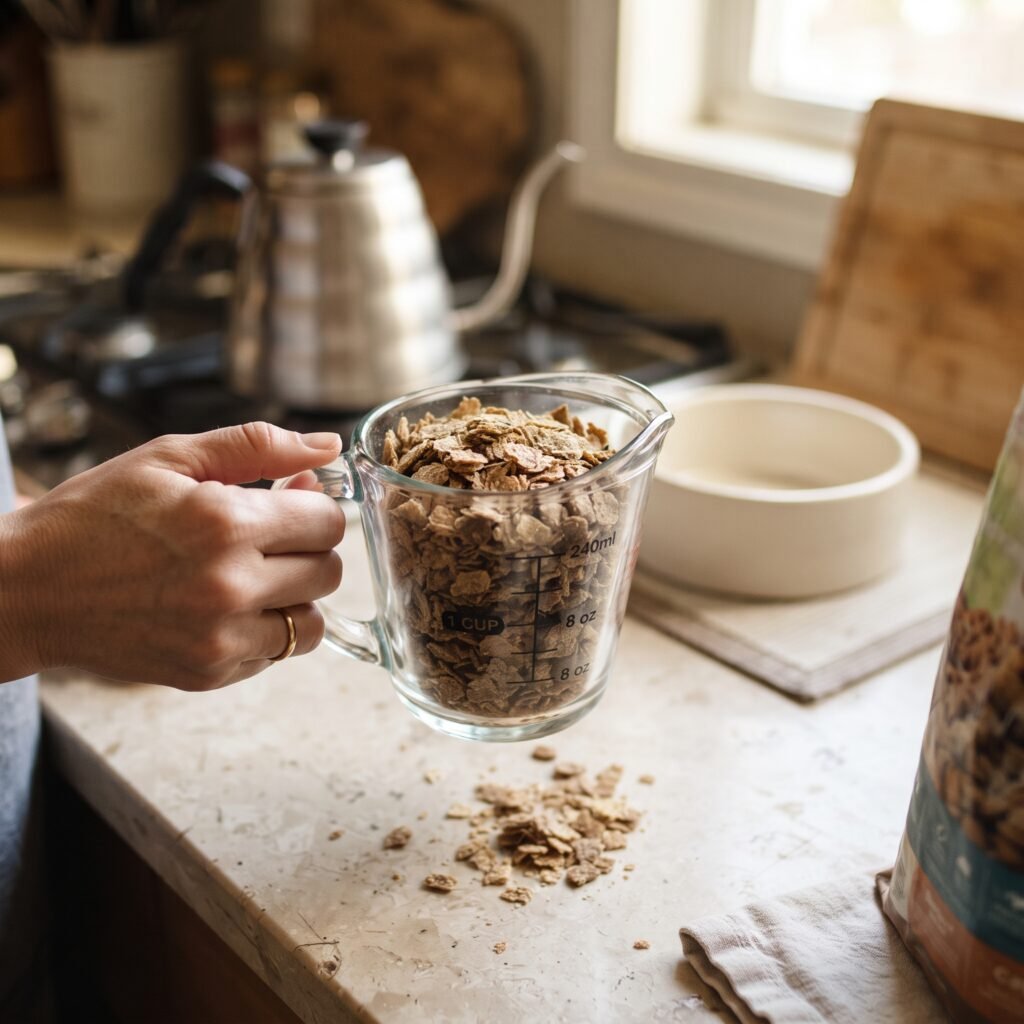
Short answer: Feed Honest Kitchen dog food as a complete meal if your dog is under about 40 lbs and you can absorb $2.00–$2.62 per dry cup. Above that weight, a 25% topper over Clusters delivers most of the benefit at roughly half the cost. Both approaches work — the mistake is deciding by box price instead of cost per calorie.
That distinction is the entire article. Nearly every roundup of Honest Kitchen dog food tells you the ingredients are human grade and the recall record is clean. Both are true, and I’ll cover both — most Honest Kitchen dog food reviews stop right there. Neither one helps you at the checkout page, where you’re staring at a $79.99 box and an $89.99 bag, trying to work out which one you and your dog can live with for the next twelve months.
Recommended Products
Best Dog Food in 2026
What are you actually choosing between?
There are three real formats in the Honest Kitchen dog food range, and they behave completely differently inside a feeding plan.
Wholemade dehydrated is the original Honest Kitchen dog food product. A dry, flaky mix you rehydrate with warm water — a 10 lb box makes about 40 lbs of finished food because you’re adding roughly three cups of water per cup of mix. Each pound yields about four dry cups.
Whole Food Clusters and Essential Clusters are the scoop-and-serve dry format. They’re cold-pressed, roasted, and gently dehydrated below 200°F rather than extruded at high heat like conventional kibble. No rehydration needed, though plenty of dogs prefer them with a splash of warm water stirred through.
Base mixes — the Fruit & Veggie line — are the one Honest Kitchen dog food format that is deliberately incomplete. You add your own cooked or raw protein. This is the cheapest route into the brand per calorie and the easiest way to unbalance a diet if you improvise the meat ratio week to week.
Then there’s the fourth option nobody puts on the packaging: partial feeding. A quarter of the bowl, a third, half. This is what most long-term customers I’ve spoken to actually do, and it’s where the interesting trade-offs live.
The brand nudges you toward it themselves. Their own FAQ suggests mixing half the suggested serving of your dog’s dry food with half the suggested serving of the dehydrated recipe. That’s a 50/50 bowl — and whether it’s a smart move or a sloppy one depends entirely on what occupies the other half.
How much does Honest Kitchen dog food really cost per 1,000 calories?
Box price is a trap, and Honest Kitchen dog food is packaged in a way that makes it an easy trap to fall into. A 10 lb box “makes 40 lbs,” but you’re buying water weight, and your dog eats calories, not pounds.
Here’s the math at manufacturer list prices I pulled in August 2026. Every recipe below is chicken, so you’re comparing like with like.
| Format (chicken recipe) | Protein / Fat (as fed) | kcal per dry cup | Pack + list price | Cost per dry cup | Cost per 1,000 kcal |
|---|---|---|---|---|---|
| Wholemade Whole Grain, dehydrated | 24.5% / 14.0% | 485 | 10 lb box, $79.99 | $2.00 | $4.12 |
| Wholemade Grain Free, dehydrated | 24.0% / 14.0% | 446 | 10 lb box, $104.99 | $2.62 | $5.88 |
| Whole Food Clusters, whole grain | 24.0% / 14.5% | 428 | 20 lb bag, $89.99 | $1.12 | $2.63 |
| Essential Clusters, whole grain | 22.0% / 10.0% | 363 | 20 lb bag, $79.99 | $1.00 | $2.75 |
Four things jump out of that Honest Kitchen dog food comparison.
Grain-free dehydrated costs 43% more per calorie than whole grain dehydrated. Same protein, same fat, fewer calories per cup, higher price per box. Unless your dog has a diagnosed reason to avoid barley and oats, you’re paying a premium for a marketing category.
Honest Kitchen Clusters run roughly 36% cheaper per calorie than the dehydrated line. That single fact is the biggest lever available on your Honest Kitchen dog food budget, and most people never notice it because the bag is physically larger and looks more expensive.
Essential Clusters appear cheapest per cup but aren’t cheapest per calorie. At 363 kcal a cup they’re lean, so you feed more of them. This is exactly what vanishes when you shop by bag price.
And the dehydrated line’s cost scales brutally with body weight. A 25 lb terrier eating 500 kcal a day costs about $2.06 daily on whole grain dehydrated. A 75 lb retriever eating 1,400 kcal costs about $5.77 daily — $173 a month, one dog, one food, before treats.
For context, the brand’s own comparison puts Honest Kitchen dehydrated dog food at around $2.44 a day for a 30 lb active dog against roughly $6.16 a day for leading fresh-food brands. That comparison is fair on its own terms. It’s also built around a 30 lb dog, which tells you something about where this product’s economics stop working.
How does Honest Kitchen dog food compare to premium kibble and fresh delivery?
Three tiers exist in this market, and Honest Kitchen dog food straddles two of them.
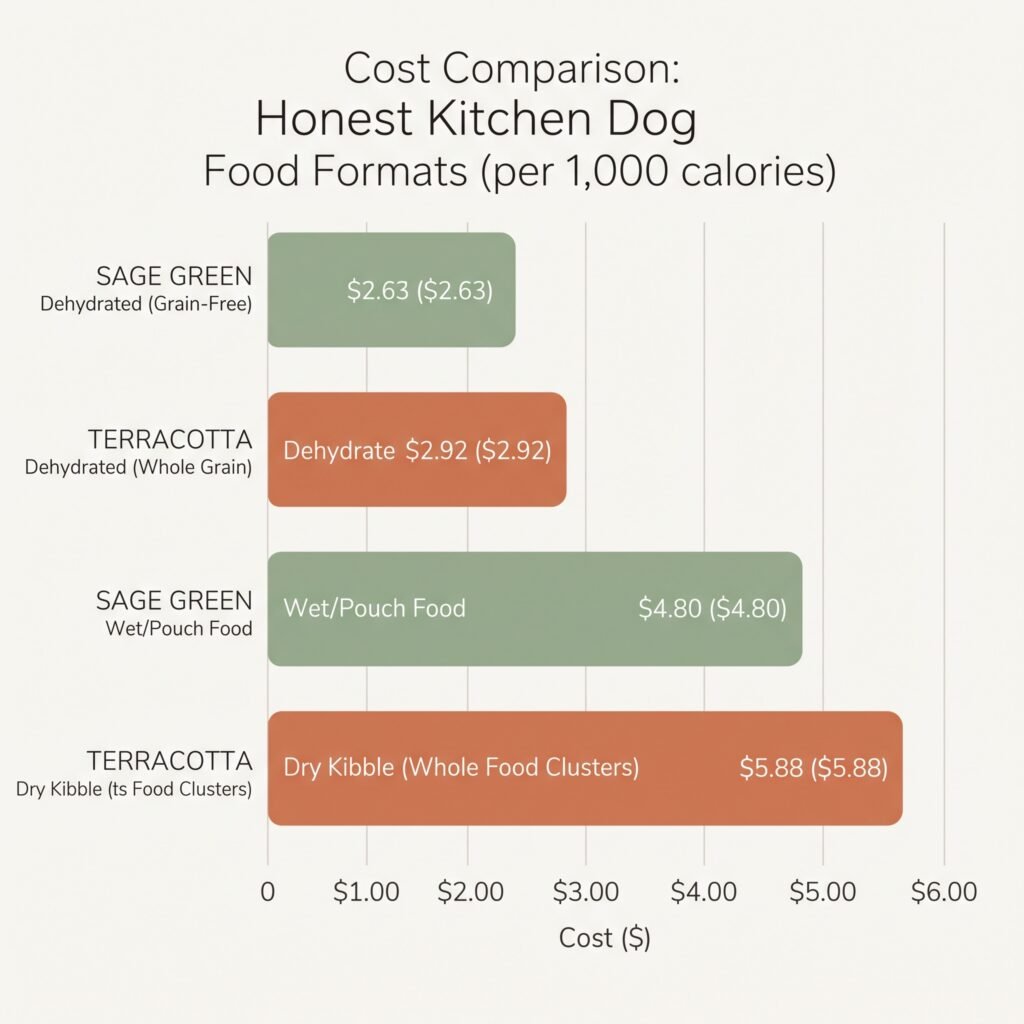
Mainstream premium kibble, when I’ve run the same cost-per-calorie math on the bags I keep in rotation, generally lands somewhere around $1.00 to $1.60 per 1,000 kcal. Fresh refrigerated delivery services sit at the top — the brand’s own published comparison puts leading fresh brands near $6.16 a day for a 30 lb active dog.
Honest Kitchen Clusters land at $2.63 to $2.75 per 1,000 kcal. That’s roughly double premium kibble and a long way below fresh. You’re paying about a dollar a day more than kibble, for a food made in a human food facility with an ingredient list you can read.
The dehydrated line at $4.12 to $5.88 is a different proposition. It approaches fresh-food pricing while offering shelf stability, no freezer footprint, and a twelve-month shelf life instead of a few days in the fridge.
So the value case for human grade dog food isn’t uniform across the brand’s own catalogue. Clusters are the value play. The dehydrated recipes are a convenience-and-moisture play that happens to also be human grade. Buying the second while telling yourself you bought the first is how the monthly spend gets away from people.
One caveat on my kibble figures: bag prices swing hard with promotions and retailer, so treat that range as a ballpark I calculated rather than a published number. The Honest Kitchen dog food figures in the table above are list prices straight from the manufacturer.
What’s actually in Honest Kitchen dog food, and which ingredients matter?
Pull the panel on the whole grain chicken Honest Kitchen dog food recipe and you get chicken first, then barley, potatoes, flaxseed, oats, peas, carrots, tricalcium phosphate, parsley, bananas, celery, minerals, taurine, vitamins, dried kelp, salt, fish oil, and choline chloride.
Three details in that list are worth your attention, and they’re not the ones most Honest Kitchen dog food reviews highlight.
The minerals are chelated. Zinc, iron, and copper appear as amino acid chelates rather than oxides or sulfates. Chelated minerals are bound to protein and absorb more efficiently. It’s a small formulation cost that cheaper brands skip, and it’s a reliable tell that someone competent wrote the formula.
Taurine is added directly. Dogs synthesize taurine from methionine and cysteine, so it isn’t classed as essential for them — which is precisely why most dry foods don’t bother adding it. Its presence here reads as a deliberate hedge against the DCM questions that have hung over the category.
The first ingredient is dehydrated, not fresh. This matters more than it sounds. When a fresh-meat brand lists “deboned chicken” first, that chicken is roughly 70% water before processing, so its position on the list overstates its contribution. Because Honest Kitchen dog food ingredients are weighed after dehydration, chicken listed first genuinely means chicken is the largest component by finished weight. It’s one of the few ingredient panels in the category you can read literally, and it’s the strongest practical argument for the price.
The grain-free Honest Kitchen dog food recipe swaps barley and oats for potatoes, sweet potatoes, apples, pumpkin, and cabbage. It also contains dried garlic in small quantities — which reliably alarms people, and which the manufacturer defends as a safe inclusion at that level. If it bothers you, feed a whole grain recipe. There are seven of them.
At what point does a topper stop being a topper?
This is the question that separates people who understand what they’re doing from people repeating something they read in a forum thread.
Standard veterinary guidance holds that treats and unbalanced extras should stay under 10% of daily calories. Past that, you begin diluting the complete-and-balanced base diet enough to shift the overall nutrient profile.
That rule was written for unbalanced extras — cooked chicken, cheese, a spoonful of pumpkin. It does not apply the same way here, and understanding why saves you money.
Most Wholemade and Clusters recipes carry an AAFCO complete-and-balanced statement. When you mix two complete-and-balanced foods, you dilute nothing. You’re blending two formulas that each independently meet the nutrient profile on their own. A 50/50 bowl of Honest Kitchen Clusters and rehydrated Wholemade is nutritionally sound at any ratio you like.
The 10% ceiling reappears the moment you reach for something labeled differently. Bone broths, stews, instant goat’s milk, and most single-protein toppers carry an “intermittent or supplemental feeding only” statement instead. Those are the products that need to stay under a tenth of daily calories.
So the working rule: read the AAFCO statement on the specific tub, not the brand. The Honest Kitchen dog food catalogue contains both kinds of product, and the back panel tells you which is which in six-point type.
Here’s the worked example for my own dog, at 900 kcal a day.
A 25% topper means 225 kcal from the dehydrated recipe — just under half a dry cup — and 675 kcal from Clusters, about 1.6 cups. Daily cost: $0.93 plus $1.76, so $2.69. Full-feeding the same dog on dehydrated Honest Kitchen dog food costs $3.71. Over a year that gap is $372.
One more wrinkle people miss. If you’re topping a cheap kibble with 25% Honest Kitchen dog food because the kibble underwhelms you, the topper doesn’t repair the kibble. You’ve improved a quarter of the bowl. That’s a genuine gain in palatability and moisture and a marginal one in nutrition — worth doing, but don’t tell yourself you’ve upgraded the diet.
What happened when I ran this with a 42 lb dog?
My Honest Kitchen dog food test case was a 42 lb mixed-breed, roughly four years old, with intermittently loose stools on a mid-tier grain-inclusive kibble. Target intake around 900 kcal a day, split across two meals.
I ran three phases over eleven weeks: full dehydrated, 25% dehydrated over Clusters, then Clusters alone.
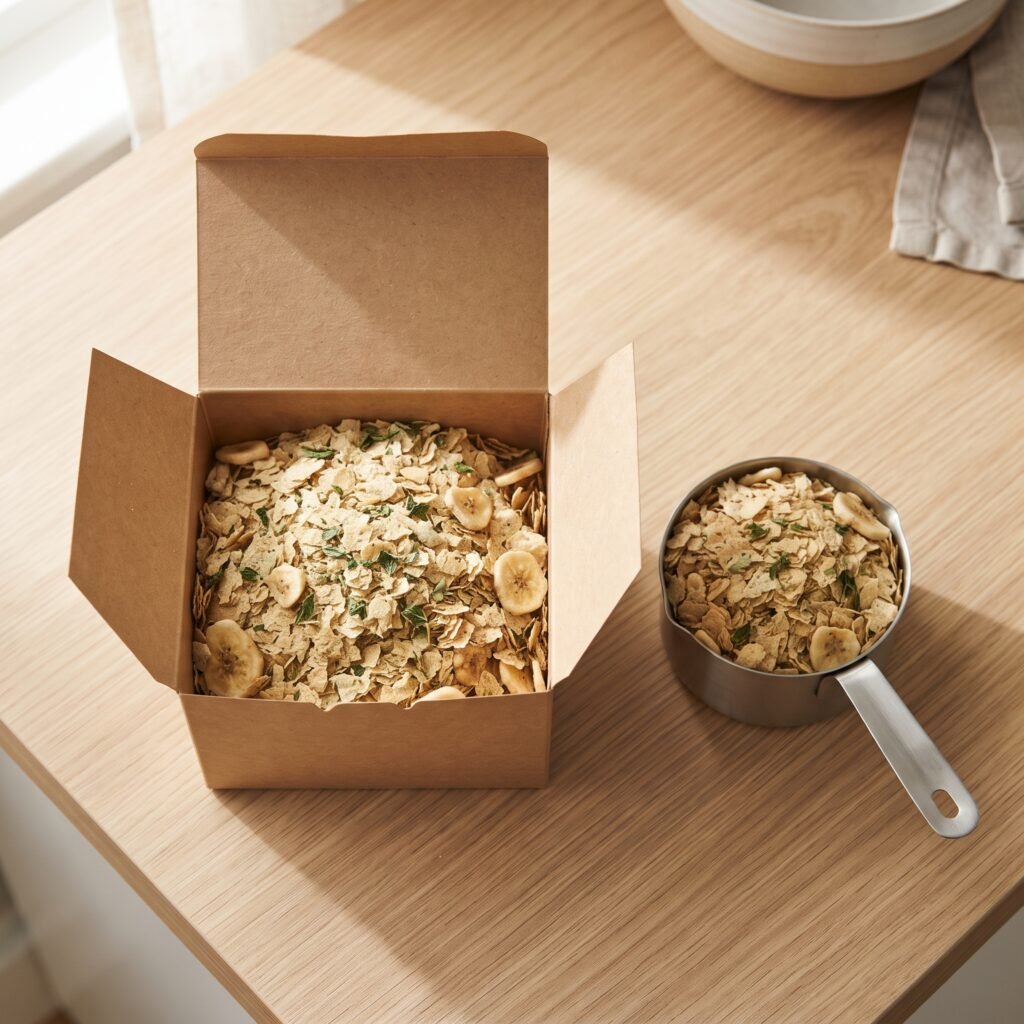
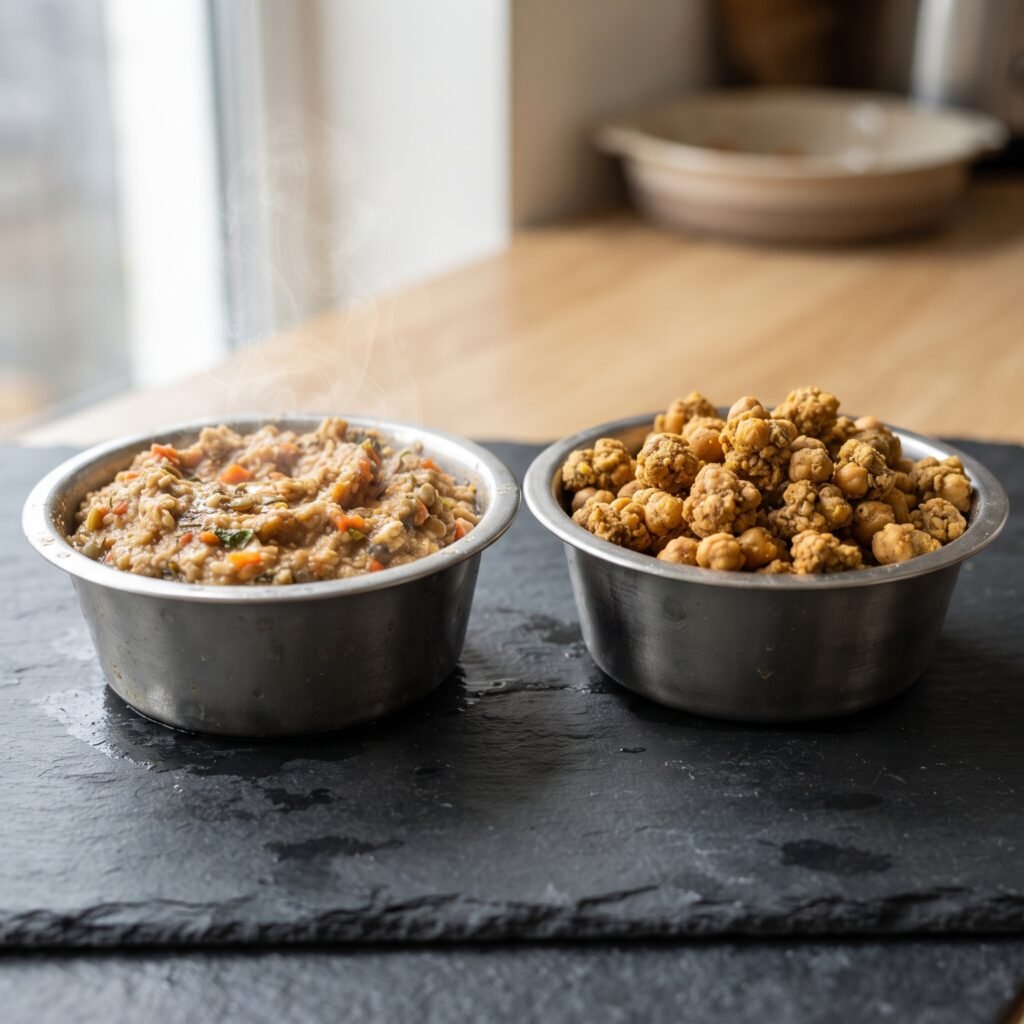
The texture surprised me. Dry, the whole grain chicken mix looks like coarse bran flakes shot through with green flecks — parsley and kelp — and small dried banana pieces. It smells like a stock cube and dried herbs. It does not smell like pet food, which is the single most common observation in Honest Kitchen dog food reviews and, for once, an accurate one.
After three minutes in warm water it becomes a loose, oatmeal-textured mash that holds its shape on a spoon but slumps in the bowl.
She inhaled it. Bowl licked clean in under ninety seconds, every meal, for eleven weeks. Stool firmed up by day six and stayed firm through the end of the trial.
Honest Kitchen Clusters are a different animal. Honest Kitchen Clusters are golden-brown, irregular, roughly chickpea-sized, and they crumble under thumb pressure in a way extruded kibble simply doesn’t. By the bottom third of a 20 lb bag you have a meaningful layer of fines. I started tipping the last two cups into a bowl with warm water rather than serving them dry.
Water intake changed measurably. On full dehydrated feeding she drank noticeably less from her bowl — unsurprising, since she was taking in about three cups of water per cup of food at mealtimes. For dogs with a history of urinary crystals, or dogs who simply don’t drink enough, that’s a real clinical argument for Honest Kitchen dehydrated dog food that has nothing to do with ingredient quality.
The 25% topper phase won on cost without losing anything I could measure. Same enthusiasm at the bowl, same stool quality, $2.69 a day instead of $3.71.
Where Honest Kitchen dog food did not work
Two failures, and both taught me more than the successes did.
The senior refused it outright. A 12-year-old terrier in the same household — nine years on the same crunchy kibble — would not eat rehydrated Honest Kitchen dog food. Not on day one, not on day ten, not with a scattering of her old kibble stirred through it. She’d lick the surface and walk away.
Some dogs are texture-imprinted, and no amount of ingredient superiority overrides that. She did fine on Honest Kitchen Clusters, which crunch. If I’d started her on the dehydrated line at four instead of twelve, I suspect the outcome would have been different.
The cost math failed outright on the big dog. I priced this out for a friend’s 85 lb shepherd mix at roughly 1,600 kcal a day. Full-feeding whole grain dehydrated Honest Kitchen dog food: $6.59 a day, $198 a month. Not “a bit expensive” — not viable for most households.
For large dogs, the dehydrated line is a topper product, full stop. The brand’s own cost messaging is built around a 30 lb dog for exactly this reason.
I also transitioned the 42 lb dog too fast on the first attempt — three days instead of seven — and earned two days of soft stool that had nothing to do with the food and everything to do with my impatience.
Which format fits which dog?
Small breeds and dogs with dental loss
Rehydrated Honest Kitchen dog food is the obvious answer for a dog missing teeth. It requires no chewing at all. A 15 lb dog eating around 400 kcal daily runs about $1.65 a day on whole grain dehydrated, one of the few scenarios where full-feeding Honest Kitchen dog food is comfortably affordable long-term.
Watch the box size, though. Honest Kitchen dehydrated dog food has a twelve-month shelf life from manufacture, and a small dog will take four months to work through a 10 lb box. Buy the 4 lb box at $39.99 even though it’s worse per pound — a stale box is 100% waste.
Large-breed puppies
Read the AAFCO statement on the specific Honest Kitchen dog food bag carefully. A food labeled for “growth” is not automatically appropriate for a puppy who’ll mature above 70 lbs; that requires a statement specifically including growth of large-size dogs, because of calcium ceilings during skeletal development.
Several Honest Kitchen dog food recipes carry exactly that language, including the whole grain chicken. Not all of them do. This is a label-reading job, not a brand-trust job, and it’s the one place where getting it wrong has orthopedic consequences.
Dogs on a veterinary therapeutic diet
Don’t. If your dog is on a prescription renal, hepatic, or hydrolyzed-protein diet, adding Honest Kitchen dog food as a topper undermines the entire point of the therapeutic formulation. Ask your vet for an approved topper instead.
The brand does publish protein levels across the range — the whole grain turkey and beef recipes sit at the lower end, around 22–22.5% as fed — but “lower protein” and “renal appropriate” are not the same claim, and treating them as interchangeable is how dogs end up back at the clinic.
Picky eaters and free-feeders
Rehydrated Honest Kitchen dog food cannot sit out. Once water hits it, you’ve got a perishable meal with a two-hour window in a warm kitchen, less on a hot day. If your household free-feeds, the dehydrated line is a non-starter and Clusters are the only workable option.
For genuine picky eaters, the warm-water aroma is the whole selling point of Honest Kitchen dog food. Warming the water to just above body temperature releases noticeably more smell than mixing it cool, which is the cheapest palatability trick in this entire category.
Is a trial size worth buying first?
Yes, and this is the cheapest insurance in the category. The whole grain chicken recipe sells in a 15 oz box for $14.99 and a 2 lb bag for $26.99, both terrible value per pound and both worth it.
You’re not testing nutrition with a trial size. You’re testing whether your particular dog will eat wet mash at all — the one variable no Honest Kitchen dog food review can answer for you, and the exact variable that sank it for my twelve-year-old.
There’s also a 90-day money-back guarantee on the brand’s own store, though some sale and short-dated items are excluded. Between the trial size and that guarantee, there’s very little reason to gamble on a $79.99 box first.
Multi-dog households
Mixed feeding gets expensive and confusing quickly, and Honest Kitchen dog food is pricey enough to make that confusion cost you. If you have three dogs and one needs the extra moisture, feed that dog the dehydrated recipe and put the others on Clusters. Don’t try to run a single format across a house with different needs, mouths, and budgets.
Has Honest Kitchen dog food ever been recalled or flagged by the FDA?
Here’s the Honest Kitchen dog food safety record without spin.
There has been exactly one Honest Kitchen dog food recall in the company’s history: February 2013, five lots across the Verve, Zeal, and Thrive recipes, after a supplier’s parsley batch tested positive for Salmonella. The company pulled the affected lots voluntarily, cut ties with the parsley supplier, and added Salmonella-specific testing to incoming ingredients afterward.
No illnesses were reported in connection with those lots, and the founder characterized the action as precautionary. That was thirteen years ago, and there has been no Honest Kitchen dog food recall since.
The human grade dog food claim is unusually well substantiated. The company applied for and received FDA acknowledgement to use the label, uses only human-edible components, and manufactures in a human food facility. Under the AAFCO definition adopted in 2019, that phrase carries a specific legal meaning — every ingredient human-edible, the whole product manufactured to human food standards. Most brands using human grade dog food language in their marketing cannot meet it, which is why the phrase is worth checking rather than trusting.
They’ve also run feeding trials, which almost nobody in this price tier does. In-home comprehensive AAFCO feeding trials were conducted by a third-party veterinary group across roughly six months, with eight healthy dogs per study, covering the dehydrated grain-free chicken, dehydrated whole grain chicken, and grain-free chicken Clusters recipes. Formulating to a nutrient profile is the cheap route to an AAFCO statement; feeding trials are the expensive one.
The honest caveat: several grain-free Honest Kitchen dog food recipes lean on peas and legumes, and the FDA’s investigation into diet-associated dilated cardiomyopathy centered on grain-free, legume-heavy formulas. The brand wasn’t named in any of the FDA’s DCM case reports, and the science remains unsettled. If that unsettledness bothers you, the whole grain recipes sidestep the question entirely and cost less per calorie anyway.
What’s the transition mistake almost everyone makes?
Seven days. Not three.
The brand’s own guidance is to add a little Honest Kitchen dog food to the current food across five to seven days while decreasing the old. Dehydrated food carries far more moisture and far less rendered fat than extruded kibble, and the gut microbiome needs the full week.
The second mistake is the water ratio. The label gives a range, and people default to the maximum. Plenty of owners find their dogs prefer it noticeably drier than the instructions suggest — closer to thick porridge than soup. If your dog nudges the bowl and walks away, cut the water by a third before concluding the food failed.
Third: measure dry, not rehydrated. All Honest Kitchen dog food feeding guidance is expressed in dry cups. Measuring the finished mash is how dogs quietly end up eating a quarter of what they need for weeks on end.
Methodology: how this was evaluated
Prices for every Honest Kitchen dog food format were taken directly from the manufacturer’s product pages in August 2026 at list price, before subscription discounts of around 5% or the periodic sitewide promotions the brand runs. Your real cost will usually be lower.
Guaranteed analysis and caloric content figures come from manufacturer and major retailer product pages for each specific recipe. Cost per 1,000 kcal was calculated from published kcal-per-dry-cup values and the manufacturer’s stated cup yields — four dry cups per pound for both the dehydrated line and Clusters.
Recall history was checked against the FDA’s animal and veterinary recall database and independent recall trackers rather than the brand’s own marketing. Nutrient adequacy language was assessed against AAFCO Dog Food Nutrient Profiles, where adult maintenance minimums sit at 18% crude protein and 5.5% crude fat on a dry matter basis, and growth and reproduction minimums at 22.5% protein and 8.5% fat.
Hands-on observations come from eleven weeks of feeding across two dogs in one household. That’s a sample of two, which is a sample of two. Your dog may disagree with mine.
FAQ
Is Honest Kitchen dog food worth the money? For dogs under about 40 lbs, yes — the dehydrated line runs $2.00 to $2.62 per dry cup, competitive with fresh-food subscriptions at a fraction of the freezer space. For dogs over 70 lbs, full-feeding is hard to justify at close to $200 a month, and a partial-feed approach makes far more sense.
Can I feed Honest Kitchen dog food dry, without adding water? Clusters are designed to be served dry. Honest Kitchen dehydrated dog food is not — feeding them dry means your dog rehydrates them using their own body water, which is uncomfortable at best and genuinely risky for a dog who doesn’t drink much. Add the water.
Has there ever been an Honest Kitchen dog food recall? Once, in February 2013, covering five lots of three recipes after a supplier’s parsley batch tested positive for Salmonella. No illnesses were reported and there has been no recall since. Check the FDA’s recall database yourself before relying on any brand’s safety record, including this one.
How long does a 10 lb box of Honest Kitchen dog food last? It yields about 40 dry cups. A 30 lb dog at average activity eats roughly one dry cup daily, so about 40 days. A 60 lb dog eats two to two-and-a-half cups, so 16 to 20 days. Divide 40 by your dog’s daily cup requirement and you have your answer.
Is Honest Kitchen dog food good for dogs with sensitive stomachs? Several Honest Kitchen dog food reviews single out the Limited Ingredient recipes here, and they’re built for exactly that, and the added moisture helps some dogs. But “sensitive stomach” spans everything from mild dietary indiscretion to inflammatory bowel disease — if your dog has chronic symptoms, that’s a veterinary workup, not a food-swap experiment.
The bottom line
The interesting question about Honest Kitchen dog food was never whether the ingredients are good. They are, verifiably, and the company has earned more of that trust than most brands in the category.
The interesting question is what share of your dog’s bowl it should occupy. The honest answer depends on your dog’s weight, your dog’s texture preferences, and a number you can only reach by dividing price by calories rather than by pounds.
Small dog, sensitive gut, low water intake: full-feed the dehydrated line and don’t look back. Big dog, tight budget: Clusters as the base, dehydrated Honest Kitchen dog food as a 25% topper, and you’ve captured most of the benefit for roughly half the money. Dog who hates wet food: Clusters, and stop fighting it.
Run your own numbers before you order. The box price will lie to you. The cost per 1,000 calories won’t.