
How to Choose Staffy Food When Your Staffordshire Bull Terrier Won't Stop Itching
Short answer: Feed Honest Kitchen dog food as a complete meal if your dog is under about 40 lbs and you can absorb $2.00–$2.62 per dry cup. Above that weight, a 25% topper over Clusters delivers most of the benefit at roughly half the cost. Both approaches work — the mistake is deciding by box price instead of cost per calorie.
That distinction is the entire article. Nearly every roundup of Honest Kitchen dog food tells you the ingredients are human grade and the recall record is clean. Both are true, and I’ll cover both — most Honest Kitchen dog food reviews stop right there. Neither one helps you at the checkout page, where you’re staring at a $79.99 box and an $89.99 bag, trying to work out which one you and your dog can live with for the next twelve months.
Recommended Products
Best Dog Food in 2026
Is your Staffy’s itching actually a food problem?
Here’s the uncomfortable part. In dogs presented for chronic itching, adverse food reactions make up a minority of cases — environmental atopy is far more common, and Staffordshire Bull Terriers are a breed with a documented predisposition to atopic dermatitis. Changing staffy food when the trigger is dust mites or grass pollen is like repainting a room to fix a leak.
There are clues that shift the odds before you spend a penny.
Seasonality. Itching that flares in spring and settles in winter is pointing at pollen, not protein. Food reactions don’t take the summer off. If you kept a rough diary this year, look at it before you change staffy food.
Age of onset. Environmental allergy in dogs typically shows up between roughly one and three years old. Food reactions can start at any age, including in dogs that have eaten the same staffy food happily for four years — the immune system doesn’t need novelty to decide it’s had enough.
Where the itch lives. Paws, muzzle, ears, armpits and belly are classic atopy zones. Food-driven cases often add gut signs: soft stools, more than two or three bowel movements a day, gurgling, intermittent vomiting. Ear infections that keep coming back on both sides are worth flagging to your vet either way.
What else is going on. Fleas are still the single most common cause of itching, and a Staffy’s short coat hides flea dirt better than you’d think. Demodex, secondary yeast and bacterial infections all cause scratching that no staffy food on earth will resolve.
So the honest first step isn’t a new bag. It’s a vet visit to rule out parasites and infection, because running an elimination diet on top of an untreated skin infection produces a result you can’t interpret.
Why do Staffies seem to react more than other breeds?
Staffies are a muscular, short-coated, close-to-the-ground breed with skin folds around the face and a habit of belly-crawling through whatever’s growing in the garden. That’s a lot of skin contact with allergens, and very little coat to buffer it.
Breed predisposition to atopic dermatitis is well documented in Staffordshire Bull Terriers, and once the skin barrier is inflamed, everything else — including diet — has more leverage. That’s the nuance most staffy food articles skip. Diet isn’t usually the sole cause, but it can be one of several inputs stacking up past the itch threshold.
Think of it as a bucket. Pollen fills it in May. A flea bite adds an inch. A protein the immune system dislikes tops it off. Remove any one input and the bucket may stop overflowing — which is exactly why a staffy food change sometimes “works” for reasons that have nothing to do with the food.
It’s also why I’m sceptical of dramatic before-and-after claims. A dog that improves in week two of a new staffy food probably improved because you also started weekly baths and a proper flea preventative.
What does a real elimination trial actually look like?
This is where most attempts fall apart, and it’s the part a two-sentence AI summary can’t carry.
An elimination trial means feeding one single food — one protein source, one carbohydrate source, or one hydrolysed formula — and absolutely nothing else, for 8 to 12 weeks. Skin takes time to turn over. Judging staffy food at week three is judging an unfinished experiment.
“Nothing else” is stricter than people expect:
- No treats, including training treats and dental chews
- No flavoured heartworm or flea preventatives (ask your vet for unflavoured alternatives)
- No flavoured toothpaste
- No rawhide, bully sticks, pig ears, antlers dipped in anything
- No table scraps, no toddler dropping toast, no licking the plates in the dishwasher
- No peanut butter in the enrichment toy
- No shared water bowls at daycare
For a food-obsessed breed, that last cluster is brutal. Staffies will hoover a dropped crumb before you’ve registered it hit the floor. If you have children under five, plan for it — I’ve watched an entire trial get invalidated by a shared cereal bar.
Use the trial food itself as the treat. Set aside a portion of the daily ration in a pouch and train with it. It works better than owners expect, because the deprivation makes ordinary staffy food suddenly interesting.
Then do the challenge. If the itching improves substantially by week ten, reintroduce the old food. If symptoms return within one to fourteen days, you’ve confirmed a food reaction. Skipping the challenge means you never actually learn anything — you just move to a more expensive staffy food forever on a hunch.
Hydrolysed or novel protein: which staffy food should you trial?
Two legitimate routes, different trade-offs. Both count as elimination-diet staffy food; they fail in different ways.
Hydrolysed diets break protein into fragments small enough that the immune system usually doesn’t recognise them. They’re the more reliable diagnostic tool and they’re what most dermatologists reach for. They’re also expensive, veterinary-exclusive in most markets, and some dogs find them unpalatable — which for a Staffy is saying something.
Novel protein diets use a protein the dog has genuinely never eaten: kangaroo, venison, rabbit, duck if duck is truly new. The catch is the word “genuinely.” If your Staffy has eaten twelve different staffy food brands over four years, finding a truly novel protein is harder than it looks. Studies of over-the-counter “limited ingredient” foods have repeatedly found proteins on the label that aren’t in the bag and proteins in the bag that aren’t on the label.
That contamination issue is the single strongest argument for using a veterinary diet during the trial phase specifically. Once you know the answer, you can often move to a cheaper over-the-counter staffy food that avoids the offending protein.
One practical detail nobody mentions: kibble size. Hydrolysed formulas tend to come as small, dense, uniform discs around 8–10 mm — noticeably harder than standard staffy food and low in surface fat, which is part of why they smell so flat. A Staffy with that jaw will crunch through them without effort, but the small size means fast eaters inhale the bowl in ninety seconds. I switched the reader’s dog to a slow-feeder bowl in week two, and the retching that had been blamed on the new staffy food stopped immediately. It was the speed, not the diet.
Comparison: elimination-trial staffy food options
Values are typical ranges on a dry-matter basis for dry formulas; check the specific bag, because ranges vary widely between brands. Cost per day is estimated for a 16 kg (35 lb) adult Staffy at roughly 900 kcal.
| Staffy food type | Protein (DM) | Fat (DM) | kcal/cup | Diagnostic reliability | Est. cost/day | Main watch-out |
|---|---|---|---|---|---|---|
| Veterinary hydrolysed | 20–26% | 12–18% | 340–400 | Highest | $3.50–$5.50 | Palatability; price |
| Veterinary novel protein | 22–28% | 12–20% | 350–420 | High | $3.00–$5.00 | Prescription-only in many regions |
| OTC “limited ingredient” | 24–32% | 13–18% | 350–420 | Moderate — contamination risk | $1.80–$3.00 | Label may not match contents |
| Home-cooked novel protein | Varies | Varies | Varies | High if formulated | $4.00–$7.00 | Must be balanced by a veterinary nutritionist |
| Standard adult maintenance | 24–30% | 14–18% | 350–430 | None (baseline) | $1.20–$2.20 | Fine post-trial if protein is avoided |
Home-cooked deserves one warning. An unbalanced home diet fed for twelve weeks to a growing or adult Staffy can create calcium, zinc or vitamin problems that are worse than the itch. If you go that route, get the recipe formulated properly — this is not a “chicken and rice” situation.
Where does grain-free fit into all this?
Grain-free became shorthand for hypoallergenic staffy food, and it shouldn’t have. Wheat is a recognised allergen, but so are beef, dairy and chicken — the proteins dogs eat most. Most grain-free bags simply replace grain with peas, lentils or potato while keeping the same chicken or beef protein that might be the actual problem.
There’s a second consideration. The FDA has investigated a possible link between diets high in peas, lentils and other pulses and cases of dilated cardiomyopathy in dogs, including breeds not genetically predisposed to it. The agency has been clear the relationship isn’t established, and it stopped issuing routine updates pending better science — but “unproven” isn’t “disproven.”
My practical position: don’t choose grain-free staffy food unless there’s a reason. If your Staffy tests out as wheat-reactive, avoid wheat. If the trial points at beef, avoid beef. Choosing a legume-heavy staffy food because a marketing page implied grains cause itching is a decision with a real, if uncertain, downside and no clear upside.
If you’re already feeding grain-free staffy food and your dog is thriving, that’s a conversation for your vet rather than a reason to panic. Ask whether a cardiac check is warranted given the diet history.
How much staffy food does a Staffordshire Bull Terrier actually need?
Here’s the second problem hiding behind the first. Staffies carry weight in a way that fools people. The breed is genuinely muscular, so a chunky dog reads as “solid” rather than overweight, and extra fat worsens skin inflammation and joint load simultaneously.
Start with the maths, then correct with your hands. Resting energy requirement is roughly 70 × (body weight in kg)^0.75, and most neutered adult pet dogs land near 1.6 × RER, with active dogs closer to 1.8.
| Staffy weight | RER (kcal) | Typical adult range | Approx. cups/day at 380 kcal/cup |
|---|---|---|---|
| 11 kg / 24 lb | 425 | 675–760 kcal | 1.8–2.0 |
| 13 kg / 29 lb | 480 | 765–865 kcal | 2.0–2.3 |
| 16 kg / 35 lb | 560 | 895–1010 kcal | 2.4–2.7 |
| 18 kg / 40 lb | 610 | 980–1100 kcal | 2.6–2.9 |
Treat those as starting points, not prescriptions. Feeding guides on staffy food bags are population averages; individual metabolism varies by 20% or more in either direction.
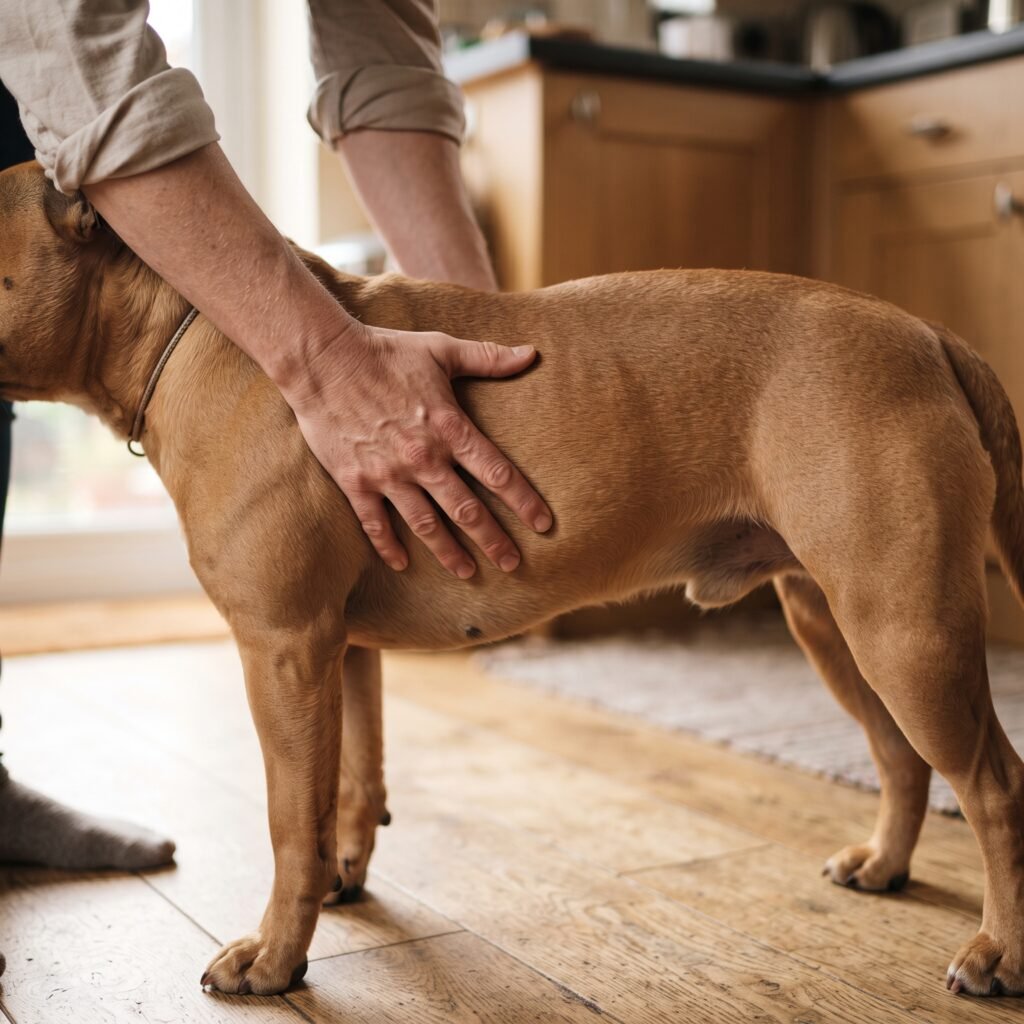
The hands part matters more than the numbers. Run your palms along the ribs — you should feel them with light pressure, like the back of your knuckles, not have to press. From above, there’s a visible waist behind the ribcage. From the side, the belly tucks up. A Staffy who fails all three is overweight regardless of what the staffy food packet says.
And keep treats under 10% of daily calories. Two dental chews can eat a third of a small Staffy’s allowance, which is how dogs gain weight on a “correct” portion of staffy food.
What about Staffy puppy food?
Growing Staffies need a food labelled for growth, and the difference is real. AAFCO nutrient profiles set higher minimums for growth than for adult maintenance — 22.5% crude protein and 8.5% fat on a dry-matter basis versus 18% and 5.5% for adults — plus tighter calcium and phosphorus requirements.
Staffies are a medium breed, so large-breed puppy formulas aren’t necessary. What matters is that the bag carries an AAFCO statement for growth or all life stages, and that you don’t add calcium supplements on top. Over-supplementing a growing dog does more harm than under-feeding a decent staffy puppy food.
Two practical notes on staffy puppy food. First, don’t run an elimination trial on a puppy without veterinary supervision — most therapeutic diets aren’t formulated for growth. Second, itchy puppies under six months are more often dealing with parasites or infection than food allergy, so the diagnostic order changes.
Transition to adult staffy food around 12 months for most Staffies. The trigger is growth plate closure and slowing growth, not a birthday.
What I got wrong: the salmon and sweet potato detour
I’ll give you the failure, because it’s more useful than another success story.
A reader’s Staffy — 17 kg, four years old, chewing her paws raw — went onto a well-reviewed salmon and sweet potato staffy food in early March. By late April she was visibly better. Everyone declared victory and I wrote it up in my notes as a food-responsive case.
By mid-June she was worse than she’d started. The improvement had tracked a cold, wet spring with a late pollen season. The staffy food hadn’t done anything; the weather had.
Two things went wrong. We never did the re-challenge, so we had no confirmation. And we’d changed three variables at once — new food, new shampoo, new flea preventative — which meant even a genuine improvement couldn’t be attributed to anything.
The second failure was more expensive. When we finally ran a proper hydrolysed trial that autumn, she refused the food outright for four days. We salvaged it by warming it slightly and mixing a spoonful of the same hydrolysed food in wet form, but I’d have saved a week by ordering a sample first. Hydrolysed staffy food smells noticeably different — flatter, faintly cereal-like, without the fat-and-liver smell dogs key on — and some dogs genuinely object.
She turned out to be atopic, not food-allergic. The diet work wasn’t wasted — it ruled something out — but it wasn’t the answer.
What does good staffy food look like once you know the answer?
Post-trial, the criteria get simpler. You’re no longer buying a diagnostic tool; you’re buying a maintenance diet that avoids one or two proteins.
Check the AAFCO statement. It should say the food is formulated to meet, or has passed feeding trials for, the relevant life stage. Feeding trials are the stronger claim. A staffy food without an AAFCO adequacy statement isn’t complete food, whatever else the bag says.
Read the first five ingredients. They carry most of the weight. A named meat or meat meal in the top two is a reasonable signal; “meat and animal derivatives” isn’t, because you can’t avoid a protein you can’t identify.
Look at kcal/cup, not the price per bag. A 400 kcal/cup staffy food at $60 for 12 kg is often cheaper per day than a 330 kcal/cup food at $45.
Check recall history. The FDA maintains a public recall database. Five minutes there tells you more about a manufacturer than any review page.
Watch the fat. Staffies gain weight easily, and high-fat staffy food (18%+ DM) makes portion control harder unless your dog is genuinely working.
Wet, dry or mixed matters less than people think for skin. Wet food helps hydration and appeals to fussy dogs; dry staffy food is cheaper and easier to portion accurately. Mixing is fine as long as you count both toward the daily calories.
What if you can’t afford a veterinary elimination diet?
This is the question I get most often and the one glossed over everywhere else. A twelve-week hydrolysed trial for a 16 kg Staffy can run $300–$450. That’s a real barrier, and telling people to spend it anyway isn’t advice.
Here’s how I’d triage on a tight budget.
Spend the money on the vet visit first, not the food. Flea treatment and a course for a secondary skin infection cost a fraction of a diet trial and resolve a meaningful share of itchy Staffies outright. Buying premium staffy food while a yeast infection runs unchecked is the most expensive mistake available.
If you’re doing an over-the-counter trial, single-source is the priority. Look for the shortest ingredient list you can find with one animal protein and one carbohydrate. Accept that contamination risk makes the result less reliable — a negative result on an over-the-counter staffy food doesn’t fully rule food out, but a clear positive is still useful information.
Buy the trial food in the largest bag you’ll use within six weeks. Cost per kilo drops sharply with size, and twelve weeks of a single food is exactly the scenario bulk buying is for. Store it sealed in the original bag inside a bin — decanting straight into plastic accelerates fat rancidity, and rancid staffy food causes its own digestive upset.
Don’t half-do it. A partially strict trial costs the same as a strict one and produces nothing you can act on. If you can’t commit to removing every treat for ten weeks — because of the school run, or a housemate, or a very persuasive dog — postpone the trial until you can, and spend the money on parasite control and skin support in the meantime.
There’s also a cheaper diagnostic order worth considering. Six weeks of aggressive flea control plus weekly bathing costs under $80 in most places. If the itch drops substantially, you’ve saved yourself a diet trial entirely.
Does anything change for an older Staffy?
Senior Staffies — roughly eight and up — usually need fewer calories and often more joint support, but the itch logic doesn’t change. A new-onset skin problem in a nine-year-old is less likely to be a fresh food allergy and more likely to be endocrine, so ask your vet about thyroid testing before you rewrite the diet.
Weight control gets harder as activity drops, and an overweight senior Staffy on a rich staffy food is carrying inflammation, joint load and skin problems at once. Cutting portions by 10% and reweighing in three weeks beats switching to a “senior” bag, since senior formulas aren’t a regulated category and vary enormously.
How I evaluated the staffy food guidance in this article
Methodology note. Nutrient minimums referenced here come from the AAFCO Dog Food Nutrient Profiles for growth and adult maintenance, expressed on a dry-matter basis so different moisture levels compare fairly. Recall history was checked against the FDA’s public animal food recall listings rather than brand-supplied statements.
Elimination trial protocols follow the 8–12 week strict-trial-plus-challenge approach used in veterinary dermatology. Energy requirements use the standard RER formula with published activity multipliers, then adjusted against body condition scoring, because formulas estimate and hands measure.
Where a claim isn’t verifiable — the exact proportion of itchy dogs with food allergy, for instance — I’ve stated it in general terms rather than attaching a number I can’t source. Staffy food marketing is full of precise-sounding statistics with no origin, and I’d rather be vague than wrong.
Reviewed for accuracy against: AAFCO nutrient profiles, FDA recall and DCM investigation communications, and standard veterinary dermatology elimination-diet protocol. This article is general information about staffy food, not veterinary advice for your individual dog.
A 12-week decision path you can actually follow
Weeks 0–1. Vet visit. Rule out fleas, mites, and skin or ear infection. Treat what’s found. Start a symptom diary scoring itch out of 10 daily — memory is unreliable and you’ll need a baseline.
Week 1. Choose one trial staffy food. Hydrolysed if you want the most reliable answer, veterinary novel protein if palatability is a concern. Order a sample before committing to a large bag.
Weeks 1–2. Transition over 7–10 days, mixing increasing proportions. Remove every other food source in the house. Tell everyone who feeds the dog, including the neighbour who thinks a biscuit is harmless.
Weeks 2–10. Feed only the trial staffy food. Keep scoring. Don’t change shampoo, preventative or anything else during this window — one variable at a time is the whole point.
Week 10. Assess. Substantial improvement means proceed to challenge. No change at all after ten strict weeks means food probably isn’t the driver, and your vet visit should now be about atopy management.
Weeks 10–12. Re-challenge with the original staffy food. Symptoms returning within two weeks confirms a food reaction. Then reintroduce single proteins one at a time, two weeks apart, to identify which one.
After. Move to the cheapest complete staffy food that avoids the confirmed protein. There’s no reason to stay on a therapeutic diet forever if a standard bag avoids the trigger.
Image alt text suggestions
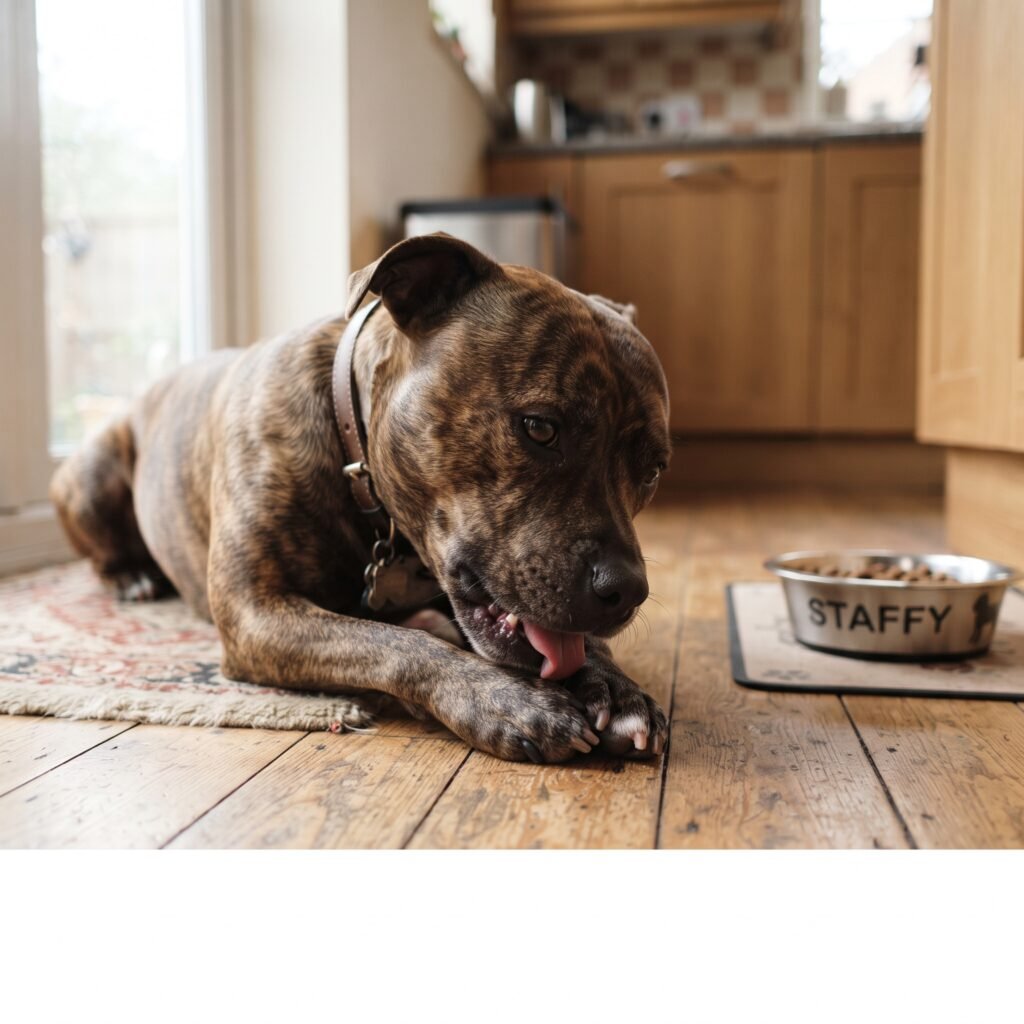
- “Staffordshire Bull Terrier eating hydrolysed staffy food from a stainless bowl”
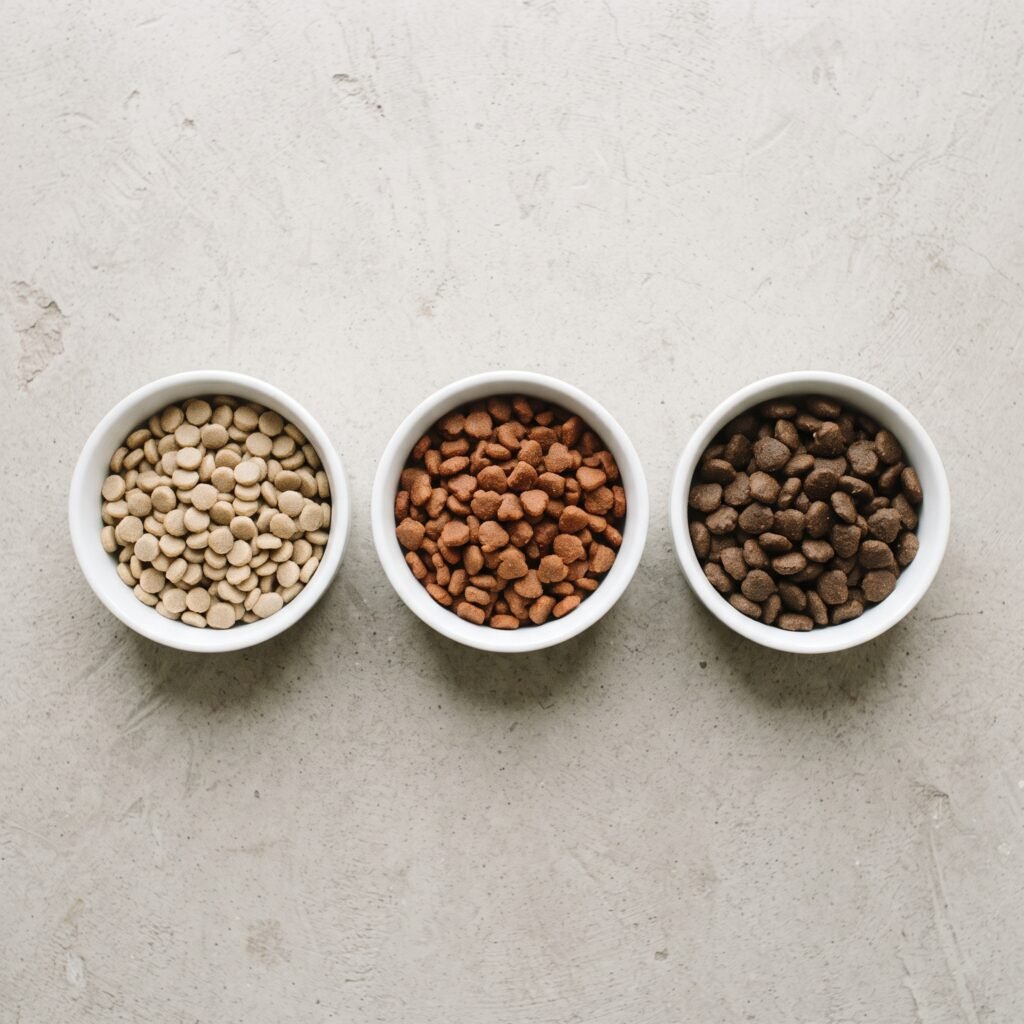
- “Comparison of three staffy food types for dogs with itchy skin”
- “Owner checking rib coverage on a Staffy to adjust staffy food portions”
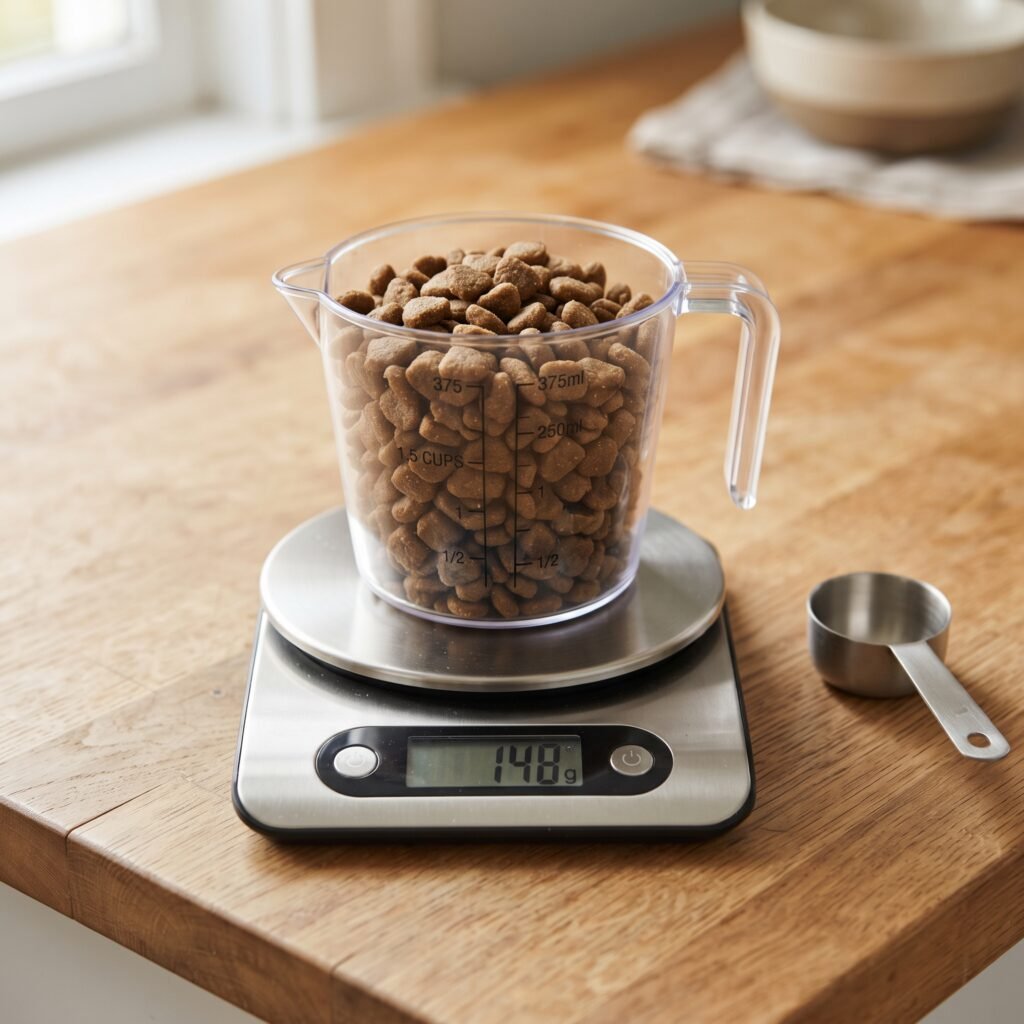
- “Staffy puppy food portion measured in a standard cup on a kitchen scale”
FAQ
What is the best staffy food for a Staffy with itchy skin? There isn’t one best bag, because the right staffy food depends on which protein your dog reacts to — and most itchy Staffies turn out to be environmentally allergic rather than food allergic. Start with a strict hydrolysed or novel-protein trial to get an answer, then choose a maintenance food that avoids the confirmed trigger.
How long before I see results after changing my Staffy’s food? Gut symptoms like loose stools can improve within one to two weeks, but skin needs 8–12 weeks to respond. Judging new staffy food at three or four weeks is the most common reason owners abandon a trial that was about to work.
Is grain-free staffy food better for allergies? Usually not. Grain-free foods typically swap grains for peas or lentils while keeping common protein allergens like chicken or beef, and the FDA has investigated a possible association between pulse-heavy diets and dilated cardiomyopathy. Choose grain-free staffy food only if a trial has actually implicated a grain.
How much should I feed a 35 lb Staffy? Roughly 895–1010 kcal a day for a typical neutered adult, which is around 2.4–2.7 cups of a 380 kcal/cup staffy food. Adjust every two weeks based on rib coverage and waist rather than sticking to the number on the bag.
Can I switch my Staffy straight onto a new food? Transition over 7–10 days by mixing increasing amounts of the new staffy food into the old. Abrupt changes commonly cause a few days of loose stool, which is both unpleasant and confusing if you’re trying to read whether the new food is helping.
The decision, summarised
The real question isn’t which staffy food to buy. It’s whether food is your problem at all — and you can only answer that with a strict trial and an honest re-challenge.
Rule out parasites and infection first. Run one food for ten weeks with genuine discipline. Challenge to confirm. Then buy the least expensive complete staffy food that avoids the protein you identified, keep your Staffy lean, and accept that some dogs itch for reasons no bag of food can fix.
That’s less satisfying than “feed this brand.” It’s also the version that works.