The Great Dane Dog Food Decision Nobody Explains: Growth Rate Over Age
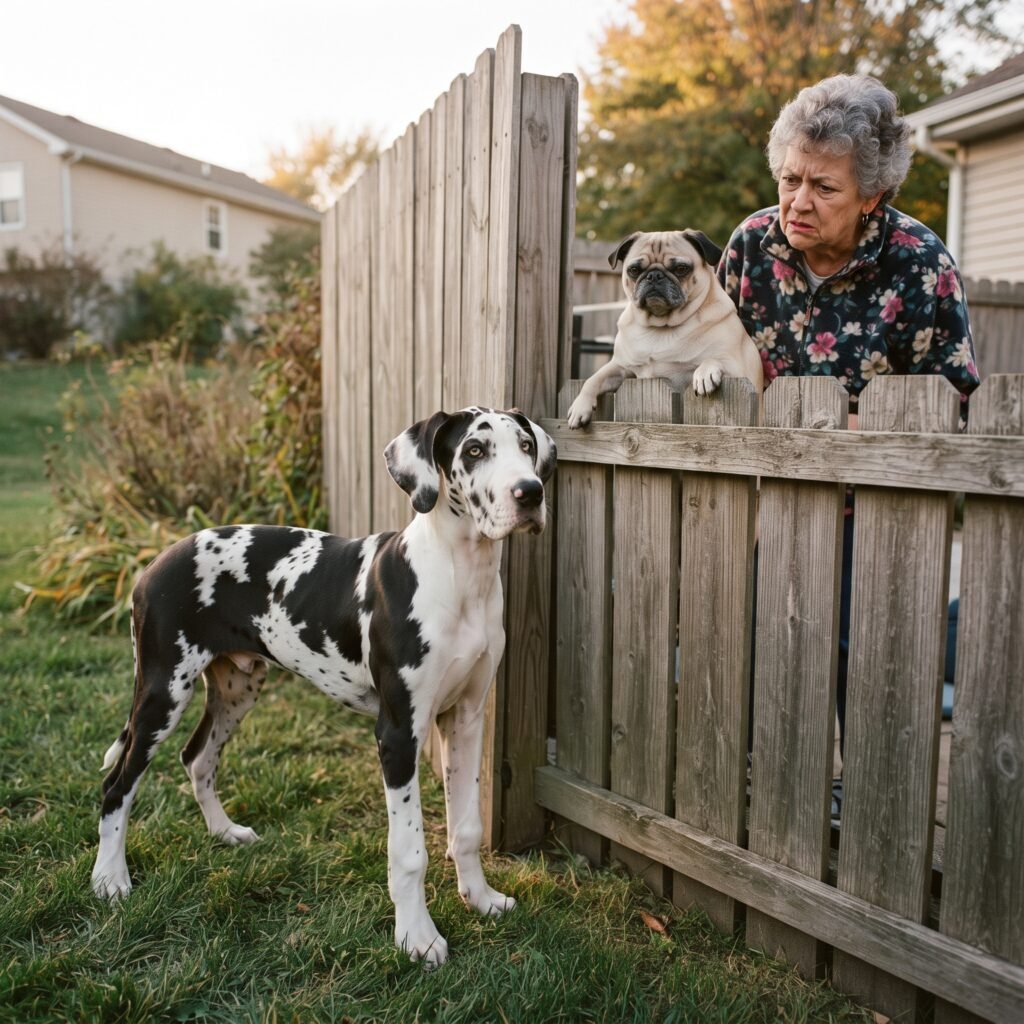
Short answer: The best great dane dog food is a large-breed growth formula with calcium capped near 1.2–1.8% dry matter and a Ca:P ratio between 1:1 and 1.5:1, fed to a lean body condition. For Danes, how much you feed matters more than which bag you buy, because fast growth — not slow growth — causes the orthopedic damage.
I have fed, weighed, and second-guessed a lot of giant-breed puppies. The pattern is always the same: someone buys an excellent great dane dog food, follows the chart on the back, and by six months has a puppy who looks magnificent and is quietly wrecking their own joints.
The bag isn’t lying. The bag just doesn’t know your dog.
Ask ten owners for the best dog food for great danes and you’ll get ten brand names. Ask a vet who handles giant breeds and you’ll get a question back: how fast is he growing?
Recommended Products
Best Dog Food in 2026
Why does the feeding chart on great dane dog food fail so often?
Every great dane feeding chart is built from expected adult weight. You look up “100–150 lbs,” you find a range, you pour. The problem is that a Great Dane’s expected adult weight is a guess until roughly 18 months, and the range printed on most great dane dog food bags spans two or three cups.
Two cups of a 430 kcal/cup formula is 860 calories. For a six-month-old Dane, that’s the difference between growing at a sustainable rate and growing at a rate that outpaces cartilage development.
Here’s what makes Danes different from a Lab or a Golden. A Great Dane gains roughly 100 pounds in its first six to eight months. That’s an enormous amount of skeletal construction happening on a schedule the puppy cannot slow down on its own — but you can, through the bowl.
So the real question isn’t “what’s the best great dane dog food.” It’s “what does this Dane, at this growth velocity, need this month.”
What actually goes wrong when a Great Dane grows too fast?
Three things show up in giant-breed puppies fed too generously, and I’ve seen versions of all three.
Hypertrophic osteodystrophy (HOD). Painful swelling at the growth plates, usually in the front legs, often with a fever. It shows up in fast-growing large and giant breeds and tends to hit between two and eight months.
Panosteitis. Shifting-leg lameness that appears, resolves, and reappears in another leg. Owners describe it as “he was fine yesterday.” It’s self-limiting but miserable, and no great dane dog food shortens it once it starts.
Osteochondrosis (OCD). Cartilage that thickens instead of converting properly to bone, most often in the shoulder. This one can end in surgery.
None of these are caused only by diet. Genetics, exercise on hard surfaces, and sheer bad luck all contribute. But excess calories and excess calcium are the two variables you control completely, and both are decided when you choose your great dane dog food and measure the scoop.
That’s the core trade-off. A richer great dane dog food builds a bigger-looking puppy faster. A leaner feeding plan builds the same adult dog, more slowly, with better joints. You cannot have fast growth and optimal joints. Pick one.
Is a lean Great Dane puppy actually healthy?
A properly fed Dane puppy looks slightly underwhelming. Ribs are easy to feel under a thin fat layer, the waist tucks visibly from above, and the hips look a little bony from behind. Strangers will comment.
I’ve had a neighbor ask if my fawn girl, Juno, was “getting enough” at seven months. She was at a body condition score of 4 out of 9, exactly where she belonged. At three she moves like a dog half her size.
The instinct to fill out a Dane puppy is the single most common mistake in giant-breed feeding, and no great dane dog food can protect a puppy from being overfed.
How do I tell if my Great Dane is growing too fast?
You need two data points, both of which take about four minutes a week.
The weigh-in
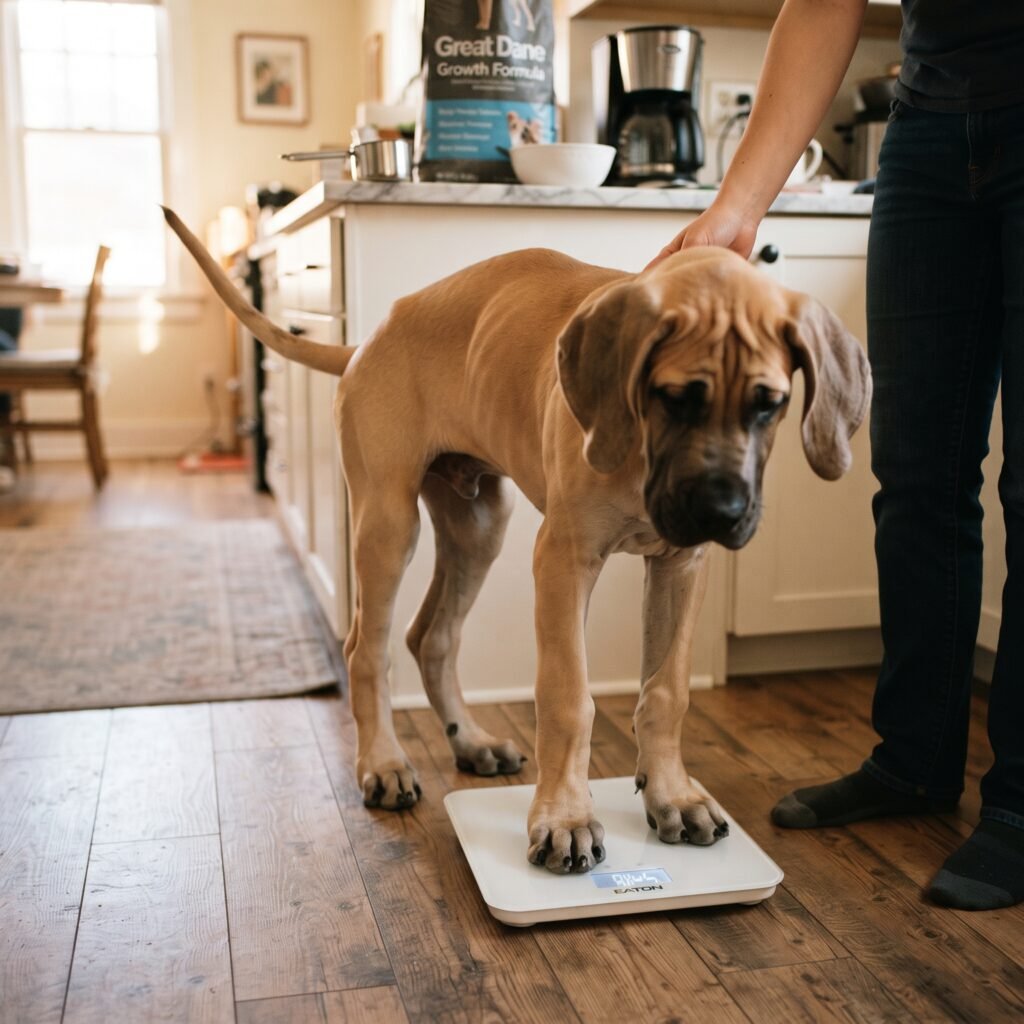
Weigh weekly until 12 months, then monthly. A bathroom scale works: weigh yourself, weigh yourself holding the puppy until they get too big, then use a vet clinic’s floor scale (most let you walk in free).
What you’re watching isn’t the weight — it’s the change in weight. A jump of 8–10 lbs in a single week around the four-to-six-month mark is a signal to hold calories steady rather than increase them, even if the great dane feeding chart on the bag says to go up a cup.
This is also the point where knowing how much to feed a great dane stops being a lookup and starts being a weekly adjustment.
The hands-on check
Run both hands flat along the ribcage, no pressing. You should feel individual ribs like piano keys under a thin covering. If you have to push, you’re carrying too much fat. If the ribs are visually sharp and the spine knobs stand out, back the other way.
Look from above for a defined waist behind the ribs. Look from the side for an upward tuck at the abdomen.
If the numbers and the hands disagree — the scale is climbing fast but the dog feels lean — trust the hands and hold the food steady for a week. If both say “too much,” reduce the daily portion of your great dane dog food by about 10% and reassess in seven days.
How much to feed a Great Dane at each stage
Every great dane feeding chart you’ll find, including this one, is a starting hypothesis. Use it to set your first scoop, then let the weigh-ins and rib checks do the real work.
The numbers below assume a food running roughly 380 kcal per cup. If your great dane dog food is denser — say 420 — cut the cup figures by about 10%. If it’s lighter at 350, add about 8%.
| Age | Typical weight | Daily calories | Cups/day @ 380 kcal | Meals |
|---|---|---|---|---|
| 8–12 weeks | 25–45 lb | 1,700–2,200 | 4.5–5.5 | 4 |
| 4–5 months | 60–85 lb | 2,400–2,900 | 6–7.5 | 3 |
| 6–8 months | 90–115 lb | 2,800–3,400 | 7.5–9 | 3 |
| 9–12 months | 105–130 lb | 2,700–3,200 | 7–8.5 | 3 |
| 13–18 months | 120–150 lb | 2,500–3,000 | 6.5–8 | 2–3 |
| Adult (18 mo+) | 110–175 lb | 2,400–2,900 | 6–7.5 | 2 |
| Senior (6 yr+) | 110–170 lb | 2,100–2,600 | 5.5–7 | 2 |
Females typically sit at the low end of each band and males at the high end. Neutered dogs of either sex need roughly 10–15% fewer calories than the table suggests, whatever great dane dog food you’re using.
Notice what happens between 9 and 18 months: calorie needs flatten and then fall while the dog is still gaining weight. This is where owners overfeed without realizing it, because they’re still following the great dane puppy food schedule that worked at seven months.
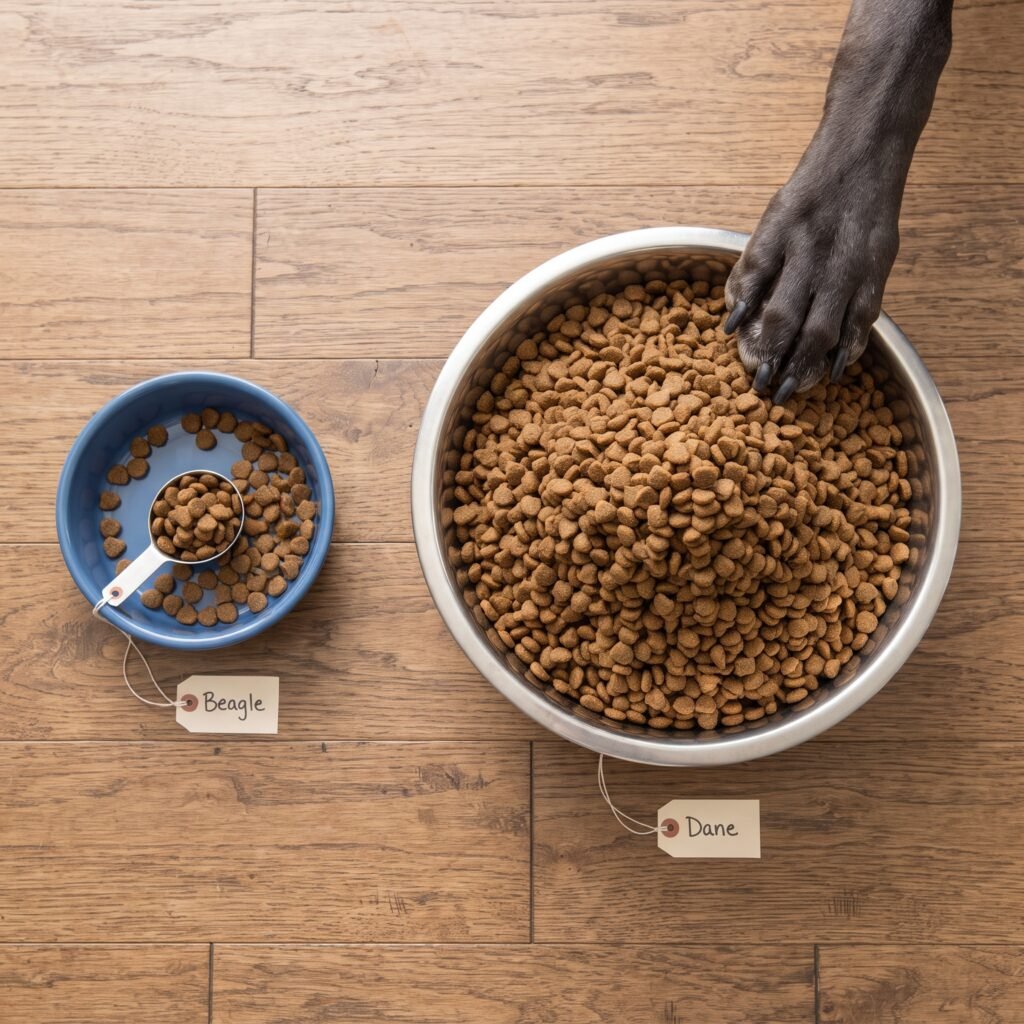
The answer to how much to feed a great dane is genuinely “less than you think, more often than you think.” Volume gets split across meals to protect the stomach; total calories stay conservative to protect the joints.
One practical note on measuring. Use an actual dry measuring cup, not a coffee mug or the scoop that came in the bag. Better still, weigh the food in grams on a kitchen scale — at Dane portions, a sloppy scoop drifting 15% high adds up to nearly a full extra cup a day.
What numbers should I look for on a great dane dog food label?
Here’s where most owners get lost, because the guaranteed analysis on the bag is in “as fed” percentages that include moisture, and those numbers aren’t comparable between brands.
Two conversions fix that.
Dry matter basis: divide the as-fed percentage by the dry matter fraction. A kibble with 10% moisture is 90% dry matter, so 1.1% calcium as fed is 1.1 ÷ 0.90 = 1.22% on a dry matter basis.
Per 1,000 kcal: the more useful one for growth, because it accounts for how calorie-dense the food is. Most manufacturers will publish it now, and any great dane dog food company that won’t answer this question by email has told you something useful.
AAFCO’s growth profile for large-size dogs — defined as those expected to exceed 70 lbs as adults — sets a calcium minimum of 1.2% dry matter and a maximum of 1.8% dry matter, which works out to roughly 3.0 to 4.5 grams per 1,000 kcal. Phosphorus runs a minimum of 1.0% dry matter, and the calcium-to-phosphorus ratio should sit between 1:1 and 2:1.
For a Great Dane specifically, I aim for the lower half of that calcium window and a ratio closer to 1.1:1 to 1.4:1.
The AAFCO statement that actually matters
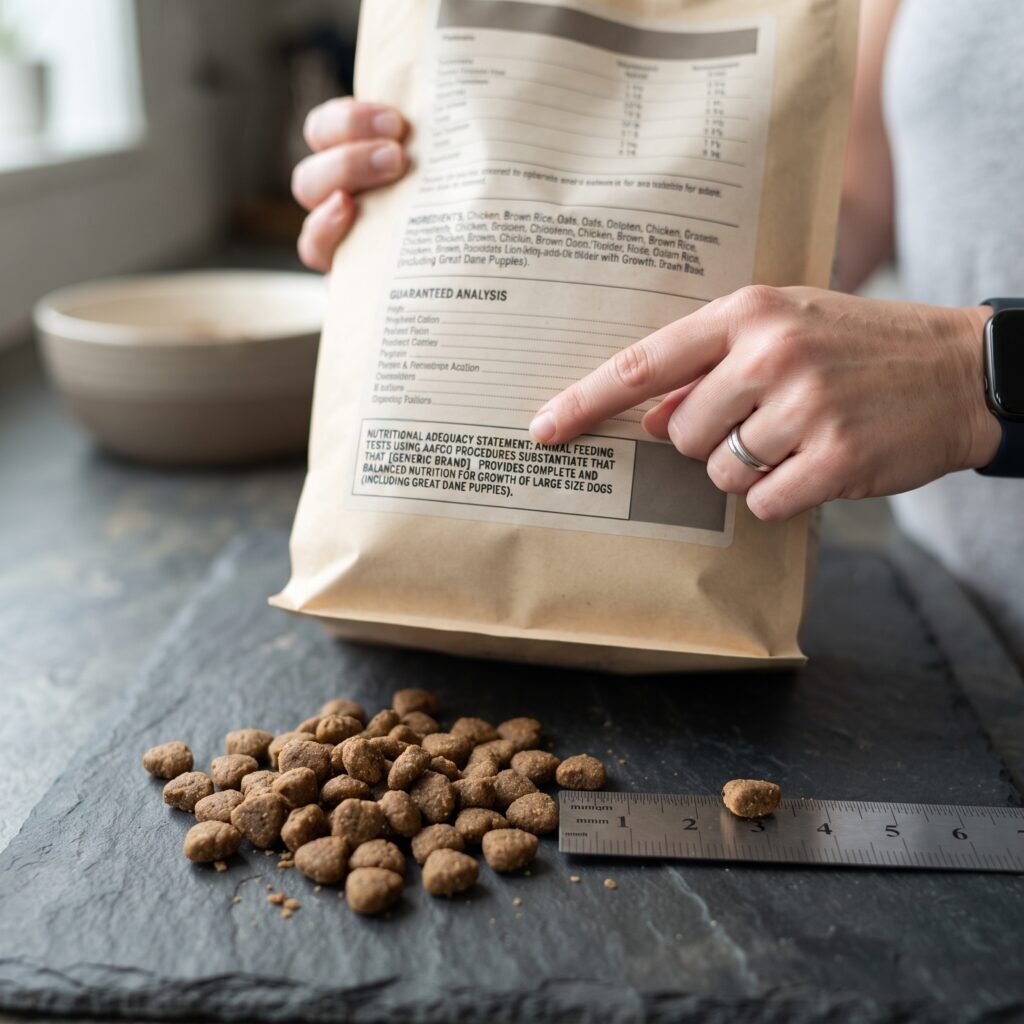
Flip the bag to the nutritional adequacy statement. You want wording that includes growth of large size dogs, 70 lbs or more as an adult. If that phrase is absent, the great dane dog food you’re holding was not tested against the large-breed calcium ceiling — even if the front of the bag says “large breed.”
This is the highest-value 15 seconds you’ll spend in the pet aisle. Marketing language on the front is unregulated. That statement on the back is not.
I’ve picked up bags labeled large breed puppy food that carried only a general growth statement, meaning they were formulated against the 2.5% calcium ceiling rather than the 1.8% one. For a Lab that’s fine. For a Dane it’s the difference that matters most.
Comparison table: what to target in a great dane dog food
| Nutrient | Dane puppy (4–14 mo) | Dane adult (18 mo+) | Why it matters |
|---|---|---|---|
| Calories | 340–400 kcal/cup | 340–420 kcal/cup | Lower density lets you feed volume without overfeeding |
| Protein (DM) | 26–30% | 22–26% | Growth minimum is 22.5% DM; adult minimum is 18% |
| Fat (DM) | 12–16% | 10–14% | Above ~18% makes lean feeding hard at Dane volumes |
| Calcium (DM) | 1.2–1.5% | 0.6–1.2% | Large-breed growth ceiling is 1.8% DM |
| Calcium (per 1,000 kcal) | 3.0–3.8 g | 2.0–3.0 g | Regulatory max for large-breed growth ≈ 4.5 g |
| Phosphorus (DM) | 0.9–1.2% | 0.5–1.0% | Pairs with calcium; ratio matters more than either alone |
| Ca:P ratio | 1.1:1 – 1.4:1 | 1:1 – 2:1 | Excess calcium is the bigger risk in giant breeds |
| Kibble size | 12–16 mm | 14–18 mm | Larger pieces slow down inhalers |
| AAFCO statement | Growth, incl. large size (70 lb+) | Adult maintenance | Non-negotiable for puppies |
Values reflect typical published ranges for large-breed formulas and AAFCO nutrient profiles, not any single brand’s numbers. Always confirm calcium per 1,000 kcal with the manufacturer.
Should I feed puppy food or adult food to a Great Dane puppy?
This is the fork in the road, and there are two legitimate schools.
School one: large breed puppy food until 12–18 months. Modern large-breed growth formulas are calcium-capped and calorie-moderate. They’re formulated for exactly this job, and they include the extra protein a growing Dane uses.
School two: adult maintenance formula from 4–6 months onward. Older breeder tradition, built on the logic that adult food is lower in calcium and calories, so it slows growth by default.
I’ve used both. School one wins on nutritional precision — you get a food designed for the growth phase with a verified calcium ceiling. School two works, but it’s blunt instrumentation. You’re using a food not formulated for growth to solve a problem better solved by measuring portions.
My default is a large breed puppy food fed at roughly 80–85% of the bag’s recommendation, adjusted weekly against body condition. That gives you a great dane dog food built for the job, with the calorie brake applied by hand.
If you’re choosing the best dog food for great danes on a single criterion, make it this one: a verified large-breed growth statement, then portion control on top.
When exactly do I switch a Great Dane to adult food?
Not on a birthday. Switch when growth in height has clearly plateaued — usually somewhere between 14 and 18 months, later in males.
The practical marker: measure withers height monthly. When you get two consecutive months with under half an inch of change, the growth plates are effectively done and the extra calcium and protein no longer buy you anything.
Then transition over 10–14 days. Danes have famously reactive digestive tracts, and a fast switch between great dane dog food formulas produces the kind of week nobody enjoys.
The approach that didn’t work for me
At 11 months, Juno was growing faster than I wanted — up about 9 lbs in one week, and her elbows looked thick. My reaction was to move her early onto a lower-calorie adult formula, thinking I’d slow her down without cutting volume.
It backfired in three ways.
She was hungry. The adult food ran about 340 kcal/cup, so hitting her requirement took nearly 11 cups a day, split across three meals. That’s an enormous volume of food sitting in a stomach that’s already a bloat risk.
Her stool quality collapsed. Loose, urgent, and frequent — partly the volume, partly the fiber profile, partly that I’d transitioned over five days instead of twelve because I was impatient.
And it didn’t even solve the problem. She kept gaining at nearly the same rate, because I hadn’t reduced calories, just diluted them.
What actually worked was going back to her great dane puppy food and cutting the portion by roughly 12%, holding it there for three weeks, and adding two short leash walks instead of yard sprints. Her weekly gain settled to 4–5 lbs. The lesson: the fix for fast growth is fewer calories, not a different bag.
That’s the part a generic recommendation can’t give you. Changing great dane dog food formulas feels like action. Measuring less of the same food is the action.
What about grain-free great dane dog food and DCM?
This question comes up constantly, and the honest answer is unsatisfying.
In 2018 the FDA opened an investigation into reports of dilated cardiomyopathy in dogs eating diets high in peas, lentils, and other legumes — many of them grain-free. The agency has since stated that a causal link has not been established and that the picture is more complex than diet alone.
Where that leaves us practically: there’s no proven danger, and no all-clear either, which is an uncomfortable place to make a great dane dog food decision from.
Great Danes carry a genetic predisposition to DCM independent of diet, which changes the risk math for this breed specifically. Given that, I default to a grain-inclusive great dane dog food unless there’s a documented reason not to — a diagnosed grain allergy, or an elimination diet run by a vet.
If you’re already feeding grain-free and your dog is thriving, I wouldn’t panic-switch. I’d ask your vet about a baseline taurine level and an echo if there’s any family history, and I’d choose formulas from companies that employ full-time veterinary nutritionists and run feeding trials.
For a deeper breakdown of the legume question across breeds, see our separate write-up on grain-free diets.
Does great dane dog food choice affect bloat risk?
Bloat — gastric dilatation-volvulus — is the single most serious acute risk in this breed, and food plays a role, though a smaller one than most owners assume.
Research out of Purdue on large and giant breeds found several dietary and management associations with elevated GDV risk. The findings most relevant to what’s in your bowl:
- Feeding a single large meal per day rather than splitting into two or three
- Rapid eating
- Formulas with fat or oil listed among the first four ingredients
- Elevated feeders, which were associated with increased risk in giant breeds, contrary to popular advice
- Moistening dry food containing citric acid
None of this makes a specific great dane dog food “bloat-safe.” What it does is shape the routine around it: split the daily amount across two or three meals, use a slow-feeder bowl at floor level, and keep hard exercise away from mealtimes by an hour on either side.
In other words, the bowl and the schedule carry more weight here than the great dane dog food inside them.
Juno inhaled her first bowl of a new formula in about 90 seconds — dense, disc-shaped pieces roughly 14 mm across, with an oily coating and a strong smell of rendered chicken fat. A slow-feeder bowl took that to just over four minutes. That single $12 purchase did more for her risk profile than any ingredient swap.
Also worth knowing: a prophylactic gastropexy at spay or neuter is the most effective intervention available, and it’s worth discussing with your vet regardless of what great dane dog food you feed.
How much does feeding a Great Dane actually cost?
This is the constraint that quietly decides most people’s answer, and I’d rather address it directly than pretend budget isn’t a factor.
An adult Dane needs somewhere around 2,400–3,000 kcal per day depending on sex, size, and activity. A growing puppy at peak can need more. At 380 kcal/cup, that’s roughly 6.5 to 8 cups daily.
Run that against the great dane feeding chart above and you’ll see why budget belongs in this conversation. Nobody feeds a giant breed for the price of feeding a beagle, and a plan you can’t sustain for eight years isn’t a plan.
| Option | Typical price | Kcal/cup | Cost per day (2,700 kcal) | Monthly |
|---|---|---|---|---|
| Budget large-breed kibble (30 lb) | $48 | 360 | ~$2.90 | ~$87 |
| Mid-tier large-breed formula (30 lb) | $68 | 385 | ~$3.85 | ~$116 |
| Premium large-breed formula (24 lb) | $88 | 420 | ~$5.50 | ~$165 |
| Fresh/subscription food | varies | — | ~$9–12 | ~$270–360 |
Prices are illustrative U.S. ranges as of writing and vary widely by retailer and region.
Two honest observations. First, a well-formulated mid-tier great dane dog food that carries the large-breed growth statement will serve your dog better than a premium boutique formula that doesn’t. Price does not track calcium control.
Second, fresh food is genuinely excellent nutrition and genuinely difficult to sustain at Dane volumes. I tried a fresh-food subscription for two months and stopped — not because Juno disliked it, but because the cost ran past $300 a month and the calcium content varied enough between batches that I couldn’t verify what she was getting during growth. For an adult Dane with no growth-plate concerns, it’s a more reasonable option — I’d just be cautious about using it as a great dane puppy food during the growth window unless the company publishes calcium per 1,000 kcal.
A workable middle path: mid-tier kibble as the base, with a topper of plain canned food or a spoonful of unsweetened pumpkin for palatability. That keeps the nutritional backbone consistent and cheap.
What if my Great Dane has a sensitive stomach?
Danes are prone to loose stool, gas, and general digestive drama, and it’s frequently blamed on protein sources when the actual cause is speed of transition or portion size.
Before you go hunting for a limited-ingredient great dane dog food, work through this order:
- Slow the transition. Twelve to fourteen days, not five. Increase the new food by about 10% every other day.
- Split the meals. Three smaller meals instead of two often fixes stool quality on its own.
- Check the fat. Formulas above roughly 18% fat on a dry matter basis cause problems for a lot of Danes.
- Add a probiotic. A vet-recommended canine-specific strain, given for at least three weeks before you judge it.
- Then consider a novel protein or limited-ingredient formula.
Most of the time, steps one through three fix it without changing great dane dog food at all.
If loose stool comes with weight loss, blood, or vomiting, skip the list and call your vet. Danes hide illness poorly and deteriorate quickly.
What about senior Great Danes?
Danes are considered senior around six, which arrives fast. At that point the priorities shift: maintaining lean muscle, protecting joints, and managing kidney health.
Don’t automatically drop protein. Older dogs generally need adequate high-quality protein to hold muscle mass, and blanket protein restriction is only appropriate with diagnosed kidney disease. What I do reduce is calories, since activity drops and a heavy senior Dane is a Dane in pain.
A senior great dane dog food with added omega-3s, glucosamine, and chondroitin is reasonable, though the doses in most foods are lower than a therapeutic supplement would provide. If joints are already stiff, treat the great dane dog food as a baseline and add the supplement separately.
How this was evaluated
I compared guaranteed analyses and manufacturer-published nutrient data against AAFCO’s nutrient profiles for growth of large size dogs, converting everything to a dry matter and per-1,000-kcal basis so brands were actually comparable.
I prioritized foods carrying an AAFCO statement that specifically names growth of large size dogs (70 lbs or more as an adult), and I checked each manufacturer against the FDA’s published recall and withdrawal records.
Where I’ve described texture, kibble size, eating speed, or stool response, those are direct observations from feeding a Great Dane from 10 weeks through adulthood, not summaries of other reviews. Where a claim wasn’t verifiable, I’ve stated it in general terms rather than attaching a number to it.
None of this replaces your veterinarian. A dog with a diagnosed condition needs a plan built around that condition, not a general-purpose great dane dog food article.
Frequently asked questions
How much to feed a Great Dane puppy per day?
Most Dane puppies land between 6 and 10 cups daily at peak growth, split across three meals, but the range is wide enough that the number is nearly useless on its own. Start at roughly 85% of the great dane dog food bag’s recommendation for the expected adult weight, then adjust by 10% in either direction based on weekly body condition checks.
Is large breed puppy food necessary for a Great Dane?
Yes, or an equivalent formula with verified calcium control. Standard puppy formulas can legally contain up to 2.5% calcium on a dry matter basis, well above the 1.8% ceiling set for large-breed growth, and that excess is the specific mechanism behind giant-breed skeletal problems.
When should a Great Dane switch from puppy to adult food?
Between 14 and 18 months for most Danes, later for large males, and the trigger should be height plateauing rather than a calendar date. Two consecutive months with less than half an inch of change at the withers is a reliable signal that growth plates have closed.
Can Great Danes eat regular adult dog food as puppies?
They can, and some experienced breeders choose adult great dane dog food deliberately to slow growth. It works, but it’s an imprecise tool — you’re better off using a large-breed growth formula and reducing the portion, which controls calories without giving up the growth-appropriate protein and mineral balance.
Does a raised bowl help prevent bloat in Great Danes?
The research points the other way. A Purdue study on giant breeds associated elevated feeders with increased GDV risk, so unless your vet has recommended one for a specific issue like megaesophagus, a floor-level slow-feeder bowl is the safer default.
Where this leaves you
The best great dane dog food is a large-breed growth formula with calcium in the 1.2–1.5% dry matter range, carrying an AAFCO statement that names large size dogs, fed in a measured amount that keeps your puppy visibly lean.
Then the actual work begins: weigh weekly, run your hands over the ribs, and adjust the portion by 10% at a time. The bag gives you a starting point. The dog gives you the answer.
If you take one thing from this: with great dane dog food, restraint outperforms upgrades. A moderately priced, correctly formulated food fed slightly under the recommendation will build a better adult Dane than the most expensive bag in the store poured generously.
That’s the honest version of the best dog food for great danes question. The bag matters less than the hand holding the scoop.