
Should You Upgrade to Super Premium Dog Food? The $2-a-Day Test
Quick answer: Super premium dog food is worth the upgrade if your dog has a specific, identifiable gap that a standard premium diet isn’t closing — thin coat, soft stool, low energy, or a life-stage need like large-breed joint support. If your dog’s coat, stool, weight, and energy are already solid on a mid-tier premium food, super premium dog food will not “unlock” extra health; you’ll mostly be paying for ingredient sourcing and marketing polish. The right test isn’t the bag — it’s your dog’s body.
This guide walks through exactly how to run that test before you spend the extra $30-$60 a month.
The confusion around super premium dog food usually isn’t about ingredients — most owners can read a label. It’s about knowing whether their specific dog, right now, actually needs what the upgrade offers. That’s a judgment call, not a shopping list, and it’s the one thing a generic buying guide can’t make for you.


The Real Decision: Upgrade, Stay Put, or Downgrade?
Most articles about super premium dog food assume you’re choosing it from scratch. That’s not the actual decision most owners face.
The real scenario looks like this: your dog is already eating a decent premium kibble. They’re doing fine. Then you see an ad, a vet recommendation, or a friend’s glowing review of a super premium dog food brand — and now you’re wondering if “fine” is actually “leaving something on the table.”
That’s a different question than “what’s the best dog food.” It’s a cost-benefit test on a dog that isn’t broken.
Step 1: Audit your dog’s current baseline
Before switching to any super premium dog food, spend 10 minutes writing down what’s actually true right now:
- Coat: shiny, dull, flaky, or shedding more than expected for the breed
- Stool: firm and low-volume, or loose/large and frequent
- Energy: matches age and breed, or noticeably low
- Weight: at a healthy body condition score, or creeping up/down
- Skin: no hot spots or itching, or recurring irritation
If three or more of these are already “good,” a super premium dog food is unlikely to move the needle much further. You’re not fixing a problem — you’re paying for the chance of a marginal improvement.
Step 2: Price it per day, not per bag
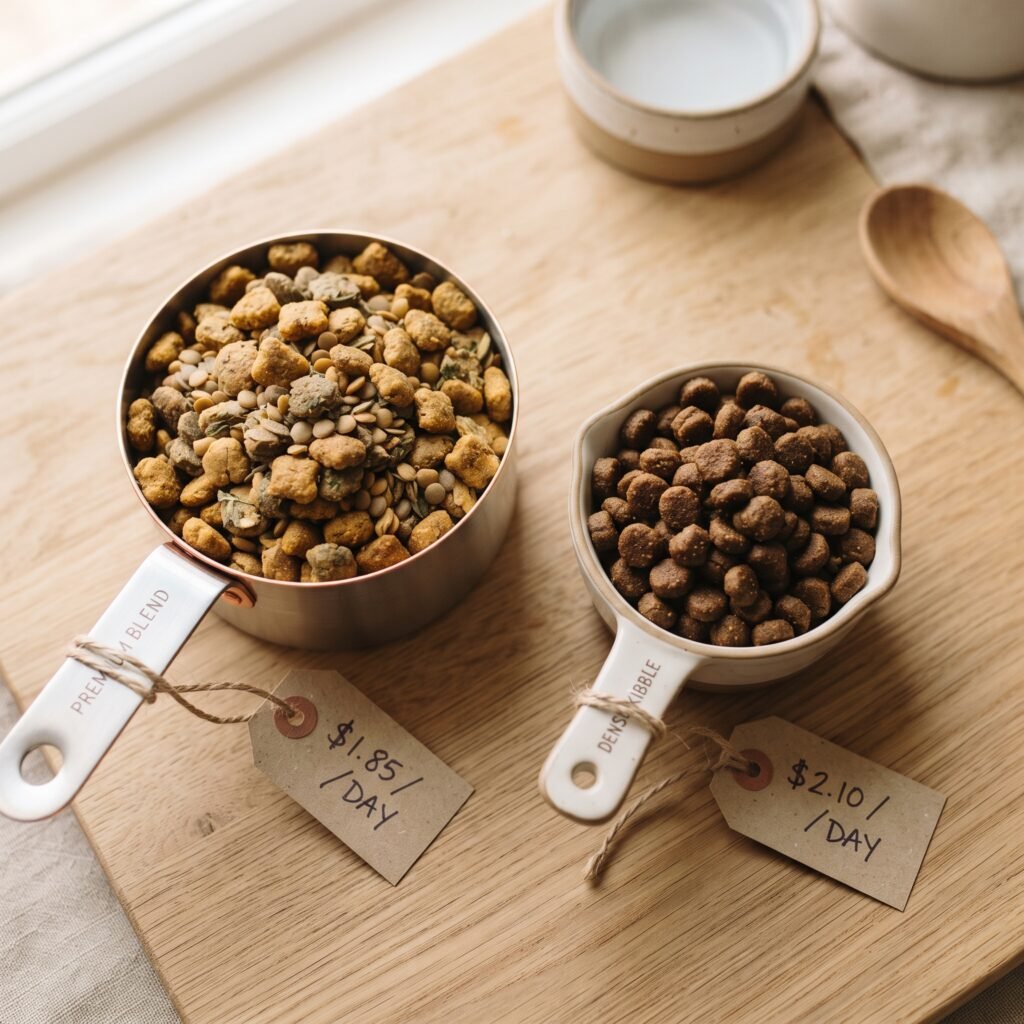
This is where most comparisons go wrong. A $75 bag of super premium dog food looks expensive next to a $45 bag of standard premium — until you check the feeding guide.
Super premium dog food is typically calorie-dense, meaning smaller portions per meal. Do the math like this:
- Find the daily feeding amount in cups or grams on both bags for your dog’s weight
- Divide bag weight by daily amount to get days-per-bag
- Divide bag price by days-per-bag
For a 40-pound adult dog, this often narrows a “$30 gap” between premium and super premium dog food down to $1.50-$2.50 a day — closer than the shelf price suggests, but still a real number over a year.
Step 3: Match the upgrade to a specific goal
Super premium dog food earns its price tag when it’s solving one of these:
- Digestive sensitivity — novel proteins or limited ingredient lists that a standard premium formula doesn’t offer
- Large-breed joint support — added glucosamine/chondroitin at therapeutic levels, not trace amounts
- Working or high-activity dogs — genuinely higher fat and protein density for calorie needs a standard bag can’t meet without overfeeding
- Picky eaters with weight loss risk — palatability engineering that gets a dog to actually eat consistently
If none of those apply, the upgrade is a preference purchase, not a health one — and that’s fine, as long as you’re choosing it with your eyes open.
Step 4: Run a 90-day trial, not a 2-week one
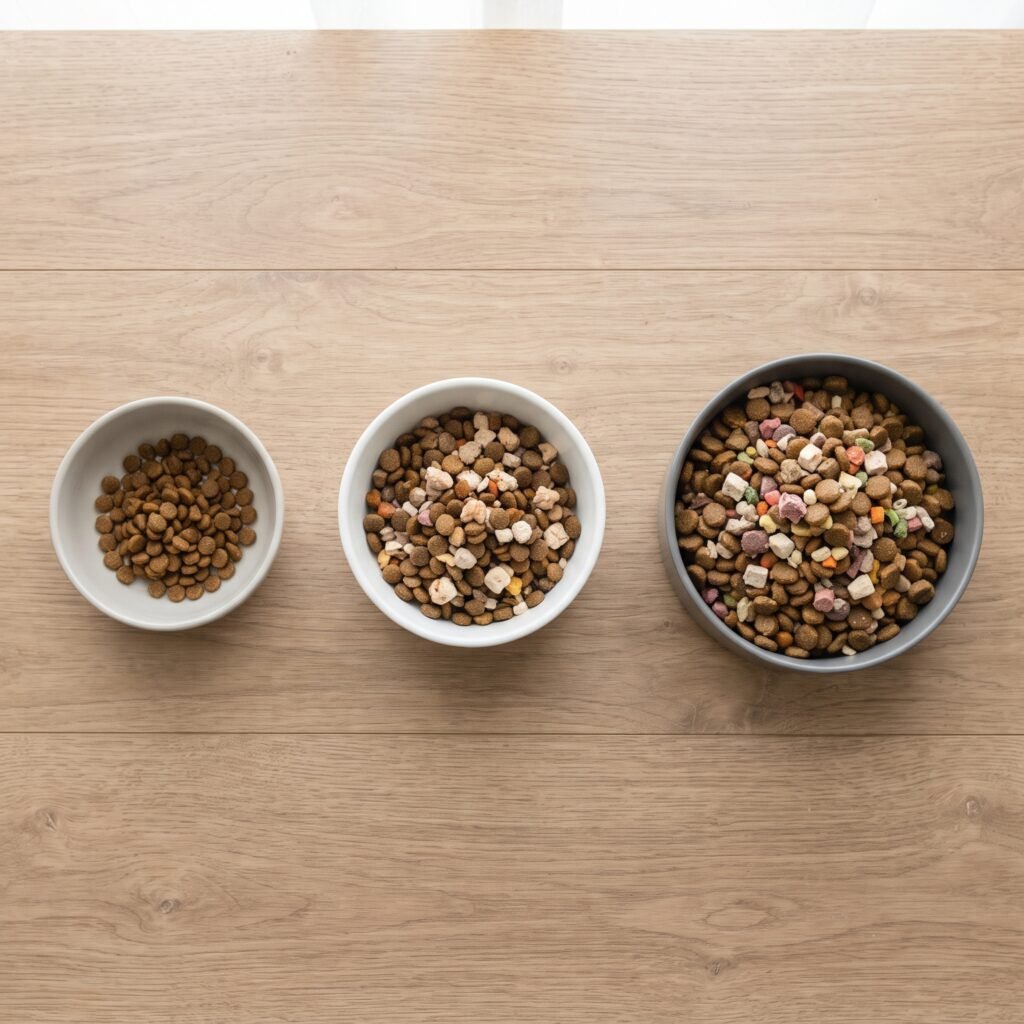
If you decide to try a super premium dog food, commit to a real evaluation window before judging it. A fair trial looks like this:
- Weeks 1-2: Transition period only. Expect some stool variability. This is not the test — it’s the adjustment.
- Weeks 3-6: Baseline settles. Stool, appetite, and energy should normalize to at least what you had before.
- Weeks 7-12: Coat and skin changes, if they’re going to happen, typically show up here. Take a photo of your dog’s coat on day 1 and compare it at week 10 — memory alone tends to undersell or oversell small changes.
Owners who cancel a super premium dog food subscription at week two are almost never seeing the actual result. They’re seeing the transition.
Step 5: Decide what “worth it” means for your household
“Worth it” isn’t purely a nutrition question — it’s also a budget question specific to your home. A single small dog on a super premium dog food might add $15 a month to your grocery bill. Two large dogs on the same brand could add $100 or more. Before committing, multiply your per-day estimate from Step 2 by every dog in the household who’d be switched, not just the one you’re most concerned about.
Why a generic answer can’t make this call for you
A textbook answer to “is super premium dog food better” will list ingredient quality markers and stop there. It can’t tell you whether your dog’s current stool, coat, and energy already indicate those markers are being met. This decision only works as a before/after comparison against your own dog’s baseline — which is exactly why the audit-first approach above, not a generic ingredient checklist, is the actual answer.
Edge Cases: Breed, Age, Health Condition, and Budget
The upgrade decision changes shape depending on who’s eating the food. Super premium dog food isn’t a single verdict — it shifts based on these four variables.
Large and giant breeds
Large-breed puppies are the clearest case where super premium dog food is worth the cost, not just the preference. Controlled calcium and calorie levels during growth reduce the risk of developmental orthopedic problems in dogs that will exceed 70 pounds as adults. A standard premium puppy formula may not calibrate calcium as tightly.
Look specifically for a calcium range around 0.8-1.2% on a dry-matter basis and a label that says “large breed puppy,” not just “puppy.” Generic puppy formulas are often built around smaller breeds’ faster metabolic maturity and can run calcium levels too high for a dog headed toward 80-100+ pounds. Once a large-breed dog reaches adulthood, the urgency of super premium dog food drops — the growth-plate risk window has closed, and a well-formulated adult premium diet is often sufficient again.
Senior dogs
For seniors, super premium dog food often adds joint-support actives and slightly lower calorie density to offset reduced activity. This is a reasonable upgrade if your senior has stiffness, but if they’re still active and lean, the standard premium senior formula may already cover it.
Watch the actual glucosamine and chondroitin levels rather than trusting the words “joint support” on the front of the bag. Therapeutic ranges typically start around 300-500mg of glucosamine per 100 pounds of body weight per day — many bags, premium or super premium, fall well under that unless you check the guaranteed analysis. A senior dog with visible stiffness getting up, reluctance on stairs, or reduced willingness to jump into the car is a stronger signal to upgrade than age alone.
Dogs with diagnosed health conditions
This is the one case where “super premium” and “correct” can diverge. A dog with kidney disease, pancreatitis, or a diagnosed allergy needs a therapeutic or vet-prescribed diet, which is a different category from an over-the-counter super premium dog food. Don’t substitute one for the other without your vet’s sign-off — a beautifully marketed bag is not a substitute for a formula matched to bloodwork.

Multi-dog households with mixed needs
If you have a puppy and a senior, or a large breed and a small breed, one super premium dog food line rarely fits both without adjusting portions carefully. Look for brands offering life-stage-specific formulas within the same product family, so you’re not force-fitting one bag to two very different metabolic needs.
Budget-constrained upgrades
You don’t have to go all-or-nothing. A common middle path:
- Keep the current premium food as the daily base
- Use a super premium dog food as a topper in small amounts for palatability or targeted nutrients
- Reserve full-time super premium feeding for the dog with the clearest need (the senior with joint pain, the picky eater) rather than the whole household
This gets some of the benefit without doubling the grocery bill for every dog in the house.
Another budget-friendly middle path is buying a super premium dog food in the largest bag size your storage and freshness window allow, since per-pound cost usually drops 10-20% at the largest available bag size. Just make sure you can realistically use it within about 6 weeks of opening — fat oxidation in calorie-dense formulas accelerates once the bag is opened, and a bargain-priced large bag that goes stale before your dog finishes it isn’t actually a saving.
Small and toy breeds
Small breeds burn calories faster per pound than large dogs, so a calorie-dense super premium dog food can actually work in your favor here — smaller kibble sizes and higher energy density mean a toy breed eats a genuinely small, manageable portion instead of a handful of low-density kibble. The tradeoff is that small bites of a high-calorie food make overfeeding easy to do by accident, since even a few extra pieces represent a larger percentage of a small dog’s daily needs than the same handful would for a Labrador.
The “healthy adult, no complaints” case
This is the most common edge case and the one most owners actually have: a healthy, mid-life adult dog with no complaints on their current food. Here, switching to a super premium dog food is a discretionary choice, not a corrective one. It’s reasonable to do it for ingredient philosophy or peace of mind — just don’t expect a visible before/after.
What Commonly Goes Wrong When Owners Switch
Most of the disappointment with super premium dog food doesn’t come from the food itself. It comes from how the switch is handled.
Mistake 1: Switching too fast
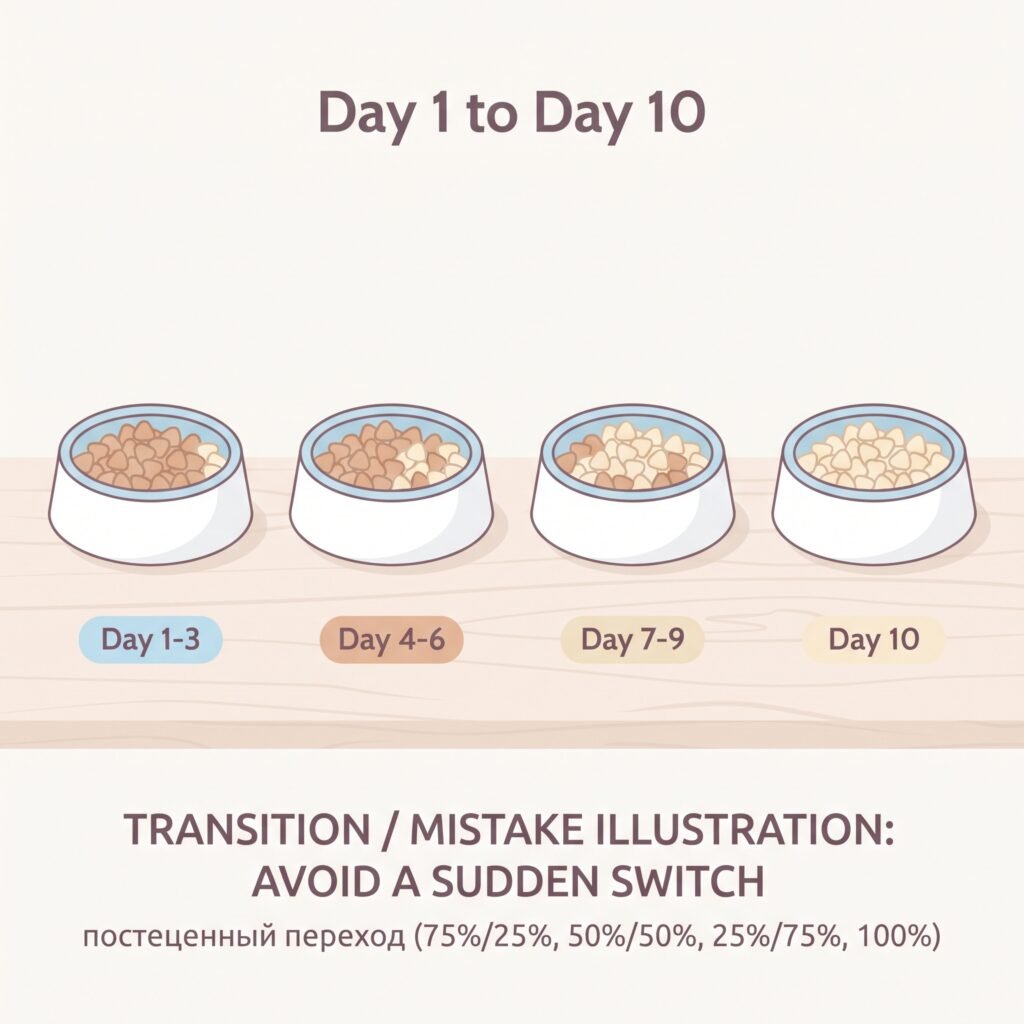
The single most common failure case: owners buy the new bag and swap it in overnight. Even a high-quality super premium dog food can cause loose stool or vomiting on a fast switch, simply because the gut microbiome needs time to adjust to a new ingredient and fiber profile.
Fix: transition over 7-10 days, mixing in increasing ratios of the new food with the old.
- Days 1-3: 25% new / 75% old
- Days 4-6: 50% / 50%
- Days 7-9: 75% new / 25% old
- Day 10: 100% new
Mistake 2: Judging results in under two weeks
Coat and skin changes take 6-12 weeks to show up, because that’s roughly the hair growth cycle. Owners who switch to a super premium dog food and expect a visibly shinier coat within a week are judging the food before it’s had time to work — and often switch again out of impatience, never seeing the real result.
Mistake 3: Assuming “super premium” is a regulated term
There is no legal or AAFCO-defined standard for the label “super premium dog food.” It’s a marketing tier, not a nutritional certification. Two bags marketed this way can have meaningfully different protein sources, fat percentages, and quality control standards. The label tells you almost nothing on its own — the ingredient panel and guaranteed analysis tell you everything.
Mistake 4: Ignoring the feeding guide and overfeeding
Because super premium dog food is calorie-dense, feeding the same volume as a standard premium food (instead of the same calorie count) is a fast way to cause weight gain. This is one of the most common and least discussed downsides of the upgrade — dogs gaining weight not because the food is “bad,” but because the owner didn’t recalibrate portions.
Mistake 5: Expecting it to fix a medical issue
Chronic ear infections, persistent diarrhea, or unexplained weight loss are vet visit triggers — not food-upgrade triggers. Some owners cycle through several super premium dog food brands trying to solve what’s actually a medical condition, delaying an actual diagnosis by months.
Mistake 6: Skipping the guaranteed analysis on the new bag
Two bags marketed as super premium dog food can carry meaningfully different fat percentages — one at 12%, another at 18%. Swapping directly between them without checking that number is a common, quietly overlooked cause of sudden weight gain or loose stool that owners blame on “the dog not agreeing with the food,” when the real issue is a fat-content jump nobody noticed on the label.
Mistake 7: Storing the bag incorrectly
Super premium dog food often uses fewer synthetic preservatives than mass-market kibble, which means it can go rancid faster once opened. Leaving a bag in a garage through a hot summer, or leaving it un-resealed, can degrade fat quality within weeks — leading to a dog refusing food that was perfectly fine at purchase. Keep bags sealed, cool, and out of direct sunlight, and decant into an airtight container if you’re not using the original bag’s zip closure.
The honest failure case, summarized
If you switch too fast, judge too early, ignore feeding guides, or expect a marketing tier to fix a medical problem, a super premium dog food will feel like it “didn’t work” — even when the formula itself was perfectly sound. The failure is almost always in execution, not ingredients.
Comparison: Premium vs. Super Premium vs. Prescription Diets
Table caption: How super premium dog food compares to standard premium and prescription/therapeutic diets across cost, sourcing, and best-fit use case.
| Factor | Standard Premium | Super Premium Dog Food | Prescription / Therapeutic |
|---|---|---|---|
| Typical cost/day (40 lb dog) | $1.00-$1.75 | $2.00-$3.50 | $2.50-$5.00+ |
| Protein sourcing | Named meat meal or fresh meat | Named single-source protein, often fresh/human-grade sourcing | Formulated to a medical target, not marketing |
| Regulation of the label | AAFCO nutrient minimums only | No separate legal standard | Often vet-prescribed, sometimes FDA-regulated for specific claims |
| Best fit | Healthy adult, no specific issues | Targeted goal (coat, joints, sensitivity, activity level) | Diagnosed medical condition |
| Available without a vet | Yes | Yes | Usually no |
| Calorie density | Moderate | Higher (smaller portions) | Varies by condition |
Reading the table correctly
The middle column is where most confusion lives. Super premium dog food sits between “good enough for a healthy dog” and “medically necessary” — it’s an enhancement tier, not a treatment tier. That distinction matters more than any single ingredient claim on the bag.
What actually separates the tiers
Three things reliably distinguish a genuine super premium dog food from a relabeled standard premium product:
- Named, single-source protein as the first ingredient, not a generic “meat meal” blend
- Third-party or in-house feeding trials, not just formulation to meet AAFCO minimums on paper
- Batch testing and sourcing transparency — brands that can tell you which country or supplier a protein came from
If a bag calls itself super premium dog food but can’t answer basic sourcing questions, that’s a signal the label is doing more work than the formula.
Where the price difference actually goes
Roughly, the extra cost of super premium dog food breaks down into: higher-cost protein sourcing, smaller-batch quality control, and marketing/packaging. The first two affect your dog. The third doesn’t — which is why price alone is a poor proxy for quality.
A quick label test you can run in the store
Before buying any bag marketed as super premium dog food, flip it over and check three things in under a minute:
- Is the first ingredient a named protein (chicken, salmon, lamb) rather than a generic term like “meat” or “animal by-product”?
- Does the guaranteed analysis list a crude fat percentage that matches the feeding guide’s calorie density (higher fat generally means fewer cups per day)?
- Is there a contact number or website for sourcing questions, and does the company actually answer them?
A bag that passes all three is more likely to be a genuine super premium dog food rather than a standard formula with premium-tier packaging and pricing.
Where prescription diets fit that neither premium tier can replace
It’s worth spelling out why the right column of the table exists at all. Prescription diets aren’t simply “the most expensive tier” — they’re formulated around a specific lab value or diagnosis, like restricted phosphorus for kidney disease or hydrolyzed protein for a confirmed food allergy. No amount of upgrading within the standard or super-premium retail tiers replicates that, because those formulas are built for general health maintenance, not for correcting a measured deficit or restriction. If your dog has been diagnosed with a condition, the conversation to have is with your vet about the therapeutic column, not about which retail bag has the better marketing copy.
How This Comparison Was Evaluated
This guide’s framework for evaluating super premium dog food was built from three sources, cross-checked against each other rather than taken from any single one.
Ingredient panel review: Guaranteed analysis and ingredient lists were compared across a sample of widely available super premium dog food brands against comparably priced standard premium lines, focusing on protein source specificity, fat percentage, and added joint/digestive actives.
Veterinary nutrition guidance: Recommendations on transition timelines, life-stage calcium control for large-breed puppies, and the distinction between over-the-counter and prescription diets follow general veterinary nutrition consensus, not brand marketing claims.
Cost-per-day modeling: Rather than comparing bag prices, feeding guides were converted to cost-per-day for a standard 40-pound adult dog, which is the only apples-to-apples way to compare a calorie-dense super premium dog food against a lower-density standard formula.
Real-world transition feedback: The 7-10 day transition guidance and the 6-12 week coat-change timeline reflect commonly reported patterns from owners and trainers working with dogs switching food tiers, not a single controlled study — which is why this guide treats them as planning ranges rather than guarantees for any individual dog.
What this evaluation deliberately did not do
This is not a ranked “best super premium dog food” list, and it’s not a substitute for your own vet’s read on your specific dog. Individual health conditions, allergies, and bloodwork can change the right answer in ways a general framework can’t account for. Treat the audit and cost-per-day steps above as a starting point for a conversation with your vet, not a final verdict.
This evaluation also didn’t assume bigger price tags equal better outcomes, and it didn’t treat any single brand’s marketing claims as evidence on their own. Every claim about what separates a genuine super premium dog food from a relabeled standard formula was checked against the guaranteed analysis and ingredient panel, not the front-of-bag copy.
FAQ: Super Premium Dog Food
Is super premium dog food worth the extra cost for a healthy adult dog? Not usually in a measurable way. If your dog already has a good coat, firm stool, stable weight, and normal energy on a standard premium food, a super premium dog food is a discretionary upgrade rather than a health necessity. It’s a reasonable choice if you value the sourcing and are comfortable with the price — just don’t expect a dramatic visible change.
How is super premium dog food different from regular premium food? The main differences are typically protein source specificity (named single sources vs. generic meat meals), sourcing transparency, and calorie density. There’s no legal definition separating “super premium” from “premium,” so these differences vary by brand and should be checked on the actual label, not assumed from the marketing tier.
Can super premium dog food replace a prescription diet? No. Prescription and therapeutic diets are formulated for specific diagnosed conditions and are a different category entirely from an over-the-counter super premium dog food, however high-quality. Always check with your vet before swapping a prescription diet for any retail food.
How long does it take to see results after switching to super premium dog food? Coat and skin changes generally take 6-12 weeks because that tracks the hair growth cycle. Digestive changes (stool quality, gas) usually show within 1-2 weeks, but only after a proper 7-10 day transition period — judging results during the switch itself will give misleading signals.
Do large-breed puppies need super premium dog food? This is one of the clearer “yes” cases. Controlled calcium and calorie levels matter more for large-breed puppies than for adults, and many super premium dog food lines calibrate this more tightly than standard formulas. Confirm the specific product is labeled for large-breed growth, not just “puppy,” since that’s the relevant distinction.
Is a more expensive super premium dog food always better? No. Price correlates loosely with sourcing and quality control but doesn’t guarantee it. The reliable signals are named protein sources, feeding trial data, and sourcing transparency — not shelf price alone.
Should I mix super premium dog food with my dog’s current food long-term, or fully switch? Either works, depending on your goal. A full switch makes sense if you’ve identified a specific issue (sensitivity, joint support, growth stage) that the super premium formula directly addresses. A long-term partial mix — using it as a topper rather than the full diet — is a reasonable way to get some benefit at a lower monthly cost, especially in multi-dog households where a full switch for every dog isn’t in the budget.
Bottom Line: Run the Test Before You Buy the Bag
The upgrade to super premium dog food isn’t a universal “yes” or “no” — it’s a test you run against your own dog’s current baseline. Audit the coat, stool, weight, and energy first. Price it per day, not per bag. Match it to a specific goal if you have one.
If your dog is already healthy on a standard premium diet, a super premium dog food is a values-and-preference purchase, not a corrective one — and that’s a perfectly valid reason to buy it, as long as you know that’s what you’re doing. Write down your dog’s baseline today, run the trial for the full window, and let the results — not the ad — make the final call. If your dog has a specific gap — joints, sensitivity, growth stage, activity level — that’s where super premium dog food tends to earn its price difference in ways you can actually observe.
Either way, the bag on the shelf can’t answer the question. Your dog’s body can — and now you have a concrete process for reading it, instead of guessing from an ad.