
Best Low Carb Dog Food in 2026: Top Picks for Weight Loss, Energy & Better Health
Most kibble is 40–60% carbs — far more than dogs need. Our low carb dog food picks cut the fillers and deliver real protein, so your dog loses weight, gains energy, and feels better fast.

Walk into any premium pet store in 2026 and you’ll notice a clear trend: the fastest-growing segment of the dog food market isn’t grain-free, it isn’t raw, and it isn’t fresh-cooked — it’s low carb dog food. As more dog owners take a serious look at what’s actually inside their dog’s bowl, the carbohydrate content of conventional kibble has become one of the most scrutinized and frequently questioned aspects of commercial pet nutrition. And for very good reason: most standard dry kibble formulas contain between 40% and 60% carbohydrates on a dry matter basis — a macronutrient load that dogs’ metabolic systems were not evolutionarily designed to process at such high quantities.
This comprehensive 2026 guide covers everything you need to know about low carb dog food: the science behind canine carbohydrate metabolism, which dogs benefit most from lower-carbohydrate diets, how to accurately calculate carbohydrate content on any dog food label, the top-rated brands across every format category, the critical distinction between low carb dog food and the more extreme ketogenic format, specific guidance for diabetic dogs, and the important caveats every buyer should understand before making a dietary change.
Always consult your veterinarian before switching to a low-carbohydrate diet, particularly for dogs with diabetes, pancreatitis, kidney disease, or other diagnosed health conditions where macronutrient management is clinically significant.
What Is Low Carb Dog Food and What Does “Low Carb” Actually Mean?
The term “low carb dog food” lacks a regulatory definition — unlike AAFCO nutritional compliance, there is no official threshold below which a food is officially classified as “low carb.” This makes understanding the actual numbers critically important when evaluating any formula marketed as a lower-carbohydrate option.
DogCaress’s January 2026 veterinary-reviewed guide defines low carb dog food as “a type of canine diet that contains significantly reduced levels of carbohydrates, typically comprising 10-20% of the total caloric content” — compared to the 40% to 60% carbohydrate content found in many conventional kibble formulas. This 10-20% target aligns with veterinary guidance from the World Small Animal Veterinary Association (WSAVA), which the same guide cites as confirming that low-carb diets can be beneficial in managing canine obesity and conditions like diabetes.
Within the broad category of low carb dog food, there are meaningfully different levels of carbohydrate restriction:
- Moderate low-carb (20-30% carbs on dry matter basis): Significantly lower than standard kibble, achievable in high-quality commercial dry formulas like Orijen and some Nulo Freestyle recipes
- Low-carb (10-20% carbs on dry matter basis): The target range for most owners seeking genuine carbohydrate reduction — achievable through freeze-dried, air-dried, fresh-cooked, and specialized kibble formats
- Very low-carb/keto (under 10% carbs on dry matter basis): The most restrictive category — typically found only in raw, freeze-dried, or specifically formulated keto kibble products like Ketona. Reserved for specific therapeutic applications and requires veterinary supervision
Why Carbohydrates Matter in Dog Nutrition: The Science
The scientific case for low carb dog food starts with a fundamental fact about canine physiology: unlike humans, dogs have no biological requirement for dietary carbohydrates. Dogster’s October 2025 vet-reviewed nutrition guide confirms this directly: “While canines can get energy from protein and fat, they can usually get enough energy from breaking down fat and protein.” Spot & Tango’s February 2026 nutritional guide is equally direct: “Carbohydrates are not considered an essential nutrient for dogs, unlike protein and fat.”
This doesn’t mean carbohydrates are inherently harmful to dogs — complex carbohydrates from whole food sources like carrots, spinach, and quinoa can provide fiber, antioxidants, and slow-releasing energy. The problem, as Spot & Tango’s guide identifies, is that “many lower-cost kibble brands use refined carbohydrates like corn, wheat, rice, and potatoes as cheap fillers. These ingredients boost calorie content but add very little in terms of nutritional value.” Over time, a diet heavy in these refined, high-glycemic carbohydrates can contribute to:
- Obesity and weight gain: Excess refined carbohydrates elevate insulin levels and promote fat storage, making weight management significantly harder even when total caloric intake appears controlled
- Blood sugar instability: High-glycemic carbohydrates cause rapid spikes in blood glucose followed by corresponding insulin responses — a metabolic cycle that is particularly damaging for diabetic dogs and metabolically stressed overweight dogs
- Chronic inflammation: Refined grain carbohydrates can contribute to systemic inflammatory responses in sensitive dogs, exacerbating skin conditions, joint inflammation, and digestive sensitivities
- Dental disease: DogCaress’s January 2026 guide cites the American Veterinary Dental College on this point: “Reduced carbohydrate intake can lower the risk of dental diseases, such as plaque buildup and gingivitis. High sugar levels from carbs contribute to oral bacteria that cause these issues”
- Reduced satiety: High-carbohydrate diets provide less lasting satiety per calorie than protein and fat-rich formulas — contributing to the constant hunger and begging behavior that many owners of carb-heavy kibble-fed dogs recognize
How to Calculate Carbohydrate Content in Dog Food
One of the most important skills for any owner evaluating low carb dog food is knowing how to calculate the actual carbohydrate content of any formula — because carbohydrate percentage is not required to appear on the guaranteed analysis panel of most commercial dog foods. Here is the calculation:
Carbohydrate % = 100% − Protein% − Fat% − Moisture% − Ash% − Fiber%
The ash percentage is often not listed on consumer labels — in that case, use 6% as a standard default estimate. For a typical mainstream kibble listing 26% protein, 14% fat, 10% moisture, 4% fiber, and estimating 6% ash: 100 − 26 − 14 − 10 − 4 − 6 = 40% estimated carbohydrates.
For accurate comparison across different moisture levels (comparing wet food to dry food, for example), convert all values to a dry matter basis by dividing by (100 minus the moisture percentage). KetoNatural Pet Foods’ comprehensive low-carb buying guide specifically emphasizes this calculation as the essential tool for any serious low carb dog food evaluation — noting that the carbohydrate content of most kibble “is simply not displayed anywhere on the product label” and must be calculated by the consumer.
High Protein Low Carb Dog Food: Why the Two Go Together
The concept of high protein low carb dog food is grounded in a straightforward nutritional principle: if carbohydrates are reduced as an energy and caloric source, that caloric gap must be filled by protein, fat, or both. Most quality low carb dog food formulas achieve their reduced carbohydrate content by elevating their protein content — replacing the starchy fillers that conventional kibble uses with additional named animal proteins that deliver superior biological value.
This protein elevation delivers compounding benefits beyond simple carbohydrate replacement:
- Higher protein supports lean muscle maintenance — particularly important for senior dogs, working dogs, and weight-loss programs where muscle preservation must be protected alongside fat reduction
- Protein is more satiating per calorie than carbohydrates — reducing hunger-driven eating behavior and making portion control more effective
- Animal proteins naturally deliver amino acids including taurine, leucine, and arginine that provide cardiac, muscular, and immune benefits that carbohydrate fillers cannot replicate
Dog Food Advisor’s May 2026 high-protein analysis specifically documents several formulas achieving genuinely impressive protein-to-carb ratios: Raised Right’s beef recipe at 61% protein and 8% estimated carbs; Maxbone’s freeze-dried formula at 49.5% protein and 8% estimated carbs; and Maev Raw at 47.4% protein and 24.2% carbs. These formulas represent the real-world performance ceiling of the high protein low carb dog food category in 2026.

High Protein Low Carb Dog Food Diet: A Day-in-the-Life Nutritional Framework
Understanding how to implement a high protein low carb dog food diet practically — beyond simply selecting a lower-carb product — requires thinking about the complete nutritional picture:
Protein Target
Most healthy adult dogs on a high protein, low carb dog food program benefit from formulas delivering at least 30% protein on a dry matter basis — with the most impressive options reaching 40% to 60%+ in raw and freeze-dried formats. The protein source quality matters as much as the percentage: named animal proteins (beef, chicken, salmon, turkey, bison) deliver complete amino acid profiles that plant-sourced protein fillers cannot replicate.
Fat Content
When carbohydrates are reduced, fat typically increases as the secondary energy source. Tailwaves’ December 2025 veterinary-reviewed guide specifically cautions: “Avoid very high-fat options if your dog has a history of pancreatitis or fat sensitivity.” For dogs without these conditions, healthy fat from named sources (salmon oil, chicken fat preserved with mixed tocopherols) provides essential fatty acids, fat-soluble vitamin carriers, and sustained energy that supports the reduced carbohydrate load.
Fiber Sources
Reducing carbohydrates should not mean eliminating fiber entirely. Quality low carb dog food formulas maintain meaningful dietary fiber through low-glycemic vegetables — spinach, kale, broccoli, pumpkin, carrots — that provide prebiotic support, gut motility, and stool formation without the high-glycemic carbohydrate load of starchy grains.
Feeding Frequency
Two consistent, measured meals daily is the standard recommendation for dogs on low carb dog food programs — supporting blood glucose stability through predictable meal timing rather than the irregular glucose fluctuations of free-feeding or single large daily meals.
Best Low Carb Dog Food Brands in 2026: Top Picks Reviewed
1. Ketona Chicken Recipe — Best Overall Low Carb Kibble
Tailwaves’ December 2025 veterinary review identifies Ketona as offering “the strongest low-carb profile in a traditional kibble format” and “the best overall pick for 2026.” Manufactured by KetoNatural Pet Foods, Ketona’s Chicken Recipe achieves less than 6% total digestible carbohydrate content — an extraordinary achievement for a kibble format where the extrusion manufacturing process typically requires carbohydrate-heavy binders. DogCaress’s January 2026 analysis confirms 46%+ protein alongside the sub-6% carbohydrate figure. The formula uses non-GMO, antibiotic-free chicken raised sustainably in the USA. For owners specifically seeking the most carbohydrate-restricted kibble option available in 2026, Ketona is the clear benchmark.
2. Raised Right (Dr. Karen Becker Formulated) — Best Ultra-Low Carb Fresh Food
Raised Right represents one of the most impressive low carb food for dogs options in the fresh-cooked segment. Formulated by veterinarian Dr. Karen Becker in collaboration with pet food expert Steve Brown, most Raised Right recipes contain less than 2% carbohydrates — achieved by avoiding all high-carb fillers including potato, rice, oats, yam, squash, pasta, and barley entirely. The brand is the first to voluntarily submit recipes for independent AAFCO nutrient profile verification through Check Your Pet Food, publicly sharing full nutritional analysis data for every recipe. Human-grade ingredients, gently cooked in a human-grade facility, with every batch lab safety tested. Dog Food Advisor’s May 2026 analysis of the beef recipe confirms 61% protein, 24% fat, and 8% estimated carbs — among the lowest in any commercially available complete-and-balanced format.
3. Ziwi Peak Air-Dried — Best Air-Dried Low Carb Option
Tailwaves’ December 2025 review specifically recommends Ziwi Peak Air-Dried as delivering “exceptional digestibility and nutrient density” in the low carb dog food category — noting it as particularly suitable for “picky eaters or those sensitive to heavy starches.” Ziwi Peak’s air-dried formulas achieve approximately 96% meat, organ, and bone content with minimal plant-based carbohydrate inclusion, delivering extremely high protein and fat alongside naturally very low carbohydrates in a shelf-stable, no-refrigeration format.
4. Spot & Tango UnKibble — Best Fresh-Dry Low Carb Option
Spot & Tango’s February 2026 nutritional guide confirms that their fresh food recipes are “designed by veterinary nutritionists and use whole ingredients that naturally reduce carb load without sacrificing essential nutrients.” The UnKibble format — gently processed fresh whole ingredients rather than extruded kibble — achieves meaningfully lower carbohydrate content than conventional dry food while maintaining the serving convenience that makes daily feeding practical. The personalized meal plans calibrated to individual dog weight and activity level address the portion precision that effective carbohydrate management requires.
5. Nulo Freestyle Adult Trim Cod & Lentils — Best Budget Low Carb Kibble
For owners seeking a more affordable low carb dog food in kibble format, Tailwaves’ December 2025 review identifies Nulo Freestyle Adult Trim Cod & Lentils as “a dependable choice” among budget-accessible options. Lower carbohydrate content than standard kibble with cod as the primary protein, though lentil inclusion means buyers should discuss the DCM question with their veterinarian before long-term feeding.
6. Visionary Pet Foods (KetoPet Research-Backed) — Best Keto Freeze-Dried Option
Backed by seven years of veterinary research through KetoPet — a 501(c)(3) nonprofit dedicated to canine health outcomes — Visionary Pet Foods offers freeze-dried keto dog food formulated for the most carbohydrate-restricted end of the low carb dog food spectrum. The full ingredient panel (beef, beef heart, beef liver, beef kidney, kale, sunflower seeds, salmon oil, inulin, vitamin E) reflects complete transparency and the whole-animal nutrition philosophy that keto feeding advocates. Suitable for healthy adult dogs under veterinary supervision.

Low Carb Dog Food for Diabetic Dogs: Clinical Guidance
Low carb dog food for diabetic dogs represents one of the most clinically meaningful applications of carbohydrate-restricted feeding — and one that requires the most careful veterinary oversight. As Riverbank Animal Hospital’s February 2026 clinical guide states: “Protein helps slow digestion and reduces sudden increases in blood sugar. Low-carb foods limit glucose spikes, making insulin more effective.”
The connection is straightforward from a metabolic standpoint: carbohydrates are the primary dietary driver of post-meal blood glucose elevation. High-glycemic carbohydrates cause rapid, dramatic spikes in blood glucose that are extremely difficult to manage effectively with insulin therapy — requiring larger insulin doses, more frequent monitoring, and more precise meal timing. A genuinely low-carbohydrate diet for a diabetic dog smooths the post-meal glucose curve, creating more predictable glycemic responses that allow insulin to work more efficiently at lower doses with fewer dangerous peaks and troughs.
Specific guidance for diabetic dogs on low carb dog food:
- Target carbohydrate content of 10% to 25% on a dry matter basis — significantly lower than the 40-60% in standard kibble but not necessarily as extreme as the keto threshold. Riverbank Animal Hospital specifically recommends “lean meats like chicken, turkey, and fish” as “excellent protein sources that help control blood sugar”
- Feed at consistent times, twice daily, timed to coordinate with insulin administration — never vary the feeding schedule of a diabetic dog on low carb dog food without veterinary guidance
- Transition to low carb dog food gradually over 10 to 14 days for diabetic dogs — abrupt dietary changes can cause unpredictable glycemic responses that complicate insulin management
- Monitor blood glucose throughout the transition and for 30 days after stabilizing on the new diet — insulin dose adjustments may be needed as the improved glycemic profile of the lower-carbohydrate diet reduces blood glucose peaks
- Prescription low carb dog food for diabetic dogs is available through veterinary clinics — Hill’s w/d and Royal Canin Glycobalance specifically address both glycemic control and the caloric management requirements of diabetic dog feeding
Important Caveats: When Low Carb Dog Food Requires Extra Care
While low carb dog food is appropriate and beneficial for many dogs, several specific health situations require additional caution and mandatory veterinary oversight:
- Pancreatitis history: Very high-fat low carb dog food formulas — particularly keto formats with 50%+ fat on a dry matter basis — can trigger or worsen pancreatitis in dogs with compromised pancreatic function. The Whole Dog Journal’s January 2026 keto guide specifically notes: “Dogs with pancreatitis, fat-malabsorption disorders, or certain liver conditions may not tolerate high-fat intake well.” For these dogs, low-carb formulas with moderate rather than very high fat levels are more appropriate
- Growing puppies: Puppies have specific caloric density and macronutrient requirements for growth that carbohydrate-restricted diets may not adequately provide without specific formulation for growth life stages. Always confirm AAFCO growth certification on any low carb dog food fed to puppies
- Kidney disease: High-protein low carb dog food significantly elevates dietary protein — which is a concern for dogs with confirmed renal insufficiency where phosphorus and protein management are clinically critical. Dogs with any kidney disease should discuss carbohydrate management with their veterinarian before adopting a high-protein, low-carbohydrate diet
- Working and high-performance dogs: Dogster’s October 2025 vet review specifically notes that “working and high-energy dogs may need an extra source of energy to be healthy” — and that carbohydrate-derived energy may actually be beneficial during sustained endurance activities. The optimal carbohydrate level for working dogs may be higher than for sedentary or weight-management-focused dogs
Frequently Asked Questions About Low Carb Dog Food
What percentage of carbohydrates is considered low carb for dogs?
Veterinary and nutritional expert consensus from multiple 2026 sources defines genuine low carb dog food as containing 10% to 20% carbohydrates on a dry matter basis — compared to the 40% to 60% typical of conventional kibble. The WSAVA supports this range for dogs managing obesity and diabetes. For context, Ketona’s ultra-low-carb kibble achieves under 6% carbohydrates on a dry matter basis — the most extreme end of the commercially available kibble spectrum.
Is low carb dog food the same as grain-free dog food?
No — and this is one of the most important distinctions in the low carb dog food category. Grain-free dog food eliminates grains but frequently substitutes them with high-carbohydrate alternatives like potatoes, sweet potatoes, tapioca, and peas — resulting in similar or even higher total carbohydrate content than some grain-inclusive formulas. True low carb dog food reduces total carbohydrate content regardless of whether grains are the source. Always calculate the actual carbohydrate percentage rather than assuming grain-free means low-carb.
Can I make homemade low carb dog food?
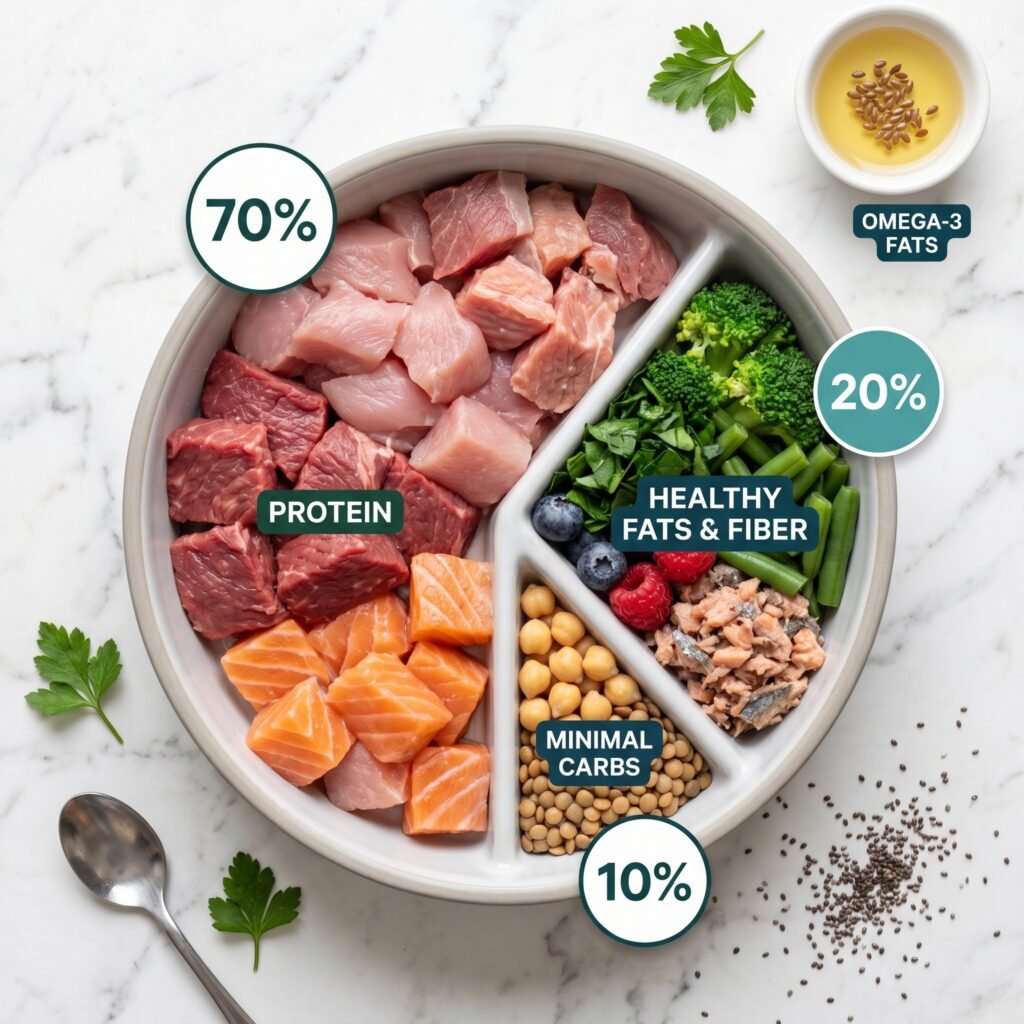
Yes — but only under veterinary nutritionist oversight. The foundation of homemade low carb dog food is lean animal protein (60% to 70% of the diet), low-glycemic vegetables (20%), and healthy fat sources (10% to 20%), alongside a veterinarian-approved complete mineral and vitamin supplement. Without professional formulation review, homemade diets frequently develop calcium, phosphorus, zinc, or essential vitamin deficiencies that cause serious long-term health consequences even when macronutrient targets look correct on the surface.
How long does it take to see results from switching to low carb dog food?
Most owners switching to quality low carb dog food report observable improvements — firmer stools, improved energy, reduced hunger and begging, and visible coat improvements — within three to six weeks of consistent feeding following a gradual transition. For weight management goals, meaningful body condition improvement typically requires eight to twelve weeks of consistent low-carbohydrate feeding alongside appropriate portion control. For diabetic dogs, blood glucose curve improvements may be observable within the first two to four weeks — though insulin adjustments should only be made under veterinary supervision based on monitored glucose data.
Final Thoughts: Is Low Carb Dog Food Right for Your Dog in 2026?
The shift toward low carb dog food in 2026 reflects a genuine, science-backed understanding of canine metabolic biology — and for the right dog, it represents one of the most impactful dietary improvements an owner can make. Dogs managing weight, blood sugar instability, chronic inflammation, skin conditions, or the metabolic challenges of aging all have documented reasons to benefit from reducing refined carbohydrate intake and replacing it with high-quality animal protein and healthy fats.
The practical decision framework is straightforward: if your dog is overweight, diabetic, metabolically sluggish, or showing the coat and digestive issues associated with high-glycemic commercial diets, low carb dog food is worth a serious conversation with your veterinarian. Calculate the actual carbohydrate content of your current food using the formula provided in this guide — the result will likely surprise you. Choose a format (fresh, freeze-dried, air-dried, or specialized kibble) that matches your lifestyle and budget. Transition gradually. Monitor the response over six to eight weeks. And let the evidence your dog’s body provides — in coat condition, energy level, stool quality, and maintained healthy weight — tell you whether you’ve made the right call.
Looking for more expert guides on therapeutic nutrition, specific health condition management, and in-depth brand reviews? Browse our blog for comprehensive, science-backed resources designed to help every dog owner make the most confident feeding decisions possible.