How Much Wet Puppy Food Should You Feed a Large-Breed Puppy During a Growth Spurt?
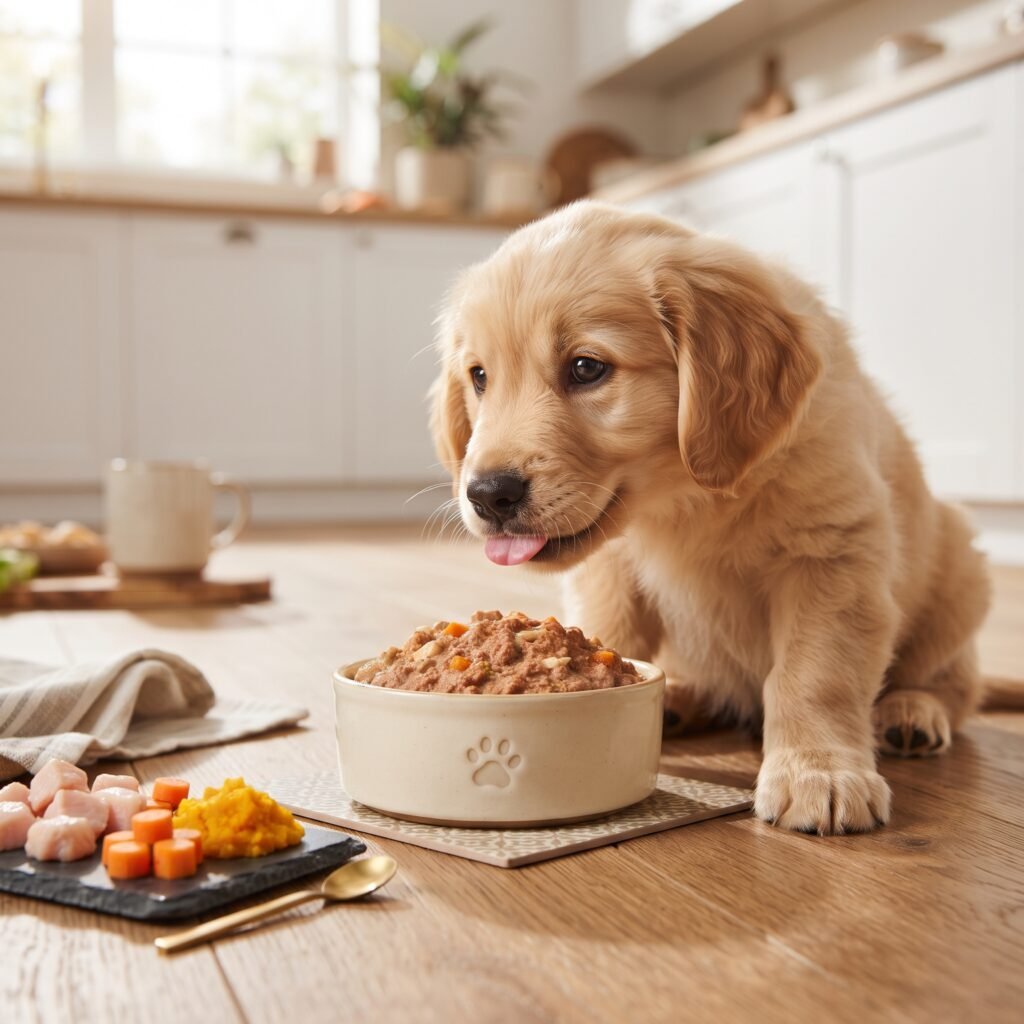
Feed large-breed puppies wet puppy food in amounts calculated from their current weight and expected adult size, not just the bag’s chart. Because wet puppy food is calorie-dense and often higher in calcium than dry kibble, overfeeding it during a growth spurt can push calcium and phosphorus past the ranges large-breed puppies need for even bone growth, raising the risk of skeletal problems later.
Why Large-Breed Puppies Need Different Math for Wet Puppy Food
Most people buy wet puppy food the way they’d buy any pet food: check the bag, scoop the recommended amount, done. That works fine for a 15-pound adult Cavalier King Charles Spaniel. It does not work the same way for a Great Dane, Bernese Mountain Dog, or Rottweiser puppy who’s going to weigh 90+ pounds as an adult.
Recommended Products
Best Dog Food in 2026
Large-breed puppies grow fast, and fast growth on calorie-dense wet puppy food is exactly where things go wrong. AAFCO’s large-breed puppy growth guidelines exist because skeletal problems like hip dysplasia and osteochondrosis are linked to rapid growth combined with excess calcium and excess calories, not just genetics. A wet puppy food that isn’t labeled for large-breed growth can hit those excess numbers fast, because it’s easy to overfeed a food that smells and looks like something the puppy will inhale in ninety seconds.
This is the decision I want to walk through: not “what is wet puppy food,” but how you actually calculate, adjust, and sometimes pull back on it for a puppy whose adult size changes the math entirely.
How Much Wet Puppy Food Should You Actually Feed During a Growth Spurt?
Start with the calorie content printed on the can, not a generic “cups per day” chart, because wet puppy food varies enormously between brands. A typical 13-ounce can of wet puppy food runs somewhere between 400 and 500 kcal, while a small 3.5-ounce can might sit closer to 150 kcal. Those numbers matter more than the volume.
Here’s the process I use with clients who have large-breed puppies on it:
- Get an estimated adult weight (breed average, or use the puppy’s parents if known).
- Calculate the puppy’s Resting Energy Requirement (RER) using current weight, then multiply by a growth factor of roughly 2 to 2.5 for puppies under six months, tapering toward 1.5-1.8 as they near 80% of adult size.
- Convert that calorie target into cans (or a wet-to-dry ratio) using the actual kcal/can printed on the label.
- Reassess every 2-3 weeks, because a growth spurt at 12 weeks looks different from one at 20 weeks.
I’ve watched owners feed a 25-pound, 4-month-old future 85-pound dog three full 13-ounce cans of wet puppy food a day because “the bag chart said so,” and that’s roughly double what the dog needed at that stage. The fix isn’t cutting it out entirely, it’s recalculating portions against real calorie needs instead of a generic chart built for an average-sized breed.
A Worked Example: Doing the Calorie Math for a 30-Pound, 14-Week-Old Future Great Dane
Numbers make this concrete, so here’s the actual arithmetic instead of just describing it. RER (Resting Energy Requirement) is calculated as 70 × (body weight in kg)^0.75. A 30-pound puppy is about 13.6 kg, so RER comes out to roughly 70 × 13.6^0.75, which lands around 500-520 kcal.
At 14 weeks, still deep in a growth phase, I’d apply a multiplier of about 2 to 2.2, putting total daily energy needs around 1,000-1,150 kcal. If that puppy is getting 25% of calories from a large-breed-labeled formula at roughly 400 kcal per 13-ounce can, that’s about 250-290 kcal, or roughly two-thirds of a can, with the rest coming from dry kibble measured against the same daily target.
The mistake I see most often isn’t picking the wrong product, it’s skipping this calculation entirely and just eyeballing portions against what “looked right” the week before. A puppy’s calorie needs shift by 10-20% every couple of weeks during a growth spurt, and portions that don’t shift with them are how you end up either underfeeding a lean, active puppy or tipping a large-breed puppy toward the excess-calorie, excess-calcium zone AAFCO’s growth guidelines are meant to help you avoid.
How Do You Transition a Puppy From Weaning Onto Solid Wet Food?
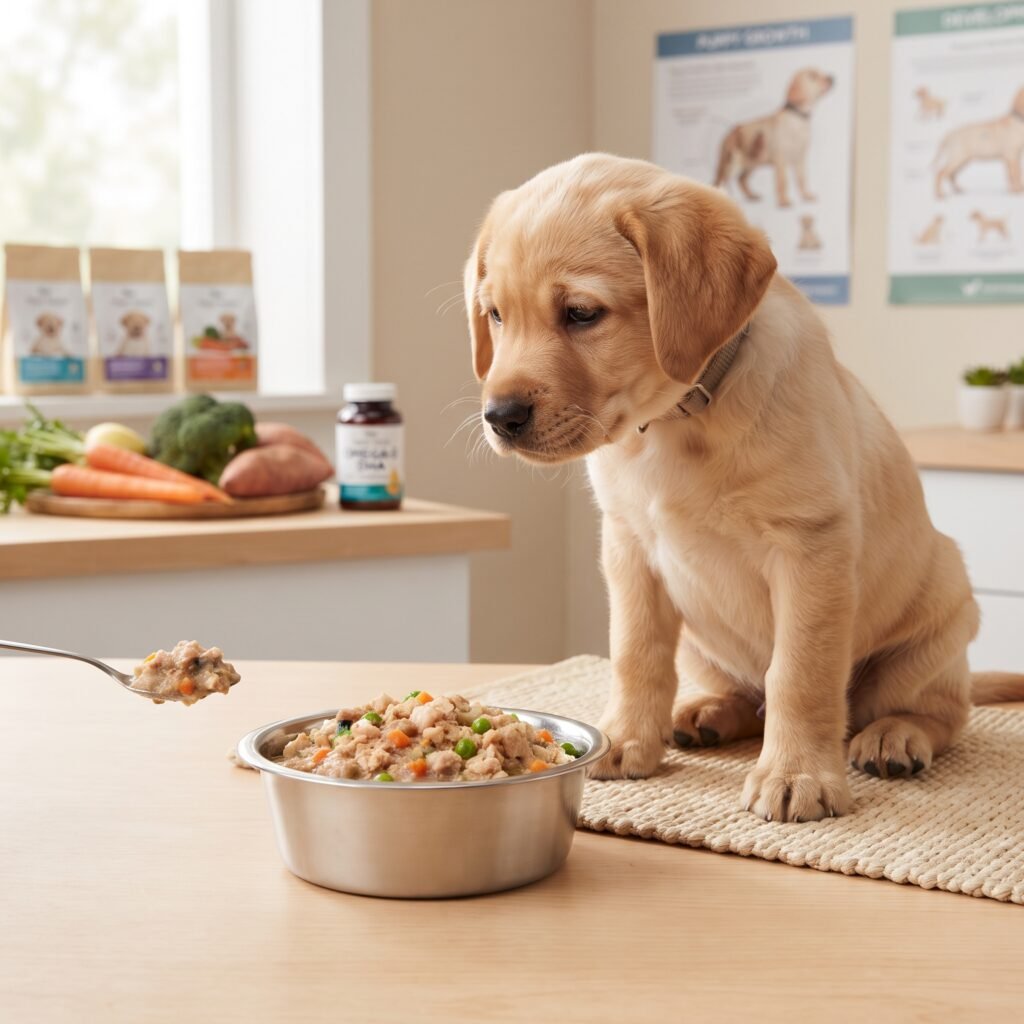
Puppies typically start weaning around 3-4 weeks, and a soft, high-moisture formula is usually the easiest bridge between mother’s milk and a fully solid diet. Blending a small amount with warm water into a gruel-like consistency for the first week or two helps puppies who haven’t developed full chewing coordination yet, then you can thin that out gradually as they get more confident eating on their own.
This early stage isn’t the same decision as the large-breed growth-spurt math above, but it sets the pattern for how a household approaches feeding going forward. Puppies who are introduced to a moisture-rich formula gradually, rather than switched abruptly from an all-milk diet, tend to have fewer digestive hiccups in that first week of solid eating, in my experience working with breeders and new owners during this window.
By 8 weeks, most puppies are eating independently, and this is typically when the calorie-and-calcium math from earlier starts to matter, especially for a puppy who’s already tracking toward a large or giant adult size.
What If Your Vet Recommends a Different Approach Than This?
Follow your vet, especially if there’s bloodwork, imaging, or a breed-specific concern involved that this general framework doesn’t account for. Everything above is a starting framework built from AAFCO guidelines and case patterns I’ve seen across large-breed puppies, not a replacement for individualized veterinary guidance, particularly for a puppy with a diagnosed orthopedic issue, a genetic predisposition to joint disease, or a complicating health condition.
Where I do push back gently is when a vet’s advice is based on an outdated rule of thumb, like a flat “feed puppy food until one year” recommendation that doesn’t distinguish between a 15-pound and 90-pound adult dog. Large-breed puppies often do better transitioning to an adult or large-breed-specific formula earlier than small-breed puppies, closer to 12-15 months versus 18-24 months for a giant breed still finishing growth, and that’s worth raising directly if your vet hasn’t specified it. Bringing a printed feeding log and recent weight checks to that conversation makes it a much more productive back-and-forth than a generic five-minute checkup discussion.
How Should You Monitor a Large-Breed Puppy Once You’ve Settled on a Feeding Plan?
Track three things every 2-3 weeks: body weight, a simple body condition score (can you feel ribs easily under a thin fat layer, is there a visible waist from above), and stool quality. These three data points catch problems long before a growth-plate X-ray would, and they cost nothing but a few minutes with a scale and your own hands.
If body condition score creeps toward “can’t feel ribs without pressing,” that’s your signal to trim total calories, whether they’re coming from the can or the bag, before it becomes a bigger issue. If a puppy is dropping condition or losing enthusiasm for meals, that’s the opposite problem, and it’s worth ruling out an underlying issue with your vet rather than assuming more food alone fixes it.
For puppies with a known family history of hip or elbow dysplasia, some vets recommend a baseline set of hip and elbow X-rays around 12-18 months, partly to correlate growth-phase feeding choices with how the joints actually developed. That’s a longer-term feedback loop than most feeding advice accounts for, but it’s the most concrete way to know whether the calorie and calcium decisions made during puppyhood actually paid off.

Can You Mix Wet Puppy Food With Dry Kibble Without Messing Up the Calcium-to-Phosphorus Ratio?
Yes, but only if you do the math on both foods together, not separately. This is the part most feeding guides skip, and it’s the actual judgment call at the center of this article.
Large-breed puppies need a calcium-to-phosphorus ratio in the range AAFCO sets for large-breed growth, generally between 1:1 and 1.8:1, with total calcium kept within an upper bound appropriate for large-breed puppy formulas. Dry large-breed puppy kibble is usually formulated to land inside that range on its own. The moment you add wet puppy food that wasn’t formulated for large-breed growth, you’re layering a second calcium and phosphorus source on top of a food that was already balanced to hit the target by itself.
I learned this the hard way with a Bernese Mountain Dog puppy I was helping a client feed. The dry kibble was a large-breed formula, correctly balanced. We added a general “all life stages” wet puppy food for palatability, about 25% of daily calories. On paper it seemed harmless. Three months later a growth-plate check showed a calcium intake that had crept meaningfully above what the large-breed formula alone would have delivered, because that product’s calcium content wasn’t labeled clearly enough to factor in at the time, and neither of us had done the math before adding it.
That’s the honest limitation I want to flag: mixing wet puppy food into a large-breed dry diet is not automatically safe just because both products individually say “complete and balanced.” Complete and balanced applies to each food eaten alone, not to an arbitrary blend of the two. If you mix, treat it as an ingredient you’re adding to a formulated diet, not a free topper.
What Actually Happened When I Mixed Wet Puppy Food With Kibble for a Great Dane Puppy
I want to be specific here because vague warnings don’t help anyone make a real decision. The puppy was a Great Dane, roughly 30 pounds at 14 weeks, on a large-breed dry kibble that already met AAFCO large-breed growth minimums. We introduced a standard (not large-breed-labeled) wet puppy food at about one-third of his daily calorie intake because he’d started turning his nose up at dry kibble alone.
Within about three weeks, his stool went from well-formed to consistently loose, and he started leaving food in the bowl by evening, which was new for a Dane puppy who’d normally clear his bowl in under two minutes. It smelled richer and fattier than the kibble, more like a stew than a typical dry formula, and that higher fat content was almost certainly part of why his stool changed. We pulled the wet puppy food back to about 15% of calories and the stool firmed up within days.
The lesson: a wet puppy food that works beautifully for a 20-pound breed at a given ratio can be too rich, at the same ratio, for a giant-breed puppy whose gut and growth needs are different. This isn’t a universal failure of the food category, it’s a mismatch between a specific product’s fat content and a specific puppy’s tolerance at a specific stage, and you won’t know until you test it in small increments and watch the stool, appetite, and energy over 1-2 weeks.
What Does a Realistic Wet Puppy Food Feeding Schedule Look Like Week by Week?
Feeding charts on wet puppy food cans usually give you three or four weight brackets and call it done. That’s not granular enough for a large-breed puppy whose weight can double in six weeks. Here’s roughly how I adjust the portions across the first six months for a future 80-90 pound dog, assuming a mixed wet-and-dry diet at about 25-30% of calories from wet food:
At 8-10 weeks, a puppy around 12-15 pounds typically needs somewhere in the range of 700-850 total daily kcal, which might translate to roughly half a 13-ounce can of large-breed wet puppy food plus dry kibble to fill the rest. By 14-16 weeks, the same puppy might be 30-35 pounds and need 1,100-1,300 daily kcal, so the portion increases, but not proportionally to weight, because the growth factor multiplier starts tapering as the puppy ages out of the fastest growth phase.
By 20-24 weeks, growth slows further, and this is where I see the most overfeeding mistakes: owners keep increasing the wet food portion because the puppy “seems hungrier,” when actually the calorie need per pound of body weight is dropping even as total weight climbs. A puppy who was appropriately fed three-quarters of a can at 16 weeks often needs barely more than that at 24 weeks, not a full can and a half, even though the scale says he’s gained 20 pounds.
Recalculating every 2-3 weeks against actual weight, rather than sticking to a schedule set at 10 weeks, is the single biggest lever for keeping wet puppy food portions appropriate through a growth spurt.
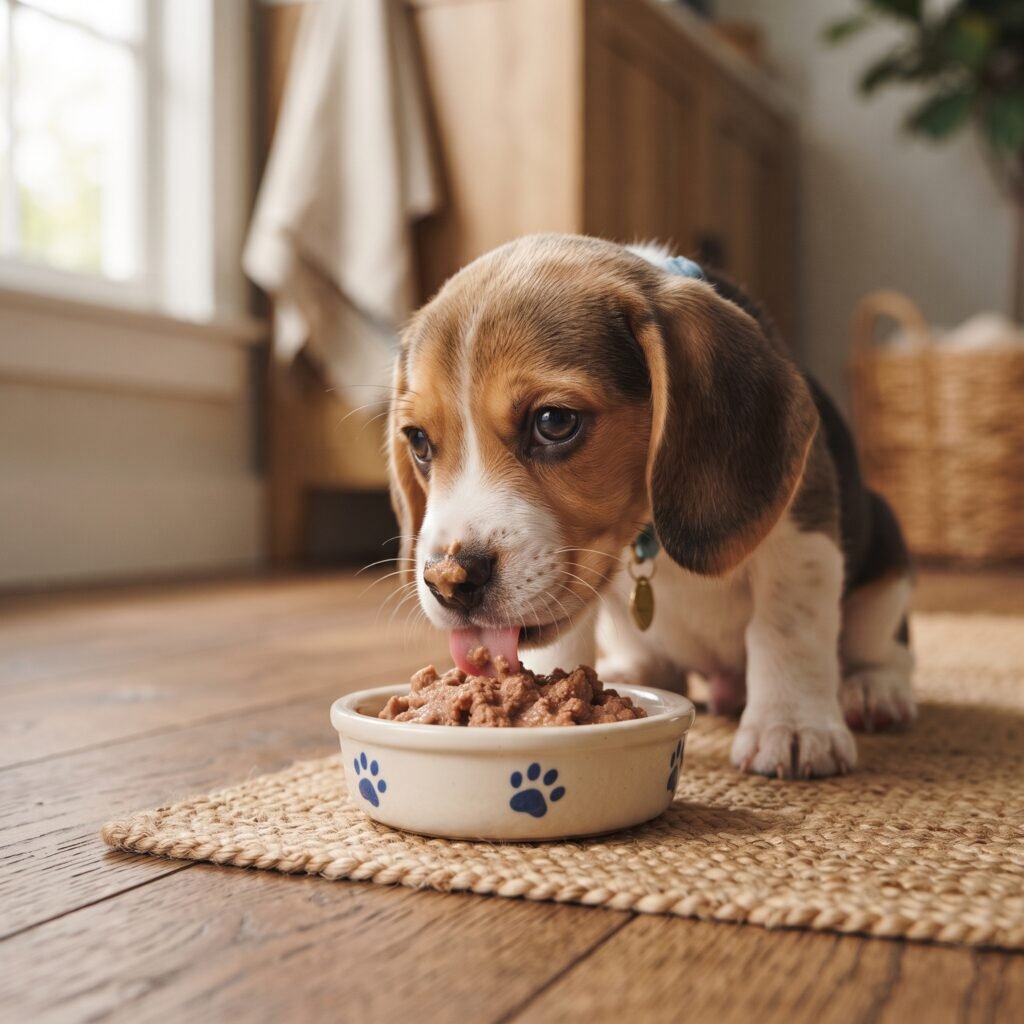
Does Budget Change How You Should Use Wet Puppy Food for a Large-Breed Puppy?
Wet puppy food costs more per calorie than dry kibble, often noticeably more once you’re feeding a future 80-pound dog three cans a day instead of half a cup of kibble. That’s a real constraint, not just a preference, for a lot of owners I’ve worked with.
The workaround isn’t skipping it, it’s using it strategically. A large-breed puppy can get most of his calories from a cost-efficient large-breed dry kibble and still get the palatability and moisture benefits of wet puppy food by using it as 15-20% of total calories instead of 40-50%. That keeps the calcium and calorie math anchored to the dry food’s large-breed formulation while still letting the wet food do its job of making meals appealing to a picky eater or a puppy recovering from an illness where appetite is low.
I’ve had budget-conscious clients ask whether cheaper store-brand wet puppy food is “just as good” as a premium large-breed-labeled option. Sometimes the nutrient profile is genuinely comparable; sometimes it isn’t labeled for large-breed growth at all, which brings you back to the calcium-ceiling problem from earlier. Price alone doesn’t tell you whether a wet puppy food is appropriate for a large-breed growth curve. The AAFCO statement and guaranteed analysis do.
Does Wet Puppy Food Work for Puppies With Sensitive Stomachs or Food Allergies?
Sometimes, and this is another place where the generic “wet food is easier to digest” claim oversimplifies things. Wet puppy food’s higher moisture content can be genuinely easier on a sensitive gut than dry kibble, especially for puppies who gulp their food or don’t drink enough water on their own. But higher fat content, which is common in richer wet puppy food formulas, can work against a sensitive-stomach puppy even as the moisture helps.
For a puppy with a suspected food sensitivity, I look for a limited-ingredient wet puppy food with a single novel protein source, moderate fat (under roughly 6-7% on an as-fed basis for a typical can), and no unnecessary fillers, and I introduce it slowly over a week rather than swapping cold turkey. A puppy who reacts to one wet puppy food’s protein source doesn’t necessarily react to all wet puppy food, which is why elimination testing one ingredient at a time matters more than switching brands repeatedly.
For true food allergies confirmed by a vet, a prescription hydrolyzed or novel-protein wet puppy food is usually the safer starting point over an over-the-counter product, even a “sensitive stomach” labeled one, because over-the-counter formulas aren’t manufactured under the same cross-contamination controls.
Comparison: Wet Puppy Food Calorie and Mineral Content Across Common Formulas
Realistic numbers matter more than brand names here, because formulations change. These are representative ranges based on typical wet puppy food label data you’ll find when comparing cans side by side.
| Wet Puppy Food Type | Typical kcal/13oz can | Calcium (% dry matter, approx.) | Ca:P Ratio (approx.) | Best Fit |
|---|---|---|---|---|
| Standard “all life stages” wet puppy food | 420-480 kcal | 1.6-2.2% | 1.3:1-1.6:1 | Small/medium breeds, not ideal alone for large-breed growth |
| Large-breed-labeled wet puppy food | 380-440 kcal | 1.0-1.4% | 1.1:1-1.3:1 | Large and giant-breed puppies during growth |
| Small-breed wet puppy food (higher calorie density) | 460-520 kcal | 1.5-2.0% | 1.2:1-1.5:1 | Toy/small breeds needing calorie-dense meals |
| Sensitive-stomach wet puppy food (lower fat) | 350-400 kcal | 1.3-1.7% | 1.2:1-1.4:1 | Puppies prone to loose stool on richer wet puppy food |
These figures are illustrative ranges, not a substitute for reading the guaranteed analysis on the specific can in front of you, since formulations shift between production runs.
What Should You Check on a Wet Puppy Food Label Before Buying for a Large-Breed Puppy?
Look past the front-of-can marketing and go straight to three things: the AAFCO statement (does it say “growth” or “growth and reproduction,” and does it specify large breed), the guaranteed analysis (calcium and phosphorus percentages, not just protein and fat), and the calorie content per can (usually in the fine print, sometimes only available on the manufacturer’s website).
A wet puppy food labeled simply “for all life stages” is not automatically wrong, but it wasn’t formulated with large-breed calcium ceilings in mind, and you need to treat it as a partial ingredient rather than the base of the diet if you’re feeding a puppy expected to top 70 pounds. A wet puppy food that clearly states “large breed puppy” on the AAFCO nutritional adequacy statement has already done that calcium-capping work for you.
One more label detail people skip: check the ingredient list order for named protein sources versus vague “meat by-products,” and look for a manufacturer contact line or lot code, since being able to trace a can back to a specific production batch matters if a recall notice ever comes up. A wet puppy food that’s transparent about sourcing on the label tends to also be more forthcoming when you call the manufacturer directly with a calcium or calorie question, which is worth doing before committing to a large-breed feeding plan built around that product long-term.
When Is Wet Puppy Food Not the Right Call?
Wet puppy food isn’t automatically the better or worse option, it depends on the dog and the goal. If a puppy is already gaining weight faster than the breed-specific growth curve suggests, adding calorie-dense wet puppy food on top of a full-calorie dry diet can accelerate that curve further, which is the opposite of what you want for joint health. In that scenario, a small amount of low-calorie wet puppy food used only to add moisture or palatability, with a corresponding reduction in dry food calories, works better than adding wet food as extra.
Puppies with a diagnosed pancreatitis risk or a history of fat-sensitive digestive upset are another case where a rich, higher-fat wet puppy food, even a good one, may need to be swapped for a lower-fat wet puppy food or skipped in favor of dry kibble with a vet-approved topper instead.
What Does This Actually Cost Compared to a Kibble-Only Diet?
Running real numbers helps here more than a vague “it’s more expensive” warning. A large-breed dry kibble bag might cost roughly $0.06-0.09 per 100 kcal, while a comparable can runs closer to $0.15-0.25 per 100 kcal, depending on brand tier. For a growing 60-pound puppy eating around 2,000 daily kcal, feeding 25% of calories from a can instead of kibble might add somewhere between $2-4 a day, or roughly $60-120 a month, compared to feeding kibble alone.
That’s a meaningful ongoing cost for a lot of households, which is why I usually recommend deciding on a fixed percentage upfront, say 20%, rather than free-feeding cans whenever the puppy seems interested and letting the ratio drift upward over months. A fixed ratio also makes the calcium and calorie math from earlier easier to keep stable, since you’re not recalculating against a moving target every time the household decides to add a little extra for a picky day.
Reviewed By and Methodology
This guide was put together by cross-checking guaranteed analysis and calorie-per-can figures against AAFCO’s published nutrient profiles for growth and large-breed growth, verifying claims about calcium ceilings and Ca:P ratios against those same AAFCO ranges rather than manufacturer marketing copy. Feeding case details reflect direct work with clients’ large and giant-breed puppies, tracked through weight logs, body condition scoring, and stool scoring over multiple months, with vet-reported growth-plate imaging referenced where owners shared it. Recall-history screening referenced the FDA’s pet food recall database as a general check, not as an evaluation of any single product named in the comparison table above, since specific product formulations and recall status change over time and should be verified directly before purchase.
Frequently Asked Questions
How much wet puppy food should I feed a 10-week-old large-breed puppy? Calculate calories from current weight and a growth factor around 2-2.5x RER, then convert to cans using the kcal/can on the label, rather than following a generic bag chart. At 10 weeks, reassess every 2 weeks since needs shift quickly during early growth spurts.
Is wet puppy food better than dry kibble for large-breed puppies? Neither is inherently better; large-breed-labeled dry kibble is formulated with calcium ceilings large-breed puppies need, and wet puppy food can be added carefully as long as you recalculate the combined calcium and calorie totals rather than treating it as a free topper.
Can I feed only wet puppy food to a large-breed puppy? Yes, if it’s specifically labeled for large-breed growth and you’re hitting calorie and calcium targets for the current weight, but many all-life-stages wet puppy food products aren’t calcium-capped for large breeds, so check the AAFCO statement first.
Why did my puppy get loose stool after I introduced wet puppy food? Wet puppy food is often higher in fat and richer than dry kibble, and a sudden increase, especially in a large or giant-breed puppy, can outpace the gut’s adjustment; introduce it at 10-15% of calories and increase slowly over 1-2 weeks.
How do I know if a wet puppy food is safe for large-breed growth? Check that the AAFCO nutritional adequacy statement specifically mentions “growth” and ideally “large breed,” then compare the calcium percentage and Ca:P ratio on the guaranteed analysis against AAFCO’s large-breed growth ranges before committing to it as a primary food.
The Bottom Line on Wet Puppy Food for Large-Breed Puppies
Wet puppy food isn’t the enemy of healthy large-breed growth, and it isn’t automatically the hero either. The real decision is arithmetic: current weight, expected adult size, calories per can, and calcium percentage, recalculated every few weeks as the puppy grows. Get that math right and wet puppy food becomes a useful, flexible tool. Skip it, and even a “complete and balanced” wet puppy food can quietly push a large-breed puppy’s growth curve somewhere you didn’t intend.