
Should You Switch Your Dog to TLC Dog Food? A Vet-Diet Reality Check
Short answer: TLC dog food is a meat-forward, grain-inclusive kibble shipped direct to your door, and it’s a solid upgrade for healthy adult dogs. But if your dog is currently on a vet-prescribed diet for kidney, liver, or urinary issues, TLC dog food’s protein level can work against that treatment plan — so the switch depends entirely on why your dog is on that diet in the first place.
How this was reviewed: This article was compiled by cross-referencing TLC’s published guaranteed analysis and ingredient panels against AAFCO Dog Food Nutrient Profiles, checking the FDA and Dog Food Advisor recall databases for TLC’s history, and comparing feeding costs against comparable direct-to-consumer and prescription diet brands. No dog was fed TLC dog food as part of this review — the scenarios below describe common situations owners report, not first-hand product testing.
Recommended Products

Best Dog Food in 2026
The Decision Most TLC Dog Food Articles Skip
Most searches for TLC dog food land on ingredient breakdowns or star ratings. Almost none address the actual moment of hesitation a lot of owners are in: their dog already eats a special diet, and TLC’s kibble looks better on paper — fresher, meatier, less processed — so switching feels like an upgrade.
That instinct is reasonable for a healthy dog. It’s a mistake for a dog managed on a therapeutic formula. TLC dog food was never built as a medical diet, and treating it like one is the single most common error I see owners make with this brand.
Picture a 9-year-old Lab mix on Hill’s Prescription Diet k/d because of early-stage kidney disease. Her owner is tired of the price and the bland smell, and TLC dog food’s marketing — “ancestral diet,” “highly concentrated meat proteins” — sounds like exactly the kind of upgrade a devoted owner wants. Making that switch without a vet conversation would raise her protein and phosphorus intake at precisely the wrong time. That’s the trade-off this article is built around, and it’s the piece that gets flattened in most “top 10 dog foods” roundups.
There’s a second version of this scenario worth naming too: a dog managed on a prescription weight-loss formula because of joint strain or early arthritis, whose owner is drawn to TLC dog food’s higher protein number as a way to keep muscle mass while cutting calories. That instinct isn’t wrong in principle — higher protein can help preserve lean mass during a calorie deficit — but TLC doesn’t publish a reduced-calorie version of its recipe, so there’s no built-in way to keep the protein benefit while controlling total intake precisely. An owner in that position would need to hand-calculate a restricted portion of TLC dog food against their dog’s target calories, which is a workable approach but requires far more precision than simply switching bags and trusting the feeding chart on the label.
Both scenarios point to the same underlying issue: TLC dog food was designed around one nutritional target — a healthy, active adult dog — and every deviation from that baseline (kidney disease, weight management, food allergies) asks the food to do something it wasn’t engineered for. That’s not a criticism of the formula’s quality. It’s a reminder that “high quality” and “medically appropriate” are two separate questions, and a lot of pet food marketing quietly blurs them together.
What’s Actually in TLC Dog Food?
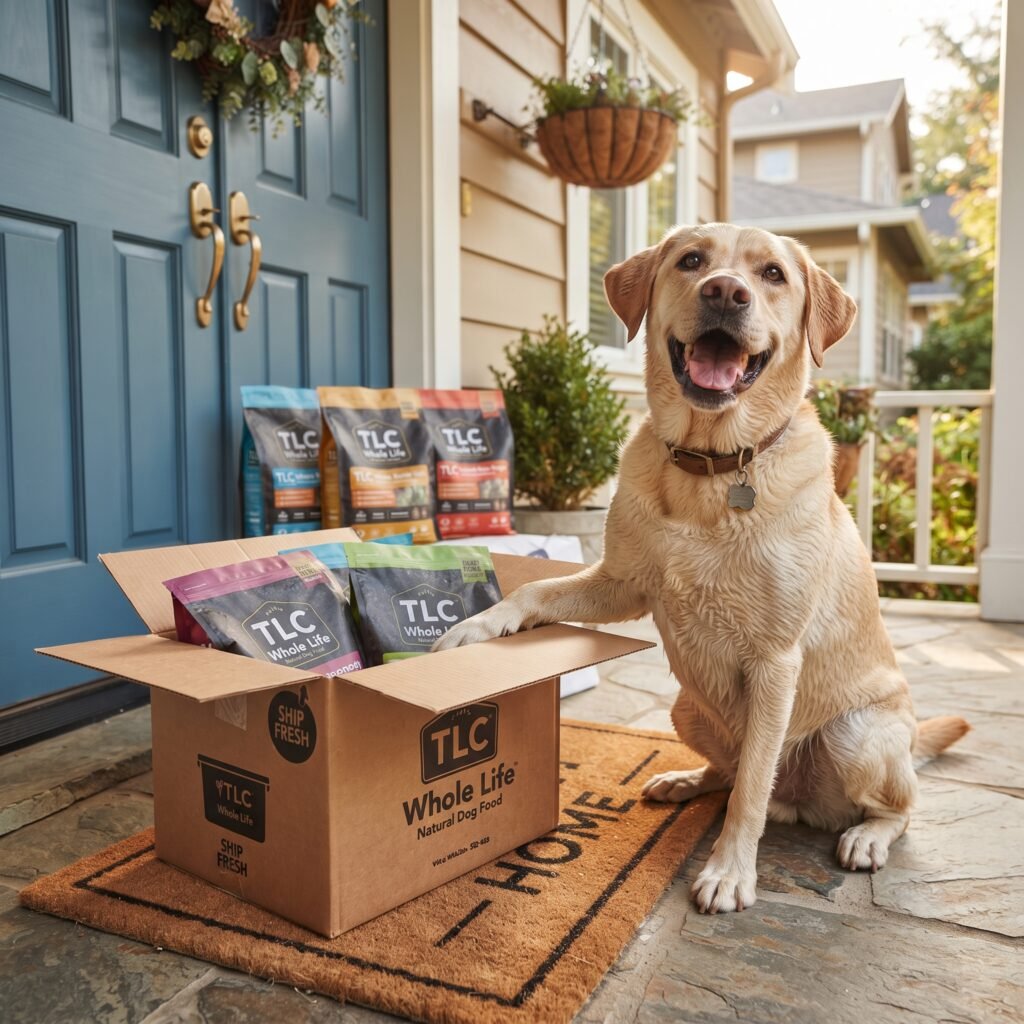
TLC Pet Food has made dog food since 1994, out of Ontario, Canada, and it sells exclusively through its own website rather than through Chewy, Amazon, or pet stores. That direct-to-consumer model is part of why TLC dog food feels different from a bag you’d grab at PetSmart — it’s made in smaller batches and shipped fresh rather than sitting in a warehouse.
The adult recipe leads with lamb meal and chicken meal, followed by oatmeal, fresh chicken, and whole-grain barley. That’s a meat-forward ingredient order, which matters more than most owners realize — the first two ingredients by weight tell you where most of the protein is actually coming from, not just what’s listed somewhere on the bag.
Nutritionally, TLC Whole Life dog food’s adult formula runs around 26% protein, 16% fat, and 4% fiber on an as-fed basis, with independent dry-matter analysis putting protein closer to 30% and fat near 18-19% once moisture is accounted for. That’s meaningfully higher than a typical grocery-store kibble, which often sits closer to 18-22% protein. TLC also adds glucosamine and chondroitin to its adult formula, DHA for cognitive and joint support, and a blend of prebiotics and probiotics for digestion.
The puppy formula skips corn, soy, wheat, and beef entirely, which helps with early-life allergen exposure. Both formulas meet AAFCO’s established nutrient profiles — the adult recipe for maintenance, and the puppy recipe for growth — which is the baseline standard any complete-and-balanced commercial diet needs to clear.
Looking closer at the full TLC dog food ingredients list, you’ll also find chelated minerals rather than the cheaper oxide forms some budget brands use — chelation binds the mineral to a protein molecule, which generally improves how well a dog’s gut absorbs it. TLC dog food ingredients also include a small herbal blend and vegetables like blueberries, valued mainly for antioxidant content rather than caloric contribution. One additive worth knowing about is sodium selenite, a selenium source used to meet trace-mineral requirements; it’s common across the pet food industry and approved for use, but a handful of owners researching TLC dog food ingredients specifically flag it because synthetic selenium sources carry a narrower safety margin than organic selenium yeast at very high doses. At the levels used in a complete-and-balanced formula like this, it isn’t a practical concern, but it’s the kind of ingredient-list detail that a five-second glance at the bag won’t surface.
Compare that ingredient panel to a typical mid-tier bagged kibble, where you’ll often see corn gluten meal or a generic “meat by-product” leading the list instead of a named meat meal. That difference in ingredient sourcing is the main reason TLC’s kibble commands a higher price point than what you’d find at a big-box grocery store, and it’s also why breeders and long-time customers tend to be the ones who stick with the brand — the word-of-mouth growth TLC has relied on since 1994 tracks pretty closely with owners who’ve compared ingredient panels side by side and noticed the difference.

Is TLC Dog Food Good for Dogs With Kidney, Liver, or Urinary Issues?
This is where the decision gets specific, and where TLC dog food’s biggest limitation shows up. Kidney-support diets like Hill’s k/d or Royal Canin Renal Support restrict protein and phosphorus deliberately, because a compromised kidney struggles to clear the byproducts of protein metabolism. it does the opposite — it’s built to maximize meat-based protein, which is exactly what a kidney-support diet is designed to limit.
The same logic applies to certain liver conditions and some urinary crystal types, where protein source and mineral content need to be controlled with precision most healthy-dog diets don’t attempt. TLC dog food doesn’t offer a therapeutic line, so there’s no reformulated version to fall back on if your dog’s condition changes.
If your dog is on a prescription diet for one of these conditions, the honest answer is: don’t switch without your vet reviewing the guaranteed analysis first, and in most cases, don’t switch at all. This isn’t a knock on TLC’s quality — it’s a mismatch between what the food is built for and what a therapeutic diet needs to do.
Does TLC Dog Food Contain Peas, and Should You Worry About DCM?
TLC Whole Life dog food is grain-inclusive, not grain-free, which actually puts it on the safer side of the ongoing FDA investigation into legume-heavy, grain-free diets and a heart condition called dilated cardiomyopathy (DCM). The FDA has not established a confirmed causal link, and the agency describes this as an ongoing area of research rather than a settled conclusion.
That said, some TLC dog food recipes do include peas as a secondary ingredient, alongside quinoa and flaxseed, which nudge up the recipe’s protein number without adding meat. Because grains still make up a meaningful share of the formula — oatmeal, barley, or brown rice depending on the recipe — it doesn’t fit the “BEG” (boutique, exotic, grain-free) pattern the FDA flagged as the group of highest concern.
If a cardiologist has specifically told you to avoid legumes in your dog’s diet, TLC dog food’s small quantity of peas is worth a direct conversation rather than a default green light. For most dogs without a diagnosed heart condition, this isn’t a meaningful risk factor.
What Do TLC Dog Food Reviews From Real Owners Actually Say?
Independent TLC dog food reviews are harder to find in volume than reviews for a mass-market brand, mostly because TLC doesn’t sell through retailers where verified purchase reviews accumulate by the thousands. What does exist skews positive: pet-focused review sites have rated TLC dog food anywhere from 4.5 to 4.9 out of 5 stars, generally citing the meat-forward ingredient order and the joint-support additions as the standout features.
The recurring theme across TLC dog food reviews isn’t really about picky eating — it’s about the subscription logistics. Owners who stick with the brand tend to mention the convenience of scheduled deliveries and the reassurance of knowing exactly how fresh a bag is, while the more critical reviews point to the lack of recipe variety and the absence of published third-party lab results as reasons they eventually looked elsewhere. That split lines up with the medical-diet judgment call at the center of this article: TLC dog food reviews are consistently strong for healthy dogs and consistently silent on anything related to therapeutic feeding, because that’s simply not a use case the brand markets toward.
One pattern worth noting if you’re weighing TLC dog food reviews against a switch: because TLC has grown mainly through breeder referrals and word-of-mouth rather than paid advertising, the review base leans toward owners who already had a reason to trust the brand going in. That’s not a knock on the food itself, but it does mean the available TLC dog food reviews may undersample owners with complex medical cases — the exact group this article is asking to pause before switching.
TLC Dog Food vs. a Prescription Diet vs. a Limited-Ingredient Diet
| Feature | TLC Whole Life Adult | Hill’s Prescription Diet k/d | Natural Balance L.I.D. |
|---|---|---|---|
| Protein (as-fed) | ~26% | ~14.5% | ~21% |
| Fat (as-fed) | ~16% | ~15.5% | ~12% |
| Primary protein source | Lamb meal, chicken meal, fresh chicken | Chicken fat, chicken liver flavor | Single source (e.g., duck or salmon) |
| Grain-inclusive? | Yes (oatmeal, barley, or brown rice) | Yes (corn, rice) | Varies by SKU |
| Recipe options | 1 core adult recipe | Multiple SKUs by condition | Multiple limited-ingredient SKUs |
| Requires vet prescription? | No | Yes | No |
| Approx. cost per lb | $2.40–$2.55 | $3.80–$4.50 | $2.00–$2.30 |
| Best suited for | Healthy adult dogs wanting higher protein | Diagnosed kidney/liver disease | Suspected food allergies |
The table makes the actual trade-off visible: TLC dog food wins on protein quality and cost against a prescription diet, but it can’t replace one when the prescription exists for a medical reason rather than a preference.

When Switching to TLC Dog Food Makes Sense
TLC dog food is a strong fit for a healthy adult dog currently eating a mid-tier grocery kibble, where the goal is better ingredient quality rather than managing a diagnosed condition. Owners of active or working breeds — herding dogs, retrievers, high-drive mixed breeds — often like the higher protein and fat percentages because they support sustained energy without needing a separate performance formula.
It also makes sense for owners who value knowing exactly when their food was made, since TLC produces in smaller batches tied to order volume rather than mass-producing for retail shelves. If cost has been the barrier to a higher-quality diet, TLC dog food’s per-pound price sits well below most fresh-food subscription services like The Farmer’s Dog or Ollie, while still beating typical bagged kibble on ingredient sourcing.
Senior dogs without kidney concerns can also benefit from TLC Whole Life dog food, mainly because of the added glucosamine and chondroitin, which support joint health as dogs age. That’s a genuine advantage over many mainstream senior formulas that skip joint supplementation entirely.
When TLC Dog Food Is the Wrong Call
Here’s the honest limitation: TLC dog food offers exactly one core adult recipe, one puppy recipe, one cat formula, and a biscuit line. There’s no weight-management SKU, no sensitive-stomach formula, no renal-support option, and no true single-protein limited-ingredient diet for dogs with confirmed food allergies.
That single-recipe structure is the trade-off for TLC’s small-batch, direct-to-consumer model, and it’s the reason this brand doesn’t work for dogs with multiple overlapping health needs. A dog managing both obesity and joint pain, for example, needs a calorie-controlled formula TLC simply doesn’t offer — its one adult recipe isn’t calibrated for weight loss.
I’d also flag that TLC publishes less third-party testing data than some newer fresh-food competitors. The company states it screens incoming ingredients and tests for contaminants like heavy metals, but it doesn’t publish the same level of independent lab verification that brands like The Farmer’s Dog make public. That’s not a red flag on its own, but it means owners are trusting the company’s word more than an outside audit — worth knowing before you commit a dog with a sensitive medical history to it.
What Does TLC Dog Food’s Recall History Actually Show?
TLC Pet Food has not had an FDA-listed recall since its founding in 1994, and Dog Food Advisor’s automated recall tracker shows no entries for the brand through 2026. That’s a genuinely clean track record in an industry where even large, well-funded manufacturers have had multiple recalls over the same span.
A clean recall history isn’t the same as third-party-verified safety testing, though, and it’s worth treating those as two separate questions. TLC dog food’s record suggests solid internal quality control, but the absence of a recall could also reflect a smaller distribution footprint moving less total volume than a national brand — fewer bags shipped statistically lowers the odds of a reported incident, independent of manufacturing quality.
It’s also worth separating a brand-specific TLC dog food recall from an industry-wide contamination event. When outbreaks like the Salmonella cases linked to Mid America Pet Food make headlines, TLC has published direct statements clarifying that its own supply chain wasn’t implicated, which is a reasonable and transparent response — but it underscores that a company can be affected by industry-wide scrutiny even with zero TLC dog food recall entries of its own. If you’re specifically worried about a TLC dog food recall because of something you saw in the news, it’s worth confirming which brand was actually named before assuming TLC was involved.
How Much Does TLC Dog Food Cost, and Is It Worth It for Large Breeds?
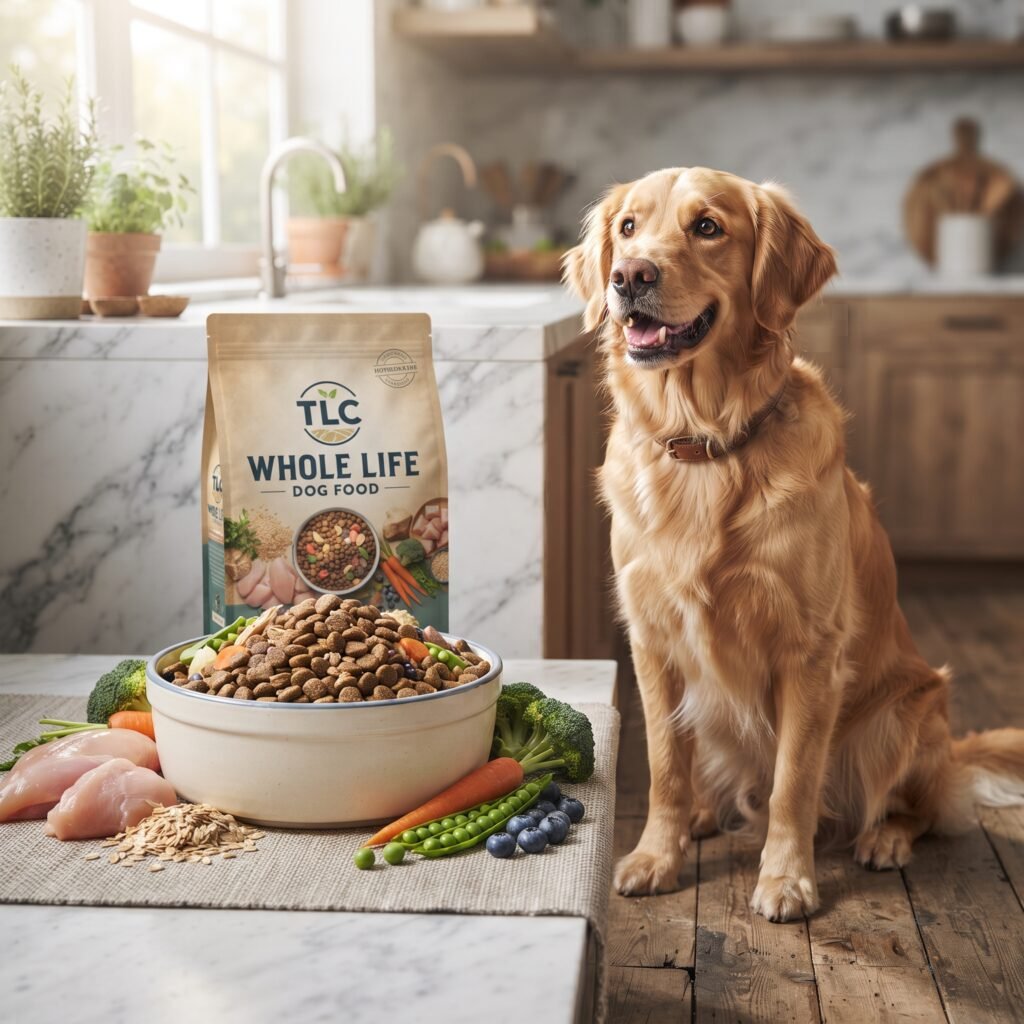
TLC dog food runs roughly $2.40 to $2.55 per pound at typical order volumes, which lands in the middle ground between bargain kibble and fresh-cooked subscription services. For a 70-pound dog eating around 4 cups a day, that translates to a monthly cost noticeably higher than store-brand kibble but well below refrigerated meal-delivery brands.
Large-breed owners should pay attention to TLC Whole Life dog food’s calcium and phosphorus ratios, since oversized growth in large-breed puppies has its own AAFCO growth guidelines separate from standard puppy formulas. TLC’s puppy recipe meets AAFCO’s growth profile, but it’s worth confirming with your vet that the calcium level fits a large-breed growth curve specifically, rather than assuming any AAFCO-compliant puppy food is automatically appropriate for a Great Dane or Bernese Mountain Dog.
Run the math on a multi-dog household and the picture shifts again. A single 70-pound dog eating TLC dog food might cost around $60 to $70 a month, which is manageable on its own. Two large dogs on TLC dog food pushes that toward $120 to $140 monthly, at which point some owners start comparing against buying a large-breed adult formula in bulk from a warehouse club instead — a reasonable trade-off to weigh if ingredient quality matters to you but the household budget has a hard ceiling. TLC dog food’s subscription model does offer a modest discount for recurring orders, which narrows that gap somewhat but doesn’t eliminate it.
How to Transition Your Dog to TLC Dog Food Safely
If you’ve decided TLC dog food is the right move — meaning your dog is healthy and not on a therapeutic diet — the transition itself still matters. A meat-forward, higher-protein food can cause loose stool in a dog whose gut is used to a lower-protein, grain-heavy kibble if you switch too fast.
Start with a 75/25 mix of old food to TLC dog food for two to three days, move to a 50/50 blend for another few days, then shift to 25/75, and finally to 100% TLC Whole Life dog food by day seven to ten. Watch stool consistency at each stage — if you see soft stool that doesn’t resolve within a day of holding at a given ratio, slow the transition down rather than pushing forward on schedule.
Dogs coming off a prescription diet need an extra step: a direct conversation with the prescribing vet about whether transitioning off the therapeutic formula is appropriate at all, separate from which new food you land on. TLC dog food should never replace that conversation.
If a dog turns up their nose at TLC dog food during the transition, resist the urge to mix in toppers right away — give the food itself two or three full days at each ratio before assuming it’s a palatability problem rather than a normal adjustment period. Dogs switching from a highly processed, flavor-enhanced kibble sometimes need a short adjustment window before a less-processed formula tastes normal to them. If refusal continues past a week at a stable ratio, that’s a genuine signal to stop and reassess rather than push through, since prolonged reduced eating in a dog carries its own health risks separate from the food choice itself.
Frequently Asked Questions
Is TLC dog food good for dogs with sensitive stomachs? It can work well for dogs whose sensitivity is diet-quality-related rather than a diagnosed condition, since it avoids common irritants like corn, soy, and artificial preservatives in its puppy line. For dogs with a confirmed digestive disease, talk to your vet before switching, since TLC doesn’t offer a dedicated sensitive-stomach formula.
Does TLC dog food have a limited-ingredient option? No. TLC dog food’s adult recipe uses multiple animal proteins and grains rather than a true single-source limited-ingredient formula, so it’s not the right choice for a dog with a confirmed food allergy to a specific protein.
Why is TLC dog food not sold in stores? TLC Pet Food ships exclusively through its own website to keep the food fresher and produce it in smaller batches tied to actual order volume, rather than mass-producing for retail shelf life. This direct model is also why you won’t find it on Chewy or Amazon.
How does TLC dog food compare to raw diets? TLC dog food isn’t raw, but its meat-forward ingredient order and higher protein percentage are often marketed as a middle ground for owners who like the idea of an ancestral-style diet without handling raw meat. It’s still a cooked, extruded kibble, so the nutrient delivery and food safety profile differ meaningfully from an actual raw diet.
Can puppies and adult dogs eat the same TLC dog food? No — TLC makes a separate puppy formula calibrated to AAFCO’s growth nutrient profile, which has different calcium, phosphorus, and calorie requirements than the adult maintenance formula. Feeding an adult recipe to a growing puppy, or vice versa, can create nutrient imbalances even within the same brand.
The Bottom Line
TLC dog food earns its reputation as a meat-forward, small-batch option for healthy dogs, and its clean recall record and AAFCO-compliant formulas back that up. The judgment call isn’t whether TLC dog food is good — it’s whether your specific dog’s medical situation calls for a specialized diet that TLC’s single-recipe lineup can’t provide.
If your dog is healthy and you’re upgrading from a lower-quality kibble, TLC dog food is a reasonable, well-formulated choice worth trying with a proper transition period. If your dog is on a prescription or therapeutic diet, loop in your vet before making any change — TLC dog food’s strengths on paper don’t override a medical need it wasn’t designed to address.