
Canned Sardines for Dogs: The Grocery Aisle Decision Most Owners Get Backwards
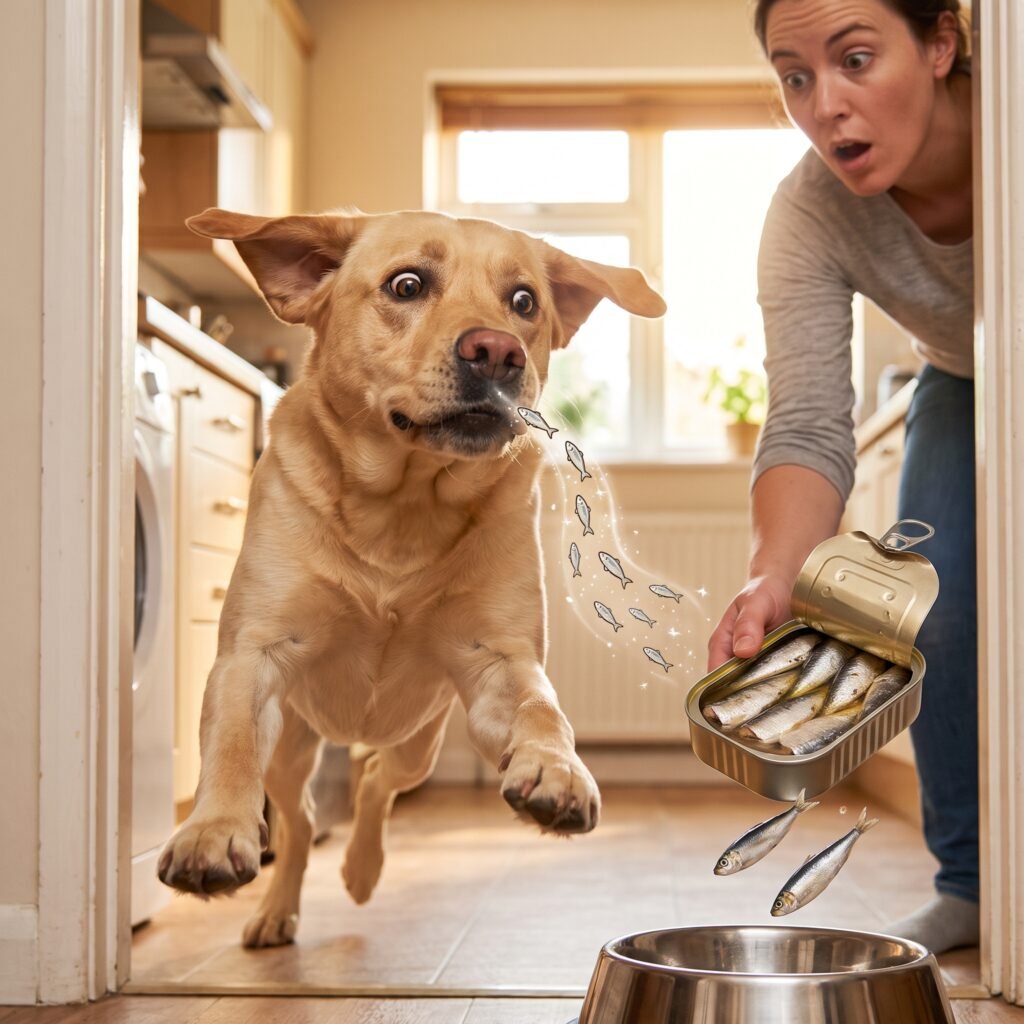
Canned sardines for dogs are safe and genuinely useful — but only if you pick the right can and stop at the right amount. Choose sardines packed in water with no salt added, drain them, and cap the serving at roughly 10% of your dog’s daily calories. That usually means a quarter can for small dogs and one full can for large dogs, two or three times a week.
That’s the short version. It’s also the version that gets people into trouble, because it skips every decision that actually matters once you’re standing in front of eleven different tins.
Recommended Products

Best Dog Food in 2026
Why the can matters more than the fish
Here’s the thing almost nobody tells you: the sardine itself is nearly identical across brands. It’s a small forage fish, harvested young, cooked in the tin. The nutrition of the flesh barely moves.
What moves — dramatically — is everything around the fish. Packing medium, added salt, added sauces, added oils. Two cans sitting side by side on the same shelf can differ by 400 mg of sodium and 90 calories.
For a 15-lb dog, that difference is the whole ballgame. It’s also why the best canned sardines for dogs in a Great Dane’s bowl and the best tin for a Chihuahua aren’t always the same product. For a 75-lb Lab, it’s a rounding error. This is why “are canned sardines for dogs healthy?” is the wrong question and “which can, for which dog, how often?” is the right one.
I’ve been reading fish labels for SmartPupFood for a few years now, and the pattern I keep hitting is that owners get the concept right and the execution wrong. They’ve heard sardines are good. They buy whatever’s on sale. Their dog gets a can of sardines in tomato sauce with onion powder in it.
So let’s do this properly, from the shelf to the bowl.
What’s actually inside canned sardines for dogs?
Canned sardines for dogs earn their reputation on four things: long-chain omega-3s, complete protein, soft edible bones, and vitamin D. It’s a genuinely dense little package.
Here’s what a standard 3.75 oz tin looks like once you drain it — roughly 90 grams of actual fish.
| Nutrient | Per 3.75 oz can (drained, in water) | Per 3.75 oz can (drained, in olive oil) | Why it matters for a dog |
|---|---|---|---|
| Calories | ~135 kcal | ~190 kcal | Sets your serving-size ceiling |
| Protein | ~21 g | ~22 g | Complete amino acid profile |
| Total fat | ~5 g | ~10.5 g | Oil-packed roughly doubles it |
| EPA + DHA (omega-3) | ~800–900 mg | ~900–1,000 mg | The actual reason you’re doing this |
| Calcium | ~330 mg | ~350 mg | From the soft, edible spine |
| Phosphorus | ~440 mg | ~450 mg | Watch this if kidneys are a concern |
| Sodium (no salt added) | ~110–160 mg | ~140–200 mg | The variable that ruins good intentions |
| Sodium (salted) | ~400–500 mg | ~430–530 mg | Same fish, four times the salt |
| Vitamin D | ~170–190 IU | ~175–195 IU | Meaningful, but not a supplement |
Two numbers deserve a second look.
EPA and DHA. These are the marine omega-3s that dogs can actually use. Dogs convert plant-based ALA (flax, chia) into EPA and DHA poorly, which is why “omega-3 enriched” claims built on flaxseed underdeliver. Canned sardines for dogs skip the conversion problem entirely — the fish already did the work.
The bones. The spine in a canned sardine is pressure-softened during processing until it crushes between your fingers. That’s where most of the calcium lives. It’s also why sardines carry a meaningfully different mineral load than, say, canned tuna, which is boneless and brings almost no calcium at all.
I’ll come back to that calcium, because it’s the thing that quietly disqualifies one group of dogs.
Water, olive oil, or tomato sauce — which canned sardines for dogs are safe?
This is the decision. Everything else is downstream of it.
| Packing style | Safe for dogs? | Sodium per can | Calories per can | My verdict |
|---|---|---|---|---|
| Water, no salt added | Yes — best choice | ~110–160 mg | ~135 kcal | The default. Buy this one. |
| Water, salted | Acceptable, rinse first | ~400–500 mg | ~135 kcal | Fine for big dogs, skip for small ones |
| Olive oil, no salt added | Yes, with calorie adjustment | ~140–200 mg | ~190 kcal | Good if your dog needs the calories |
| Olive oil, salted | Use sparingly | ~430–530 mg | ~190 kcal | Drain hard, rinse, small servings |
| Tomato sauce | Usually no | ~350–650 mg | ~150 kcal | Onion/garlic powder risk |
| Mustard sauce | No | ~400–700 mg | ~160 kcal | Spices, vinegar, GI upset |
| Hot sauce / chili | No | Varies | Varies | Obvious no |
| Smoked in oil | No | Often 500 mg+ | ~200 kcal | Smoke flavoring, higher sodium |

Water, no salt added, is the answer 90% of the time. If you want a one-line rule for buying the best canned sardines for dogs, that’s it. It’s the cleanest version of canned sardines for dogs available in any ordinary supermarket, and it’s usually within fifty cents of the alternatives.
Olive oil isn’t the villain people make it. Plain olive oil is not toxic to dogs. The issue is arithmetic — it adds about 55 calories and 5 grams of fat per can. For a dog on a weight-loss plan or a dog with a history of pancreatitis, that’s a real problem. For an underweight senior, it’s a feature.
Tomato sauce is where I draw a hard line. Not because tomato is dangerous — ripe tomato flesh is fine for dogs — but because “tomato sauce” on a sardine tin frequently means tomato purée plus onion powder, garlic powder, or “natural flavoring.” Onion and garlic in concentrated powder form damage canine red blood cells. Read the ingredient panel; if you see either word, put it back.
One more shelf note. “Sardines in spring water” and “sardines in water” mean the same thing. “Sardines in soybean oil” is common in budget tins and is nutritionally unremarkable but adds omega-6s you don’t need — I’d pass.
Are the expensive tins better than the cheap ones?
Mostly no, and this catches people off guard — in pet food, price usually tracks quality. Here it doesn’t.
Sardines are a commodity fish. A store-brand tin of sardines in water and a five-dollar imported tin of sardines in olive oil hold the same species, caught by the same fleets, processed to broadly similar standards. The premium price buys firmer intact fillets, better-grade oil, and nicer packaging.
None of that reaches your dog.
| Price tier | Typical cost per tin | What the money buys | Verdict for dogs |
|---|---|---|---|
| Store brand, water-packed | $1.00–1.60 | Basic tin, softer fillets, often no salt added | The best canned sardines for dogs, honestly |
| Mid-tier, water or olive oil | $2.00–3.00 | Firmer texture, consistent sizing | Fine, no real advantage |
| Premium imported, olive oil | $4.00–7.00 | Higher-grade oil, artisan processing | Wasted on a dog |
| Skinless & boneless, any tier | $2.50–5.00 | Convenience for humans | Avoid — you want those bones |
That last row matters more than the price. Skinless-and-boneless tins strip out the calcium that makes sardines worth feeding in the first place. If the label says boneless, it’s the wrong tin.
A few label claims to ignore. “Wild caught” is not a premium feature on sardines — nobody farms them, so every tin on the shelf is wild caught. “Omega-3 rich” is equally meaningless; it’s a sardine.
One claim worth reading is the can lining. BPA-free linings have become common, and if you’re feeding canned sardines for dogs several times a week for years, it’s a reasonable preference — though the evidence on real-world risk at these quantities is thin, and I wouldn’t pay a large premium for it.
My actual shopping rule: cheapest tin that says water, no salt added, with bones in. That’s it. I’ve compared premium and store-brand canned sardines for dogs side by side in the same bowl, and no dog I’ve fed has shown a preference for either.
How many sardines can a dog eat?
The honest answer to how many sardines can a dog eat is: fewer than most owners assume. The governing rule is the 10% guideline: toppers, treats, and extras should stay under 10% of daily calories so they don’t unbalance a complete diet. This isn’t an AAFCO regulation — it’s long-standing veterinary nutrition convention — but it’s the right frame here.
Do the math once and you’ll never have to think about it again.
| Dog’s weight | Approx. daily calories | 10% budget | Canned sardines in water | Suggested frequency |
|---|---|---|---|---|
| 10 lb | ~300 kcal | 30 kcal | ~1/5 can (20 g) | 2× per week |
| 20 lb | ~500 kcal | 50 kcal | ~1/3 can (33 g) | 2–3× per week |
| 40 lb | ~900 kcal | 90 kcal | ~2/3 can (60 g) | 2–3× per week |
| 60 lb | ~1,200 kcal | 120 kcal | ~3/4 can (68 g) | 3× per week |
| 80 lb | ~1,500 kcal | 150 kcal | 1 full can (90 g) | 3× per week |
Those daily calorie figures are ballpark for a neutered adult at a healthy weight and moderate activity. An intact working dog eats far more; a sedentary senior eats less. Use your dog’s actual food bag as the reference point, not my table.
Why frequency instead of daily? Two reasons. First, feeding canned sardines for dogs every single day makes the mineral contribution large enough that it starts to matter against a complete diet — particularly phosphorus. Second, rotating novel proteins in and out is easier on sensitive stomachs than a daily fixed addition.
Two to three times a week hits the omega-3 benefit without the drift.
And subtract the calories. This is the step everyone skips. If your 40-lb dog gets 60 grams of sardines, take a proportional scoop out of dinner. Toppers are the single most common route to slow, invisible weight gain in otherwise well-fed dogs.

Which dogs should skip canned sardines?
Are sardines good for dogs across the board? Almost — but there are five situations where I’d say no, or “ask your vet first,” and they’re specific enough that a generic recommendation misses them entirely.
Dogs with heart disease on sodium-restricted diets
If your dog is on a prescription cardiac diet, the whole point of that diet is controlled sodium. A salted can can add 400–500 mg in one sitting. Even no-salt-added versions should be cleared with the cardiologist first. This is the clearest disqualifier for canned sardines for dogs.
Dogs prone to urate stones
Sardines are high in purines. Dalmatians — and other dogs with urate urolithiasis or a portosystemic shunt — are typically managed on low-purine diets specifically to avoid this. Sardines are exactly the wrong food here. It’s a small population, but if you own a Dalmatian, this is the single most important paragraph on the page.
Dogs with a pancreatitis history
Miniature Schnauzers, some Yorkies, and any dog with a previous episode of pancreatitis need a tight lid on fat. Oil-packed sardines are out. Water-packed, drained, in small amounts, are worth discussing with your vet — but I wouldn’t freelance it.
Large-breed puppies still growing
Growing large-breed puppies need calcium held in a fairly narrow window; excess calcium during growth is associated with developmental orthopedic problems. A sardine’s edible bones add real calcium. Occasional small pieces are unlikely to matter, but routine canned sardines for dogs under a year old in a large breed is a habit I’d avoid without vet input.
Dogs on carefully balanced homemade diets
If a veterinary nutritionist formulated your dog’s meals, adding sardines on your own initiative changes the mineral ratios that were calculated for a reason. Ask before you add.
Worth adding: sardines are a low-mercury fish. They’re small, short-lived, and eat plankton, so they sit near the bottom of the food chain and don’t accumulate the mercury that larger predatory fish do. Mercury is one of the few things you genuinely don’t need to worry about here.
When canned sardines didn’t work for me
Trust signals are cheap when everything goes well, so here are three times canned sardines for dogs went sideways on me.
The 12-pound terrier mix. I started a small senior terrier on a quarter can of water-packed sardines twice a week for a dull coat. Within four days she had soft, urgent stools. Not diarrhea — just clearly unhappy. I’d underestimated how much fat 22 grams of fish represents for a dog that size. I dropped to about a tablespoon of mashed fish once a week, and her gut settled. Small dogs need a slower on-ramp than the tables suggest.
The coat that never improved. A 40-lb mixed breed with a persistently dry, flaky coat got canned sardines for dogs three times a week for six weeks. Almost no change. The problem wasn’t omega-3 deficiency — it turned out to be an environmental allergy driving low-grade inflammation, and it needed a vet, not a fish. Sardines fix a nutrient gap. They don’t fix a diagnosis.
The dog who simply refused. A very food-motivated Beagle — the kind of dog who eats socks — would not touch them. Sniffed, backed up, looked personally offended. I tried mashing them into kibble, warming them slightly, mixing with plain yogurt. Nothing. Some dogs find that oily, iodine-heavy smell genuinely unpleasant, and no amount of technique changes it. If your dog is that dog, a fish oil capsule delivers the same EPA and DHA with none of the drama.
That last one matters because so much content assumes enthusiastic acceptance. Roughly one dog in ten, in my experience, wants nothing to do with canned sardines for dogs.
Canned sardines for dogs or a fish oil supplement?
This is the fork in the road most owners eventually hit, and there’s no universal winner.
| Canned sardines | Fish oil supplement | |
|---|---|---|
| EPA + DHA per serving | ~800–900 mg per can | 300–1,500 mg per pump/capsule |
| Dose precision | Rough | Exact |
| Extra calories | 135–190 per can | 40–50 per teaspoon |
| Protein contribution | ~21 g | None |
| Calcium contribution | ~330 mg | None |
| Sodium | 110–500 mg | Essentially none |
| Cost per week | $2–5 | $1.50–4 |
| Palatability | Loved or refused | Usually easy |
| Oxidation risk | Very low (sealed tin) | Real once opened |
Choose canned sardines for dogs when you want whole food, your dog likes them, and you value the protein and calcium alongside the omega-3s. There’s also a practical advantage: a sealed tin doesn’t go rancid. Fish oil in an opened bottle oxidizes, and oxidized oil is worse than no oil.
Choose a supplement when you need a precise therapeutic dose — for joint disease, kidney disease, or dermatologic conditions where the vet is targeting a specific mg/kg — or when your dog won’t eat fish, or when calories are tight.
Plenty of dogs do both: a supplement for the baseline dose, canned sardines for dogs twice a week as a topper the dog actually looks forward to.
How do sardines compare to other canned fish?
Once you’re standing in the tinned fish aisle anyway, it’s fair to ask whether something else on that shelf beats canned sardines for dogs.
| Canned fish | Omega-3 (EPA+DHA) | Edible bones? | Mercury level | Typical sodium | Verdict |
|---|---|---|---|---|---|
| Sardines (water) | ~800–900 mg/can | Yes, soft | Very low | 110–500 mg | Best all-round choice |
| Mackerel (water) | ~900–1,100 mg/can | Yes, soft | Low (Atlantic/jack) | 200–400 mg | Excellent, harder to find |
| Pink salmon, bone-in | ~700–1,000 mg/can | Yes, soft | Low | 300–600 mg | Very good, pricier |
| Chunk light tuna | ~150–300 mg/can | No | Moderate | 200–350 mg | Weak omega-3, skip |
| Anchovies | High per gram | Yes | Very low | 1,000 mg+ | Salt bomb — no |
Two takeaways.
Tuna is the popular wrong answer. It’s the tin most people already have, and it’s the weakest option here — a fraction of the omega-3s, no calcium, and enough mercury that it’s not a good routine food. If you’re choosing between tuna and canned sardines for dogs, sardines win on every axis except smell.
Anchovies fail on sodium alone. Gram for gram they’re nutritionally superb, but they’re cured in salt, and a single fillet can carry more sodium than a whole no-salt-added sardine tin. Some freeze-dried anchovy treats solve this; the canned ones don’t.
Canned mackerel in water is the one genuine rival, and if your store carries it, rotating it with canned sardines for dogs is a nice way to vary the protein without varying the nutrition much.
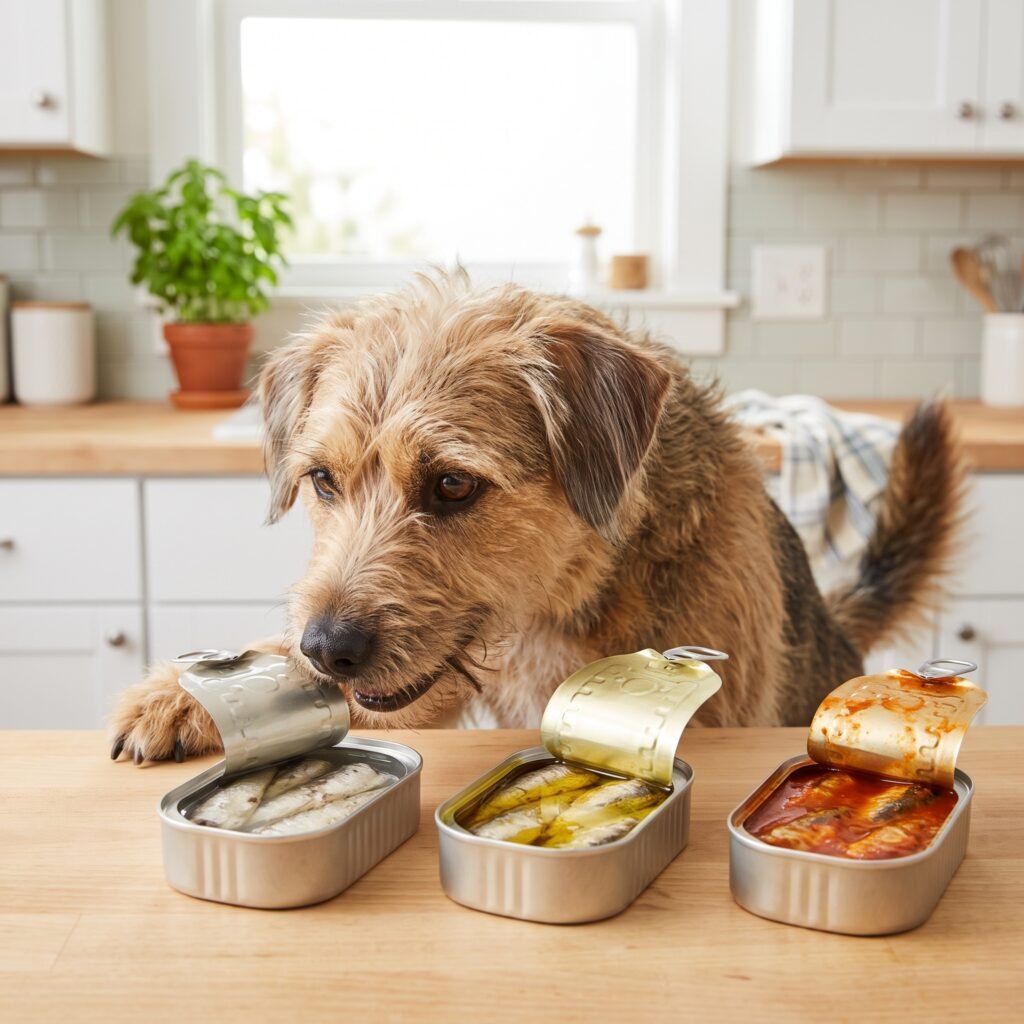
How I serve canned sardines for dogs
Small execution details make the difference between a good habit and a messy one.
Drain, and consider rinsing. Pour off the liquid completely. If the can is salted, tip the fish into a strainer and run cool water over it for ten seconds. You’ll lose a little surface oil and a meaningful fraction of the sodium.
Mash the bones in. Don’t pick them out. Press the fish with a fork until the spine breaks up — it’s soft enough to crush without effort, roughly the resistance of a cooked lentil. That’s the calcium, and mashing also prevents a fast eater from swallowing a whole fish sideways.
Serve at room temperature or slightly warm. Cold-from-the-fridge sardines are less aromatic. Fifteen seconds in a warm bowl of water lifts the smell and dramatically improves acceptance in hesitant dogs.
Portion and freeze. This is the single habit that makes canned sardines for dogs sustainable rather than a weekly chore. I portion an opened can into an ice cube tray — each cube lands around 15 grams — and freeze. One cube on top of kibble for a small dog, three or four for a large one. An opened tin lasts two days in the fridge in a sealed container, and honestly, your fridge will let you know.
Expect the smell. Canned sardines for dogs come with a distinct oily, briny odor that lingers on bowls and hands. Wash the bowl immediately with hot water and soap. Some dogs also get noticeably fishy breath for an hour or so afterward. That’s normal, not a sign of a problem.
Introduce slowly. Start at roughly a third of the target portion for the first two servings and watch the stool. Sensitive-stomach dogs tell you within 48 hours whether this is going to work.
How I evaluated this
Methodology note. The nutrient figures I’ve used for canned sardines for dogs above come from cross-referencing USDA composition data for canned sardines against the ingredient and nutrition panels on tins I bought and read directly, across water-packed, oil-packed, and sauce-packed varieties. Values are given as ranges because brands differ and formulations change — always read the panel in front of you.
Serving sizes were calculated against AAFCO-established adult maintenance nutrient profiles and the standard veterinary 10%-of-daily-calories convention for treats and toppers, rather than against any single brand’s guidance. Where a claim couldn’t be verified — for example, a precise omega-3 figure for a named brand — I’ve stated it as a range instead of inventing a number.
I also checked the FDA’s pet food recall and withdrawal listings for relevant patterns. Human-grade canned fish sits under a different regulatory regime than pet food and has a strong safety record, but recall status is worth a periodic look for anything you feed routinely.
Nothing here replaces your veterinarian, particularly for the conditions in the “skip it” section above.
FAQ
Can dogs eat sardines in olive oil every day? I wouldn’t. Sardines in olive oil add roughly 55 calories and 5 grams of fat per can, which accumulates quickly into weight gain and is a poor idea for any dog with a pancreatitis history. Two to three times weekly, with the calories subtracted from meals, is the sustainable pattern.
Are canned sardines for dogs better than fresh sardines? For most households, yes. Canning softens the bones until they’re safe and crushable, kills parasites, and eliminates the handling risk that comes with raw fish. Fresh sardines are excellent if you cook them and debone carefully, but canned is easier and just as nutritious.
Do I need to remove the bones from canned sardines? No — and you shouldn’t. The pressure-cooking process softens the spine to the point where it crushes under a fork, and that bone is the main calcium source in the can. Mash it in rather than picking it out.
Can puppies eat canned sardines? Small-breed puppies over about 12 weeks can have tiny amounts of water-packed, drained sardines. Large-breed puppies are the exception — their calcium intake needs to stay within a narrow range during growth, so check with your vet before making it routine.
Are sardines good for dogs with itchy skin? Sometimes. The EPA and DHA in canned sardines for dogs have a documented anti-inflammatory role and can improve coat quality when there’s a genuine omega-3 shortfall. But if itching is driven by allergies, fleas, or infection, sardines won’t touch it — get a diagnosis first, as I learned the hard way.
Are sardines good for dogs with kidney disease? Usually not as a routine topper. A single tin carries roughly 440 mg of phosphorus, and phosphorus restriction is central to managing chronic kidney disease in dogs. The omega-3s are genuinely beneficial for kidney patients, so ask your vet about a purified fish oil instead — same benefit, no phosphorus.
Can I feed canned sardines for dogs on top of a fish-based kibble? Yes. There’s no upper limit you’re likely to bump into by stacking a fish kibble with two sardine servings a week, and the extra EPA and DHA are useful. Just count the calories — fish kibbles are often calorie-dense, and the topper still comes out of the daily budget.
How long do sardines last once opened? Transfer leftovers to a sealed glass or plastic container and use within two days. Freezing pre-portioned cubes is the better system if you have a small dog who’ll only get through a can slowly.
The bottom line
Canned sardines for dogs are one of the few genuinely excellent whole-food toppers you can buy in an ordinary supermarket for under three dollars. They deliver EPA and DHA in the form dogs actually use, plus complete protein and soft, digestible calcium.
But the value lives entirely in the execution. If you’re wondering how many sardines can a dog eat and which tin to buy, the answer fits on a sticky note. Buy sardines in water with no salt added. Drain it. Mash the bones in. Cap the portion at 10% of daily calories and subtract it from dinner. Feed two or three times a week, not daily.
And know when to walk away — cardiac patients, Dalmatians, pancreatitis-prone dogs, and large-breed puppies all have real reasons to skip canned sardines for dogs entirely. If your dog isn’t in one of those groups and doesn’t object to the smell, it’s about as good a two-dollar upgrade as their bowl is going to get.