
Beef Cheek Rolls for Dogs: Who Should Chew Them and Who Shouldn't
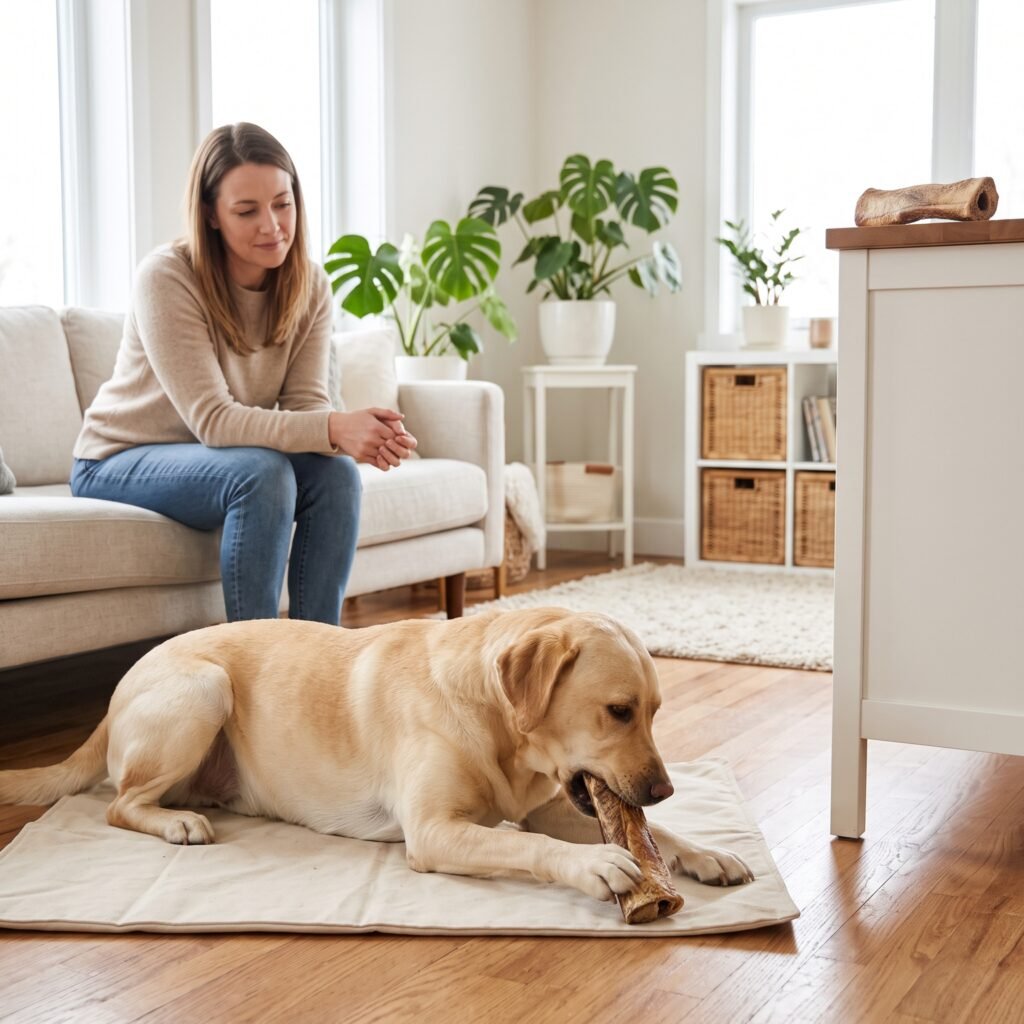
Beef cheek rolls for dogs are rolled strips of beef cheek hide, sold as long-lasting chews. They suit steady, supervised chewers, not dogs who gulp chunks. They carry choking, blockage, calorie, and contamination risks. Count them toward daily calories, supervise every session, and throw them away when they shrink.
A reader once asked me whether beef cheek rolls for dogs were “basically the same as a bully stick.” She had a 55-pound lab mix who inhaled everything, and she wanted something to keep him busy for an hour.
I told her the honest answer: it depends on how he chews, not on what the package says. A dog who gnaws patiently and a dog who tears off chunks need very different advice about beef cheek rolls for dogs.
This article is built around that one decision. You’ll learn how to read your dog’s chewing style, what the real risks are, how to count the calories, and what to try instead if the answer is “not this one.”
Recommended Products
Best Dog Food in 2026
What are beef cheek rolls for dogs, and how are they made?
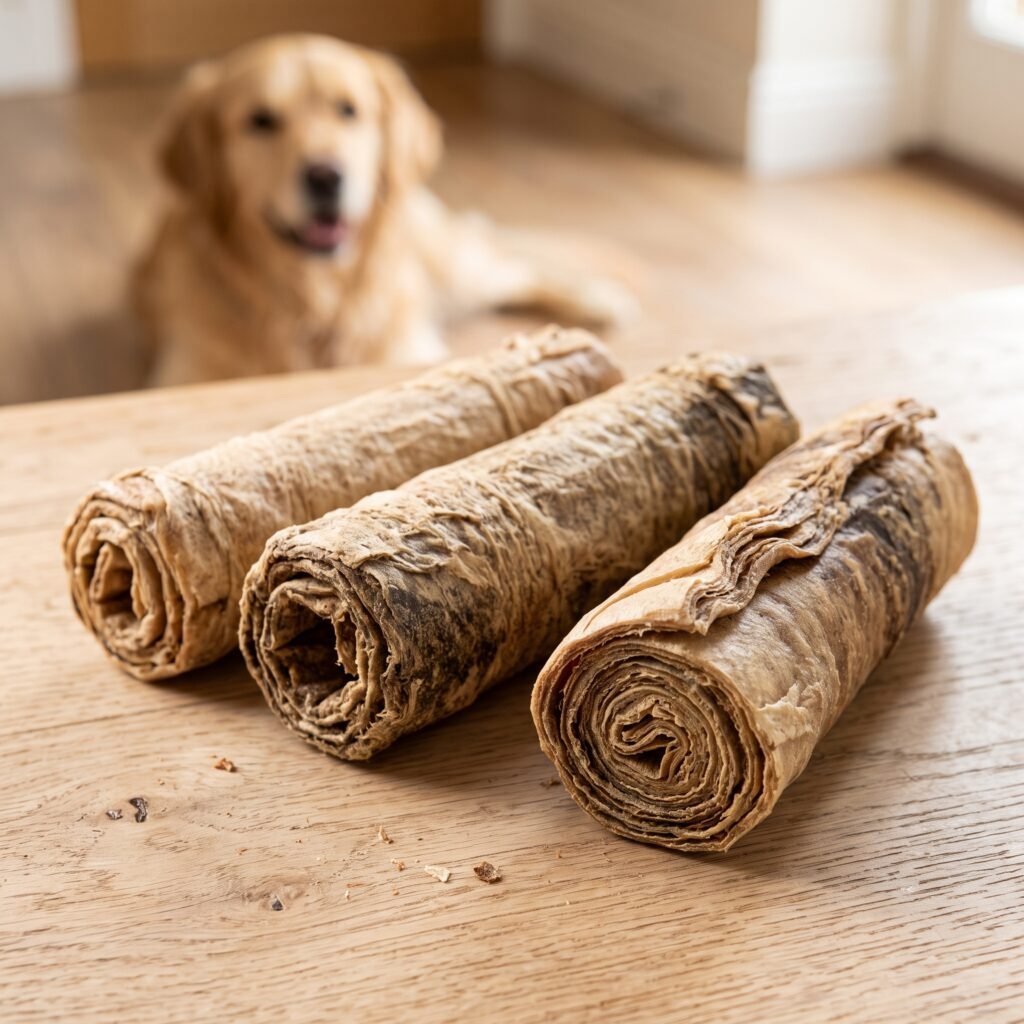
They’re chews made from the skin of a cow’s cheek, flattened, rolled, and dried. A retailer listing I checked describes its product as single-ingredient beef cheek, with no added preservatives, fillers, flavors, or colors. It lists a hard chew texture for medium to large dogs.
That makes beef cheek rolls for dogs a close relative of rawhide. Veterinary writers describe rawhide as a chew made from animal skin, usually cattle hide, and many people lump cheek rolls in with it. I treat them the same way when I think about risk.
Are beef cheek rolls the same as rawhide?
In practice, they behave like rawhide, and the risks overlap. Marketing language like “natural” or “single ingredient” can make them sound gentler, but the chew still softens, swells, and breaks into pieces as your dog works on it.
If your vet has told you to avoid rawhide, ask before you offer beef cheek rolls for dogs. Don’t assume a different name means a different risk.
What does the label usually say?
Look for the ingredient list, the country of origin, the size, and any safety warnings. One listing I read gave the origin as Turkey, listed no guaranteed analysis, and warned owners to supervise, discard splintered pieces, and wash hands after handling.
Sizes also confuse buyers. On that same listing, the product title said 10 inches while the detail table said roughly 6 inches long. Check the measurements before you order for a big dog.
What are the real risks of beef cheek rolls for dogs?
Most of the risks come down to what happens when a dog swallows a piece. I’ll go through them plainly, because this is the part that should shape your decision.
Choking and blockage. A published veterinary school article on rawhide notes that pieces can lodge anywhere from the throat to the intestines. Small pieces can cause choking or blockages in the esophagus, stomach, or small intestine, and severe cases may need surgery.
Aggressive chewers. The same source says dogs who swallow chunks eagerly are more likely to have problems than casual gnawers. That’s the main reason I’d steer a gulper away from beef cheek rolls for dogs.
Calories. The article estimates a thin flat rawhide piece at roughly 50 to 100 calories and says rolled or shaped pieces contain far more. Rolled chews like these are dense, so one session can add a real share of a small dog’s day.
Bacteria. Because the chew is uncooked, it can carry bacteria such as salmonella that may affect dogs and people. Wash your hands after handling, and keep the chew away from kitchen surfaces and small children.
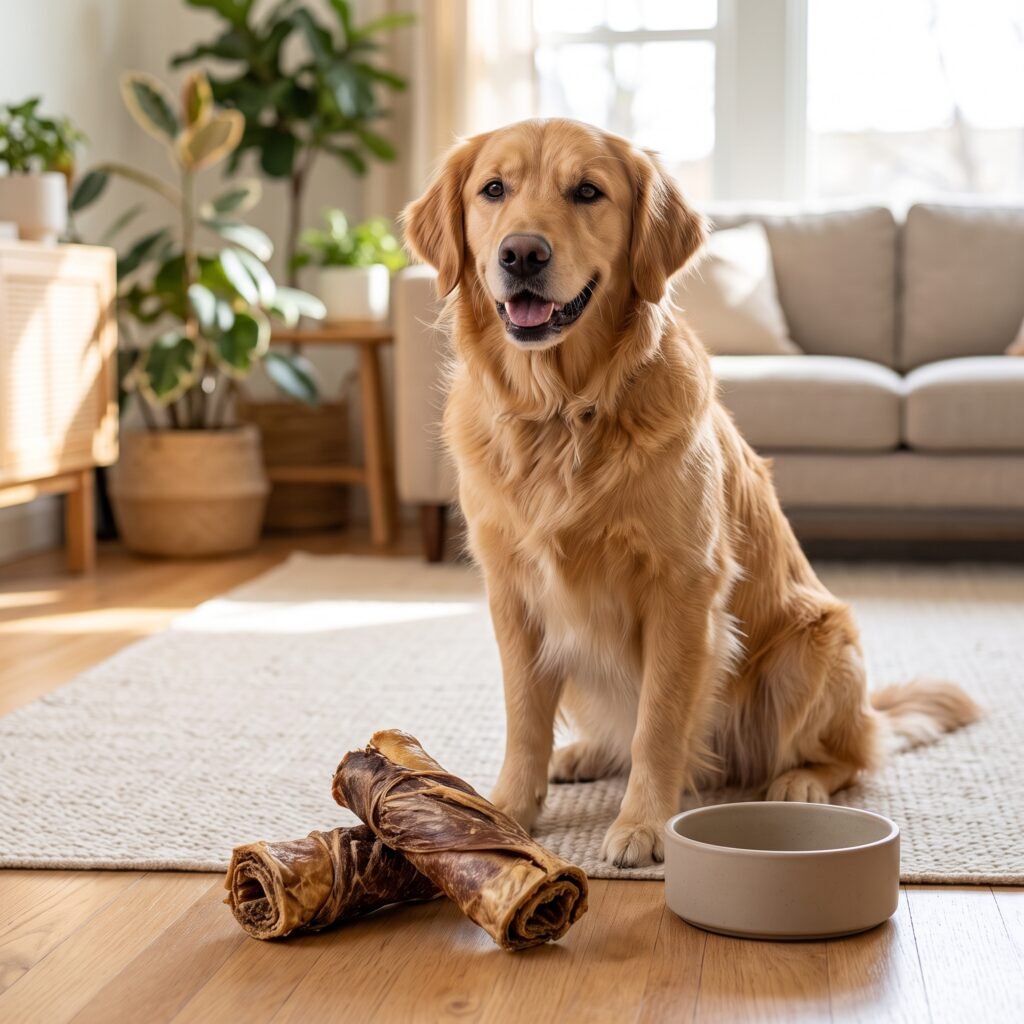
Do beef cheek rolls for dogs help clean teeth?
Many labels imply dental benefits, and I’d treat that as marketing unless your vet says otherwise. Chewing may scrape some surface plaque, but it isn’t a replacement for brushing or a professional cleaning.
I’ve also seen dogs who chewed constantly and still needed dental work. If dental health is your goal, ask your vet about brushing routines and products with independent dental testing.
Are there any real benefits?
There are practical ones. A long-lasting chew can occupy a restless dog, ease boredom, and give an outlet for natural chewing. For the right dog, beef cheek rolls for dogs can be a calm way to spend twenty minutes.
Notice that these are behavior benefits, not nutrition benefits. That’s why I count them as an activity with a calorie cost, not as a health food.
How do I tell if my dog is a gnawer or a gulper?
This is the heart of the decision, and it’s something no label can answer. Watch your dog with a chew you already trust, like a sturdy rubber toy or a very large, safe chew, and note what he does.
Here’s how I sort what I see.
| Chewing style | What it looks like | Fit for beef cheek rolls for dogs |
|---|---|---|
| Gnawer | Holds the chew, works at it slowly, takes breaks | Often a reasonable fit with supervision |
| Shredder | Tears off strips and swallows some | Risky, consider alternatives |
| Gulper | Bites hard, swallows large pieces, tries to eat it whole | Poor fit, skip |
| Guarder | Growls or stiffens when approached with a chew | Not safe without professional help |
The gulper row is the one that matters most. My lab-mix reader’s dog fit it exactly, which is why I told her to skip beef cheek rolls for dogs and look at other options.
Can a dog change chewing style?
Yes. A puppy may gnaw, then become more forceful as his jaw strengthens. A senior may slow down. Reassess every few months, and anytime a chew breaks apart faster than before.
What if my dog guards chews?
Don’t hand over a high-value chew like beef cheek rolls for dogs to a dog who growls over it. Guarding can escalate fast, and a chew can be the trigger. Talk to your vet or a qualified trainer first.
How do I supervise a session with beef cheek rolls for dogs?
Supervision means being close enough to act in seconds. Here’s the routine I use.
- Size the chew. It should be longer than your dog’s muzzle so it can’t be swallowed whole.
- Pick a calm spot. Offer it on a mat or in a crate, away from other pets and children.
- Stay in the room. Watch the first minutes closely, then check in often.
- Know what to look for. Pieces coming off, gagging, drooling, or a dog who stops to pace.
- Time it. I stop sessions at around 15 to 20 minutes for most dogs.
- Take it away and trade. Swap for a small treat, and put the chew away.
I’ve never regretted ending a session early. I have regretted letting one run long.
When should I throw the chew away?
Throw it away when it’s small enough to fit comfortably in your dog’s mouth, when it develops sharp edges or splinters, or when it breaks into pieces. The listing I read says the same: discard it if it splinters or breaks apart.
A good rule of thumb is that if you wonder whether it’s too small, it is.
What should I do if my dog swallows a chunk?
Watch closely. Vomiting, gagging, repeated retching, a swollen or painful belly, refusal to eat, lethargy, or trouble passing stool are all reasons to call your vet right away. Don’t wait to see if it passes on its own.
Keep the rest of the chew so your vet can see what you’re dealing with, and mention the brand.
How many calories do beef cheek rolls for dogs add?
More than most owners think, and the label rarely says. One listing I checked had no guaranteed analysis at all, so you can’t calculate precisely from the package.
Use the general guidance as a warning sign. The veterinary article I mentioned puts thin rawhide at roughly 50 to 100 calories and says rolled chews run far higher. For a 10-pound dog who eats around 400 calories a day, even a modest chew can be a large fraction.
How do I count a chew into the daily food?
Ask the manufacturer for calories per chew. If they can’t tell you, estimate cautiously and trim the meal to match. Weigh the chew before and after a session if you want a rough sense of how much your dog actually consumed.
A heavy chewer who works through a whole roll every day will gain weight unless you adjust meals. I’ve watched it happen over a couple of months.
Are beef cheek rolls for dogs okay for overweight dogs or dogs with pancreatitis?
I’d ask the vet first. A calorie-dense chew can work against weight loss, and fatty extras can be a problem for dogs prone to pancreatitis. In those cases, a lower-calorie option may serve better.
What do beef cheek rolls for dogs cost compared with other chews?
Price swings are large, so use your own numbers. As one data point, a retailer listing I saw priced a four-count pack of 10-inch rolls at $35.99, or about $9 per chew. That’s before shipping, and it may change.
Divide the pack price by the number of chews, then divide again by how many sessions each chew lasts. That’s your true cost per session.
If a roll lasts a gnawer a week of short sessions, it may be good value. If it vanishes in ten minutes, it’s an expensive snack. That’s another reason to match beef cheek rolls for dogs to the right dog.

What went wrong when I gave beef cheek rolls to a gulper?
Here’s my honest failed attempt. Years ago I offered a thick roll to a 60-pound boxer mix who had always been a steady chewer on rubber toys. I assumed he’d treat it the same way.
He didn’t. Within five minutes he’d softened the end into a gummy, glistening mass, and he started tearing at it. The smell was strong and a bit sour, like warm leather. He lifted a floppy, swollen piece and swallowed it before I could react.
He retched twice, then settled. I called the vet and watched him closely for two days, and he was fine. I was lucky.
I took the chew away that day and never gave him another one. The lesson is that past behavior with a different toy doesn’t predict behavior with a chew that softens. This approach doesn’t work for dogs who change gears when the texture changes.
What are good alternatives to beef cheek rolls for dogs?
If your dog is a gulper, a shredder, or a guarder, or if your vet says no to rawhide-style chews, you have options. None is perfect, and each has trade-offs.
| Alternative | Pros | Cons |
|---|---|---|
| Durable rubber chew toys | Long-lasting, no calories unless stuffed | Some dogs lose interest |
| Stuffable toys with food | Slows eating, occupies the dog | Calories from the filling |
| Frozen lick mats | Calming, easy to control | Messy |
| Dental chews with independent testing | Designed for dental care | Calories, dogs may gulp them |
| Puzzle feeders | Uses the daily meal | Takes setup |
I like stuffable rubber toys for gulpers, because I can control the filling and the calories. A frozen mat gives a calmer outlet for dogs who need to settle.
If you want a rawhide alternative for dogs, look for chews that are digestible, sized for your dog, and clearly labeled with calories. Then supervise those just as carefully.
What about bully sticks and antlers?
Each has its own pros and cons. Bully sticks are often more digestible than rolled hide, but they’re calorie-dense. Antlers and bones can crack teeth, so many vets advise caution. Ask your vet which fits your dog’s mouth and habits.
Can puppies, seniors, and small dogs have beef cheek rolls for dogs?
Edge cases change the answer, and I’d rather be careful than comfortable.
Puppies. Young dogs have small throats and developing teeth, and they often swallow pieces whole. I’d ask your vet before giving beef cheek rolls for dogs to a puppy.
Seniors. Older dogs may have sore or missing teeth, and a hard chew can be uncomfortable. Their digestion may also be more sensitive.
Small dogs. A roll sized for a lab is far too big and calorie-heavy for a toy breed. Choose chews made for your dog’s size, or skip it.
Large, powerful chewers. They may demolish a chew quickly. Bigger isn’t automatically safer.
Dogs with sensitive stomachs. A rich chew that swells in the gut may cause vomiting or diarrhea. Introduce anything new in small amounts.
Where do beef cheek rolls for dogs come from, and does sourcing matter?
It does. Chews are made from animal skin, so where the animal was raised and how the hide was processed can affect quality. A listing I read described free-range cattle raised without antibiotics, steroids, or added hormones, and gave Turkey as the country of origin.
Those are claims from a seller, and I haven’t verified them. If sourcing matters to you, ask the retailer for documentation, including country of origin and processing details.
Also check recall notices. The FDA publishes pet food and treat recalls, and rawhide-style products have appeared in them in the past for contamination reasons. Look up the brand before you buy, and check again if you reorder.
How I evaluated the information in this article
Methodology note. I reviewed a veterinary school article on rawhide risks and a retailer’s product listing for beef cheek rolls, and I attributed their claims in the text. I did not test the safety of any chew in a lab, and I did not invent statistics. Where I describe my own handling of chews, I’m describing general experience, and every dog is different. This article isn’t a substitute for veterinary advice, especially for puppies, seniors, and dogs with health conditions.
How do I introduce beef cheek rolls for dogs the first time?
Go slowly, and treat the first session as a test.
Offer the chew for only five to ten minutes. Stay close, and watch how your dog works at it. If he gnaws calmly, you can extend the session next time. If he tears and swallows, stop and switch to another option.
Check stool over the next day or two. Loose stool or vomiting means your dog may not tolerate this type of chew. Don’t push through it.
Store the chew in a dry place, and keep it out of reach. A dog who finds it unsupervised can turn a safe routine into a risky one.
Frequently asked questions
Are beef cheek rolls for dogs safe?
They can be safe for some supervised, steady chewers, but they carry real risks, including choking, blockage, calories, and bacteria. They’re a poor fit for gulpers and for dogs who guard chews. Ask your vet if you’re unsure.
Are beef cheek rolls the same as rawhide?
They’re made from cattle hide and behave much like rawhide, so the same cautions apply. If your vet advises against rawhide, ask before using them.
How long should I let my dog chew a beef cheek roll?
I stop sessions at about 15 to 20 minutes for most dogs, and sooner for new chewers. Discard the chew when it becomes small enough to swallow or starts to splinter.
How many calories are in beef cheek rolls for dogs?
It varies, and many labels don’t say. Rolled hide chews are dense, so ask the maker for calories per chew and subtract that from the day’s food.
What is a good rawhide alternative for dogs?
Durable rubber toys, stuffable toys, frozen lick mats, and independently tested dental chews are common choices. The right one depends on your dog’s chewing style and your vet’s advice.
Final thoughts: match the chew to the chewer
So, are beef cheek rolls for dogs a good idea? For a calm, steady gnawer with a vet’s blessing, they can be a satisfying and long-lasting activity. For a gulper, a shredder, or a guarder, the risks outweigh the reward.
Remember the order: judge your dog’s chewing style, pick a size longer than the muzzle, supervise every session, count the calories, and throw the chew away when it shrinks.
That’s how beef cheek rolls for dogs fit into a routine without turning into an emergency. When in doubt, choose the safer chew, and ask your vet.