Goldendoodle Food: Why Size Matters More Than the Brand You Pick
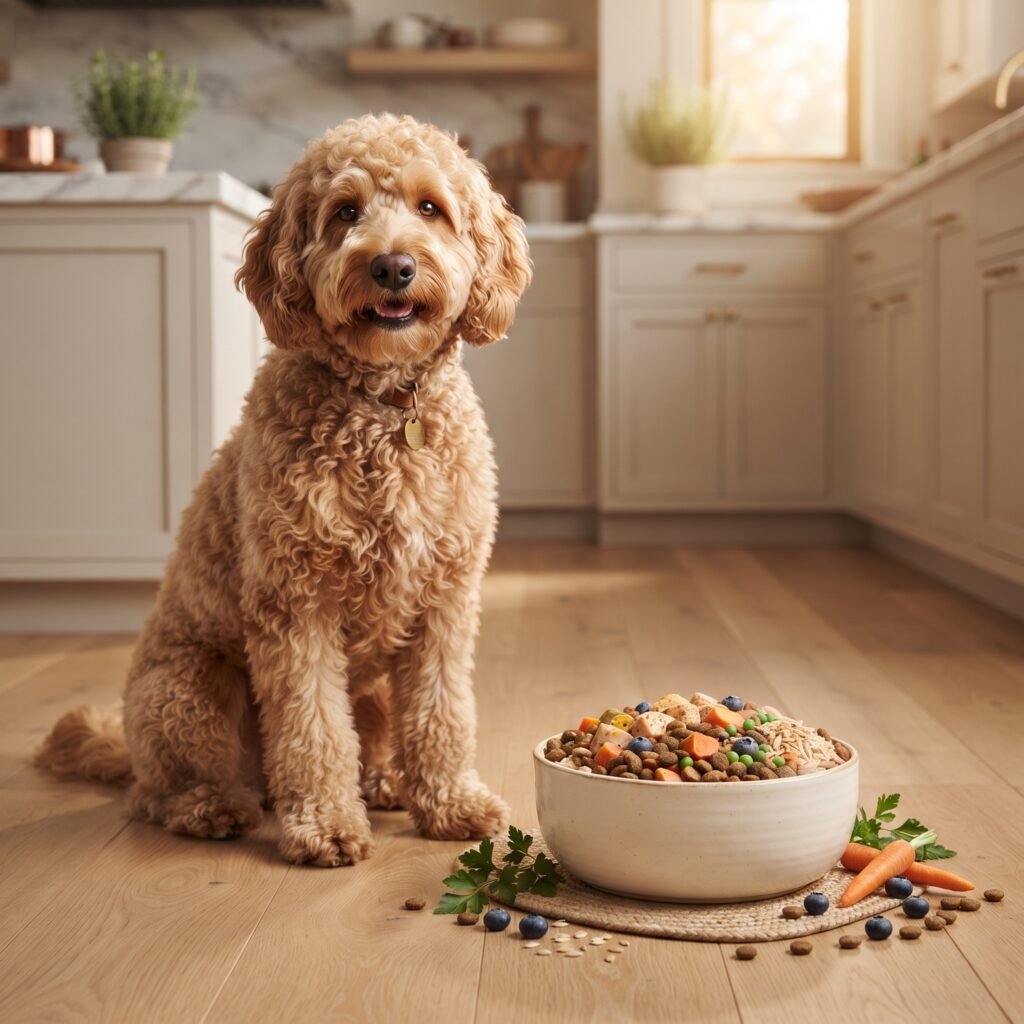
Quick answer: The best goldendoodle food depends heavily on your dog’s size variety. A mini goldendoodle under 30 pounds needs a different calorie density and kibble size than a standard over 50 pounds, and both benefit from a formula with joint-supporting nutrients given the breed’s shared risk of hip dysplasia from both Poodle and Golden Retriever lines.
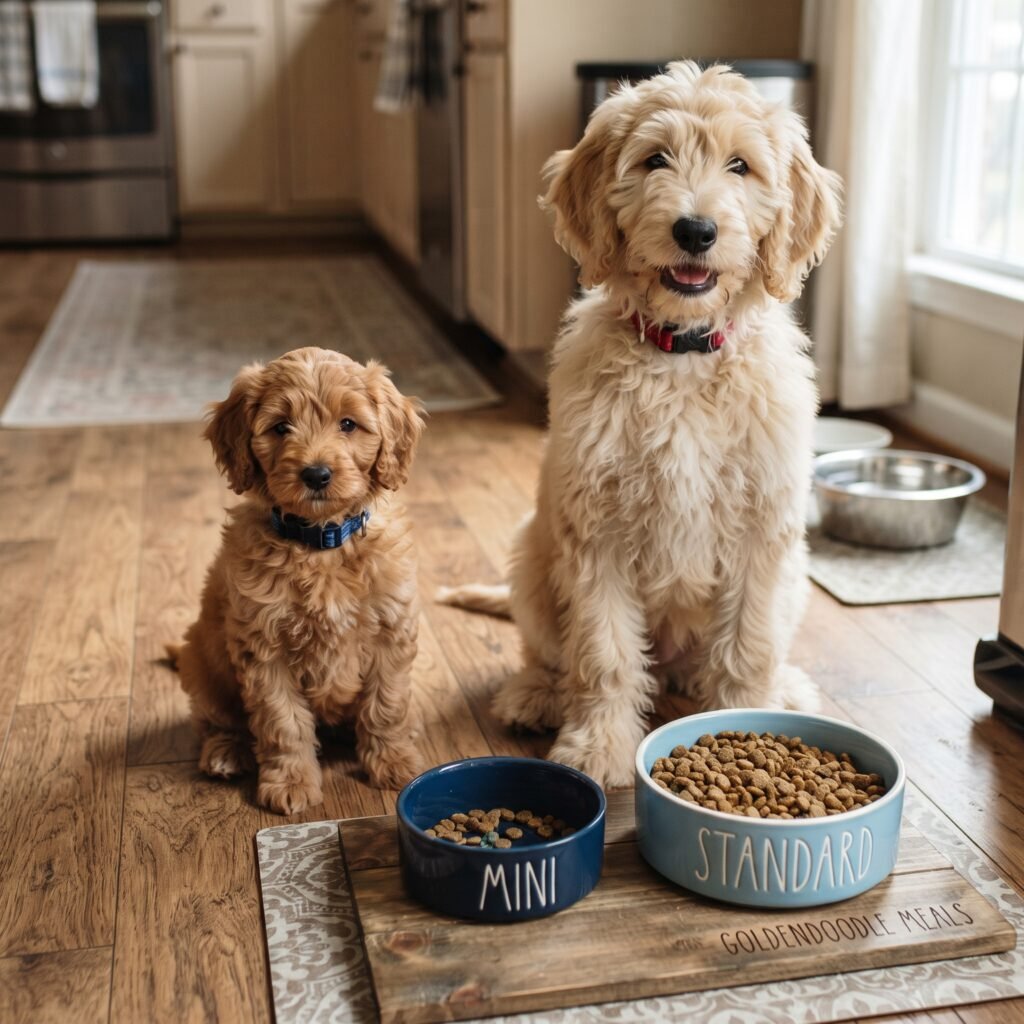
A reader emailed me a photo of her 9-week-old mini goldendoodle next to her sister’s 9-week-old standard goldendoodle puppy, both from reputable breeders, both labeled simply “goldendoodle puppy food” on the bags she’d bought. She wanted to know if they should really be eating the same thing, since one dog would top out around 20 pounds and the other near 65.
They shouldn’t be on identical feeding plans, and this is exactly the gap most goldendoodle food guides skip over. Treating “goldendoodle” as a single breed with one ideal food ignores that a goldendoodle’s adult size can range from 15 to 90 pounds depending on the cross, which changes growth rate, joint risk, and calorie needs more than coat color or generation ever will.
Recommended Products

Best Dog Food in 2026
Does a Mini Goldendoodle Need Different Food Than a Standard Goldendoodle?
Yes, and the difference matters most during the puppy stage. A mini goldendoodle, typically bred from a Miniature or Toy Poodle and topping out under 30 pounds, grows fast relative to its adult size and is usually fully grown by around 10 to 12 months. A standard goldendoodle, bred from a Standard Poodle and often reaching 50 to 90 pounds, grows more slowly over 18 to 24 months and carries real risk from excess calcium and rapid growth during that window.
That growth-rate gap is why a single “goldendoodle puppy food” bag marketed generically doesn’t serve both sizes equally well. A standard goldendoodle puppy needs a large-breed puppy formula with a calcium range controlled around 1.2% to 1.5% on a dry matter basis, specifically because larger dogs are more vulnerable to developmental joint problems when calcium runs too high during growth. A mini goldendoodle puppy can typically eat a standard small or medium breed puppy formula without that same calcium ceiling being the deciding factor.
Here’s how I’d sort goldendoodle food by size variety rather than by brand name:
- Mini goldendoodle (15-30 lbs adult): A small or medium-breed puppy formula, transitioning to adult around 10-12 months, with attention to calorie density since minis can gain weight quickly on a food formulated for bigger dogs.
- Medium goldendoodle (30-50 lbs adult): Either a medium-breed formula or a large-breed formula depending on where your dog lands in that range; check your breeder’s projected adult weight estimate.
- Standard goldendoodle (50-90 lbs adult): A large-breed puppy formula with a verified AAFCO statement for large-size growth, transitioning to adult around 18-24 months.
Getting this size categorization wrong has real consequences. I’ve seen a standard goldendoodle puppy fed a small-breed formula because the bag said “goldendoodle” on the front, and the calcium level wasn’t right for a dog that would end up near 70 pounds. His breeder caught it at a four-month weigh-in and switched him to a properly labeled large-breed goldendoodle puppy food before any lasting issue developed, but it’s a mistake worth avoiding from day one.
What Should I Look for on a Goldendoodle Food Label?
Start with the AAFCO adequacy statement rather than any goldendoodle-specific marketing claim on the front of the bag. For a standard goldendoodle puppy, you want a statement covering growth “including large-size dogs,” which confirms the formula was validated with bigger breeds in mind. For a mini or medium goldendoodle, a standard growth statement without the large-breed qualifier is usually appropriate.
Protein and fat minimums matter less for distinguishing goldendoodle food options than you’d think, since nearly every complete and balanced formula clears AAFCO’s growth floor of 22.5% protein and 8.5% fat on a dry matter basis. The more useful differences show up in calcium control, DHA sourcing, and whether the company runs AAFCO feeding trials rather than formulating by calculation alone.
Here’s how goldendoodle food options compare across a few representative categories, using realistic label ranges:
| Feature | Budget all-breed puppy food | Mid-tier size-specific formula | Premium large-breed goldendoodle food |
|---|---|---|---|
| Crude protein (dry matter) | 24-26% | 26-29% | 28-31% |
| Crude fat (dry matter) | 12-14% | 14-16% | 14-17% |
| Calcium (dry matter) | Often 1.4-1.9%, unpublished range common | 1.3-1.6% | 1.2-1.5%, large-breed validated |
| AAFCO large-size growth statement | Rarely | Sometimes | Usually, for standard-specific formulas |
| DHA source | Rarely guaranteed | Sometimes, fish oil | Named source, guaranteed minimum |
| Typical price per pound | $1.00-1.50 | $1.80-2.50 | $2.80-4.00 |
These are representative label ranges across common products in each tier, not one brand’s exact figures. Always check the specific guaranteed analysis on the bag you’re considering.
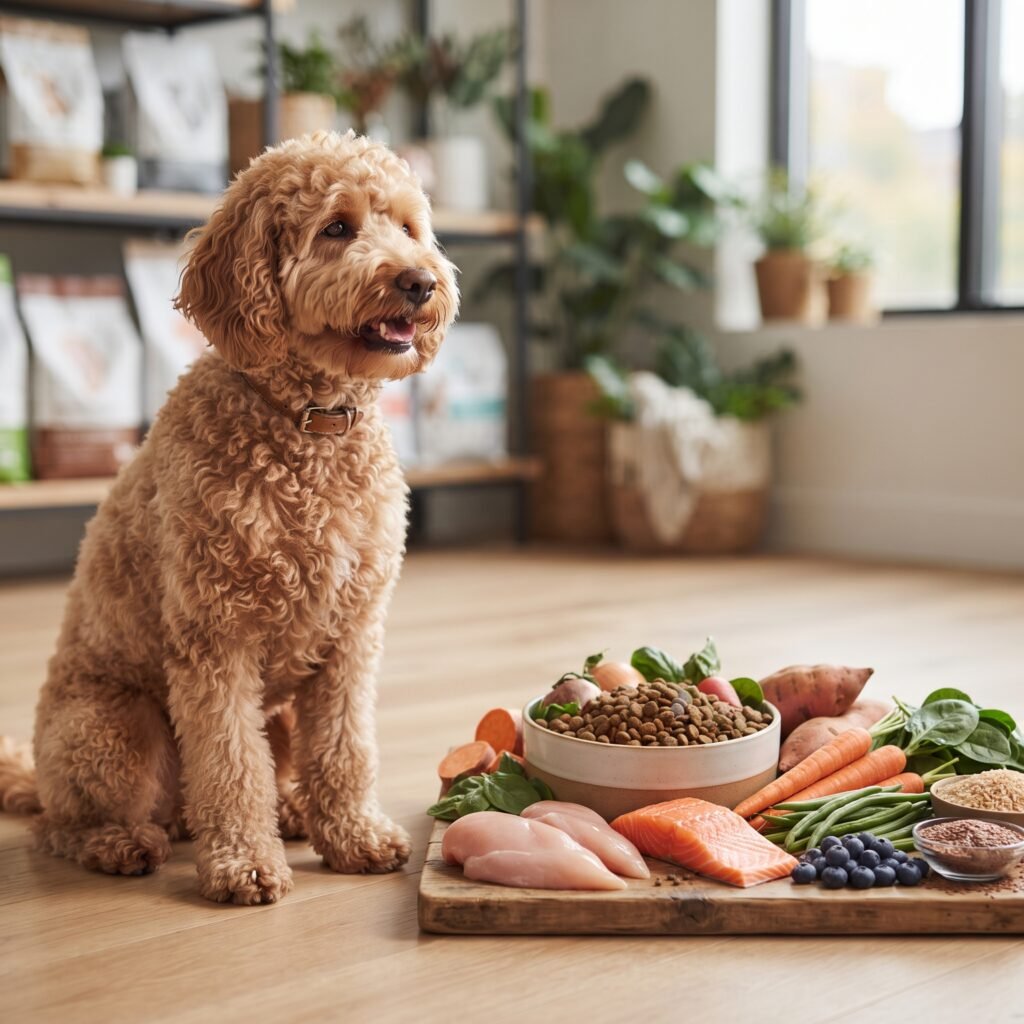
Skin and coat support ingredients are worth a closer look for this particular breed mix. Goldendoodles inherit coat traits from both the Poodle and Golden Retriever sides, and many develop a dense, curly, or wavy coat that mats easily and can trap moisture against the skin. A goldendoodle food with a guaranteed omega-3 and omega-6 ratio, typically via fish oil or flaxseed, supports coat and skin health, though it won’t replace a regular grooming routine for a coat prone to matting.
Are Goldendoodles More Prone to Food Allergies Than Other Breeds?
Goldendoodles don’t have a uniquely high rate of diagnosed food allergies compared to dogs generally, but they do inherit skin sensitivity tendencies from the Golden Retriever side, which can make food-related skin issues more noticeable when they occur. True food allergies are less common than environmental allergies in dogs overall, and the most frequently implicated proteins across all breeds are chicken, beef, and dairy, not anything specific to goldendoodles.
What I see more often in goldendoodles isn’t a diagnosed allergy but a combination of a dense coat trapping yeast and bacteria near the skin, made worse by a diet that isn’t supporting skin barrier health well. Before assuming your goldendoodle needs an expensive limited-ingredient or novel-protein goldendoodle food, rule out ear infections, environmental allergies, and grooming-related skin issues with your vet, since switching food for a problem that isn’t dietary wastes money and time.
If your vet does suspect a true food allergy after ruling out other causes, a proper elimination diet trial using a novel protein or hydrolyzed formula, run for eight to twelve weeks under veterinary guidance, is the only reliable way to confirm it. Guessing your way through a series of different goldendoodle food bags without a structured trial rarely identifies the actual trigger and can drag the problem out for months.
Here’s an honest limitation from my own experience with this. I had a 2-year-old standard goldendoodle client who I was sure had a chicken allergy based on recurring ear infections, and we spent six weeks on an expensive limited-ingredient goldendoodle food built around duck. Nothing improved. It turned out to be a straightforward yeast overgrowth tied to infrequent ear cleaning after swimming, not a food issue at all, and a simple ear-care routine solved it once his vet caught it. The food switch wasn’t wrong to try, but I should have pushed harder for an ear cytology test before assuming diet was the cause.
How Much Should I Feed My Goldendoodle at Each Size?
Feeding charts on any goldendoodle food bag are written for the average dog at each weight, and your goldendoodle’s activity level, coat density, and metabolism can shift the right amount meaningfully in either direction. Use the chart as a starting point, then adjust based on body condition rather than following the printed cup amount rigidly for months at a time.
A mini goldendoodle around 20 pounds with moderate activity typically needs somewhere around 500 to 700 calories a day as an adult, while a standard goldendoodle around 65 pounds typically needs 1,200 to 1,600 calories daily, with real variation based on how active your specific dog is. Puppies of both sizes eat considerably more relative to their current weight to support growth, which is part of why a feeding chart for an 8-week-old looks so different from the adult maintenance amount on the same bag.
Here’s the routine I recommend regardless of which size goldendoodle food category you’re in:
- Weigh your dog every two weeks during the growth phase, and monthly once they’re an adult.
- Check body condition weekly by feeling for ribs under a thin fat layer and looking for a visible waist from above.
- Adjust the portion by about 10% when the trend drifts in either direction, rather than waiting for an obvious problem.
- Recalculate after spay or neuter, since altered dogs typically need roughly 20% fewer calories than intact dogs of the same size.
Treats deserve a specific mention for this breed, since goldendoodles are frequently used in training-heavy settings like therapy and service work, where treat-based reinforcement is common. If training treats regularly exceed 10% of daily calories, trim the goldendoodle food portion at mealtime to compensate, especially for a mini variety where the calorie margin for error is smaller.
Should I Choose a Goldendoodle Food With Joint Support Built In?
Hip and elbow dysplasia risk comes from both parent breeds in a goldendoodle’s lineage, since both Golden Retrievers and Standard Poodles carry documented rates of the condition, so this isn’t a risk unique to one size variety even though standards carry more body weight on those joints. A goldendoodle food with added glucosamine and chondroitin, or a large-breed formula controlled for calorie density to prevent rapid growth, can support joint health as a preventive measure rather than waiting for a diagnosis to act.
For a standard goldendoodle specifically, keeping growth steady rather than fast is one of the more controllable factors in long-term joint health, alongside genetics you can’t change after the fact. This means resisting the urge to free-feed a fast-growing standard puppy and instead sticking to measured portions on a goldendoodle food formulated for controlled large-breed growth, even if your puppy seems like they could eat more.
For a mini or medium goldendoodle, joint support ingredients are still worth having in the formula, but the calorie-control piece matters less than it does for a standard, since a smaller dog’s joints carry proportionally less load relative to body weight. I wouldn’t pay a significant premium for a joint-support goldendoodle food marketed specifically to minis unless your vet has flagged a specific concern, like early signs of patellar luxation, which does show up across all three size varieties.
Body weight management over the dog’s entire life matters as much as any supplement in the food. Extra weight on a breed already carrying dysplasia risk from two parent lines compounds the problem more than a missing glucosamine ingredient ever would, so a well-portioned standard goldendoodle food without added joint supplements often beats an over-fed goldendoodle food that includes them.
Wet versus dry goldendoodle food is a separate decision worth a quick mention here, since joint health sometimes comes up alongside hydration questions for active dogs. Dry kibble remains the more practical and typically more calorie-controlled option for most goldendoodles, while a wet goldendoodle food or a kibble-topper can help an older dog with dental issues or a picky eater, as long as you adjust the dry portion down to account for the added calories rather than simply adding wet food on top.
Does an F1 vs. F1B Goldendoodle Change What Food They Need?
Generation labels like F1 (first-generation Golden Retriever x Poodle) and F1B (backcrossed toward Poodle) affect coat type and shedding more than they affect nutritional needs directly. An F1B goldendoodle, being genetically closer to Poodle, often has a curlier, lower-shedding coat, while an F1 goldendoodle tends toward a wavier coat with more shedding, but neither generation changes the core goldendoodle food decision on its own.
Where generation indirectly matters is coat maintenance and skin exposure. A denser, curlier F1B coat traps moisture and debris closer to the skin, which circles back to the omega-3 and omega-6 support worth looking for in a goldendoodle food, alongside a solid grooming routine rather than instead of one. I wouldn’t choose a goldendoodle food differently based on F1 versus F1B labeling alone, since size and activity level are far better predictors of nutritional need than generation.
Multigenerational goldendoodles, sometimes labeled F2 or later, can vary more unpredictably in both size and coat than F1 or F1B dogs, since the genetics are further removed from a controlled first cross. If your goldendoodle’s generation label doesn’t give you a confident adult size estimate, lean on your breeder’s weight projections or your vet’s growth tracking instead, and choose goldendoodle food based on that projected size rather than the generation label itself.
Image alt text suggestion: F1 and F1B goldendoodle puppies with different coat textures eating from separate bowls of goldendoodle food.
How I Evaluated This Information (Reviewed-By Note)
Reviewed by: SmartPupFood editorial team. This article is educational and doesn’t replace advice from your veterinarian, particularly for any goldendoodle with a diagnosed allergy or orthopedic condition.
Here’s what went into this guide:
- Size and growth-rate research: Growth timelines and adult weight ranges for mini, medium, and standard goldendoodle varieties were cross-checked against breeder and veterinary sources for both parent breeds.
- Nutrient comparison: Calcium, protein, and fat ranges were compared against AAFCO’s established nutrient profiles for growth and maintenance.
- Label verification: Representative goldendoodle food ranges reflect commonly published guaranteed analyses across budget, mid-tier, and premium large-breed categories.
- Breed health research: Statements on hip dysplasia risk and skin sensitivity reflect documented tendencies in both parent breeds rather than goldendoodle-specific studies, since the mixed breed itself has limited dedicated research.
- Hands-on notes: Observations on allergy workups and feeding adjustments come from real client cases, presented with their actual outcomes rather than idealized results.
A limitation worth stating plainly: because goldendoodles are a mixed breed without a single breed standard, less dedicated research exists on them specifically compared to purebred Golden Retrievers or Poodles. Much of this guidance extrapolates from both parent breeds and general size-based nutrition science, which is a reasonable approach but not the same as breed-specific clinical data.
I’d add one more caveat specific to a mixed breed with this much size variation: any article discussing goldendoodle food in general terms, including this one, has to speak in ranges rather than exact numbers, because a 20-pound mini and an 85-pound standard genuinely need different amounts of everything. Use the size categories here as a starting framework, then let your own dog’s actual weight, growth trend, and vet feedback fine-tune the specifics from there.

When Should I Switch My Goldendoodle From Puppy to Adult Food?
Timing the switch away from puppy goldendoodle food depends almost entirely on size variety rather than a fixed age for every dog. A mini goldendoodle is usually close to full growth by 10 to 12 months and can transition to an adult maintenance formula around then, while a standard goldendoodle is still growing until 18 to 24 months and should typically stay on a large-breed puppy or large-breed all-life-stages formula through that window.
Switching too early on a standard goldendoodle, before growth plates have closed, means losing the calcium control and controlled calorie density that a growth formula provides during the period it matters most. Switching too late on a mini goldendoodle generally carries less risk, but it can mean unnecessary extra calories for a dog that’s already reached adult size, so check in with your vet around the one-year mark either way rather than guessing.
A medium goldendoodle again falls into the judgment-call category here. If your dog is tracking toward the higher end of medium, closer to 50 pounds, I’d treat the transition timeline more like a standard’s. If your dog is tracking toward the lower end, closer to 30 pounds, a mini’s timeline is the safer assumption. Your vet’s growth chart tracking is the most reliable way to decide, more reliable than any age-based rule printed on a goldendoodle food bag.
Make the actual food switch gradually regardless of size, transitioning over seven to ten days by swapping roughly a quarter of the portion every two to three days. A sudden switch from a growth formula to an adult maintenance goldendoodle food can cause loose stool even in a dog that tolerates both formulas well individually, simply because the gut needs time to adjust to the different nutrient profile.
So, What’s the Right Goldendoodle Food for Your Dog?
Start with your dog’s actual size category, not the word “goldendoodle” on the bag. A mini needs a small or medium-breed formula with attention to calorie density, a standard needs a large-breed formula with controlled calcium and a large-size AAFCO statement, and a medium goldendoodle needs you to check where your specific dog falls between those two.
Layer in coat and skin support through omega fatty acids, keep growth steady rather than fast for bigger varieties, and don’t assume every skin or ear issue is a food allergy before ruling out simpler causes. The right goldendoodle food isn’t a single product that works for the whole breed. It’s the formula that matches your dog’s actual size, growth rate, and health history.
Whichever size goldendoodle you’re feeding, consistency and accurate portioning will do more for long-term health than any specific brand name on the bag.
If you’re still unsure which size category your goldendoodle falls into, ask your breeder for both parents’ adult weights rather than relying on puppy weight alone, since early puppy size predicts adult size poorly across a breed with this much size variation. That single data point will do more to guide your goldendoodle food decision than any amount of label reading.
Frequently Asked Questions
What is the best food for a mini goldendoodle puppy?
A small or medium-breed puppy formula is typically the right choice for a mini goldendoodle, since this size doesn’t need the large-breed calcium control that standard goldendoodles require. Watch calorie intake closely, since minis can gain weight quickly on a food formulated for a bigger dog.
Do standard goldendoodles need large-breed puppy food?
Yes, a standard goldendoodle expected to reach 50 pounds or more as an adult should eat a large-breed puppy formula with an AAFCO statement covering large-size growth. This controls calcium levels during the growth phase, which matters for a breed already carrying joint risk from both parent lines.
Is grain-free goldendoodle food better for allergies?
Not usually, since true grain allergies are uncommon in dogs and most food sensitivities in goldendoodles involve proteins rather than grains. The FDA has also investigated a possible link between certain grain-free, legume-heavy diets and heart disease, so a grain-inclusive formula is often the more conservative choice absent a diagnosed allergy.
How much should I feed my goldendoodle to keep them at a healthy weight?
Start with the feeding chart for your goldendoodle’s size and activity level, then adjust based on body condition rather than the printed amount alone. Weigh your dog regularly and reduce the portion by about 10% if you can’t easily feel ribs under a thin fat layer.
What goldendoodle food is best for joint health?
Look for a formula with added glucosamine and chondroitin, or a large-breed formula with controlled calorie density for a standard-sized puppy still growing. Keeping your goldendoodle at a healthy weight throughout life matters as much as any specific joint-support ingredient in the food.