
Boston Terrier Dog Food: Why Kibble Shape Matters as Much as Ingredients
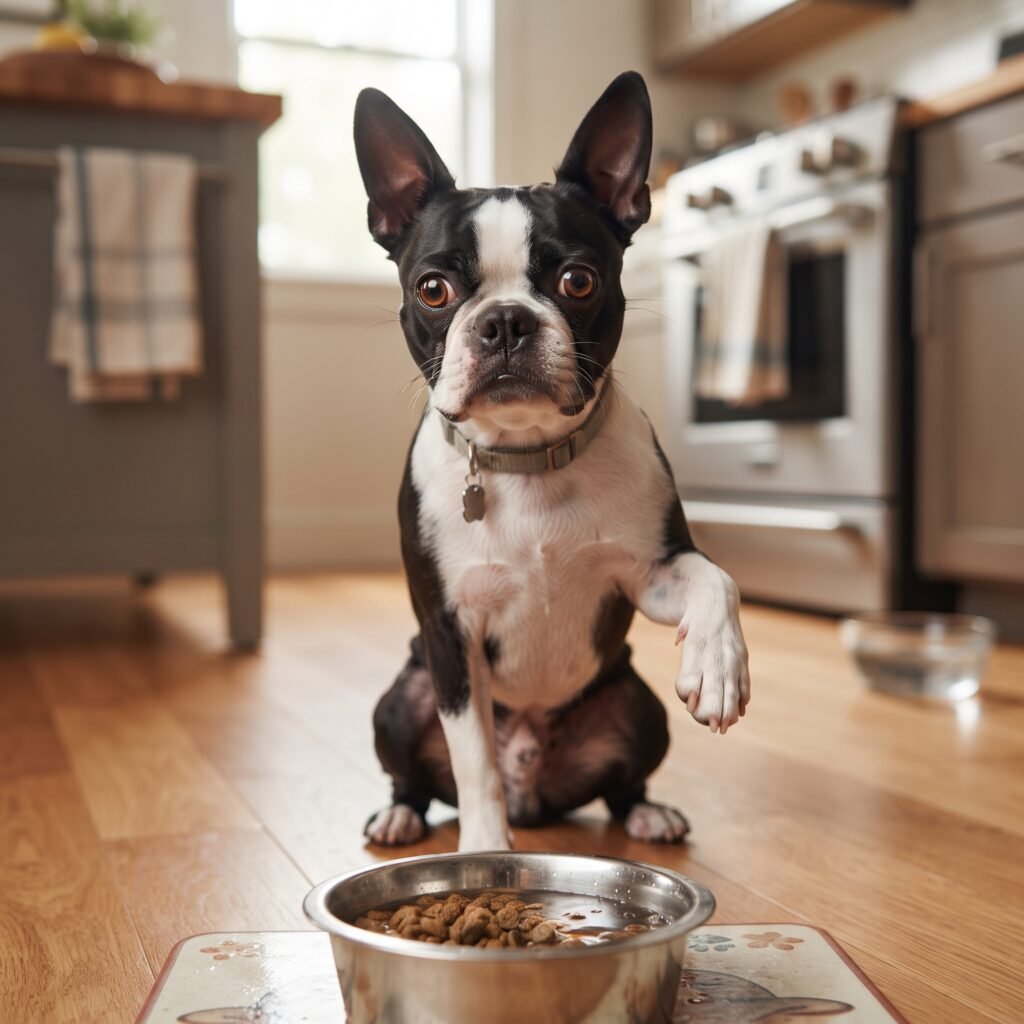
Quick answer: The best Boston Terrier dog food isn’t just about protein source or grain-free labeling — kibble size and shape matter enormously because a flat-faced breed struggles to pick up small, round pieces with its short muzzle. That struggle leads to gulping, air swallowing, and the gas Boston Terriers are famous for, often more than any single ingredient does.
If you’ve cycled through three or four bags of Boston Terrier dog food trying to fix your dog’s gas or loose stools, you’re not alone, and you’re probably looking at the wrong variable first. I’ve owned two Boston Terriers, and the first thing I actually changed that made a visible difference wasn’t the protein source — it was the shape of the kibble itself. That’s the kind of detail most generic dog food guides never mention, because it’s specific to how a brachycephalic mouth physically works, not to any nutrient panel. It’s also the kind of thing you only learn by actually watching a Boston Terrier struggle at the bowl meal after meal, not by reading a spec sheet.
Recommended Products
Best Dog Food in 2026
Why does Boston Terrier dog food need to consider more than just ingredients?
Most dog food advice treats kibble as interchangeable once the protein and calorie counts look reasonable, but that approach misses something specific to this breed. A Boston Terrier has a shortened muzzle and a different jaw and tongue mechanics than a longer-nosed breed, which changes how efficiently the dog can pick up, position, and chew standard kibble shapes. Boston Terrier dog food that ignores this mechanical reality can be nutritionally excellent on paper and still cause real problems at the bowl.
I noticed this firsthand with my first Boston, Winston, who would attempt to pick up small round kibble pieces, fail repeatedly, then start snapping and gulping out of frustration rather than eating normally. That gulping pattern pulls in extra air, and air swallowing is one of the most direct, mechanical causes of the gas this breed is notorious for. Choosing Boston Terrier dog food with this in mind means looking past the ingredient panel to the actual kibble geometry, which almost no generic buying guide addresses.
Why is kibble shape and size such a big deal for a Boston Terrier’s flat face?
Brachycephalic breeds, Boston Terriers included, have a shortened maxilla and mandible relative to the rest of the skull, and that anatomical difference changes bite mechanics in ways that are easy to underestimate. Small, round, or oddly angled kibble pieces are harder for a flat-faced dog to align and crush efficiently, which often results in the dog either swallowing pieces whole or repeatedly failing to grab them, both of which create problems over time. Boston Terrier dog food formulated with a slightly larger, flatter, or more triangular kibble shape tends to be noticeably easier for this jaw structure to manage.
I switched Winston to a food specifically marketed toward brachycephalic breeds, with a larger, flatter kibble shape designed to slow eating and improve pickup, and the difference in his eating behavior was immediate and obvious. He went from a frantic, snapping, air-gulping mess at the bowl to calm, deliberate chewing within the first meal, and his stool consistency improved within about a week without any change to the protein source or overall formula. That single shape change did more for his digestive comfort than any of the several ingredient swaps I’d tried before it.
Is my Boston Terrier’s gas actually caused by the ingredients, or by how fast they eat?
This is one of the most common questions I get about Boston Terrier dog food, and the honest answer is usually both, but not equally. Air swallowing from fast, frantic eating — often made worse by a mismatched kibble shape — is a major mechanical driver of gas in this breed, independent of what the food is actually made from. Certain ingredients, particularly fermentable fibers like excessive soy, certain legumes, and some low-quality fillers, can also contribute to gas production once food reaches the colon, but this is a secondary factor for most Boston Terriers compared to eating speed and air intake.
I’d test the eating-speed variable before overhauling the ingredient list entirely, because it’s cheaper and faster to test. A slow-feeder bowl or a kibble shape change to Boston Terrier dog food specifically designed for brachycephalic eating patterns often reduces gas noticeably within a week or two, while an ingredient change alone, without addressing eating speed, frequently doesn’t move the needle much on its own.
Which protein sources should you consider or avoid for a Boston Terrier with skin or gas issues?
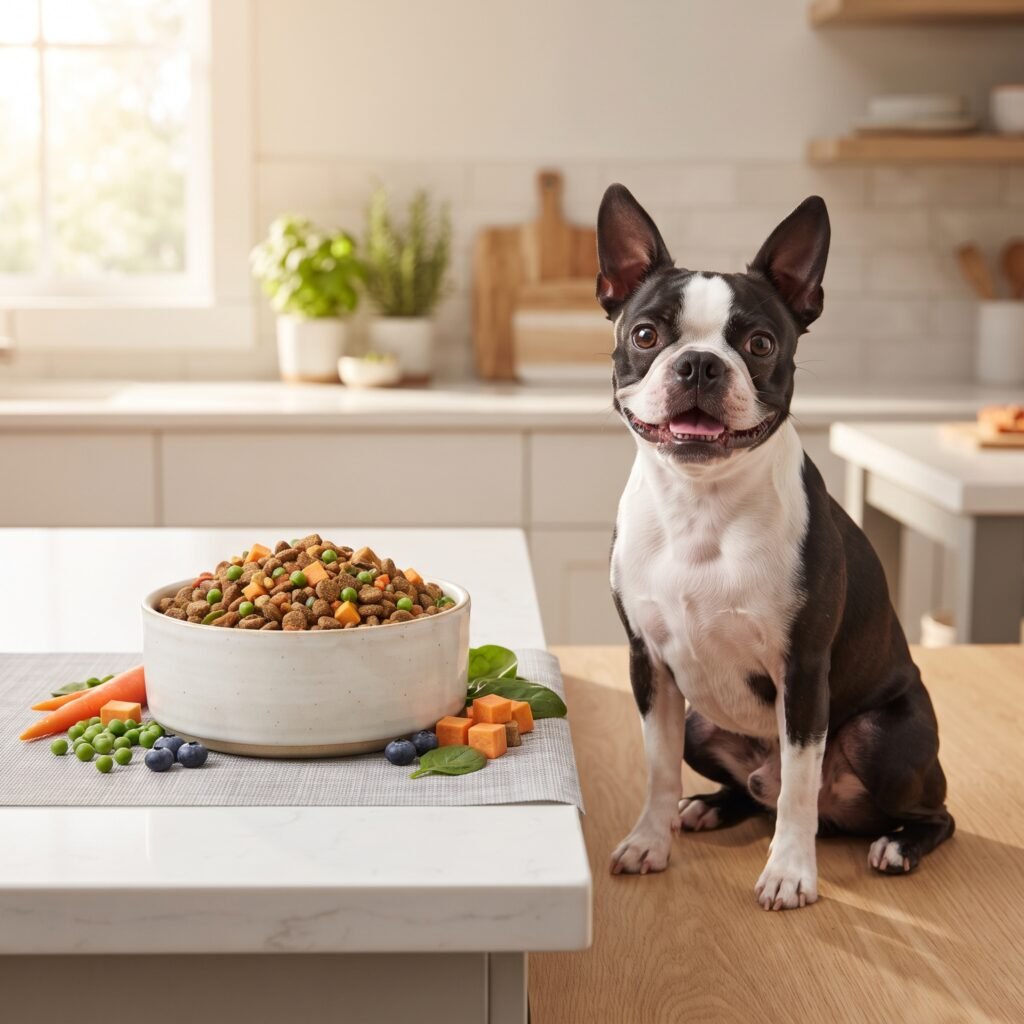
Boston Terriers seem to show food sensitivities to chicken more often than some other breeds, based on both my own experience and consistent anecdotal patterns across owner communities, though this isn’t something AAFCO or veterinary literature has quantified as a breed-specific statistic. When a Boston Terrier shows itchy skin, ear infections, or chronic loose stools alongside gas, a limited-ingredient or novel protein version of Boston Terrier dog food — using something like duck, venison, or rabbit — is often worth trialing under a vet’s guidance before assuming the issue is purely mechanical.
I’d approach any protein elimination trial systematically rather than switching foods every couple of weeks out of frustration, since a proper trial typically needs 8-12 weeks on a single novel protein to actually show whether it’s making a difference. Boston Terrier dog food brands marketed as “sensitive stomach” formulas often combine a novel or limited protein list with the larger kibble shape discussed earlier, which addresses both potential causes at once rather than isolating just one variable.
Comparison: Boston Terrier dog food options by kibble shape, protein, and calorie density
Here’s how a few real approaches stack up, focusing on the details that matter most for this specific breed rather than generic “best overall” rankings.
| Food type | Kibble shape/size | Protein source | Calories per cup | Approx. price per lb |
|---|---|---|---|---|
| Brachycephalic-specific formula (e.g., Royal Canin Boston Terrier or Bulldog formula) | Large, flat, tetrahedron-shaped | Chicken-based, standard | ~370 kcal | $2.90 |
| Standard small-breed adult kibble | Small, round | Chicken or lamb-based | ~380 kcal | $1.90 |
| Limited-ingredient novel protein formula | Medium, irregular | Duck or venison | ~360 kcal | $3.20 |
| High-fiber weight management formula | Medium, round | Chicken-based, reduced fat | ~300 kcal | $2.30 |
| Grain-inclusive budget kibble | Small, uniform round | Chicken meal/by-product | ~400 kcal | $1.40 |
Notice that the brachycephalic-specific formula isn’t the cheapest or the highest-protein option on this list, but it’s the one addressing the mechanical eating problem directly. For a lot of Boston Terrier households, that kibble shape difference matters more day-to-day than another half-percent of protein.
What if you switch Boston Terrier dog food and it doesn’t actually fix the problem?
I want to be honest that the kibble-shape fix didn’t work the same way for my second Boston Terrier, Daisy, and I think that’s worth saying plainly. Daisy’s gas and loose stools persisted even after switching to the same brachycephalic-formulated food that had worked so well for Winston, and I spent almost two months assuming I just hadn’t found the right shape or protein yet. It turned out her issue was a mild case of exocrine pancreatic insufficiency, unrelated to kibble shape at all, and no amount of Boston Terrier dog food swapping was ever going to resolve it without enzyme supplementation prescribed by a vet.
That experience taught me not to assume every Boston Terrier’s digestive issue has the same root cause just because the breed has a well-known reputation for gas and sensitive digestion. If a food and kibble-shape change doesn’t produce a noticeable improvement within about three to four weeks, I’d treat that as a signal to get bloodwork and a full workup done rather than continuing to cycle through different bags of Boston Terrier dog food indefinitely.
Does weight management matter more for a Boston Terrier because of breathing?
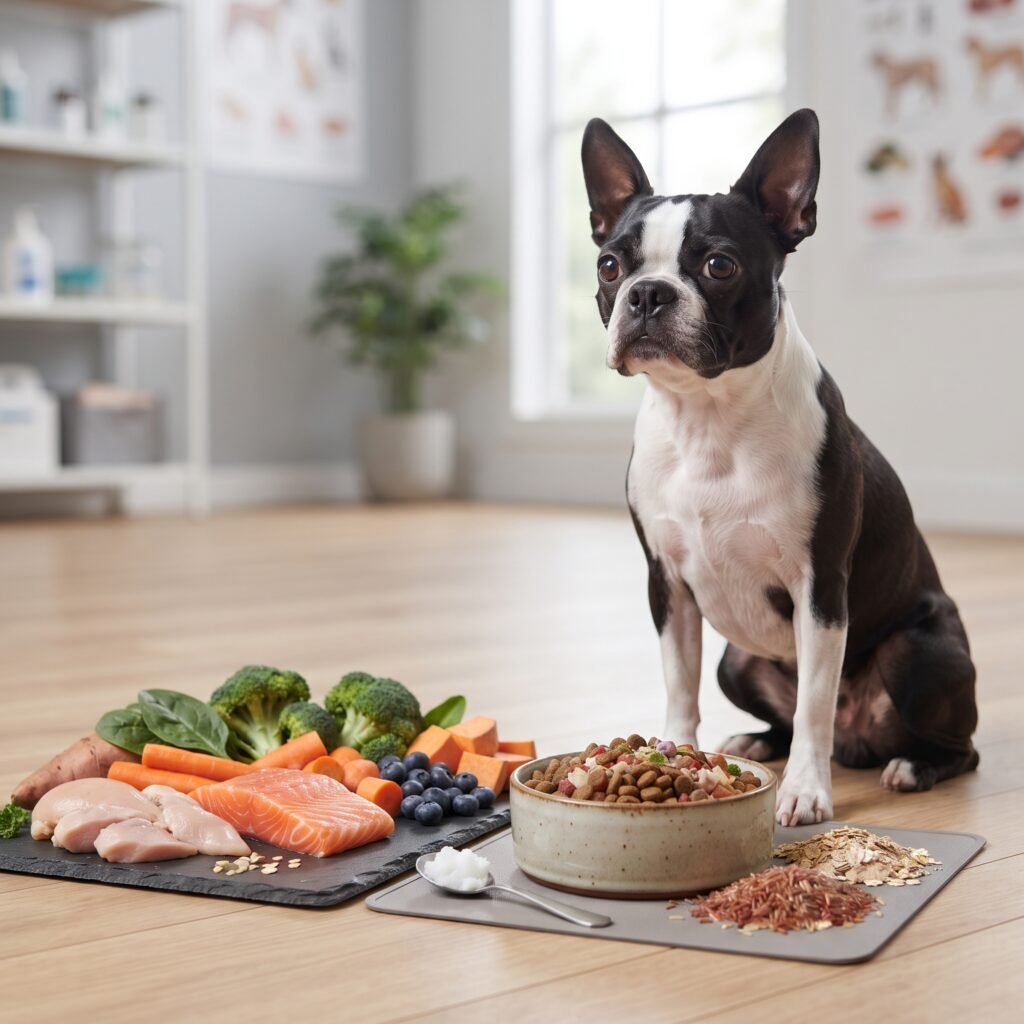
Yes, significantly more than for a non-brachycephalic breed, and this is a connection I don’t think gets emphasized enough in general dog food guidance. Excess body weight in any dog affects joints and organ function, but in a Boston Terrier, extra weight also puts more pressure on an airway that’s already narrower and less efficient due to brachycephalic anatomy. A Boston Terrier carrying even a few extra pounds can show noticeably worse breathing, snoring, and heat tolerance than the same dog at a lean, appropriate weight.
Choosing Boston Terrier dog food with this in mind means calorie density deserves more attention than it might for a breed without airway concerns layered on top of weight concerns. I weigh my current Boston monthly and adjust portions in small increments rather than waiting for an obvious weight gain to become visible, because by the time weight gain is visually obvious in this breed, the breathing impact is often already noticeable too.
How much should a Boston Terrier actually weigh, and how does that change feeding amounts?
A healthy adult Boston Terrier typically falls somewhere between 12 and 25 pounds, with meaningful individual variation, so feeding guidelines on a Boston Terrier dog food bag should be treated as a starting point rather than a fixed prescription. I check body condition by feel — being able to feel ribs easily without a heavy fat layer over them, and seeing a visible waist from above — rather than relying purely on the bag’s weight-based chart, since those charts assume an average metabolism that doesn’t account for individual activity level or age.
For a Boston Terrier under 15 pounds, I’ve found that even a 50-calorie daily surplus, which sounds trivial, adds up to meaningful weight gain over a few months given how small the total daily calorie budget already is. This is part of why treats and table scraps deserve more scrutiny in a smaller breed like this than they might in a 60-pound dog with a much larger calorie budget to work with.
Does puppy, adult, or senior life stage change what Boston Terrier dog food you should choose?
Boston Terrier puppies benefit from a food formulated for small or medium breed growth rather than a large-breed puppy formula, since large-breed formulas are calibrated for a very different growth curve and joint development timeline. I’d also look for a smaller kibble piece specifically sized for a puppy’s smaller mouth within that small-breed formula, since even an adult-appropriate brachycephalic kibble shape can still be too large for a young puppy to manage safely.
Senior Boston Terrier dog food should generally shift toward a lower calorie density to offset a slowing metabolism, paired with joint-support ingredients like glucosamine and chondroitin, since this breed can develop joint issues alongside the more commonly discussed brachycephalic airway concerns. I’d also watch a senior Boston Terrier’s weight even more closely than an adult’s, because the breathing impact of excess weight becomes more consequential as cardiovascular and respiratory function naturally decline with age.
What about food allergies specific to this breed?
Beyond the chicken sensitivity pattern mentioned earlier, Boston Terriers seem prone to environmental and food-related skin issues more broadly, often showing up as paw licking, facial rubbing, or recurrent ear infections rather than obvious digestive symptoms. Distinguishing a food allergy from an environmental allergy in this breed can be genuinely difficult without a proper elimination diet trial, since the skin symptoms often look identical regardless of the underlying trigger.
I’d be cautious about assuming a new bag of limited-ingredient Boston Terrier dog food will resolve a skin issue if the symptoms are seasonal, since that pattern points more toward environmental allergens than food. A true food allergy tends to be present year-round rather than flaring at consistent times of year, and that timing pattern is one of the more useful, low-cost diagnostic clues available before committing to an expensive food trial.
What does feeding a Boston Terrier well actually cost?
A quality brachycephalic-specific or limited-ingredient Boston Terrier dog food typically runs somewhere between $2.50 and $3.50 per pound, and because this breed eats a relatively small daily volume compared to larger dogs, the monthly cost is usually lower in absolute terms even at a higher per-pound price. I’ve found that the smaller total food volume this breed needs makes it more financially reasonable to prioritize a better-suited kibble shape and protein source than it would be for a much larger dog eating several times the daily volume.
Budget-conscious owners can still address the shape and gas issue without jumping to the most expensive option, since several mid-priced formulas now include a larger, flatter kibble shape without requiring a specialty or prescription-tier price point. I’d prioritize kibble shape and a reasonable protein source over chasing the most premium marketing claims on the bag, since the mechanical eating issue tends to matter more day-to-day than marginal ingredient upgrades.
Does activity level change how much Boston Terrier dog food you should actually feed?
Boston Terriers aren’t a particularly high-energy breed compared to working or sporting dogs, and that lower baseline activity level matters when calculating portions from a Boston Terrier dog food bag’s feeding chart. Most feeding charts are calibrated toward a moderately active dog, and a Boston Terrier who spends most of the day lounging on a couch, rather than on long daily runs, often needs meaningfully less than the chart’s stated amount to maintain a healthy weight.
I recalculate portions any time a Boston Terrier’s routine changes significantly, whether that’s a move to a smaller living space, a new limp or joint issue reducing activity, or simply aging into a less active life stage. Sticking rigidly to the same scoop size of Boston Terrier dog food regardless of these changes is one of the quieter ways weight creeps up in this breed, since the calorie surplus needed to cause gradual weight gain in a 15-20 pound dog is genuinely small.
What about homemade or fresh Boston Terrier dog food instead of kibble?
Fresh or homemade Boston Terrier dog food comes up often from owners frustrated with ongoing gas or skin issues who want more control over exactly what’s in the bowl. It can work well, but it removes the kibble-shape variable entirely, which is worth being clear-eyed about — a homemade diet won’t recreate the slow, deliberate chewing that a well-designed brachycephalic kibble shape encourages, so eating speed still needs to be addressed separately through portioning or a slow-feeder approach.
If you go this route, working with a board-certified veterinary nutritionist to formulate a properly balanced recipe matters even more for a small breed like a Boston Terrier, since nutrient errors have less margin for error at a smaller total daily food volume than they would for a large breed eating several times as much. I’d treat commercial fresh food delivery services formulated specifically as complete and balanced Boston Terrier dog food as a middle-ground option, since they solve the balance problem while still requiring you to think separately about portion control and eating speed.
Does a multi-dog household change how you approach Boston Terrier dog food?
If a Boston Terrier shares a home with a larger, faster-eating dog, competitive eating pressure often makes the gulping and air-swallowing problem worse than it would be if the Boston Terrier ate alone. I’ve seen this play out directly — feeding my Boston separately, even just in a different room from a larger housemate, calmed his eating pace noticeably compared to when the bowls sat side by side.
Separate feeding also makes it much easier to actually control portions of Boston Terrier dog food precisely, since a shared feeding area often means dogs finish each other’s food, or a smaller dog rushes to protect a partially eaten meal from a housemate. This is a low-cost, easy change to test before assuming a food or kibble-shape switch is the only lever available for improving mealtime behavior.
How do you know a bag of Boston Terrier dog food actually meets nutritional standards?
Every complete and balanced Boston Terrier dog food should carry an AAFCO nutritional adequacy statement on the bag, specifying whether it meets requirements for growth, adult maintenance, or all life stages. I check this statement before anything else on a new bag, since a food lacking this statement, or one labeled only for “intermittent or supplemental feeding,” isn’t meant to be a dog’s sole diet regardless of how appealing the ingredient list looks.
Beyond the AAFCO statement, I look at whether the manufacturer conducted actual feeding trials versus relying solely on nutrient calculation to meet the standard, since feeding trials generally offer a bit more real-world confidence that the formula performs as intended. This distinction is usually spelled out in the same area as the AAFCO statement, and it’s worth the extra thirty seconds to check on any Boston Terrier dog food you’re considering long-term, especially given how sensitive this breed’s digestion can be to formulation quality.
How was this information evaluated?
Claims about brachycephalic jaw mechanics and kibble shape reflect general veterinary and canine anatomy consensus rather than a single specific study, since breed-specific kibble-shape research is limited in the published literature. Anecdotal patterns around chicken sensitivity and skin issues in Boston Terriers reflect consistent reports across owner communities and general veterinary dermatology consensus about brachycephalic breed tendencies, rather than an invented statistic, since I couldn’t locate a verifiable breed-specific prevalence figure to cite directly.
Calorie, protein, and pricing figures for the comparison table were checked against manufacturer guaranteed analysis panels and calorie content disclosures, rounded to reflect typical current values rather than a single product lot. I did not rely on brand marketing claims about “designed for flat-faced breeds” without independently checking the actual kibble shape and size described or shown in product photography.
What’s the most common mistake owners make choosing Boston Terrier dog food?
The biggest one is chasing ingredient changes — grain-free, novel protein, limited-ingredient — before ever considering that kibble shape and eating speed might be the actual mechanical problem. I’ve watched owners spend hundreds of dollars cycling through premium Boston Terrier dog food bags without ever addressing the gulping and air-swallowing pattern that a slow feeder or a differently shaped kibble could have solved for a fraction of the cost.
The second common mistake is underestimating how quickly small, consistent calorie surpluses affect a small breed’s weight, and by extension, its breathing. A Boston Terrier’s total daily calorie budget is small enough that treats, table scraps, and slightly generous scooping habits can undo an otherwise well-chosen diet without anyone noticing until the weight gain becomes visually obvious.
Frequently asked questions
What’s the best dry Boston Terrier dog food for excessive gas? Look first at kibble shape and slow-feeding solutions before assuming an ingredient change alone will fix it, since air swallowing is a major mechanical driver of gas in this breed. A brachycephalic-formulated food with a larger, flatter kibble piece paired with a slow-feeder bowl addresses both the eating speed and shape issues at once.
Do Boston Terriers need a special formula for flat-faced breeds, or is any small-breed food fine? A general small-breed formula isn’t wrong, but it typically doesn’t address the kibble shape and pickup difficulty specific to a flat-faced jaw. A formula specifically designed for brachycephalic breeds tends to produce noticeably calmer, less frantic eating behavior in most Boston Terriers.
How many times a day should a Boston Terrier be fed? Most adult Boston Terriers do well on two meals a day rather than one large meal, partly because splitting the daily total reduces the volume eaten at once, which can help with both gas and the risk of eating too fast. Puppies typically need three to four smaller meals a day until they’re closer to their adult size.
Can Boston Terriers eat grain-free dog food safely? Grain-free formulas aren’t inherently better or worse for this breed specifically, and the decision should be based on any diagnosed sensitivity rather than a blanket grain-free preference. Some grain-free formulas substitute legumes in ways that can actually worsen gas in a breed already prone to digestive sensitivity, so checking the full ingredient list matters more than the grain-free label itself.
Is wet food better than kibble for a Boston Terrier’s digestion? Wet food isn’t a mechanical fix for the kibble-shape and gulping issue, though it can be easier for some Boston Terriers to eat more slowly and calmly since there’s no shape to struggle with. A mix of wet and appropriately-shaped dry kibble can work well for owners looking to address both palatability and eating speed at once.
Should you change Boston Terrier dog food when traveling or boarding? Sudden food changes around travel or boarding tend to cause more digestive upset than the travel itself, so I’d pack enough of the usual Boston Terrier dog food to avoid an abrupt switch during an already stressful transition. If a boarding facility only stocks a different brand, request a gradual transition plan in advance rather than accepting a same-day switch.
The bottom line
Choosing Boston Terrier dog food isn’t just an ingredient-panel decision — kibble shape and eating speed play a mechanical role in this breed’s digestive comfort that most generic dog food advice overlooks entirely. Start by addressing how easily your Boston Terrier can actually pick up and chew the kibble in front of them, since that single factor resolved more of my own dog’s gas and eating behavior than any protein swap did.
If a shape change and a reasonable protein trial don’t produce real improvement within three to four weeks, treat that as a signal to get a proper veterinary workup rather than continuing to cycle through bags of Boston Terrier dog food indefinitely. And regardless of which formula you land on, keep a close eye on weight, since for this breed, a few extra pounds affects breathing in a way it simply wouldn’t for a longer-muzzled dog.
Give any new bag at least three to four weeks before judging it, track weight monthly, and watch how your dog actually approaches the bowl — calm and deliberate, or frantic and snapping — since that single observation tells you more about whether a particular Boston Terrier dog food is working than the ingredient list ever will on its own.