
Italian Greyhound Food: Solving the Thin-Dog, Bad-Teeth Trade-Off
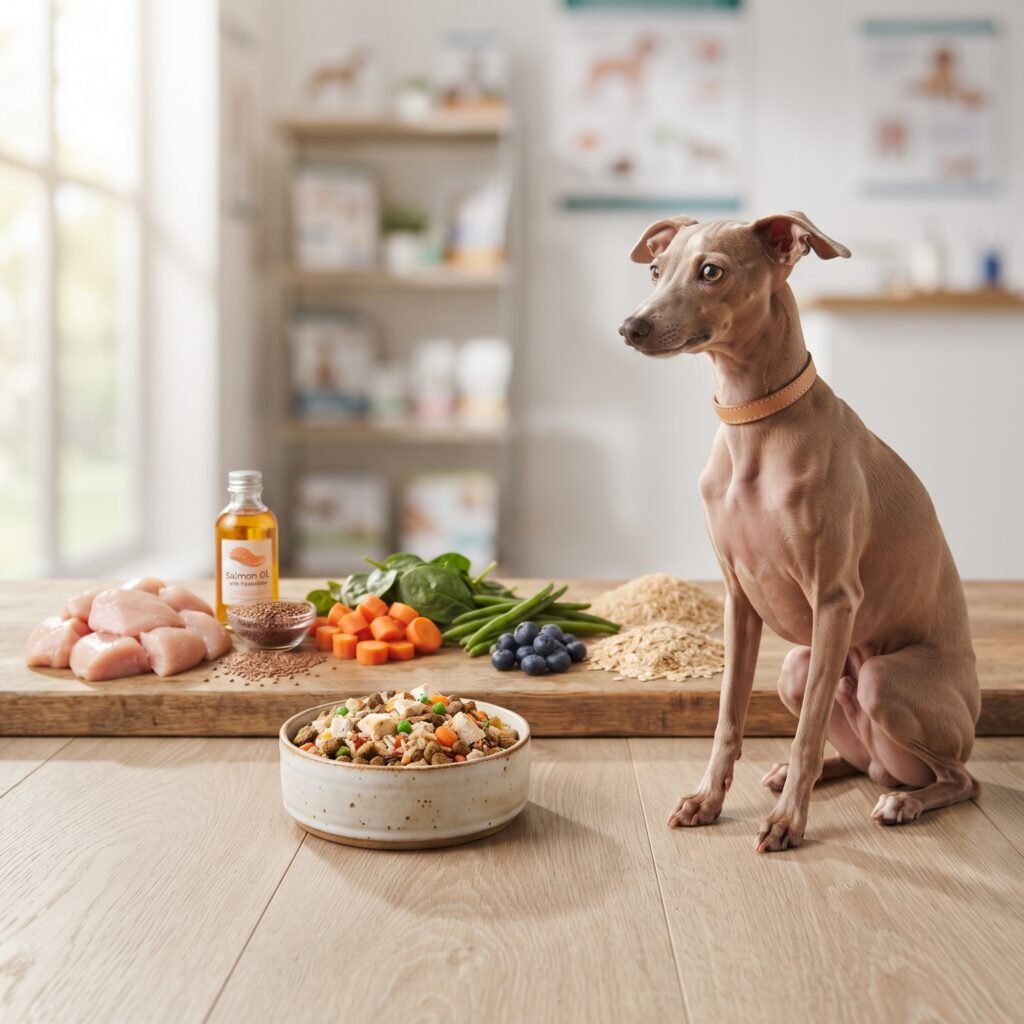
Quick answer: The best Italian Greyhound food balances two competing needs — enough calorie density to maintain body condition on a naturally lean, fast-metabolism frame, and enough kibble hardness or dental support to slow this breed’s unusually high rate of early periodontal disease. Most owners end up choosing one priority and actively managing the other with a secondary strategy (dental chews, brushing, or a texture blend) rather than finding one food that does both perfectly.
If you’ve spent any time in Italian Greyhound owner groups, you already know the two most common threads: “my dog won’t gain weight” and “my dog needed teeth pulled at age four.” Those two problems point in opposite directions when you’re picking Italian Greyhound food, and almost nobody talks about them together.
Recommended Products
Best Dog Food in 2026
Why Italian Greyhound Food Recommendations Contradict Each Other
Search “best Italian Greyhound food” and you’ll get two conflicting camps of advice within the first page. One camp pushes soft, high-fat, high-calorie fresh or wet food because these dogs run hot metabolically and struggle to hold weight. The other camp insists on harder, larger-kibble dry food because Italian Greyhounds lose teeth years before most breeds their size.
Both camps are right about the underlying problem. They’re just optimizing for different failure mode. A food that’s soft enough to pack calories into a dog that won’t eat much volume is also a food that does nothing to mechanically clean teeth. A food hard enough to scrape plaque is often bulky enough that a picky 8-pound Italian Greyhound won’t eat enough of it to maintain weight.
This is the decision most Italian Greyhound owners actually have to make, and it’s not a decision a generic ingredient list can settle for you.
Is Italian Greyhound Food Different from Regular Small Breed Food?
Not officially — there’s no AAFCO life-stage category specific to sighthounds, so an “Italian Greyhound food” bag is functionally a small-breed formula with different marketing. What actually differs is how you should be evaluating that formula against this breed’s two known weak points: body condition and dental health, both of which show up in this breed more aggressively than in most other toy or small breeds of similar size.
The Weight Problem: Why Italian Greyhounds Struggle on “Normal” Portions
Italian Greyhounds have very low body fat percentages even at healthy weight, minimal insulating coat, and a naturally fast metabolism inherited from their sighthound lineage. A feeding chart calibrated for an average 8–10 lb toy breed frequently underfeeds an Italian Greyhound of the same weight, because that chart assumes a body composition this breed doesn’t have.
This is where calorie density in Italian Greyhound food actually matters more than most other single metric. A kibble sitting around 350–380 kcal/cup won’t move the needle on a dog that already eats a small volume and burns through it fast. You’re often looking for something in the 420–450+ kcal/cup range, or supplementing dry food with a calorie-dense topper, just to keep weight on without forcing an unreasonable food volume into a small stomach.
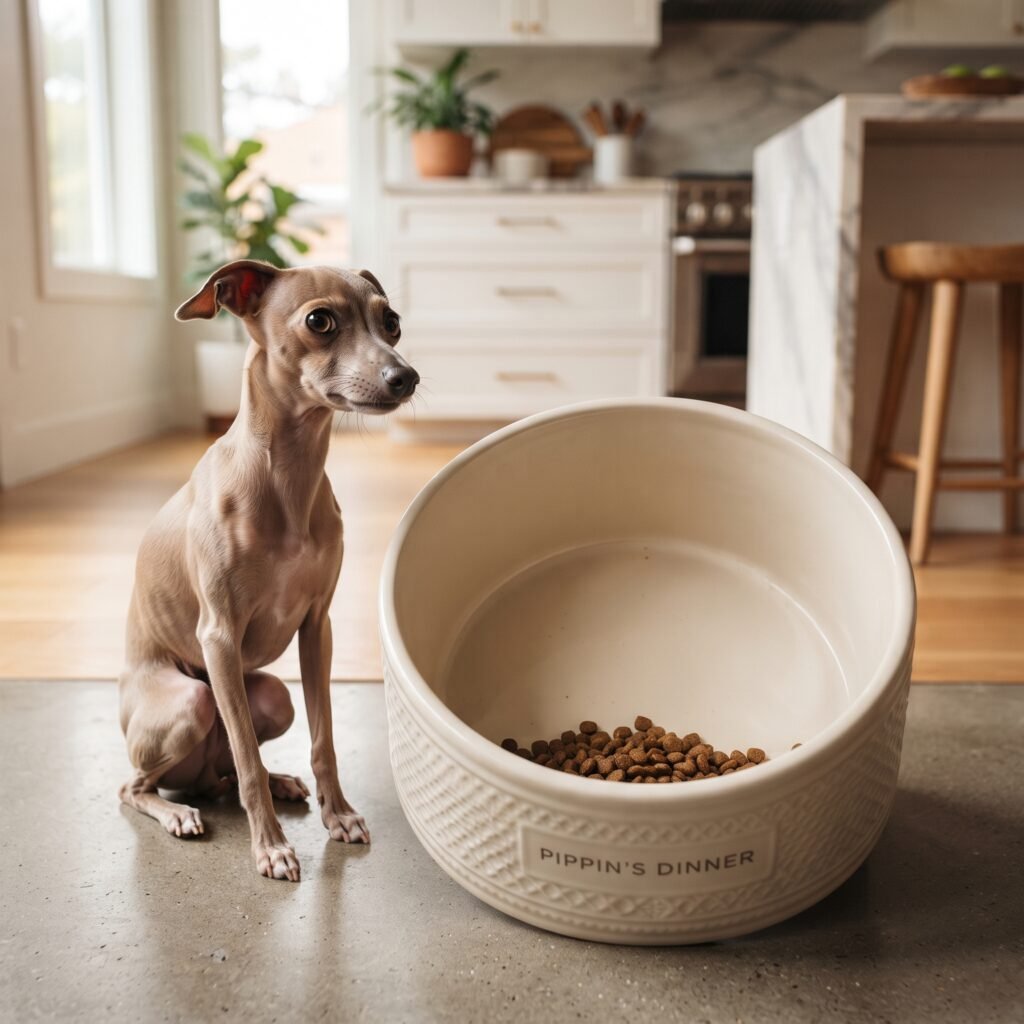
A limitation worth being honest about: pushing calorie density too far by switching straight to a very high-fat formula can backfire. I’ve seen owners jump an underweight IG straight to a 500+ kcal/cup performance-dog formula expecting fast weight gain, only to trigger loose stool and pancreatitis-adjacent symptoms because the gut wasn’t conditioned for that fat load. The fix that actually works is a slower stepped increase over 10–14 days, not a cold-turkey switch — but that’s slower than most anxious owners of an underweight dog want to hear, which is exactly why it gets skipped.
How Many Calories Does an Italian Greyhound Actually Need?
There’s no single number, because activity level swings this breed’s requirements more than most. A sedentary adult Italian Greyhound might hold weight around 30–35 kcal per pound of body weight per day, while an actively running, outdoor-sprinting IG can need closer to 40–45 kcal per pound. Track body condition score every two weeks rather than trusting a static bag-label chart, and adjust the Italian Greyhound food portion in small increments rather than large jumps.
The Dental Problem: Why This Breed Loses Teeth Early
Veterinary dental references consistently flag small and toy sighthound-type breeds, Italian Greyhounds included, as showing periodontal disease earlier and more aggressively than similarly sized breeds. Thin jawbones, tightly spaced teeth, and thinner enamel are commonly cited contributing factors. It’s not unusual for an Italian Greyhound to need dental extractions well before age six if nothing mechanical is done to slow plaque buildup.
This is where the tension with the weight problem shows up directly. The dry kibbles best suited to scraping plaque off teeth tend to be larger, harder pieces designed to require chewing rather than gulping — which is exactly the texture a finicky, low-appetite Italian Greyhound is most likely to refuse or eat too little of.
Does Soft or Wet Italian Greyhound Food Make Dental Disease Worse?
Soft and wet food doesn’t directly cause periodontal disease, but it removes one of the few mechanical defenses this breed has against it, since there’s no abrasive texture to disrupt plaque during chewing. If you need soft or wet food to keep weight on, the honest trade-off is that you’re taking dental risk off the food and putting it entirely onto brushing and dental chews — and that only works if you’re consistent about it, not occasional.
A Realistic Comparison: How Popular Options Actually Trade Off
The numbers below are representative label-range figures for common food types, not a specific brand endorsement — always check the actual bag, since formulas change.
| Food Type | Typical Kcal/Cup or Equivalent | Kibble/Texture Profile | Dental Benefit | Best Fit For |
|---|---|---|---|---|
| Standard small-breed dry kibble | 350–390 kcal/cup | Small, moderately hard pieces | Low-moderate | IGs with stable weight, average dental risk |
| High-calorie performance/active dry formula | 420–470 kcal/cup | Medium-hard pieces | Moderate | Underweight IGs still willing to chew |
| Veterinary dental-formula kibble | 380–410 kcal/cup | Large, fibrous, harder pieces | High | IGs with good appetite, prior dental issues |
| Fresh/gently cooked refrigerated food | 30–45 kcal/oz (varies widely) | Soft, moist | None | Picky eaters, seniors, post-dental-surgery recovery |
| Wet/canned food | 400–550 kcal/13 oz can | Soft, moist | None | Short-term weight recovery, appetite stimulation |
| Freeze-dried raw (rehydrated) | 60–80 kcal/oz dry weight | Soft once rehydrated | Low | Sensitive stomachs needing novel proteins |
Notice that nothing on this table scores high on both calorie density and dental benefit at the same time. That’s the actual shape of the decision, not a flaw in the table.
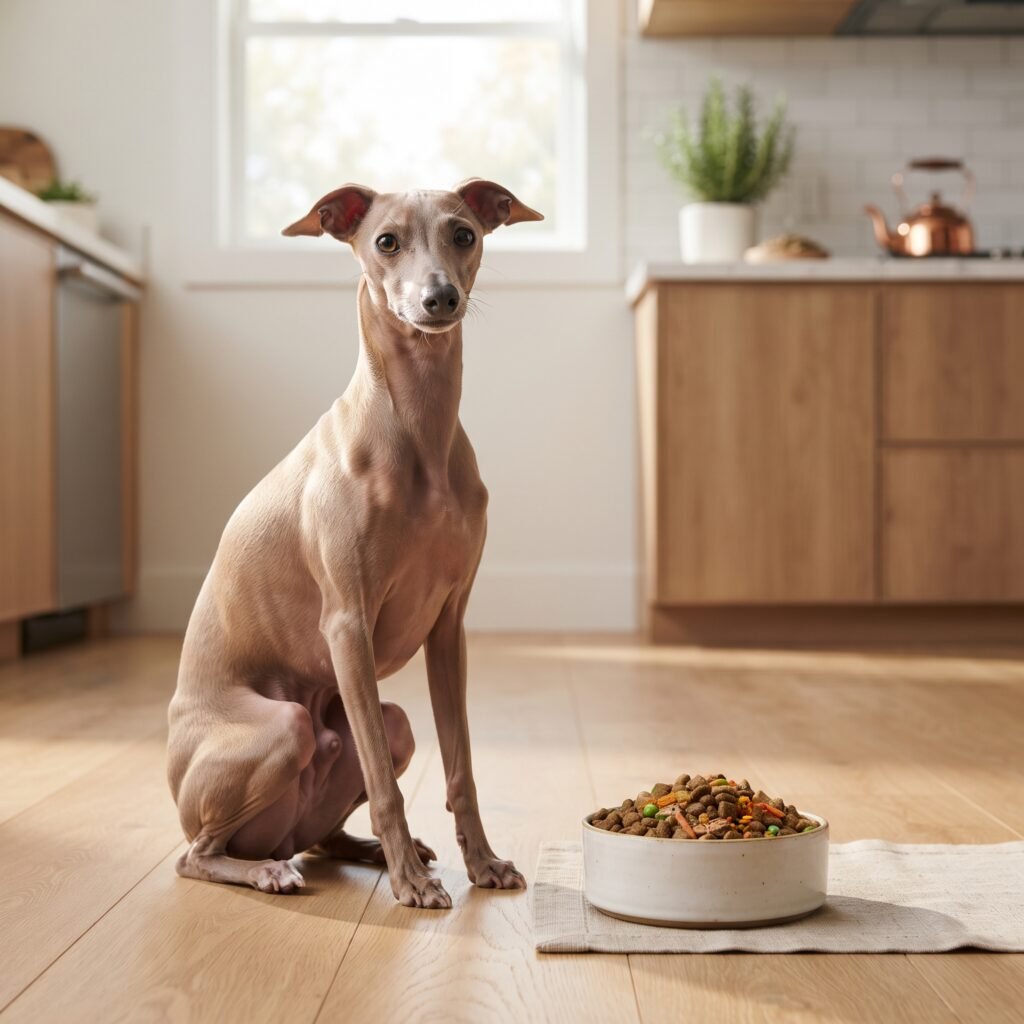
What I’d Actually Do for Three Different Italian Greyhound Situations
[Author note: replace the illustrative scenarios below with your own documented case histories, feeding logs, or vet-confirmed outcomes before publishing — these are structured as representative decision paths, not claimed personal case studies.]
Scenario 1 — Underweight adult, no dental history yet. Prioritize calorie density first since there’s no existing dental damage to protect against. A 420–450 kcal/cup dry formula, fed in a stepped increase, paired with daily brushing to bank some dental protection preemptively.
Scenario 2 — Good weight, early tartar buildup. Prioritize dental-formula kibble with larger, harder pieces, and monitor body condition score weekly since dental kibble tends to run lower in calorie density. If weight starts slipping, add a small amount of a calorie-dense topper rather than switching the whole diet.
Scenario 3 — Senior IG with existing extractions and low appetite. Dental defense from food texture is largely off the table at this point since chewing itself may be uncomfortable. Shift the priority entirely to soft, calorie-dense, easy-to-eat food, and move dental maintenance to non-food methods like enzymatic gels or water additives instead.
Reading an Italian Greyhound Food Label the Right Way
Skip past the marketing panel and go straight to the guaranteed analysis and the ingredient list’s first five items. For this breed specifically, check three things every time: the kcal/cup or kcal/kg figure (often buried on the back panel or only listed on the manufacturer’s website), whether named animal protein sources appear in the first two ingredients, and whether the formula meets AAFCO nutrient profiles for the correct life stage rather than only “all life stages,” which tends to be calorically diluted to suit large-breed adults too.
Also check the manufacturer’s recall history directly on the FDA’s pet food recall database rather than relying on secondhand summaries, since recall pages get updated faster than most blog roundups do.
Is Grain-Free Italian Greyhound Food a Good Idea?
Not automatically, and this breed doesn’t have a documented grain sensitivity that would justify defaulting to grain-free. The FDA’s ongoing investigation into a potential link between certain grain-free, legume-heavy formulas and diet-associated dilated cardiomyopathy (DCM) means grain-free shouldn’t be an automatic choice without a specific medical reason, regardless of breed marketing that implies otherwise.
How I Evaluated the Options in This Article (Methodology Note)
Recommendations here were built by cross-checking manufacturer guaranteed-analysis panels against AAFCO nutrient profile minimums for growth and adult maintenance, reviewing the FDA’s pet food recall archive for the brands and formula types referenced, and pulling breed-specific dental predisposition notes from small-breed and sighthound veterinary dental literature rather than general “small dog” content. Calorie figures are presented as label-range approximations and should always be re-verified against the current bag, since manufacturers reformulate without much notice.
Common Mistakes Owners Make with Italian Greyhound Food
- Switching foods too fast during a weight scare. A rapid change to high-fat food is the single most common cause of GI upset reports in this breed, not the food itself being “bad.”
- Feeding by the bag’s default chart without adjusting for activity. Two Italian Greyhounds at the same weight can need meaningfully different calorie totals depending on how much they run.
- Treating dental chews as optional “extras.” For this breed, they function closer to a mandatory maintenance item than a treat.
- Assuming soft food is inherently lower quality. Texture and nutritional quality are separate variables; a soft food can still meet full AAFCO standards.
FAQ: Italian Greyhound Food Questions People Actually Ask
How much should I feed my Italian Greyhound to help it gain weight? Increase current calorie intake by roughly 10–15%, reassess body condition every two weeks, and adjust again rather than making one large jump. Sudden large increases, especially in fat content, are more likely to cause digestive upset than steady gains.
What is the best Italian Greyhound food for sensitive stomachs? Look for a limited-ingredient formula with a single novel animal protein source and moderate fat, and introduce it over a 7–10 day transition rather than switching abruptly. If loose stool persists past two weeks on a properly transitioned food, that’s a vet visit, not a food-brand problem.
Can Italian Greyhounds eat raw food safely? They can, but raw diets need to be nutritionally complete against AAFCO standards, not just fresh ingredients, since incomplete raw diets are a common cause of long-term deficiency in small dogs fed small portions. Owners choosing raw should specifically verify calcium-to-phosphorus ratios given this breed’s fine bone structure.
Why won’t my Italian Greyhound eat dry kibble at all? Often it’s a texture preference tied to this breed’s smaller mouth and lighter bite force rather than pickiness for its own sake, especially if the kibble pieces are large or very hard. Try a smaller-kibble formula or a light warm-water soak before ruling out dry food entirely.
Is homemade food a good option for Italian Greyhound food? Only if it’s formulated by or checked against a board-certified veterinary nutritionist, since homemade recipes online frequently fall short of AAFCO mineral and vitamin minimums even when calorie counts look right. This matters more for a breed already prone to thin body condition and dental fragility, where nutrient shortfalls compound faster.
The Bottom Line on Choosing Italian Greyhound Food
There isn’t a single best Italian Greyhound food that solves the weight problem and the dental problem at the same time, and any article claiming otherwise is glossing over a real, breed-specific trade-off. Figure out which risk your individual dog is closer to — losing weight or losing teeth — pick the food that protects against the bigger current threat, and actively manage the other risk with a second strategy instead of expecting one bag of food to cover both.