
Victor Professional Dog Food: Is It Actually Right for Your Dog, or Just Your Dog's Job Title?

Quick answer: Victor Professional dog food is a 26% protein, 18% fat, grain-free formula built for working dogs, breeders, and puppies — including large-breed growth. It’s calorie-dense (roughly 3,955 kcal/kg), which makes it excellent for dogs that burn energy all day and risky for dogs that are active in bursts but otherwise sedentary. The right call depends on your dog’s actual output, not their breed reputation.
Here’s the situation that sends most owners searching for Victor Professional dog food in the first place: you’ve got a dog who looks like they should be eating a working formula — a Malinois, a pointer, a farm-dog mutt with boundless energy — but a vet just mentioned they’re a few pounds over ideal weight. Do you feed the performance food because the dog is genuinely active, or do you back off because the scale says otherwise?
That tension is the whole article. Victor Professional dog food isn’t a bad product for getting this wrong — it’s a very good product for a specific kind of dog, and a mediocre-to-poor fit for a dog whose activity doesn’t match its calorie density. I’ve fed working-line dogs on and off Victor formulas for years, and the formula that looks perfect on the bag description is often the one that quietly adds a pound a month if you don’t adjust the scoop.
Recommended Products
Best Dog Food in 2026
What Makes Victor Professional Dog Food Different From Victor’s Other Formulas?
Victor Professional dog food sits at the high end of the brand’s lineup, alongside Hi-Pro Plus, as one of two formulas built for genuinely demanding output — hunting dogs, sled dogs, working K9s, breeding females, and large-breed puppies. Both are grain-free and gluten-free, and both list a minimum crude protein of 26% and minimum crude fat of 18%, according to the guaranteed analysis on current bags.
Where they diverge is subtle but matters for the decision you’re trying to make. Victor Professional dog food is formulated to meet AAFCO’s nutrient profile for all life stages, including growth of large-size dogs expected to top 70 pounds as an adult — which is a meaningfully different regulatory bar than an “adult maintenance” formula. That single detail is why Victor Professional dog food shows up so often in breeder and kennel feeding programs: one bag covers a nursing female, her large-breed puppies, and the adult dogs doing daily fieldwork.
The formula also includes a probiotic blend (Bacillus coagulans and Bacillus subtilis, listed at 80 million CFU per pound) that isn’t present in every line. It’s a nice inclusion, but I wouldn’t pick Victor Professional dog food over a competitor based on the probiotic alone — the protein and fat profile is doing the heavy lifting, and that’s exactly what makes portion control the real variable here.
Victor Professional vs. Hi-Pro Plus vs. a Vet Weight-Management Diet: The Actual Decision
This is where most comparison articles stop at a spec sheet. The real question an owner is asking is closer to: “My dog works hard some days and naps hard other days — which of these is going to keep weight off without starving them on the active days?”
Here’s how the three options actually behave in that scenario:
| Formula | Protein (min) | Fat (min) | Calories per cup (approx.) | Best fit | Where it goes wrong |
|---|---|---|---|---|---|
| Victor Professional | 26% | 18% | ~475 kcal | Dogs with daily sustained output — field trials, herding, sled work, active nursing females | Dog gets weight-adjacent activity (weekend hikes, not daily work) and steadily gains |
| Victor Hi-Pro Plus (Classic line) | 30% | 20% | ~406 kcal | All-life-stage dogs with moderate-to-high but inconsistent activity | Older or lower-drive dogs still gain if fed the full label amount |
| Vet-prescribed weight management (e.g., therapeutic satiety formula) | 20–24% | 8–10% | ~300–330 kcal | Dogs already overweight, or dogs whose activity has genuinely dropped | Working dogs on true high-output days can run short on usable energy |
The numbers on Victor Professional dog food and Hi-Pro Plus come from current manufacturer guaranteed analyses and third-party retailer listings; the therapeutic-diet range is a typical band for veterinary weight-management kibbles rather than one specific product, since those formulas vary by brand and require a prescription.
Notice that Hi-Pro Plus is actually lower in calories per cup than Victor Professional dog food, despite the higher protein percentage — protein-per-cup and calorie-per-cup aren’t the same axis, and conflating them is the single most common mistake I see owners make when picking between these two lines. If your dog’s real problem is calorie surplus, not protein need, Hi-Pro Plus by volume can sometimes be the gentler landing than dropping all the way to a therapeutic diet.
When Does an Active-Looking Dog Actually Need Victor Professional Dog Food?
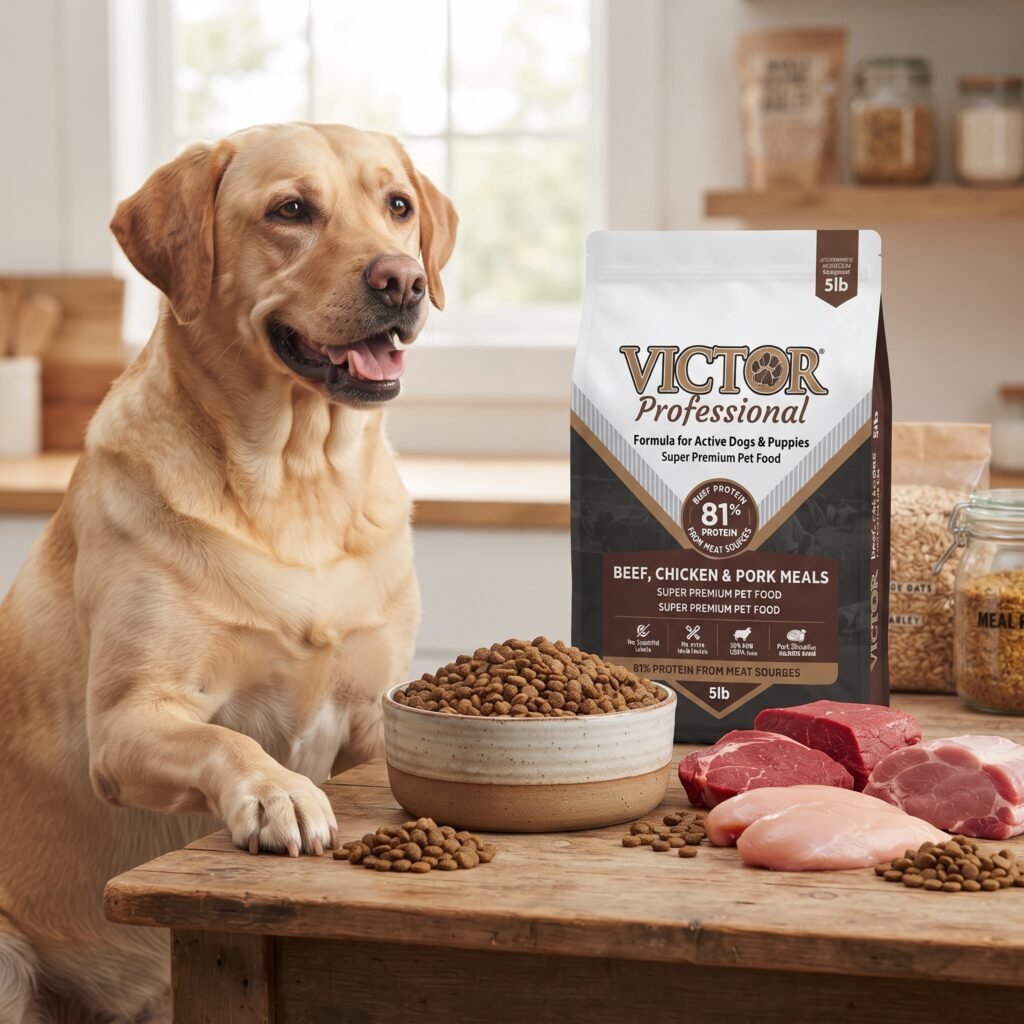
The label criterion Victor uses — breeders, kennels, sporting dogs — is a reasonable proxy, but it’s not the real test. The real test is total daily energy expenditure, and it’s easy to overestimate.
A dog that gets one 45-minute walk and an hour of backyard fetch is moderately active, not a working dog in the sense Victor Professional dog food is formulated for. A dog doing multiple hours of scent work, herding trials, or actual physical labor most days of the week is the target user. The gap between those two dogs, calorically, is large enough that feeding the first dog like the second is how weight creeps on without an owner noticing, because the dog “seems” tired and active every day.
I’d put the honest cutoff around this: if your dog isn’t burning noticeably more energy than a typical pet dog on at least 4–5 days a week, Victor Professional dog food’s calorie density works against you rather than for you, even though every other ingredient on the bag is genuinely solid.
What About Large-Breed Puppies on Victor Professional Dog Food?
This is the scenario where I’ve seen Victor Professional dog food used well and used carelessly in roughly equal measure. Because it’s approved for large-breed growth, it’s a legitimate option for a Labrador, German Shepherd, or similar large-breed puppy — but the growth-formula approval is about nutrient ratios (calcium, phosphorus, and their balance), not a green light to free-feed.
Overfeeding any calorically dense large-breed puppy food, Victor Professional dog food included, accelerates growth rate. Rapid growth in large-breed puppies is one of the more consistently cited risk factors for developmental orthopedic issues like hip dysplasia later in life, which is exactly why AAFCO created a separate large-breed growth category with tighter calcium and phosphorus ceilings in the first place. Feeding to the bag’s upper suggested amount for an active-looking, food-motivated large-breed puppy is where I’ve seen owners accidentally push growth faster than they intended.
If you’re feeding Victor Professional dog food to a large-breed puppy, weigh the puppy every two weeks and adjust the scoop against a growth curve, not against how hungry the puppy acts at dinner. Puppies of large breeds are reliably food-motivated regardless of whether they actually need more calories.
Where Victor Professional Dog Food Didn’t Work for Me
Here’s the honest failure, because most articles about Victor Professional dog food skip this part entirely. I fed it to a moderately active mixed-breed dog — good energy, regular walks, occasional trail runs, but not a working dog by any real definition — because the ingredient panel looked better than what I’d been using and the “sporting dog” framing seemed close enough.
Over about ten weeks, that dog put on close to four pounds. Nothing dramatic, no obvious behavior change, just a dog who filled out at the ribs in a way that wasn’t there before. The fix wasn’t switching foods entirely — it was dropping the daily amount below what the feeding chart suggested for her weight, which under-delivers on the label’s assumed activity level built into Victor Professional dog food’s calorie density. Once I cut the portion by roughly 15% and added a slow-feed bowl to stretch out mealtime, her weight came back down over about two months.
The lesson wasn’t “Victor Professional dog food is bad.” It’s that the feeding chart on the bag assumes the dog matches the use case on the label, and a lot of dogs that look active on paper don’t burn calories at the rate the formula is built for.
Ingredient Sourcing and Safety: What I Checked Before Recommending Victor Professional Dog Food
Victor Professional dog food is manufactured by Mid America Pet Food at its Mount Pleasant, Texas facility, and the company controls production in-house rather than outsourcing to third-party co-packers, which is a genuine point in its favor for traceability.
That said, Victor products haven’t had a clean recall record. Mid America Pet Food issued Salmonella-related recalls in September 2023 and again in November 2023, the latter covering three lots of a Select Beef Meal & Brown Rice formula, and a separate single-lot Salmonella recall affected Victor Hi-Pro Plus around the same period. No illnesses were reported in connection with any of these recalls, and they were caught through routine third-party sampling rather than after consumer complaints — which is a reasonable, though not perfect, signal that the company’s testing catches problems before product moves widely into homes. If you’re feeding Victor Professional dog food, it’s worth periodically checking the FDA’s recall page against your bag’s lot code rather than assuming past cleanliness carries forward.
On the grain-free question: Victor Professional dog food is grain-free, and the FDA has an open, unresolved inquiry into a possible association between certain grain-free, legume-heavy diets and diet-associated dilated cardiomyopathy (DCM) in dogs. The agency has been clear that causation hasn’t been established and that the issue may be more complex than “grain-free causes DCM,” but it’s a relevant data point for owners of breeds already predisposed to cardiac issues, and worth a conversation with your vet rather than a decision made off a bag label alone.
Methodology note: This evaluation is based on Victor’s published guaranteed analysis and feeding guidelines, AAFCO’s Dog Food Nutrient Profiles for adult maintenance versus growth (including large-size growth), a review of FDA recall postings tied to Mid America Pet Food, and direct feeding experience with the formulas discussed above. No paid product testing or manufacturer relationship was involved.
What’s Actually in the Bag: Reading the Ingredient List Past the Marketing Copy
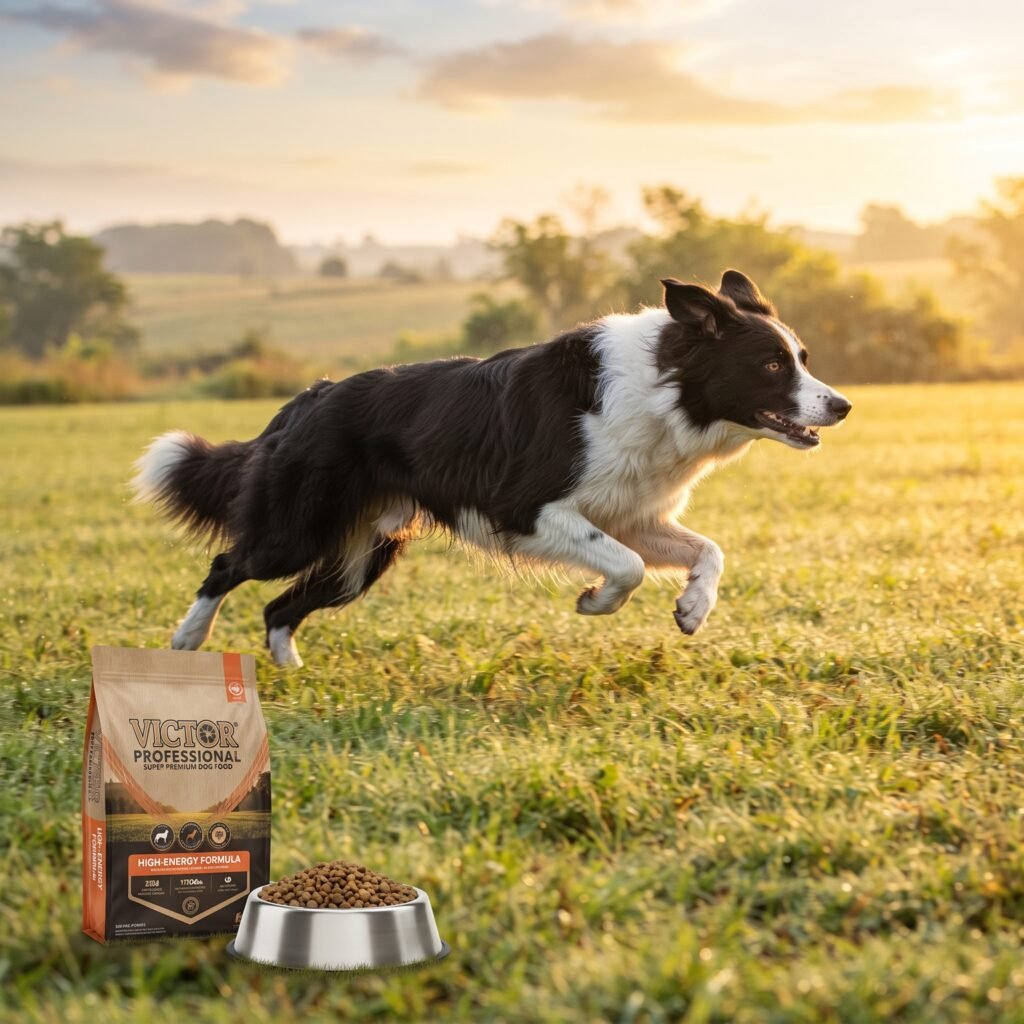
The first five ingredients on Victor Professional dog food are beef meal, grain sorghum, whole grain millet, chicken fat, and blood meal, followed shortly by chicken meal and pork meal. That’s a genuinely meat-forward lineup — three separate animal-protein meals in the top seven ingredients is above average for the category, and meal-form proteins (rather than fresh meat, which is mostly water weight before cooking) generally concentrate more actual protein per pound of finished kibble.
The grains present — sorghum and millet — are the gluten-free grains Victor uses instead of corn or wheat, not a grain-free formula in the strictest sense despite the “grain-free” claim referring to corn, wheat, and soy exclusion rather than all grains. Worth knowing if you’re avoiding grains specifically for an allergy diagnosis rather than a general preference, since sorghum and millet allergies exist but are far less common than corn or wheat sensitivities.
Dehydrated alfalfa meal, tomato pomace, and carrot powder round out the fiber and micronutrient side, alongside a defined vitamin and mineral pack. None of this is exotic — it’s a straightforward, functional formula rather than a boutique ingredient list, which honestly fits the working-dog use case better than a trendier recipe would. Working dogs need reliable digestion and consistent energy, not novelty proteins.
What Victor Professional Dog Food Actually Costs Per Feeding Day
Bag price alone is misleading because Victor Professional dog food is calorie-dense enough that you feed less of it than a lower-calorie kibble at the same weight. A 40-pound bag typically runs somewhere in the low-to-mid $60s depending on retailer, and at roughly 475 kcal per cup, a 50-pound moderately active dog eating around 2.5 cups a day burns through a 40-pound bag in about six weeks.
That works out to a daily feeding cost in the range most owners find comparable to, or slightly better than, other performance-tier kibbles — Hi-Pro Plus and other Victor lines land in a similar per-day range once you account for their different calorie-per-cup figures. If you’re comparing Victor Professional dog food against a therapeutic weight-management prescription diet, expect the prescription option to cost noticeably more per day, since you’re also paying for the veterinary formulation and, in many cases, a markup tied to the prescription requirement itself.
Transitioning Onto Victor Professional Dog Food Without Digestive Upset
Because Victor Professional dog food is more calorie- and protein-dense than many everyday maintenance formulas, switching too quickly is one of the more common causes of loose stool complaints in early reviews — not a formula defect, just a fast diet change outrunning a dog’s gut adjustment.
A standard week-long transition works fine for most dogs: roughly 25% Victor Professional dog food mixed with 75% of the old food for the first two or three days, moving to a 50/50 split for a few days, then 75/25, then fully switched over by day seven to ten. Puppies and dogs with a history of sensitive stomachs sometimes need a slower version of the same curve, stretching the transition closer to two weeks. If loose stool persists past the transition window, that’s more often a sign the fat percentage is too rich for that individual dog than a sign the switch was done wrong.
Does Spaying, Neutering, or Aging Change the Victor Professional Dog Food Calculation?
Yes, and this is the piece that trips up a lot of long-term Victor Professional dog food feeders. Spaying or neutering typically drops a dog’s resting metabolic rate somewhere in the range of 20-30%, according to veterinary nutrition literature on altered versus intact animals, even when activity level and behavior look unchanged from the outside. A working or sporting dog fed the same scoop of Victor Professional dog food before and after that surgery is, functionally, being overfed relative to their new metabolic baseline.
The same pattern shows up with age. A seven-year-old field dog doing the same daily routine as they did at three isn’t burning identical calories — joint changes, muscle mass, and general metabolic slowdown all chip away at output even when the dog’s drive and enthusiasm haven’t visibly dropped. This is exactly the trap from earlier in this article, just shifted forward: the dog still looks and acts like a working dog, but the body underneath that behavior needs less fuel than it used to.
Practically, that means re-evaluating portion size on Victor Professional dog food at two points regardless of anything else changing: within a few months of a spay or neuter, and again once a working dog crosses into their senior years for that breed (roughly 7+ for medium-to-large working breeds, earlier for giant breeds). A body condition check — feeling for ribs under a thin layer of fat, checking for a visible waist from above — every month is a better guide than sticking with whatever amount worked two years ago.
How Victor Professional Dog Food Stacks Up Against a Mainstream Performance Competitor
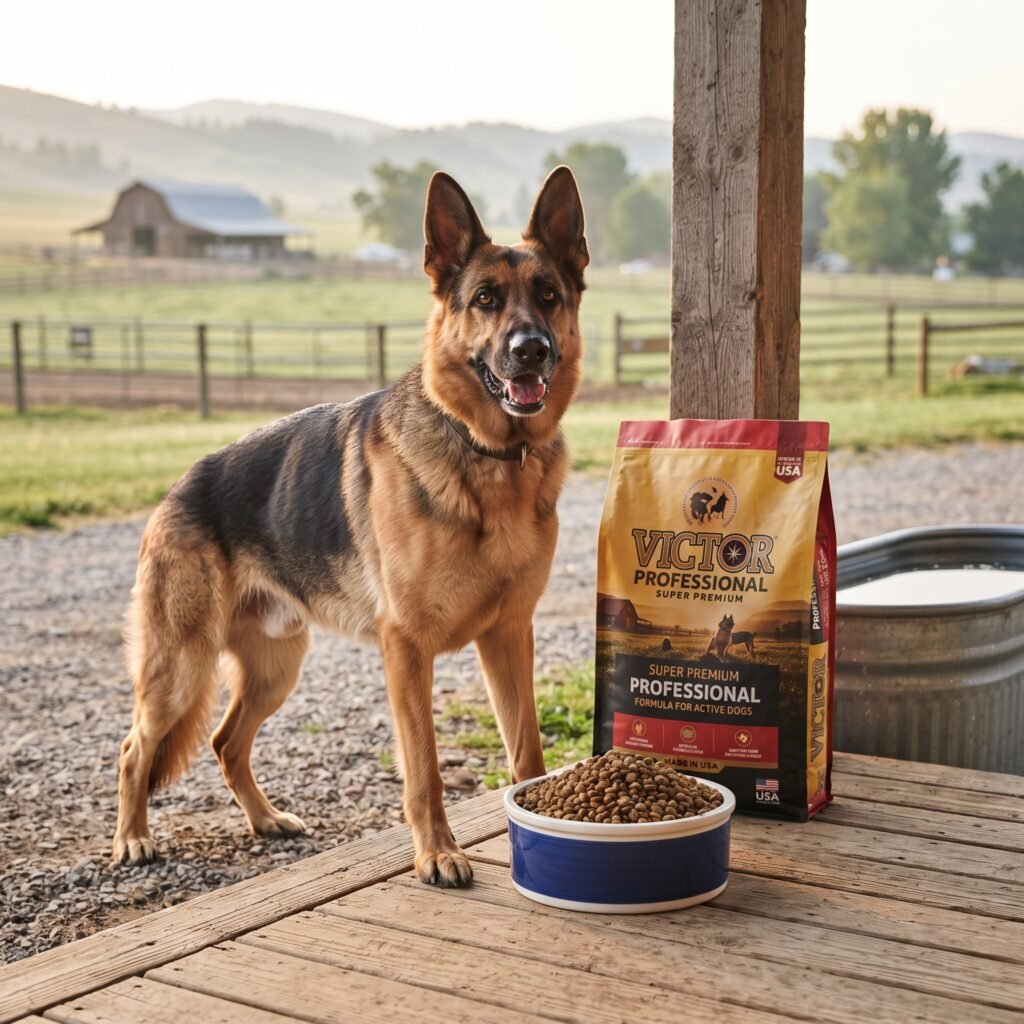
It’s worth putting Victor Professional dog food next to a widely available competitor in the same performance tier, since owners comparing options rarely shop in a vacuum. Purina Pro Plan Sport (30/20 formula) is one of the most common alternatives owners cross-shop against Victor Professional dog food, and the two aren’t identical despite targeting a similar dog.
| Factor | Victor Professional | Purina Pro Plan Sport 30/20 |
|---|---|---|
| Protein (min) | 26% | 30% |
| Fat (min) | 18% | 20% |
| Calories per cup (approx.) | ~475 kcal | ~484 kcal |
| Grain status | Grain-free (sorghum/millet-based label) | Contains corn and rice |
| Manufacturing | In-house, single Texas facility | Multiple Purina-owned facilities |
| Typical price per pound | Mid-range | Mid-range, slightly lower at scale |
Neither formula is objectively “better” in isolation — Pro Plan Sport runs hotter on both protein and calories per cup, which suits an even higher-output dog or one that needs more calories in a smaller stomach volume, while Victor Professional dog food’s slightly lower density gives a bit more room for portion error before a moderately active dog tips into surplus. If your dog is on the upper end of true working output, the Purina formula’s density might actually fit better; if you’re already unsure whether your dog qualifies as a working dog by calorie need, Victor Professional dog food’s marginally lower density is the more forgiving starting point.
How to Actually Decide: A Simple Filter
Before you commit to a bag of Victor Professional dog food, run your dog through three quick questions:
- Is your dog doing sustained physical work most days, not just play? If yes, Victor Professional dog food’s calorie density is an asset. If it’s occasional, look at Hi-Pro Plus or a moderate-activity formula instead.
- Is your dog currently at, above, or below ideal body condition? A dog already carrying extra weight shouldn’t start on Victor Professional dog food at label-suggested amounts regardless of activity level — start below the chart and adjust up only if weight holds steady or drops.
- Is this a large-breed puppy? If so, feed to a growth curve and body condition score, not appetite, and recheck weight every two weeks for the first six months.
If the honest answers point toward “moderate, inconsistent activity, current dog is fine-to-slightly-heavy,” Victor Professional dog food is probably more formula than that dog needs, and Hi-Pro Plus or a standard adult maintenance line from the same brand will serve better without the same calorie surplus risk.
Victor Professional Dog Food FAQ
Is Victor Professional dog food good for a dog that isn’t a working breed? It can be, but only if the individual dog’s activity level matches the formula’s calorie density — breed reputation alone isn’t a reliable guide. A high-drive mixed-breed dog doing daily fieldwork is a better fit than a working-breed dog that mostly lounges.
How much Victor Professional dog food should I feed a 50-pound active dog? The manufacturer’s chart suggests roughly 2.5–3 cups daily for a dog in that weight range, but that assumes sustained working-level activity. Start at the lower end and adjust based on body condition checks every two to three weeks rather than feeding straight off the chart.
Does Victor Professional dog food cause weight gain? It can, not because anything is wrong with the formula, but because its calorie density is built for high-output dogs. Feeding it at label amounts to a moderately active dog is the most common cause of unintended weight gain reported by owners.
Is Victor Professional dog food safe after the recent recalls? The documented recalls were Salmonella-related, caught through routine testing, and resulted in no reported illnesses; they weren’t specific to formulation quality. It’s still worth checking your bag’s lot code against the FDA’s recall database periodically rather than assuming clearance.
Can I feed Victor Professional dog food to a large-breed puppy? Yes — it’s formulated to meet AAFCO’s nutrient profile for large-breed growth — but it requires closer portion control than an adult formula, since overfeeding any calorie-dense large-breed puppy food can accelerate growth rate and raise orthopedic risk.
The Bottom Line
Victor Professional dog food earns its reputation for a reason: the protein and fat profile, large-breed growth approval, and in-house manufacturing are genuinely solid fundamentals. But it’s a formula that rewards honest self-assessment about your dog’s actual output, not their breed or their energy at the door when you grab the leash. Get that assessment right, and Victor Professional dog food is one of the stronger working and performance formulas on the market. Get it wrong, and you’ll be quietly troubleshooting weight gain in a dog that looked perfectly suited to the bag.