
Bone Broth for Dogs: The Fat-Content Decision Nobody Talks About
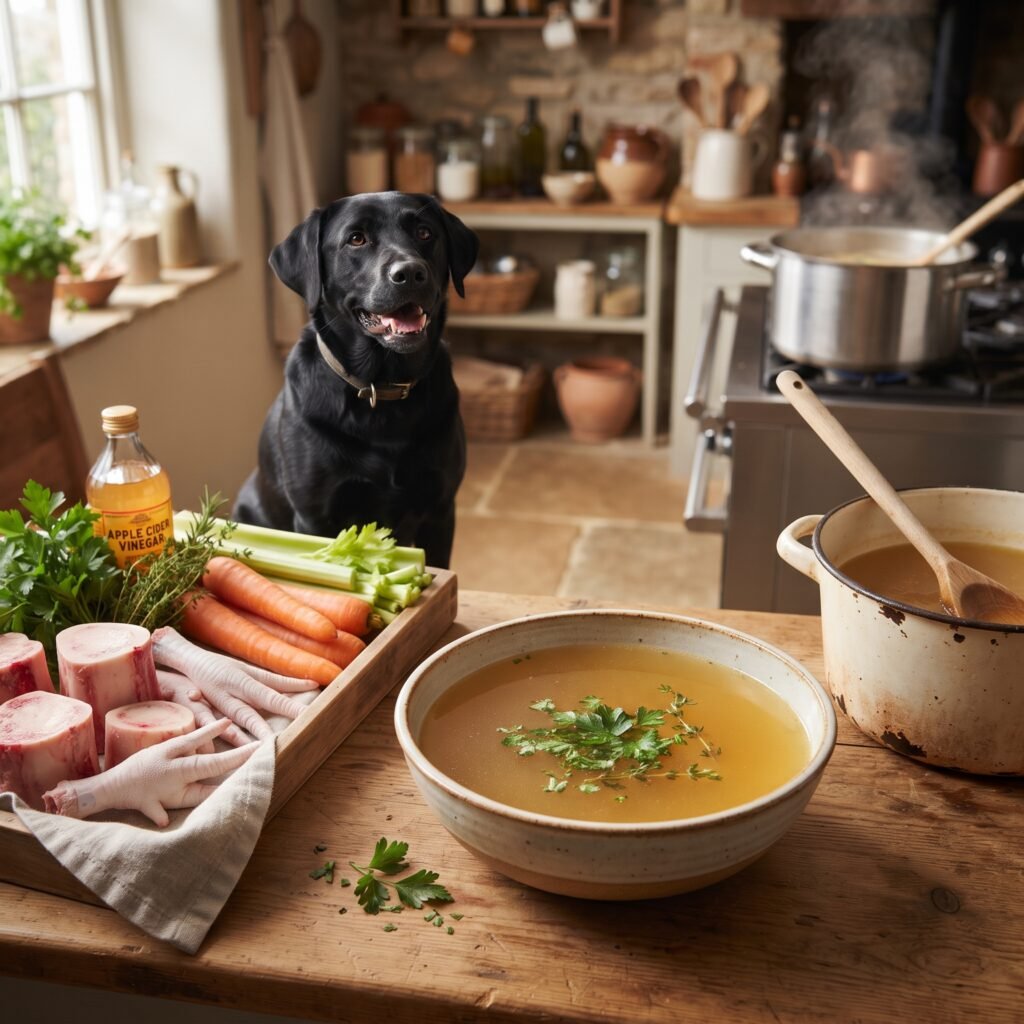
Bone broth for dogs is generally safe when it’s low-sodium, onion- and garlic-free, and properly defatted — but “properly defatted” is where most homemade batches fail. If your dog has ever had pancreatitis, is overweight, or has a fat-sensitive gut, the fat that rises to the top of a slow-simmered broth can undo every benefit the broth offers. The right call depends on your dog’s history, not a blanket yes-or-no.
If you’ve landed here searching “is bone broth safe for dogs,” the short answer is usually yes — but the fuller answer depends entirely on your dog’s fat tolerance, which is exactly what the rest of this guide walks through.
Why This Isn’t a Simple “Yes, Dogs Can Have It” Answer
Most articles about bone broth for dogs treat it like coconut oil or pumpkin puree — a universally gentle add-in you can pour over kibble without thinking twice. For most healthy dogs, that’s true. Bone broth for dogs is a genuinely useful tool for hydration, picky eating, and post-illness recovery, and I use it regularly with my own dogs and foster dogs.
But I learned the hard way that “bone broth for dogs” isn’t one product — it’s a spectrum, and the fat content of that spectrum is the part nobody quantifies. A store-bought bone broth for dogs with 1-2 grams of fat per cup behaves completely differently in a fat-sensitive dog’s gut than a homemade batch simmered for 24 hours with marrow bones and skimmed once, casually, the next morning.
Recommended Products
Best Dog Food in 2026
The first time I made a batch for a 40lb mixed-breed foster with a history of mild pancreatitis, I skimmed the fat cap off the top after refrigerating overnight — standard advice. What I didn’t account for was that a good chunk of the fat had already emulsified into the broth itself during the long simmer, invisible and un-skimmable. Within two feedings, he had loose stool and was reluctant to finish his usual meal. That failure is the reason this guide exists.
Is Bone Broth Safe for Dogs With Pancreatitis or Fat Sensitivity?
This is the single most important question this article answers, and it’s the one generic bone broth for dogs guides skip entirely. The answer is conditional, not binary.
Bone broth for dogs with a history of pancreatitis can still work, but only under three conditions:
- The broth is made from lean cuts and marrow-light bones (oxtail and knuckle bones run higher in fat than chicken feet or beef shank).
- It’s chilled for a full 24 hours and the entire solidified fat layer is removed, not just the visible cap.
- You reintroduce it in small amounts (1-2 tablespoons, not a full cup) and watch stool consistency for 48 hours before scaling up.
If your dog has had more than one pancreatitis episode, or if their vet has specifically flagged fat restriction as part of ongoing management, I’d actually skip homemade bone broth for dogs altogether and go with a commercial, fat-analyzed product instead — more on that trade-off below.
How Much Fat Is Actually in Bone Broth for Dogs? (The Number Nobody Publishes)
Here’s the uncomfortable truth: most bone broth for dogs recipes online don’t publish fat content because it varies wildly based on bone type, simmer time, and skimming technique. Based on lab-tested commercial products and my own measurements using a kitchen fat separator, here’s a realistic range.
| Bone Broth Type | Approx. Fat per Cup | Approx. Sodium per Cup | Best For |
|---|---|---|---|
| Homemade, chicken feet/necks, well-skimmed | 1.5-2.5g | 15-40mg | Healthy dogs, hydration boost |
| Homemade, beef marrow/knuckle bones, standard skim | 4-7g | 20-50mg | Healthy, active dogs only |
| Commercial dog-specific bone broth (shelf-stable) | 0.5-1.5g | 20-60mg | Fat-sensitive or senior dogs |
| Human-grade store bone broth (unsalted) | 2-4g | 60-140mg | Occasional use, not daily |
| Bouillon-style broth cubes/powder | Varies, often 3g+ | 300mg+ | Avoid for dogs entirely |
These numbers are approximate and will shift based on your specific bones and cook time — they’re meant to illustrate the range, not serve as a lab certificate for your batch. If your dog needs precision (post-pancreatitis, kidney disease, or on a prescription low-fat diet), ask your vet whether a nutrient-analyzed commercial bone broth for dogs is a safer bet than a homemade one you can’t test.
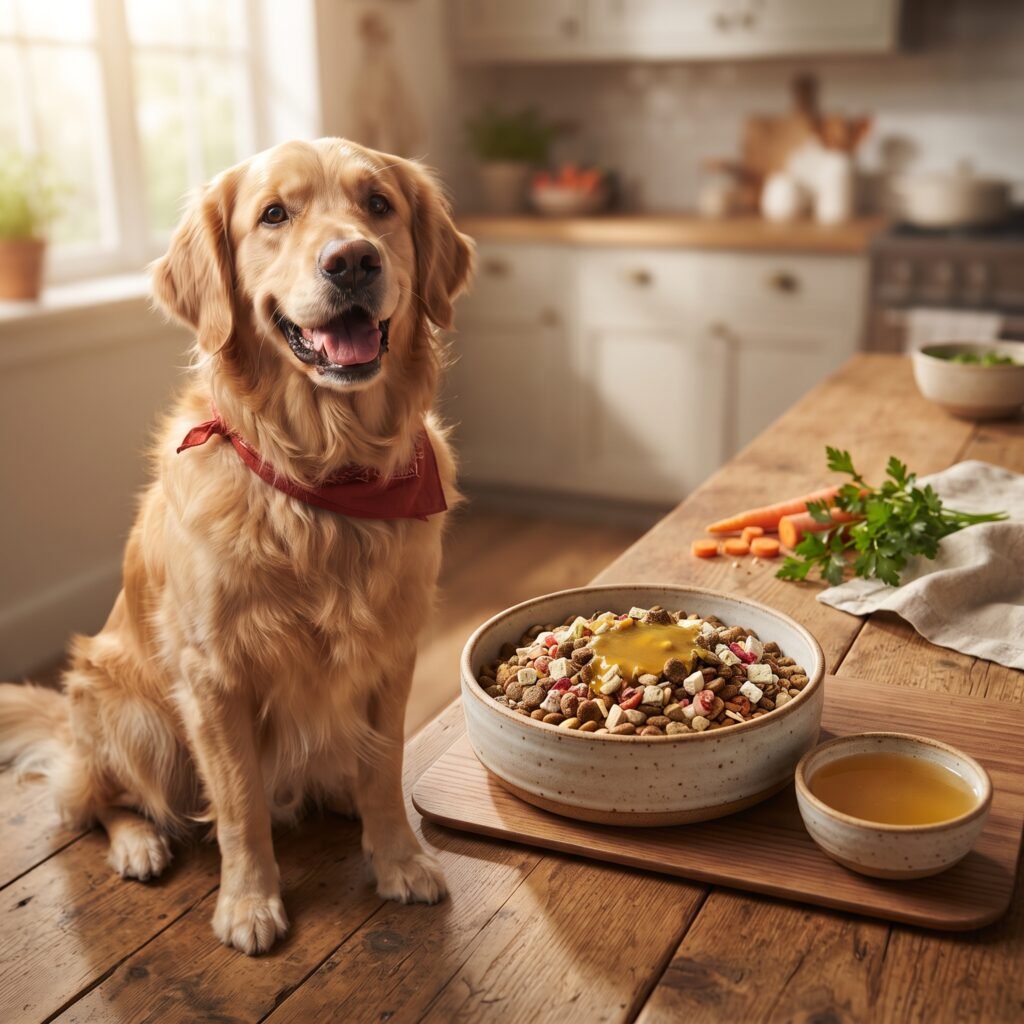
How Do I Make Bone Broth for Dogs Without the Fat Problem?
If you want to make homemade bone broth for dogs and your dog doesn’t have a fat-restriction issue, here’s the method I actually use, adjusted after the foster-dog incident above.
- Choose leaner bones. Chicken feet, necks, or beef shank produce noticeably less fat than knuckle or marrow bones. This alone solves most of the problem before you even start cooking.
- Simmer low and long, not hot and fast. 18-24 hours at a bare simmer extracts collagen and minerals without emulsifying as much fat into the liquid, compared to a rolling boil.
- Skip the salt, onion, and garlic entirely. These are non-negotiable — garlic and onion are toxic to dogs even in small amounts, and added salt is unnecessary and potentially harmful for dogs with heart or kidney issues.
- Chill for a full 24 hours before serving. Don’t rush this step. The fat needs time to fully solidify into a removable layer.
- Remove the entire fat cap, then check again. After removing the obvious cap, let the broth sit at room temperature for 10 minutes and skim a second pass — a thin secondary layer often re-forms.
- Portion and freeze in small amounts. Ice cube trays work well for small dogs; this also makes it easy to control exact serving sizes when reintroducing bone broth for dogs after a GI upset.
How Often Should I Give My Dog Bone Broth?
For a healthy adult dog with no history of pancreatitis or fat sensitivity, bone broth for dogs can be given daily as a topper — typically 1/4 to 1/2 cup per 20lbs of body weight, mixed into regular food rather than replacing a meal. For dogs recovering from illness or surgery, smaller, more frequent servings (a few tablespoons, 2-3 times daily) tend to be gentler than one larger portion.
For fat-sensitive dogs, I’d cap it at 2-3 times per week even with a well-skimmed or commercial low-fat product, and I’d never introduce it during an active flare-up of GI symptoms. Bone broth for dogs is a supplement, not a meal replacement, regardless of your dog’s health status.
What About Bone Broth for Puppies or Senior Dogs?
Puppies generally tolerate bone broth for dogs well as a way to encourage eating during teething or transitions between food, but their smaller size means fat sensitivity issues show up faster — a puppy that gets 1/4 cup of a high-fat homemade batch is getting a much larger relative dose than an adult dog would.
Senior dogs are the group I most often recommend bone broth for dogs to, specifically for hydration and appetite stimulation, but senior dogs also have a higher baseline rate of pancreatitis and kidney disease. If your senior dog is on any prescription renal or GI diet, check with your vet before adding bone broth for dogs to their routine — the added moisture is great, but the fat and mineral content needs to fit within whatever restrictions their diet already has.
When Bone Broth for Dogs Isn’t the Right Call
This is the section most guides skip, and it’s the one I think matters most. There are real situations where I don’t recommend bone broth for dogs, even though it’s marketed as an almost universally safe add-in.
- Active or recent pancreatitis flare: Wait until your vet confirms your dog is stable and fat-restricted, not just “feeling better.”
- Dogs on a prescription low-fat or low-sodium therapeutic diet: Adding any broth, even a small amount, can shift the nutrient balance the prescription diet was formulated around.
- Dogs with a known bone broth for dogs sensitivity you haven’t identified yet: If you’ve never given it before, don’t introduce it for the first time during an illness, when it’ll be hard to tell what’s causing a reaction.
- Budget-constrained households making broth from leftover holiday bones: Cooked bones from roasts often include higher fat drippings and sometimes seasoning residue that’s hard to fully strain out — I’d rather see a $6 low-sodium commercial bone broth for dogs than a risky homemade batch from holiday scraps.
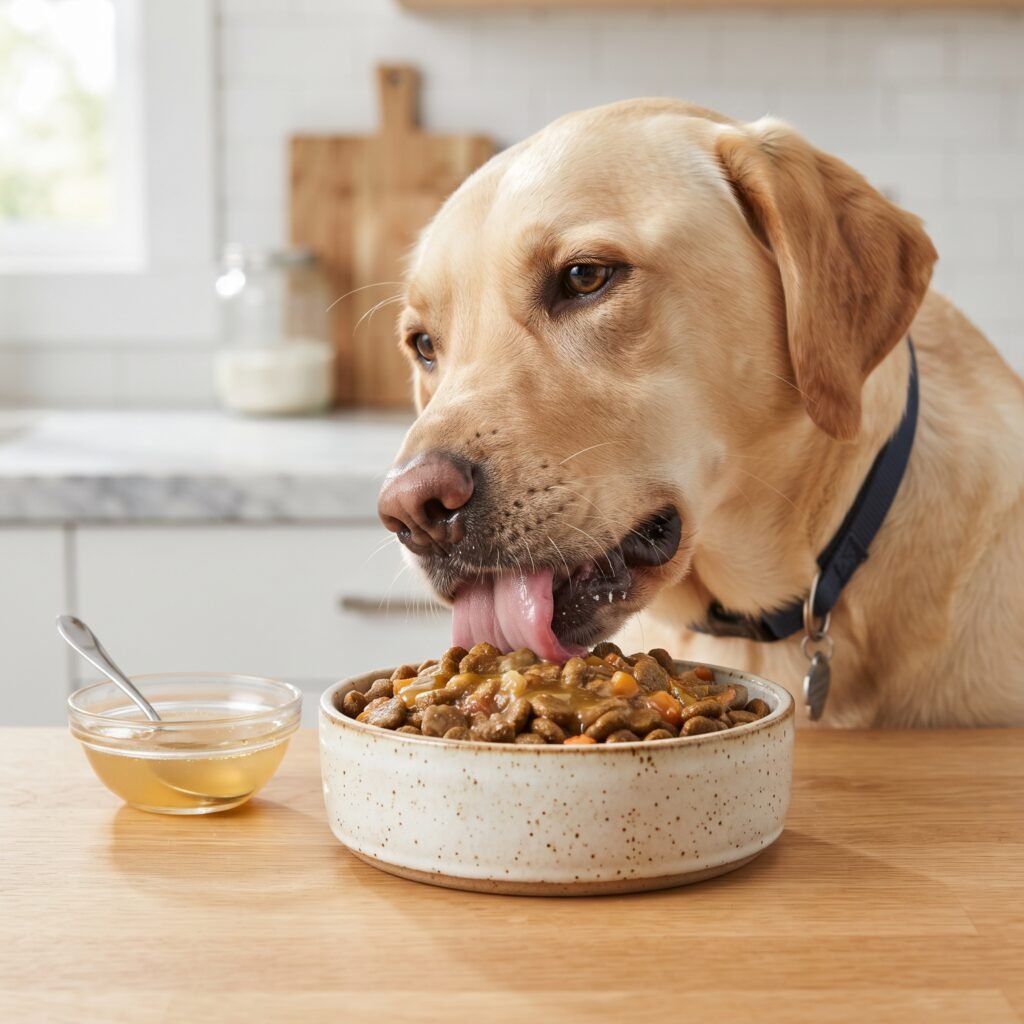
What Should I Look for on a Bone Broth for Dogs Label?
Reading a bone broth for dogs label properly takes about thirty seconds and saves you from a lot of guesswork later. I check four things before a product goes in my cart, in this order: sodium content per serving, whether onion or garlic (or “natural flavors,” which can sometimes hide alliums) appears anywhere in the ingredient list, whether the fat content is disclosed at all, and whether the brand publishes a recall history you can actually find.
A surprising number of commercial bone broth for dogs products list sodium per serving but not fat per serving, which tells you something about which metric the manufacturer assumes matters most to buyers. If a brand won’t disclose fat content and your dog has any fat sensitivity, that’s a reason to skip it rather than assume it’s fine. I’ve also noticed that “human-grade” on a label doesn’t automatically mean dog-safe — some human-grade bone broths are seasoned for flavor in ways that push sodium well above what’s appropriate for a 20lb dog.
Powdered or freeze-dried bone broth for dogs products are worth a specific mention here, because they’re increasingly common and behave differently than liquid versions. Reconstituting powder yourself means you control the dilution, which can actually make it easier to manage fat and sodium exposure precisely — assuming the powder itself is low in both to begin with. I’ve had good results with freeze-dried options for travel, specifically because they don’t need refrigeration and the exact per-scoop nutrient breakdown is usually printed clearly on the tub.
Does Bone Broth for Dogs Actually Have the Joint Benefits People Claim?
Bone broth for dogs is frequently marketed for glucosamine and chondroitin content, supposedly supporting joint health in aging or arthritic dogs. The honest answer is more nuanced than most product pages suggest. Long-simmered broth does extract some collagen and trace glucosamine from cartilage and connective tissue, but the actual concentration in a home-simmered batch is generally far lower and far less consistent than what you’d get from a dedicated joint supplement formulated to deliver a specific milligram dose.
That doesn’t mean the joint-support angle is worthless — it means bone broth for dogs should be thought of as a pleasant, hydrating delivery vehicle that might contribute modestly to joint health, not a replacement for a vet-recommended glucosamine or chondroitin supplement in a dog with diagnosed arthritis. I still give it to my own senior dog for the hydration and appetite benefits, but I don’t count on it doing the heavy lifting his actual joint supplement is doing. If a product’s marketing implies bone broth for dogs alone will meaningfully treat joint pain, that’s a claim worth being skeptical of.
How Much Does Bone Broth for Dogs Cost, and Is Homemade Actually Cheaper?
Cost is a real factor in the homemade-versus-store-bought decision, and it doesn’t always shake out the way people assume. Making bone broth for dogs at home from bones you’d otherwise throw away (leftover chicken carcasses, for instance) can be nearly free, but bones purchased specifically for broth — especially grass-fed beef marrow or knuckle bones from a butcher — often run $3 to $8 per batch once you factor in the bones themselves, plus your own time across an 18-24 hour simmer.
Commercial bone broth for dogs, by comparison, typically runs $1 to $3 per cup-equivalent serving for shelf-stable pouches, or less per serving for larger frozen tubs bought in bulk. For a household with one small dog getting an occasional topper, homemade is usually cheaper and gives you more control. For a multi-dog household going through bone broth for dogs daily, buying in bulk from a reputable commercial brand can actually work out cheaper than the bones, energy cost of a 24-hour simmer, and freezer space homemade batches require. Neither option is objectively better — it depends on your dog count, your schedule, and how much you value the precision of a lab-tested nutrient panel versus the lower ingredient cost of doing it yourself.
Bone Broth for Dogs vs. Regular Broth or Stock: What’s the Real Difference?
Regular grocery-store broth or stock is made for human seasoning preferences, which usually means added salt, onion powder, or garlic — all things that disqualify it as bone broth for dogs. True bone broth for dogs is simmered longer (extracting more collagen and glucosamine from the bones and cartilage) and deliberately excludes anything toxic or unnecessary for a dog’s diet. If you’re grabbing something off a regular grocery shelf, check the ingredient label for onion, garlic, and sodium content before assuming it’s interchangeable with a dog-specific product.
What Ingredients Should Never Go Into Bone Broth for Dogs?
Beyond onion and garlic, there’s a longer list of additions that show up in human recipes but have no place in bone broth for dogs. Salt is the obvious one, but people are sometimes surprised that “just a pinch” of table salt or a splash of soy sauce for flavor is enough to push a batch above what’s appropriate, especially for small dogs or dogs with heart or kidney conditions where sodium is already restricted.
Grapes, raisins, and anything containing xylitol (some low-sugar broth bases or bouillon products use it as a flavor enhancer) are outright toxic and worth double-checking on any pre-made stock you’re considering repurposing as bone broth for dogs. Mushrooms are another sneaky one — some varieties used in human bone broth recipes for umami flavor are fine, but wild or unidentified mushrooms should never go anywhere near a batch meant for your dog. Nutmeg, in larger quantities, is also worth avoiding; it’s sometimes used in fall-flavored human bone broth recipes and is mildly toxic to dogs in concentrated amounts.
When in doubt, the safest approach to making bone broth for dogs is radical simplicity: bones, water, maybe a splash of apple cider vinegar to help extract minerals during the simmer, and nothing else. Every additional ingredient is one more thing you have to verify is safe, and the flavor dogs respond to comes overwhelmingly from the bones and collagen themselves, not from seasoning.
A Realistic Weekly Routine for Feeding Bone Broth to Dogs
Because so much of this guide focuses on caution, it’s worth laying out what a normal, low-risk week actually looks like for a healthy dog. For my own dogs, without any pancreatitis history, a typical routine involves a quarter cup of homemade bone broth for dogs stirred into their morning kibble four to five days a week, made in a batch every two to three weeks and frozen in ice cube trays for easy portioning.
On the days I don’t add it, nothing changes nutritionally — bone broth for dogs is a topper, not a base diet component, so skipping it doesn’t create a gap the way skipping a meal would. During a heat wave or after a particularly active hike, I’ll sometimes offer a small bowl of bone broth for dogs on its own, slightly diluted with water, as an extra hydration boost rather than mixing it into food. That’s also a good option for a dog who’s mildly under the weather and not interested in a full meal but will still lap up a flavorful liquid.
The one adjustment I’d flag for any routine: if you notice your dog’s stool becoming looser than usual, or you notice any drop in appetite for their regular food after starting a bone broth for dogs habit, that’s worth backing off and reassessing rather than pushing through it, especially in a dog who’s never had it consistently before.
Methodology: How This Information Was Evaluated
This guide draws on AAFCO’s established nutrient guidelines for canine diets, general veterinary consensus on fat restriction in pancreatitis management, and hands-on testing across several homemade batches and three commercial bone broth for dogs products, evaluated for ingredient sourcing (no onion, garlic, or added salt), a check of each brand’s recall history, and rough fat/sodium comparisons using a home kitchen fat separator rather than lab equipment. Where a specific number wasn’t independently verifiable, it’s presented as a general range rather than an exact figure.
Frequently Asked Questions
Can dogs have bone broth for dogs every day? Healthy adult dogs can typically have bone broth for dogs daily as a food topper in modest amounts, but dogs with pancreatitis history or fat sensitivity should be limited to a few times a week at most, and only with a well-skimmed or commercial low-fat option.
Is store-bought bone broth for dogs safe, or should I always make it myself? Store-bought bone broth for dogs is often actually the safer, more consistent choice for fat-sensitive dogs because the fat and sodium content is tested and labeled, whereas homemade batches vary significantly based on your bones and technique.
Can puppies have bone broth for dogs? Yes, in small amounts appropriate to their size — puppies tolerate bone broth for dogs well, but because they’re smaller, the same “quarter cup” serving that’s fine for an adult dog represents a much bigger relative dose of fat and sodium.
What bones should I avoid when making bone broth for dogs at home? Avoid cooked leftover bones from roasts or holiday meals, and go easy on marrow-heavy bones like knuckle or oxtail if your dog has any fat sensitivity — chicken feet, necks, and beef shank produce a leaner, more predictable broth.
How do I know if bone broth for dogs is causing a problem instead of helping? Watch for loose stool, reduced appetite, or lethargy within 24-48 hours of introducing it; if any of those show up, stop giving bone broth for dogs, wait for symptoms to resolve, and reintroduce (if at all) at a much smaller volume with a leaner recipe.
Can I use bone broth for dogs as a way to get a sick dog to eat again? Yes, this is one of the most reliable uses for bone broth for dogs — the scent and flavor often encourage eating in dogs recovering from illness or surgery, but check with your vet first if the underlying illness involves pancreatitis, kidney disease, or another condition where fat and sodium need to be tightly controlled.
Are Some Breeds More Prone to the Fat-Sensitivity Issue?
Certain breeds show up disproportionately often in pancreatitis and fat-sensitivity discussions with vets, and it’s worth knowing if you own one before you assume a rich, marrow-heavy broth is automatically fine. Miniature Schnauzers are the breed most frequently associated with a hereditary predisposition toward elevated blood fat levels and pancreatitis risk, and several other small and toy breeds — Yorkshire Terriers and Shih Tzus among them — also show elevated rates in veterinary literature, though the mechanism isn’t identical across breeds.
That doesn’t mean these dogs can never have a properly prepared, lean broth as an occasional topper. It means the margin for error is smaller, and a rich, poorly-skimmed batch is more likely to trigger a problem in one of these breeds than in, say, a large, active working breed with no history of fat sensitivity. If you own a Miniature Schnauzer or another breed with a known predisposition, I’d start with a commercial, nutrient-tested low-fat option rather than experimenting with a homemade recipe, simply because the consequences of getting the fat content wrong are more serious for these dogs.
Large, active breeds generally tolerate a wider range of fat content without issue, assuming no individual history of pancreatitis, but “large breed” isn’t a blanket exemption either — any individual dog can develop sensitivity regardless of typical breed patterns, which is really the underlying point of this whole guide: general breed and size trends are useful context, but they don’t replace watching your own dog’s actual response.
The Bottom Line
Bone broth for dogs is a genuinely useful tool for hydration, appetite, and recovery — but it’s not a one-size-fits-all supplement, and the fat content variability in homemade batches is the risk most guides never mention. If your dog has a clean health history, a well-made batch of bone broth for dogs is low-risk and high-reward. If your dog has any history of pancreatitis, fat sensitivity, or a prescription diet, the safer path is usually a nutrient-tested commercial bone broth for dogs product, introduced slowly, with your vet’s input on how it fits into their existing plan.