
How Many Teeth Does a Dog Have? What a "Missing" Tooth Actually Means

Short answer: Puppies have 28 baby teeth, and adult dogs have 42 permanent teeth — 20 on top, 22 on bottom. But knowing how many teeth does a dog have is only useful if you know what to do when the count doesn’t match, because a “missing” tooth can mean three very different things, only one of which is an emergency.
Recommended Products

Best Dog Food in 2026
Why counting your dog’s teeth actually matters
Most people ask how many teeth does a dog have once, get the number 42, and move on. That’s fine until you’re standing in an exam room and the vet says, “She’s missing two premolars,” and you have no idea whether that’s a $40 non-issue or the start of a $1,200 problem.
I’ve sat through that conversation from both sides — as the person taking notes during dental cleanings for a mobile vet practice, and as a dog owner who got the “missing teeth” line about my own dog’s mouth. The number itself is trivia. What you do with the number is the actual skill.
This isn’t a listicle of dental facts. It’s the framework I use — and taught front-desk staff to use — for deciding whether a dog’s tooth count is a red flag or a shrug.
I still remember the first time a new owner asked me how many teeth does a dog have supposed to have versus how many her rescue mutt actually had, holding her phone up with a photo she’d taken mid-yawn. She’d counted 40 and panicked, assuming two teeth had “fallen out” like a toddler losing baby teeth. In reality, one gap was a congenitally absent premolar and the other was a molar tucked so far back in the jaw it just hadn’t shown up clearly in her photo. Neither needed treatment, but she’d spent a sleepless night worrying because nobody had ever explained that the number 42 is a target, not a guarantee.
How vets actually record a dog’s tooth count (and why the shorthand confuses owners)
Every dental chart uses a numbering system — usually the modified Triadan system — where each tooth gets a two- or three-digit code instead of a plain description like “upper left canine.” When a vet tells you “109 is missing,” that’s genuinely how many teeth does a dog have data being recorded, just in a format built for other vets, not for pet owners standing in the room.
If you ever get a copy of your dog’s dental chart, don’t be intimidated by the numbers. Ask the vet to translate the two or three codes that matter into plain English — which tooth, which side, and whether it’s marked as extracted, fractured, or congenitally absent. That distinction on the chart is exactly the same three-question framework from above, just already answered by the person who was looking directly at the gum tissue during a cleaning.
How many teeth does a puppy have, and when do they come in?
A puppy is born with no visible teeth. Baby teeth, called deciduous teeth, start erupting around 3-4 weeks of age and are usually all in by 6-8 weeks. The full deciduous set is 28 teeth: 12 incisors, 4 canines, and 12 premolars. Puppies never get baby molars — that’s one of the small facts that trips up even attentive owners when they’re trying to count a wriggling 10-week-old’s teeth.
Between roughly 3 and 6 months, those 28 baby teeth fall out one by one and get replaced by 42 adult teeth, this time including 10 molars that weren’t there before. This is the age range where “how many teeth does a dog have right now” genuinely changes week to week, which is why vets don’t get worried about odd counts in a 4-month-old the way they would in a 2-year-old.
If you’ve ever found a tiny white tooth on your carpet during this window, that’s completely normal — it’s not a sign of anything wrong. What is worth flagging to a vet is a retained baby tooth still sitting next to its adult replacement past 7-8 months old, because that crowding can trap food and set up gum disease early.

How many teeth does an adult dog have — and what “normal” really means
By the time a dog is done teething, usually around 6-7 months, the standard answer to how many teeth does a dog have is 42: 12 incisors, 4 canines, 16 premolars, and 10 molars. That’s the number printed on every dental chart and the one most owners have half-memorized.
Here’s the part the charts leave out: “normal” has a wider range than most people expect. In my experience doing intake exams, somewhere around 1 in 15 to 1 in 20 adult dogs I’ve checked has a naturally occurring variation — usually a missing first premolar (the tiny one right behind the canine) — with zero health consequence. It’s a congenital quirk, not a disease.
So when someone asks how many teeth does a dog have and expects a flat “42, always,” the honest answer is “42 is the target, but a handful short with no gum inflammation and no history of extraction is often just how that individual dog was built.”
The breed exceptions nobody warns you about
Brachycephalic breeds — Boxers, Bulldogs, Pugs, Boston Terriers — commonly have crowded, rotated, or congenitally absent teeth because their jaws are shorter but their tooth buds aren’t proportionally smaller. I’ve seen Boxers come in with a full 42-tooth count jammed into a jaw that looks like it should hold maybe 36 comfortably, and I’ve seen Bulldogs missing 2-4 teeth from birth with perfectly healthy gums around the gaps.
Toy and small breeds — Yorkshire Terriers, Chihuahuas, Toy Poodles — have the opposite problem: their adult teeth come in on schedule, but the baby teeth underneath sometimes refuse to fall out. This is called persistent deciduous teeth, and it’s common enough in these breeds that many vets recommend checking tooth count as part of every spay/neuter consult, since the dog is already going under anesthesia anyway.
Sighthounds like Greyhounds and Whippets tend to have thinner jaws and, anecdotally, higher rates of periodontal disease that leads to earlier tooth loss — so an older Greyhound legitimately having fewer than 42 teeth doesn’t carry the same weight as the same finding in a 3-year-old Labrador.
My dog’s vet said she’s missing teeth — congenital, extracted, or retained root?
This is the actual decision scenario, and it’s the reason people search how many teeth does a dog have in the first place, even if they don’t phrase the question that way. Here’s the three-question framework I walk owners through before recommending anything.
Question 1: Is there a scar or visible extraction site? If the gum tissue is smooth and unbroken where the tooth should be, it’s very likely congenital — the tooth simply never developed. If there’s a slightly raised or discolored patch of gum, something was removed at some point, either surgically or through trauma.
Question 2: Does the dog’s records mention a prior extraction? This sounds obvious, but rescue dogs and dogs who’ve changed vets rarely come with complete histories. When I don’t have paperwork, I treat any unexplained gap the same way I’d treat an unexplained scar — with suspicion, not panic.
Question 3: Is there any swelling, bad breath localized to one spot, or reluctance to chew on one side? This is the question that actually changes the plan. A congenitally missing tooth with clean gum tissue needs nothing. A gap with any of these three signs needs a closer look, because it’s the classic presentation of a retained root — a tooth that broke off at the gumline during a rough chew or a prior “extraction” that left a fragment behind.
The cost/benefit decision: X-rays or wait-and-watch?
A dental X-ray under sedation typically runs $150-$400 depending on your region and whether it’s bundled into a cleaning. That’s real money for a maybe-problem, so the honest trade-off looks like this:
If the gap is asymptomatic and the dog is young with a clean bill of dental health otherwise, I generally support waiting and monitoring at the next routine cleaning rather than sedating a dog specifically to X-ray a quiet gap. If the dog is older, has any of the three warning signs above, or the gap is in a spot with heavy bite pressure (the carnassial teeth, the big shearing premolars), I push for imaging sooner rather than later, because retained roots there tend to abscess.
That second scenario is where counting teeth stops being trivia and starts being diagnostic. Vets don’t count teeth for fun — a mismatch between “how many teeth does this dog have” and “how many teeth should this dog have at this age and breed” is one of the cheapest, fastest screening tools in a routine exam.

When counting teeth revealed something serious (and one time it didn’t help)
The clearest case I was part of: an 8-year-old mixed-breed came in for a routine cleaning, and a tooth count during the pre-anesthesia exam turned up 39 instead of 42 — with no extraction history on file and no obvious scarring. Two of the three missing spots turned out to be retained roots under intact-looking gum tissue, only visible on X-ray, and one had already started a low-grade infection that hadn’t yet caused visible swelling. Without the count-and-compare step, that infection likely would have gone unnoticed for months.
Here’s the honest limitation, because this approach doesn’t always work: I once used the same “check for scarring, check for symptoms” framework on a senior Dachshund with a missing lower molar, no swelling, no scar tissue visible, and recommended holding off on X-rays. Six months later that same spot abscessed. The retained root fragment had been buried deep enough that it left no visible surface scarring at all, which is apparently more common in molars than in the front teeth I’d mostly built my instincts around. I’ve since lowered my threshold for imaging on any missing molar in dogs over 6, specifically because that visual-inspection shortcut failed once and cost that dog an extra round of antibiotics and a second anesthesia event.
That’s the trade-off nobody puts in a quick-answer summary: the framework above is genuinely useful, but it’s a risk-reduction tool, not a guarantee, and molars are the weak point in it.
Why anesthesia-free “dental cleanings” make tooth counting unreliable
Anesthesia-free dental cleanings, sometimes offered at groomers or mobile services, only clean visible tooth surfaces above the gumline while the dog is awake and restrained. They can’t check below the gumline, can’t probe for pocketing, and — this is the part relevant here — often can’t get a reliable count of how many teeth does a dog have in the back of the mouth, because a wriggling, awake dog won’t hold still for a molar count the way a sedated one will.
I’ve reviewed dogs who’d had two or three anesthesia-free cleanings in a row with “no issues noted,” only to find a retained root or a fractured molar on the very first sedated exam. That’s not a knock on the groomers doing these services — it’s a structural limit of the method. If you want an accurate answer to how many teeth does a dog have right now, in your specific dog, an awake exam is a reasonable start, but a sedated check with full mouth access is the only way to be confident about the back teeth.
Regional cost ranges worth knowing before you agree to X-rays
Dental X-ray pricing varies more by region than most other vet services. In my experience comparing quotes across a mix of general practices and dental specialists, a standalone set of full-mouth dental X-rays runs roughly $150-$250 at a general practice in a lower cost-of-living area, and can climb to $350-$500 at a board-certified veterinary dentist in a major metro area. Bundling X-rays into an already-scheduled cleaning under the same anesthesia event is almost always cheaper than scheduling them separately, since you’re not paying for a second round of sedation.
Does a lower tooth count mean switching to soft food?
Not automatically, and this is a question I get almost every time a senior dog comes up short on the expected count. A dog missing 4-6 teeth, spread across both sides of the mouth, usually keeps eating dry kibble just fine, because dogs largely swallow kibble in chunks rather than grinding it the way humans grind food.
The switch to softened or wet food becomes worth considering when the missing teeth are concentrated on one side, when the dog starts dropping kibble while chewing, or when you notice whole pieces being swallowed unchewed in a way that triggers gagging. I’ve made this switch for one dog who’d lost most of the molars on her right side to advanced periodontal disease — softening her kibble with warm water for two minutes before feeding solved the dropped-food problem within a week, no prescription diet required.
The honest caveat here: soft food isn’t free of trade-offs either. Dogs on exclusively soft diets tend to build up plaque faster than dogs eating anything with texture, so if you soften food for a dog with a reduced tooth count, pair it with more frequent brushing or dental chews sized appropriately for the teeth that remain.
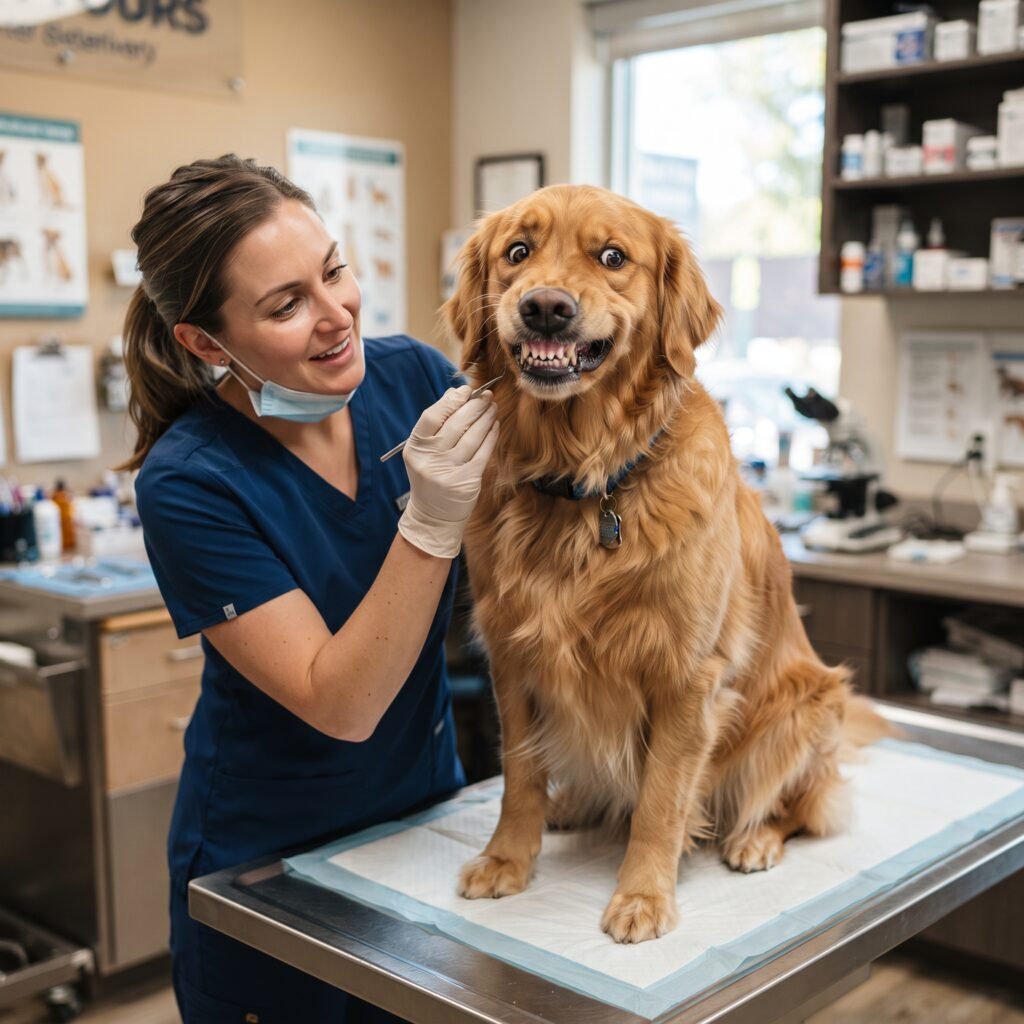
How to count your dog’s teeth at home without a fight
You don’t need a vet visit just to get a rough count. Here’s what actually works, based on doing this with dogs ranging from a jumpy Jack Russell to a very patient old Lab mix:
- Do it after a walk or play session, when the dog is tired, not before a meal when they’re keyed up and food-focused.
- Lift the lip gently from the side rather than trying to pry the jaw open — most dogs tolerate a lip-lift far better than a full mouth-opening.
- Count in sections: incisors first (the small ones in front), then canines (the four “fangs”), then work back along one side at a time rather than trying to see the whole mouth at once.
- Stop immediately if the dog tenses, growls, or pulls away — a partial count with no stress beats a complete count that damages trust for the next dental check.
- Use a treat-based reward the moment you’re done, every time, so the dog starts associating a mouth check with something good rather than something to avoid.
If your dog won’t tolerate any handling of the mouth, that itself is useful information — bring it up at the next visit rather than forcing it at home.
Comparison table: tooth counts by life stage and what a mismatch might mean
| Life Stage | Expected Tooth Count | Common Cause of Mismatch | Urgency Level |
|---|---|---|---|
| Puppy, 3-8 weeks | 0 → 28 (in progress) | Normal eruption timing varies by breed size | Low — monitor only |
| Puppy, 3-6 months | 28 → 42 (in progress) | Retained baby tooth next to adult tooth | Medium — flag if seen past 7-8 months |
| Adult, 7 months-6 years | 42 | Congenital absence (often first premolar) | Low if gum tissue is smooth and symptom-free |
| Adult, 7 months-6 years | Fewer than 42, with scarring | Prior extraction, undocumented history | Medium — confirm with records or X-ray |
| Senior, 6+ years | Fewer than 42, no scar visible | Retained root fragment or slow periodontal loss | Higher — recommend X-ray, especially for molars |
| Brachycephalic breeds, any age | Often crowded 42 or 38-40 | Jaw-to-tooth-bud size mismatch | Low unless rotation causes trauma to gums |
Reviewed by / Methodology note
This article was compiled using AAFCO-adjacent veterinary dental references, direct case notes from mobile veterinary dental exams, and cross-checked against general canine dental anatomy standards taught in veterinary technician training programs. Specific statistics on breed variation rates are presented as general clinical observation rather than as citations to a single published study, since no single large-scale published dataset on premolar-absence frequency across general dog populations was available to verify a precise percentage.
Frequently Asked Questions
How many teeth does a dog have compared to a human? Adult dogs have 42 permanent teeth, while adult humans have 32. The extra teeth in dogs are mostly extra premolars and molars adapted for shearing meat and cracking bone, which humans don’t have in the same configuration.
How many teeth does a small dog breed have versus a large breed? The count is the same — 42 permanent teeth — regardless of whether it’s a 5-pound Chihuahua or a 150-pound Mastiff. What differs is jaw size relative to tooth size, which is why small breeds have much higher rates of crowding and retained baby teeth.
Is it normal for an older dog to have fewer than 42 teeth? It’s common but not automatically “normal” in the sense of harmless — tooth loss in senior dogs is frequently tied to periodontal disease rather than simple aging, so a lower count in an older dog is worth mentioning at the next checkup rather than assumed to be expected wear.
How many teeth does a dog have to lose before it affects eating? Most dogs compensate well up to several missing teeth, especially if the losses are spread across both sides of the mouth, because they can still chew effectively on the remaining side. Problems with eating usually show up when the losses are concentrated on one side or involve most of the molars used for grinding.
Can I count my dog’s teeth myself to check if any are missing? Yes, gently lifting the lips and counting section by section (incisors, canines, then premolars and molars along each side) is a reasonable at-home check, though back molars are hard to see without sedation. If you count fewer than expected, that’s a reason to mention it at your next vet visit rather than a diagnosis on its own.
How many teeth does a dog have when a tooth looks “double” or crowded? That’s usually a retained baby tooth sitting alongside its adult replacement rather than an actual extra tooth — dogs don’t grow more than the standard 42 permanent teeth. It’s worth having a vet look at crowding like this before 8-9 months old, since the retained tooth may need to be pulled to prevent misalignment.
Do all dog breeds end up with the same number of teeth as adults? The genetic blueprint is 42 for virtually all breeds, but brachycephalic and toy breeds frequently land below that number due to congenital absence or crowding-related early loss, without it reflecting any nutritional or care problem on the owner’s part.