
Beef Trachea for Dogs: How to Match the Right Cut to Your Dog's Chew Style
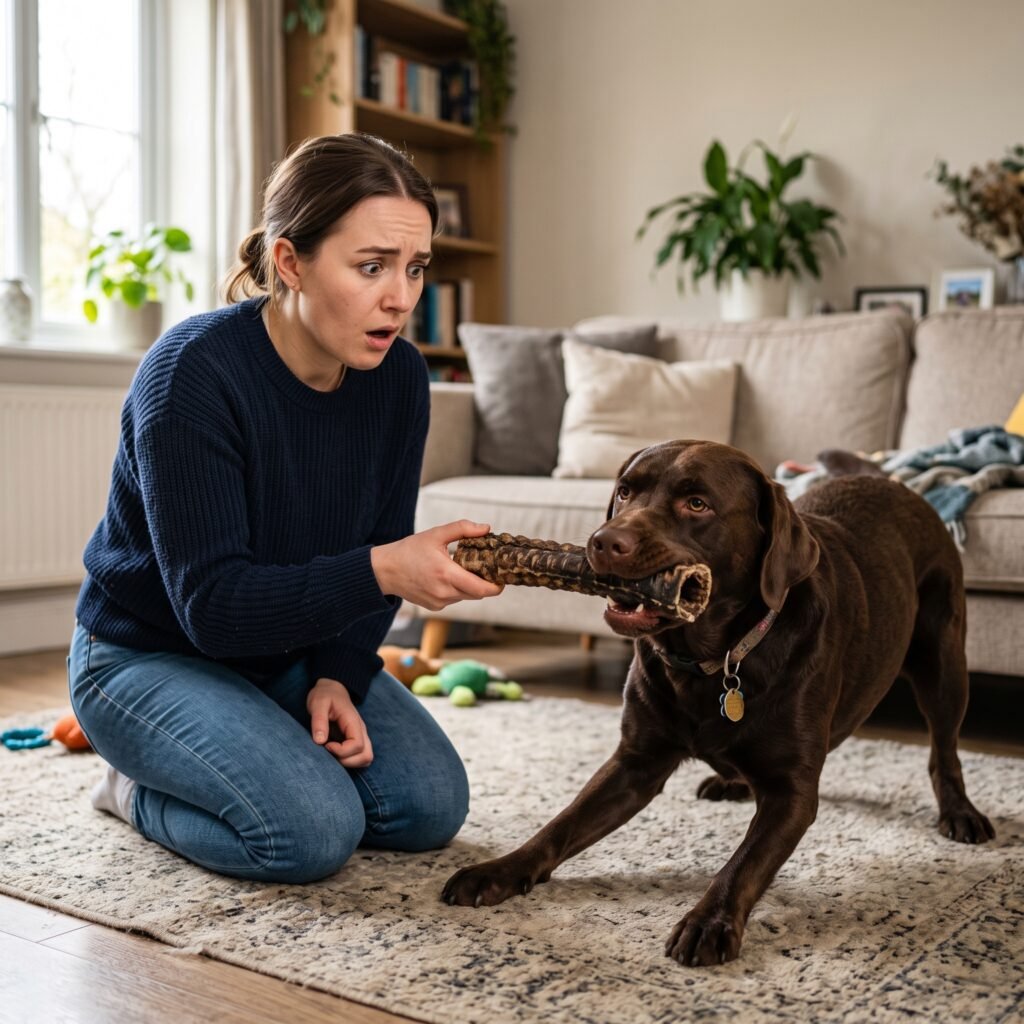
Beef trachea for dogs is dehydrated cartilage from the windpipe — a soft, hollow chew that shreds instead of splintering. The right pick depends less on your dog’s weight than on how he chews. Gulpers need long, uncut tubes. Shredders do fine with rings. Hard grinders finish one in under two minutes.
That last sentence is the part nobody tells you at the checkout counter.
I’ve watched four dogs of wildly different sizes work through the same box of beef trachea for dogs, and the 9-pound papillon got more minutes out of hers than the 62-pound Lab mix got out of his. Weight predicted almost nothing. Jaw behaviour predicted almost everything.
So this guide is organised around the decision you actually have to make in the aisle: not “is this safe,” but “which one of these five formats fits the dog I own.” I’ll also show you why buying beef trachea for dogs as a joint supplement is the wrong reason to buy it — and what the right reason is.
Recommended Products
Best Dog Food in 2026
How I evaluated this
I compared the labels of nine dehydrated beef trachea dog chews across six brands sold in the US, weighed individual pieces on a kitchen scale, and logged chew times with four dogs (9 lb, 24 lb, 41 lb, 62 lb) over six weeks. I checked each brand’s stated country of origin and sourcing language, cross-referenced brand names against the FDA’s pet food recall listings, and compared guaranteed-analysis figures against the general nutrient framework AAFCO publishes for complete diets.
Limitation, stated plainly: I ran no lab assays. Every nutrient figure below is vendor-declared or a weighed measurement, not an independently verified number. Where a value isn’t published — and glucosamine content usually isn’t — I say so instead of estimating.
Why does chew style matter more than size when buying beef trachea for dogs?
Because trachea softens. Fast.
A dry trachea tube feels like a stiff corrugated hose — ridged cartilage rings on the outside, a waxy hollow sleeve inside. Give it ninety seconds of saliva and that structure turns pliable and slick. Bully sticks and antlers stay hard while your dog works them. Beef trachea for dogs does the opposite: it gets more swallowable the longer it’s in the mouth.
That single property is why chew style beats body weight as your selection rule.
The gulper
Basil, the 62-pound Lab mix, is a gulper. He doesn’t chew to reduce a chew — he chews to soften it enough to send down whole.
For a dog like this, beef trachea for dogs is only appropriate in one form: a full 12-inch tube, held at one end by you or clipped into a chew holder. Loose rings and short segments are the wrong call. A 2-inch ring flattens into a folded disc in about four seconds, and a folded disc is a swallowable object.
If you can’t supervise, a gulper shouldn’t have trachea at all. There’s no version of “leave him with it in the crate” that I’d sign off on.
The shredder
Nettle, the 9-pound papillon, is a shredder. She braces a piece with her front paws, works the edge with her incisors, and peels off strips.
Shredders are the ideal customer for beef trachea for dogs. Rings, chips, and puffed pieces all work, because she reduces material rather than repositioning it toward her throat. She gets fifteen to twenty minutes out of a 2-inch ring — more chew time than the Lab gets from a full tube.
The grinder
Odie, an 11-year-old beagle with worn molars, is a grinder. He parks a chew on his back teeth and mills it down steadily.
Grinders get honest value from beef trachea for dogs, with one caveat: if the dog has healthy adult molars and real jaw power, plain trachea is too soft to last. This is where owners feel ripped off — four dollars for a chew that’s gone in ninety seconds.
How to tell which one you own: hand your dog a chew and watch for sixty seconds. Head tilted back and repositioning toward the molars with a swallowing motion = gulper. Paws pinning, head down, small side-to-side peeling = shredder. Slow rhythmic crunching in one spot = grinder.

What formats does beef trachea for dogs come in, and who is each one for?
Five, in practice — and the differences are far bigger than the packaging suggests.
The figures below are compiled from vendor-declared labels plus my own kitchen-scale weights. Individual pieces vary considerably, easily ±20% on weight, because trachea is a whole animal part and no two windpipes are identical.
| Format | Typical piece weight | Vendor-declared kcal per piece | Crude fat (GA min–max) | Chew time, 40–60 lb dog | Best for |
|---|---|---|---|---|---|
| Whole tube, 12″ | 40–55 g | 110–150 | 3–8% | 6–12 min | Gulpers, held or clipped; large dogs |
| Half tube, 6″ | 20–28 g | 55–80 | 3–8% | 3–6 min | Medium shredders; portion control |
| Rings / chips, 2–3″ | 6–9 g | 18–28 | 3–8% | 1–3 min (15–20 min for toy breeds) | Small dogs, training rewards, seniors |
| Puffed trachea, 5–6″ | 12–18 g | 45–65 | 4–9% | 1–2 min | Puppies, dental-disease dogs, light chewers |
| Stuffed trachea, 6″ | 45–60 g | 180–260 | 12–22% | 4–8 min | Occasional high-value reward only |
Two things in that table deserve more than a glance.
Puffed trachea is a different product. Heat-puffing expands the cartilage into something airy and brittle — closer to a prawn cracker than a chew. It’s the gentlest option in the beef trachea for dogs category, which makes it genuinely useful for a dog with periodontal disease, and nearly worthless as an occupier for a healthy adult.
Stuffed trachea breaks the whole nutritional argument. Plain trachea is a lean chew. Fill the tube with a liver-and-fat paste and you can quadruple the calories and triple the fat. If you came to beef trachea dog chews specifically for the low-fat profile, the stuffed version undoes the reason you came.
Does beef trachea for dogs actually deliver joint support?
This is where I part company with most of the category’s marketing.
Trachea is hyaline cartilage, and cartilage genuinely contains glucosamine and chondroitin. That part is true, and it’s why beef trachea glucosamine claims appear on nearly every bag. The problem isn’t the chemistry. It’s the arithmetic.
Almost no brand publishes a milligram figure for glucosamine per piece. In the nine products I checked, not one listed a quantified amount — the claim lived entirely in marketing copy, never in the guaranteed analysis. When a supplement claim can’t survive contact with a label, treat it as a bonus, not a mechanism.
Compare that with how joint supplements are actually dosed. Veterinary joint products are formulated and labelled with specific glucosamine and chondroitin amounts per serving, scaled to the dog’s weight, given daily, and evaluated over weeks. A chew that provides an unstated quantity, a few times a week, is not the same intervention wearing a different hat.
There’s a second issue nobody mentions: dose ceiling. To push a meaningful daily quantity through beef trachea for dogs, you’d be feeding trachea daily, in volume — and calories, not cartilage, become the limiting factor long before you get there. A 25-pound dog’s entire treat allowance is roughly 40–50 kcal a day under the commonly cited 10% guideline. That’s one and a half trachea rings.
So what’s the honest verdict? If your dog has diagnosed arthritis or is a large-breed senior, buy a dosed joint supplement your vet recommends and treat any beef trachea glucosamine content as a rounding error. If your dog is healthy, buy beef trachea for dogs because it’s a lean, single-ingredient, low-splinter chew — which is a genuinely good reason — and let the cartilage be a small bonus.
I’d rather sell you the chew on what it actually does well.
Internal link opportunity: glucosamine for dogs: what the label should tell you
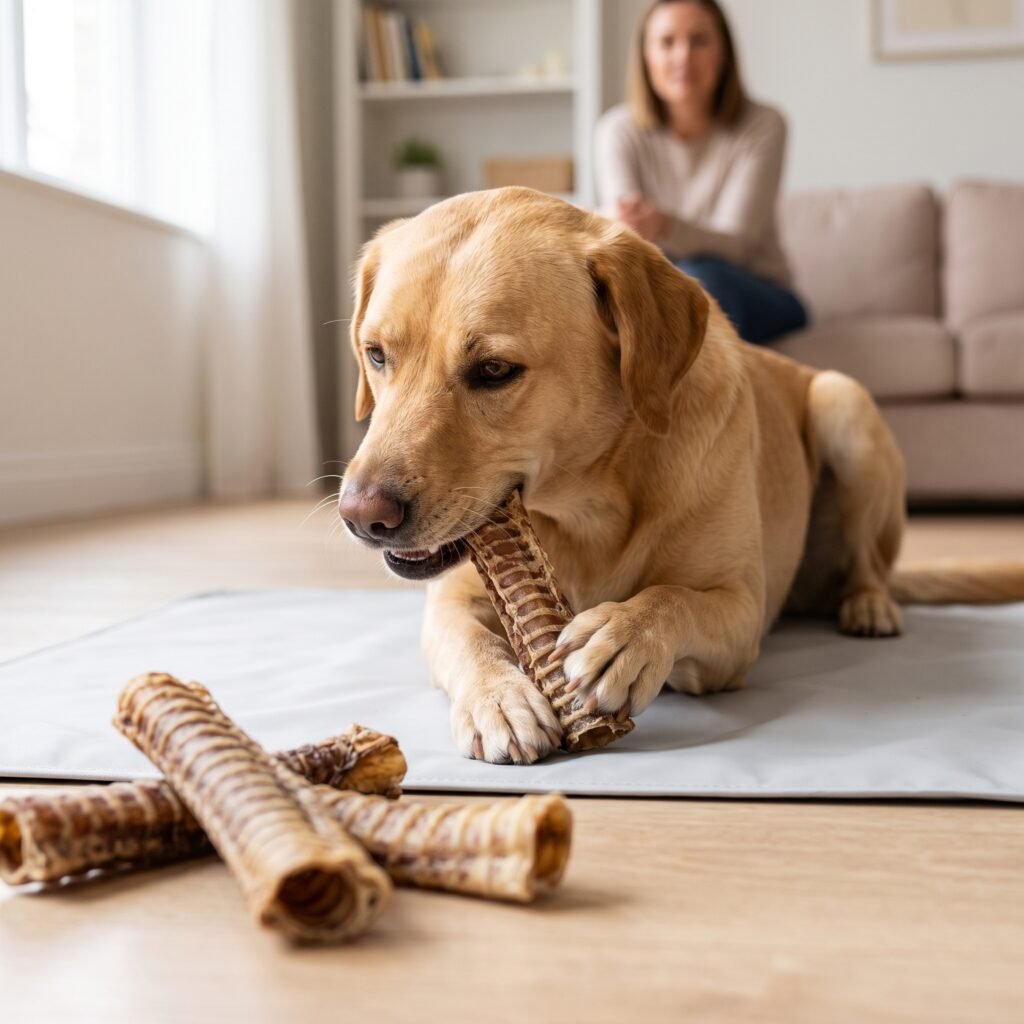
Is beef trachea safe for dogs, and where does it actually go wrong?
The safety profile of beef trachea for dogs is better than most chews in its price range, with four things worth weighing.
Splintering: low risk. Cartilage doesn’t fracture into sharp shards the way weight-bearing bone does. This is the strongest argument for beef trachea for dogs over antlers, hooves and femur bones.
Tooth fracture: low risk, and this matters more than people realise. Slab fractures of the upper carnassial teeth are a well-documented consequence of hard chews, and trachea is soft enough to sit safely below that threshold.
Choking and obstruction: this is the real one. Because trachea softens and flattens, a piece that looked appropriately sized when dry can become a swallowable folded mass ninety seconds later. This is a supervision problem, not a product defect.
Bacterial contamination: the category-wide risk. Dehydrated single-ingredient animal chews are not sterile, and FDA and CDC have investigated illness linked to contaminated dehydrated pet chews — the 2019 pig ear investigation being the most prominent example, where the people handling the chews got sick, not just the dogs.
Wash your hands after handing one over. Wash the surface it sat on. That advice sounds fussy until you read a case report.
Is beef trachea safe for dogs with sensitive stomachs? Usually yes, and better than most alternatives, because plain dehydrated trachea is low in fat. Fat is what triggers most treat-related GI upset, and lean chews cause fewer problems than rich ones.
When beef trachea for dogs didn’t work for me
Two failures, both instructive.
The four-second ring. Early on I gave Basil a 3-inch trachea ring, assuming a 62-pound dog needed a bigger piece than the papillon and that this counted as bigger. He pinned it once, folded it flat, and swallowed it in roughly four seconds. Twenty minutes later he brought most of it back up on the hallway rug, intact and slick.
Nothing worse happened. But it was a genuine near-miss, and the mistake was mine — I’d sized the chew to his body instead of to his behaviour, which is the exact error this whole article exists to prevent. Basil now gets 12-inch tubes only, one end in my hand.
The stuffed-trachea stool disaster. I tried a liver-stuffed 6-inch tube with Odie, the senior beagle, as a Sunday treat. He loved it. Thirty-six hours later we were on the third soft stool and I was mopping.
The cause was obvious in hindsight: the filling took a low-fat chew to something like 18% crude fat, and an 11-year-old beagle’s digestive tract doesn’t absorb that kind of jump gracefully. The plain version had never bothered him. If your dog has any history of pancreatitis or fat sensitivity, skip stuffed entirely — the tube isn’t the problem, the paste is.
The smell, honestly. Plain dehydrated beef trachea for dogs smells like a dried barnyard — musty, faintly meaty, not offensive. Once wet, it turns into something closer to warm wet dog, and puffed pieces leave a slight grease shadow on upholstery. Feed it on a mat or a hard floor. Nobody warns you and then it’s on the sofa.
How does beef trachea for dogs compare with bully sticks, ears and antlers?
The trade-off is always the same: durability versus safety versus calories. Beef trachea for dogs sits at the safe, lean, short-lasting corner of that triangle.
| Chew (6″ or standard piece) | Hardness | Typical kcal | Crude fat | Splinter / fracture risk | Best use |
|---|---|---|---|---|---|
| Beef trachea | Soft, softens further | 55–80 | 3–8% | Very low | Lean daily-ish chew, seniors, sensitive stomachs |
| Bully stick | Firm | 80–110 | 10–18% | Low splinter, gulp risk at the stub | Longer occupier, higher calorie cost |
| Beef ear | Medium | 70–95 | 8–15% | Low | Mid-range value chew |
| Pig ear | Medium, greasy | 100–150 | 15–22% | Low splinter, high GI risk | Occasional only; poor for fat-sensitive dogs |
| Split elk antler | Very hard | Negligible consumed | — | High tooth-fracture risk | I don’t recommend it |
Read that table by column, not by row.
If you want time, bully sticks beat beef trachea for dogs roughly two to one, and cost you double the calories per minute. If you want lean, trachea wins outright. If you want both, you want a rubber toy stuffed with something, not an edible chew.
The pairing I actually use: a bully stick when I need forty minutes of quiet, plain beef trachea for dogs on ordinary days when I just want to give the dog a job.
Internal link opportunity: bully sticks vs. beef trachea: calories per chewing minute
What should I check on the label before buying beef trachea for dogs?
Four things, in order of how much they matter.
1. Ingredient list length. It should read: beef trachea. That’s it. Anything with glycerin, sorbic acid, smoke flavour or colouring is a processed chew wearing a single-ingredient costume.
2. Country of origin — sourced and processed. Brands frequently disclose one and stay quiet about the other. “Sourced from US cattle” tells you nothing about where the dehydration happened. Look for both stated explicitly; if only one appears, assume the other is elsewhere.
3. Recall history. Search the brand name against the FDA’s animal food recall listings before your first order, not after a problem. It takes ninety seconds and it’s the single highest-value check in this list.
4. Guaranteed analysis actually printed. Plain dehydrated beef trachea typically lands somewhere around 60–75% crude protein and single-digit crude fat on a dry-matter basis. A brand that won’t print a GA at all is telling you something about its quality control.
One thing you won’t find, and shouldn’t expect: an AAFCO complete-and-balanced statement. AAFCO nutrient profiles apply to complete diets, not to treats and chews, so its absence on a bag of beef trachea dog chews is normal rather than a red flag.
External source: FDA — Animal Food Recalls & Withdrawals
How do I introduce beef trachea for dogs to a dog with a sensitive stomach?
Slowly, and with the piece sized down rather than the frequency reduced.
Day one, give roughly a third of a 6-inch tube — not a full piece — and take the rest back. Most owners get this backwards, offering a whole chew “just once this week.” A large novel protein load in one sitting is exactly what an unhappy gut handles worst.
Day two, watch the stool before you offer anything else. You’re looking for a normal formed stool, not merely the absence of vomiting.
Day three and four, repeat the same third-portion. If everything holds, go to a half tube on day five, and a full 6-inch tube by the end of week one.
For dogs already on a limited-ingredient diet for suspected food sensitivity, don’t introduce beef trachea for dogs at all during an elimination trial. A novel chew mid-trial invalidates the trial, and you’ll spend eight weeks not knowing what you learned.
Internal link opportunity: how to run a food elimination trial without ruining it
Which dogs should skip beef trachea for dogs?
Most dogs handle beef trachea for dogs without any trouble. These are the exceptions worth naming specifically.
Puppies under about four months. Not for safety of material — trachea is soft — but because deciduous teeth and enthusiastic swallowing are a bad combination. Puffed trachea broken into small pieces is the safer entry point if you want to start early.
Dogs with a pancreatitis history. Plain trachea is fine and often a good pick because of the low fat. Stuffed trachea is not. Read that distinction twice; the packaging blurs it deliberately.
Confirmed gulpers with no supervision available. Covered above, but it bears repeating: the risk profile of beef trachea for dogs changes entirely depending on whether a human is in the room.
Dogs on strict calorie restriction. A single 12-inch tube can be 150 kcal. For an overweight 30-pound dog on a weight-loss plan, that’s most of a day’s treat budget in one chew. Rings exist for exactly this reason.
Raw-fed dogs already getting cartilage. If your dog’s diet already includes trachea, chicken feet or similar cartilage-rich parts, adding more dehydrated beef trachea for dogs is redundant rather than harmful — you’re paying a premium for something already on the plate.
Image suggestion: alt=”Senior beagle chewing a small ring of beef trachea for dogs on a feeding mat”
How often can I give beef trachea for dogs?
Anchor it to beef trachea calories, not to a number of chews per week.
The widely used veterinary guideline holds that treats and chews should stay under roughly 10% of daily calorie intake, with the remaining 90% coming from a complete, balanced diet. Work out your dog’s daily calories, take 10%, and see how many pieces fit.
A rough translation for plain, unstuffed pieces:
- Toy breed (under 12 lb): one 2-inch ring, three or four times a week
- Small (12–25 lb): one to two rings daily, or a 6-inch tube every other day
- Medium (25–50 lb): one 6-inch tube most days
- Large (50–90 lb): one 12-inch tube most days, held
Two adjustments to that grid. If the chew is stuffed, halve it — the calorie figures triple. And if your dog is on a therapeutic diet for any condition, the 10% allowance may not apply at all, because treats can undermine the therapeutic ratios the diet depends on.
Frequency is also a stool question. If you go from zero to daily beef trachea for dogs overnight, expect a few soft stools even in a robust dog. Ramp it.
What should beef trachea for dogs cost, and how do you judge value?
Price per piece is the wrong unit. Price per chewing minute is the right one, and it reorders the whole shelf.
At the time of writing, plain 6-inch pieces commonly run somewhere in the two-to-four-dollar range each when bought singly, and noticeably less in bulk bags. A 12-inch tube costs roughly double a 6-inch. Puffed pieces look cheap per unit and are the worst value per minute of anything in the category, because they’re mostly air.
Now run the division. If a 6-inch tube costs $3 and your Lab finishes it in three minutes, you’re paying a dollar a minute. The same $3 spent on a bully stick buys twenty-five to forty minutes. For a powerful chewer, beef trachea for dogs is an expensive way to buy quiet.
Flip the dog and the maths flips too. Nettle gets fifteen to twenty minutes out of a ring that costs well under a dollar, which makes beef trachea for dogs one of the cheapest chews per minute in my cupboard.
Two things that genuinely improve value:
Buy bulk, then portion yourself. Whole 12-inch tubes cut into thirds with kitchen shears cost far less than pre-cut rings sold by the same brand. Cut them yourself and you also control the length, which — as the whole first half of this article argues — is the variable that actually matters.
Wet and freeze. Run a piece under the tap for five seconds and freeze it for an hour. The chew becomes firmer and colder, and chew time roughly doubles for softer-mouthed dogs. It does nothing for a determined gulper, and it doesn’t change beef trachea calories at all — you’re buying duration, not nutrition.
What doesn’t improve value: paying a premium for beef trachea glucosamine claims. You’re paying for marketing copy that no label quantifies.
How should I store beef trachea for dogs?
Dry, sealed, and out of the bag it came in.
Dehydrated beef trachea for dogs holds moisture better than it looks like it should, and the resealable pouches most brands use are thin. Move pieces into a hard, airtight container and they’ll stay good for months at room temperature. Left half-open in a humid kitchen, they can go soft and musty in weeks.
Don’t refrigerate them for storage. Condensation is the enemy here — a cold piece brought back to room temperature sweats, and moisture on a dehydrated animal product is exactly the condition you don’t want. Freezing is fine for the wet-and-freeze trick above, but that’s a same-day use, not a storage plan.
Check pieces before handing them over. Normal is dry, hard and faintly meaty. Not normal is tacky to the touch, visibly darkened at the edges, or sour-smelling.
One practical note on hygiene: store beef trachea for dogs away from human food and wash the container periodically. The bacterial risk in this category sits with handling, not with the dog.
Frequently asked questions
Is beef trachea safe for dogs to eat every day? For most healthy adult dogs, yes, provided the daily piece fits inside the 10% treat allowance and your dog isn’t a gulper. Daily feeding is more likely to cause a calorie or stool problem than a safety incident. Skip daily use entirely for dogs on calorie restriction or therapeutic diets.
Does beef trachea for dogs help with joint pain? It contains natural glucosamine and chondroitin, but essentially no brand publishes how much, and the quantity a dog could realistically eat is well below the dosing used in actual joint supplements. Treat it as a small bonus, not a treatment. For a diagnosed joint condition, use a dosed product your vet recommends.
Can puppies have beef trachea? After roughly four months, in small pieces and under supervision. Puffed trachea broken down is the gentlest entry point for young dogs. The concern is swallowing behaviour and baby teeth, not the material itself.
How many calories are in beef trachea for dogs? Vendor labels put beef trachea calories at roughly 18–28 kcal for a 2-inch ring, 55–80 for a 6-inch tube, and 110–150 for a 12-inch tube. Stuffed versions are dramatically higher — often 180–260 kcal — because the filling adds fat, not cartilage.
Why does my dog’s beef trachea smell so strong? Dehydrated beef trachea dog chews are minimally processed animal parts, so a musty, meaty odour is normal and not a spoilage sign. A sour, ammonia-like or genuinely rancid smell is different — that one goes in the bin. Store pieces in a sealed container somewhere dry rather than in the original open bag.
The bottom line
Buy beef trachea for dogs because it’s lean, single-ingredient, and unlikely to crack a molar. Don’t buy it as a joint supplement, and don’t buy the stuffed version if fat is your reason for shopping this category at all.
Then pick the format by watching your dog for sixty seconds. Gulper, long tube, held. Shredder, rings, and enjoy the fifteen quiet minutes. Grinder with good teeth, accept that this is a two-minute chew and budget accordingly.
The dogs that get the most out of beef trachea for dogs are small shredders and seniors with tired teeth. The dogs that get the least are powerful, healthy-mouthed adults who’d be better served by something firmer. Neither of those facts appears on a single bag I’ve bought.