
Can Dogs Eat Steak? What I Actually Do With Leftovers, Cut by Cut
Short answer: Can dogs eat steak? Yes — plain, cooked, trimmed steak is safe for most healthy dogs in small amounts. But the cut matters more than the answer. Fat caps, gristle, seasoned crust, marinades with garlic or onion, and cooked bones are the real hazards. Keep steak under 10% of daily calories.
That snippet above is the version you’ll find everywhere. It’s true, and it’s nowhere near enough to make the decision you’re actually facing.
Here’s the real scenario. It’s 9pm, a third of a ribeye is left on the board, your dog has been doing the full-body wiggle for twenty minutes, and you have to decide now. Not “can dogs eat steak” in the abstract — can this dog eat this piece tonight.
My own dog is a 42-pound beagle-lab mix with a stomach that files formal complaints. I’ve built a triage I run in about thirty seconds, and it’s saved me at least four unpleasant 2am cleanups.
This article is that triage. Not a textbook.
Recommended Products
Best Dog Food in 2026
The 30-Second Leftover Triage
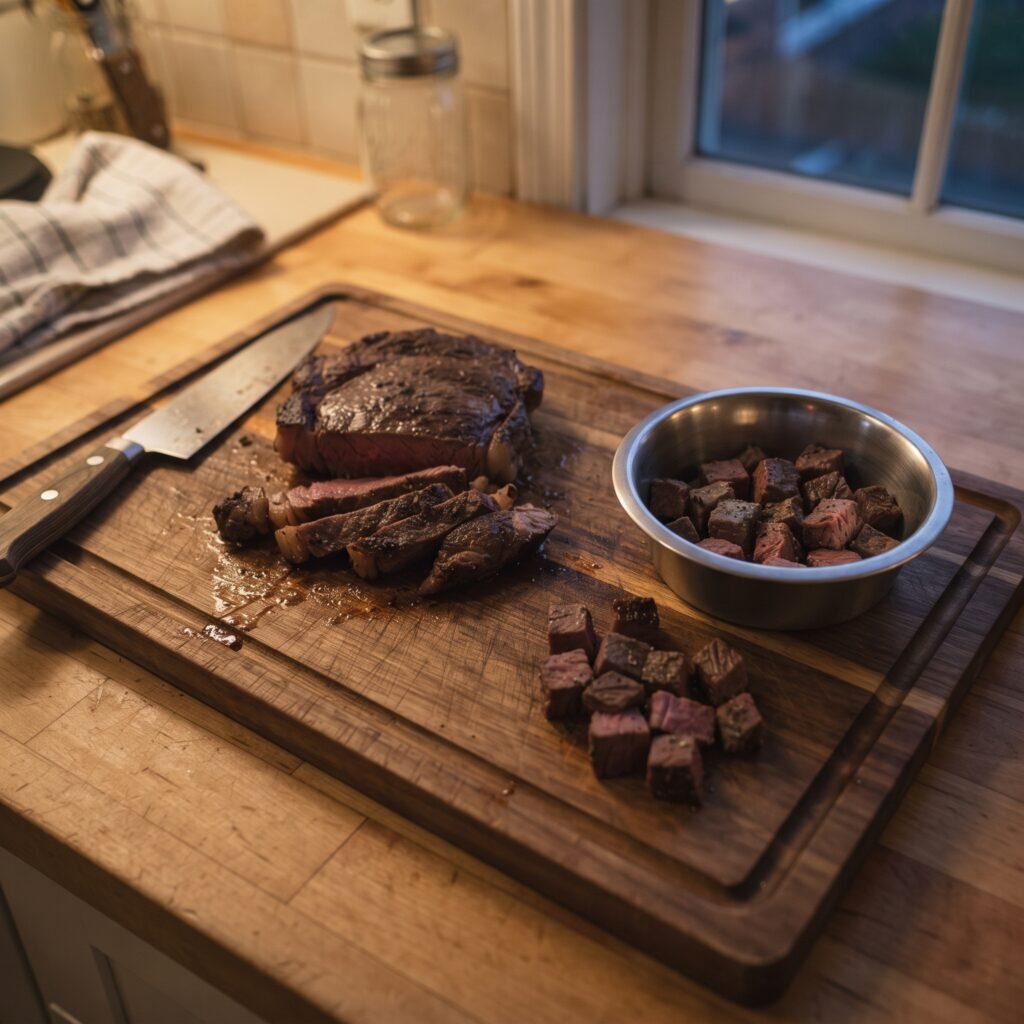
Before I answer “can dogs eat steak” for any given plate, I sort the meat into three piles. Physically. On the board.
Pile 1 — goes in the bowl. Interior muscle meat, no crust, no visible fat marbling beyond the natural streaks, no gristle. This is the only pile that touches dog food.
Pile 2 — goes in the fridge for me. The seasoned outer crust, the edges that sat in marinade, anything with a pepper or salt coating I can see.
Pile 3 — goes in the bin. The fat cap, the silverskin, the gristle, and any bone. All of it. Every time.
That’s the whole system. The reason it works is that the question “can dogs eat steak” has four separate answers depending on which pile you’re holding, and most people only ever hear the answer for pile one.
The rest of this guide explains why each pile lands where it does, and how much of pile one your specific dog can actually have.
Why I trim before I decide, not after
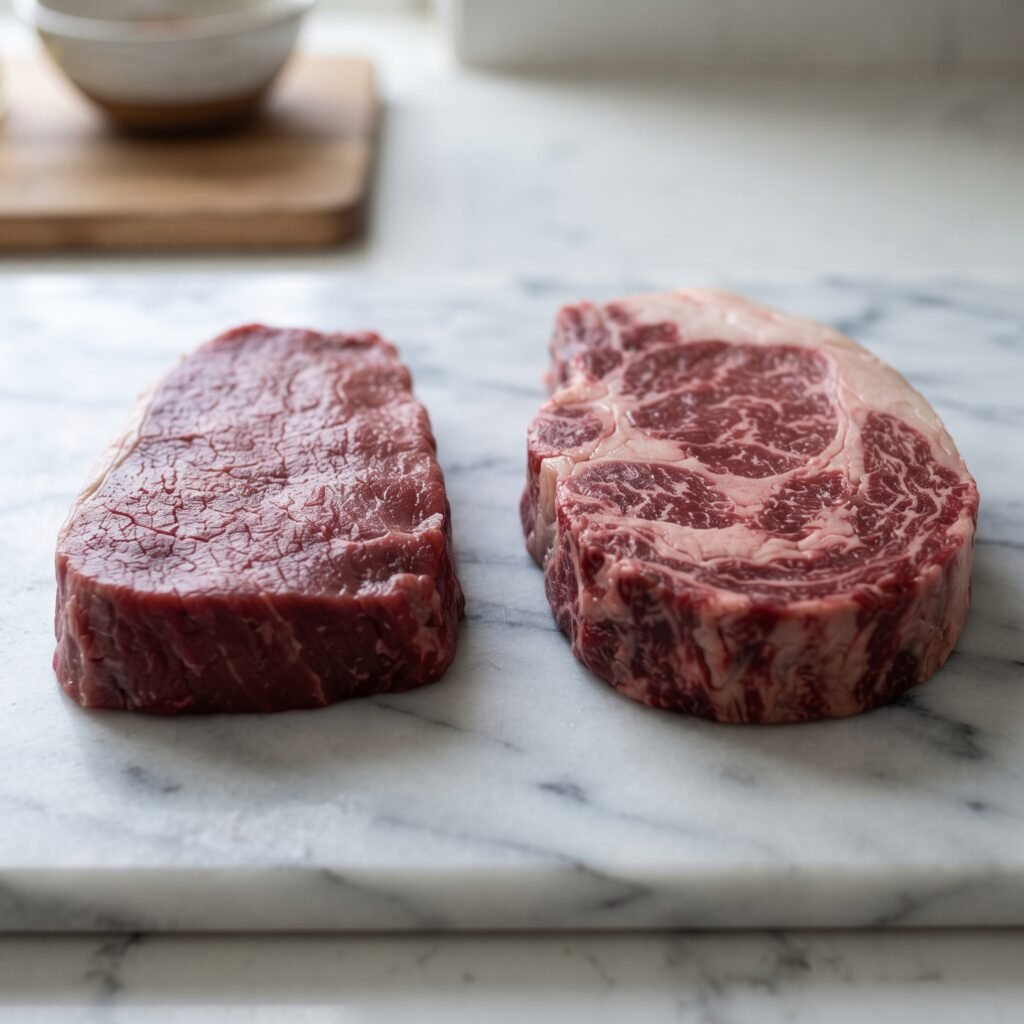
Trimming first changes the answer. A 3-ounce piece of untrimmed ribeye and a 3-ounce piece of trimmed ribeye are not the same food — the fat content can nearly double.
So when someone asks me can dogs eat steak and I say “it depends on the cut,” what I really mean is it depends on what’s still attached to the cut when it hits the bowl.
Can Dogs Eat Steak From Any Cut? Here’s the Comparison Table
Not all steak is the same food nutritionally. The fat spread between a trimmed top sirloin and an untrimmed ribeye is wide enough to matter a lot for a small dog.
These are approximate values for a 3-ounce (85g) cooked portion, trimmed of the external fat cap. Treat them as planning numbers, not lab results.
| Cut | Approx. calories (3 oz cooked) | Fat (g) | Protein (g) | My verdict for dogs |
|---|---|---|---|---|
| Top sirloin (trimmed) | 160–180 | 6–8 | 25–26 | Best default choice |
| Eye of round | 140–160 | 4–6 | 24–25 | Leanest; good for weight-managed dogs |
| Filet / tenderloin | 175–190 | 8–9 | 24–26 | Fine, but expensive for a topper |
| Flank steak | 170–190 | 8–9 | 23–24 | Good, but chewy — cut small |
| NY strip (trimmed) | 190–210 | 10–12 | 24–25 | Acceptable in small portions |
| T-bone / porterhouse | 200–220 | 12–14 | 22–24 | Meat OK, bone never |
| Ribeye (trimmed) | 230–260 | 17–20 | 22–24 | Too rich for most dogs |
| Ribeye (untrimmed) | 290–330 | 24–28 | 20–22 | Skip it |
| Chuck eye | 210–240 | 14–16 | 22–24 | Occasional only |
Read that table as a fat ladder. When people ask can dogs eat steak, the honest reply is that trimmed sirloin and untrimmed ribeye are two different decisions with two different risk profiles.
A 20-pound dog getting 3 ounces of untrimmed ribeye just took on roughly 26 grams of fat in one sitting. That’s a genuinely large fat load for a small body, and it’s the single most common way a well-meaning steak night turns into a vet visit.
The cut I reach for most
Top sirloin, trimmed, cut into pea-sized cubes. It’s lean, it holds together instead of shredding into a greasy mess, and it doesn’t crumble into the kibble and coat everything.
Flank steak is nutritionally similar but it’s stringy. I’ve watched my dog inhale a half-inch strip of flank without a single chew, which is exactly how you end up with a coughing dog. Cut it smaller than you think you need to.
Grade changes the answer too
Prime, Choice, and Select aren’t quality tiers so much as marbling tiers, and marbling is intramuscular fat you can’t trim off. A Prime ribeye carries meaningfully more fat than a Select one from the same cut.
So can dogs eat steak from a Prime cut? Technically yes, but you’ve stacked the fattest grade on top of the fattest cut. If I’m buying Prime, the dog gets sirloin from a different package.
Wagyu and heavily marbled specialty beef sit even further along that ladder. Can dogs eat steak that’s 40% fat by weight? They can swallow it. They shouldn’t be given it.
Can Dogs Eat Steak Fat? This Is Where Most People Go Wrong
No. And this is the part I’d underline twice if I could.
The fat cap — that white band along the edge of a strip or ribeye — is the piece people most often hand over, because it’s the piece we don’t want. It feels like a kindness. It’s the highest-risk part of the whole steak.
Large fat loads are a well-recognized trigger for pancreatitis in dogs, and the classic clinical picture is a dog who got into rich table scraps. Vomiting, a hunched posture, refusal to eat, sometimes diarrhea. It can be severe.
So when the question is can dogs eat steak fat specifically, the answer isn’t “in moderation.” It’s no, as a standing rule, because the moderate dose is small enough that you’re not really giving them anything anyway.
Gristle and silverskin belong in the bin too
Silverskin is that shiny connective membrane. It doesn’t break down when cooked and it doesn’t break down in a stomach either — I’ve seen it come back out the other end essentially intact. Chunks of gristle also carry a real choking and obstruction risk for dogs who swallow first and think later.
Can dogs eat steak trimmings as a general category? Not the ones you were planning to throw out. Those are trimmings for a reason.
How Much Steak Can a Dog Eat Before It’s Too Much?
How much steak can a dog eat before the extras start distorting the diet? The rule I use is the standard 10% guideline: treats and extras should stay under 10% of daily calories, with the other 90% coming from a complete and balanced diet.
To make that concrete, here’s roughly what 10% looks like for a neutered adult dog at a healthy weight, using trimmed top sirloin at about 55 calories per ounce.
| Dog’s weight | Approx. daily calories | 10% treat budget | Trimmed sirloin equivalent |
|---|---|---|---|
| 10 lb | ~340 kcal | ~34 kcal | ~0.6 oz (about 1 tbsp, cubed) |
| 25 lb | ~690 kcal | ~69 kcal | ~1.2 oz |
| 40 lb | ~980 kcal | ~98 kcal | ~1.8 oz |
| 60 lb | ~1,320 kcal | ~132 kcal | ~2.4 oz |
| 80 lb | ~1,650 kcal | ~165 kcal | ~3.0 oz |
Two things to notice.
First, these are small numbers. For a 10-pound dog, the honest answer to can dogs eat steak is “yes, about a tablespoon of it,” which is a lot less generous than most people picture.
Second, when you work out how much steak can a dog eat on a given day, that budget is the whole treat budget. If your dog already had two biscuits and a dental chew, the steak allowance is what’s left over, not a bonus on top.
The math I do at the counter
I don’t weigh anything at 9pm. I use my thumb.
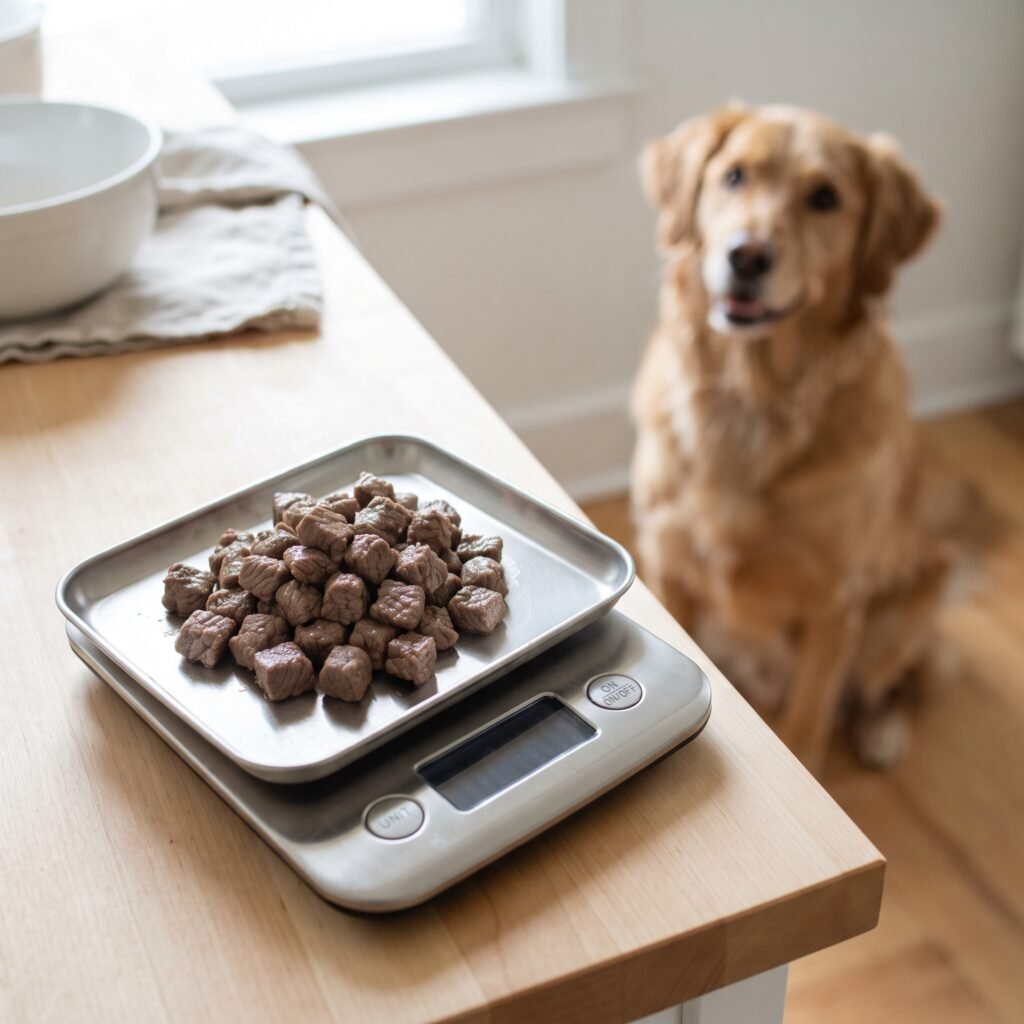
A cube roughly the size of my thumb tip is about a quarter-ounce of trimmed sirloin, call it 14 calories. Four of those is an ounce. For my 42-pound dog that means seven or eight thumb-tip cubes is the ceiling on a day when he hasn’t had other treats.
That estimate is deliberately rough, and rough is fine — the point of asking can dogs eat steak in portion terms is to keep you from free-pouring, not to hit a gram target.
Can Dogs Eat Steak as a Training Treat?
This is where the portion math quietly breaks, and it’s worth its own section.
Steak is an extremely high-value reward. For recall work or vet-visit desensitization, it outperforms almost anything commercial. That’s a real advantage and I use it.
The problem is arithmetic. A ten-minute training session might involve forty rewards. At a quarter-ounce each, that’s ten ounces of steak — roughly five times a 40-pound dog’s entire daily treat budget.
So can dogs eat steak during training? Yes, if you shrink the reward to something absurd. I cut training pieces to about the size of a pencil eraser, which is maybe a twentieth of an ounce. Forty of those is still only two ounces.
Dogs respond to the rate of reward far more than the size of it. A pea-sized piece delivered forty times beats a thumb-sized piece delivered five times, and it keeps you inside the budget.
One practical note: steak gets slippery and greasy in a pocket. I mix the cubes with a spoonful of their kibble in the treat pouch so they don’t clump, which also stretches the steak further.
Can Dogs Eat Steak With Seasoning, Marinade, or Sauce?
This is the pile-two question, and the answer is a clean no for anything you seasoned for human taste.
The problem isn’t salt alone, though salt matters. It’s the allium family — garlic and onion, plus shallots, leeks, and chives. Alliums damage canine red blood cells and can cause anemia, and the powdered forms are far more concentrated by weight than the fresh ones.
Now look at what’s actually in a normal steak preparation. Garlic powder, onion powder, Worcestershire sauce, soy sauce, steak seasoning blends, compound butter with garlic, chimichurri with raw garlic. Almost every standard treatment includes an allium, which is why can dogs eat steak with seasoning is really a question about garlic and onion rather than salt.
So can dogs eat steak that’s been marinated? Not the marinated parts. The interior of a thick cut is usually largely unseasoned, which is why I cut in from the middle rather than handing over an end piece.
Can dogs eat steak with seasoning if it’s just salt and pepper?
Slightly different risk, still not something I’d offer.
A small amount of salt won’t harm a healthy dog with water available, but the crust is also where the char and the concentrated seasoning sit. And it sets a habit: once the seasoned edge is fair game, the garlic-butter edge starts looking fair game too.
I’d rather have one simple rule than a sliding scale I have to re-litigate every time someone asks can dogs eat steak with seasoning still on it.
Butter, oil, and the pan drippings
No to all three, and pan drippings especially. They’re essentially concentrated fat plus concentrated seasoning, which is both hazards in one spoon.
Pouring drippings over kibble is a common habit and one of the fastest routes to a fat-triggered GI episode.
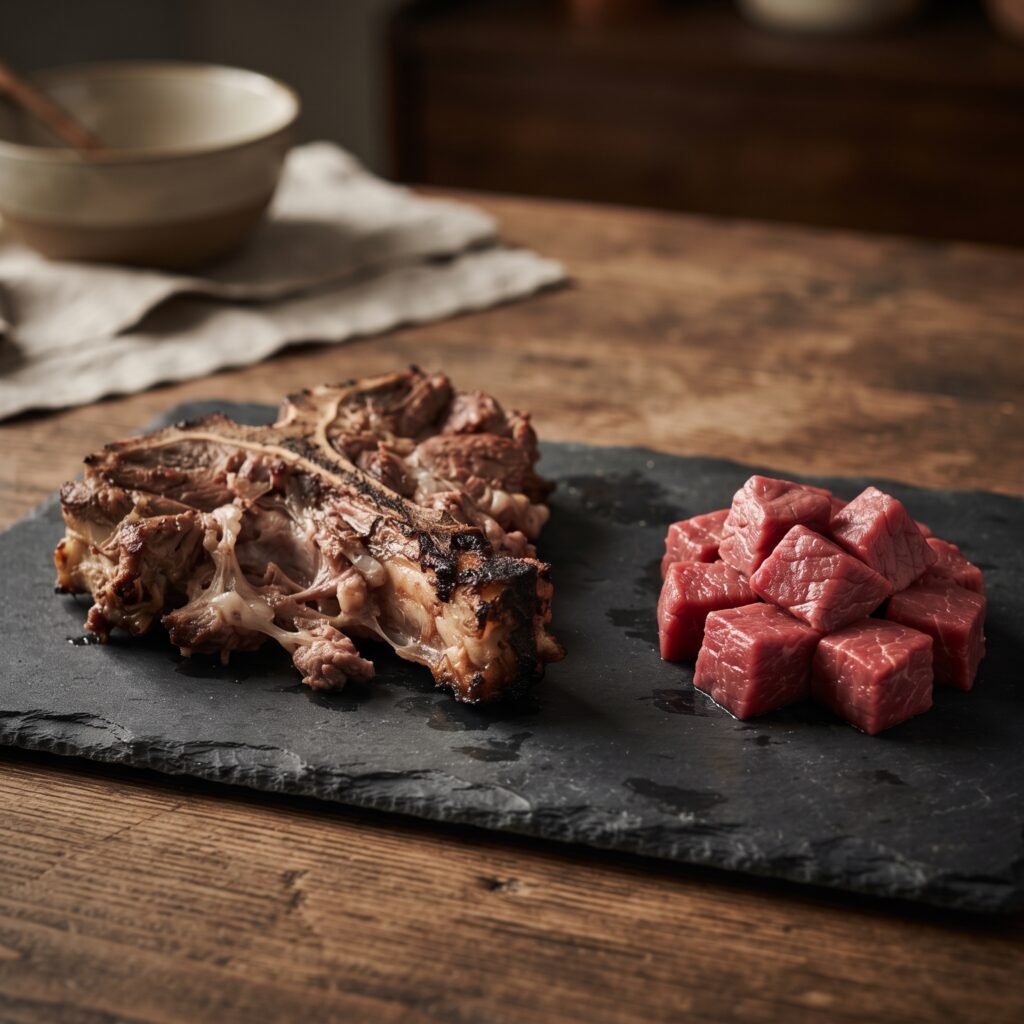
Can Dogs Eat Steak Raw, or Should It Always Be Cooked?
Cooked. That’s my position, and I’ll give you the honest version of both sides.
The FDA has consistently warned about pathogen risk in raw meat diets, primarily Salmonella and Listeria, and the risk isn’t only to the dog — it’s to the humans handling the bowl, the counter, and the dog’s face afterward. That risk is real and documented through recall activity in the raw pet food category.
The counter-argument from raw feeders is that dogs eating raw steak handle bacterial loads better than we do, and there’s some truth in that. But “usually handles it” isn’t the same as “safe for the household,” and I’m not comfortable making that trade on a leftover.
So when someone asks can dogs eat steak raw, my answer is that they can, biologically, and that I don’t recommend it — particularly in homes with young children, elderly members, or anyone immunocompromised.
How I cook it when I’m cooking specifically for the dog
Plain. No oil, no salt, dry pan or boiled.
I sear a trimmed piece of sirloin in a dry nonstick pan until it’s cooked through, let it cool completely, then cube it. It smells like almost nothing — which is the tell that you did it right. If the kitchen smells amazing, you seasoned it.
Cooking through also settles the medium-rare question, since a rare interior still carries surface bacteria folded inward during handling.
Can Dogs Eat Steak Bones? The T-Bone Problem
No. Not cooked, not ever, and this is the hill I’ll die on.
Cooked bone becomes brittle and splinters along sharp lines. The documented risks include mouth and throat injuries, esophageal damage, intestinal obstruction, and perforation.
T-bones and porterhouses add a second problem: the dense vertebral bone is hard enough to fracture teeth. Slab fractures of the upper carnassial are a classic hard-chew injury, and they usually mean extraction or a root canal.
So the answer to can dogs eat steak bones is a flat no even though it feels stingy. The bone is the part of the steak your dog wants most and the part that has actually sent dogs to emergency surgery.
If your dog already grabbed one
Don’t induce vomiting — a bone that splintered on the way down will splinter on the way back up. Call your vet or an emergency clinic and describe the size of the bone and the size of your dog. That’s the whole protocol.
Where This Approach Failed For Me
Here’s the part I’d want to read if I were you.
My triage assumes the problem is the fat and the seasoning. For about two years, I ran it perfectly — trimmed sirloin, no crust, portion-controlled — and my dog still got loose stools roughly one time in three after steak nights.
I blamed the trimming. I blamed cross-contamination from the board. I cut the portion in half, then in half again, down to about half an ounce for a 42-pound dog, which is a genuinely trivial amount.
Still happened.
What finally fixed it wasn’t the steak at all. It was the timing. He was getting steak as a topper on top of his normal full dinner, so the total meal volume and total fat for that sitting were both higher than a normal day — even though the steak portion itself was tiny.
Once I started removing an equivalent volume of kibble and letting the steak replace part of the meal instead of adding to it, the problem essentially disappeared. Two episodes in the eighteen months since, both on days I’d been sloppy about it.
So the honest limitation of “can dogs eat steak in small portions” is that portion size alone doesn’t protect a sensitive dog. Meal composition does. If your dog reacts to steak despite careful trimming, look at what else was in the bowl at the same time before you conclude beef is the problem.
I’ve also had it fail in the opposite direction. A friend’s terrier tolerates ribeye trimmings with no issue whatsoever, which is a useful reminder that these are population-level rules, not laws of physics. Your dog’s tolerance is your dog’s.
Which is the uncomfortable part of answering can dogs eat steak for someone else’s dog: I can tell you where the risk sits, but I can’t tell you where your individual dog’s line is. Only a few careful small portions will.
Which Dogs Should Skip Steak Entirely?
The general answer to can dogs eat steak assumes a healthy adult dog. Several groups fall outside that assumption.
Dogs with a history of pancreatitis
Skip it, or clear it with your vet first. A dog who has had one episode is at elevated risk for another, and fat load is the lever you can actually control.
Miniature Schnauzers deserve a specific mention here. The breed has a documented predisposition toward elevated blood triglycerides, and that lipid tendency is associated with higher pancreatitis risk. If you have a Schnauzer, I’d treat even trimmed steak as an occasional very small extra, not a routine.
Can puppies eat steak? Not really — here’s why
Their diet needs to be tightly balanced for growth, particularly calcium and phosphorus. Muscle meat is heavily phosphorus-weighted and calcium-poor — roughly the inverse of what a growing skeleton needs.
AAFCO growth profiles specify calcium-to-phosphorus ratios within a defined range for good reason. So can puppies eat steak? A tiny taste won’t hurt, but it displaces balanced calories at the worst possible life stage. I’d wait until the growth plates close.
Owners of large-breed puppies ask me whether puppies can eat steak more than any other group, usually because they’re trying to add protein for growth. That instinct backfires: large-breed growth formulas are carefully calcium-controlled, and unbalanced meat toppers are exactly what those diets are designed to avoid.
Dogs on prescription or therapeutic diets
Kidney diets restrict phosphorus and often moderate protein. Steak is high in both. Low-fat GI diets exist specifically to control the variable steak is worst at.
If your dog is on a therapeutic food, the topper undermines the prescription. Ask your vet before adding anything, including this.
Overweight dogs
The 10% budget is calculated off ideal weight, not current weight. And on a weight-loss plan, eye of round or a plain green bean buys more satiety per calorie than sirloin does.
Seniors with dental disease
An 11-year-old with missing premolars can’t process a chewy flank steak. Cut smaller, or choose a softer protein. The risk here is swallowing a piece whole rather than any nutritional issue.
Can dogs eat steak with reduced dentition? Yes, if you do the chewing for them with a knife. Mince it rather than cube it.
Storage, Reheating, and the Three-Day Question
Leftover steak is where most of these decisions actually happen, so the storage rules matter.
Refrigerate cooked steak within two hours and use it within three to four days. That’s the standard food-safety window for cooked meats and it applies to the dog’s portion exactly as it applies to yours.
If it smells off to you, it’s off for the dog too. Dogs have vastly better noses than we do and vastly worse judgment about acting on them.
Can dogs eat steak that’s been left on the counter overnight? No — and neither can you. The two-hour rule is the two-hour rule.
Should I reheat it?
Not necessary — cold is fine, as long as you’re not reheating it in butter or drippings and reintroducing the fat you trimmed away. Room temperature sits easier on a sensitive stomach, so I pull the portion out ten minutes early.
Freezing dog portions
This is the trick that made steak sustainable in my house. When I trim, I cube the dog-safe portion, freeze it flat on a tray, then bag it.
A frozen quarter-ounce cube thaws in about five minutes in a palm, and pre-portioning removes the biggest failure point in the whole system — the moment where you eyeball it and go slightly over. Can dogs eat steak safely long-term? Much more easily when you decided the portion three weeks ago instead of at 9pm.
Methodology: How I Evaluated This
The nutrient figures in the cut comparison table are drawn from standard published composition values for cooked beef cuts, presented as ranges because trim level, grade, and cooking method all shift the numbers meaningfully. I’ve rounded rather than implying false precision.
For safety guidance, I cross-checked three things: AAFCO nutrient profile principles for adult maintenance and growth (particularly protein, fat, and the calcium-to-phosphorus relationship), FDA guidance and recall history around raw meat pet food and pathogen risk, and established veterinary consensus on allium toxicity, cooked bone hazards, and dietary fat as a pancreatitis trigger.
Where a specific figure isn’t verifiable, I’ve said so in general terms rather than inventing a statistic. The calorie budgets in the portion table are calculated from standard resting energy requirement formulas with a typical neutered-adult activity multiplier — they’re planning estimates, and your vet’s number for your dog beats mine.
The first-hand observations are from feeding my own dog and from years of asking other owners what actually went wrong at their houses. Most of the useful nuance in “can dogs eat steak” turns out to live in those stories rather than in the nutrient tables.
Reviewed for: ingredient safety, AAFCO nutrient profile alignment, and recall-history relevance. This article is general nutrition information and does not replace individualized veterinary advice.
Frequently Asked Questions
Can dogs eat steak every day?
I wouldn’t. Even at a compliant 10% portion, daily steak means a daily unbalanced addition, and the phosphorus load adds up for older dogs whose kidney function you may not have tested yet. A few times a week is plenty, and rotating proteins is better than committing to one.
Can dogs eat steak fat trimmings if they’re cooked?
No — cooking doesn’t reduce the fat content, it just renders some of it out while the rest stays. Cooked fat trimmings are still a concentrated fat load and still a pancreatitis risk, especially for small dogs and predisposed breeds. Bin them.
Can dogs eat medium rare steak?
A healthy adult dog will usually be fine, but the risk isn’t zero, and it extends to everyone who handles the bowl. Surface bacteria can be transferred to the interior during handling and slicing, so a rare center isn’t automatically clean. I cook the dog’s portion through.
Can dogs eat steak if they have a chicken allergy?
Usually yes — beef and chicken are different proteins, so a chicken-sensitive dog often tolerates beef without issue. That said, beef is itself one of the more common canine food allergens, so introduce it in a small single portion and watch for 48 hours before making it routine.
How much steak can a 20 pound dog eat?
Roughly an ounce of trimmed lean steak, which works out to about 55 calories, or around 10% of a typical 20-pound dog’s daily intake. If they’ve had other treats that day, cut it down accordingly — the budget is shared, not stacked.
Can dogs eat steak and rice for an upset stomach?
Boiled chicken or lean ground turkey is the better bland-diet protein, because steak is fattier than either even when trimmed. If steak is genuinely all you have, boil a lean cut, drain it, and pair it with plain white rice — but call your vet if the upset lasts beyond 24 hours.
Can dogs eat steak bones if they’re raw instead of cooked?
Raw bones splinter less than cooked ones, but the tooth-fracture risk from a dense T-bone doesn’t change with cooking, and raw bones add the pathogen exposure discussed above. I don’t give steak bones in either state.
The Bottom Line
Can dogs eat steak? Yes — and the version of yes that’s actually useful is narrower than the headline.
Plain interior muscle meat, trimmed, cooked through, cut small, portioned against your dog’s real calorie budget, and swapped in for part of a meal rather than piled on top of one. That’s the whole safe version.
The fat cap, the gristle, the seasoned crust, the marinade, and the bone are the parts that cause problems, and they’re the parts we most instinctively want to hand over because we don’t want them ourselves.
If you take one thing from this: trim first, then decide. The answer to can dogs eat steak changes completely depending on what’s still attached when it reaches the bowl.
And if your dog reacts badly despite doing everything right, look at the whole meal before you blame the beef. That’s the mistake that cost me two years.