
Pedigree Canned Dog Food: The Topper Math Most Owners Get Wrong
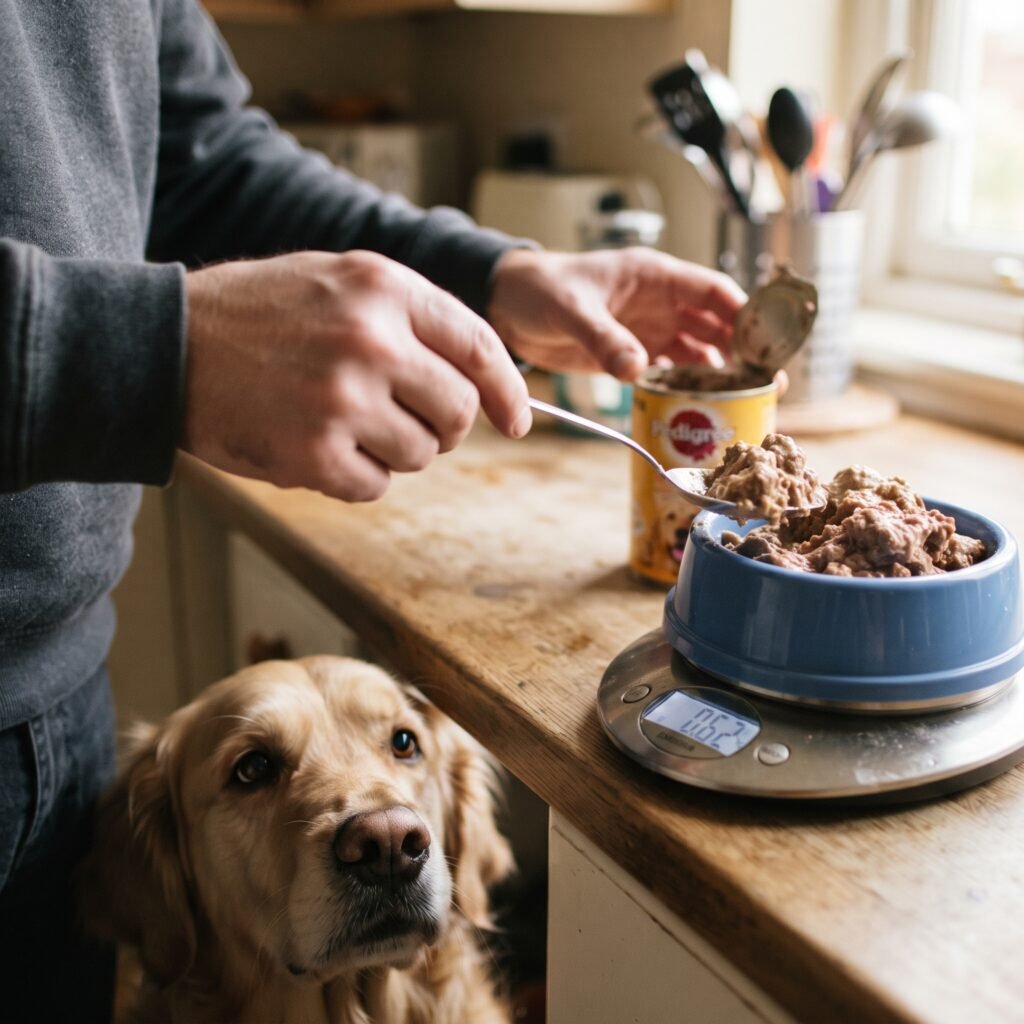
Short answer: Because Pedigree canned dog food is AAFCO complete-and-balanced for adult maintenance, the 10% treat rule doesn’t limit it — you can replace up to 100% of a meal. The real limit is calories. One 13.2 oz can runs roughly 390–408 kcal, which is close to half a 30 lb dog’s daily intake.
That number is the whole article.
Most owners I talk to treat Pedigree canned dog food as a garnish. They spoon half a can over a full cup of kibble, feel good about the upgrade, and six weeks later the dog is two pounds heavier and won’t touch dry food without gravy on it.
The mistake isn’t the food. It’s the arithmetic. Half a can of Pedigree canned dog food is not a flavor accent — it’s about 195 calories, which for a beagle is a quarter of the day.
So this piece is about a specific decision: you’ve got a bag of kibble, a case of cans, and a dog who’s bored, elderly, dental-compromised, or just picky. How much Pedigree canned dog food goes in the bowl, what comes out of the bowl to make room, and when should you not do this at all?
I’ll give you the label numbers, the dry-matter conversions, my cost-per-calorie spreadsheet, the two dogs this approach failed with, and the reason I now read the mixing instructions on the can instead of the feeding chart.
Recommended Products

Best Dog Food in 2026
Why doesn’t the 10% rule apply to Pedigree canned dog food?
Here’s the thing almost every summary gets backwards.
The 10% rule — the one that says toppers and treats shouldn’t exceed a tenth of daily calories — exists to protect the nutritional balance of the base diet. Add too much unbalanced food and you dilute the vitamins, minerals, and amino acids the complete diet was engineered to deliver.
Pedigree canned dog food isn’t unbalanced. The Chopped Ground Dinner line carries an AAFCO complete-and-balanced statement for adult maintenance, and the packaging is explicit that it can be fed as a topper, mixed with dry, or served as the entire meal.
That changes the math completely. Adding Pedigree canned dog food to kibble isn’t topping — it’s substitution. You’re swapping one complete diet for another, in whatever ratio you like.
Which means the constraint is no longer balance. It’s calories, cost, and your dog’s gut.
What the can actually tells you to do
Pedigree prints two different instructions on their canned line, and they answer two different questions.
The feeding guideline — roughly 1/3 to 2/3 of a 13.2 oz can per 10 lb of adult dog per day — is for feeding Pedigree canned dog food as the sole diet. For a 30 lb dog that’s one to two full cans daily.
The mix-it-up instruction is the one you want: replace about half a can of Pedigree canned dog food for every 2/3 cup of dry Pedigree kibble you remove. Some variety packs phrase it as 3/4 can per 1 cup of dry.
That second instruction is the useful one, and it’s the one people skip. It tells you what to take out, not just what to put in.
If you only read the feeding chart, you’ll add Pedigree canned dog food on top of a full kibble portion and overfeed by 200–400 calories a day. That’s the failure mode, and it’s why so many owners report weight gain after switching to wet.
How many calories are actually in a can?
Real label figures, taken from cans I’ve had in my own cupboard. Verify against your current batch — Mars reformulates and the numbers drift.
| Pedigree canned dog food variety | Size | kcal ME/kg | kcal per can | Protein (min) | Fat (min) | Moisture (max) |
|---|---|---|---|---|---|---|
| Chopped Ground Dinner, Chicken | 13.2 oz | 1,070 | 401 | 8.0% | 6.0% | 78.0% |
| Chopped Ground Dinner, Beef | 13.2 oz | 1,043 | 391 | 8.0% | 6.0% | 78.0% |
| Chopped Ground Dinner, Filet Mignon Flavor | 13.2 oz | 1,088 | 408 | 8.0% | 6.0% | 78.0% |
| Chopped Ground Dinner, Turkey & Bacon Flavor | 13.2 oz | 1,080 | 405 | 8.0% | 6.0% | 78.0% |
| Chopped Ground Dinner Weight Management, Chicken & Rice | 13.2 oz | 779 | 292 | — | — | — |
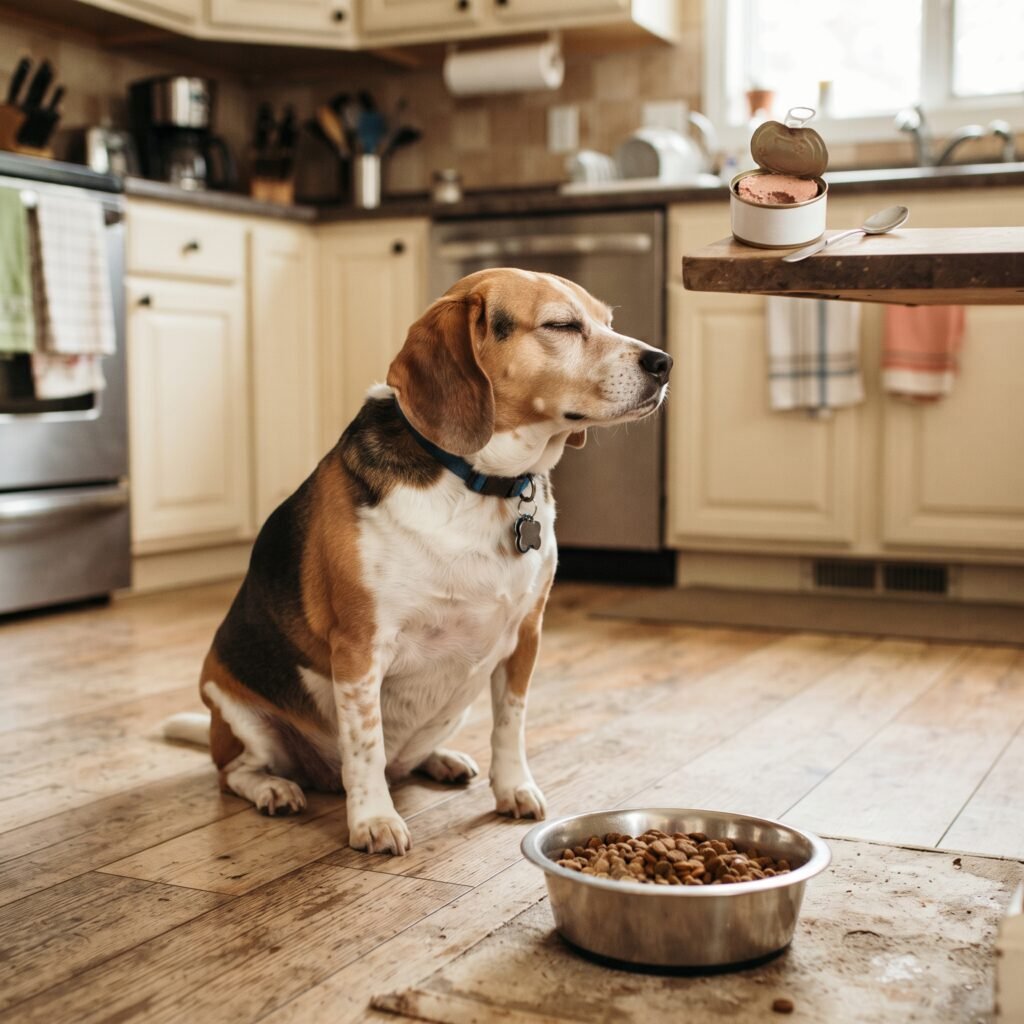
Note the last row. The Weight Management version of Pedigree canned dog food carries roughly 27% fewer calories per can than the standard Chopped Ground Dinner. That single swap is the easiest fix for the overfeeding problem, and it costs about the same.
I’ve also seen 48-count case listings quoting higher figures — 439 kcal/can for chicken, 420 for beef. Same product name, different numbers. Read your own can.
Doing the swap for a real dog
Let’s use a 30 lb dog at roughly 800 kcal/day, eating about 2.25 cups of adult kibble.
You want to move a third of that to Pedigree canned dog food. That’s ~265 kcal.
At 401 kcal per can, 265 kcal is about 2/3 of a can of Pedigree canned dog food. To make room, you remove roughly 3/4 cup of kibble.
Now compare that to what most people actually do: they leave the 2.25 cups alone and add half a can. That’s 195 extra calories — a 24% daily surplus. Sustained for a month, that’s real weight.
The mix-it-up ratio on the can does this math for you. Use it.
What do the Pedigree canned dog food ingredients look like on a dry matter basis?
Guaranteed analysis percentages on wet food are almost meaningless as printed, because 78% of what’s in the can is water. To compare Pedigree canned dog food against kibble, you have to convert both to dry matter.
The conversion: divide the nutrient percentage by the dry matter percentage (100 minus moisture).
For Pedigree canned dog food at 8% protein and 78% moisture, dry matter is 22%. So 8 ÷ 22 = 36.4% protein on a dry matter basis. Fat: 6 ÷ 22 = 27.3%.
| Metric | Pedigree canned (Chopped Ground Dinner) | Typical adult kibble | AAFCO adult maintenance minimum |
|---|---|---|---|
| Moisture | 78% | ~10–12% | — |
| Dry matter | 22% | ~88–90% | — |
| Protein, as fed | 8.0% | ~21% | — |
| Protein, dry matter basis | 36.4% | ~23.9% | 18.0% |
| Fat, as fed | 6.0% | ~10% | — |
| Fat, dry matter basis | 27.3% | ~11.4% | 5.5% |
| Fiber, dry matter basis | ~4.5% | ~4% | — |
This surprises people. On a dry matter basis, Pedigree canned dog food carries substantially more protein and roughly double the fat of the average budget kibble.
That’s not a marketing claim — it’s just what happens when you remove the water and look at what’s left.
It also explains two things at once: why picky dogs go for the cans, and why the fat content matters for certain dogs. Hold that second point; I’ll come back to it in the edge cases.
The Pedigree canned dog food ingredients themselves are straightforward and unglamorous. A typical chicken variety opens with chicken, sufficient water for processing, meat by-products, animal liver, brewers rice, and wheat flour, followed by the mineral and vitamin premix, carrageenan, sodium tripolyphosphate, dried yam, and gums.
Meat by-products get a bad reputation they only partly deserve. Organ meat is nutritionally dense and it’s what the by-product designation usually covers. It’s not a red flag — it’s a signal that you’re buying commodity protein rather than named muscle cuts, which is exactly what the price reflects.
The added colors are harder to defend. Yellow #5, Yellow #6, and Red #3 appear across several varieties, and they exist for the human buying the can. Your dog does not care whether the chunks look beefy. If artificial color is a dealbreaker for you, that’s a legitimate reason to look elsewhere, and I won’t argue you out of it.
Which line should you buy for mixing?
Not all Pedigree canned dog food behaves the same in a bowl. Texture matters more than the flavor name.
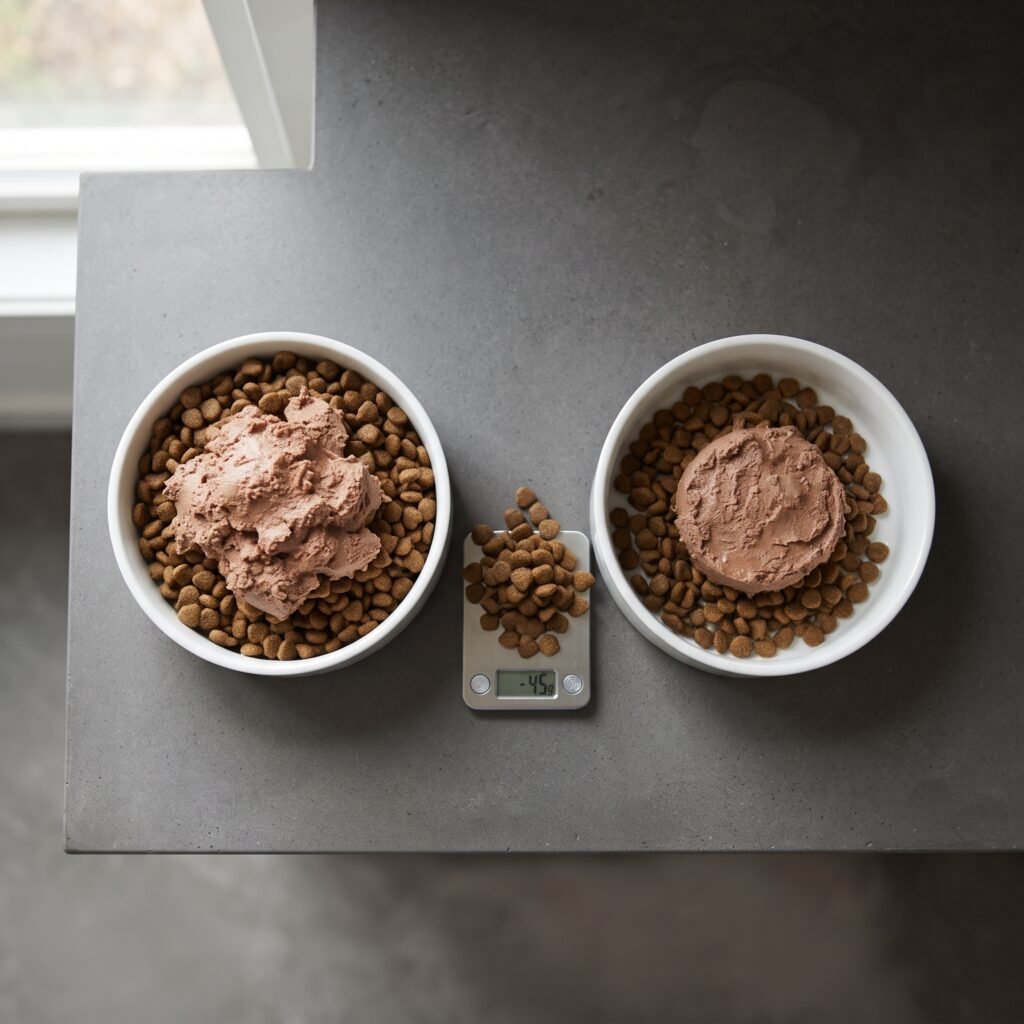
Pedigree Chopped Ground Dinner is a dense, uniform pâté-style loaf. It breaks into crumbles under a fork and coats kibble well. This is the one I use for mixing.
Choice Cuts in Gravy is chunks suspended in a thin sauce. The gravy soaks straight into kibble within about a minute, which sounds great and isn’t — the kibble goes soggy while the chunks stay separate, and picky dogs eat around the chunks and leave the mush.
Homestyle / Stew-style varieties sit between the two.
For a dog who needs to actually consume the kibble, the pâté texture wins. For a dog who’s eating wet only, the chunks-in-gravy formats are fine and often preferred.
One practical detail on the Pedigree Chopped Ground Dinner cans: it comes out as an intact cylinder that holds the shape of the can, closer to firm meatloaf than to canned cat food. Mine takes about four passes with a fork to break down properly. It smells strongly savory and faintly sweet — noticeable across a kitchen, which is the point for an inappetent dog and a downside if you’re sensitive to it.
If you’re weighing portions, half a 13.2 oz can is roughly 187 g. I keep a cheap kitchen scale next to the cans because eyeballing “half” reliably drifts to about 60% in the dog’s favor.
What does Pedigree canned dog food cost per 100 calories?
This is where the decision usually gets made, and it’s the calculation almost nobody runs.
| Food | Typical price | Calories | Cost per 100 kcal |
|---|---|---|---|
| Pedigree canned dog food, 13.2 oz (12-pack) | ~$1.70/can | ~400 kcal | ~$0.43 |
| Pedigree adult dry kibble, 40 lb bag | ~$45 | ~66,000 kcal | ~$0.07 |
| Mid-tier premium canned, 12.5 oz | ~$3.40/can | ~475 kcal | ~$0.72 |
| Fresh-cooked subscription food | ~$5.50/day (30 lb dog) | ~800 kcal | ~$0.69 |
Prices move constantly and vary by region, so treat these as ratios rather than quotes.
The ratio that matters: Pedigree canned dog food costs roughly six times more per calorie than the same brand’s kibble, and roughly 40% less than mid-tier premium wet food.
For a 30 lb dog, moving one third of daily calories to Pedigree canned dog food adds about $0.95 a day. Call it $29 a month. Moving the entire diet to it costs roughly $3.40 a day, or about $100 a month.
That’s the honest trade-off. Pedigree canned dog food is not cheap food — it’s cheap wet food. Wet food of any kind is expensive per calorie because you’re paying to ship water.
If budget is the binding constraint and the dog eats kibble happily, the cans are a luxury. If the dog won’t eat, has dental disease, or needs the moisture, they’re the least expensive way to solve a real problem.
When did Pedigree canned dog food not work for me?
Twice, memorably. Both failures were mine, not the food’s, but they’re worth knowing about.
The first was a nine-year-old beagle mix. I started adding half a can of Pedigree canned dog food to her evening meal because she’d gotten indifferent about dinner. It worked immediately — she cleaned the bowl for the first time in weeks.
Then it kept working, and I kept doing it, and I never took the kibble back out. Ten weeks later she’d gained just under three pounds on a 26 lb frame. That’s over 11% of her body weight.
Worse, she’d stopped eating plain kibble entirely. Not “reluctantly ate it” — she’d sniff the bowl and walk away. I had to spend a month tapering the wet portion down while she held out, and she won several of those standoffs.
The lesson: Pedigree canned dog food is very palatable, and palatability is a one-way ratchet. Once a dog knows dinner can taste like that, plain kibble becomes a negotiation. If you start, plan to continue.
The second was a 40 lb boxer mix with a genuinely sensitive stomach. He’d been on a limited-ingredient diet and I moved him onto Pedigree canned dog food too fast — three days instead of ten, because he was refusing the LID food and I got impatient.
Loose stool for six days. Not dramatic, but unpleasant for both of us. When I restarted properly over twelve days, he handled the same food without a problem.
I suspect the fat was part of it. At 27.3% fat on a dry matter basis, Pedigree canned dog food is a meaningful jump for a dog coming off a lower-fat formula, and sensitive guts notice fat changes more than protein changes.
That dog is also the reason I’d hesitate to recommend Pedigree canned dog food as the best canned dog food for senior dogs with any history of pancreatitis. More on that next.
Which dogs shouldn’t be eating this?
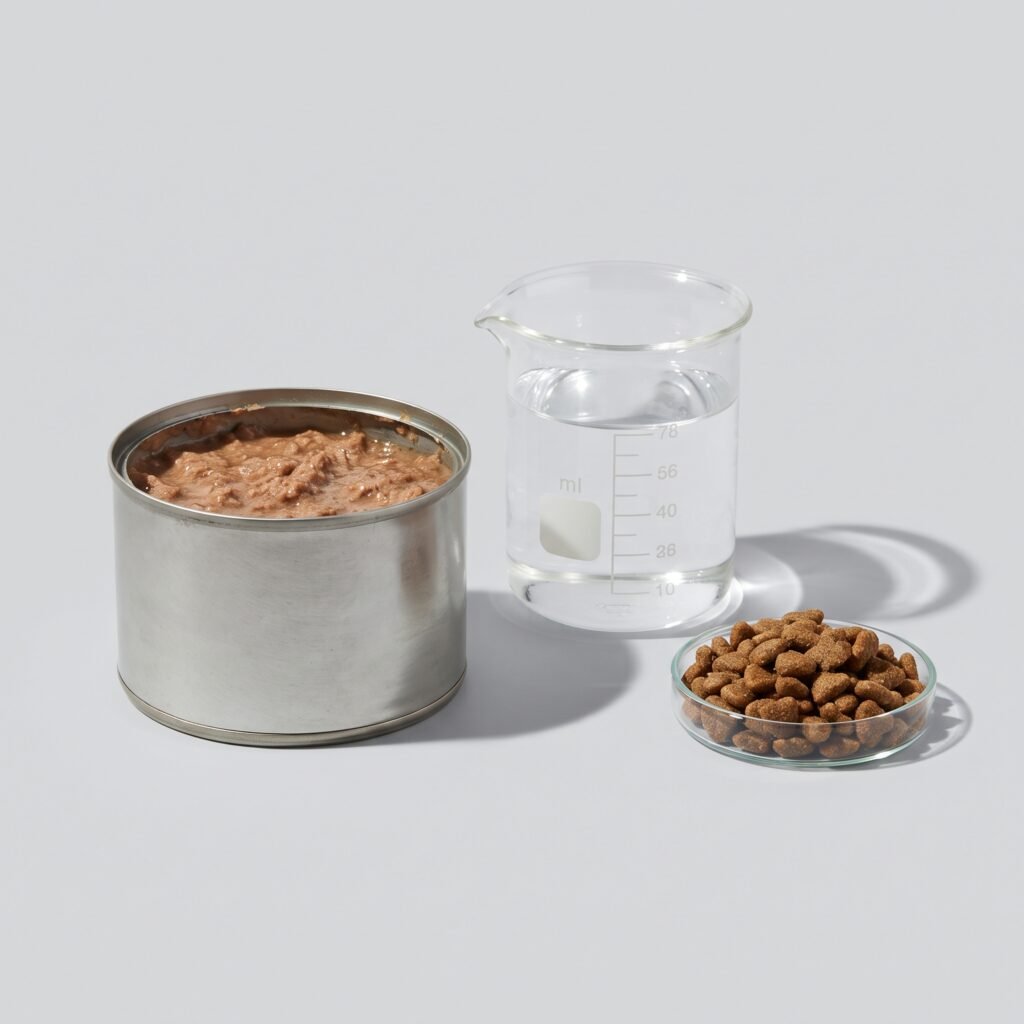
The complete-and-balanced statement on Pedigree canned dog food covers adult maintenance. It is not a therapeutic diet, and there are specific dogs where it’s the wrong tool.
Dogs with a pancreatitis history
The fat content is the issue. 27.3% fat on a dry matter basis is well above what most vets want for a dog with prior pancreatitis, where restricted-fat prescription diets are typically the recommendation. This isn’t a knock on the food — it’s simply not formulated for that job.
Dogs with kidney disease
Renal diets restrict phosphorus and moderate protein, and they’re prescription products for a reason. The high moisture in Pedigree canned dog food is genuinely helpful for CKD dogs, but moisture alone doesn’t make it appropriate. Talk to your vet about a therapeutic wet diet instead — you get the hydration benefit and the mineral restriction together.
Puppies and pregnant or nursing dogs
Most Pedigree canned dog food varieties are labeled for adult maintenance, not growth. AAFCO growth profiles require higher minimums — 22.5% protein and 8.5% fat on a dry matter basis, plus tighter calcium and phosphorus controls. Check the AAFCO statement on your specific can. Some Pedigree lines carry an all-life-stages statement; most of the Chopped Ground Dinner adult varieties do not.
Dogs on a weight-loss plan
Not disqualifying, but use the Weight Management version. At 292 kcal per can versus roughly 400, you get the same volume of food for meaningfully fewer calories, and volume is what a hungry dieting dog responds to.
Dogs with a chicken sensitivity
Read past the flavor name. Several Pedigree canned dog food varieties list chicken as the first ingredient even when the front of the can says beef or filet mignon. If you’re avoiding chicken, the flavor name will mislead you — the ingredient panel won’t.
The edge case worth flagging: small senior dogs with dental disease
If you’re hunting for the best canned dog food for senior dogs on a fixed budget, this is where Pedigree canned dog food genuinely shines, and where I recommend it without hedging. A 12 lb terrier with extractions and worn molars needs about 350 kcal a day. That’s a bit under one 13.2 oz can.
Soft texture, high palatability, no chewing required, and complete nutrition in a format that doesn’t need a prescription. For that dog, the cost objection mostly evaporates because the portion is small, and the alternative — a dog slowly under-eating because chewing hurts — is far worse than any ingredient panel concern.
Can you mix Pedigree canned dog food with a different brand of kibble?
Yes, and most people do. The mix-it-up ratio printed on the can assumes you’re pairing Pedigree wet dog food with Pedigree kibble, but the underlying logic transfers to any brand — you just have to do the conversion yourself.
The rule is calories, not volume. Find the kcal per cup on your kibble bag, decide what fraction of the day you’re moving to wet, and divide by the kcal per can.
Worked example. Say your kibble runs 375 kcal per cup and your 50 lb dog eats 1,100 kcal a day, or about 2.9 cups. You want a quarter of that as Pedigree canned dog food — 275 kcal, which is about 2/3 of a Pedigree Chopped Ground Dinner can. Remove 3/4 cup of kibble to make room.
One caveat that matters more than brand: don’t stack two nutrient premixes and assume it’s harmless. It usually is, because both foods are formulated to AAFCO minimums rather than maximums, and dogs tolerate a wide range. But if your kibble is already fortified well above baseline — some performance and puppy formulas are — check with your vet before making Pedigree wet dog food a permanent half of the diet.
The other consideration is fat. If you’re mixing Pedigree canned dog food into a high-fat performance kibble, you’re compounding two rich foods. The Pedigree canned dog food ingredients skew fatty on a dry matter basis, and a 27.3% fat wet food on top of a 20% fat kibble is a lot of fat for a dog who isn’t actually working.
For most dogs on a standard adult maintenance kibble, mixing across brands is a non-issue. Do the calorie math, remove the dry, and watch the waistline for a month.
How do you transition without a week of loose stool?
Pedigree’s own guidance is a 7–14 day transition, and for sensitive dogs they suggest taking longer. That’s good advice and I’d extend it.
Here’s the schedule I use, which is slower than the label:
Days 1–3: 15% new food, 85% current food. Not 25% — start lower than the label suggests.
Days 4–6: 30/70. Watch stool quality before advancing. Soft-but-formed is fine; anything looser means hold, don’t advance.
Days 7–9: 50/50.
Days 10–12: 75/25.
Days 13–14: full transition.
If you’re only doing a partial swap — the topper scenario — you still transition. Introducing 265 kcal of new food in one evening is a meaningful dietary change even though it’s not a full diet switch.
Two practical notes. Serve Pedigree canned dog food at room temperature rather than straight from the fridge; cold wet food is both less aromatic and harder on some stomachs. And refrigerate opened cans for a maximum of three days, which is the manufacturer’s own guidance.
For a 13.2 oz can, three days means a small dog might not finish it in time. Freeze portions in an ice cube tray if you’re feeding under about 130 g a day.
How I evaluated this, and what to check yourself
Methodology. I worked from current label data on Pedigree canned dog food — guaranteed analysis, caloric content in kcal ME per can, ingredient panels, and AAFCO nutritional adequacy statements — and converted the guaranteed analysis to a dry matter basis for comparison against AAFCO’s published adult maintenance and growth minimums. Cost figures come from case-pack pricing divided by total calories, not by weight. I also reviewed the brand’s FDA recall history.
Recall history matters here, and it’s recent. In July 2026, Mars Petcare issued a voluntary recall of two lots of Pedigree High Protein Chopped Chicken & Duck Flavor wet dog food, 13.2 oz cans, lot codes 613C3KKCFC and 613C1KKCFC. The recalled product may contain metal and plastic foreign material, which could pose choking, laceration, or gastrointestinal blockage risks, and no related reports of pet illness or injury had been received at the time of the announcement.
The affected cans had failed quality control and were sent to a third party for destruction, but were instead fraudulently returned to the marketplace and sold to customers. That’s an unusual failure mode — it’s a supply-chain security problem rather than a manufacturing one, and it’s worth understanding the distinction rather than reading it as evidence of sloppy production.
Prior events: a May 2024 recall of 315 bags of Pedigree Adult Complete Nutrition dry food over loose metal pieces, an August 2014 dry food recall for small metal fragments, a June 2012 canned recall for a possible choking hazard, and a September 2008 dry food recall for potential salmonella.
That’s a moderate recall record for a brand of this volume — not spotless, and not alarming. Every Pedigree canned dog food recall I could find has involved foreign material or contamination risk rather than nutritional deficiency.
What to verify before you buy: the lot code against the FDA’s active recall list, the AAFCO statement on your specific variety, the kcal per can figure printed on the label, and the first five ingredients if your dog has known sensitivities.
Frequently asked questions
Is Pedigree canned dog food good for dogs, or is it junk food?
It’s adequate, complete nutrition at a low price point — not junk, and not premium. Is Pedigree canned dog food good for dogs with no special dietary needs? Yes, it meets AAFCO adult maintenance profiles and delivers more protein and fat on a dry matter basis than most budget kibble. The trade-offs are commodity protein sources and artificial colors, not nutritional inadequacy.
Can I feed Pedigree canned dog food every day as a complete meal?
Yes. The Chopped Ground Dinner line is labeled complete and balanced for adult maintenance, so it can be the entire diet. Expect to feed roughly 1/3 to 2/3 of a 13.2 oz can per 10 lb of body weight daily, and budget around $3.40 a day for a 30 lb dog.
How much Pedigree canned dog food equals a cup of kibble?
Roughly 3/4 of a 13.2 oz can replaces one 8 oz measuring cup of Pedigree adult kibble, per the manufacturer’s mix-it-up instruction. In calories, that’s about 300 kcal of wet food swapping for about 340 kcal of dry. Always remove kibble when you add wet — that’s the step people skip.
Does Pedigree canned dog food cause diarrhea?
Not inherently, but rapid transitions do. At 27.3% fat on a dry matter basis, it’s a notable jump from lower-fat diets, and sensitive dogs react to that change. A 10–14 day gradual transition resolves this in the large majority of cases.
What is the best canned dog food for senior dogs with bad teeth?
For soft texture, palatability, and complete nutrition at low cost, Pedigree canned dog food is a reasonable pick — particularly the pâté-style Pedigree Chopped Ground Dinner, which requires no chewing. Seniors with kidney disease, pancreatitis history, or diagnosed conditions should be on a vet-recommended therapeutic diet instead.
Is Pedigree wet dog food better than Pedigree dry kibble?
On a dry matter basis, Pedigree wet dog food carries more protein and roughly double the fat of the dry line, plus 78% moisture that supports hydration. Dry costs about a sixth as much per calorie and supports less plaque accumulation. Most owners get the best result mixing both rather than choosing.
The bottom line
So — is Pedigree canned dog food good for dogs? The decision isn’t really about ingredient quality. It’s about whether you’re going to do the subtraction.
If you add Pedigree canned dog food to a full kibble portion, you will overfeed your dog. If you swap it in — half a can for every 2/3 cup of dry removed — you get a more palatable, higher-moisture, higher-protein bowl for about a dollar a day.
For a healthy adult dog who’s bored with dinner, that’s a fair trade. For a small senior with dental disease, Pedigree canned dog food is close to the best value in the category. For a dog with pancreatitis history, kidney disease, or a growth-stage requirement, it’s the wrong product regardless of price.
And if you start, expect to keep going. That beagle never did go back to plain kibble.