Raaw Energy Pet Food Recall: The 72-Hour Freezer and Household Triage for Owners Who Already Fed It
If you have frozen raw tubes in your chest freezer and no idea which batch they came from, the Raaw Energy pet food recall is not a headline problem. It is a kitchen problem, tonight.
Direct answer: The Raaw Energy pet food recall now covers every product manufactured between July 17, 2025 and December 23, 2025, plus one Beef and Turkey Medley lot dated 3.31.26 — more than 180 lots in total. Discard any tube whose white date-code sticker falls in that window, or whose sticker is missing entirely. Then disinfect bowls, freezer shelves and hands, because the household is the exposure route.
That last sentence is where most coverage of the Raaw Energy pet food recall stops short, and it is the reason this guide exists. The bacteria involved move from the food to the dog to the people, and a dog with no symptoms is still a carrier. This guide walks the actual decision sequence, in order.
Why the Raaw Energy Pet Food Recall Is Harder to Act On Than a Normal Recall
Most recalls give you a lot number. You read the number, you match it to a list, you are done in ninety seconds.
The Raaw Energy pet food recall does not work that way, and this single fact is why so many households are stuck.
There are no lot numbers — only a date code on a sticker
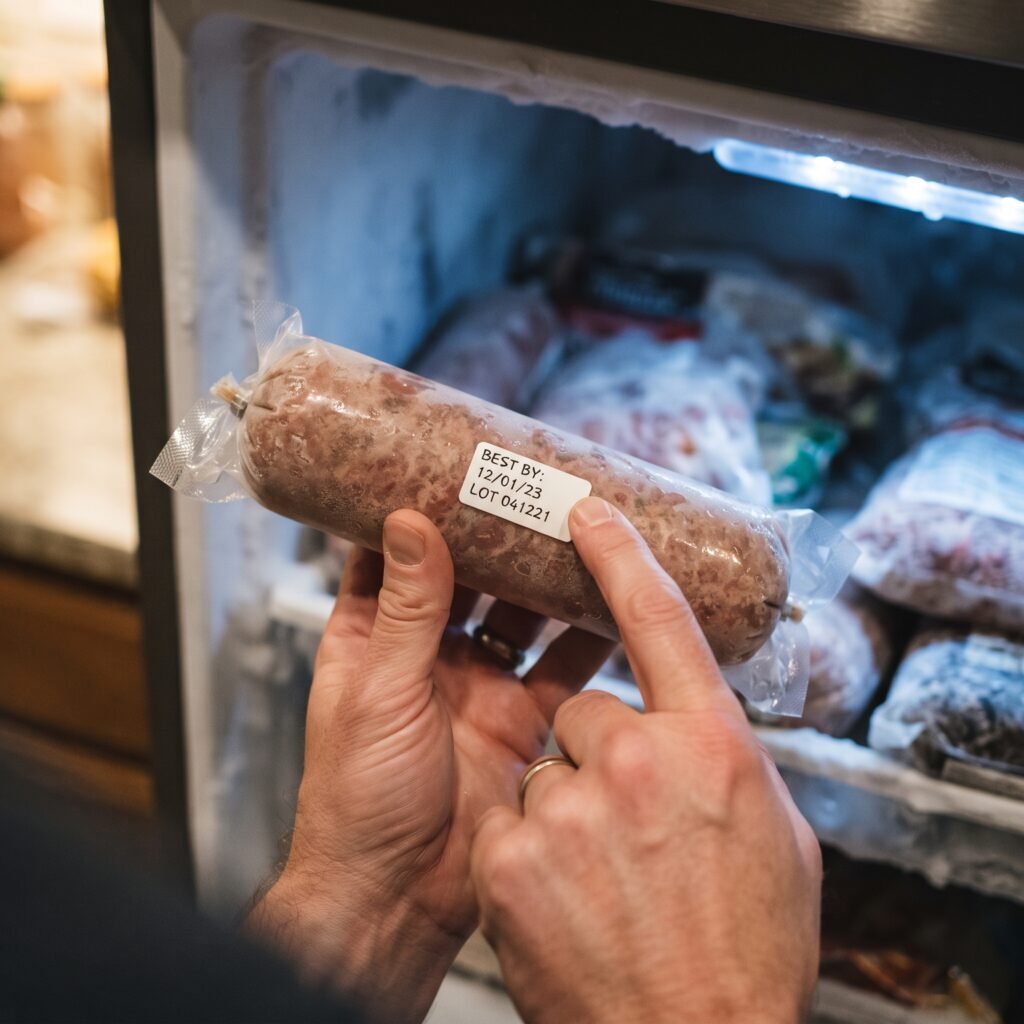
Raaw Energy does not use conventional lot numbering. Batches are distinguishable only by a manufacture date code printed on white stick-on labels, applied to both the clear plastic tube and the brown cardboard outer box.
That means the entire Raaw Energy pet food recall hinges on a sticker that has spent months in a freezer.
Stickers frost over. Stickers peel. Stickers get thrown out with the box when someone reorganises the freezer in January and stacks the tubes loose.
The FDA’s instruction on this point is unambiguous: if you no longer have the packaging, or you cannot read the date code, throw the food away.
There is no second method. No barcode lookup, no batch database, no customer service record that can tell you what a naked tube is.
The distribution model means nobody will call you
Raaw Energy products were ordered through the company’s website and picked up in person by customers. They were not stocked on retail shelves.
That matters enormously for the Raaw Energy pet food recall, because retail recalls are backstopped by two systems most owners never think about — shelf tags at the store, and loyalty-card purchase alerts that trigger a text message.
Direct pickup has neither. If you bought in October and moved house in February, the recall notice may never reach you.
So the burden of the Raaw Energy pet food recall falls entirely on the owner opening the freezer.
Freezing did not make it safe
This is the assumption I hear most often, and it is wrong.
Neither refrigeration nor freezing eliminates Salmonella, Listeria monocytogenes, or Campylobacter jejuni. Cold pauses bacterial growth. It does not sterilise.
A tube from August 2025 that has been rock-solid frozen for eleven months is exactly as affected by the Raaw Energy pet food recall as one bought last week.
Do this, in this order
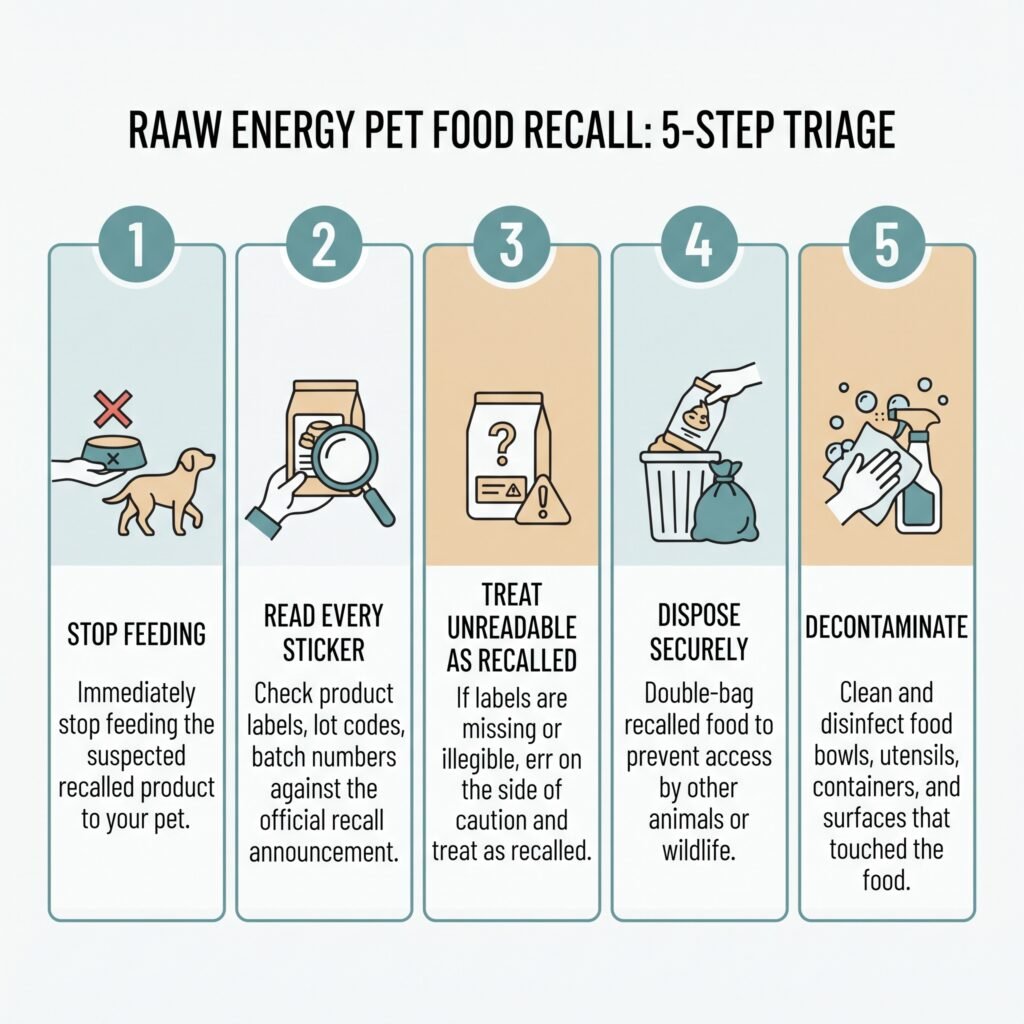
These five steps are the core of a correct Raaw Energy pet food recall response.
Step one — stop feeding, before you investigate. Do not finish the open tube while you check dates. Bag it, freeze it separately, decide after.
Step two — read every sticker. You are looking for a manufacture date between 7.17.25 and 12.23.25, or the single outlier code 3.31.26 on Beef and Turkey Medley. Both the tube and the box carry the code.
Step three — treat unreadable as recalled. Missing sticker, frost-blurred sticker, tube transferred to a container — all discard.
Step four — dispose securely. Into a sealed container or bag, into a bin that a raccoon, a neighbour’s dog or a curious toddler cannot open. The FDA specifically warns against donating recalled product to shelters or rescues, which is where well-meaning owners often send food they no longer trust.
Step five — decontaminate, then think about your dog. This ordering surprises people, and Section 3 explains why it is deliberate.
What if you already threw the box away?
You are not being careless. Most people bin the outer carton on day one to save freezer space, and the tubes carry their own stickers precisely so this is survivable.
The problem arises when the tube sticker has frosted, torn or lifted at the corner. Partial codes are the worst case — a legible “10.” with an unreadable day tells you the tube was made in October, which sits squarely inside the Raaw Energy pet food recall window anyway.
If you can read the month and it falls between July and December 2025, treat it as recalled. If you can read nothing, treat it as recalled.
Guessing from memory — “I’m fairly sure this was a January order” — is not identification. Delivery timing and manufacture date are different things, and the Raaw Energy pet food recall is defined by the latter.
What triggered the Raaw Energy pet food recall
The chain started with one sick dog.
A consumer complaint went to the Connecticut Department of Agriculture. Connecticut and New Jersey agriculture departments then collected and tested eight unopened product samples. All eight came back positive for pathogenic bacteria — Listeria monocytogenes, Salmonella, and Campylobacter jejuni across the set.
The FDA issued its advisory on January 23, 2026, and recommended the firm recall those eight lots. At the time of that advisory, the FDA noted the firm had not initiated an adequate recall.
Four months later the picture widened. New Jersey tested four further samples from the production window. All four were positive for Listeria monocytogenes.
On May 21, 2026 the company halted all dog food production. On May 22 it announced the expanded Raaw Energy pet food recall covering the full five-month window plus the March 2026 Beef and Turkey Medley lot.
The FDA has also stated that since the original January advisory, it has received additional consumer complaints of illness in animals that ate the product.
Raaw Energy Pet Food Recall Edge Cases: Puppies, Seniors, Immunocompromised Dogs and Tight Budgets
The blanket advice — throw it out, call your vet if symptoms appear — is correct and insufficient. Risk is not evenly distributed across households.
Puppies and large-breed adolescents
Young animals are more likely to develop severe Campylobacter symptoms than healthy adults. Puppies are also the population most associated with transmitting C. jejuni to people through ordinary handling.
A twelve-week-old puppy fed a recalled tube is a different situation from a six-year-old Labrador, and warrants a same-day vet call rather than a watch-and-wait.
For large-breed puppies there is a second consideration the Raaw Energy pet food recall creates indirectly: the emergency diet swap. Abruptly moving a growing puppy onto whatever bag is available at the supermarket can disrupt the calcium and phosphorus balance their skeletal development depends on.
Discard the food immediately — but choose the replacement with the same care you used to choose the raw diet.
Senior dogs and dogs on immunosuppressive medication
Elderly and immunocompromised animals are more likely to develop severe symptoms. A dog on steroids, chemotherapy, or long-term immune-modulating drugs for an autoimmune condition sits in the highest-risk tier of the Raaw Energy pet food recall.
For these dogs, do not wait for vomiting or diarrhoea. Call the veterinary practice, tell them the specific pathogens involved, and ask whether they want to see the dog or start monitoring.

Households with a pregnant person, an infant, or an immunocompromised adult
This is the edge case that gets buried, and it is arguably the most serious dimension of the Raaw Energy pet food recall.
Listeria monocytogenes causes illness and death in humans, particularly in those who are pregnant, very young, very old, or immunocompromised. Infection during pregnancy can lead to miscarriage, stillbirth, premature delivery, or life-threatening infection of the newborn.
Human listeriosis symptoms can include headache, stiff neck, confusion, loss of balance and convulsions, alongside fever and muscle aches.
Pets do not need to show symptoms to pass L. monocytogenes to their people. Infected animals shed bacteria in faeces and saliva, contaminating the household environment.
If someone in your home is pregnant or immunocompromised and your dog ate recalled product, that person should speak to their own healthcare provider — not only the vet.
Multi-dog and multi-species households
One dog eats the recalled tube. Three dogs share a water bowl, a yard and a great deal of face-licking.
The Raaw Energy pet food recall does not stop at the individual who was fed. Faecal-oral spread between housemates is straightforward, and cats in the same home are also susceptible to C. jejuni.
Clean the whole environment, not one bowl.
Dogs who board, attend daycare or visit dog parks
If your dog ate recalled product and then spends days in a shared facility, the exposure stops being a household matter.
Tell the facility. Shedding is invisible, shared water bowls are universal, and staff handling faeces have the same exposure route your family does.
Most good boarding operators would rather hear that a client’s dog is linked to the Raaw Energy pet food recall than find out afterwards.
Owners for whom discarding is a real financial hit
Let us be honest about the arithmetic. Frozen raw bought in 5-pound tubes, in boxes, is a bulk purchase. A full freezer of recalled product represents a meaningful sum.
The Raaw Energy pet food recall guidance is still discard, not use-up — but you have two legitimate routes to reduce the loss.
First, the company has directed customers with questions to contact it, and consumers have been pointed toward refunds. Document what you had before you bin it. Photograph the tubes, the stickers and the date codes.
Second, if your dog became ill, veterinary invoices are part of the record. Report the illness through the FDA Safety Reporting Portal, and keep receipts.
What you should not do is compromise on disposal to save money. Feeding down the freezer to avoid waste converts a financial problem into a household health problem.
Dogs with existing gastrointestinal disease
For a dog with inflammatory bowel disease, chronic enteropathy, or a history of haemorrhagic gastroenteritis, distinguishing a flare from a new bacterial infection is genuinely difficult.
The Raaw Energy pet food recall gives these owners one useful piece of information to hand the vet: the specific organisms detected. That narrows the diagnostic conversation considerably compared with “he’s had diarrhoea again.”
Where Owners Go Wrong With the Raaw Energy Pet Food Recall
I want to be direct about the failure modes here, including the uncomfortable one.
Failure one: watching the dog instead of cleaning the kitchen
The instinct after a recall is to monitor the animal. Reasonable — but incomplete.
Pets exposed to contaminated food can be infected without showing symptoms, and asymptomatic carriers still shed bacteria through faeces and saliva.
So a household that watches an apparently healthy dog for a week, while continuing to use the same unwashed bowl, scoop and freezer shelf, has responded to the Raaw Energy pet food recall in the least effective possible order.
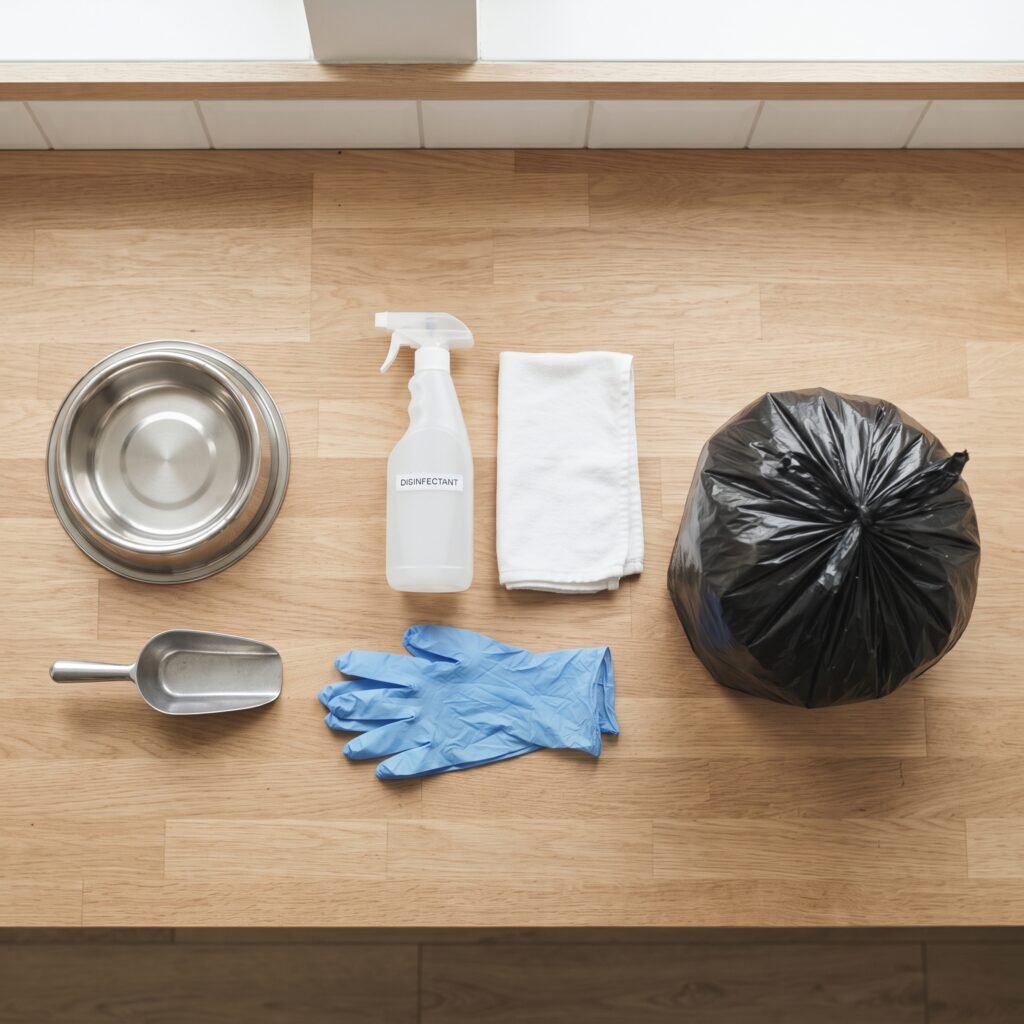
The FDA’s cleaning list is broader than most people assume: storage containers, bowls, utensils, food-prep surfaces, pet bedding, litter boxes, toys, floors, and the refrigerator or freezer itself.
Failure two: cleaning the bowl but not the freezer
The freezer is the part nearly everyone skips.
Recalled tubes sat on those shelves, thawed slightly during transport, and dripped. Contaminated packaging touched the surfaces where next month’s food will sit.
Emptying and disinfecting the freezer is tedious. It is also the step that determines whether the Raaw Energy pet food recall ends in your home or recurs in it.
Failure three: assuming a negative test result clears your tube
The expanded recall was issued out of an abundance of caution. Not all products from the window were tested, and some that were tested came back negative.
Owners read that as reassurance. It is the opposite.
Because untested product was made during a period when contamination was confirmed, the Raaw Energy pet food recall covers the entire production window regardless of individual test outcomes. A negative result on a different tube tells you nothing about yours.
Failure four: the panic switch to an unsuitable diet
This is the harm caused by the response rather than the food.
An owner discards a freezer of raw, panics, and puts a dog with a chicken allergy onto a chicken-based kibble at full ration that evening. Result: a week of diarrhoea that looks alarmingly like a pathogen exposure and sends everyone to the emergency vet.
Handle the Raaw Energy pet food recall in two separate decisions. Decision one, tonight: what is safe to feed. Decision two, over the following days: what the long-term diet should be.
A plain, bland transitional diet for a few days is not a nutritional failure. It buys you time to choose properly.
Failure five: not reporting
Most owners never file a report. The FDA advisory itself notes that additional consumer complaints of animal illness arrived after the January advisory, and that expanding evidence base is part of what moved this from an eight-lot advisory to a recall spanning more than 180 lots.
If your dog was ill, the Safety Reporting Portal entry takes minutes and is the only mechanism that connects your case to the wider picture.
Failure six: treating it as a topper rather than a meal
Some owners use raw tubes as a spoonful of enrichment over kibble rather than as the whole diet, and conclude the exposure was trivial.
Dose is not the relevant variable here. A small quantity of contaminated food still contaminates the bowl, the spoon, the counter and the dog’s mouth.
The Raaw Energy pet food recall applies identically to topper-sized portions, and the cleaning steps do not scale down with the serving size.
Failure seven: telling the vet “raw food” instead of the brand
Vets triage differently when they know which organisms are on the table. Name the brand, the flavour, the date code and the pathogens.
Raaw Energy Pet Food Recall Response Options Compared
Once the freezer is empty, you face a genuine fork. Here is how the realistic options compare.
Table: Comparing feeding options after the Raaw Energy pet food recall
| Option | Identification certainty | Household pathogen risk | Cost impact | Transition risk | Best suited to |
|---|---|---|---|---|---|
| Discard all, switch to gently cooked or commercial fresh-cooked | Complete — no date codes to interpret | Low; cooking destroys the organisms at issue | Moderate to high per calorie | Low if transitioned over 5–7 days | Households with infants, pregnant members or immunocompromised adults |
| Discard all, switch to a complete dry or canned diet | Complete | Lowest of the realistic options | Lowest | Low to moderate | Budget-constrained households and multi-dog homes |
| Keep raw feeding, move to a brand using high-pressure processing | Depends on new brand’s lot coding | Reduced but not eliminated | High | Low — texture and format stay familiar | Committed raw feeders who want to keep the format |
| Keep raw feeding, home-prepare to a formulated recipe | Full control of inputs | Present; depends entirely on your kitchen hygiene | Moderate, plus significant time | Moderate | Owners willing to work from a veterinary nutritionist’s recipe |
| Keep the remaining tubes and feed selectively | Poor — the failure point of this recall | Unacceptable | Nil upfront | N/A | No one; contradicts the recall |
How to read this Raaw Energy pet food recall comparison
The final row is included because it is what a meaningful number of people actually do, and it deserves to be named rather than ignored.
The logic feels sound — “these three tubes are dated January 2026, outside the window.” The problem is that the Raaw Energy pet food recall is defined by date codes on stickers, in a freezer, months later. Selective feeding relies on the least reliable component in the whole chain.
On lot coding as a purchase criterion. If there is one durable lesson from the Raaw Energy pet food recall, it is that traceability is a food-safety feature, not paperwork.
Before you buy the replacement, look at how the new product is coded. A printed lot number on the packaging itself, rather than an adhesive label, survives freezer burn and handling. Ask whether the brand publishes batch test results.
On why there is no “wait and see” row. Every option in the table involves removing the recalled product first. There is no version of responding to the Raaw Energy pet food recall that begins with continuing to feed while you research alternatives.
The table is about what replaces the food, not whether it should be replaced.
On high-pressure processing. HPP reduces pathogen load in raw product without cooking it. It reduces risk; it does not remove it, and HPP products have appeared in recalls before.
If the reason you are reconsidering raw is a household member’s vulnerability, HPP is a partial answer to a question that may deserve a complete one.
On cost. The cheapest column is not the worst column. A complete, properly formulated dry or canned diet is a legitimate nutritional choice, and the Raaw Energy pet food recall is a poor reason to feel that switching away from raw is a downgrade.
On home preparation. Home-prepared raw moves the food-safety responsibility from a facility with drains and evaporators to your kitchen counter. Some owners manage that well. Most homemade diets fail on formulation rather than hygiene, which is why the recipe should come from a board-certified veterinary nutritionist.
How We Evaluated the Raaw Energy Pet Food Recall
Transparency about method matters more than usual on a safety topic, so here is exactly what this article is built on.
Primary regulatory documents first. The product lists, date codes, pathogen findings, state distribution and cleaning instructions are taken from the FDA’s advisory page for the Raaw Energy pet food recall and from the company’s own recall announcement as posted by the FDA. Where reporting and the primary documents disagreed, the primary documents won.
The update history was read in sequence, not just the latest version. This matters. The January 23, 2026 advisory covered eight lots. A February 6, 2026 update removed discussion of pathogenic E. coli after further New Jersey laboratory analysis determined the E. coli strain found in one Beef Chicken Tripe Medley sample was not pathogenic. The May 22, 2026 update expanded the Raaw Energy pet food recall to more than 180 lots.
Articles written from a single snapshot get this wrong in both directions — either overstating the E. coli finding or understating the scale of the expansion.
State distribution was cross-checked. The company’s announcement lists nine states. Some earlier news coverage of the January advisory named additional Northeastern states. This article treats the nine-state list as authoritative for the expanded recall while advising owners outside those states to check their freezers anyway, because the discrepancy is unresolved in the public record.
Clinical detail is taken from regulatory and veterinary sources, not from general nutrition writing. Symptom lists, asymptomatic carriage and human transmission routes come from the FDA advisory and CDC-linked guidance.
What we did not do. We did not reproduce the full 180-lot date-code table. It runs to dozens of products with multiple codes each and is revised as the situation develops — a stale copy of a safety table is worse than a link to the live one. Check the FDA page directly against your stickers.
We also make no claim about the number of confirmed animal illnesses. The FDA states it has received additional complaints; it has not published a case count, and inventing one would be irresponsible.
Reader-facing limitation. This guide is written to help you act, not to replace veterinary judgement. Where the Raaw Energy pet food recall intersects with a specific dog’s medical history, the vet who knows that history is the better authority.
Last verified: August 2026, against the FDA advisory as updated May 22, 2026.
Raaw Energy Pet Food Recall FAQ
Which products are covered by the Raaw Energy pet food recall?
All Raaw Energy dog food manufactured between July 17, 2025 and December 23, 2025, plus Beef and Turkey Medley with the date code 3.31.26. That spans more than 180 lots across dozens of recipes, in both 2-pound and 5-pound tubes. The affected products were distributed in Connecticut, Delaware, Massachusetts, Maryland, New Hampshire, New Jersey, New York, Pennsylvania and Virginia.
My dog ate recalled food and seems completely fine. Do I still need to do anything?
Yes. Pets can be infected without showing symptoms and can still shed bacteria in faeces and saliva. An asymptomatic dog is the scenario where the Raaw Energy pet food recall poses the most underestimated household risk, because nobody is being careful. Complete the cleaning steps, wash hands after handling the dog, and pick up faeces promptly.
What symptoms should I watch for in my dog?
Vomiting, diarrhoea — which may be bloody or mucoid — fever, lethargy, reduced appetite and straining. Severe or bloody diarrhoea, or any symptoms in a puppy, senior or immunosuppressed dog, warrant a prompt veterinary call rather than home monitoring.
Can people get sick from the Raaw Energy pet food recall products?
Yes, by two routes: handling contaminated food or surfaces, and contact with an infected pet’s saliva or faeces. Human symptoms can include nausea, vomiting, fever, aches and diarrhoea. Severe Listeria infection can lead to meningitis, and infection in pregnancy carries serious risks. Anyone with symptoms should contact their own healthcare provider.
Is Raaw Energy still making dog food?
The company halted all dog food production effective May 21, 2026, and described corrective actions including resurfacing production areas, cleaning drains and sewer lines, additional evaporator cleaning, strengthened quality control and the purchase of a pathogen detection system for batch-level testing. Before buying from any brand named in a recall, confirm current status directly with the FDA rather than relying on articles.
Does cooking or re-freezing the recalled food make it safe to use?
Re-freezing does nothing — cold does not eliminate these organisms. Cooking is a different question, but it is not the intended answer here: the Raaw Energy pet food recall instruction is to discard, not to salvage, and thoroughly cooking a contaminated product still means handling it, thawing it and contaminating your kitchen in the process. Dispose of it.
How do I report an illness connected to the recall?
Contact your veterinarian first. Then file through the FDA’s Safety Reporting Portal. Owners can also reach the company by phone using the number published on the FDA recall notice.
The Bottom Line on the Raaw Energy Pet Food Recall
The single action that matters tonight is opening the freezer and reading the white stickers. Anything made between 7.17.25 and 12.23.25, anything marked 3.31.26 Beef and Turkey Medley, and anything you cannot positively date goes into a sealed bag and a secure bin.
Then clean — bowls, scoops, mats, bedding, floors and the freezer itself — before you settle in to watch your dog, because the household surfaces are the part of the Raaw Energy pet food recall that keeps working after the food is gone.
If your dog is a puppy, a senior, or immunosuppressed, or if anyone in your home is pregnant or immunocompromised, make the calls rather than waiting for symptoms. That is the tier of the Raaw Energy pet food recall where hours matter.
And when you choose the replacement diet, treat traceability as a feature. The reason the Raaw Energy pet food recall has been so difficult for ordinary owners to act on is not the bacteria. It is a sticker in a freezer.