
Maltese Dog Food: How to Choose Based on the Problem You're Actually Solving
The best Maltese dog food isn’t one product — it’s the one matched to the problem you’re solving. A 6-pound Maltese needs roughly 200 to 240 calories a day, so kibble size, calorie density, and portion precision matter far more than marketing claims. Sort your choice by tear stains, teeth, stomach, or appetite first.
Why does most maltese dog food advice fall apart at six pounds?
Because almost all maltese dog food advice is written for a 40-pound dog and then scaled down badly. Feeding charts on the back of the bag are printed in cups, and a cup is a terrible unit of measure when your dog’s entire daily ration is a little more than half of one.
Run the numbers yourself. Resting energy requirement is 70 × (body weight in kg)^0.75 — a formula your vet uses and one you can verify. A 6-pound (2.7 kg) Maltese lands at about 147 kcal at rest, and a neutered adult typically eats 1.4 to 1.6 times that, so 206 to 236 kcal a day.
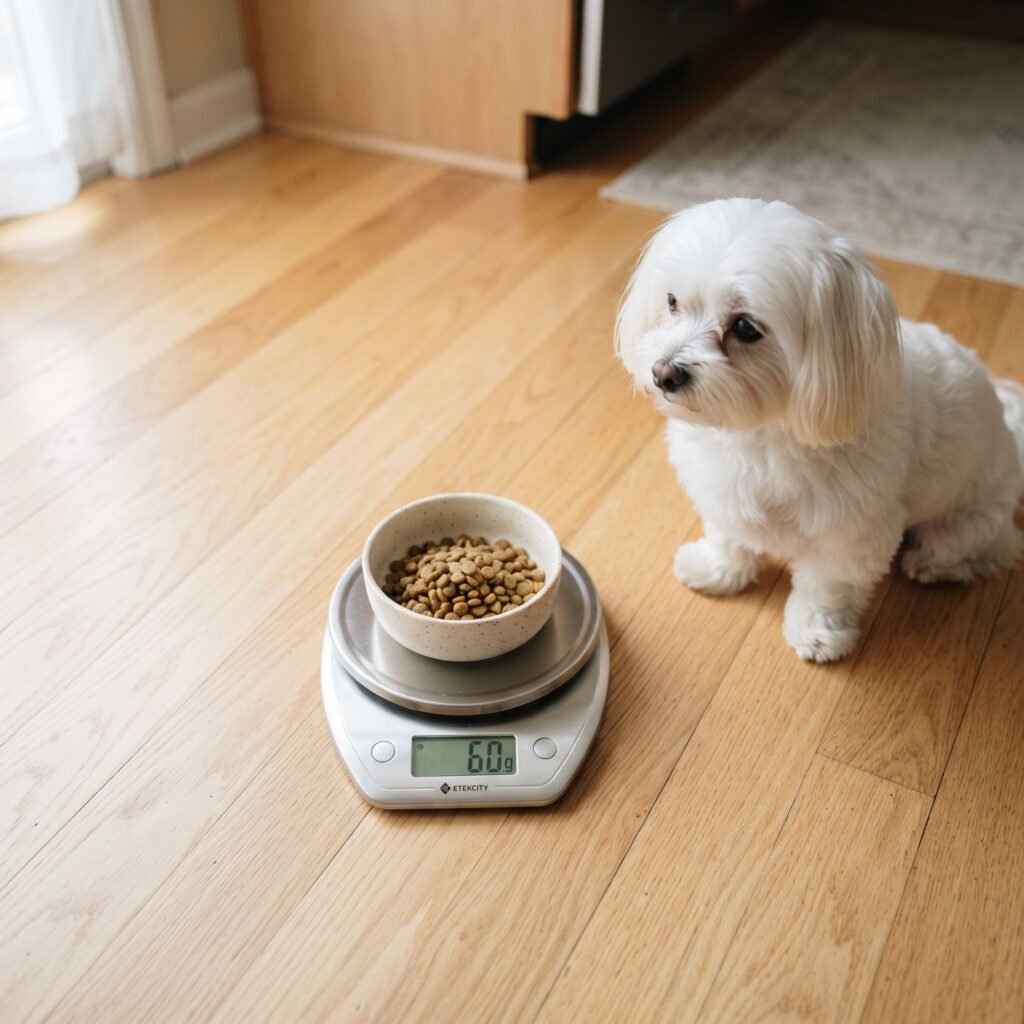
At 400 kcal per cup, that’s roughly 57 to 65 grams of kibble. Not “about ¾ cup.” Sixty grams
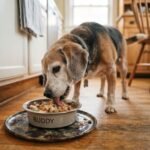
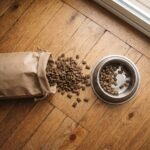
Here’s why that precision changes which maltese dog food you buy. A single tablespoon of a calorie-dense fresh topper runs 25 to 35 kcal — that’s 12 to 15 percent of this dog’s daily intake, added on top of a full bowl. Three training treats at 8 kcal each are another 10 percent.
I keep a $12 digital kitchen scale next to the food bin for exactly this reason. Eyeballing a scoop for a Labrador costs you a few percent. Eyeballing it for a Maltese costs you a pound, and a pound on a 6-pound dog is 17 percent of her body weight.
So the first rule of choosing maltese dog food: whatever you pick has to be something you can portion accurately and won’t be tempted to top with extras. Calorie density is not a feature here. It’s a liability you have to manage.
Which problem are you actually solving?
Owners rarely search for maltese dog food out of idle curiosity. There’s usually a symptom driving it, and the right answer forks hard depending on which one you’re dealing with:
- Rust-colored tear stains under the eyes and in the beard
- A puppy who won’t eat, or eats erratically and then acts wobbly
- Dental disease — missing teeth, painful chewing, dropped kibble
- Soft stool, gurgling, or intermittent vomiting in an otherwise healthy dog
Each of these points to a different maltese dog food, and two of them point to something that isn’t food at all. Work out which fork you’re on before you read another ingredient panel, because the best dog food for Maltese with a wrecked mouth is a poor choice for a 10-week-old puppy, and vice versa.
Will switching maltese dog food actually get rid of tear stains?
Usually not. This is the single most common reason owners go shopping for a new maltese dog food, and it’s the one where I’ve watched the most money get spent for the least result.
Tear staining is porphyrin — an iron-containing pigment excreted in tears and saliva that oxidizes to that rust color when it sits on white hair. Every dog produces it. On a Maltese it’s just brutally visible, because the coat is white and the face is flat enough that tears spill onto it rather than draining properly.
The diet-causes-stains theory usually blames grain, or chicken, or tap water minerals. The evidence for any of it is thin. What actually drives visible staining, most often, is anatomy and moisture: shallow eye sockets, blocked or malformed nasolacrimal ducts, eyelashes growing inward, or a beard that stays permanently damp.
Here’s what a change in dog food for Maltese tear stains can legitimately do. A gravy-coated or heavily oiled kibble smears into the muzzle hair every meal and holds moisture against the skin. Damp hair plus yeast equals a darker, browner stain with a faintly sour smell — that’s a different stain from porphyrin, and switching to a drier, cleaner-coated food genuinely helps it.
That’s the honest answer on dog food for Maltese tear stains: it helps at the margins. Dry-coated small kibble, a bowl your dog doesn’t have to bury her face in, and a wipe-down after meals will do more for the beard than any protein swap.
The elimination diet that didn’t work
I ran a 90-day trial on a 5.8-pound Maltese whose owner was convinced chicken was the culprit. We moved to a limited-ingredient duck-and-potato formula, controlled treats down to the same protein, filtered water, the whole protocol. Stool stayed perfect. Coat improved slightly.
The stains did not move. Not a shade.
Her vet found a partially obstructed tear duct on one side and mild distichiasis — eyelashes growing where they shouldn’t. Flushing the duct and plucking the lashes did in three weeks what three months of switching maltese dog food couldn’t touch. The food wasn’t wrong. It was answering a question the dog wasn’t asking.
If you’ve done a clean 8 to 12 week trial and the staining hasn’t changed, stop shopping and book an ophthalmic exam. Keep the maltese dog food if she’s thriving on it; just stop expecting it to fix a plumbing problem.
What should I feed a Maltese puppy who won’t eat?
This is the fork where getting it wrong is genuinely dangerous. Toy-breed puppies under roughly 3 to 4 months old have very little liver glycogen and almost no body fat to buffer a missed meal, which puts them at real risk of hypoglycemia.
A Maltese puppy who skips breakfast, then plays hard, can go from normal to wobbly, glassy-eyed, and unresponsive in a couple of hours. That’s an emergency, not a phase. Your vet will tell you how to keep a glucose source on hand and when to use it — ask before you need it, not during.
So the priorities for Maltese puppy food are, in order: calorie density, palatability, and meal frequency. You want a growth or all-life-stages formula meeting AAFCO’s growth profile — a minimum of 22.5 percent crude protein and 8.5 percent crude fat on a dry matter basis, versus 18 and 5.5 percent for adult maintenance.
Feed three to four small meals a day until about four months, then three until six months. Free-feeding a picky puppy sounds sensible and often backfires, because stale kibble sitting out all day is less appealing than a fresh bowl, and you lose all visibility into whether she actually ate.
Maltese puppy food also has to be physically manageable — a 10-week-old Maltese has a jaw the width of your thumb, and 8 mm kibble is a genuine obstacle for her.
Palatability is where most maltese dog food choices get made at this age. Warm the food slightly. Add a spoon of water to release aroma. If she’s genuinely refusing, a small amount of the same brand’s wet formula stirred in usually gets her going without teaching her to hold out for something better.
The best dog food for Maltese puppies is the one she finishes reliably three times a day. Nutritional perfection she refuses is worth nothing.
One caution I’d give any owner of a picky toy breed: if you rotate to a new food every time she hesitates for two days, you will manufacture a picky eater. Give a formula 10 to 14 days before you judge it, assuming she’s eating enough to stay stable.
How do I choose maltese dog food when my dog has lost teeth?
Toy breeds carry a heavy dental burden — crowded jaws, retained baby teeth, and periodontal disease that often starts before age three. By ten, plenty of Maltese have lost molars or had a full-mouth extraction.
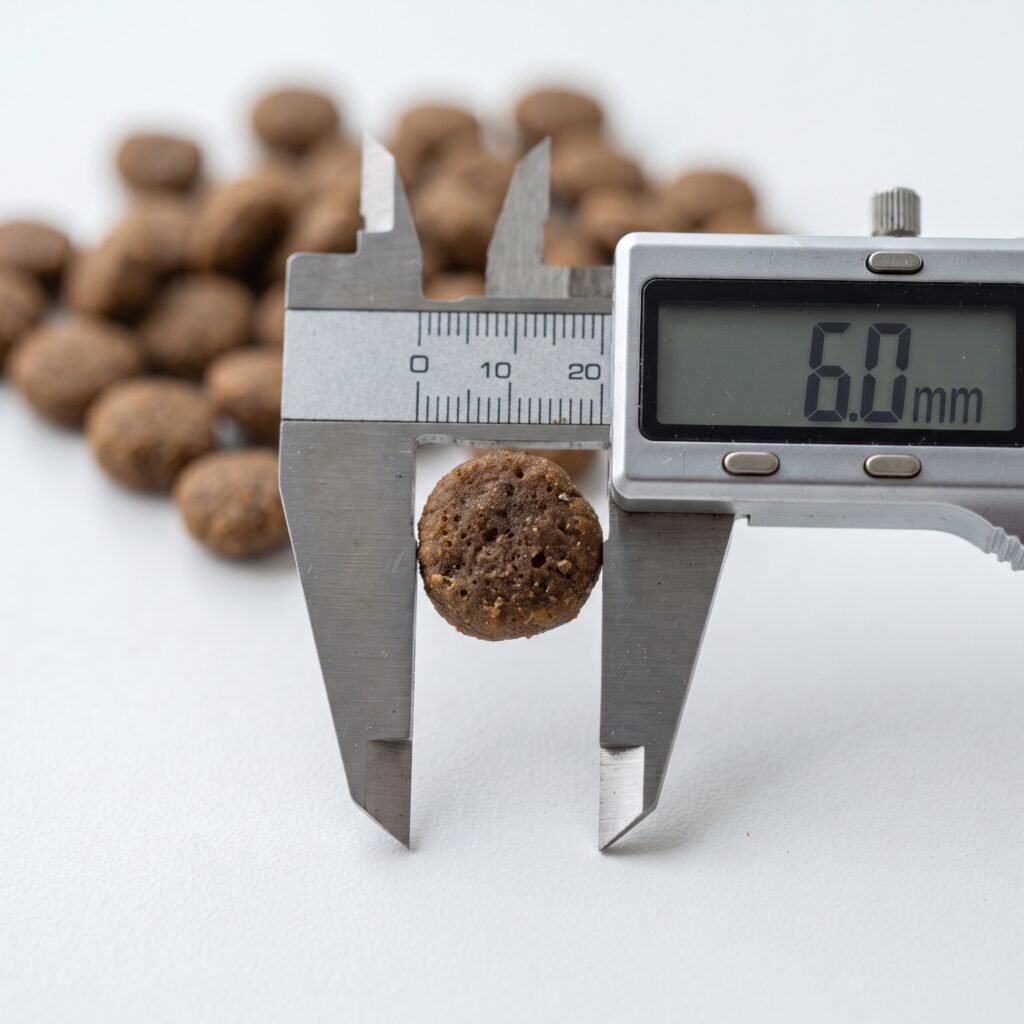
Here’s the thing nobody mentions: most small breed dog food is engineered to be swallowed easily, not chewed, which means “small-breed kibble” is not automatically a dental food. I measured a handful of popular small-breed formulas with digital calipers and got pieces between 5 and 8 mm across. At that size, a Maltese doesn’t chew — she swallows. Zero mechanical cleaning, which is the entire premise of dental kibble.
Genuine dental diets use a larger, fibrous kibble engineered so the tooth sinks in rather than shattering it. Those pieces are often 12 to 15 mm, which a healthy adult Maltese can manage and a senior with three teeth absolutely cannot. Look for the Veterinary Oral Health Council seal rather than the word “dental” on the front of the bag — it’s the only third-party mark on maltese dog food packaging that certifies a measured effect on plaque or tartar.
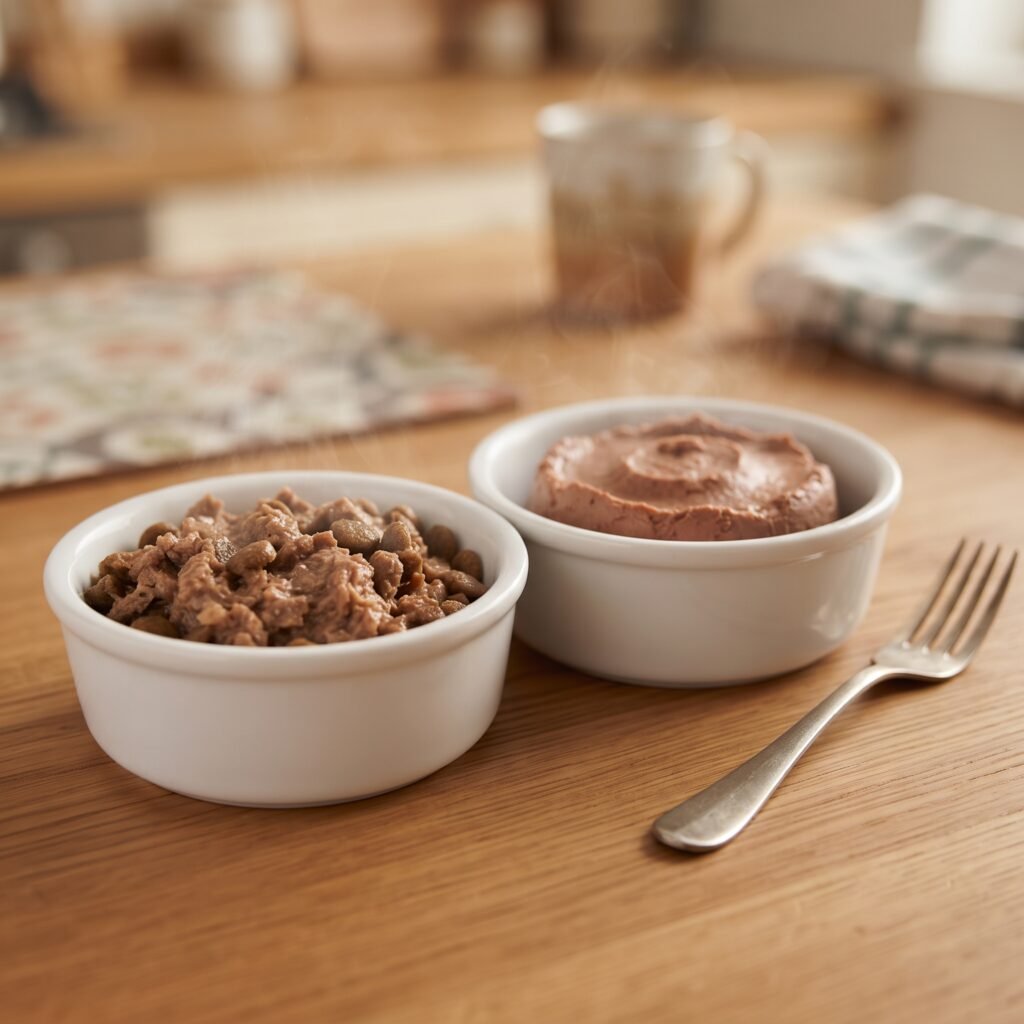
For a dog who’s already lost teeth, the correct maltese dog food is soft, and the format choice comes down to cost and stool quality. Options: a quality canned pâté, gently cooked fresh food, or the maltese dog food she already tolerates, rehydrated.
Rehydration is underrated and cheap. Add warm water at roughly equal volume, wait ten minutes, and 6 mm kibble goes from hard pellet to a soft paste that mashes under a fork. A senior I fed this way went from dropping half her dinner on the floor to finishing in under two minutes.
Two warnings. Rehydrated food spoils fast — an hour on the counter in a warm kitchen and it’s off. And soft food accelerates plaque on whatever teeth remain, so brushing matters more, not less, after you switch.
What if my Maltese has soft stool or a sensitive stomach?
Start by ruling out the obvious before you change the maltese dog food. Table scraps, a new treat, a chew, or too-fast a transition explains most of it. For a tiny dog, “too fast” happens easily — 10 percent of a 60-gram ration is 6 grams, which is about a teaspoon.
Transition over 7 to 10 days and measure the increments on the scale. I’ve seen people do a “gradual” switch by dumping a handful of the new maltese dog food into a small bowl, which for a 6-pound dog is nearly a full swap on day one.
If stool is still loose after a clean two-week transition, look at fat first. A formula at 20 percent fat on a dry matter basis is a lot for a dog with a sensitive gut; dropping to 12 to 15 percent often resolves it without any protein change at all.
Fiber is the second lever. A moderate fiber level, roughly 3 to 5 percent, firms things up for most dogs. A tablespoon of plain canned pumpkin is the folk remedy, but on a 6-pound dog that’s a meaningful chunk of daily volume — a teaspoon is plenty.
Most sensitive-stomach maltese dog food marketing sells you a protein swap when the actual fix was a fat number. Only after those two levers should you go chasing protein sources. A true food allergy trial means a novel or hydrolyzed protein, fed exclusively, for eight to twelve weeks with zero exceptions — no flavored medications, no dental chews, no crumbs from a toddler’s high chair. Half-committed trials tell you nothing and waste months.
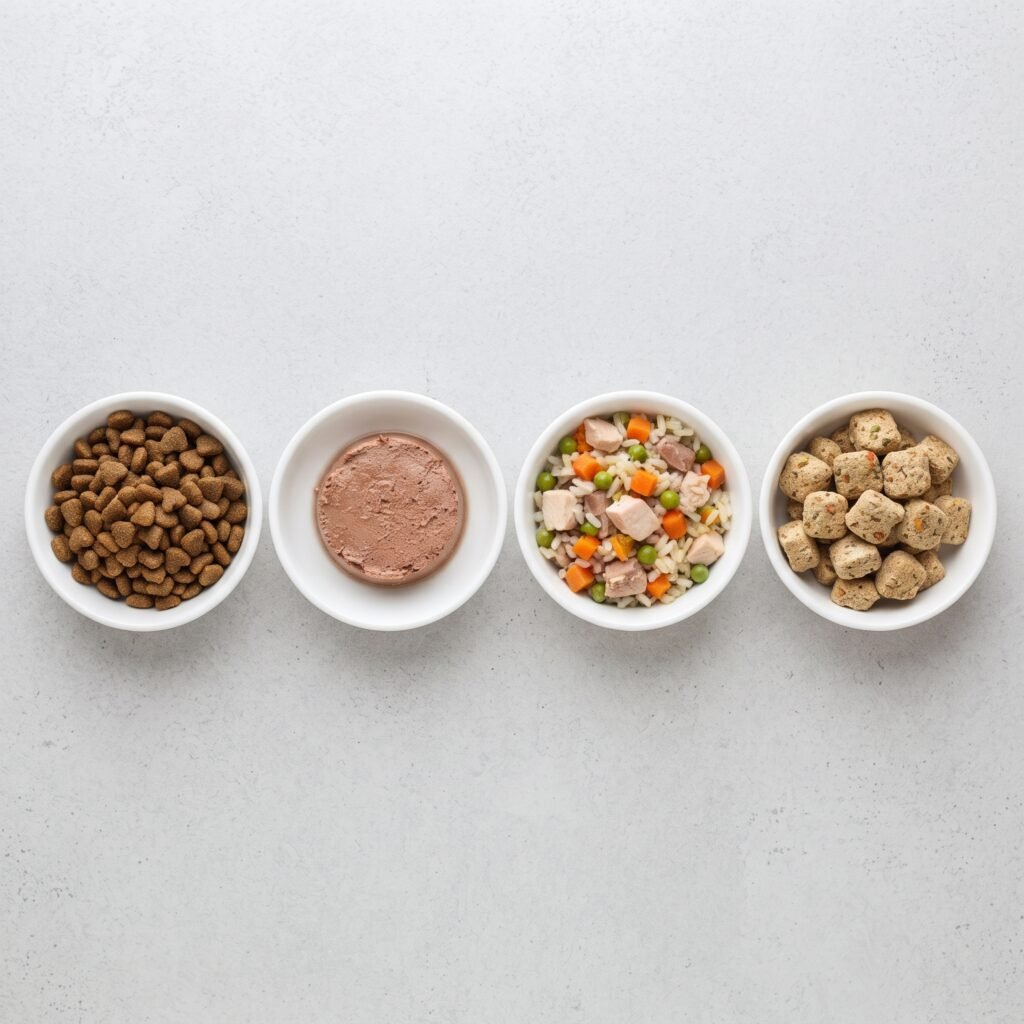
How do the main maltese dog food formats compare for a 6-pound dog?
The maltese dog food formats below show typical ranges from guaranteed analyses converted to a dry matter basis, with daily costs calculated for a dog eating about 220 kcal a day. Convert as-fed to dry matter yourself by dividing the percentage by (100 minus moisture), then multiplying by 100 — it’s the only way to compare a can against a bag honestly.
| Format | Typical calories | Protein (DM) | Fat (DM) | Piece size | Approx. cost/day at 220 kcal |
|---|---|---|---|---|---|
| Small-breed dry kibble | 370–420 kcal/cup | 26–32% | 15–20% | 5–8 mm | $0.35–$0.75 |
| Canned pâté | 90–120 kcal per 3 oz | 38–45% | 20–28% | n/a (soft) | $1.50–$3.00 |
| Gently cooked fresh | 35–45 kcal/oz | 30–40% | 20–30% | n/a (soft) | $2.50–$5.00 |
| Freeze-dried raw | 110–140 kcal/oz | 40–50% | 25–35% | 10–15 mm nuggets | $3.00–$6.00 |
| Dental kibble (VOHC) | 320–380 kcal/cup | 20–26% | 10–14% | 12–15 mm | $0.60–$1.00 |
Read that table as a set of trade-offs rather than a ranking. Freeze-dried raw looks impressive on protein and terrible on cost, and at $5 a day it’s $1,800 a year to feed a dog who eats less than a can of soda’s worth of volume.
Canned is the sleeper maltese dog food option for this breed specifically. High moisture, soft texture, easy to portion by half-can, and the protein numbers on a dry matter basis usually beat kibble at the same price tier. The downsides are dental plaque and a beard that needs wiping.
The dental kibble row is there to make the point I made above: it’s lower in protein and fat than standard small-breed maltese dog food because it’s built around texture, not nutrition maximization. That’s a legitimate trade if your dog’s teeth are the problem, and a pointless one if they aren’t.
How much maltese dog food should I actually feed each day?
If you’ve searched how much to feed a Maltese and come back with an answer in cups, the table above explains why the cups were useless. Use the formula instead, then adjust by body condition over four weeks. These figures assume a neutered adult at a typical activity level; intact, young, or highly active dogs sit at the upper end or above it.
| Body weight | Resting need | Daily calories | Grams of kibble (400 kcal/cup) |
|---|---|---|---|
| 4 lb | ~109 kcal | 152–174 kcal | 42–48 g |
| 5 lb | ~129 kcal | 181–207 kcal | 50–57 g |
| 6 lb | ~147 kcal | 206–236 kcal | 57–65 g |
| 7 lb | ~167 kcal | 234–268 kcal | 64–74 g |
| 8 lb | ~183 kcal | 256–293 kcal | 70–80 g |
| 10 lb | ~216 kcal | 303–346 kcal | 83–95 g |
The answer to how much to feed a Maltese includes treats: they come out of that total, not on top of it. Cap them at 10 percent, which for a 6-pound Maltese is about 22 kcal — roughly two small training treats or a few pieces of her own kibble saved from the meal.
Body condition beats any chart and beats the feeding guide printed on every bag of maltese dog food you’ll ever buy. You should feel ribs easily under a thin layer, see a waist from above, and see a tuck from the side. If you can’t feel ribs, cut 10 percent and recheck in three weeks.
How should maltese dog food change as she ages?
Three transitions, and only one of them runs on a calendar.
Maltese puppy food to adult formula, around 10 to 12 months. Toy breeds finish growing early, and staying on a growth diet past that point is the quietest way a Maltese becomes an 8-pound dog on a 6-pound frame. Make the switch on the scale, not on her birthday.
Then nothing, for years. Between roughly one and eight, a healthy Maltese on a food that suits her needs no change at all. Rotating brands every bag causes more soft-stool episodes than it prevents. Good coat, firm stool, stable weight — the maltese dog food is working, so leave it alone.
Adult to senior, which also isn’t a date. “Senior” on a bag is marketing, not a regulated category. AAFCO recognizes growth and reproduction, and adult maintenance. That’s the whole list. A senior formula is legally an adult maintenance food wearing different packaging.
What actually changes is the dog. Lean muscle drops with age, so protein needs go up rather than down — the old habit of restricting protein in healthy older dogs has largely been abandoned. Activity falls, so calories come down.
Teeth get worse, so texture starts to matter. And if kidney or cardiac disease shows up, the diet stops being a shopping decision entirely — that’s a prescription from your vet, not a choice off a shelf.
The practical version: at eight or nine, recheck her calorie need against her body condition, get a proper look at her mouth, and hold the protein where it is. Change the maltese dog food for what the exam finds, not for what the label says about her age.
Can you feed a Maltese well on a tight budget?
Yes — more easily than for almost any other breed, because she eats 60 grams a day.
Run the math the other direction. A 5-pound bag of a decent small breed dog food at 400 kcal per cup holds about 2,270 grams, which is roughly 38 days of meals for a 6-pound Maltese. At $28 a bag, that’s 74 cents a day. A mainstream grocery brand meeting the same AAFCO profile lands nearer $12 a month.
Buy the small bag even though the big one costs less per pound. Fat oxidizes once a bag is opened, and a 30-pound sack would take your dog well over a year to finish. Rancid fat smells faintly like old crayons — I’ve opened bags like that, and it’s the real explanation behind plenty of “suddenly picky” dogs.
The budget leaks at the margins, not at the bowl. Fresh subscriptions, freeze-dried toppers, and boutique treats can triple your monthly spend without correcting a single deficiency. If money is tight, that’s the first thing to cut and the last thing you’ll miss.
What I wouldn’t economize on is the manufacturer. Cheap maltese dog food from a company with a staff nutritionist and real feeding trials beats expensive maltese dog food from a brand that can’t answer those questions — and price sorts those two groups far less reliably than you’d hope.
One more budget reality: dental work is the true cost of this breed. A cleaning under anesthesia runs into the hundreds and many Maltese need one every year or two. Money saved on food is better parked there than spent on a topper.
Should I avoid grain-free maltese dog food?
This one deserves a careful answer rather than a slogan. The FDA opened an investigation in 2018 into reports of dilated cardiomyopathy in dogs eating grain-free diets, many of them high in peas, lentils, and other legumes. In its later updates the agency stated that a causal link had not been established and that the science was more complex than a simple ingredient association.
So: not proven, not dismissed. Given that, my default recommendation for maltese dog food is a grain-inclusive formula from a manufacturer with real nutritional expertise, unless there’s a documented reason to avoid grain.
That reason exists sometimes. A dog with a confirmed wheat or corn sensitivity, identified through a proper elimination trial, should obviously avoid it. “My neighbor said grain is filler” is not that reason.
The manufacturer question matters more than the grain question anyway. Ask whether the company employs a full-time board-certified veterinary nutritionist or a PhD in animal nutrition, whether it owns its manufacturing plants, and whether it runs AAFCO feeding trials rather than only formulating to meet a profile. Those three answers tell you more about a bag of small breed dog food than the entire front label.
How I evaluate maltese dog food (methodology note)
Reviewed against: AAFCO Dog Food Nutrient Profiles for the appropriate life stage; FDA recall and withdrawal records; manufacturer responses to the standard nutritionist, plant-ownership, and feeding-trial questions.
Every formula I discuss gets the same treatment. I pull the guaranteed analysis and convert it to dry matter so a can and a bag can be compared on equal footing. I check the AAFCO statement on every bag of maltese dog food for two things — the life stage it’s formulated for, and whether it was substantiated by formulation or by feeding trial.
I check the recall history of both the brand and, where it’s disclosed, the manufacturing facility. Co-packing means a recall at one plant can touch several brands that look unrelated on the shelf.
For anything I feed directly, I measure kibble with digital calipers, weigh portions to the gram, and score stool daily for 14 days after the transition completes. Palatability gets noted honestly, including refusals.
Where a specific claim isn’t verifiable — a proprietary digestibility figure, say, or a marketing statistic with no published source behind it — I leave it out rather than repeat it. If you see a precise number in an article about maltese dog food with no source attached, treat it as decoration.
Where my usual advice didn’t work
I normally push gently cooked fresh maltese dog food for picky eaters, because the aroma and texture solve refusal problems fast. With a 5-pound seven-year-old female, it worked too well.
She ate enthusiastically for the first time in a year. She also gained 14 ounces in six weeks, which on her frame was closing in on 18 percent of body weight. The subscription portioning was calibrated in whole packs, and the smallest pack overshot her actual need by roughly 40 calories a day — about a fifth of her total.
Splitting packs and weighing them fixed the calories, but the owner found the daily fiddling with a scale and half-open pouches annoying enough that she went back to kibble with warm water. That was the right call for that household. Perfect maltese dog food you portion sloppily is worse than good maltese dog food you portion exactly.
The other failure worth naming: freeze-dried raw nuggets. I’ve had two Maltese flatly refuse them crumbled over kibble — one nosed the bowl, then walked off and slept. The liver-forward smell that makes most dogs frantic seemed to be exactly what she objected to. Expensive maltese dog food that ends up in the bin has a nutritional value of zero.
Frequently asked questions
What is the best dog food for Maltese with tear stains?
No dog food for Maltese tear stains reliably removes porphyrin staining, because the pigment is present in every dog’s tears. A dry-coated small kibble that doesn’t smear into the muzzle hair will reduce the damp, yeasty brown staining that sits on top of it. If stains persist after a clean 8 to 12 week trial, get the tear ducts and eyelashes examined.
How much should I feed a Maltese per day?
A typical neutered adult Maltese at 6 pounds needs about 206 to 236 calories daily, which is roughly 57 to 65 grams of standard maltese dog food. Weigh it rather than scooping, and count treats inside that total, not on top. Adjust by body condition after three to four weeks.
Is grain-free maltese dog food bad for small dogs?
The FDA’s investigation into grain-free diets and dilated cardiomyopathy did not establish a causal link, but it hasn’t been ruled out either. Absent a diagnosed grain sensitivity, a grain-inclusive formula from a company with a staff veterinary nutritionist is the lower-risk default. Discuss it with your vet if your dog has any cardiac history.
Can I feed my Maltese puppy adult food?
Not before about 10 to 12 months. Growth formulas carry higher minimums for protein and fat — 22.5 and 8.5 percent on a dry matter basis under AAFCO’s growth profile, against 18 and 5.5 for adult maintenance — and toy-breed puppies need that calorie density to avoid hypoglycemia. An all-life-stages formula meeting the growth profile works as Maltese puppy food too.
Why does my Maltese suddenly refuse her food?
Rule out dental pain first, since periodontal disease is common in toy breeds and a sore mouth looks exactly like pickiness. Stale maltese dog food, a warm kitchen, and free-feeding all reduce palatability too. If refusal lasts more than 48 hours or comes with lethargy or vomiting, see your vet rather than switching brands.
The short version
Pick your maltese dog food by the problem in front of you. Tear stains are usually anatomy, not diet. A refusing puppy needs calorie density and frequent meals. A senior with a compromised mouth needs soft food and better brushing. Soft stool usually means fat, fiber, or a rushed transition — in that order.
Then weigh the portions. The right maltese dog food is only right at the right gram count. Precision matters more on a 6-pound dog than any label on the bag, and it’s the one part of the decision entirely within your control.