
Hill's Science Diet Puppy Food: How to Choose When You Don't Know Your Puppy's Adult Size

Quick answer: Choose Hill’s Science Diet puppy food based on projected adult weight, not current weight. If your puppy will mature at 70 lbs or more, use the Large Breed formula for its controlled calcium. Under 70 lbs, the standard recipe is appropriate. For uncertain mixes projected at 55–70 lbs, default to Large Breed.
[Image alt: Bag of Hill’s Science Diet puppy food next to a mixed-breed puppy at a feeding station]
The shelter told me she was “lab mix, maybe 45 pounds grown.” She hit 52 lbs at eight months and kept going. Her adult weight landed at 68 — two pounds under the line that governs which Hill’s Science Diet puppy food she should have been eating the entire time.
That’s the actual decision most people face, and almost nobody writes about it honestly. The guidance everywhere says “feed large breed formula to large breed puppies.” Fine, if you have a papered Bernese. Useless if you have a shelter dog with a guess written on her intake sheet.
This article is about that gap. Not what Hill’s Science Diet puppy food is — what to do when the label’s own decision rule doesn’t cleanly apply to your dog.


Why does the choice between Hill’s Science Diet puppy food formulas matter so much?
It comes down to one mineral: calcium.
Both versions of Hill’s Science Diet puppy food are complete and balanced for growth. The difference is how much calcium they deliver while your puppy’s skeleton is still deciding what shape it will be.
Puppies under about six months can’t fully regulate how much dietary calcium they absorb. Adult dogs down-regulate absorption when intake is high. Growing puppies — especially fast-growing large breeds — absorb a large share of what you give them whether they need it or not.
Excess calcium during that window is associated with developmental orthopedic disease: osteochondrosis, hypertrophic osteodystrophy, and abnormal bone remodeling. This is well-established veterinary nutrition, not marketing. It’s why AAFCO created a separate calcium ceiling in the first place.
In 2016, the AAFCO Canine Nutrition Expert Subcommittee published an upper calcium limit specific to large breed growth formulas, capping calcium at 1.8% on a dry matter basis. That 1.8% maximum applies to formulas that may be fed to large size puppies — defined as those reaching 70 pounds or more as mature lean adults. For every other life stage, including non-large-size growth, the ceiling is 2.5% dry matter.
So the entire Hill’s Science Diet puppy food product split — standard versus Large Breed — exists to serve two sides of one regulatory line. And that line is drawn at a number you have to predict, not measure.
That’s the trap. You’re making a nutritional decision at eight weeks based on a body weight that won’t exist for a year.
What does the AAFCO statement on the bag actually tell you?
Flip the bag over and find the nutritional adequacy statement. It’s in tiny print, usually near the feeding chart.
If it reads “growth/all life stages including growth of large-size dogs (70 pounds or more as an adult),” the food is appropriate for large breed puppies. If it reads “except for growth of large-size dogs,” it shouldn’t be fed to them.
There’s a second thing to check that most Hill’s Science Diet puppy food reviews skip entirely: how adequacy was substantiated. Some foods are substantiated by formulation — the recipe is calculated to hit AAFCO’s profile on paper. Others are substantiated by feeding trials, where dogs actually ate the food under an AAFCO protocol and were monitored.
Hill’s uses feeding trials on its large breed puppy line. The label states that animal feeding tests using AAFCO procedures substantiate that Hill’s Science Diet Puppy Large Breed provides complete and balanced nutrition for growing puppies. That’s the more demanding of the two paths, and it’s a legitimate mark in the brand’s favor.
What’s actually different between the two Hill’s Science Diet puppy food formulas?
Here’s where published numbers get interesting. Below is a dry-matter comparison of the two main dry recipes against the AAFCO growth profile.
Dry matter basis matters because guaranteed analysis on the bag is as-fed, which includes moisture — you can’t compare a bag guarantee to an AAFCO number directly without converting.
| Nutrient (dry matter basis) | Hill’s Science Diet Puppy (Chicken & Brown Rice) | Hill’s Science Diet Puppy Large Breed (Chicken & Brown Rice) | AAFCO Growth Profile |
|---|---|---|---|
| Crude protein | 27.8% | 26.3% | 22.5% minimum |
| Crude fat | 19.0% | 15.4% | 8.5% minimum |
| Calcium | 1.54% | 1.16% | 1.2% min / 1.8% max (large size) |
| Phosphorus | 1.26% | 0.95% | 1.0% min / 1.6% max |
| Calcium:phosphorus ratio | ~1.22:1 | ~1.22:1 | 1:1 to 2:1 |
| Crude fiber | 2.5% | 2.4% | Not specified |
| DHA | 0.062% | ~0.083% | Not specified |
Figures are typical published analyses at time of writing. Manufacturers reformulate — verify against your current bag before making decisions.
Three things jump out.

The calcium gap is real and it’s large. The standard Hill’s Science Diet puppy food runs roughly a third higher in calcium than the Large Breed version. That’s not a rounding difference; that’s a deliberate formulation split.
Fat differs more than most people expect. 19% versus 15.4% dry matter is a meaningful energy density difference. Large breed formulas run leaner on purpose — restrained growth rate is protective for developing joints. A skeletally immature Great Dane growing slightly slower is a feature, not a compromise.
The Ca:P ratio is identical. Both sit around 1.22:1, comfortably inside AAFCO’s window. Hill’s isn’t just diluting calcium and leaving phosphorus stranded — it’s moving both together, which is what you want.
Now the honest wrinkle. That 1.16% calcium figure on the Large Breed formula sits marginally below AAFCO’s 1.2% growth minimum. That isn’t a violation, because the product is substantiated by feeding trial rather than formulation — the profile minimum isn’t the compliance path it’s held to. But it’s the kind of detail that gets flattened out of most Hill’s Science Diet puppy food reviews, and you deserve to know it exists rather than discover it on a forum at midnight.
What’s in the bag? A look at Hill’s Science Diet puppy food ingredients
The current Large Breed recipe leads with chicken, brown rice, whole grain oats, chicken meal, cracked pearled barley, chicken fat, pea protein, brewers rice, whole grain wheat, soybean meal, and whole grain corn.
The standard formula’s Hill’s Science Diet puppy food ingredients list runs similarly: chicken, brown rice, whole grain wheat, chicken meal, chicken fat, whole grain corn, whole grain oats, pea protein, soybean meal, then flavors, fibers, and the vitamin-mineral pack.
Two observations from someone who reads a lot of these panels.
First, this is a grain-inclusive, moderately plant-protein-supplemented formula. Pea protein and soybean meal contribute measurably to that 26–28% protein figure. If you specifically want animal protein doing the heavy lifting, Hill’s Science Diet puppy food ingredients will not thrill you.
Second, the mineral pack uses oxides and sulfates rather than chelated (proteinated) minerals. Chelated forms are generally better absorbed. Hill’s counters this with feeding-trial data showing the nutrients land where they need to, which is arguably the stronger evidence — but it’s a fair criticism of the ingredient panel on its face.
[Image alt: Close-up of Hill’s Science Diet puppy food ingredients panel showing chicken and brown rice]
How was this evaluated? (Methodology note)
I want to be specific about what this assessment is and isn’t.
What I did: compared published dry-matter nutrient profiles for both dry recipes against the current AAFCO Dog Food Nutrient Profiles for growth; read the full ingredient panels and nutritional adequacy statements on current retail packaging; checked FDA recall records for the brand; and fed both dry versions of Hill’s Science Diet puppy food across three puppies of different projected sizes over multi-month periods, weighing weekly and scoring body condition.
What I didn’t do: commission independent lab analysis, run radiographic growth studies, or test every recipe in the line. Nobody writing a consumer article has done those things, and you should be skeptical of anyone implying otherwise.
Conflict note: no relationship with Hill’s, no sponsorship, no free product. Bags were bought at retail. Most Hill’s Science Diet puppy food reviews you’ll find online are affiliate-driven roundups that never touched the product; this one is not, and you should hold it to that standard.
Reviewed for accuracy against: AAFCO Dog Food Nutrient Profiles (growth and reproduction), current manufacturer nutrient data, and FDA recall databases. Where a claim couldn’t be verified against one of those, it isn’t in this article.
Is Hill’s Science Diet good for puppies in the 55–70 lb gray zone?
This is the question that made me write the article, so let’s do it properly.
Your puppy is a shelter mix. Best guess is 60 lbs grown, give or take fifteen. The AAFCO threshold is 70. You have to pick a bag today.
Default to Large Breed. Here’s the reasoning, and it’s asymmetric-risk logic rather than nutritional optimization.
If you feed Large Breed Hill’s Science Diet puppy food to a dog who matures at 55 lbs, the downside is a slightly leaner-growing puppy who reaches the same adult size a few weeks later. That’s it. There is no deficiency risk — the food is complete and balanced for growth.
If you feed standard Hill’s Science Diet puppy food to a dog who matures at 78 lbs, the downside is elevated calcium intake during the exact developmental window when your dog’s joints are least able to buffer it. That risk is small in absolute terms but the consequence is orthopedic and permanent.
Unequal consequences mean you don’t split the difference. You take the option whose worst case you can live with — and with Hill’s Science Diet puppy food, that option costs you nothing extra per bag.
How do I estimate my puppy’s adult weight well enough to choose?
Three methods, in descending order of reliability.
Paw and frame check at 16 weeks. Not paw size alone — that’s folklore. Look at the ratio of leg length to body depth and whether the elbows sit noticeably below the chest line. Deep-chested, long-legged, loose-skinned puppies at four months are telling you something.
Weight doubling at four months. For medium-to-large mixes, four-month weight roughly doubled lands you in the right neighborhood. A 30 lb four-month-old is a 60ish lb adult — right in the gray zone, which is your signal to go Large Breed.
DNA test. Around $100 and it settles the argument. If you’re genuinely on the fence and your dog is under five months, this is the highest-value hundred dollars in the decision. Adult weight predictions from the major panels are imperfect but far better than a shelter’s guess.
What if I guessed wrong and already started the standard formula?
Switch, and don’t panic about it.
Calcium risk is cumulative and window-dependent, not a single-exposure event. A puppy who ate standard Hill’s Science Diet puppy food for six weeks and then moved to Large Breed at four months is in a very different position from one who ate it straight through to twelve months.
Transition over seven days as usual — 25% new food for two days, 50% for two days, 75% for two days, then full. Puppies with settled stomachs often handle a faster switch, but there’s no prize for rushing.
And a rule worth tattooing somewhere: do not add a calcium supplement to any commercial puppy food. Not a joint powder with calcium in it, not eggshell, not cottage cheese as a daily topper. The formula is balanced. Supplementing is how well-meaning owners cause the exact problem the Large Breed formula exists to prevent.
What is Hill’s Science Diet puppy food actually like to feed?
Enough spreadsheets. Here’s what a bag of Hill’s Science Diet puppy food is actually like in your kitchen.
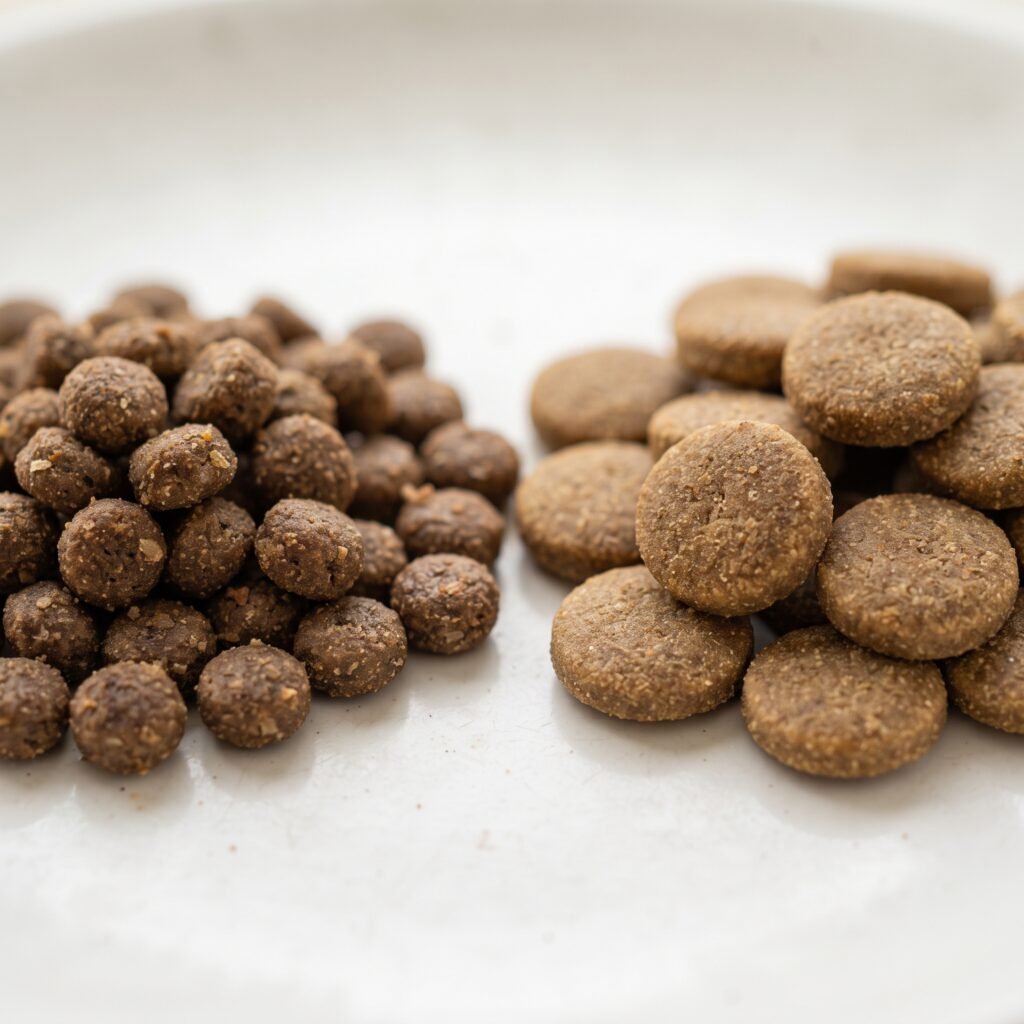
The Large Breed kibble is a flattened disc, roughly the diameter of a dime and maybe three millimeters thick — noticeably larger and flatter than the standard puppy kibble, which is a small rounded piece closer to pea-sized. That size difference matters more than it sounds. A Dane puppy inhaling small kibble swallows most of it whole; the larger disc forces at least token chewing.
The smell is mild. Faintly cereal-forward with a low chicken-fat note underneath — nothing like the aggressive rendered-meat smell of higher-fat performance foods. If you’ve got someone in the house who gags at dog food, this is on the tolerable end.
Texture is dry and hard, low grease. My hands didn’t feel oily after scooping, which tracks with the moderate fat level. It holds up well as a training reward because it doesn’t crumble in a pocket.
The concrete observation I’d flag: soaked kibble goes to mush fast. When I softened Large Breed Hill’s Science Diet puppy food with warm water for a seven-week-old still transitioning off gruel, it broke down to porridge in about four minutes — much faster than denser kibbles, which take fifteen. Good if you’re weaning. Annoying if you use a slow feeder and want the food to hold shape, because it turns into paste in the grooves.
Stool quality across all three test dogs was consistently firm and moderate in volume. That’s the practical signal most owners actually care about, and it’s where Hill’s Science Diet puppy food performs reliably well.
How do I use the Hills Science Diet puppy feeding chart without overfeeding?
The Hills Science Diet puppy feeding chart on the bag is a starting point calibrated to an average puppy. Your puppy is not average.
Feed to body condition, not to the chart. You should be able to feel ribs under light pressure without pressing, see a waist from above, and see a tuck from the side. If you can see rib outlines at rest, that’s too lean; if you’re hunting for ribs under a fat layer, cut back.
For gray-zone puppies specifically, I run the Hills Science Diet puppy feeding chart amount and then hold at the low end of the recommended range. Restrained growth is protective for large-frame dogs. A slightly lean puppy is the goal, not a plump one.
Weigh weekly and write it down. A growth curve tells you things a single number can’t — a sudden acceleration means it’s time to trim the portion, not celebrate.
One more thing the Hills Science Diet puppy feeding chart won’t tell you: split meals into three daily until four months, then two. And subtract training treats from the daily total. A puppy in an intensive training week can pick up a quarter of daily calories from rewards, which quietly wrecks the math on any feeding chart.
When Hill’s Science Diet puppy food didn’t work: an honest failure
I need to tell you about the dog it went badly for, because the pattern is common.
A twelve-week-old shepherd mix, projected 65 lbs, went onto Large Breed Hill’s Science Diet puppy food on exactly the reasoning I laid out above. Textbook decision. Seven-day transition, no shortcuts.
By week three he had intermittent loose stool, visible gas discomfort, and — the part that concerned me — he’d started leaving food. Not refusing outright. Eating two-thirds and walking away, which in a growing large-breed puppy is a problem, because underfeeding a fast-growing frame carries its own risks.
I gave it another two weeks assuming adaptation. That was the mistake. Four weeks of marginal intake in a puppy’s fastest growth phase is not a period you get back.
The vet’s assessment was a probable wheat or soy sensitivity — both are meaningful inclusions in this formula. We moved to a limited-ingredient large breed growth diet with a different protein base and the stool normalized inside ten days.
What I’d do differently: set a hard two-week evaluation point. If stool quality hasn’t stabilized and intake hasn’t returned to full by day fourteen post-transition, stop waiting. The “give it a month to adjust” advice is fine for adult dogs with time to spare. It’s not fine for a puppy in a growth window that closes.
Why this matters for the recommendation: the grain-inclusive, soy-and-wheat-containing formulation that makes Hill’s Science Diet puppy food affordable and widely available is the same thing that makes it a poor fit for the subset of puppies with those sensitivities. That’s not a defect. It’s a trade-off, and the honest framing is that Hill’s Science Diet puppy food works well for most puppies and clearly doesn’t for some.
If your puppy is one of the some, no amount of patience fixes it.

Has Hill’s Science Diet puppy food ever been recalled?
Yes — and the details matter more than the headline.
In early 2019, Hill’s voluntarily recalled a number of canned dog foods across its Science Diet and Prescription Diet lines due to elevated vitamin D, later expanding the recall. The cause was traced to a vitamin premix supplier error. Excess vitamin D can cause serious harm, and the event was significant.
The critical distinction: that recall covered canned products. Dry formulas — including the dry Hill’s Science Diet puppy food discussed in this article — were not part of it.
How I read this as a buyer: a supplier-side premix failure is a real quality-control failure, and Hill’s took justified criticism for the response timeline. It’s also the kind of failure that has hit multiple large manufacturers, and the company’s dry-food recall history is comparatively clean.
If you’re buying dry Hill’s Science Diet puppy food, that 2019 event is not directly relevant to your bag — but knowing why it happened tells you something about supply-chain risk that applies to every brand. Check the FDA’s recall database yourself before any large purchase. It takes ninety seconds and it’s the single most useful safety habit a dog owner can build.
Is Hill’s Science Diet good for puppies with sensitive stomachs?
Mixed, and the answer splits by cause.
People ask whether Hill’s Science Diet is good for puppies with delicate digestion as if there’s one answer, and there isn’t. For puppies whose digestive upset comes from dietary indiscretion, stress, or a rough transition, Hill’s Science Diet puppy food generally does fine. The moderate fat level helps — high-fat foods are a common trigger for loose stool in young dogs, and 15–19% dry matter fat is restrained by puppy-food standards.
For puppies with an actual protein or grain sensitivity, it’s the wrong tool, as my shepherd mix demonstrated. Wheat, soy, and corn all appear meaningfully in the ingredient list.
Hill’s does make a Sensitive Stomach & Skin puppy formula, which is a reasonable next step before abandoning the brand. But if you’ve already run a proper elimination trial and identified a specific trigger present in the recipe, switching brands beats switching formulas within one.
Which Hill’s Science Diet puppy food is right for a small breed puppy?
Small breed puppies have the opposite problem from large ones: they don’t need calcium restriction, but they do need calorie density and kibble small enough to physically eat.
A Yorkshire Terrier puppy is at genuine risk of hypoglycemia if meals are spaced too far apart — a concern that never applies to a Mastiff. Small breed formulations address this with higher energy density per cup.
For toy and small breeds, the small-breed version of Hill’s Science Diet puppy food is the correct pick, and the standard Hill’s Science Diet puppy food is acceptable as a second choice if the kibble size works for your dog’s mouth. What you should not do is feed Large Breed to a small dog — you’d be applying calcium restriction and lower fat to a puppy who needs neither, and possibly slowing growth for no benefit.
[Image alt: Small breed puppy eating Hill’s Science Diet puppy food from a shallow bowl]
When should I switch off Hill’s Science Diet puppy food?
Tie the switch off Hill’s Science Diet puppy food to skeletal maturity, not a birthday.
Small breeds (under 25 lbs adult) generally finish growing around 9–12 months. Medium breeds land near 12 months. Large breeds run 15–18 months, and giant breeds can take up to 24.
That means a Great Dane on Hill’s Science Diet puppy food Large Breed may reasonably stay on it well past his first birthday — while a Beagle littermate’s owner has moved to adult food six months earlier. Same age, different biology.
The practical marker is growth-plate closure, and your vet can assess this. In the absence of imaging, the reliable signal is that weight has been flat for four to six consecutive weeks while food intake stayed constant.
Switching too early means undersupplying a still-growing frame. Switching too late means feeding growth-level calories to a dog who’s finished, which is a straightforward path to an overweight young adult. Neither error is catastrophic; both are avoidable with a scale and a notebook.
Frequently asked questions
Is Hill’s Science Diet puppy food good for German Shepherds?
Generally yes, using the Large Breed formula — German Shepherds typically mature between 50 and 90 lbs, and males routinely cross the 70 lb threshold. Given the breed’s known predisposition to hip and elbow dysplasia, the controlled-calcium version is the appropriate default even for a female projected under 70 lbs. The asymmetric-risk logic applies with extra force in a breed with orthopedic history.
How long should a puppy eat Hill’s Science Diet puppy food?
Until skeletal maturity, which varies from about 9 months in toy breeds to 18–24 months in giant breeds. Use flat weight over four to six weeks as your practical signal rather than a calendar date. Large breed puppies stay on growth formula considerably longer than most owners expect.
Can I mix Hill’s Science Diet puppy food with wet food?
Yes, and it’s a useful trick for puppies with low food drive or during transitions. Count the wet food’s calories against the daily total rather than adding it on top, and keep the ratio consistent day to day — sudden changes in the wet-to-dry ratio are a common cause of loose stool that owners misattribute to the kibble itself.
Is Hill’s Science Diet puppy food worth the price compared to budget brands?
For most owners, Hill’s Science Diet puppy food earns its price — largely because of feeding-trial substantiation and a solid dry-food safety record rather than premium ingredients. The ingredient panel is unremarkable and includes plant proteins and non-chelated minerals, so you’re paying for formulation rigour and quality control, not for a luxury recipe. If your priority is meat-forward ingredients, other brands deliver more per dollar.
Do I need to soak Hill’s Science Diet puppy food for a young puppy?
Only during weaning, roughly weeks 4–8, and briefly. The kibble softens quickly — around four minutes in warm water for the Large Breed discs — so don’t over-soak it into paste. Most puppies handle dry kibble comfortably by 8 weeks, and chewing dry food supports jaw development and dental health.
The bottom line
The decision that matters with Hill’s Science Diet puppy food isn’t whether the brand is good — it’s which formula, chosen against a projected adult weight you can’t yet verify.
If your puppy will clear 70 lbs, use Large Breed and its controlled calcium. If you’re confident they’ll stay well under, standard Hill’s Science Diet puppy food is well-formulated and appropriate. If you’re anywhere in the 55–70 lb uncertainty band, take Large Breed and accept a slightly slower growth curve as cheap insurance.
Then watch the actual dog in front of you. Weigh weekly, feed to body condition rather than to the chart, and give yourself a hard two-week checkpoint after the transition. If stool and appetite haven’t settled by then, the food isn’t right for your puppy regardless of how good the nutrient profile looks on paper.
That last part is the whole job. The label tells you what’s in the bag. Only you can see how your dog is doing on it.