
Large Breed Puppy Food: How to Choose It When You Don't Know How Big He'll Get
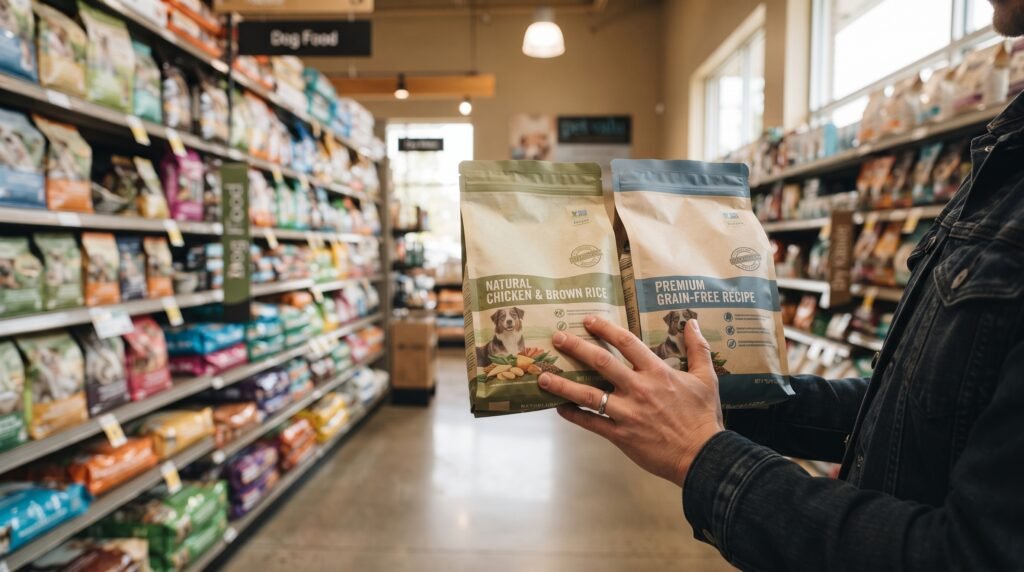
You brought home a puppy with enormous paws, an unknown father, and a shelter card that says “Shepherd mix, probably.” Now you’re standing in an aisle being asked to predict his adult weight before you can buy his first bag of food.
That’s the real problem with large breed puppy food. Every guide tells you to feed it if your dog will mature over 50–70 lbs. Almost nobody tells you what to do when you genuinely can’t know that yet.
Short answer: Feed large breed puppy food if your puppy is likely to exceed 50–70 lbs at maturity. If adult size is genuinely uncertain — mixed breed, unknown parents, rescue — default to it anyway. Being wrong in that direction costs you almost nothing. Being wrong in the other direction can cost your dog his hips.
This guide is built around that asymmetry, not around a rule you can’t apply.
The Core Decision: You’re Feeding the Adult Dog, Not the Puppy in Front of You
What “large breed” actually means on a bag
Here’s the first thing that trips people up: the industry doesn’t agree with itself.
AAFCO — the body whose nutrient profiles most US pet foods are formulated against — defines large-size growth as dogs expected to reach 70 lbs or more as adults. That’s the threshold tied to the regulatory calcium ceiling.
But walk the aisle and you’ll find large breed puppy food marketed at owners of 50 lb dogs. Some brands say 55 lbs. Some say “over 25 kg.” A few just print a picture of a Golden Retriever and leave you to infer.
Neither number is wrong, exactly. The 70 lb line is regulatory; the 50 lb line is a safety margin brands adopt because breed-average weights are unreliable and owners guess low. But the gap matters, because it means the phrase “large breed puppy food” on a bag doesn’t guarantee a specific calcium spec — you have to check.
What large breed puppy food actually does differently
Large breed puppy food is not simply puppy food with bigger kibble. Kibble size is a chewing convenience, not a nutritional feature.
The defining difference is controlled calcium. Foods labeled as suitable for growth of large-size dogs are capped at roughly 1.8% calcium on a dry matter basis, or about 4.5 g per 1,000 kcal. Standard growth formulas are permitted to run higher.
Why that matters: puppies of every size absorb calcium passively from the gut during their first months. They can’t yet down-regulate absorption the way an adult dog can. A giant-breed puppy eating a calcium-dense food can take on far more mineral than his skeleton can organize.
The consequences show up as developmental orthopedic disease — hip and elbow dysplasia, osteochondrosis, hypertrophic osteodystrophy. These are structural problems that appear during growth and don’t reverse when you fix the diet later.
Calorie density is the second lever. A quality large breed puppy food typically lands around 330–380 kcal per cup, where standard puppy formulas often run 400–450. That’s deliberate. Slower, steadier growth produces better joints than fast growth does.
The landmark evidence here is Purina’s lifetime Labrador study, which followed paired littermates fed the same diet at different volumes. The leaner-fed dogs showed markedly less hip dysplasia and lived roughly two years longer at the median. Growth rate, not just growth food, was the variable.
Phosphorus and the calcium-to-phosphorus ratio round it out. You want phosphorus around 1.0–1.6% dry matter and a Ca:P ratio between 1:1 and 2:1. Good large breed puppy food holds both.
Estimating adult weight with imperfect information
So you still need a projection. Here’s what actually works, ranked by reliability.
1. A DNA test. $80–$150 and about three weeks. Modern panels give a predicted adult weight range, not just breed percentages. For a mixed-breed rescue this is the only method that isn’t guesswork.
2. Known parent weights. If you’ve seen the dam and sire, your puppy will usually land between them, skewing toward the same-sex parent. This is reliable for planned litters and useless for strays.
3. The four-month doubling estimate. For large breeds, weight at 16 weeks roughly doubles to adult weight. A 30 lb four-month-old is heading for something near 60 lbs. Treat this as a range, not a number — it’s routinely off by 10–15%.
4. Growth curve tracking with your vet. WSAVA publishes puppy growth charts by projected adult size. Plotting monthly weights tells you whether your dog is tracking the medium or large curve, often before the estimate does.
Paw size is not a method. It’s the most repeated tip in dog forums and it has essentially no predictive value.
The asymmetry that resolves the question
Now the part that matters most.
Suppose you feed large breed puppy food to a dog who matures at 42 lbs. What happens? He gets a slightly less calorie-dense food with a slightly tighter calcium ceiling. You feed a little more volume. Nothing else changes. His nutrient minimums are still met — the AAFCO growth minimums are identical.
Now suppose you feed standard puppy food to a dog who matures at 85 lbs. You’ve spent his entire skeletal formation window on unrestricted calcium and higher calorie density, during the only period when that damage can be done.
That’s not a symmetrical bet. One error is a minor inefficiency; the other is potentially permanent.
So the rule under uncertainty is: when the projection is ambiguous, choose large breed puppy food. When the projection is confidently small — a known Beagle litter, a DNA-confirmed 25 lb adult — feed standard puppy food and don’t overthink it.
The gray zone is 45–60 lbs. In that band, most veterinary nutritionists lean toward the large-breed formula, because the downside is negligible and the projection error bars are wide.

Edge Cases: Breed, Age, Health and Budget
The default holds for most dogs. These are the situations where it needs adjusting.
Giant breeds are a different problem
Great Danes, Mastiffs, Irish Wolfhounds, Newfoundlands and Saint Bernards are not just “large plus.” A Dane goes from 2 lbs to 120 lbs in about 18 months — the steepest growth curve in the domestic dog.
For these dogs, a large-breed growth formula is a floor requirement, not a preference. Look for formulas at the lower end of the calcium range, closer to 3.0–3.5 g/1,000 kcal, and stay on growth food until 18–24 months rather than 12.
Some giant-breed owners are told to switch to adult food at six months to slow growth. Don’t. Adult maintenance formulas don’t reliably meet growth minimums. Reduce portions of an appropriate large breed puppy food instead.
The rescue of unknown age
You’ve adopted a dog the shelter guessed at “5 to 8 months.” That range spans a meaningful nutritional difference.
Your vet can narrow it using dentition — adult premolars and molars erupt on a fairly predictable schedule — and radiographs will show whether growth plates are still open. Until you know, large breed puppy food is the safer holding pattern. An adult dog eating growth food for six weeks is a non-event; a still-growing dog on adult food isn’t.
Breeds that sit in the gray band
Bulldogs, Boxers, Staffordshire Bull Terriers, Border Collies and Australian Shepherds cluster right around the 45–60 lb line where the guidance splits.
Two extra considerations here. Bully breeds carry weight densely and are prone to over-conditioning, which argues for the lower calorie density of large breed puppy food. Working-line herding dogs burn calories hard and may need higher volumes to hold condition — still achievable on a large breed formula, just with bigger portions.
Food sensitivities and limited-ingredient needs
This is where the market genuinely thins out. Limited-ingredient options exist but the selection is narrow, and many novel-protein diets are formulated for all life stages without a large-size growth statement.
If your puppy has a confirmed sensitivity, work with your vet rather than the shelf. A veterinary therapeutic growth diet, or a standard large breed puppy food with the offending protein absent, usually beats a boutique limited-ingredient food with no large-size growth claim.
Be cautious about grain-free choices made for their own sake. The FDA’s investigation into diet-associated dilated cardiomyopathy centered on grain-free formulas heavy in peas, lentils and potatoes. The findings remain unresolved, but there’s no demonstrated benefit to grain-free for a puppy without a diagnosed grain allergy — which is rare.
Budget constraints
An honest point that most content in this category avoids: a mid-priced large breed puppy food from a manufacturer with a resident nutritionist and its own plants will generally serve your dog better than a premium boutique bag with a longer ingredient list and no formulation expertise behind it.
Price per bag is also misleading. Compare cost per 1,000 kcal. A denser food at a higher shelf price often costs less per day than a cheaper one you have to feed more of.
If money is genuinely tight, the priority order is: correct life-stage statement first, large-size growth claim second, ingredient aesthetics a distant third.
Multi-dog households
Free-feeding is common in multi-dog homes and it’s the fastest way to undo everything large breed puppy food is designed to do. Measured meals, twice or three times daily, separated if necessary.
If an adult dog shares the house, feed separately. Adult maintenance food doesn’t meet growth minimums, and your puppy will absolutely help himself.
The reverse matters too. An adult dog grazing on your puppy’s bowl is taking on growth-level calories he doesn’t need, which is how the resident dog quietly gains six pounds over a winter.
Second puppies and staggered litters
If you’re raising two puppies with different projected adult weights, don’t run two bags. Feed both the large breed puppy food and adjust portions individually.
The smaller dog loses nothing; the larger one gets the calcium ceiling he needs. Two bowls, two measured amounts, one bag.
Puppies already showing lameness
If your puppy is limping, sitting oddly, or reluctant on stairs, this is a veterinary question before it’s a nutrition question. Changing food does not treat an existing orthopedic problem, though getting the diet right stops you adding to it.
What Commonly Goes Wrong
Most owners buy the right bag. The failures happen afterward.
Right bag, wrong bowl
This is the single most common failure. Large breed puppy food is engineered to moderate growth rate — and then it’s fed by the “fill it up” method, which erases the benefit entirely.
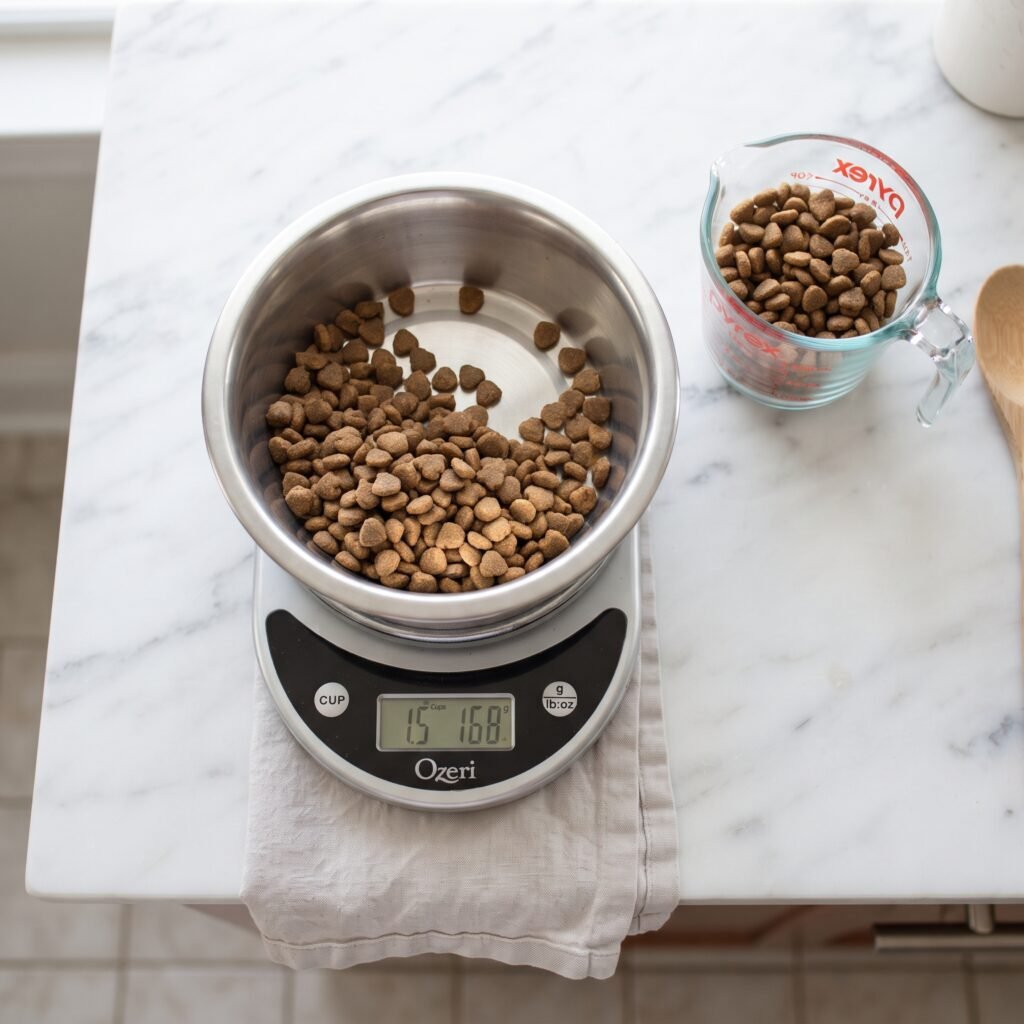
Use a measuring cup or, better, a kitchen scale. Scoops vary, and a heaped scoop can run 30% over a level one.
Feeding guidelines on the bag are population averages, often generous. Use them as a starting point, then adjust to body condition.
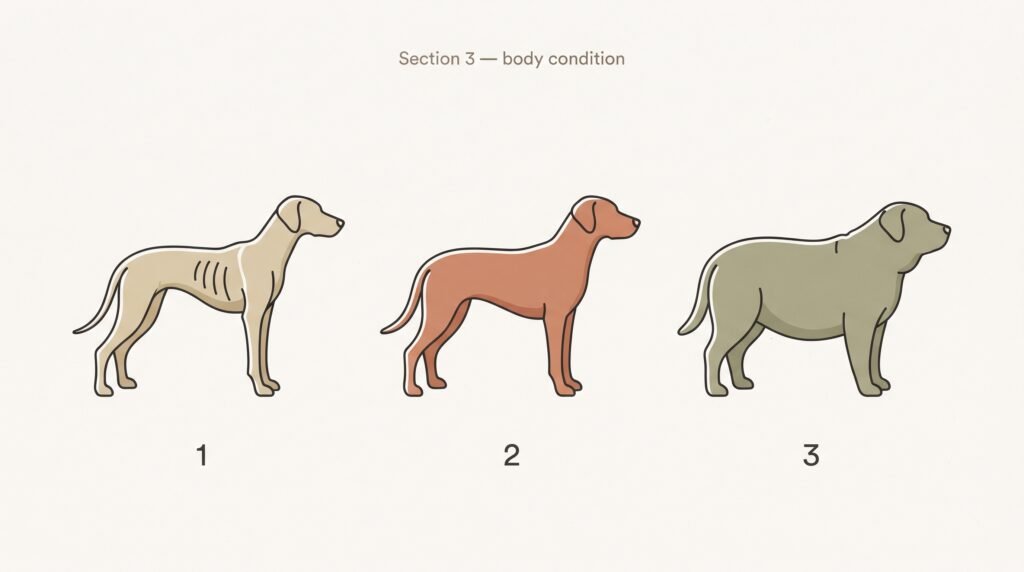
The target is a body condition score of 4 out of 9 during growth — slightly leaner than you’d think looks right. You should feel ribs easily under a thin fat layer, see a waist from above, and see an abdominal tuck from the side.
A large breed puppy who looks pleasantly chunky is being grown too fast. This is genuinely counter-cultural — friends and family will tell you he’s too thin. Nearly every veterinary orthopedist would rather see him lean.
Adding calcium
Some owners add calcium supplements, bone meal, or dairy to “support” growing bones. This directly defeats the purpose of buying large breed puppy food and is actively harmful.
A complete and balanced large breed puppy food already supplies calcium at the correct level. Adding more pushes intake past the exact ceiling the food was designed to hold.
The same applies to eggshell powder, cottage cheese by the cupful, and most “bone health” chews. If it’s marketed as a calcium source, it works against you here.
Topper drift
You add a spoonful of wet food. Then two. Then some chicken. Then table scraps.
Each addition is small and none is measured. Collectively they can shift a carefully balanced large breed puppy food by 15–20% in calories and dilute its mineral ratios. If you want to add toppers, keep them under 10% of daily calories and subtract that amount from the kibble.
Leaving large breed puppy food too early
Large breed puppies look grown at eight or nine months. They aren’t. Growth plates typically close between 12 and 18 months in large breeds, and later in giants.
Switching early means finishing skeletal development on a food that doesn’t meet growth requirements. There’s no benefit to leaving large breed puppy food early, and the “he’s eating so much” instinct is better addressed by portion control than by changing life stage.
Neutering timing interacts here too — early neutering can delay growth plate closure, extending the window during which growth nutrition matters. Worth a conversation with your vet if you’re planning the procedure before 12 months.
Chasing marketing claims
“Grain-free,” “ancestral,” “human-grade,” “no fillers.” None of these terms has a regulatory nutritional definition, and none tells you the calcium content.
Meanwhile the one thing that does matter — the AAFCO nutritional adequacy statement, in small print on the back — goes unread. That statement is where you find out whether a bag of large breed puppy food is actually formulated for large-size growth or just marketed that way.
Buying by the breed on the bag
Brands photograph a Golden Retriever or a German Shepherd on the front and owners of that breed buy accordingly. It’s a reasonable shortcut that fails badly on mixed breeds, and on breeds chosen for the photo shoot rather than for size.
Forgetting that exercise is part of the same equation
No diet compensates for this one. Repetitive high-impact work — long runs on pavement, forced stair climbing, agility jumps before the plates close — undoes in the yard what large breed puppy food is doing in the bowl.
The common guideline is roughly five minutes of structured exercise per month of age, twice daily. Free play on grass, self-limited by the puppy, sits outside that budget and is genuinely good for him.
It’s the human-paced, repetitive work that causes trouble — the jog you bring him on because he seems tireless.
Assuming all-life-stages is equivalent
An all-life-stages food meets growth minimums, which sounds sufficient. But unless the statement explicitly includes growth of large-size dogs, it isn’t held to the tighter calcium ceiling.
This is the trap that catches conscientious owners most often. The bag says it’s suitable for puppies. The small print says nothing about large-size growth.
Comparison: Large Breed Puppy Food vs the Alternatives
Table: how large breed puppy food compares to other formula types for a growing large-breed dog.
| Feature | Large breed puppy food | Standard puppy food | All life stages | Adult maintenance |
|---|---|---|---|---|
| Calcium ceiling (DM) | ~1.8% max | Higher permitted | Higher unless large-size claim | Not growth-appropriate |
| Calcium per 1,000 kcal | ~3.0–4.5 g | Commonly higher | Varies widely | Varies |
| Typical energy density | 330–380 kcal/cup | 400–450 kcal/cup | 380–450 kcal/cup | 320–400 kcal/cup |
| AAFCO statement to look for | Growth, including growth of large size dogs (70 lb+ adult) | Growth/reproduction | All life stages | Adult maintenance only |
| Best for | Projected adult weight 50 lb+ | Confidently small/medium adults | Only with large-size growth wording | Dogs past growth plate closure |
| Main risk if misapplied | Slightly lower calorie density | Excess calcium during growth | Unverified calcium ceiling | Growth nutrient deficits |
Reading the table properly
The row that decides everything is the AAFCO statement. Everything above it is detail; that line is the actual regulatory claim.
You’re looking for wording along the lines of: “formulated to meet the nutritional levels established by the AAFCO Dog Food Nutrient Profiles for growth, including growth of large size dogs (70 lbs or more as an adult).”
If the large-size clause is absent, the food has not been held to the large-breed calcium ceiling — regardless of what the front of the bag says.
Standard puppy food isn’t a bad product. It’s a correct product for a dog who’ll mature at 30 lbs. The problem is exclusively one of application.
All life stages is the most misunderstood category. It’s convenient for multi-dog homes, and some of these foods do carry the large-size growth clause. Check for it specifically — the convenience isn’t worth an unverified calcium level during your dog’s one growth window.
Adult maintenance food should not be used to slow a large breed puppy’s growth. That’s a real piece of folk advice and it’s the wrong tool. You’d be creating nutrient deficits to solve a portion-control problem. Use large breed puppy food and feed less of it.
Wet, fresh and raw
Canned large breed puppy food exists but is comparatively rare, and mineral content on an as-fed basis is harder to compare without converting to dry matter or kcal basis.
Fresh-cooked subscription services increasingly offer growth formulas. Ask directly whether the recipe carries the large-size growth statement — several don’t.
Raw diets are the highest-risk category here, not primarily for pathogens but for mineral balance. Homemade raw diets for large breed puppies frequently miss the calcium window in both directions. If you’re committed to raw, use a board-certified veterinary nutritionist to formulate it.
Kibble size, in one line
Kibble diameter is about chewing mechanics and eating speed. Larger pieces can slow a fast eater slightly, which is a mild bloat-risk consideration in deep-chested breeds. It has no bearing on whether a food is appropriate large breed puppy food.
A note on transitioning between brands
If you’re switching from whatever the breeder or shelter used, go slowly — 7 to 10 days, moving in roughly 25% increments every two or three days.
Loose stool during a fast switch gets misread as intolerance, and owners abandon a perfectly good food. Give the transition its full window before you judge the bag.
Methodology: How We Evaluated Large Breed Puppy Food
Transparency about criteria matters more than a ranked list, so here’s what we actually check.
1. The nutritional adequacy statement. We require explicit large-size growth wording. Foods claiming growth suitability without it are excluded regardless of quality.
2. Substantiation method. AAFCO adequacy can be established by formulation or by feeding trial. Feeding trials are more expensive and more meaningful. We note which method a large breed puppy food used.
3. Calcium expressed per 1,000 kcal. Percentages on a guaranteed analysis are as-fed and not comparable across moisture levels. We request the calcium and phosphorus figures per 1,000 kcal directly from manufacturers, and treat a refusal to supply them as disqualifying.
4. Who formulated it. We ask whether a full-time, qualified nutritionist — PhD in animal nutrition or board-certified by ACVN/ECVCN — is employed by the company. Consulting arrangements are noted separately.
5. Manufacturing control. Whether the company owns its plants, and what its recall history looks like over the past decade.
6. Cost per 1,000 kcal. Not price per bag. This is how large breed puppy food options are actually compared on cost.
7. Field feedback. We collect owner-reported stool quality, palatability and transition tolerance, and treat it as directional rather than decisive.
What we deliberately don’t weight: ingredient-panel aesthetics. Ingredient lists are ordered by pre-cooking weight, which makes fresh meat appear ahead of meals that contribute more protein after moisture is removed. Reading them as a quality ranking is a well-documented error.
We also don’t weight ingredient-count minimalism, “grain-free” status absent a diagnosed allergy, or marketing terms with no regulatory definition. None of them predicts whether a growth diet holds its calcium ceiling.
These are adapted from the WSAVA Global Nutrition Committee’s guidelines for selecting pet foods. Anyone can run the same questions on any bag of large breed puppy food, which is rather the point — the criteria matter more than our conclusions.
FAQ
When should I switch from large breed puppy food to adult food?
Most large breeds transition between 12 and 18 months; giant breeds at 18–24 months. The trigger is growth plate closure, not a birthday.
Signs you’re close: weight has been stable for 4–6 weeks and height has stopped changing. Your vet can confirm with radiographs if it matters. Transition over 7–10 days by mixing increasing proportions of adult food.
Is large breed puppy food really necessary, or is it marketing?
It’s necessary, and the reason is narrow and specific: the calcium ceiling. That’s a real regulatory distinction with real orthopedic consequences during growth.
Much of the rest of the marketing around large breed puppy food — kibble size, joint supplement inclusions, proprietary blend names — is considerably softer. The calcium spec is the part worth paying for.
Can I feed large breed puppy food to a small dog?
Nutritionally, yes — it meets the same growth minimums. It’s slightly less calorie dense, so you’d feed a bit more volume, and the kibble may be too large for a toy breed to chew comfortably.
There’s no reason to seek this out, but if you’ve got a mixed litter or an uncertain projection, feeding large breed puppy food across the board is a safe choice.
What calcium level should large breed puppy food have?
Roughly 3.0–4.5 g per 1,000 kcal, or about 1.2–1.8% on a dry matter basis. Phosphorus around 2.5–4.0 g per 1,000 kcal, with a Ca:P ratio between 1:1 and 2:1.
Ask the manufacturer for these figures directly — guaranteed analysis panels usually don’t show them.
My puppy always seems hungry on large breed puppy food. Should I feed more?
Usually no. Large breed puppies are close to permanently hungry; it’s a poor signal of adequacy.
Judge by body condition instead. If you can feel ribs easily and see a waist, he’s right where he should be. If you can’t feel ribs, reduce the portion. Splitting the same daily amount across three meals helps with the begging without adding calories.
Is grain-free large breed puppy food a safer choice?
There’s no evidence it is, absent a diagnosed grain allergy — which is uncommon. The FDA’s ongoing DCM investigation focused on grain-free formulas built heavily on peas, lentils and potatoes.
Grains are not fillers. Unless your vet has identified a specific sensitivity, this isn’t a variable worth optimising.
Do I need a joint supplement alongside large breed puppy food?
Most quality formulas already include glucosamine and chondroitin, and the evidence for supplementing a well-fed growing puppy further is thin.
Portion control and lean body condition do more for your dog’s joints than any additive. If you want to spend money on his skeleton, spend it on a scale and on keeping him at a body condition score of 4 out of 9.
The Bottom Line
The question isn’t really “what’s the best large breed puppy food.” It’s “how do I decide when I can’t yet know how big my dog will be.”
The answer is to let the asymmetry decide for you. Feeding large breed puppy food to a dog who turns out medium-sized costs you a marginally less calorie-dense bag. Skipping it for a dog who turns out large costs him a skeletal system you can’t rebuild.
So: estimate adult weight with a DNA test or parent weights if you can. Default to large breed puppy food when the estimate is ambiguous or lands anywhere above 45–50 lbs. Check the AAFCO statement for the large-size growth clause. Then measure every meal, keep him visibly lean, and stay on growth food until the plates close.
That’s the whole framework. Large breed puppy food matters less than what you do with it.
Reviewed against AAFCO Dog Food Nutrient Profiles and WSAVA Global Nutrition Committee guidance. Not a substitute for individualized veterinary advice.