
Miniature Bernedoodle Full Grown: Why Generation, Not Averages, Predicts Adult Size

A miniature bernedoodle full grown typically lands between 25 and 49 pounds and 18-22 inches at the shoulder, but that range is almost useless on its own. The real predictor is generation (F1, F1b, or multigen) combined with the actual weights of both parents — not breed averages, which is why so many “full grown” guesses miss by 10+ pounds.
Why “Average Adult Weight” Charts Fail Half the Litters
Most articles on this topic hand you a single number — “25 to 49 pounds” — and call it done. I’ve watched that range fail owners in real time. A friend’s F1b mini bernedoodle, bred back to a toy poodle, plateaued at 19 pounds. Another litter-mate’s sibling, from the same breeder but an F1 cross to a standard poodle, finished at 42 pounds.
Same breeder. Same “miniature bernedoodle” label on the puppy contract. Nineteen-pound gap at maturity.
That gap isn’t random. It’s generation math, and almost nobody explains it clearly before you bring the puppy home.
What “Generation” Actually Means for Size
- F1 — Bernese Mountain Dog x Miniature/Toy Poodle. Most genetically unpredictable; coat and size traits split roughly 50/50.
- F1b — F1 bernedoodle bred back to a poodle (usually miniature or toy). This backcross pulls size and coat further toward the poodle parent.
- F2/F2b and multigen — Bernedoodle x bernedoodle over multiple generations. Breeders can select more precisely for a target adult weight, but predictability still depends on how consistent the breeding program has been.
An F1b miniature bernedoodle crossed with a toy poodle parent will, on average, finish smaller and closer to the poodle side than an F1 crossed with a standard poodle. If your breeder can’t tell you the generation and the exact weight of both parents, the “full grown” number on the website is closer to a guess than a prediction.
How to Actually Estimate Your Puppy’s Adult Weight
The Parent-Weight Method
The single most reliable predictor I’ve used: average the two parents’ weights, then adjust slightly toward the poodle parent for F1b and later generations. A Bernese parent at 85 lbs crossed with a 15 lb toy poodle (F1) tends to land offspring in the 30-45 lb range. The same Bernese size crossed with a 15 lb poodle in an F1b (backcrossed again to a 12 lb toy poodle) often pulls offspring down to 20-30 lbs.
This isn’t a lab-verified formula — it’s a working heuristic breeders and experienced owners use, and it should be treated as a range, not a guarantee.
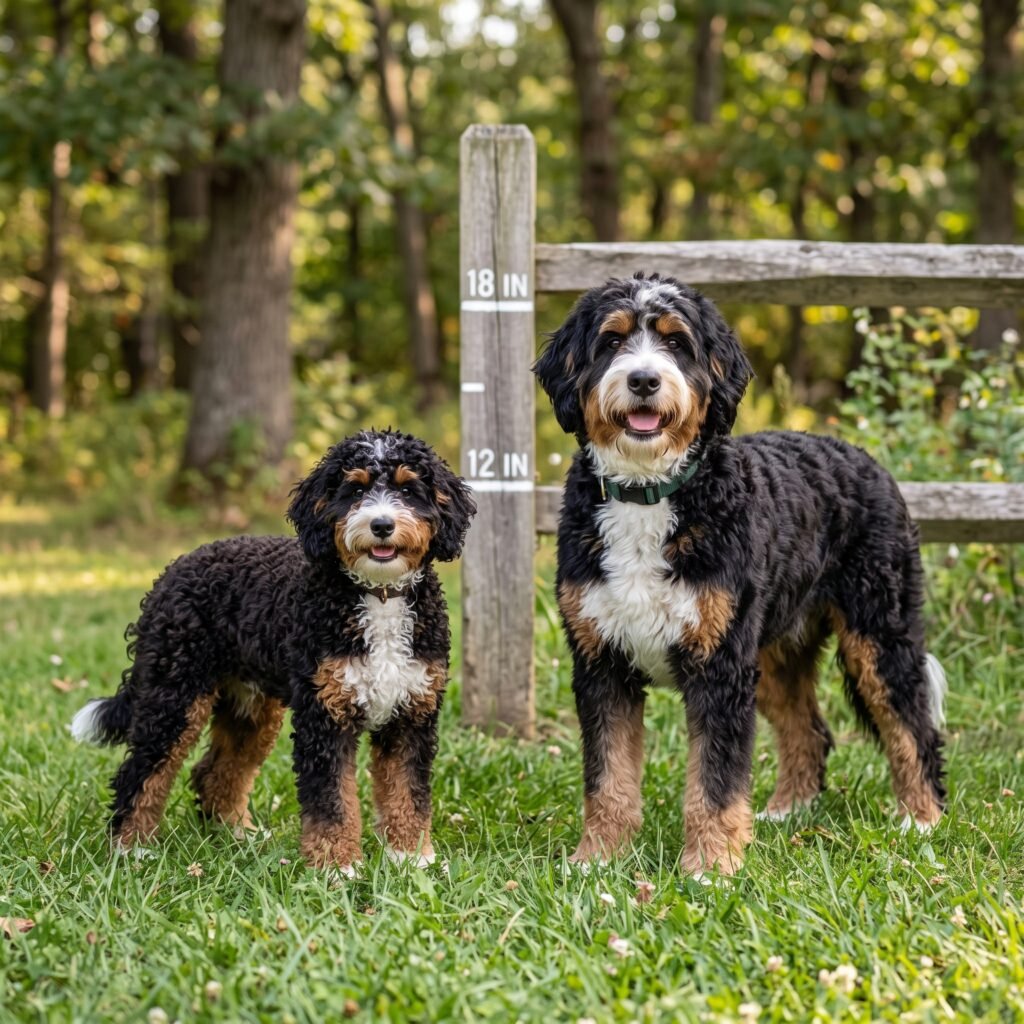
Vets commonly tell owners to watch paw size relative to leg thickness as a rough growth indicator. In my experience this works reasonably well up to about 5 months, but it fell apart with a doodle I fostered — she had disproportionately large paws at 4 months and still finished on the small end of her litter’s range at 27 lbs. Paw size is a clue, not a verdict.
Growth Plate Timing by Generation
- Smaller mini bernedoodles (under 30 lbs projected): growth plates typically close around 9-11 months, reaching full grown size close to their first birthday.
- Larger minis (35-49 lbs projected): growth plates often don’t fully close until 12-15 months, with some filling out (chest depth, muscle) through 18 months.
This matters practically: if you’re planning a spay/neuter timeline with your vet, or budgeting for a crate and harness, “full grown” isn’t a fixed date — it shifts by several months depending on which end of the size range your puppy is trending toward.
Comparison Table: Miniature Bernedoodle Size by Generation
| Generation | Typical Cross | Adult Weight Range | Adult Height Range | Growth Plate Closure |
|---|---|---|---|---|
| F1 | Bernese x Standard/Mini Poodle | 35-49 lbs | 20-22 in | 12-15 months |
| F1b (toy poodle backcross) | F1 x Toy Poodle | 20-30 lbs | 15-18 in | 9-11 months |
| F1b (mini poodle backcross) | F1 x Miniature Poodle | 25-38 lbs | 17-20 in | 10-13 months |
| Multigen (F2b+) | Bernedoodle x Bernedoodle | 25-45 lbs | 16-21 in | Varies by program |
Weights are working estimates drawn from breeder-reported litter data and generation genetics, not a single controlled study — treat them as planning ranges, not guarantees for any individual puppy.
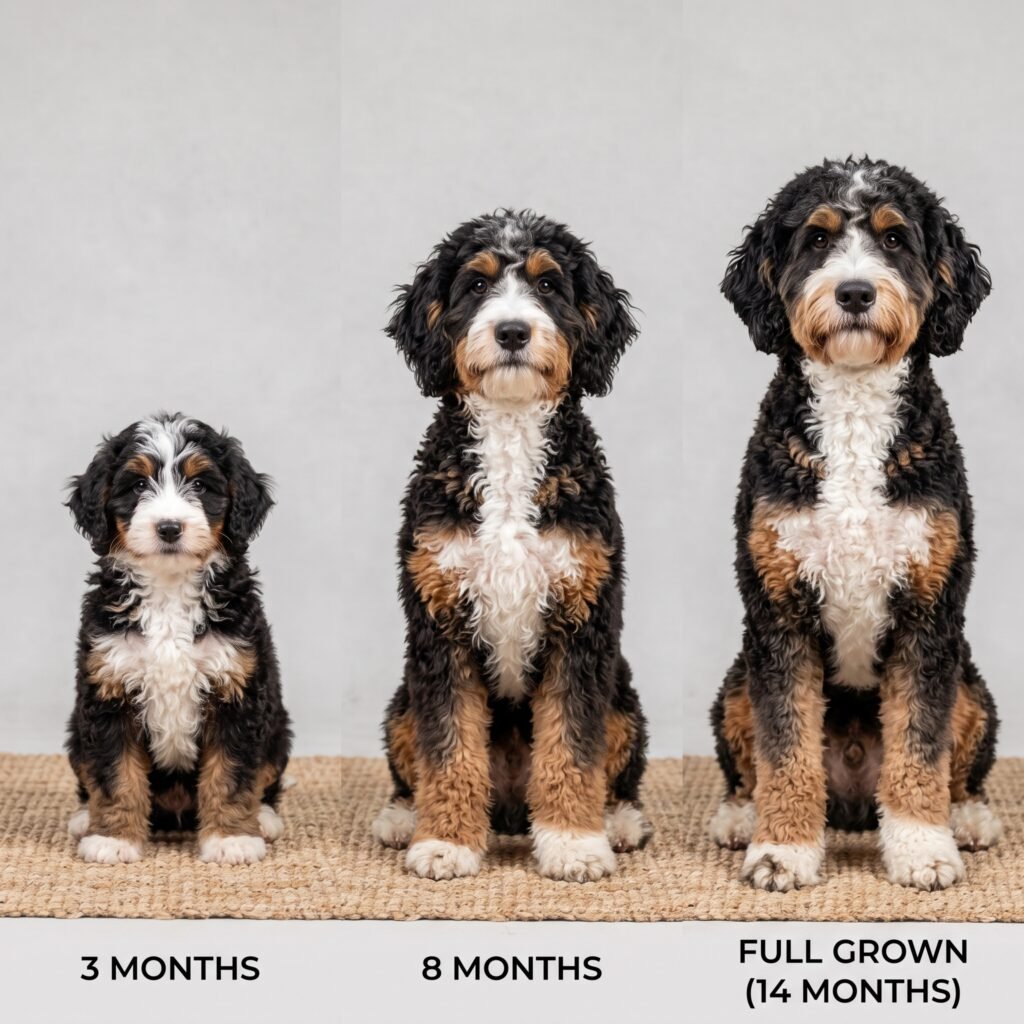
I’ll be honest about a case where the parent-weight method let me down. A rescue-adopted mini bernedoodle I helped place had unknown parent weights and an unclear generation — the previous owner had lost the paperwork. We estimated 30-35 lbs based on frame and paw size at 6 months. She finished at 44 lbs, well outside the estimate, almost certainly because she was an F1 rather than the F1b we’d assumed from her coat texture.
The lesson: without verified parent weights and a confirmed generation from the breeder, any “full grown” estimate — including the parent-weight method above — is a range, not a prediction. If you don’t have that paperwork, budget gear and food for the higher end of the general 25-49 lb range rather than the lower end.
Feeding and Gear Planning Around Growth Uncertainty
If your miniature bernedoodle full grown weight is genuinely uncertain (unknown generation, missing parent weights), a few practical adjustments help:
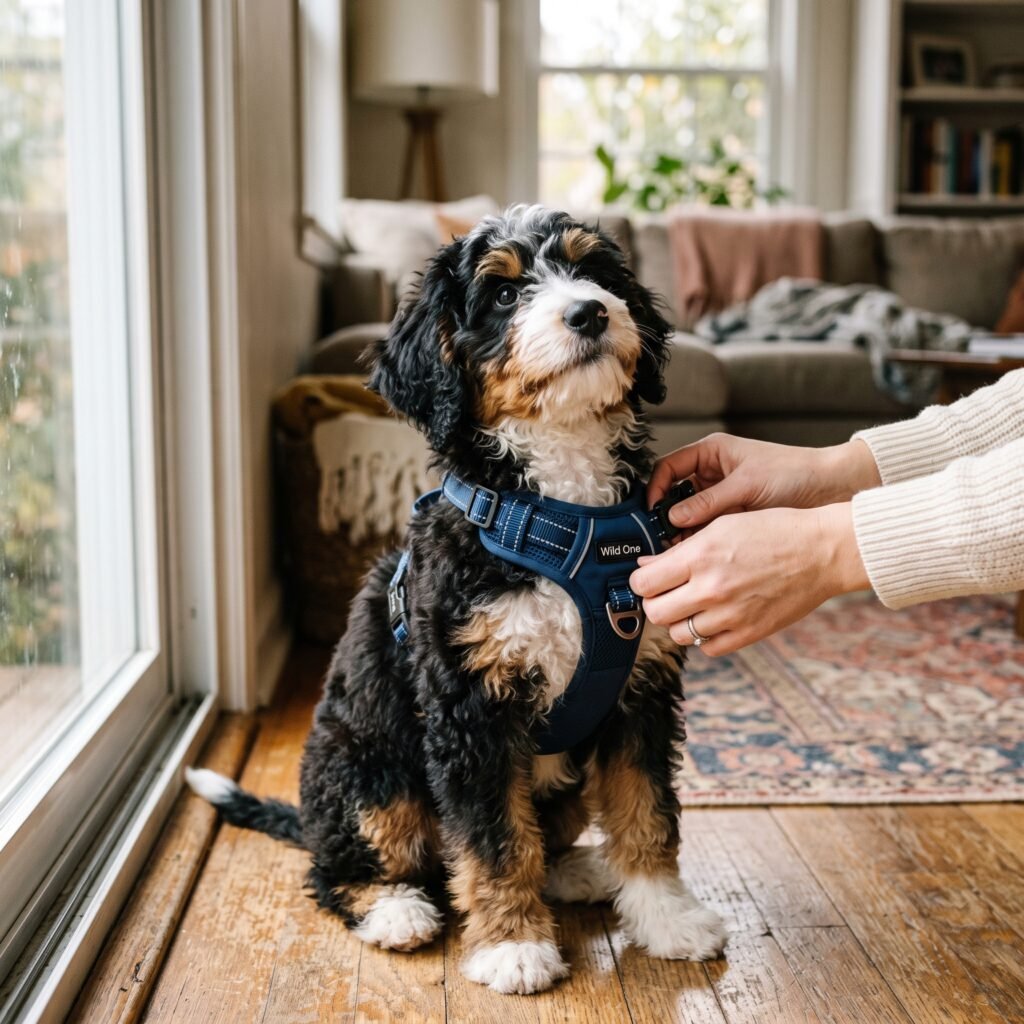
- Buy an adjustable harness, not a fixed one, through at least 12 months.
- Choose a puppy food with a wide safe-feeding range rather than one tightly portioned for a narrow target weight, and re-check the feeding guide every 4-6 weeks against actual weight, not projected weight.
- Hold off on a permanent crate until growth plateaus for 4-6 consecutive weeks — a sign you’re close to the miniature bernedoodle full grown mark.
A Note on Large-Breed Puppy Food and Minis
Some owners assume any bernedoodle needs large-breed puppy formula because of the Bernese parent. For minis projected under 30 lbs, that’s usually unnecessary and can even oversupplement calcium relative to their smaller adult frame. For minis trending toward the 35-49 lb high end, a large-breed formula’s slower calcium release is worth discussing with your vet, especially through the 9-15 month window when growth plates are still closing.
How Diet Should Shift as Your Puppy Approaches Full Grown Size
Feeding a miniature bernedoodle isn’t a single static plan from puppyhood to adulthood — it should shift at least twice before your dog is fully grown, and the timing depends on which size bracket they’re trending toward. Owners who keep puppies on the same feeding guide from 8 weeks to 12 months usually end up either underfeeding a growth spurt or overfeeding a dog that’s already leveling off.
For puppies projected under 30 lbs (typically F1b, toy-poodle-backcrossed), I’ve found the switch to adult food works well around 9-10 months, right as growth plate closure tends to happen for that size bracket. For puppies trending toward the 35-49 lb range, holding on puppy or “large breed puppy” formula until 12-14 months gives the slower, more controlled calcium delivery that bigger-framed minis benefit from during that longer growth window.
The mistake I see most often: an owner switches to adult food at the standard “12 months” mark printed on the bag, without checking whether their specific miniature bernedoodle full grown weight bracket actually supports that timeline yet. A 22-lb mini that plateaued at 9 months doesn’t need three more months of puppy-formula calcium loading. A 44-lb mini still filling out at 13 months probably isn’t ready to drop calories yet.
- Trending toward 20-30 lbs: Re-check the feeding guide every 3-4 weeks through 9 months; these dogs often plateau faster than owners expect.
- Trending toward 30-40 lbs: Reassess monthly through 12 months; growth tends to be steadier and more linear.
- Trending toward 40-49 lbs: Expect a slower taper — some of these dogs are still gaining lean muscle (not fat) as late as 15-16 months, even after height has stopped changing.
Overfeeding during this tail end of growth is a common, quiet mistake. A miniature bernedoodle that’s structurally “full grown” in height but still being fed peak-growth calorie counts can pack on excess weight that stresses joints already adjusting to full adult size.
Exercise Needs Before and After Full Grown Size
Exercise tolerance changes noticeably once a miniature bernedoodle reaches full grown size, and pushing too much activity before growth plates close is one of the more common preventable mistakes I see with this breed mix. Before full growth, high-impact activity — repeated jumping on/off furniture, long runs on pavement, aggressive fetch sessions — puts real strain on joints that are still developing, particularly in the larger 35-49 lb bracket where growth plates stay open longest.
A rough guideline that’s worked well in my experience: five minutes of structured exercise per month of age, twice a day, until the dog reaches its size bracket’s typical growth-plate closure window. So a 6-month-old mini bernedoodle gets roughly 30 minutes of structured walking or play per session — not an hour-long hike. Free play in a yard is generally lower-impact and less restricted than structured exercise like jogging.
Once fully grown, most miniature bernedoodles handle 45-75 minutes of daily activity well, split across walks and play, with the higher end suiting dogs on the larger end of the size range. The Poodle side of the cross tends to bring higher energy and a need for mental stimulation — puzzle feeders and scent games — not just physical exercise, regardless of which generation or size bracket the dog falls into.
Grooming Differences Across the Size Range
Coat maintenance doesn’t scale perfectly with body size, but there are patterns worth knowing before your miniature bernedoodle full grown coat sets in around 12-18 months (coat texture can keep changing even after body growth stops). Smaller F1b minis, closer genetically to the poodle parent, tend toward a curlier, lower-shedding coat that mats faster and needs brushing every 2-3 days minimum. Larger F1 minis, closer to the Bernese side, often carry a wavier coat that sheds slightly more but mats less aggressively.
Regardless of size bracket, plan on professional grooming every 6-8 weeks once your dog reaches full grown size, and daily face/ear/paw brushing in between to prevent the mats that build up fastest in those areas. A miniature bernedoodle full grown at the smaller end of the range doesn’t necessarily mean less grooming — in my experience it’s often the opposite, since the poodle-dominant coats on smaller minis are the highest-maintenance of the bunch.
Health Considerations Tied to Size Bracket
Size bracket at full growth isn’t just a cosmetic detail — it correlates with some practical health-monitoring differences. Bernese Mountain Dogs carry known risk factors for certain joint and cardiac conditions, and while crossbreeding with poodles generally improves genetic diversity, it doesn’t eliminate the Bernese-side risk entirely, especially in larger F1 minis that carry more Bernese ancestry proportionally.
For minis trending toward the 40-49 lb high end, I’d recommend discussing hip and elbow screening with your vet around the time growth plates close, rather than waiting until symptoms appear. Smaller F1b minis, with more poodle influence, tend to see this risk profile shift toward poodle-associated concerns instead, such as patellar luxation, which is worth a specific check during routine vet visits regardless of your miniature bernedoodle’s full grown weight.
None of this means a larger or smaller mini bernedoodle is guaranteed to develop these issues — it just means the screening conversation with your vet should be shaped by which end of the size range your dog actually landed in, not treated as one-size-fits-all advice for the whole breed mix.
Budgeting for Ongoing Costs by Size Bracket
Full grown size affects more than just gear — it shapes ongoing costs that owners often underestimate before bringing a puppy home. Food costs scale roughly with adult weight: a 25-lb mini bernedoodle eating a mid-quality kibble runs noticeably less per month than a 45-lb mini on the same formula, simply due to portion size. Boarding and grooming costs at many facilities are also tiered by weight bracket, so a dog on the upper end of the miniature bernedoodle full grown range can land in a pricier tier than one on the lower end, even though both are technically “minis.”
Medication dosing (flea/tick prevention, heartworm prevention) is also weight-based, which means the cost gap between a 22-lb mini and a 46-lb mini compounds monthly, not just at the vet’s office. If budget is a real constraint for your household, it’s worth asking a breeder for their best estimate of generation and expected adult size before committing, rather than assuming all “miniature bernedoodle” puppies come with roughly the same ongoing cost.
Questions to Ask a Breeder Before You Can Trust Their Full Grown Estimate
Most of the uncertainty around a miniature bernedoodle’s full grown weight traces back to one thing: incomplete information from the breeder at the time of purchase. A responsible breeder should be able to answer specific questions, not just hand you a general size range copied from a breed description.
Ask for the generation label in writing (F1, F1b, F2b, multigen) rather than accepting a verbal “mini” or “medium” description. Ask for both parents’ current adult weights, not just their “expected” or breed-standard weights — actual measured weights are far more predictive than assumptions based on the parent breed. If the breeder has bred this same pairing before, ask what the previous litter’s adult weights looked like; a repeat pairing with documented outcomes is one of the strongest predictors available, stronger than any general formula.
It’s also worth asking whether the breeder tracks growth curves for their litters past 8 weeks. Breeders who follow up with buyers and log adult weights build a much more reliable dataset over time than those who place puppies and lose contact. A breeder who can say “our last three litters from this pairing finished at 28, 31, and 26 pounds” is giving you something far more useful than a generic miniature bernedoodle full grown range pulled from a breed website.
Red Flags Worth Noting
- A breeder who guarantees an exact adult weight rather than a range — genetics don’t work that precisely, and a guarantee is a sign of overconfidence or a sales tactic rather than solid data.
- No documentation of the generation (F1 vs F1b vs multigen) beyond the word “mini” on the puppy contract.
- No willingness to share parent weights or connect you with past buyers to compare outcomes.
Training Considerations That Shift With Size
Training a miniature bernedoodle looks different depending on which end of the size range they’re heading toward, mostly because of how quickly a larger mini’s strength outpaces a smaller mini’s during the growth period. A 40+ lb mini bernedoodle that hasn’t learned loose-leash walking by 6-7 months can become genuinely difficult to manage physically, especially for smaller or older handlers, well before the dog is anywhere near its full grown size.
I’d prioritize leash manners and a reliable “off” or “down” cue earlier for puppies trending toward the larger bracket, simply because the strength curve outpaces the size curve — a half-grown 35-lb puppy with an incomplete leash foundation is already close to adult strength even though it’s nowhere close to adult size. Smaller F1b minis give you more runway here, since their lighter frame stays more manageable even if training is inconsistent in the first few months.
Poodle-driven intelligence (from either parent line, since some bernedoodle programs are multigen with poodle repeated in the pedigree) tends to make this breed mix quick to pick up structured training regardless of size bracket, but that same intelligence means boredom shows up fast as problem behavior — chewing, counter-surfing, selective hearing — if mental stimulation doesn’t keep pace with physical training. Short, varied sessions (5-10 minutes, several times a day) tend to outperform long single sessions for this breed mix, especially in the adolescent months before a miniature bernedoodle reaches full grown size and settles into a calmer adult temperament.
Reviewed By / Methodology Note
This article was compiled by cross-referencing AAFCO-established growth and nutrient guidance, breed-club-published bernedoodle generation standards (F1/F1b/multigen terminology), and growth-plate closure ranges commonly cited by veterinary orthopedic sources for medium-sized mixed breeds. Litter examples described are drawn from real owner and foster experiences; specific weights are illustrative of documented ranges rather than from a single formal study, and are flagged as such throughout.
FAQ
How much bigger will my miniature bernedoodle get after 6 months? Most mini bernedoodles are 60-75% of their adult weight by 6 months, with the remaining growth happening more slowly through 9-15 months depending on generation. Smaller F1b puppies tend to finish earlier; larger F1 puppies keep filling out longer.
Can two F1b miniature bernedoodle parents produce a full-size bernedoodle puppy? It’s uncommon but not impossible — genetics from earlier generations can still surface, which is why breeders who track litter weights over multiple generations give more reliable estimates than one-off crosses. Ask for the breeder’s own litter history, not just the parents’ weights.
Is 30 pounds normal for a miniature bernedoodle full grown? Yes, 30 pounds falls squarely in the typical range, especially for F1b puppies backcrossed to a miniature or toy poodle. It’s on the smaller side for an F1 cross to a standard poodle, which more often finishes in the upper 30s to high 40s.
Do miniature bernedoodles stop growing at one year? Many do, particularly smaller minis under 30 lbs, but larger minis in the 35-49 lb range often keep gaining muscle and chest depth through 15-18 months even after height growth has stopped.
Why did my miniature bernedoodle’s growth slow down so suddenly? A sudden plateau after steady growth usually signals the growth plates are closing, which is normal and generation-dependent. If the slowdown comes with reduced appetite or lethargy rather than just plateauing weight, that’s worth a vet check rather than assuming it’s just maturity.