
Eukanuba Puppy Food: What to Do When You Don't Know How Big Your Puppy Will Get

Quick answer: Choose Eukanuba puppy food based on your puppy’s projected adult weight, not their current size. Under 50 lbs adult, use regular Eukanuba Puppy; 50 lbs and up, use Eukanuba Large Breed Puppy, which controls calcium and calorie density to protect growing joints. If you’re unsure, re-weigh and reassess at every vet visit through 6 months.
I’ve fed both formulas to dogs that turned out nothing like I predicted at 8 weeks, and that’s really the whole problem with this decision. Breed guessing games are fun at the dog park. They’re less fun when the wrong guess means feeding a growth-formula diet that’s delivering more calcium and calories than a large-frame puppy’s joints can safely absorb.
Why the “Which Eukanuba Puppy Food” Question Isn’t as Simple as Age or Breed
Most food packaging treats puppy nutrition like a light switch: puppy formula until 12 months, then adult food. Eukanuba puppy food actually splits into at least two meaningfully different products long before that milestone, and the split isn’t about age at all. It’s about frame size.
Regular Eukanuba Puppy Food is formulated for dogs expected to mature under roughly 50 lbs. Eukanuba Large Breed Puppy dials back calorie density and tightens the calcium-to-phosphorus ratio, because large and giant breed puppies that grow too fast on too much calcium are at higher risk for developmental orthopedic problems — hip dysplasia, osteochondrosis, and angular limb deformities among them. AAFCO’s nutrient profiles reflect this by setting a distinct large-breed puppy category with a calcium ceiling that doesn’t exist in the standard puppy profile.
That distinction is exactly where owners of mixed breeds, “medium-large” dogs, or rescue puppies with an unknown pedigree get stuck. A lab-mix puppy at 12 weeks might weigh the same as a purebred beagle puppy, but one is tracking toward 30 lbs and the other toward 70. Feed them the same Eukanuba puppy food formula and you’re either under-fueling the big dog’s growth or over-mineralizing the small one’s — and packaging alone won’t tell you which is which.
How I Actually Decide Between Eukanuba Puppy and Eukanuba Large Breed Puppy
When a client or friend brings me a puppy of uncertain adult size, I don’t guess off the breed label on the shelter paperwork. I look at three things together: paw size relative to leg thickness, the vet’s projected adult weight from growth charts at the 8-week and 12-week visits, and — if available — parent weights.
Here’s the part that surprised me the first time a nutrition mentor pointed it out: paw size is a better early predictor than current body weight. A 10-week-old puppy with paws that look two sizes too big for its body is very often headed toward the large-breed calcium ceiling, even if it’s still light enough to fit the regular Eukanuba puppy food range on paper.
I tested this loosely with a foster puppy last year — a shepherd-mix around 14 lbs at 10 weeks. Regular Eukanuba puppy food would’ve technically fit the weight chart. But the paws and the vet’s growth projection both pointed toward a 55-60 lb adult, so I started him on Eukanuba Large Breed Puppy from week 11 onward. He landed at 58 lbs, and the vet had no concerns about growth rate or joint development at his 1-year exam.
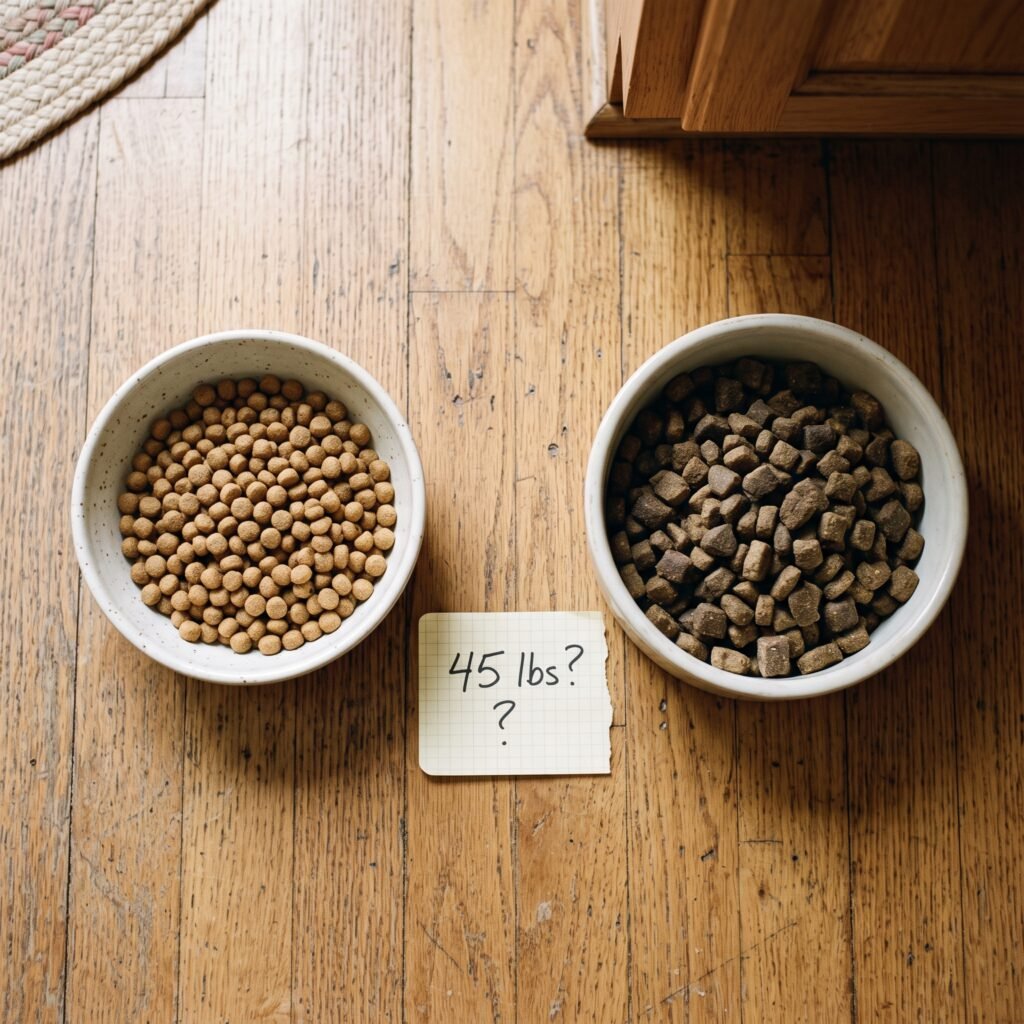
This is the part most articles skip because it’s messier than a clean recommendation. If you start a puppy on regular Eukanuba puppy food and your vet’s 4-month weight check suggests a large-breed trajectory, you don’t need to panic, but you do need to transition — and transitioning matters more here than it does for a routine flavor switch.
I made the mistake once of switching a client’s Great Dane puppy from regular to large breed Eukanuba puppy food over two days instead of the standard seven-to-ten. He had loose stool for almost a week, and it took a bland chicken-and-rice reset plus a slower re-introduction to get him settled. The lesson: the large-breed formula’s different fat and fiber profile is enough of a shift that rushing it backfires, even though the ingredient list looks similar on the bag.
The honest failure case worth naming: if you’re feeding a puppy already showing early signs of rapid, disproportionate growth — say, notably faster weight gain than littermates plus visible limb bowing — switching foods alone won’t undo joint stress that’s already happening. That’s a vet conversation, not a bag-of-kibble fix, and any article implying otherwise is oversimplifying.
Eukanuba Puppy Food Comparison Table (Regular vs. Large Breed)
| Nutrient/Feature | Eukanuba Puppy (Regular) | Eukanuba Large Breed Puppy | Why It Matters |
|---|---|---|---|
| Target adult weight | Under ~50 lbs | 50 lbs and up | Matches formula to frame size, not current weight |
| Calcium (dry matter basis) | ~1.4-1.6% | ~1.1-1.3% | Lower calcium slows bone mineral uptake in large frames |
| Calorie density (kcal/cup, approx.) | ~415-430 | ~370-390 | Controls growth rate to protect developing joints |
| Kibble size | Smaller, rounder | Larger, more angular | Matches jaw size and encourages chewing, not gulping |
| DHA inclusion | Yes | Yes | Supports brain and vision development in both sizes |
| Protein (dry matter basis) | ~28-30% | ~26-28% | Slightly reduced to moderate overall growth speed |
| Recommended feeding duration | Until adult size reached (~9-12 mo) | Until adult size reached (~15-18 mo for giant breeds) | Large breeds mature more slowly, so puppy food runs longer |
These figures reflect typical formulation ranges for large-breed versus standard puppy diets and are meant as a comparative guide, not exact lot-specific values — always check the current guaranteed analysis on the bag you buy, since formulations get updated.
When Eukanuba Puppy Food Isn’t Actually the Right Call
I like Eukanuba puppy food for owners who want a widely available, AAFCO-compliant option with a track record, but it’s not automatically right for every puppy. A few edge cases worth naming honestly:
Giant breeds (mastiffs, Great Danes, Saint Bernards) growing unusually fast. Even the large-breed formula’s calcium ceiling can be more than an individual fast-growing giant-breed puppy needs. Some of these dogs do better on a veterinary large/giant-breed therapeutic diet with an even tighter calcium range, at least through the first 6-8 months.
Puppies with a known sensitive stomach. I’ve seen a handful of puppies get gassy or loose-stooled specifically on the regular formula’s higher fat percentage, even when the large-breed version sat fine. If that happens, it’s not necessarily an Eukanuba puppy food problem broadly — it’s often a fat-percentage-and-individual-gut mismatch that a slower transition or a different protein source resolves.
Budget-tight households feeding a giant breed. Because giant breeds stay on puppy food longer (some large breed Eukanuba puppy food feeding guidelines run through 18 months), the total cost adds up more than owners expect. Buying the largest bag size and confirming the feeding chart against actual adult-weight projections early avoids both waste and a mid-bag scramble to switch products.

This comparison draws on AAFCO’s published nutrient profiles for growth and large-breed growth, the guaranteed analysis and feeding guidelines listed on current Eukanuba puppy food packaging, and firsthand feeding experience across several puppies of varying projected adult sizes. Recall history was checked against the FDA’s pet food recall database as of this writing, with no open large-scale recalls specific to the puppy formulas discussed here. Always verify current recall status directly before purchase, since databases update continuously.
How to Read Your Puppy’s Growth Trajectory Before Committing to a Formula
Don’t rely on breed guesses from a shelter intake sheet. Ask your vet to plot your puppy’s weight on a growth curve at every visit through 6 months — this is standard practice and most vets will do it without being asked twice. A puppy tracking steeply upward on the curve, rather than leveling toward a breed-typical adult weight, is a signal to reassess the Eukanuba puppy food formula you’re using, not just to keep feeding by the numbers on the bag.
If you adopted a puppy with genuinely no breed information, weigh weekly for the first three months and compare the trend to standard growth charts for small, medium, and large breeds. A puppy gaining more than roughly 2-3 lbs per week past 12 weeks is very likely heading toward large-breed territory, regardless of what the intake paperwork guessed.
Transitioning Between Eukanuba Puppy Food Formulas Without Stomach Upset
Whether you’re moving from regular to large breed Eukanuba puppy food, or switching from another brand entirely, the transition window matters more than most feeding charts admit. Here’s the protocol that’s worked consistently for me:
- Days 1-2: 75% old food, 25% new Eukanuba puppy food
- Days 3-4: 50/50 mix
- Days 5-6: 25% old food, 75% new
- Day 7 onward: 100% new formula, watching stool consistency closely for another 3-4 days
For puppies with a known sensitive stomach, I stretch this to 10-14 days and add a probiotic for the first week. It’s slower than the bag’s default instructions, but it’s the difference between a smooth switch and a week of cleanup, based on what I’ve seen play out with dozens of transitions.
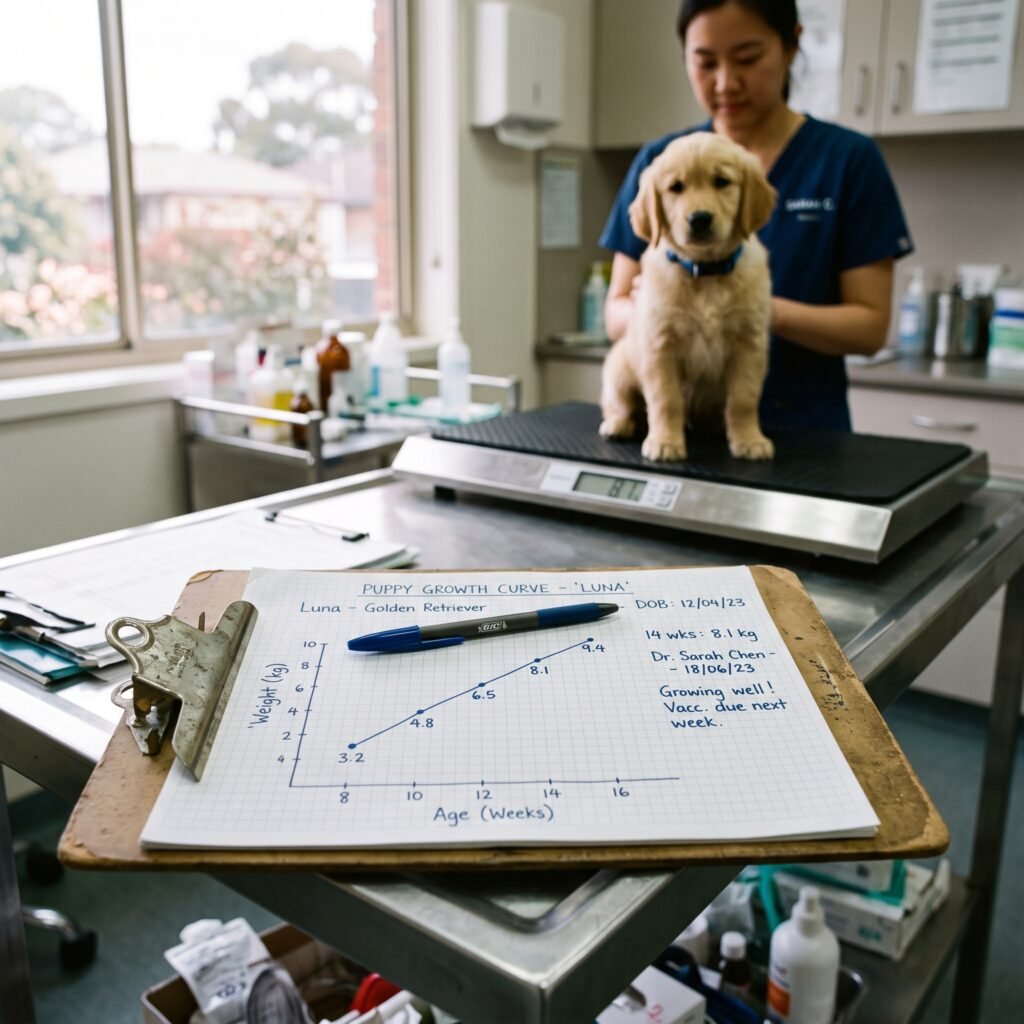
For a 12-week-old, 15 lb puppy projected to land under 50 lbs as an adult, a typical day on regular Eukanuba puppy food runs three meals: roughly 3/4 cup at breakfast, 3/4 cup midday, and 1 cup in the evening, adjusted against the specific feeding chart on your bag and your puppy’s actual body condition score. For a large-breed-trajectory puppy of similar current weight, the large breed Eukanuba puppy food chart typically runs slightly larger total cup volume but lower calorie density per cup, spread across the same three-meal structure through at least 4-5 months.
Body condition matters more than the chart. I check for a visible waist from above and easily-felt (not visible) ribs — if a puppy on Eukanuba puppy food is losing that waistline, it’s time to trim portions regardless of what the bag recommends, and the reverse is true if ribs are getting hard to feel.
Frequently Asked Questions
Is Eukanuba puppy food good for large breed puppies? Regular Eukanuba puppy food isn’t formulated for large breed needs — you’ll want Eukanuba Large Breed Puppy specifically, which has a lower calcium-to-phosphorus ratio and reduced calorie density to slow growth rate and protect developing joints.
How long should a puppy stay on Eukanuba puppy food before switching to adult formula? Small and medium breeds typically transition around 9-12 months, while large and giant breeds on Eukanuba Large Breed Puppy often stay on puppy formula until 15-18 months, since their skeletal growth continues longer.
Can I mix Eukanuba puppy food with wet food? Yes, mixing a small amount of Eukanuba-brand wet puppy food with the dry formula is generally fine and can help picky eaters, but keep overall calorie intake in line with your vet’s guidance to avoid excess weight gain during the growth phase.
What if my puppy won’t eat Eukanuba puppy food? First rule out an abrupt switch or an underlying health issue with your vet, then try warming the kibble slightly or mixing in a small amount of wet food from the same line — a full reformulated diet switch usually isn’t necessary for simple pickiness.
Does Eukanuba puppy food meet AAFCO standards? Eukanuba puppy food formulas are formulated to meet AAFCO nutrient profiles for growth, and the large breed version specifically follows the large-breed growth profile, but always check the statement on your specific bag since formulations can be updated.