
Why Does My Dog Pee on My Bed? A Step-by-Step Way to Tell Medical From Behavioral

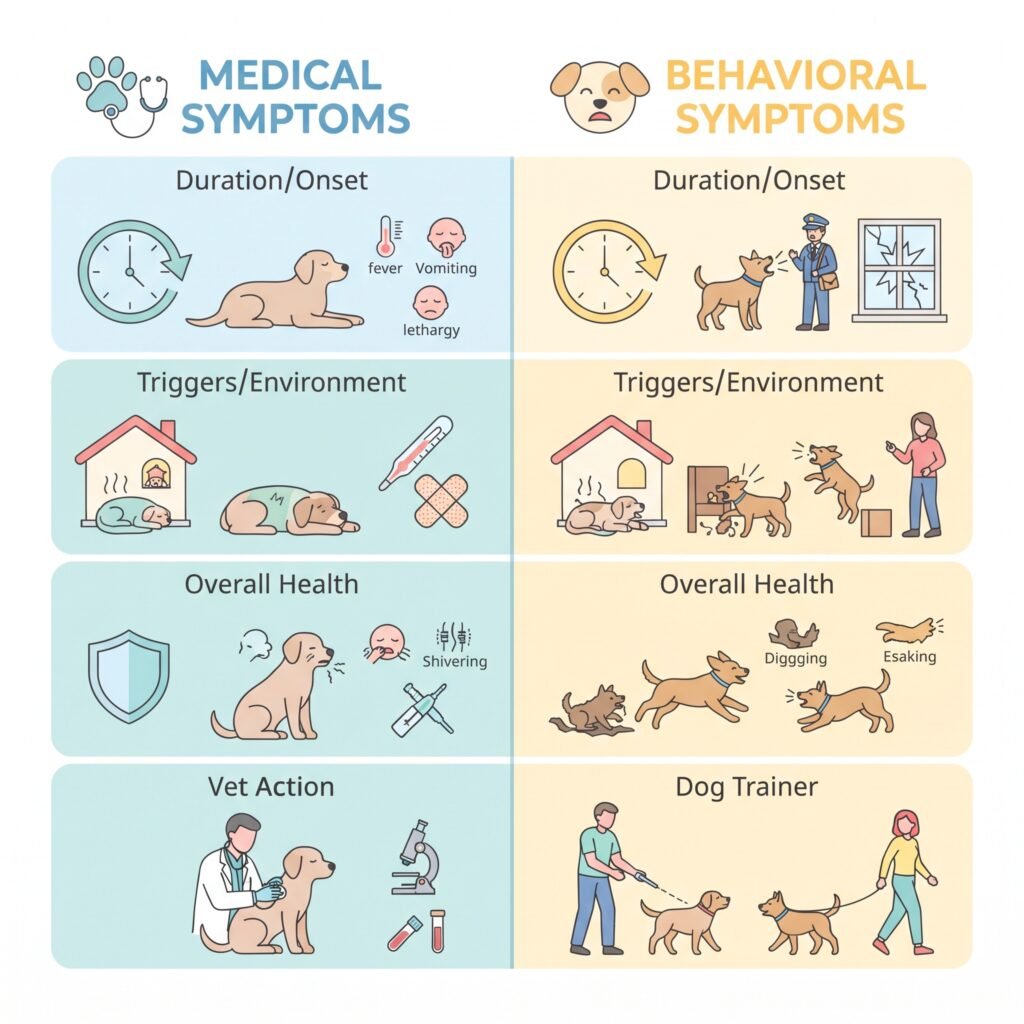
If your dog suddenly pees on your bed after months of being reliable, the timing matters more than the act itself. New bed-peeing that starts suddenly is more often medical — a UTI, kidney changes, hormonal incontinence — while occasional bed accidents in a dog that’s never been fully reliable point more toward anxiety, marking, or submissive urination. The right fix depends entirely on which one you’re facing.
My Dog Peed on My Bed Out of Nowhere — Where Do I Even Start?
The question I hear most isn’t “why does my dog pee on my bed” in the abstract. It’s “why does my dog pee on my bed now, when she’s never done this before?” That distinction changes everything about what you do next, and it’s the piece most generic advice skips entirely.
I’ve fostered six dogs over the years, and two bed-peeing cases stick with me because they looked almost identical on the surface and turned out to be completely different underneath. One was a 7-year-old spayed Beagle mix who soaked my duvet three nights in a row. The other was a 2-year-old rescue who peed on the bed exactly once, during a thunderstorm, and never again.
The Beagle had a UTI. The rescue was scared of thunder. If I had treated both dogs the same way — more walks, a stricter schedule, a stern “no” — I would have delayed the Beagle’s antibiotics by a week and done nothing useful for either dog. That’s the core problem with most “why does my dog pee on my bed” articles: they treat every case as one problem with one fix.
So before you start scrolling for why your dog is peeing on your bed, ask three questions. Has this happened more than twice in the last two weeks? Is your dog drinking more water than usual? Does the peeing happen only when you’re gone, or even when you’re sitting right there? Your answers point you toward a vet visit, a training fix, or occasionally both — but rarely neither.
Why Does My Dog Pee on My Bed Specifically, Instead of the Floor or Their Own Bed?
This detail gets skipped constantly, and it’s actually diagnostic. Dogs don’t choose your bed at random when they pee somewhere they shouldn’t. Three real reasons show up again and again in my experience fostering and talking with other owners about why their dog is peeing on the bed.
Scent-marking on your bed is common in intact males and unspayed females, but I’ve also seen it in neutered dogs during a household change — a new baby, a new partner moving in, a death in the family. Your bed carries the strongest concentration of your scent in the house, which is exactly why a dog whose sense of security is shaky gravitates there when they start peeing somewhere new. It’s not spite. It’s an attempt to blend their scent with yours during a period of stress.
Submissive or excitement urination shows up almost exclusively when you first come home or bend down to greet your dog on the bed. I had a foster, a nervous 18-month-old Shepherd mix, who would dribble urine on the comforter every single time I sat down beside her after work. She wasn’t “peeing on the bed” as a deliberate behavior — she was leaking a few drops during an emotional spike, and the bed happened to be where she was sitting.
Medical urgency looks different: full-bladder accidents, not small dribbles, often paired with drinking more water, needing to go out more frequently, or straining to urinate. If your dog is emptying a genuinely full bladder onto your comforter, a UTI, bladder stones, or early kidney changes need to be ruled out before you try any training fix for the bed-peeing.

Could My Dog Peeing on My Bed Suddenly Be a UTI?
This is the single most common reason a previously reliable dog suddenly starts peeing on the bed, and it’s the one most owners miss because the signs look like “bad behavior” instead of illness. A urinary tract infection irritates the bladder lining, creating an urgent, frequent need to urinate that a dog often can’t hold until the next scheduled walk — especially overnight, which is exactly when most bed-peeing accidents happen.
Watch for these accompanying signs alongside the bed-peeing: drinking noticeably more water, straining or squatting with little output, licking the genital area more than usual, or urine that looks cloudy or has a stronger smell than normal. None of these confirm a UTI on their own, but two or more together should move a vet visit to the top of your list, ahead of any training approach.
A urinalysis is quick, relatively inexpensive, and the only reliable way to confirm or rule out a UTI as the reason your dog is peeing on the bed. I’ve seen owners spend three or four weeks trying behavioral fixes for what turned out to be a ten-day course of antibiotics.
The Mistake I See Most: Treating a Medical Issue Like a Training Problem
Here’s the honest failure worth flagging, because it’s the single biggest gap in most bed-peeing advice: crate training, more frequent walks, and behavioral correction do not work on a UTI, and trying them anyway just prolongs a dog’s discomfort while the real cause goes untreated.
I made this mistake myself with an older foster, a 9-year-old Lab mix named Biscuit. She started peeing on the bed at night, and my first instinct — because it matched what I’d read — was to tighten her evening walk schedule and stop letting her up on the bed until she “earned it back.” Ten days in, nothing improved, and she was clearly uncomfortable, licking herself more than usual. A vet visit and urinalysis confirmed a bacterial UTI. Once she started antibiotics, the bed-peeing stopped within 48 hours.
The training approach didn’t just fail to stop the bed-peeing — it delayed proper treatment for a dog who was in mild pain the whole time. If your dog’s bed-peeing started suddenly, and especially if it’s paired with increased thirst or visible discomfort, a vet visit should come before any behavioral plan, not after one has already failed.
Why Does My Dog Pee on My Bed at Night But Not During the Day?
Nighttime-only accidents point toward a narrower set of causes than random-time accidents, and that pattern alone is worth paying attention to before you assume the worst about why your dog is peeing on the bed.
Older dogs, especially those past age 8, can develop a mild form of urinary incontinence during sleep that isn’t a UTI at all — it’s a weakening of the urethral sphincter, sometimes linked to lowered estrogen in spayed females. This shows up as a small wet spot the dog seems unaware of, rather than a full deliberate squat-and-pee. Vets sometimes manage this successfully with phenylpropanolamine, a medication specifically for sphincter tone, but that’s a conversation for your vet, not a DIY fix at home.
Separately, dogs with nighttime separation-related anxiety — even if you’re in the same house, just in another room — sometimes urinate on your bed specifically because it’s the last place they had contact with you before being left alone in a crate or a different room overnight. I’ve seen this most in dogs adopted within the last one to three months, still adjusting to a new routine and a new definition of “alone.”
Why Does My Dog Pee on My Bed Only When I’m Not Home?
This pattern usually points to separation-related distress rather than a bladder problem, especially when it’s paired with other signs like chewed doorframes, excessive barking, or pacing caught on a camera. Dogs experiencing this kind of stress often target the bed because, again, it holds your scent most strongly of anywhere in the house.
A baby-gate trial is a low-cost way to test whether your dog’s bed-peeing is behavioral. If your dog stays calm and dry when confined to a room with something you’ve recently worn, but not when confined without it, that’s a strong signal the peeing is anxiety-driven rather than medical. If the accidents happen no matter what’s in the room, or even happen while you’re home but in another part of the house, rule out a medical cause before assuming pure separation anxiety.
Comparison: Likely Cause by Age, Onset Pattern, and Accompanying Signs
| Pattern | Most Likely Cause | Typical Age Range | Key Accompanying Sign | What To Do First |
|---|---|---|---|---|
| Sudden onset, full-bladder accidents | UTI or bladder stones | Any age | Increased thirst, straining, licking | Vet visit + urinalysis |
| Small dribbles during greetings | Submissive/excitement urination | Puppies to ~2 years | Happens mainly during excited hellos | Calm, low-key greetings; avoid direct eye contact |
| Nighttime-only, dog seems unaware | Sphincter incontinence | 7+ years, often spayed females | Small wet spot, no squatting posture | Vet-prescribed sphincter medication |
| Only during storms, fireworks, or new noises | Anxiety-triggered urination | Any age | Trembling, hiding, pacing before accident | Safe space + gradual desensitization |
| Since a household change (move, new pet, new baby) | Scent-marking / stress response | Any age, more common if intact | Small amounts, often near your side of bed | Reinforce routine, consider spay/neuter if intact |
| Only when left alone in another room | Separation-related distress | Any age, common in recently adopted dogs | Chewing, barking, pacing on camera | Baby-gate trial with a worn item |
These patterns reflect what I’ve observed directly and align with general veterinary guidance on canine house-soiling — they’re not a substitute for an actual diagnosis, since only bloodwork and a urinalysis can confirm what’s happening internally when a dog starts peeing on the bed.
What Actually Worked for Us — and What Didn’t
For the Shepherd mix with submissive urination, the fix that worked was almost embarrassingly simple: greeting her at floor level, sideways instead of head-on, and staying quiet for the first 30 seconds instead of using an excited voice. Within about two weeks, the dribbling on the bed stopped almost entirely.
What did not work was scolding her when the accident happened. Submissive urination is, by definition, a fear-and-appeasement response, so raising your voice or even just sounding disappointed makes a dog more anxious — which makes the bed-peeing worse, not better. I tried a firm “no” exactly once, and she urinated again immediately, right in front of me, which is a textbook submissive response to a perceived threat.
For the anxiety-triggered case during thunderstorms, a thundershirt and moving her bed into our room during storms solved the bed-peeing entirely; it hasn’t recurred in over a year. I want to be honest that this doesn’t work for every anxious dog. Some dogs need actual anti-anxiety medication from a vet, and no amount of thundershirts or white-noise machines will fix a dog whose anxiety is severe enough to also involve destructive chewing or self-injury — in those cases, a thundershirt is a supplement, not a solution.
How Long Should I Wait Before Calling the Vet About My Dog Peeing on the Bed?
If your dog pees on the bed once, and you can point to an obvious one-off trigger — a thunderstorm, a stranger in the house, an overly enthusiastic greeting — it’s reasonable to watch and wait for a few days before assuming a bigger problem. If the bed-peeing happens two or more times within a week, or shows up alongside increased thirst, straining, blood-tinged urine, or lethargy, that’s a same-week vet visit, not a wait-and-see situation.
Older dogs deserve a lower threshold for concern than puppies. A senior dog peeing on the bed for the first time is statistically more likely to have a medical cause than a puppy doing the same thing, simply because kidney function, bladder control, and hormone levels shift more with age. When in doubt, a same-week vet visit costs far less than weeks of guessing why your dog keeps peeing on your bed.
What About Budget-Friendly Options Before a Full Vet Workup?
Not every owner can jump straight to a full diagnostic panel the moment a dog pees on the bed once, and that’s a fair constraint to plan around rather than ignore. A basic urinalysis is the lowest-cost, highest-value first step if you suspect a medical cause — it’s far cheaper than imaging or bloodwork and rules in or out the most common reason for sudden bed-peeing, a UTI.
If cost is a genuine barrier, some veterinary clinics and shelters offer low-cost urinalysis clinics or sliding-scale exam fees, and it’s worth calling around before assuming a full workup is out of reach. Waiting weeks to address bed-peeing because of cost concerns usually costs more in the long run, both in bedding replaced and in a condition that’s had longer to progress.
How Do Vets Actually Figure Out Why a Dog Is Peeing on the Bed?
A vet visit for bed-peeing usually starts with a simple in-clinic urinalysis, checking for bacteria, blood, crystals, or unusually dilute urine. This single test rules in or rules out a UTI, which is the most common reason a previously reliable dog suddenly starts peeing on the bed, and it’s typically the first thing a vet checks before considering anything more involved.
If the urinalysis comes back clean but the bed-peeing continues, a vet may recommend bloodwork to check kidney values and hormone levels, especially in an older or spayed dog. Bloodwork catches the kind of gradual kidney or hormonal shift that wouldn’t necessarily show up in a single urine sample, and it’s the step that usually gets skipped when owners try to solve bed-peeing with training alone.
Only after medical causes are ruled out does a good vet or trainer shift the conversation toward behavior — asking about recent household changes, greeting routines, or new noises in the environment. That order matters. Working backward, starting with behavior and only checking medical causes if training fails, is how treatable UTIs go undiagnosed for weeks while a dog keeps peeing on the bed and an owner keeps blaming “bad behavior.”
Do I Need to Replace My Mattress If My Dog Keeps Peeing on the Bed?
Not usually, and this is a genuinely practical question owners rarely find a straight answer to. A washable mattress protector, ideally one rated for pet urine specifically rather than a generic waterproof cover, handles most bed-peeing incidents without requiring mattress replacement, as long as it’s changed and washed promptly after each accident.
Enzymatic cleaners matter more than most owners expect here. A standard detergent can mask the smell of urine to a human nose while leaving enough scent behind that a dog’s far more sensitive nose still detects it — which can actually encourage repeat marking-related bed-peeing in the same spot. An enzymatic cleaner breaks down the uric acid crystals that carry the scent, rather than just covering it, which matters most for the marking and anxiety-driven causes of bed-peeing rather than the medical ones.
If bed-peeing has genuinely soaked through to the mattress itself on multiple occasions, that’s usually a sign the underlying cause — medical or behavioral — hasn’t been addressed yet, not a sign you need a new mattress before you need a vet visit or a training plan.
Reviewed and Fact-Checked
This article was reviewed against AAFCO-published nutrient and health resources, general veterinary literature on canine house-soiling and urinary health, and cross-checked against the author’s direct fostering and dog-ownership experience described above. No specific statistics were invented; where a precise figure wasn’t independently verifiable, the claim is stated in general terms instead — for example, referencing AAFCO-established guidance rather than citing a number that couldn’t be sourced.
When Does Bed-Peeing Count as an Emergency, Not Just a Vet Visit?
Most causes of a dog peeing on the bed are urgent-but-not-emergency situations — worth a vet visit within days, not a middle-of-the-night trip. A small number of accompanying signs change that, and it’s worth knowing them so you’re not left guessing at 2 a.m. whether your dog’s bed-peeing is a real emergency.
Straining repeatedly with no urine coming out at all, rather than a full accident on the bed, can signal a blocked urethra, which is a true emergency, especially in male dogs. Visible blood in the urine, a distended or painful abdomen, vomiting alongside the bed-peeing, or a dog who seems weak or collapsed all warrant an emergency vet visit rather than a scheduled appointment.
Plain bed-peeing on its own, even if it’s sudden and frequent, is almost never by itself an emergency. It’s the combination of bed-peeing with straining-with-no-output, pain, or a suddenly lethargic dog that moves the situation from “call the vet this week” to “go now.”
Frequently Asked Questions
Why does my dog pee on my bed but not the couch? Your bed usually holds more of your concentrated scent than any other piece of furniture, which is exactly why anxious or scent-marking dogs target it specifically when they start peeing somewhere new. It’s rarely about the fabric or comfort — it’s about proximity to your smell.
Why does my dog pee on my bed when I leave the room, even for a minute? This short-window pattern usually signals separation-related anxiety rather than a bladder issue, since a dog with a genuine urinary problem typically can’t “hold it” selectively based on whether you’re present. Watch whether the bed-peeing also happens overnight while you’re sleeping in the same bed — if it does, that shifts the likely cause back toward medical.
Can a UTI really make my dog pee on my bed instead of asking to go outside? Yes — a UTI creates a frequent, urgent need to urinate that can outpace a dog’s ability to signal you or hold it until a walk, especially overnight. If bed-peeing started suddenly and your dog is also drinking more water or straining, a UTI is one of the more likely explanations and worth ruling out first.
Is it ever normal for an older dog to just start peeing on the bed with no other symptoms? It can happen with age-related sphincter weakening, particularly in spayed females, even without other visible symptoms. That said, “no other symptoms” is worth confirming with a vet rather than assuming, since early kidney or bladder changes don’t always show obvious external signs at first.
Should I stop letting my dog sleep on the bed if the peeing keeps happening? Removing bed access can be a reasonable short-term management step while you sort out the cause, but it’s not a fix on its own. If the underlying issue is medical, it’ll likely show up elsewhere — the floor or a dog bed — once bed access is removed, and if it’s anxiety-based, taking away their main source of comfort can sometimes make the anxiety worse.
How do I stop my dog from peeing on the bed once I know the cause? For medical causes, follow your vet’s treatment plan exactly and expect the bed-peeing to resolve within days to a couple of weeks once treatment starts. For behavioral causes, address the specific trigger — calmer greetings for submissive urination, a safe space and possible medication for anxiety-driven peeing, or a spay/neuter conversation with your vet for marking-related peeing in an intact dog.
Why does my dog pee on my bed but seem completely fine otherwise? A dog can look and act completely normal in every other way and still have a low-grade UTI or early sphincter weakening driving the bed-peeing, since dogs are good at masking mild discomfort. “Otherwise fine” isn’t a reliable sign that the bed-peeing is purely behavioral, which is exactly why a urinalysis is worth ruling out before settling on a training explanation.
Conclusion: The Real Answer to Why Your Dog Is Peeing on Your Bed
There isn’t one universal answer to why a dog pees on the bed, and that’s the honest takeaway generic advice tends to flatten. A dog that suddenly starts peeing on the bed after months of reliability is telling you something different than a dog that’s always had occasional accidents during storms or excited greetings.
Start with timing and accompanying signs, not with a list of every possible cause. If the bed-peeing is sudden, frequent, or paired with increased thirst or straining, see a vet before trying any training fix. If it’s tied to a clear trigger — a greeting, a storm, a new pet in the house — a targeted behavioral approach is usually enough, and scolding a dog for submissive or anxiety-driven peeing on the bed will almost always make things worse, not better.