
Do Dogs Taste Spicy Foods? The Complete 2026 Science Guide Every Pet Owner Needs
Do dogs taste spicy foods the same way humans do? Discover the 2026 science behind your dog's taste buds, spicy food reactions, and what is — and isn't — safe to feed them.

Do Dogs Taste Spicy Foods? The Short Answer
If you have ever dropped a jalapeño on the kitchen floor and watched your dog sniff it with curious intensity, you have probably wondered: do dogs taste spicy foods the way we do? The answer is nuanced, scientifically fascinating, and more complex than a simple yes or no.
Dogs do experience something when they eat spicy food — but it is not quite the same burning, tongue-scorching sensation that humans feel. The experience of “spiciness” in mammals is not purely about taste. It involves a sophisticated interplay between taste receptors, pain receptors, the nervous system, and the brain’s interpretation of chemical compounds like capsaicin. And in this system, dogs and humans are wired quite differently.
The short answer: do dogs taste spicy foods? Yes, partially — but not the way you do. They can detect certain flavor compounds associated with spicy ingredients, but their neurological and receptor-level response to the chemical that causes the burning sensation is significantly different from the human experience. What dogs lack in spice perception through taste, however, they more than make up for through their extraordinary sense of smell — which means spicy food registers powerfully in your dog’s brain even before the first bite.
Understanding how this all works is not just an interesting scientific curiosity. It has real implications for your dog’s safety, digestive health, and overall wellbeing. This guide covers everything the latest 2026 veterinary science tells us about whether dogs taste spicy food — and what it means for how you feed your pet.
Table of Contents
- Do Dogs Taste Spicy Foods? The Short Answer
- How a Dog’s Sense of Taste Actually Works
- Do Dogs Have Taste Buds for Spicy Food?
- The Science of Capsaicin and the Canine Tongue
- Do Dogs Taste Spicy Foods Like Humans Do?
- Why Dogs Still React to Spicy Food (Even Without Tasting It)
- Signs Your Dog Has Eaten Something Spicy
- Is Spicy Food Dangerous for Dogs?
- Spicy Foods and Ingredients to Keep Away From Your Dog
- What to Do If Your Dog Eats Spicy Food
- Frequently Asked Questions
Do Dogs Taste Spicy Foods? The Short Answer
If you have ever dropped a jalapeño on the kitchen floor and watched your dog sniff it with curious intensity, you have probably wondered: do dogs taste spicy foods the way we do? The answer is nuanced, scientifically fascinating, and more complex than a simple yes or no.
Dogs do experience something when they eat spicy food — but it is not quite the same burning, tongue-scorching sensation that humans feel. The experience of “spiciness” in mammals is not purely about taste. It involves a sophisticated interplay between taste receptors, pain receptors, the nervous system, and the brain’s interpretation of chemical compounds like capsaicin. And in this system, dogs and humans are wired quite differently.
The short answer: do dogs taste spicy foods? Yes, partially — but not the way you do. They can detect certain flavor compounds associated with spicy ingredients, but their neurological and receptor-level response to the chemical that causes the burning sensation is significantly different from the human experience. What dogs lack in spice perception through taste, however, they more than make up for through their extraordinary sense of smell — which means spicy food registers powerfully in your dog’s brain even before the first bite.
Understanding how this all works is not just an interesting scientific curiosity. It has real implications for your dog’s safety, digestive health, and overall wellbeing. This guide covers everything the latest 2026 veterinary science tells us about whether dogs taste spicy food — and what it means for how you feed your pet.
How a Dog’s Sense of Taste Actually Works
To fully understand whether do dogs taste spicy foods is even the right question to ask, you first need to understand how canine taste works — and where it dramatically diverges from human taste.
The Taste Bud Numbers Gap
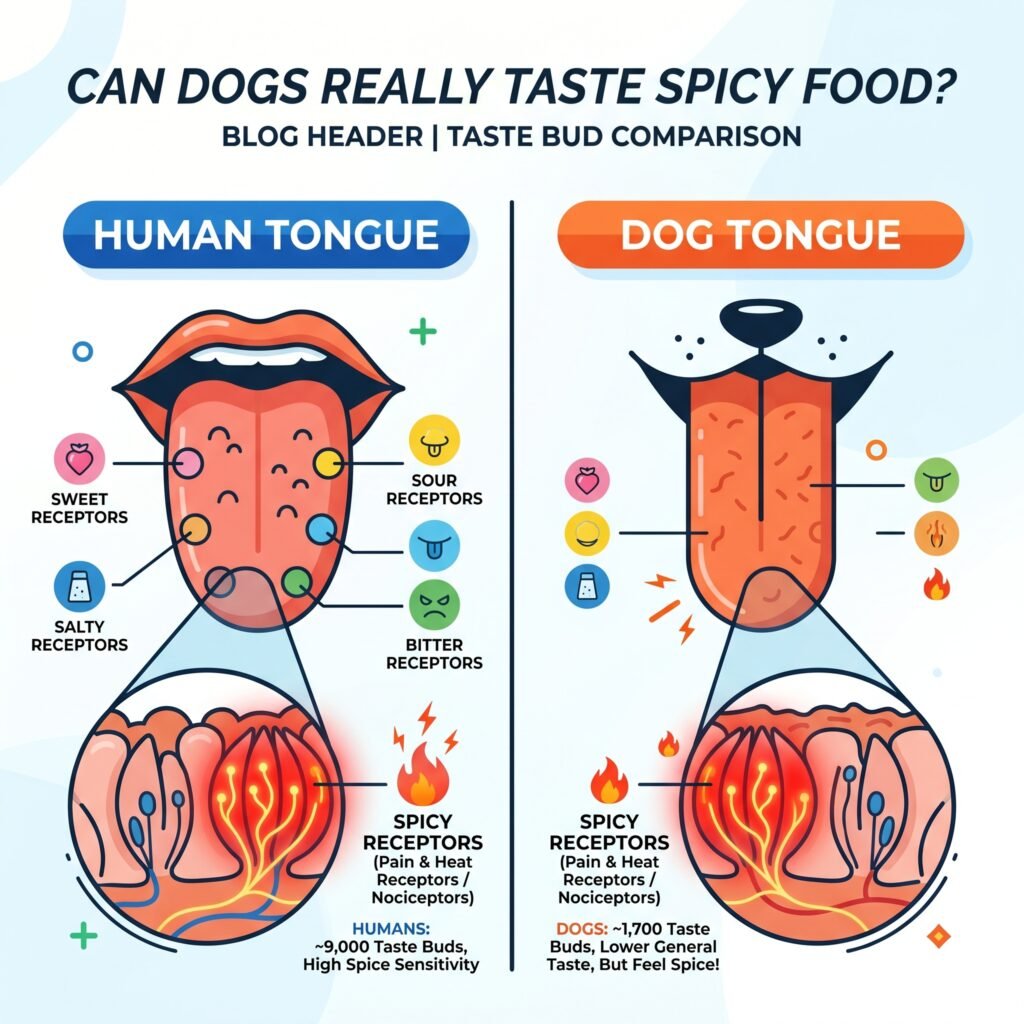
Humans have approximately 9,000 to 10,000 taste buds, distributed across the tongue, soft palate, and throat. Dogs, by comparison, have only about 1,700 taste buds — roughly one-sixth as many. This alone tells you something important: taste, as a sensory experience, is far less dominant for dogs than it is for humans.
This is not a design flaw. Dogs evolved as opportunistic omnivores and scavengers. Their survival depended far more on their extraordinary sense of smell (dogs have up to 300 million olfactory receptors compared to a human’s 6 million) than on nuanced taste discrimination. Where humans use taste to evaluate and enjoy food, dogs primarily use smell to assess whether something is edible, safe, and nutritionally interesting.
What Tastes Can Dogs Actually Detect?
Despite having far fewer taste buds, dogs can still detect the four primary taste categories:
Sweet — Dogs have functional sweet receptors, which may have evolved to help them detect ripe fruit and energy-rich carbohydrates. This is why many dogs enjoy fruits like apples and bananas.
Salty — Dogs can taste salt but are generally less attracted to it than humans, and high-salt foods can be dangerous for them.
Sour — Dogs tend to dislike sour tastes, and sour-based deterrent sprays work on this principle to keep dogs from chewing furniture.
Bitter — Dogs are particularly sensitive to bitter compounds, likely as a protective mechanism against plant toxins. Anti-chew sprays often use bitter apple or bitter cherry extracts for this reason.
Umami — Dogs have strong umami receptors, which explains their attraction to meat, bone broth, and savory foods.
Notably absent from this list is a dedicated “spicy” receptor in the traditional taste sense. Spiciness — as humans experience it — is not actually a taste at all. This is the key to understanding the question: do dogs taste spicy foods?

Do Dogs Have Taste Buds for Spicy Food?
This brings us to one of the most commonly searched questions: do dogs have taste buds for spicy food? The answer requires understanding what “spicy” actually is at a biological level.
Spicy Is Not a Taste — It’s a Pain Signal
When humans eat something spicy — a chili pepper, hot sauce, or a jalapeño — the burning sensation is not caused by the food triggering taste buds. It is caused by a chemical compound called capsaicin activating a specific pain and heat receptor called TRPV1 (Transient Receptor Potential Vanilloid 1). TRPV1 is the same receptor that responds to actual heat above 43°C (109°F). Capsaicin essentially fools the brain into thinking the mouth is on fire.
So when people ask do dogs have taste buds for spicy food? — technically, no. Neither dogs nor humans have “spicy taste buds.” The burning experience is a pain response, not a taste response.
Do Dogs Have TRPV1 Receptors?
Yes — and this is where things get interesting. Dogs do possess TRPV1 receptors in their mouth, throat, and gastrointestinal tract. This means they can physically respond to capsaicin. However, research suggests that canine TRPV1 receptors may be less sensitive to capsaicin than human receptors, and the behavioral and neurological response dogs have to spicy compounds appears to be less intense than the human burning experience.
The concentration at which capsaicin triggers a significant response in dogs is likely higher than in humans, though exact thresholds are still a subject of active veterinary and pharmacological research as of 2026.
What this means practically: do dogs have taste buds for spicy food? No — not in the technical sense. But they do have the pain receptors that respond to capsaicin, meaning spicy food is not neurologically invisible to them. They feel something — it just may not register with the same fiery intensity that humans experience.
The Science of Capsaicin and the Canine Tongue
To go deeper on do dogs taste spicy foods, let’s look at the chemistry and neuroscience in more detail.
What Is Capsaicin?
Capsaicin (8-methyl-N-vanillyl-6-nonenamide) is the active compound in chili peppers responsible for the burning sensation in humans. It is measured using the Scoville Heat Unit (SHU) scale:
- Bell peppers: 0 SHU (no capsaicin)
- Jalapeños: 2,500–8,000 SHU
- Cayenne pepper: 30,000–50,000 SHU
- Habaneros: 100,000–350,000 SHU
- Ghost peppers: 800,000–1,000,000 SHU
For humans, even mild exposure at 2,500–8,000 SHU produces noticeable burning. For dogs, the burning response appears to kick in at lower concentrations in some studies, and higher in others — research is ongoing. What is consistent is that dogs exposed to high-SHU foods show clear signs of discomfort: pawing at the mouth, drooling, whimpering, and digestive distress.
The Role of Smell in Spice Detection
Here is a critical point often missed when people ask do dogs taste spicy foods: dogs evaluate food primarily through smell, not taste. Capsaicin and other spicy compounds like piperine (black pepper) and allicin (garlic) have powerful, volatile aromatic profiles. A dog can detect the chemical signature of spicy food from across the room.
This is why dogs sometimes approach spicy food with curiosity despite it being unpleasant to eat. The smell profile is interesting and complex — rich in aromatic compounds the dog’s olfactory system finds compelling. But once eaten, the TRPV1-mediated response kicks in, and the dog typically shows signs of discomfort.
Does Cooking Change the Spice Perception?
Cooking can partially break down capsaicin and reduce the Scoville heat of a dish. However, many spiced meals still retain significant capsaicin concentrations after cooking. For a dog already uncertain about whether do dogs taste spicy foods or simply react to them, cooked spicy food presents the same essential risk as raw spicy ingredients — just potentially at a slightly lower intensity.
Do Dogs Taste Spicy Foods Like Humans Do?
This is perhaps the most nuanced version of the question: do dogs taste spicy foods like humans do? The answer, based on 2026 veterinary science, is a clear no — but the reasons why are worth unpacking.
The Human Spice Experience
For humans, eating spicy food triggers:
- TRPV1 receptor activation → burning pain signal
- Endorphin release → the “spice high” many people enjoy
- Increased heart rate and sweating (thermoregulatory response)
- Repeated exposure → desensitization (building spice tolerance)
- Cultural and psychological enjoyment — humans associate spice with flavor complexity
The human experience of spice is both physiological and psychological. People can train themselves to enjoy spicy food through repeated, gradual exposure. This tolerance-building is a well-documented neurological adaptation.
The Canine Spice Experience
For dogs, the picture looks quite different:
No endorphin reward loop — There is currently no evidence that dogs experience the same endorphin-mediated pleasure response to capsaicin that humans do. The “spice high” that makes hot sauce addictive to some people does not appear to apply to dogs.
No cultural context — Dogs do not have the psychological or cultural conditioning that makes humans associate spicy food with enjoyment, social bonding, or culinary adventure.
Limited tolerance building — While TRPV1 receptors can be desensitized with repeated capsaicin exposure in any mammal, deliberately exposing dogs to spicy food to build tolerance is harmful and unnecessary.
Stronger digestive consequences — Dogs have a shorter, more sensitive gastrointestinal tract relative to their body size than humans. Capsaicin irritates the GI lining and can cause significant vomiting, diarrhea, and abdominal pain in dogs at amounts that humans would consider mild.
So do dogs taste spicy foods like humans do? No — they experience a muted, primarily pain-receptor-based response without the pleasurable dimensions that make spice enjoyable to humans, and with more pronounced gastrointestinal consequences.
Why Dogs Still React to Spicy Food (Even Without Tasting It)
Given that dogs do not experience spice the way humans do, why do they sometimes eagerly eat spicy food — and why do they react so strongly afterward?
The Smell Trap
Dogs are drawn to spicy foods primarily because of smell, not taste. Spicy dishes — curries, chili, spiced meats — are aromatic, complex, and full of umami compounds from meat proteins. A dog’s nose picks up the meat, fat, and savory notes long before it registers the capsaicin. By the time the dog realizes the food is unpleasant in the mouth, they have already eaten it.
Food Opportunism
Dogs are naturally opportunistic eaters. Evolutionary programming drives them to consume food when available, without the luxury of deliberation that humans practice. This is why a dog will eat a dropped jalapeño before pausing to consider whether do dogs taste spicy foods and whether it will be uncomfortable.
Social and Environmental Cues
Dogs are deeply attuned to human behavior. If they see you eating something with apparent enjoyment, they want to share in it. This social mirroring drives them to seek out human food regardless of its spice level. The smell of your spicy dinner is compelling precisely because you are eating it and seem to enjoy it.
After Eating: The Delayed Reaction
Unlike humans who feel the burn immediately and intensely, dogs may show a slight delay before the full discomfort sets in — particularly in the gastrointestinal tract. Owners sometimes mistake initial acceptance of spicy food for tolerance, only to find their dog vomiting or experiencing diarrhea an hour later.

Signs Your Dog Has Eaten Something Spicy
Knowing the signs of spicy food ingestion is important for every dog owner. Whether or not do dogs taste spicy foods is the question you started with, recognizing the symptoms helps you respond quickly.
Immediate Oral Reactions
- Excessive drooling — Saliva production spikes as the body tries to dilute and flush irritants
- Pawing at the mouth or nose — The dog is trying to physically remove the irritation
- Lip licking and tongue flicking — Attempting to clear the burning sensation
- Sneezing — Spicy vapor from capsaicin can irritate the nasal passages, especially in brachycephalic (flat-faced) breeds
- Whimpering or vocalization — Indicating pain or discomfort
Gastrointestinal Reactions (30 Minutes to Several Hours Later)
- Vomiting — The most common response to spicy food ingestion
- Diarrhea — Often loose, watery, and urgent
- Flatulence — Significant gas production as capsaicin irritates the gut lining
- Abdominal bloating or hunching — The dog may adopt a “prayer position” with front legs flat and rear elevated, indicating stomach pain
- Loss of appetite — Following a spicy food incident, dogs often refuse subsequent meals
- Lethargy — General discomfort and unwillingness to move
Serious Symptoms Requiring Veterinary Attention
- Persistent vomiting (more than 3–4 times)
- Blood in vomit or stool
- Signs of extreme abdominal pain
- Trembling, weakness, or collapse
- Difficulty breathing (rare, but possible with very high capsaicin exposure)
If your dog shows any serious symptoms after eating spicy food, contact your veterinarian immediately.
Is Spicy Food Dangerous for Dogs?
Beyond the question of do dogs taste spicy foods, the more urgent question is: how dangerous is it? The answer depends on the type of spicy ingredient, the quantity consumed, and your dog’s individual sensitivity.
Capsaicin: Uncomfortable but Rarely Life-Threatening
Pure capsaicin exposure from foods like jalapeños, cayenne, or hot sauce is generally not lethal to dogs in small quantities. The primary danger is gastrointestinal distress — vomiting and diarrhea — which can lead to dehydration if severe or prolonged. A dog that steals a small bite of spicy food will likely be uncomfortable for a few hours but recover without intervention.
However, large quantities of very hot peppers (habaneros, ghost peppers) could cause more serious GI distress, and in dogs with pre-existing conditions (inflammatory bowel disease, pancreatitis, kidney disease), even small amounts of spicy food can trigger dangerous flare-ups.
The Hidden Dangers in Spicy Dishes
The greater risk often lies not in the capsaicin itself, but in the other ingredients commonly found in spicy human food:
Garlic and onions — Found in virtually every spicy cuisine, garlic and onions (and their relatives: leeks, shallots, chives) contain thiosulfates that cause hemolytic anemia in dogs. Garlic is particularly toxic — even small amounts consumed regularly can cause red blood cell destruction. This is a far more serious danger than the capsaicin in the same dish.
Salt — Spicy processed foods (hot chips, spicy instant noodles, spiced jerky) are typically very high in sodium, which can cause salt toxicity, excessive thirst, and in severe cases, neurological symptoms in dogs.
Xylitol — Some spicy sauces and condiments, particularly certain “health-focused” hot sauces, may contain xylitol as a sweetener. Xylitol is extremely toxic to dogs and causes rapid, dangerous drops in blood sugar.
Fat content — Many spicy dishes are high in fat (spicy chicken wings, spiced pork, fried foods). High fat loads can trigger acute pancreatitis in dogs, which is a serious, potentially life-threatening emergency.
Artificial additives — Commercially prepared spicy foods often contain preservatives, colorings, and flavor enhancers that are not appropriate for dogs.
So even if the capsaicin itself poses limited acute danger, the full ingredient profile of most spicy human foods makes them inappropriate and potentially dangerous for dogs.
Spicy Foods and Ingredients to Keep Away From Your Dog
Based on everything we know about whether do dogs taste spicy food and how their bodies respond, here is a practical list of spicy and heat-associated foods to keep out of your dog’s reach.
High-Risk Foods (Never Feed These)
Hot peppers of any variety — Jalapeños, serranos, habaneros, ghost peppers, cayenne peppers. The higher the Scoville rating, the more severe the oral and GI reaction.
Hot sauce and chili sauce — Including Tabasco, Sriracha, sambal, and similar condiments. These are concentrated capsaicin sources combined with salt and often garlic.
Spicy curry dishes — Most curry recipes contain garlic, onion, and spices that are individually toxic to dogs, quite apart from the heat level.
Chili (the dish) — A dangerous combination of capsaicin, onions, garlic, beans, and high sodium.
Spicy chips and crackers — Doritos, Takis, Hot Cheetos, and similar snacks contain excessive salt, artificial additives, and capsaicin. A dog that helps itself to a bag of hot chips is at risk for salt toxicity and GI distress.
Wasabi and horseradish — These produce their pungent heat through different compounds (isothiocyanates rather than capsaicin) but cause the same oral and gastrointestinal irritation. Horseradish can also cause blistering of the mouth and throat lining in large amounts.
Black pepper in large quantities — Small incidental amounts of black pepper in cooked food are not dangerous, but deliberately sprinkling pepper on food is unnecessary and irritating.
Spiced meats and deli products — Pepperoni, spicy salami, chorizo, and similar cured meats are high in salt, fat, garlic, and spices — a toxic combination for dogs.
Ginger — Small amounts of fresh ginger are actually used medicinally for dogs (for nausea) and are generally considered safe. However, crystallized or pickled ginger with added sugar and spices, or ginger in large quantities, can cause digestive upset.
What to Do If Your Dog Eats Spicy Food
If your dog has eaten spicy food, here is a step-by-step response guide:
Step 1: Assess What Was Eaten
Determine the type of spicy food, the approximate quantity, and whether it contained any known dog toxins (garlic, onion, xylitol, excessive salt). This information is critical if you need to call your veterinarian.
Step 2: Offer Water
Provide your dog with fresh, clean water immediately. Hydration helps dilute capsaicin in the mouth and GI tract and reduces the intensity of oral burning. Do not force your dog to drink — offer and allow them to drink voluntarily.
Step 3: Do NOT Give Milk
Many people believe milk neutralizes spicy burning in dogs as it does in humans (due to casein binding to capsaicin). While casein does bind capsaicin, dairy products can cause their own GI upset in dogs, many of which are lactose-intolerant. Adding dairy to an already irritated GI tract may worsen symptoms.
Step 4: Monitor Closely for 2–4 Hours
Watch for vomiting, diarrhea, excessive drooling, signs of abdominal pain, lethargy, or any unusual behavior. Keep track of how many times your dog vomits and whether there is any blood in the vomit or stool.
Step 5: Withhold Food Temporarily
If your dog vomits, withhold food for 4–6 hours to allow the stomach to settle. After this rest period, offer a small amount of bland food (plain boiled chicken and white rice) before returning to normal feeding.
Step 6: Call Your Vet If Needed
Contact your veterinarian if:
- Vomiting occurs more than 3 times
- There is blood in vomit or stool
- Your dog shows extreme lethargy or pain
- The spicy food contained garlic, onion, or xylitol
- Your dog has a pre-existing health condition (pancreatitis, IBD, kidney disease)
- Symptoms persist beyond 24 hours
For garlic or onion ingestion specifically, contact your vet immediately regardless of quantity, as toxicity can develop over 24–72 hours and is not always immediately apparent.
Frequently Asked Questions
Do dogs taste spicy foods the same way humans do?
No. Do dogs taste spicy foods like humans do? The answer is definitively no. Humans experience spice through a combination of pain receptor activation, endorphin response, and psychological context. Dogs experience a muted version of the pain response without the pleasure component, and with more significant gastrointestinal consequences. Their limited taste buds and different neurological wiring mean the “spicy experience” is fundamentally different for them.
Do dogs have taste buds for spicy food?
Technically, do dogs have taste buds for spicy food? No — neither dogs nor humans have taste buds specifically for spice. “Spiciness” is a pain response, not a taste. Dogs do have the TRPV1 pain receptors that respond to capsaicin, but their sensitivity may differ from humans, and the response lacks the reward pathway that makes spice enjoyable to people.
Can dogs develop a tolerance for spicy food?
Dogs can develop some degree of TRPV1 receptor desensitization with repeated capsaicin exposure, similar to how humans build spice tolerance. However, deliberately feeding dogs spicy food to build tolerance is harmful — the GI consequences of repeated exposure (inflammation, irritation, increased risk of ulceration) far outweigh any potential benefit. There is no reason for a dog to develop spice tolerance.
Why does my dog always want my spicy food?
Dogs are attracted to the aromatic complexity of spicy food — particularly the meat, fat, and umami compounds present in most spicy dishes. They smell the food before tasting it, and what they smell is appetizing. The capsaicin-related discomfort is not apparent until after eating. Additionally, dogs are social eaters who want what their humans are having.
Is wasabi dangerous for dogs?
Yes — wasabi should not be given to dogs. It produces intense burning through isothiocyanates rather than capsaicin, and can cause oral irritation, excessive drooling, vomiting, and in large quantities, possible damage to the esophageal and stomach lining. The fact that do dogs taste spicy foods like wasabi is uncertain does not make wasabi safe.
Can I use spicy pepper spray to deter my dog from certain areas?
Capsaicin-based dog deterrent sprays exist commercially and are sometimes used to discourage dogs from entering specific areas or chewing objects. These are generally considered humane for this purpose as the concentration is calibrated to deter without causing significant harm. However, any direct application to a dog’s face, nose, or mouth is harmful and should never be done.
Are any spicy foods safe for dogs?
Mild spices in very small incidental quantities — a tiny amount of black pepper in cooked food, or a trace of ginger — are unlikely to cause harm in healthy dogs. However, there is no spicy food that dogs need for nutrition, and no health benefit to deliberately feeding a dog spicy ingredients. The safest approach is simply to avoid spicy foods entirely when it comes to your dog’s diet.
Conclusion: What 2026 Science Tells Us About Dogs and Spicy Food
The question do dogs taste spicy foods has a richly layered answer that goes well beyond a simple yes or no. Dogs experience spicy food through a combination of their extraordinary sense of smell, a partial TRPV1 pain receptor response, and significant gastrointestinal consequences — but they do not experience the full burning intensity or pleasurable endorphin dimension that humans associate with eating spicy food.
Do dogs taste spicy foods like humans do? Clearly not. Their fewer taste buds, different receptor sensitivity, absent pleasure response, and more vulnerable digestive system all conspire to make the spicy food experience fundamentally different — and far less enjoyable — for dogs.
Do dogs have taste buds for spicy food? No — and neither do humans. Spice is a pain experience, not a taste one. What dogs do have is the neurological machinery to feel some level of discomfort from capsaicin, coupled with a powerful sense of smell that draws them toward aromatic spicy dishes before they know what’s in store.
The practical takeaway for pet owners is simple: do dogs taste spicy food enough to suffer for it? Yes. Keep spicy human food away from your dog — not because the capsaicin itself is always catastrophically dangerous, but because the full ingredient profile of most spicy dishes (garlic, onion, salt, fat, additives) is harmful, and the gastrointestinal discomfort caused even by capsaicin alone is unnecessary suffering for an animal that gets no pleasure from the experience.
Your dog’s curious nose may lead them toward your spicy dinner every single time — but knowing the science helps you make the right call and keep that jalapeño safely out of reach.
Last updated: May 2026. Always consult a licensed veterinarian regarding your dog’s specific dietary needs and health conditions.