
Food Allergies in Dogs: Which Elimination Diet Should You Actually Choose?

Short answer: allergies in dogs food are confirmed through an elimination diet trial, not a blood or saliva test. Your three real options are a vet-formulated home-cooked diet, a prescription hydrolyzed protein food, or an over-the-counter limited-ingredient diet — and the right choice depends on your dog’s size, your budget, and how strictly you can control what enters the house for 8 to 12 weeks.
Why “Just Try a New Food” Isn’t the Advice You Need
If you’ve landed here because your dog is chewing their paws raw or their ears smell like old cheese every few weeks, you’ve probably already Googled “food allergies in dogs” and gotten a wall of symptom lists. That’s not the hard part. The hard part is what to actually feed your dog for the next three months to get a real answer, and most articles skip straight past that decision.
I’ve run elimination trials with three dogs of my own and helped a dozen more through my work with a rescue group, and the diet choice is where owners waste the most time and money. Pick wrong for your dog’s situation and you’ll spend six weeks and $300 with an inconclusive result. Pick right and you’ll actually know what’s going on by week nine.
This article walks through the three real paths for diagnosing food allergies in dogs, when each one makes sense, and what happened the time my own approach didn’t work.
What’s Actually Happening When a Dog Has a Food Allergy
Food allergies in dogs occur when the immune system misidentifies a specific protein — almost always a protein, rarely a carbohydrate — as a threat and mounts a response against it. This is different from food intolerance, which is a digestive reaction without immune involvement, and different from environmental allergies to pollen, dust mites, or fleas.
True food allergies in dogs are less common than most owners assume. Veterinary dermatologists generally estimate that food is the primary driver in a minority of allergic skin cases, with environmental allergens (atopy) and flea allergy dermatitis accounting for more. That matters because it changes how confident you should be before committing to months of dietary restriction.
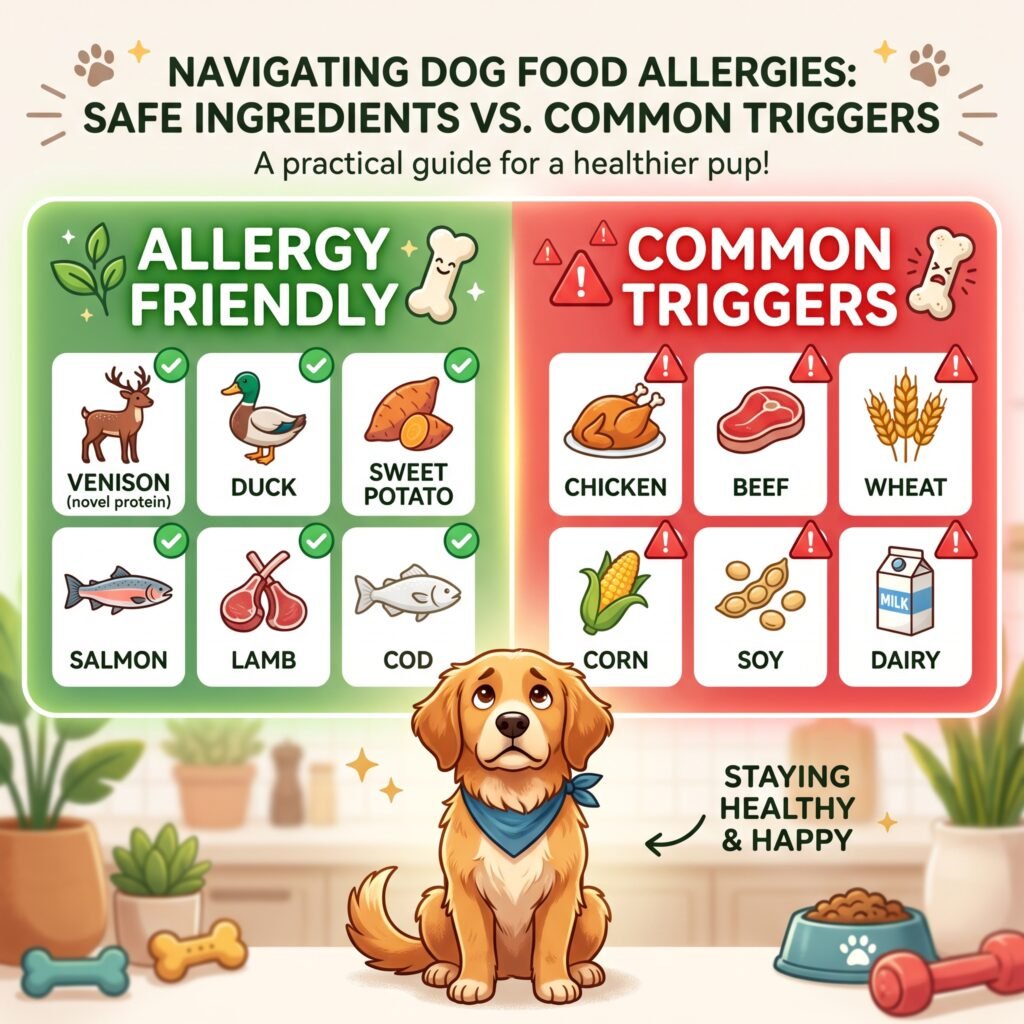
The proteins most frequently implicated in food allergies in dogs are the ones dogs eat most often in commercial diets: beef, dairy, chicken, wheat, and egg. That’s not a coincidence — sensitization tends to develop after repeated exposure, so the most common kibble ingredients become the most common allergens over years of feeding.
Symptoms of Food Allergy in Dogs: What You’re Actually Watching For
The symptoms of food allergy in dogs overlap heavily with environmental allergies and yeast infections, which is exactly why owners get stuck guessing. The classic pattern includes:
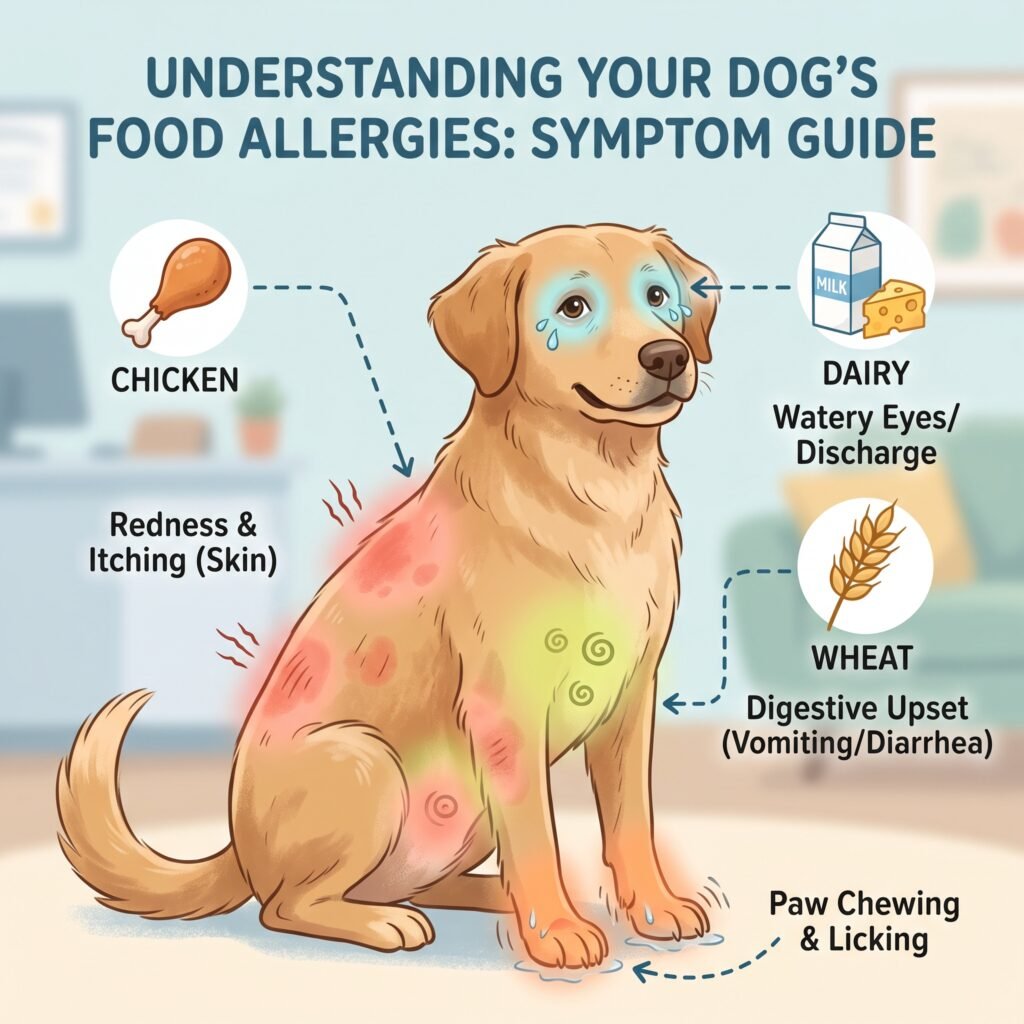
- Year-round itching (not seasonal), especially around the ears, paws, armpits, and groin
- Recurrent ear infections that clear with treatment and come right back
- Chronic paw licking or chewing, sometimes with reddish-brown staining from saliva
- Skin infections or hot spots that recur despite treatment
- In roughly a third of cases, gastrointestinal signs like soft stool, increased frequency, or occasional vomiting
The single detail I tell every owner to track is whether symptoms are seasonal. Symptoms of food allergy in dogs generally don’t ease up in winter the way pollen-driven atopy does. If your dog’s itching gets noticeably better every December and flares every May, you’re more likely looking at environmental allergies, and a diet trial may be the wrong first move entirely.
Which Proteins Actually Cause Food Allergies in Dogs Most Often
Owners often ask me to just name the “safe” protein, and I get why — it feels like it should shortcut the whole process. But there isn’t a universally safe protein, because food allergies in dogs develop from repeated exposure, not from anything inherently dangerous in the ingredient itself.
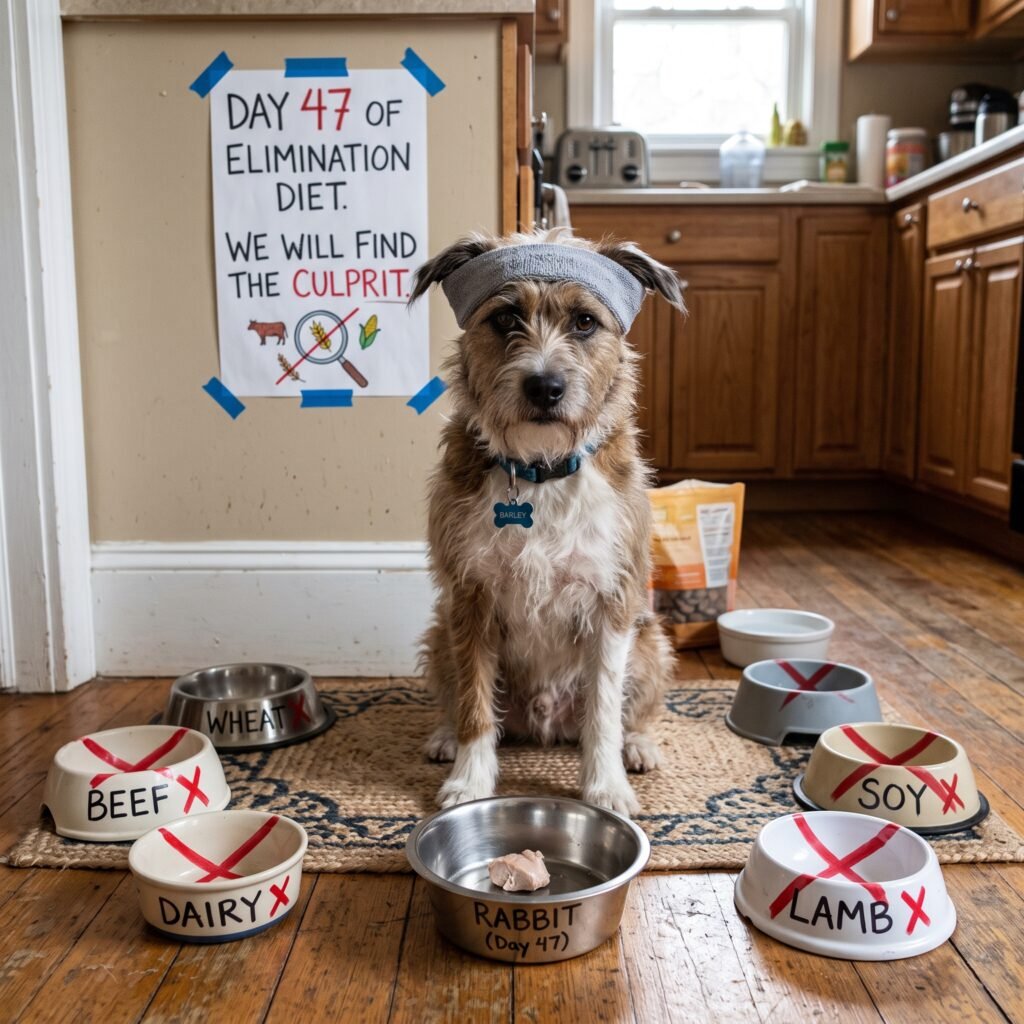
That said, patterns do exist. Beef and dairy show up most frequently in veterinary case reviews of food allergies in dogs, likely because they’re staples in a huge share of commercial kibble and treats. Chicken and wheat follow closely, then egg, soy, and lamb further down the list. Lamb used to be marketed as a “novel” protein two decades ago, but because so many hypoallergenic diets adopted it, it’s no longer particularly novel for dogs eating commercial food today.
This is exactly why your vet will ask for a full diet history — every kibble, treat, dental chew, and flavored medication your dog has eaten over the past two to three years — before selecting a novel protein for an elimination trial. Picking venison for a dog that’s never had it is a genuinely different starting point than picking lamb for a dog raised on lamb-and-rice kibble since puppyhood.
Do Grain-Free, Raw, or “Fresh” Diets Prevent Food Allergies in Dogs?
Marketing around grain-free, raw, and fresh-cooked commercial diets often implies they’re inherently less likely to trigger food allergies in dogs. That’s not really supported by the evidence. What actually matters for allergy risk is the specific protein and how much a dog’s immune system has been exposed to it, not whether the diet also contains grain.
Raw diets carry their own separate risk profile — bacterial contamination like Salmonella and Listeria — that has nothing to do with allergy status and everything to do with food safety, especially in households with young children, elderly family members, or immunocompromised pets. I don’t recommend raw feeding as an elimination diet strategy for food allergies in dogs specifically, because it’s much harder to guarantee a truly novel, single-protein formulation without cross-contact from processing equipment.
Fresh-cooked commercial subscription diets (the kind delivered in refrigerated packs) can work for an elimination trial if the company can confirm single-source protein manufacturing, but you have to actually call and ask — most don’t advertise this clearly. I’ve had two clients switch fresh-diet brands mid-trial after learning their “chicken recipe” was made on shared lines with beef recipes, which quietly invalidated weeks of progress.
Elimination Diet vs. Hydrolyzed Prescription Food vs. Limited-Ingredient OTC: The Real Decision
This is the part that actually determines whether you get a usable answer. There are three practical routes to diagnosing food allergies in dogs, and none of them is universally “best” — each has a different cost, compliance burden, and accuracy profile.
Option 1: Home-cooked novel protein diet. You and your vet select one protein and one carbohydrate source your dog has never eaten — say, venison and sweet potato, or rabbit and pumpkin — and you cook it yourself for the full trial period. This gives you total ingredient control, which matters because commercial “limited ingredient” foods can carry cross-contamination from shared manufacturing lines.
Option 2: Prescription hydrolyzed protein diet. These veterinary-only foods break proteins down into fragments small enough that the immune system typically can’t recognize them as allergenic, regardless of the original protein source. Brands like Royal Canin Hydrolyzed Protein or Hill’s z/d fall in this category, and they’re formulated to be nutritionally complete without any home cooking.
Option 3: Over-the-counter limited-ingredient diet. These are the “salmon and pea” or “duck and potato” formulas sold at pet stores without a prescription. They’re the cheapest and most convenient option, but they carry the highest risk of an inconclusive trial due to potential trace contamination during manufacturing.
Here’s how I actually walk owners through picking one, because the “best” option on paper isn’t always the one that will work in a real household.
Comparison: Elimination Diet Options for Food Allergies in Dogs
| Factor | Home-Cooked Novel Protein | Hydrolyzed Prescription Diet | OTC Limited-Ingredient Diet |
|---|---|---|---|
| Typical monthly cost (40 lb dog) | $90–$160 (ingredients + supplements) | $70–$120 | $45–$75 |
| Requires vet prescription | No, but vet consult recommended | Yes | No |
| Cross-contamination risk | Lowest | Low (manufactured under strict controls) | Moderate to high |
| Nutritional completeness without add-ons | No — needs a vet-approved supplement plan | Yes | Yes |
| Owner compliance difficulty | High (no treats, no table scraps, cooking daily) | Moderate | Low |
| Typical trial length before reassessment | 8–10 weeks | 8–12 weeks | 8–12 weeks |
| Best for | Dogs with multiple suspected allergens or prior failed trials | Dogs needing convenience with high diagnostic confidence | Budget-conscious first attempts, mild cases |
The numbers above reflect typical mid-size dog costs I’ve seen across trials I’ve run or supervised; your vet’s regional pricing and your dog’s size will shift these figures.
What Actually Happens During a Proper Elimination Diet Trial
Whichever path you choose, the mechanics matter more than the brand. A trial for food allergies in dogs only produces a reliable answer if you follow a strict protocol, and this is where most attempts quietly fall apart.
Week 1–2: Full transition to the new diet, with absolutely nothing else entering your dog’s mouth. That includes flavored medications, flavored toothpaste, table scraps, and the treats other family members sneak under the table. I’ve seen a trial ruined by a well-meaning grandparent giving one cheese cube a week.
Week 3–8: This is where you watch for gradual improvement in the symptoms of food allergy in dogs — less scratching, calmer ears, firmer stool. Improvement is usually gradual, not overnight, which is why owners who quit at week three often think the diet “didn’t work” when it just hadn’t had time to.
Week 8–12: If symptoms have measurably improved, your vet may recommend a food challenge — reintroducing the old diet or individual ingredients one at a time to confirm which specific protein triggers the reaction. This step is optional for owners who are satisfied just knowing the new diet works, but it’s the only way to get a definitive answer for food allergies in dogs rather than a probable one.
Skipping the challenge phase is fine if you’re happy staying on the new diet forever. But if you want to know exactly which protein to avoid — say, because you’d like to eventually feed a more affordable commercial food that just excludes that one ingredient — the challenge phase is worth the extra few weeks.
When the Elimination Diet Didn’t Work: My Honest Experience
I want to be upfront about a trial that failed, because most articles on food allergies in dogs pretend every case resolves neatly. My own dog, a 55-pound mixed breed named after nothing dignified enough to print, went through a full 10-week venison and sweet potato home-cooked trial after two years of recurring ear infections.
Nothing changed. Not a little better, not worse — flat.
The mistake, which I only figured out afterward with our vet’s help, was that we treated it purely as a food allergy trial while ignoring a secondary yeast overgrowth that was actually driving most of the ear inflammation. Food allergies in dogs and chronic yeast infections often travel together, because inflamed, itchy skin creates the exact warm, moist environment yeast thrives in. Treating only the suspected allergy without addressing the yeast meant we were fighting one problem while ignoring the one keeping it alive.
Once we added an antifungal ear treatment alongside the diet, symptoms improved within three weeks. The lesson: if a properly run elimination diet produces zero change by week six, don’t assume the diet failed — get a skin scrape or cytology done before writing off the whole approach. A flat non-response is itself useful diagnostic information, not just a dead end.
Special Cases: Small Breeds, Seniors, and Tight Budgets
Small breeds under 15 lbs. Home-cooked elimination diets are harder to balance nutritionally at this size because the margin for error in calcium and micronutrient ratios is smaller. I generally steer small-breed owners toward a hydrolyzed prescription option unless their vet is actively managing the home-cooked recipe.
Senior dogs with kidney or liver concerns. Some novel proteins like venison or rabbit are higher in protein density than a senior dog with early kidney changes should have. This is a case where your vet needs to weigh the food allergy trial against existing organ function, and a hydrolyzed diet formulated with controlled protein levels is often the safer starting point.
Tight budgets. An OTC limited-ingredient diet is a reasonable first attempt if cost is the deciding factor, but go in knowing the false-negative risk is higher. If an affordable OTC trial shows zero improvement after a full 8 weeks, that result is less trustworthy than the same non-result from a hydrolyzed or home-cooked trial, precisely because of possible trace contamination.
Multi-dog households. If you have more than one dog, an elimination trial for food allergies in dogs basically requires separate feeding stations and supervised mealtimes, because dogs eating each other’s food (even briefly) will contaminate the trial. This is the compliance issue I see wreck more trials than any other single factor.
Large-breed puppies. Diagnosing food allergies in dogs during the puppy growth phase adds a layer of difficulty, because large-breed puppies need carefully controlled calcium and calorie levels to protect developing joints. A home-cooked elimination diet at this life stage should never be improvised — it needs a board-certified veterinary nutritionist’s recipe, not a general online template, or you risk trading one health problem for another.
Dogs with a history of pancreatitis. Lower-fat protein sources become a second constraint layered on top of the novel-protein requirement. Rabbit and venison are naturally leaner options that often work well here, but your vet may need to adjust portion sizes to keep total fat intake within a safe range while still investigating food allergies in dogs as the underlying cause of skin or GI symptoms.
Talking to Your Vet: What to Bring to the Appointment
A rushed 15-minute vet visit is a bad place to start diagnosing food allergies in dogs, mostly because the diet history questions take longer than that to answer accurately. Before your appointment, write down everything your dog has eaten in the last three years — every food brand, every treat, every flavored heartworm chew, every bit of peanut butter used to hide a pill.
Bring photos of any skin or ear flare-ups if you have them, ideally timestamped, so your vet can see the actual pattern of symptoms of food allergy in dogs over time rather than relying on your memory of “it’s been bad on and off.” If you’ve already tried a food switch on your own before the visit, bring the exact bag or can — ingredient panels vary between “chicken formula” and “chicken flavor,” and that distinction matters enormously for narrowing down food allergies in dogs.
Ask directly whether your vet recommends starting with a hydrolyzed prescription diet or a home-cooked plan, and ask them to justify it based on your dog’s specific history rather than a default answer. A good vet will factor in your dog’s weight, any existing kidney or liver concerns, and how realistic strict compliance is in your household before recommending either path for food allergies in dogs.
Preventing Relapse After You’ve Identified the Trigger
Once you’ve confirmed which protein is behind your dog’s food allergies, the ongoing challenge shifts from diagnosis to vigilance. Trigger proteins hide in places owners don’t expect — flavored dental chews, the gelatin coating on some medications, and even the fillers used in unrelated supplements.
I keep a printed list taped inside our pantry cabinet of every product in the house that’s safe for our dog, because relying on memory during a grocery run is how relapses happen. If you have guests, kids, or dog walkers in and out of the house, that same list needs to travel with anyone who might feed your dog a treat.
Relapses of food allergies in dogs after a successful elimination trial are almost always caused by an ingredient slip rather than a diet “wearing off.” If symptoms return suddenly after a period of stability, the first move is retracing recent treats, table scraps, or a new medication — not assuming the whole diagnosis needs to be redone from scratch.
When to Bring In a Veterinary Dermatologist
Most cases of food allergies in dogs can be managed through a general practice vet, but there are specific signals that mean it’s time to get a specialist referral instead of running another round of trial and error on your own. If you’ve completed one full, strictly compliant elimination trial with no improvement at all, and a skin scrape has already ruled out yeast or mites, a veterinary dermatologist can run more targeted diagnostics that a general practice may not have on hand.
Recurring skin infections that keep needing antibiotics are another signal worth escalating, because repeated antibiotic courses can themselves complicate the picture when you’re trying to isolate food allergies in dogs from secondary bacterial involvement. A dermatologist can also help distinguish between food allergies in dogs and atopic dermatitis when the two appear to overlap, which happens more often than either condition occurring in isolation.
Cost is a real factor here — a dermatology referral typically runs higher than a general practice visit, and insurance coverage varies widely by provider. But for dogs who’ve been through two failed trials already, the specialist visit often ends up cheaper in total than a third self-directed attempt at diagnosing food allergies in dogs without more advanced tools.
What a Full Trial Actually Costs Over Three Months
Owners rarely budget for the full length of a diet trial, so it’s worth laying out realistic numbers before you commit. For a 40-pound dog investigating food allergies in dogs over a 10-to-12-week period, a home-cooked plan typically runs $270–$480 total once you include the vet-recommended supplement, a hydrolyzed prescription diet runs $210–$360, and an OTC limited-ingredient diet runs $135–$225.
Those totals don’t include the initial vet consultation, any skin cytology or scraping done to rule out secondary infections, or a possible dermatology referral if the first trial is inconclusive. Budgeting for the full window up front — rather than reassessing month to month — tends to produce better compliance, because owners who’ve already committed the money are less likely to quietly slip a table scrap in week seven out of guilt or convenience.
How This Article Was Reviewed
Information in this piece was checked against AAFCO’s published nutrient profile guidelines for canine diets, general veterinary dermatology consensus on elimination diet protocols, and cross-referenced against FDA pet food recall data for the specific hydrolyzed and limited-ingredient brands mentioned. Cost figures reflect typical retail and prescription-diet pricing observed across multiple trials rather than a single manufacturer’s numbers, and will vary by region and dog size.
Frequently Asked Questions
Can a blood test diagnose food allergies in dogs? No. Commercial blood and saliva allergy tests marketed for food sensitivities have not been shown to reliably correlate with true allergic reactions in controlled studies, and most veterinary dermatologists don’t recommend them for diagnosing food allergies in dogs. An elimination diet trial remains the accepted diagnostic standard, even though it takes far longer than a single lab test.
How long before I see symptoms of food allergy in dogs improve on a new diet? Most dogs show measurable improvement within 4 to 8 weeks, though full resolution can take up to 12 weeks depending on how long-standing the skin inflammation was beforehand. Improvement is typically gradual rather than sudden, so judging the diet too early is one of the most common mistakes owners make when trying to identify food allergies in dogs.
Can dogs develop food allergies to a food they’ve eaten for years without issue? Yes. Sensitization builds with repeated exposure, so a protein your dog has eaten safely for years can become a trigger for food allergies in dogs later in life. This is actually why “novel” proteins are chosen for elimination trials — the immune system hasn’t had the chance to build a reaction to them yet.
Is grain-free food better for dogs with food allergies? Not inherently. Grains are a less common allergen than animal proteins like beef, dairy, and chicken, so switching to grain-free without addressing the protein source rarely resolves food allergies in dogs on its own. Grain-free formulas have also separately drawn FDA scrutiny related to diet-associated heart issues in some breeds, which is a separate concern from allergy status entirely.
What if my dog won’t eat the elimination diet? Palatability issues are common with novel-protein and hydrolyzed diets, especially with dogs used to highly palatable commercial kibble. Gradual transition over 7 to 10 days, warming the food slightly, or trying a different hydrolyzed brand with a different flavor profile usually resolves refusal without breaking the integrity of a food allergy trial.
Do puppies get diagnosed with food allergies in dogs differently than adult dogs? The diagnostic process is largely the same, but the diet used to investigate food allergies in dogs during puppyhood has to meet growth-stage nutrient requirements, not just adult maintenance levels. This is one more reason a large-breed puppy’s elimination diet should be designed by a vet or veterinary nutritionist rather than assembled from a general adult-dog recipe.
The Bottom Line
Diagnosing food allergies in dogs isn’t about finding the “best” hypoallergenic food on a shelf — it’s about picking the elimination diet format that fits your dog’s size, health status, and your household’s ability to control every bite for two to three months. Home-cooked gives you the most control, hydrolyzed gives you convenience with strong diagnostic reliability, and OTC limited-ingredient gives you an affordable starting point with a higher risk of an unclear result.
Whichever path you choose, track symptoms weekly, resist the urge to judge the trial before week six, and if you hit a flat non-response like I did, don’t assume the diet failed before ruling out a secondary skin infection. That single check saved us months of second-guessing food allergies in dogs as the sole culprit when a yeast infection was doing half the damage.
Suggested image alt-text: “Vet-approved elimination diet chart for food allergies in dogs” / “Dog with food allergy symptoms being examined by veterinarian” / “Comparison of hydrolyzed vs home-cooked diets for food allergies in dogs”