What Does "All Life Stages" Dog Food Actually Mean? (2026)
"All life stages" dog food meets AAFCO standards for both puppies and adults — but that doesn't mean it's right for every dog. We explain what the label means and the best all life stages brands.

Walk through any pet store or scroll through any online dog food retailer and you’ll encounter the term regularly — “complete and balanced for all life stages dog food.” It appears on bags from budget grocery brands to premium specialty formulas. But what does it actually mean? Can you really feed the same food to your eight-week-old puppy, your healthy five-year-old adult, and your twelve-year-old senior? And is all life stages dog food genuinely the nutritional equivalent of life-stage-specific formulas — or is it a marketing convenience that sacrifices optimal nutrition for a one-size-fits-all label claim?
This comprehensive 2026 guide answers every important question about all life stages dog food: the precise regulatory definition from AAFCO (the Association of American Feed Control Officials), the critical caveat that makes “all life stages” more complex than it first appears for large-breed puppies, what the difference between formulated and feeding-trial-tested means for this claim, the top-rated brands offering all life stages formulas in 2026, and a dedicated section reviewing Canidae’s All Life Stages range — one of the most searched brands in this category — in complete detail.
What Does “All Life Stages Dog Food” Actually Mean?
The term all life stages dog food has a precise regulatory definition established by AAFCO — the Association of American Feed Control Officials, the private nonprofit organization whose nutritional standards define what “complete and balanced” means for pet food sold in the United States. As Sundays for Dogs’ AAFCO guide defines it: “All Life Stages (ALS) — Complete and balanced nutrition for dogs of all ages, including large breed puppies.”
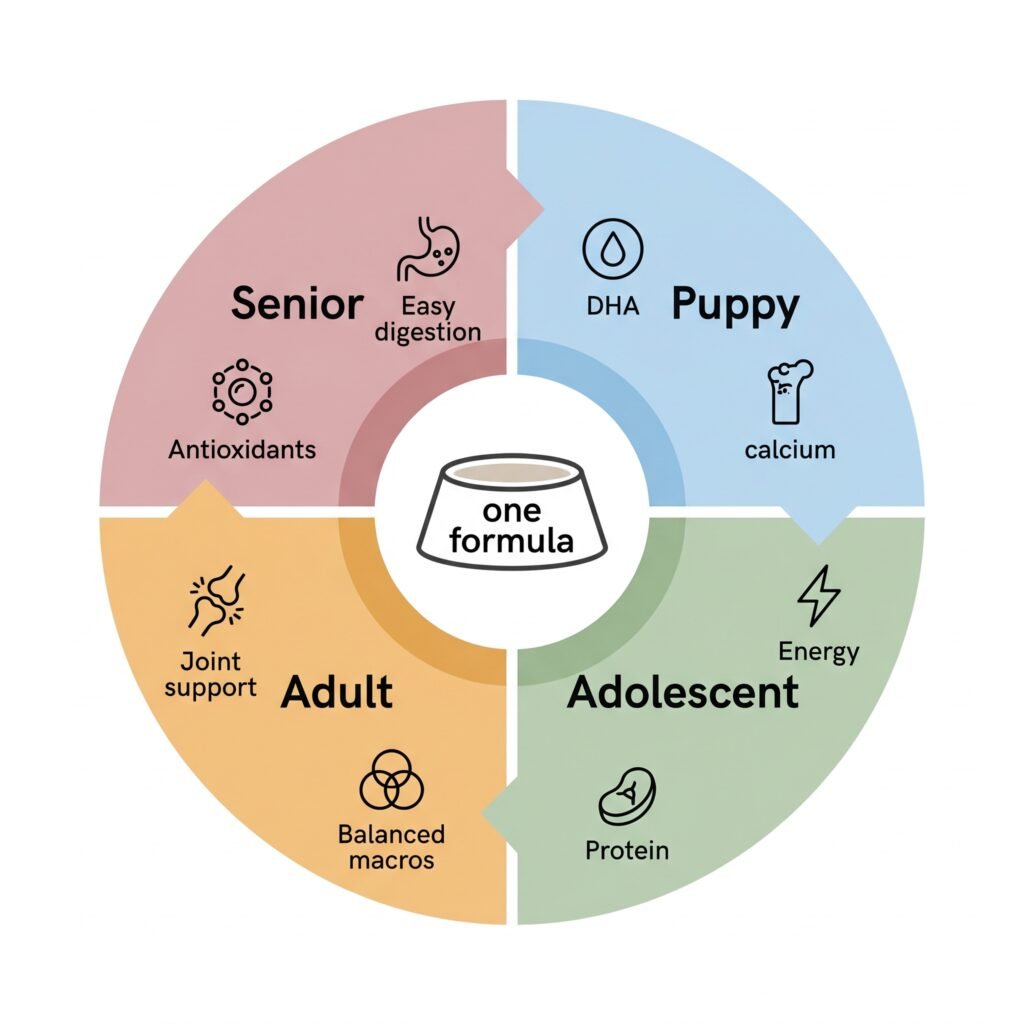
For a food to legitimately carry the all life stages dog food designation, it must meet the nutritional requirements for the most demanding life stage covered by that claim — which is growth (puppies) and reproduction (pregnant and lactating females), not adult maintenance. This is critically important to understand: because puppies require significantly more protein, calcium, phosphorus, and DHA than adult dogs, an all life stages dog food formula must meet these elevated requirements to cover the full spectrum legitimately. An adult maintenance-only food cannot make this claim — it meets lower nutritional thresholds that are insufficient for growth.
PetMD’s AAFCO guide — reviewed by veterinary experts — confirms the three life stage categories that AAFCO recognizes for dog food:
- Adult maintenance: Appropriate for healthy non-pregnant adult dogs only — not suitable for puppies or reproducing females
- Growth and reproduction: Designed for puppies, kittens, and pregnant/lactating females with elevated nutrient requirements
- All life stages: Must meet the nutritional standards for both growth/reproduction AND adult maintenance — the most comprehensive claim, requiring the highest nutritional standards to substantiate
As Spot & Tango’s March 2026 expert-reviewed AAFCO guide summarizes: “Foods labeled ‘all life stages’ cover puppies through adults” — confirming the breadth of the claim and its practical implication for multi-dog households where different ages share a single food.
The Critical Large Breed Puppy Caveat
The single most important caveat in understanding all life stages dog food — and the one that most buyers overlook — is the large breed puppy qualifier. The full AAFCO all life stages statement should read: “complete and balanced for all life stages including the growth of large breed puppies” for it to be appropriate for large-breed dogs during puppyhood.
Without the specific large breed qualifier, an all life stages dog food formula may meet standard growth requirements for small and medium breed puppies but may have calcium levels that are too high and caloric density that promotes too-rapid growth in large and giant breed puppies — exactly the conditions that increase developmental orthopedic disease, hip dysplasia, and OCD risk in breeds expected to exceed 50 to 70 pounds at adult maturity.
As Sundays for Dogs’ AAFCO guide specifically confirms: “All Life Stages (ALS) — Complete and balanced nutrition for dogs of all ages, including large breed puppies.” The presence or absence of this phrase on the AAFCO nutritional adequacy statement on the back of any all life stages dog food bag is the definitive test of whether it is appropriate for your large-breed puppy. If the phrase “including growth of large breed puppies” or “including large breed puppies” appears — the food is appropriate for large breeds at all ages. If it does not appear — it may still be appropriate for small and medium breed puppies, but not for large or giant breed puppies.
Can Puppies Eat All Life Stages Dog Food? The Complete Answer
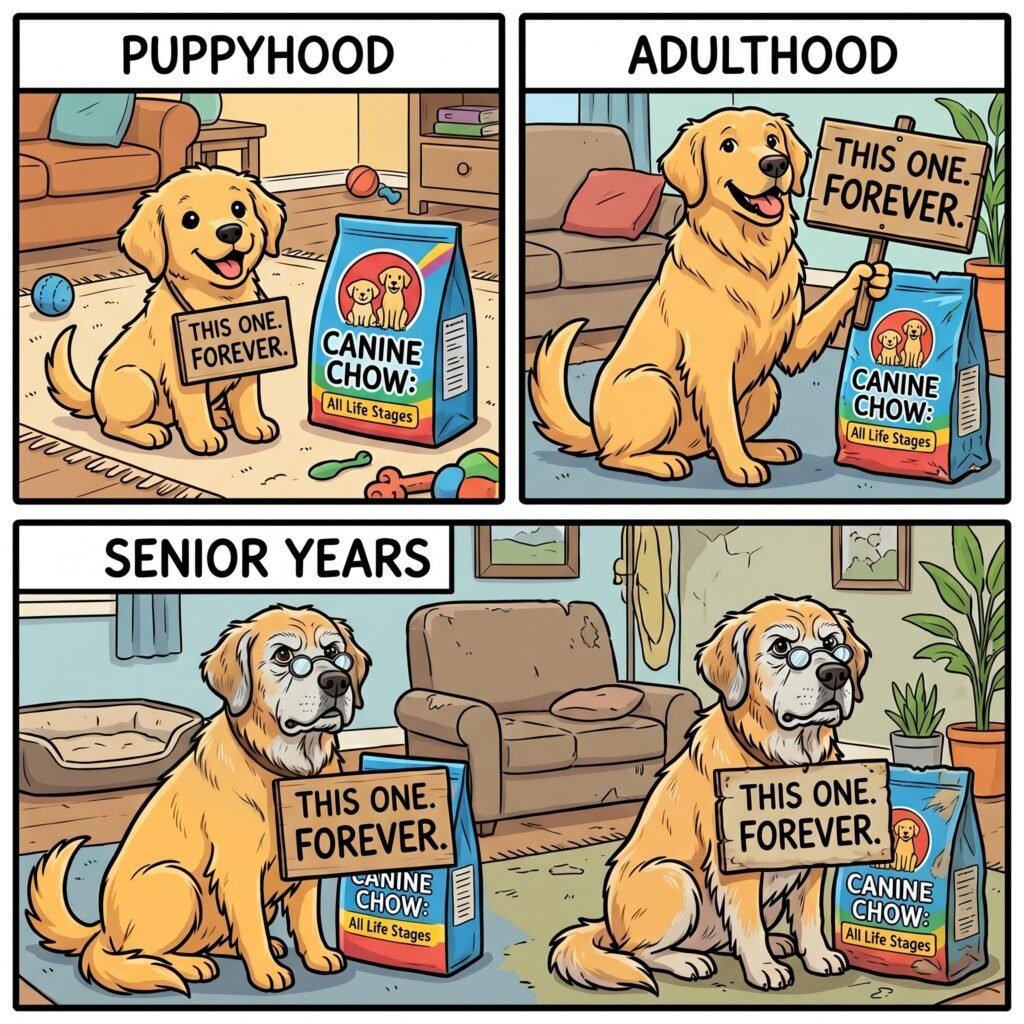
This is the most searched question in the all life stages dog food topic — and the answer is: yes, but with important qualifications that depend on your puppy’s expected adult size.
For can puppies eat all life stages dog food — the answer is:
- Small and medium breed puppies (expected adult weight under 50 lbs): Yes — a properly formulated all life stages dog food that meets AAFCO growth requirements provides adequate nutrition for small and medium breed puppy development. Many veterinarians and breeders specifically recommend quality all life stages dog food for these puppies as a nutritionally complete alternative to separate puppy formulas
- Large and giant breed puppies (expected adult weight over 50-70 lbs): Only if the AAFCO nutritional adequacy statement specifically includes the phrase “including growth of large breed puppies.” Without this specific qualifier, the calcium levels, caloric density, and phosphorus balance in a standard all life stages dog food formula may not be appropriately calibrated for large-breed skeletal development — even if the food is otherwise high-quality and complete for small and medium breeds
- All puppies: Confirm the specific AAFCO statement before feeding — do not rely on the front-of-bag “all life stages” claim alone. The nutritional adequacy statement on the back panel is the controlling information, and its precise wording determines the formula’s legitimate scope of use
- Sundays for Dogs’ AAFCO guide provides this practical guidance: “Puppies that are younger than 18 months may eat a growth or all life stages formula. Once pups are one year old, they are technically adults and can safely eat adult maintenance dog food recipes.” This timeline applies to small and medium breeds — large and giant breeds typically require growth-appropriate nutrition until 15 to 24 months.
Formulated vs. Feeding Trial Tested: Why It Matters for All Life Stages Claims
Before evaluating specific brands of all life stages dog food, understanding the two pathways to AAFCO compliance is essential — because not all claims are created equal:
Pathway 1: Formulated to Meet AAFCO Nutrient Profiles
The faster, cheaper, and less rigorous pathway: a laboratory analyzes the recipe and confirms that the calculated nutrient levels meet AAFCO minimums on paper. This confirms mathematical compliance but provides no evidence that real dogs absorbed, processed, or thrived on those nutrients in practice. As Spot & Tango’s March 2026 guide explains: “‘Formulated to meet AAFCO nutrient profiles’ means calculation only” — a legitimate compliance pathway, but the lower bar of the two options.
Pathway 2: Substantiated by AAFCO Feeding Trials
The gold standard: real dogs ate the food for a minimum of 26 weeks under veterinary supervision, with bloodwork and health monitoring throughout the trial period. Spot & Tango’s guide describes this as the higher-quality validation: “‘Animal feeding tests using AAFCO procedures’ means feeding trials were conducted” — proof that the food actually supports health in living animals, not just on a nutritional calculation spreadsheet. For all life stages dog food specifically, feeding trial validation carries extra weight because the claim covers life stages with very different physiological requirements — and confirming that the same formula genuinely supports both puppy development and adult maintenance through actual animal testing is a meaningful quality credential.
Look for “animal feeding tests using AAFCO procedures” on any all life stages dog food label you are seriously evaluating. This single phrase is more informative than everything on the front of the bag combined.
Benefits of Feeding All Life Stages Dog Food
All life stages dog food offers several practical advantages that explain its popularity across a wide range of dog owners and household configurations:
Simplified Multi-Dog Household Feeding
The most compelling practical benefit of all life stages dog food is its ability to simplify feeding in households with dogs at different life stages. A family with a new puppy, a healthy adult dog, and a senior companion can potentially feed all three from the same bag — eliminating the complexity and cost of purchasing, storing, and managing multiple life-stage-specific formulas simultaneously. The convenience is genuine and meaningful for multi-dog households.
Higher Baseline Nutritional Density
Because all life stages dog food must meet the elevated nutritional standards for growth — the most demanding life stage — the formula is inherently more nutritionally dense than adult-maintenance-only formulas. Healthy adult dogs feeding on a quality all life stages dog food are receiving nutrition calibrated for growth-stage demands, which typically means higher protein, more complete amino acid profiles, better calcium-phosphorus ratios, and more comprehensive micronutrient coverage than the adult maintenance minimum requires.
Flexibility Across Seasonal and Activity Changes
For owners of working dogs, sporting dogs, or dogs whose activity levels vary significantly with seasons, all life stages dog food provides nutritional headroom that adult maintenance formulas don’t offer. During peak performance periods — hunting season, agility competition periods, intensive training cycles — the elevated nutritional density of an all life stages dog food formula supports demands that adult maintenance nutrition may not fully cover.
Canidae All Life Stages Dog Food: Complete Review
Canidae all life stages dog food is one of the most searched all life stages brands in the United States, and for good reason. Founded in 1996 in Brownwood, Texas by passionate pet owners who believed dogs deserved better than conventional commercial formulas, Canidae remains privately owned and independently operated — a meaningful distinction in a market where most major pet food brands are owned by multinational corporate conglomerates.
Canidae Brand Background and Quality Credentials
DogFoodGuides’ January 2026 comprehensive Canidae review confirms the brand’s manufacturing infrastructure: two facilities — the Canidae Pet Nutrition Plant in Texas and the Ethos Pet Nutrition Center in Brownwood, Kansas — with advanced safety protocols including ingredient traceability from supplier to shelf, on-site lab testing for contaminants and nutritional accuracy, and third-party verification for AAFCO compliance. The review confirms: “As of 2026, there have been no new recalls in the last eight years — a strong indicator of trust and consistency.”
Dr. Georgia Jeremiah, pet nutrition expert and Wag!’s veterinary consultant, specifically recommends Canidae: “Canidae dog food is made with high-quality animal protein sources, providing essential amino acids, and is free from artificial colors, flavors” — a personal professional endorsement that carries genuine weight for the brand’s nutrition quality positioning.
Canidae All Life Stages Product Range
The Canidae All Life Stages line is specifically described by Wag!’s review as the brand’s “‘one bag fits all’ range. It’s ideal for multi-dog households and includes vet-formulated wet and dry recipes for all ages, breeds, and sizes.” Key features of the All Life Stages range include:
- Real meat, poultry, or fish as the first ingredient: Confirmed across the full All Life Stages range — chicken, turkey, fish, and lamb lead respective formulas as named whole proteins
- Brown rice as primary grain carbohydrate: Wag!’s review notes that “brown rice is one of the best grains in dog foods — it’s high in fiber and B vitamins” — a meaningful quality observation given how many budget brands substitute refined white rice or corn
- Salmon oil addition: “Canidae adds salmon oil to its All Life Stages wet recipes, which is rich in fatty acids” — providing EPA and DHA omega-3 for coat, skin, and cognitive health
- Probiotics for digestive support: Confirmed across the All Life Stages dry and wet ranges
- No corn, wheat, or soy: Consistent across premium Canidae formulations
- Flaxseed: Added omega-3 support from plant-based source alongside salmon oil
The ThinkingDonkey 2026 all life stages comparison specifically designates Canidae’s High Protein Multi-Protein Recipe as “Best Overall” in the all life stages category — citing its “robust 30% protein and 20% fat profile engineered for dogs at every life stage” with “real chicken leading the charge, backed by turkey, lamb, and fish to deliver a diverse amino acid spectrum that supports lean muscle, sustained energy, and strong immune function.”
Canidae All Life Stages: Honest Limitations
A balanced assessment of Canidae all life stages dog food acknowledges the limitations that independent reviewers consistently note alongside genuine strengths:
- Canola oil use: DogFoodGuides’ January 2026 review lists “canola oil use may concern some owners” as a legitimate negative — a reasonable concern given that some nutritionists consider canola oil an inferior fat source compared to salmon oil or chicken fat
- Some formulas include peas and lentils: The grain-free line within Canidae’s broader range (separate from the All Life Stages grain-inclusive formulas) includes legumes that carry the DCM-investigation concern — buyers should select the grain-inclusive All Life Stages formulas specifically if DCM concern is a factor in their decision
- Wag! assessment of quality ceiling: Wag!’s review describes All Life Stages dry foods as “good — but not outstanding — quality” compared to the higher-tier Goodness line, which uses “real, antibiotic-free meat or fish as the first ingredient” at a meaningfully higher quality threshold
- Price of premium lines: DogFoodGuides identifies “premium lines (PURE and Goodness) are expensive” as a genuine buyer limitation — though the All Life Stages line itself is positioned at a more accessible price point than the premium Canidae tiers
Best All Life Stages Dog Food Brands in 2026: Top Picks
Beyond Canidae, the following brands consistently earn top marks in the all life stages dog food category from independent reviewers in 2026:
1. Canidae High Protein Multi-Protein Recipe — Best Overall All Life Stages Kibble
As identified by ThinkingDonkey’s 2026 roundup: “This is the gold standard for all-in-one nutrition.” 30% protein, 20% fat, real chicken with turkey, lamb, and fish for complete amino acid coverage. AAFCO all life stages certified. Made in USA. No corn, wheat, or soy.
2. Diamond Naturals Salmon & Potato Formula — Best for Skin and Coat
ThinkingDonkey’s 2026 review specifically recommends Diamond Naturals as the standout all life stage dog food option for dogs with skin and coat concerns — with wild-caught salmon as the #1 ingredient delivering “a powerful punch of omega fatty acids that directly target your dog’s skin and coat health.” 40-pound bulk bags deliver exceptional value for multi-dog households. The review identifies it as one of the best large-bag all life stages options by price-per-pound.
3. Taste of the Wild All Life Stages — Best Grain-Free All Life Stages Option
Taste of the Wild consistently appears in all life stages roundups for its novel protein philosophy and roasted meat palatability. ThinkingDonkey’s 2026 review includes it among the top all life stages formulas with strong grain-free credentials — though buyers should note the DCM/legume concern for long-term grain-free feeding.
4. Victor Professional — Best for High-Energy and Working Dogs
ThinkingDonkey’s 2026 roundup specifically notes Victor Professional as providing “intense energy support” in the all life stages category — making it particularly appropriate for sporting, hunting, and working dogs whose daily caloric expenditure exceeds what standard adult maintenance or average all life stages formulas deliver.
5. Loyall Life All Life Stages — Best Agricultural Science-Backed Option
Reviewed in depth separately on this site, Loyall Life’s All Life Stages formula from Nutrena/Cargill delivers TruMune® immune support and Opti-Cook® digestibility technology alongside the standard all life stages nutritional claim — combining agricultural science infrastructure with clean ingredient quality for active and working dogs at all ages.

All Stages of Life Dog Food: What to Look for on the Label
Selecting the best all stages of life dog food for your specific household requires evaluating several key label elements alongside the all life stages claim itself:
- The exact AAFCO statement: “Including growth of large breed puppies” must appear if you are feeding large breeds at any age. Confirm this phrase is present — do not assume it is included
- Feeding trial vs. formulated: “Animal feeding tests using AAFCO procedures” confirms real animal validation — meaningfully stronger than “formulated to meet AAFCO nutrient profiles”
- Named protein first: Chicken, beef, salmon, turkey — not “poultry” or “meat” — as the first ingredient confirms genuine protein quality commitment
- No ingredient splitting: Check that grains and plant proteins are not split into multiple forms to disguise their total dominance over meat content in the formula
- Natural preservation: Mixed tocopherols rather than BHA, BHT, or ethoxyquin
- Omega-3 source: Fish oil, salmon oil, or flaxseed providing EPA and DHA for coat, joint, and cognitive health across all life stages
All Stages of Life Dog Food: What to Look for on the Label
Selecting the best all stages of life dog food for your specific household requires evaluating several key label elements alongside the all life stages claim itself:
- The exact AAFCO statement: “Including growth of large breed puppies” must appear if you are feeding large breeds at any age. Confirm this phrase is present — do not assume it is included
- Feeding trial vs. formulated: “Animal feeding tests using AAFCO procedures” confirms real animal validation — meaningfully stronger than “formulated to meet AAFCO nutrient profiles”
- Named protein first: Chicken, beef, salmon, turkey — not “poultry” or “meat” — as the first ingredient confirms genuine protein quality commitment
- No ingredient splitting: Check that grains and plant proteins are not split into multiple forms to disguise their total dominance over meat content in the formula
- Natural preservation: Mixed tocopherols rather than BHA, BHT, or ethoxyquin
- Omega-3 source: Fish oil, salmon oil, or flaxseed providing EPA and DHA for coat, joint, and cognitive health across all life stages
Frequently Asked Questions About All Life Stages Dog Food
Is all life stages dog food better than puppy food for puppies?
For small and medium breed puppies: a quality all life stages dog food with a confirmed AAFCO growth statement is nutritionally equivalent to a dedicated puppy formula — providing the elevated protein, calcium, and DHA that puppy development requires. For large and giant breed puppies: only formulas that specifically state “including growth of large breed puppies” are appropriate. Many breeders and veterinarians prefer all life stages dog food for simplicity and the nutritional consistency it provides across household dogs of different ages.
Can senior dogs eat all life stages dog food?
Yes — and notably, “senior” is not an AAFCO-recognized life stage. There is no AAFCO nutritional standard for senior dog food — it is a marketing category rather than a regulated nutritional designation. Many senior dogs do well on high-quality all life stages dog food throughout their senior years, as the elevated protein levels help maintain muscle mass that aging dogs tend to lose. Dogs with diagnosed health conditions (kidney disease, heart disease, obesity) may benefit from specific therapeutic diets under veterinary guidance regardless of life stage labeling.
What is the difference between all life stages and adult maintenance dog food?
Adult maintenance dog food meets only the nutritional minimums required for healthy non-pregnant adult dogs — lower protein, calcium, and DHA thresholds than the growth stage requires. All life stages dog food must meet the more demanding growth and reproduction standards, making it nutritionally denser than adult maintenance food and appropriate for a broader population of dogs including puppies, pregnant females, and active adults with elevated nutritional demands.
Do I need to switch foods when my puppy reaches adulthood?
If you are feeding a quality all life stages dog food from puppyhood, there is no nutritional requirement to switch when your dog reaches adulthood — the formula is designed to support both life stages. The main consideration is caloric management: the elevated nutritional density of all life stages dog food may deliver more calories than a less-active adult dog requires, potentially contributing to weight gain if daily portions are not adjusted downward from puppy-stage amounts as the dog’s growth rate slows.
Final Thoughts: Is All Life Stages Dog Food Right for Your Household?
All life stages dog food is one of the most practical and genuinely versatile formulation options in the commercial dog food market — particularly for multi-dog households, for owners who prefer the nutritional headroom of growth-calibrated formulas for their active adults, and for anyone who wants the simplicity of one high-quality product across different dogs in the household without sacrificing nutritional completeness for any of them.
The keys to getting it right: always verify the exact AAFCO nutritional adequacy statement on the back panel — particularly the large breed puppy qualifier for large-breed households. Look for feeding trial validation over paper-only compliance. Choose brands with named animal proteins first, natural preservation, and omega-3 support. And work with your veterinarian to calibrate daily portions appropriately as dogs move through life stages, since the nutritional density designed for growth-stage dogs may require portion adjustment for less-active adult maintenance.
Done right, all life stages dog food from a quality brand like Canidae, Diamond Naturals, Victor, or Loyall Life provides complete, consistent, science-backed nutrition across your dog’s entire life — from the first meal as a puppy to the last meal of a long and well-nourished senior life.
Looking for more expert guides on AAFCO compliance, breed-specific nutrition, and honest brand reviews? Browse our blog for comprehensive, research-backed resources designed to help every dog owner make the most confident feeding decisions possible.