
Can Dogs Eat Cucumbers? The Weight-Loss Swap That Works (and Where It Backfires)
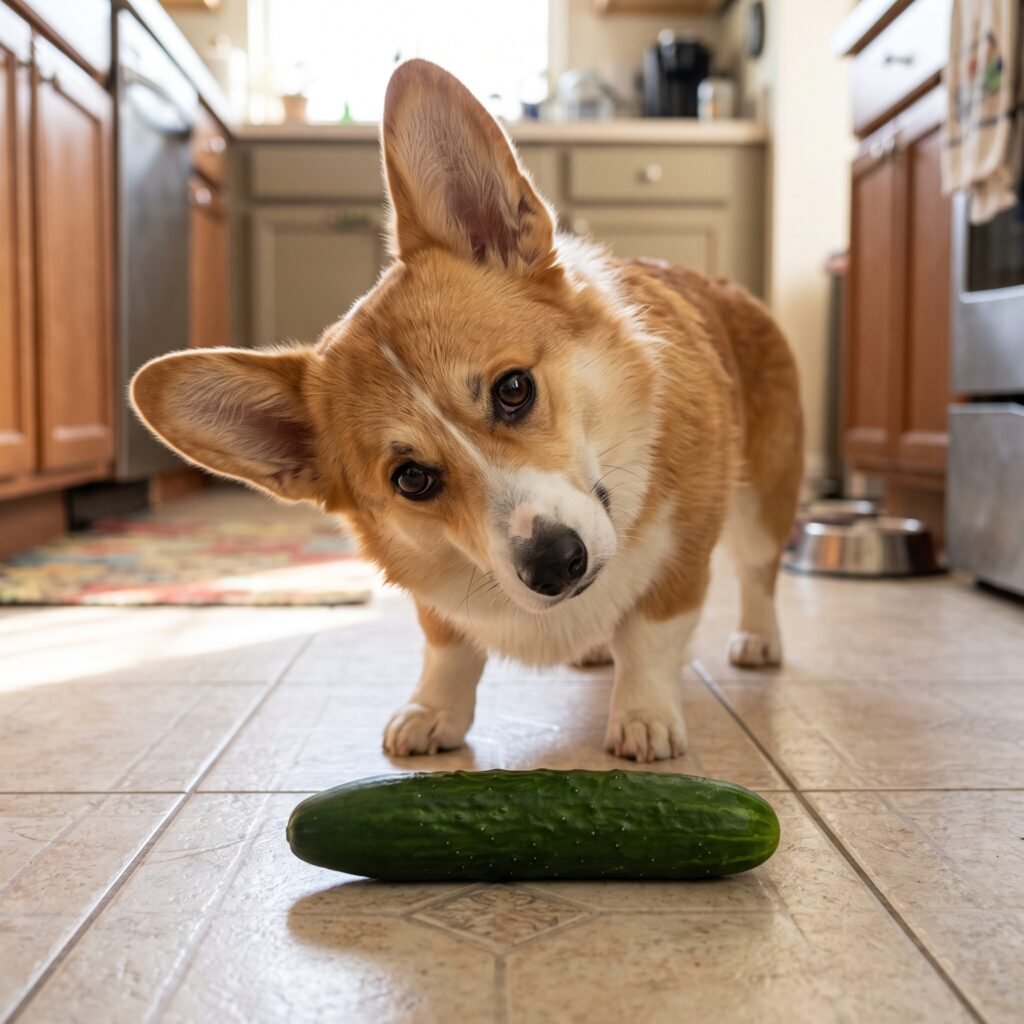
Can dogs eat cucumbers? Yes. Plain, washed cucumber is non-toxic to dogs, about 95% water, and roughly 15 calories per 100 grams. Keep it under 10% of daily calories as a treat, cut it to suit your dog’s size, and skip pickles. Used carefully, it adds volume to a diet plate without adding many calories.
Most owners asking can dogs eat cucumbers already suspect the answer is yes. The harder question comes next: should cucumber replace part of your dog’s dinner when the vet says she needs to lose weight? That choice has real trade-offs, and most articles skip them.
I tested the swap with Juno, a 40-lb shepherd mix with a sensitive stomach and about five pounds to lose. It helped for roughly two weeks. Then it stopped helping, and I’ll show you exactly where it broke.
Recommended Products
Best Dog Food in 2026
Can Dogs Eat Cucumbers Safely, or Is There a Catch?
For most healthy adult dogs, yes. Cucumber isn’t toxic, and mainstream veterinary and kennel-club resources list it as a safe fresh snack. The catches are quantity, size and what’s added to it.
So can dogs eat cucumbers without any trouble? Usually, as long as you avoid three mistakes:
- Too much, too fast. A dog that has never had much fiber and water in one go can end up with loose stool.
- The wrong shape. A thick round can lodge in a small dog’s throat, and a gulper like a Lab may swallow chunks whole.
- Seasoned or pickled versions. Pickles often carry garlic, onion and a lot of sodium. Garlic and onion are the real problem for dogs.
One more detail from the produce aisle: the stem end of a cucumber can taste bitter because of compounds called cucurbitacins. Commercial varieties are bred to keep these low, but I trim the bitter end anyway. Dogs that are otherwise cucumber fans will sometimes spit those pieces out.
Can dogs eat cucumbers every day? A healthy dog can, in small portions, and plenty of owners do. Daily feeding works best when the amount is steady rather than creeping up, because sudden jumps are what upset stomachs.
Are Cucumbers Good for Dogs, or Just Expensive Water?
Honestly, it’s closer to the second. Are cucumbers good for dogs? They’re a fine low-calorie, hydrating snack, but they aren’t a nutritional powerhouse. The numbers show why.
| Food (raw, 100 g, approx.) | Calories | Water | Fiber | Notes |
|---|---|---|---|---|
| Cucumber (with peel) | ~15 kcal | ~95 g | ~0.5 g | Very low density; trace vitamin K and potassium |
| Celery | ~14 kcal | ~95 g | ~1.6 g | Stringy; needs chopping for small dogs |
| Green beans | ~31 kcal | ~90 g | ~2.7 g | More fiber and a bit more protein |
| Carrot | ~41 kcal | ~88 g | ~2.8 g | Crunchier, higher sugar |
| Typical medium biscuit treat | ~350–400 kcal | ~10 g | varies | Check the bag; this varies by brand |
Values are rounded approximations based on USDA FoodData Central for produce. Treat figures vary widely by product, so always read your specific label.
Here’s what that table means in practice. Cucumber wins on calories and water, but it loses to green beans on fiber and to nearly everything on protein. So when someone asks me whether cucumbers for dogs count as “nutrition,” I say they count as volume, not nutrients.
That distinction drives the whole decision. Volume helps a dog feel like she’s eating more. It doesn’t help her feel full for long, which I learned the hard way.
Can dogs eat cucumbers for the hydration? Yes, and in summer that’s a real perk, especially for dogs who don’t drink enough. Just don’t treat it as a substitute for a water bowl.
How Much Cucumber Can a Dog Have Each Day?
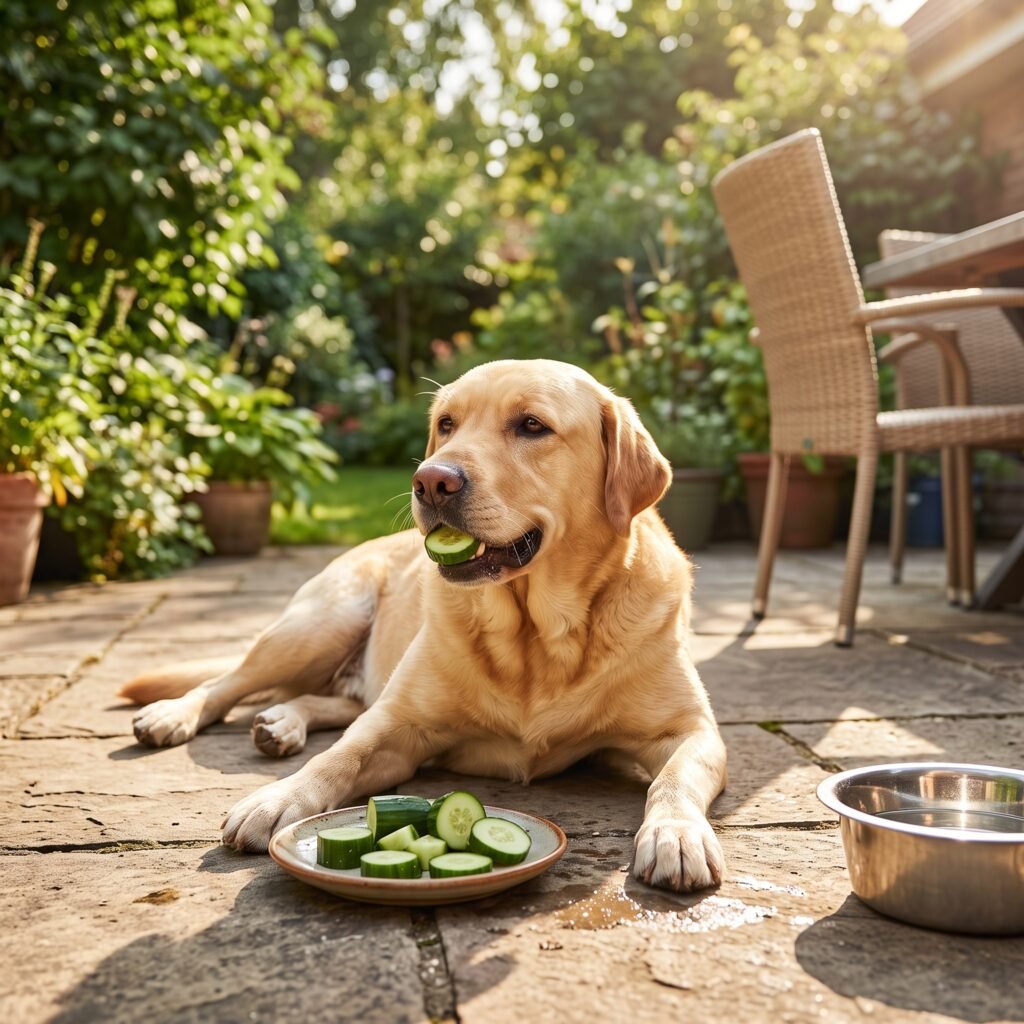
This is the question I get asked most, and the honest answer is that no official AAFCO or veterinary table gives a “cucumber serving by weight.” What exists is the widely used guideline that treats and extras shouldn’t exceed about 10% of daily calories.
Cucumber is so low in calories that the 10% rule almost never limits you. Digestive tolerance does. So I use a conservative rule of my own, which I’d call an editorial guideline, not a veterinary standard.
How much cucumber can a dog have in a day? Start with the treat tier below, and only move to the swap tier if your vet is guiding a weight-loss plan.
| Dog weight | Treat tier (diced, per day) | Swap tier (diet plan only, per day) |
|---|---|---|
| 5–10 lb | 1–2 tbsp | ¼ cup |
| 20 lb | ¼ cup | ½ cup |
| 40 lb | ½ cup | 1 cup |
| 60 lb | ¾ cup | 1½ cups |
| 80+ lb | 1 cup | 2 cups |
For perspective, a cup of sliced cucumber is only around 16 calories. So even the swap tier for a 40-lb dog adds almost nothing on the calorie side. The real impact is the kibble you remove.
Split the daily amount across two or three servings rather than one big pile. Introduce it over about a week: start with a tablespoon or two and watch the stool for several days before increasing.
Can dogs eat cucumbers in larger amounts than this? Some will tolerate it, but I wouldn’t test it on a sensitive stomach. Loose stool, gas or a bloated, gurgly belly all mean you’ve gone too far.
Can Dogs Eat Cucumbers Instead of Kibble? The Swap I Tried
Here’s the scenario that prompted this article. A dog is carrying extra weight, begging at every meal, and the owner wonders: can dogs eat cucumbers in place of some food to cut calories without a smaller-looking bowl?
It’s an appealing idea. A cup of kibble runs somewhere around 350–400 calories depending on the brand, while a cup of cucumber is about 16. Swapping a quarter cup of kibble for a cup of cucumber saves roughly 75–90 calories and makes the bowl look fuller.
What I did with Juno. Over ten days I worked up to replacing about a quarter cup of her dry food with a cup of diced, peeled-in-places cucumber, mixed through her meal and split across breakfast and dinner. She was already eating a complete adult maintenance kibble. The cucumber was cold from the fridge, which made the bowl smell less like kibble and a little like fresh-cut melon rind.
What worked. Juno ate it eagerly. She slowed down slightly because she had to chase the cucumber pieces around the bowl. Her weight dropped about a pound in the first two weeks, and her stool stayed firm.
What didn’t. At the two-week mark I pushed toward a cup and a half to see if more would help. By day three her stool turned loose, and she started pacing at 3 p.m., clearly hungry. Cucumber has almost no protein or fat, so it fills the bowl but doesn’t hold hunger off.
I backed down to the original amount and the loose stool cleared in about two days. The hunger stayed a problem though, which pushed me to a bigger realization.
The nutrient-dilution problem. If you remove kibble from a complete and balanced food, you also remove the vitamins, minerals and protein that came with it. AAFCO nutrient profiles are set per amount of food. A dog eating less of the formula may fall short of what the profile was designed to deliver, and it’s why vets often recommend a purpose-built weight-management diet instead of just cutting portions.
So can dogs eat cucumbers instead of kibble as a long-term strategy? In my experience, only as a modest, short-term helper, and ideally with your vet’s calorie target in hand. Here’s the decision framework I’d use:
- Use cucumber as a swap if your dog is otherwise healthy, you’ve confirmed a calorie target with your vet, and you’re replacing no more than about 10–15% of the kibble.
- Switch to a weight-management food if your dog needs to lose more than a few pounds. These foods are formulated to deliver the nutrients at fewer calories.
- Skip the swap entirely if your dog has a sensitive stomach, pancreatitis history or another medical condition. See the section on who should ask a vet first.
Can Dogs Eat Cucumber Skin and Seeds?
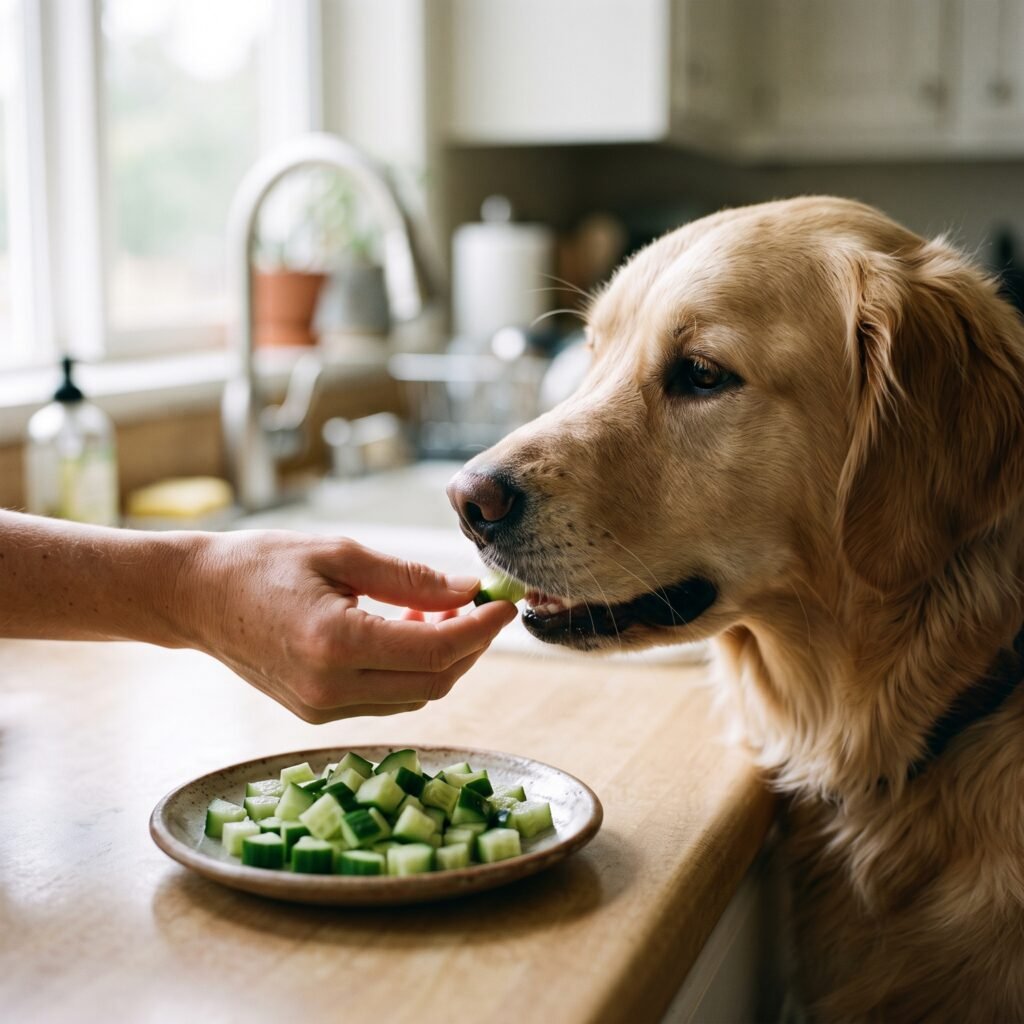
Yes to both, with some sense. Can dogs eat cucumber skin? The peel is edible, and it holds most of the cucumber’s modest fiber. On a plain garden cucumber, I leave it on.
Supermarket cucumbers are a different story. Many are coated in a food-grade wax to extend shelf life, and some carry pesticide residue. Scrub the cucumber under running water, or peel it if it’s heavily waxed or you can’t tell where it came from. When I tested this with Juno, peeled-in-strips cucumber gave her fewer gas issues than fully peeled-off skin did, but with a sensitive dog I’d still start peeled and add skin later.
Can dogs eat cucumber skin if they have a delicate gut? Start peeled. Fiber in the skin is the part most likely to cause trouble when you’re introducing a new food.
Seeds are fine. Cucumber seeds are tiny and soft, so they’re not a choking risk the way a large fruit pit would be. If you’re buying a seedless variety, you lose nothing important.
Can dogs eat cucumbers whole? I wouldn’t. A whole cucumber is a hazard for any dog that tends to gulp, and big pieces can cause choking or an intestinal blockage in a determined chewer. Always cut it up.
Can Puppies Eat Cucumbers?
Yes, with more caution than with adults. Can puppies eat cucumbers while they’re still on a puppy food? In small amounts, usually yes. Puppies have developing digestive systems, and the main concern is that you not crowd out the calories and nutrients they need for growth.
Puppies need dense nutrition. A cup of cucumber is nearly all water, so it fills a small stomach without feeding it. That’s the opposite of what a growing pup needs at mealtime.
My approach with younger dogs: offer a couple of small, cold pieces as a teething aid, well after a meal, not instead of one. Chilled (not frozen solid) cucumber is soothing on sore gums, and it’s far lower in calories than most teething treats.
Can dogs eat cucumbers at any age, then? Technically yes, but the size, the amount and the timing all need to change with age. For puppies under about four months, I’d check with your vet first, especially if the puppy has had any stomach trouble.
At the other end, senior dogs often do well with cucumber as a low-calorie, soft-ish snack. Just dice it smaller if their teeth aren’t what they used to be.
Which Dogs Should Skip Cucumbers or Ask a Vet First?
Cucumber is a low-risk food, but a few situations deserve a pause. Can dogs eat cucumbers when they have a health condition? Sometimes, and always with a vet’s input.
Dogs with a history of pancreatitis. Cucumber is very low in fat, which is a point in its favor. But any new food can trigger a flare in a fragile dog, so run it past your vet before adding anything.
Dogs with kidney disease. Cucumber has modest potassium, and the minerals matter for dogs on a managed renal diet. Your vet may want to control exactly what goes in the bowl, so ask first.
Diabetic dogs. Cucumber is low in carbohydrate, so it often fits well, but sugar and calorie management should be coordinated with your vet, not guessed at.
Small and toy breeds. A Chihuahua can get a stomach ache from a few extra slices, and a dog this size is easily thrown off by a sudden fiber change. Use the smallest treat-tier amount, and cut it into pieces no bigger than a pea.
Dogs with food allergies or very sensitive stomachs. I’d introduce cucumber on its own, a few days apart from any other new food, so any reaction is easy to trace.
Budget-conscious households. Here’s a practical plus: cucumber is usually cheaper per treat than commercial low-calorie options. The catch is that it spoils quickly, so buy one at a time rather than a bulk bag.
When should you stop and call the vet? Repeated vomiting, a swollen or painful belly, diarrhea lasting more than a day or two, or any sign of choking or blockage (retching, drooling, refusing food, straining). Don’t wait it out.
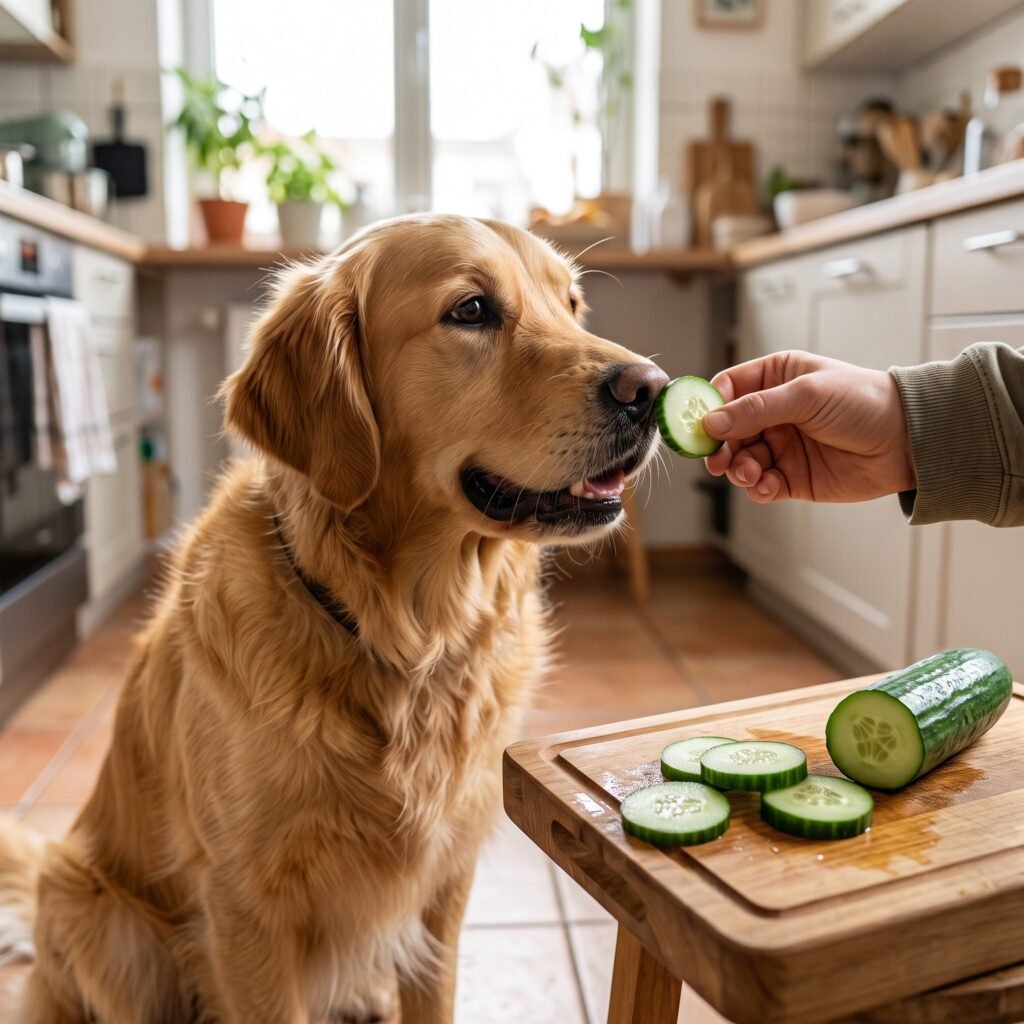
What’s the Safest Way to Serve Cucumbers to Dogs?
Plain is best. Can dogs eat cucumbers with dips, salt or dressing? No. Those add sodium, fat and often onion or garlic.
Here’s the prep routine I settled on:
- Wash thoroughly, scrubbing the skin under running water.
- Trim the stem end, since that’s where bitterness concentrates.
- Dice to the right size. Pea-sized for toy breeds, roughly a thumbnail for mid-size dogs, and small cubes (never big chunks) for large dogs.
- Serve cold, not frozen solid. Rock-hard frozen cubes can hurt gums and teeth.
- Refrigerate leftovers in a sealed container and use within a couple of days. Cut cucumber gets slimy quickly.
For hot days, I freeze thin slices on a tray, then let them soften for a minute before serving. It’s a good use of cucumbers for dogs that don’t like plain water-based treats.
What about pickles? I skip them entirely. The brine is salty, and onion and garlic are common in the recipe. Plain cucumber gives you all the benefit with none of the risk.
How I Evaluated This (Methodology)
This guide draws on a review of AAFCO’s published nutrient-profile framework, general veterinary guidance on treat limits, and USDA FoodData Central values for fresh cucumber and comparison produce. I didn’t evaluate individual brands for this piece, so there’s no product recall check to report. If you’re pairing cucumber with a specific food, check that food’s recall history on the FDA’s pet food recall page.
The serving-size table is an editorial guideline built from the 10% treat rule and my own feeding observations, not an official veterinary standard. Individual dogs vary. This article isn’t a substitute for advice from your own veterinarian, particularly for dogs with a medical condition.
So, Can Dogs Eat Cucumbers? My Decision Rule
Yes. Can dogs eat cucumbers as part of a weight-loss plan? Yes again, as a helper, not a replacement for good nutrition.
Here’s the rule I’d hand a friend. Use cucumber to add crunch and bulk, replace no more than 10–15% of kibble, and only after you’ve set a calorie target with your vet. If your dog still seems hungry, the answer isn’t more cucumber. It’s a purpose-built weight-management food.
If you only remember a few things:
- Dice it, wash it, and keep it plain.
- Start small and move up over a week.
- Watch stool and hunger, because they tell you what the numbers can’t.
- Ask your vet first for dogs with pancreatitis, kidney issues or diabetes.
Can dogs eat cucumbers every day without harm? For a healthy dog, in the amounts above, yes. And are cucumbers good for dogs? They’re good for what they are: a cheap, cold, crunchy, low-calorie snack. Just don’t ask them to be a meal.
FAQ: Can Dogs Eat Cucumbers?
Can dogs eat cucumbers every day?
Yes, healthy dogs can eat small amounts of cucumber daily. Keep the portion consistent, use the treat-tier amounts in the table above, and watch stool quality.
Can dogs eat cucumbers with the skin on?
Yes, the skin is edible, but wash it well to remove wax and residue. For sensitive dogs, start with peeled cucumber and add the skin later.
Can dogs eat cucumbers if they have diarrhea?
I’d skip it until the stool is back to normal. The water and fiber can make loose stool worse, and a bland diet recommended by your vet is the better choice.
How much cucumber can a dog have if they’re overweight?
For a 40-lb dog on a vet-supervised plan, up to about a cup a day in split servings is a reasonable ceiling. Smaller dogs need proportionally less, and any weight-loss diet should be set by your vet.
Can puppies eat cucumbers?
Yes, in tiny amounts, and mainly as a cold teething treat. Puppies need calorie-dense food, so cucumber should never replace a meal.