Pitbull Lab Mix Puppy Food: How to Choose When You Can't Predict Adult Size
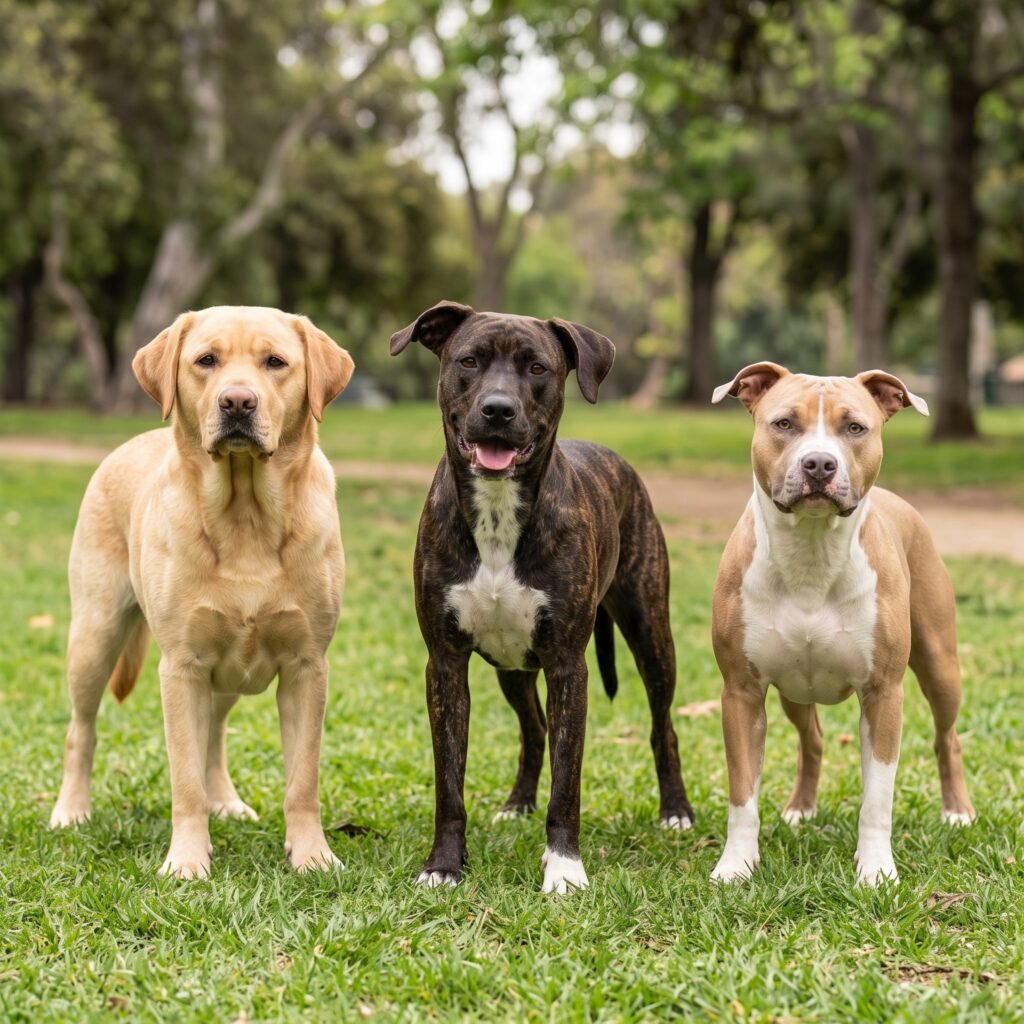
Quick answer: Feed a pitbull lab mix puppy a large breed puppy food until about 12 months, or longer if he’s heading past 70 pounds. Check that calcium stays under 1.8% dry matter, measure every meal, and keep your pitbull lab mix lean enough to show a waist.
The breeder says mom weighs 55 pounds and dad is “big, maybe 70.” That’s the entire growth forecast most people get with a pitbull lab mix litter. Your puppy could finish at 40 pounds or 85, and the food you choose at ten weeks has to hold up for both outcomes.
That’s the real decision. Large-breed formula, regular puppy food, or all life stages? Each choice has a trade-off, and a pitbull lab mix puppy punishes the wrong guess differently than a purebred does. Below is how I decide, what I measure, and where my own approach failed.
Recommended Products
Best Dog Food in 2026
What Makes a Pitbull Lab Mix Harder to Feed Than a Purebred?
With a purebred, the breed standard narrows the guesswork. A pitbull lab mix has no standard. The pit bull side tends toward medium, muscular builds. The Labrador side pushes bigger and heavier-boned. Genes don’t average neatly, though, and littermates can finish 20 pounds apart.
That gap matters because AAFCO sets different growth rules by expected adult size. It defines “large size” as 70 pounds or more at maturity. A pitbull lab mix sits right on that line, so feeding one is a judgment call, not a lookup.
The Lab half adds appetite. Plenty of Labs have food drive that borders on theatrical, and a gene variant tied to constant hunger and weight gain has been documented in the breed. The pit bull side often brings sensitive skin.
I once watched a pitbull lab mix puppy inhale a cup of kibble in about 40 seconds, then scratch his ears for an hour. You may get both traits in one dog, so the diet has to work on both fronts.
How Big Will a Pitbull Lab Mix Get, and Why Does It Change the Food?
Most adult pitbull lab mixes land between 40 and 80 pounds, and 55 to 70 is the range I see most. Females run smaller. Paw size predicts less than people think.
A better clue is weight at 16 weeks. A common vet rule of thumb is to multiply by about two for medium dogs and closer to 2.5 or more for large ones. It’s a rough range, not a promise, so check it against both parents’ sizes.
Why bother? A pitbull lab mix headed for 80 pounds needs growth-stage calcium controlled. One that finishes at 45 does fine on almost any complete puppy diet. You can’t know which one you have at ten weeks, so you feed for the harder case.
Should a Pitbull Lab Mix Eat Large Breed Puppy Food or Regular Puppy Food?
Large breed puppy food is the safer default when adult size is unknown. The reason is downside risk. Too much calcium during rapid growth in a dog that ends up large can contribute to developmental orthopedic disease. A dog that ends up medium on a large-breed formula loses very little, because those formulas still meet AAFCO growth requirements.
What numbers do I check first?
AAFCO’s growth profile calls for at least 22.5% protein and 8.5% fat on a dry matter basis. Calcium has to fall between 1.2% and 1.8%, and that upper cap is what separates large-breed formulas from standard puppy food. The calcium-to-phosphorus ratio should sit between 1:1 and 2:1.
Those are the first three things I check on any bag for a pitbull lab mix puppy. Everything else on the label is secondary.
How do I know the bag really covers large-size growth?
Skip the front-of-bag marketing and read the nutritional adequacy statement on the back. If it says “all life stages” and adds “including growth of large-size dogs (70 lb or more as an adult),” the calcium cap applies. If it says “except for growth of large-size dogs,” it’s the wrong bag for a pitbull lab mix that might hit 70.
I’ve seen “all life stages” bags with the exception clause tucked into small print. For a pitbull lab mix, that one sentence matters more than the brand name.
How Do Large Breed, Standard Puppy, and Adult Foods Compare for a Pitbull Lab Mix?
These are typical label ranges on a dry matter basis. Brands vary, so check your own bag.
| Food type | Protein (% DM) | Fat (% DM) | Calcium (% DM) | Typical kcal/cup | Best fit |
|---|---|---|---|---|---|
| Large-breed puppy | 24–30 | 10–15 | 1.0–1.5 | 340–390 | Unknown or large adult size |
| Standard puppy | 26–32 | 14–20 | 1.5–2.2 | 390–480 | Confirmed small-to-medium adults |
| All life stages | 25–32 | 12–18 | 1.2–2.0 | 370–470 | Only if label includes large-size growth |
| Adult maintenance | 21–27 | 11–16 | 0.8–1.5 | 340–400 | After growth is finished |
I use this as a screening tool. For a pitbull lab mix puppy under six months, anything in the large-breed row passes and anything in the standard puppy row gets a second look.
The calcium column separates safe from risky for a pitbull lab mix. The kcal column tells you how fast a dog will gain weight if you pour by the cup.
How Much Should a Pitbull Lab Mix Puppy Eat? A Feeding Chart That Adjusts
Bag charts overfeed. They have to cover every dog in a weight band, so they skew generous. I start from a calorie estimate and adjust by body condition.
This feeding chart for a pitbull lab mix uses standard resting-energy math with growth multipliers. Treat every number as plus or minus 15%.
| Age | Typical weight | Daily calories (kcal) | Meals per day |
|---|---|---|---|
| 8–12 weeks | 10–18 lb | 600–950 | 3–4 |
| 3–4 months | 18–30 lb | 850–1,250 | 3 |
| 5–6 months | 30–45 lb | 1,000–1,350 | 3, moving to 2 |
| 7–9 months | 45–60 lb | 1,200–1,500 | 2 |
| 10–12 months | 55–70 lb | 1,250–1,550 | 2 |
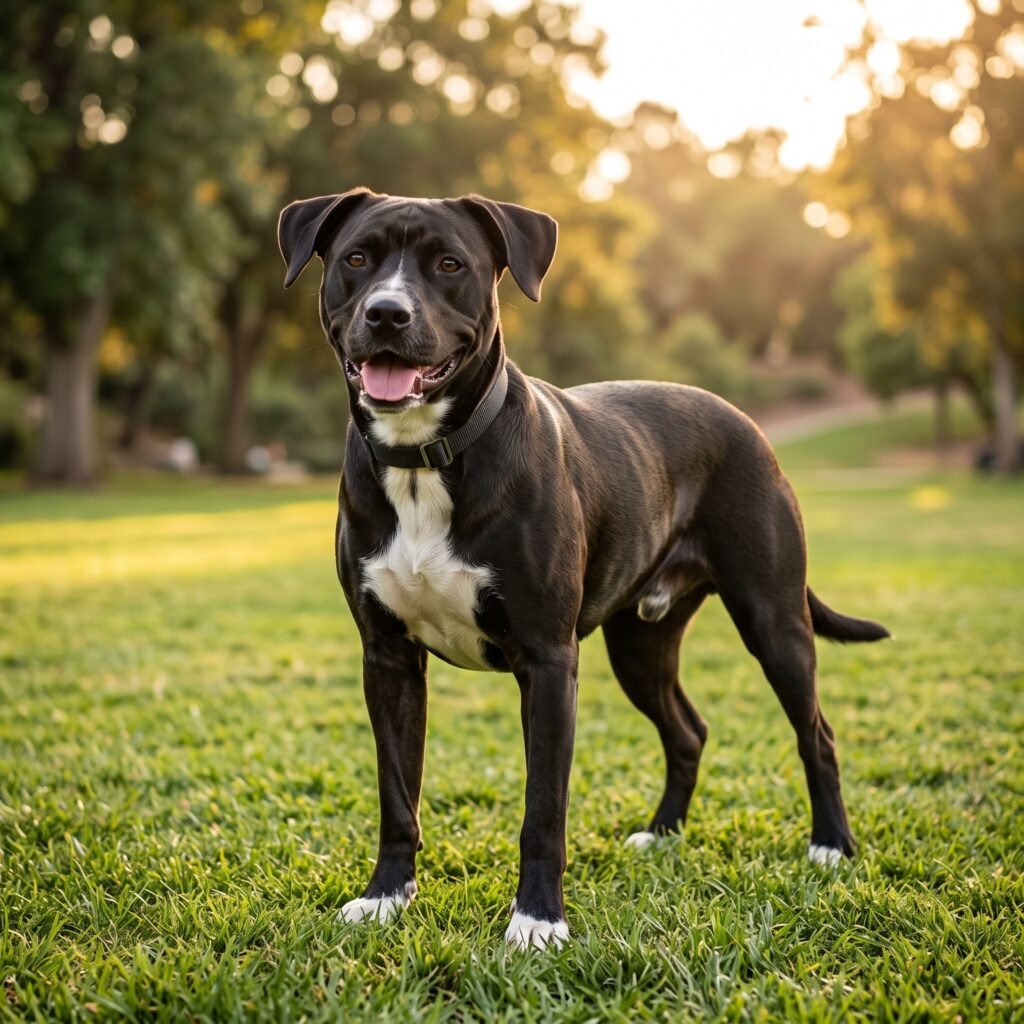
Weigh your puppy every two weeks. If the ribs disappear under your fingers, cut about 10%. A pitbull lab mix puppy should show a waist from above, with ribs you can feel but not see.
Then check your bag’s kcal per cup and convert, because the feeding chart above gives calories, not cups.
Should You Free-Feed a Pitbull Lab Mix?
No. You can’t see overeating until the dog is a pound too heavy, and extra weight during growth strains joints. A free-fed pitbull lab mix usually gains too fast.
Use measured meals: three a day until about six months, then two. If your dog eats like a vacuum, a slow-feeder bowl or snuffle mat turns a 40-second meal into five minutes.
What Went Wrong When I Fed a Pitbull Lab Mix Puppy?
I’ll start with the failures, because they taught me more than the wins did.
A foster, a 14-week-old pitbull lab mix I’ll call Tank, had soft stools on his starter food. I switched him in two days from a chicken-based large breed puppy food to a salmon formula marketed for sensitive skin. By day three he had runny stool, gas, and a very unhappy crate.
Why it failed: two days is far too fast. Gut bacteria need about a week to adjust, and an already unsettled gut needs longer. I’d also changed protein source and fat level at once, so I couldn’t tell which one caused the trouble. I went back to the old food, waited a week, then moved in 10% steps. That worked.
The second miss cost more. Tank’s ear scratching pushed me toward a limited-ingredient, grain-free diet. Eight weeks later, the scratching hadn’t changed. His vet pointed to environmental allergies, likely grass pollen, not food.
An elimination trial only means something after 8 to 12 weeks of strict feeding, and I’d muddied mine with treats and a dental chew.
Here’s the lesson. Skin trouble in a pit-bull-influenced dog is more often environmental than owners assume. Changing foods is a slow, pricey test of a theory that may be wrong.
Grain-free carries its own question too. The FDA investigated reports of dilated cardiomyopathy in dogs eating certain grain-free diets, and the link hasn’t been settled. I’d want a clear medical reason before choosing one for a pitbull lab mix.
Can a Pitbull Lab Mix With a Sensitive Stomach Eat Large Breed Puppy Food?
Usually yes, but the formula matters more than the category. A pitbull lab mix with a sensitive stomach tends to do better on a single animal protein, moderate fat (under about 15% dry matter), and a named fiber source like pumpkin or beet pulp. High-fat puppy foods are a common cause of loose stool.
My sensitive stomach protocol is boring on purpose:
- Pick one food and hold it for four weeks.
- Transition over 10 to 14 days: 25% new, then 50%, then 75%, a few days each.
- Keep treats under 10% of daily calories, from one protein.
- Score every stool. Aim for a 2 on the Purina fecal scoring chart.
A sensitive stomach in a pitbull lab mix puppy also deserves a stool test before you blame the food, since giardia and intestinal worms mimic intolerance. Treating a parasite with a diet change wastes weeks.
When Should a Pitbull Lab Mix Move From Puppy Food to Adult Food?
Not at a fixed birthday. Medium and large dogs finish growing on different schedules. A 45-pound pitbull lab mix may be done by 12 months. A pitbull lab mix headed for 80 pounds can keep filling out until 18 months.
The practical test: the scale has plateaued for four to six weeks and your vet agrees. As a rough guide, switch around 12 months if you expect under 50 pounds. Stay on a large-breed puppy formula until 15 to 18 months if you expect over 70.
Don’t drop a big dog down to regular puppy food in between, because calories and calcium both go up.
Neutering lowers energy needs for many dogs, so I trim portions about 10% around surgery and watch the waist. A finished pitbull lab mix on puppy calories gets heavy fast.
What Should You Look for on a Pitbull Lab Mix Puppy Food Label?
Calcium and the calcium-to-phosphorus ratio
For a large-breed formula, I want calcium near 1.2% to 1.5% dry matter. A calcium-to-phosphorus ratio of about 1.1:1 to 1.4:1 is where most good formulas land.
Many labels list only minimums, so call the maker for the real number. Reputable companies will give it to you in a day or two.
Named protein, fat, and a calorie statement
For a pitbull lab mix, I like a named meat first, at least 24% protein, and fat between 10% and 15%. The calorie statement (kcal per cup and per kg) is what lets you use the feeding chart. If a bag doesn’t print it, I don’t buy it.
Kibble size, smell, and DHA
Labs gulp. I prefer a 12 to 15 mm irregular kibble that slows chewing slightly. The one my foster liked best was a triangular piece that smelled like toasted chicken. He left the round, fishy one in the bowl.
DHA from fish oil supports brain and eye development in puppies, so look for it on the ingredient list. None of this matters if the pitbull lab mix puppy in front of you won’t eat it, so buy the smallest bag first.
What If You’re Feeding a Pitbull Lab Mix on a Tight Budget?
Compare cost per 1,000 calories, not cost per bag. These numbers are illustrative.
A 24-pound bag at $52 and 3,800 kcal/kg holds about 41,000 kcal, which works out to roughly $1.26 per 1,000 kcal. A $95 bag of the same size at 4,100 kcal/kg holds about 44,700 kcal, or about $2.13 per 1,000 kcal.
For a pitbull lab mix puppy, the mid-priced bag wins unless the premium one solves a specific problem. I’d rather you spend on a formula from a company that employs a qualified nutritionist, runs feeding trials, and shares nutrient numbers. That’s the spirit of WSAVA’s guidance on choosing pet foods. Skip boutique brands whose only edge is the ingredient list.
The trade-off is real. Cheaper foods often mean slightly more food per day and more stool, and I’ve had to re-tune portions when a formula changed. Feeding a pitbull lab mix well on a budget mostly comes down to measuring and not overbuying.
Is Fresh, Raw, or Homemade Food Worth It for a Pitbull Lab Mix Puppy?
Only if someone has balanced it for growth. This is where well-meaning owners do the most damage. Homemade and raw diets are easy to get wrong in calcium, and a wrong calcium number is exactly the risk we’re trying to avoid in a pitbull lab mix. Research on home-prepared diets has repeatedly found nutrient imbalances when recipes weren’t written by a nutritionist.
If you want fresh food, look for a company that publishes an AAFCO statement covering growth including large-size dogs. Or hire a board-certified veterinary nutritionist to write a recipe.
Raw adds food-safety issues. The FDA warns that raw diets can carry Salmonella and Listeria, a real concern in homes with infants or immunocompromised people.
A middle path I like is a measured large-breed kibble base with a spoonful of fresh topper counted in the calories. The pitbull lab mix puppies I’ve seen on this approach ate with more enthusiasm. In two of them, though, cost rose and stool softened, so I tapered the topper down.
How Do Treats, Chews, and Training Change the Math?
Training a Lab-influenced puppy runs on food. Twenty treats at 10 calories each is 200 calories, roughly 15% of a six-month-old’s day. Count them.
Use part of the kibble ration as rewards, and save high-value treats for hard moments like recall practice. A pitbull lab mix puppy in a six-week class can quietly eat an extra meal’s worth of treats.
If your dog has a sensitive stomach, pick a single-protein treat and hold it constant for a month. Rotating five treat flavors makes any food trial unreadable.
Which Health Risks Should Shape the Diet of a Pitbull Lab Mix?
Four come up repeatedly, and food touches all of them:
- Hip and elbow dysplasia. Both parent breeds can carry it, which is why controlled growth matters.
- Skin allergies. More often environmental, as Tank showed. Run a diet trial only with your vet’s guidance.
- Obesity. Some Labs carry a gene variant that keeps them hungry. If your pitbull lab mix acts starving at every meal, believe the scale, not the eyes.
- Exercise-induced collapse. This is a Lab-line genetic condition. Tell your vet if your dog collapses after intense play. Food doesn’t fix it, but a lean dog is easier to manage.
The best-supported nutrition finding in this area comes from a long-running Labrador retriever study. Dogs fed about 25% less than their littermates stayed leaner, developed arthritis later, and lived nearly two years longer.
It’s a Lab study, not a pit mix study. But a pitbull lab mix with Lab genes is a reasonable place to apply it.
How I Evaluated This (Methodology)
I compared nutrient claims against AAFCO growth profiles (protein, fat, calcium, and the calcium-to-phosphorus ratio) on a dry matter basis. I also read each adequacy statement, checked FDA recall history, and verified calorie density. I tracked stool quality, body condition score, and biweekly weight for each dog I fed, including the pitbull lab mix puppies mentioned here.
Reviewed by: [Name, DVM or board-certified veterinary nutritionist. Add before publishing.]
Frequently Asked Questions
How much does a full-grown pitbull lab mix weigh?
Most land between 40 and 80 pounds, with 55 to 70 common. The Lab side usually pushes the number up and the pit bull side pulls it back, but a pitbull lab mix can surprise you in either direction.
What is the best food for a pitbull lab mix with skin allergies?
Start with your vet, because the cause is often environmental rather than dietary. If a food trial is warranted, it means one novel or hydrolyzed protein for 8 to 12 weeks with no other treats. Skipping that discipline wastes the trial.
How often should I feed a pitbull lab mix puppy?
Three meals a day until about six months, then two. Use the feeding chart above for calories, and weigh every two weeks to adjust.
Is grain-free food good for a pitbull lab mix?
Not by default. The FDA has investigated a possible link between certain grain-free diets and heart disease in dogs, and the question remains unresolved. A pitbull lab mix without a diagnosed grain allergy usually does fine on a well-formulated diet that includes grains.
When do pitbull lab mixes stop growing?
Medium-sized ones finish around 12 months, and bigger ones can keep filling out until 18. Watch the scale for a four-to-six-week plateau before switching to adult food.
Conclusion: What I’d Do With Your Pitbull Lab Mix Puppy
If you remember three things, make them these. Feed a large-breed formula until growth plateaus, keep the calcium-to-phosphorus ratio inside AAFCO’s range, and measure every meal.
The pitbull lab mix is a dog where uncertainty is the whole point, so feed for the bigger outcome and adjust at the waist. Change foods slowly, and don’t chase skin problems with expensive diets before your vet rules out the environment.
Done right, a lean pitbull lab mix gets more comfortable years and fewer vet bills.