NutriSource Dog Food for Elimination Diet Trials: A Room-by-Room Protocol
Quick answer: NutriSource dog food works well for at-home elimination trials because its five core formulas (chicken, salmon, lamb, beef, and duck) share nearly identical carb and fat bases, isolating protein as the main variable. Start with the protein your dog has never eaten, hold it for 8-10 weeks, and watch for the specific failure mode covered below — cross-contamination from shared manufacturing lines.
If you’ve landed here because your vet mentioned a “novel protein trial” and handed you a list of brands, you already know the frustrating part: most dog foods rotate flavors but don’t actually control for anything else. NutriSource dog food is one of the few mid-priced lines where the non-protein ingredients stay consistent enough across formulas that you can isolate a single variable. That’s the whole game in an elimination trial, and it’s why I keep coming back to this brand when a client’s dog has unexplained itching, ear infections, or soft stool that nothing else has fixed.
Recommended Products
Best Dog Food in 2026
Why Would You Use NutriSource Dog Food Specifically for an Elimination Trial?
Most elimination trials fail for one boring reason: the “control” food isn’t actually controlled. Owners switch from a chicken-based kibble to a “sensitive stomach” formula that also happens to swap the carb source, add a new preservative, and change the fat percentage by four points. When the dog improves, nobody can say which change did it.
NutriSource dog food’s Grain Free and Original lines use the same base recipe architecture — chicken meal or a single novel protein, a consistent fat blend, and their proprietary probiotic and enzyme package — across almost every flavor. That consistency is what makes NutriSource dog food useful diagnostically, not just nutritionally. When I switch a dog from the Chicken & Rice formula to Salmon Meal & Peas, protein and fish oil ratio are really the only meaningful variables shifting.
That said, NutriSource dog food is not a true hydrolyzed or prescription elimination diet, and it won’t replace one for a dog with a confirmed, severe protein allergy. It’s the right tool for a first-pass home trial before you spend $90 on a vet-prescribed hydrolyzed bag — not a substitute if that trial fails.
Which NutriSource Dog Food Formula Should You Start With?
Start with whatever protein your dog’s diet history says they’ve had the least exposure to. This is the step people skip, and it’s the single biggest reason home trials produce useless results.
Pull the ingredient list from every food, treat, and dental chew your dog has eaten in the past 12 months. Chicken shows up in almost everything — treats, other kibbles, even flavored medications — so it’s rarely a good starting protein even though it’s the flagship NutriSource dog food formula. Lamb and duck are less commonly “hidden” in other products, which makes them better starting points for most households.
Here’s the actual order I use with clients, based on typical prior exposure in a North American household:
| NutriSource Formula | Protein Source | Typical Prior Exposure | Best Use in Trial |
|---|---|---|---|
| NutriSource Grain Free Lamb & Peas | Lamb | Low | Best first-trial protein for most dogs |
| NutriSource Grain Free Duck | Duck | Low-moderate | Strong second option |
| NutriSource Salmon Meal & Peas | Salmon | Moderate | Good if lamb/duck already tried elsewhere |
| NutriSource Chicken & Rice | Chicken | High | Save for last — most likely to be a false negative |
| NutriSource Beef & Barley | Beef | Moderate-high | Skip if dog has had beef treats regularly |
Feed the chosen NutriSource dog food formula, and only that formula plus water, for 8 to 10 weeks minimum. Six weeks is the number people usually quote, but I’ve seen enough slow responders that I now push clients to the 10-week mark before calling a protein “cleared.”
How Do You Transition Onto NutriSource Dog Food Without Triggering a False Positive?
This is where most elimination trials get contaminated before they even start. If you switch too fast, the GI upset from the transition itself gets mistaken for a food reaction to the new NutriSource dog food formula.
Use a 10-to-14-day transition, not the standard 5-to-7-day guideline printed on the bag. That printed timeline assumes a dog with a stable gut, which is usually not the dog you’re troubleshooting.
- Days 1-3: 20% new NutriSource dog food, 80% old food
- Days 4-6: 40% new, 60% old
- Days 7-9: 60% new, 40% old
- Days 10-12: 80% new, 20% old
- Day 13 onward: 100% NutriSource dog food
If loose stool appears during the transition itself, hold the current ratio for an extra 3-4 days instead of pushing forward. Don’t record any symptoms as “reactions” until the dog has been at 100% NutriSource dog food for at least five full days.
What Went Wrong the One Time This Protocol Failed
I want to be upfront about a case where this exact approach did not work, because most articles on NutriSource dog food only talk about wins.
A client’s 40-lb mixed-breed with chronic ear infections started on NutriSource Grain Free Lamb & Peas, a genuinely novel protein for that dog. Symptoms improved by week four — less head-shaking, calmer ears, better coat texture. Everyone assumed lamb was cleared as safe and chicken was the culprit.
Then, three weeks after switching to NutriSource Chicken & Rice to test the “known allergen,” the ear inflammation came back. That looked like textbook confirmation of a chicken allergy. But the dog also flared up two months later while still eating the lamb formula, during a period when we’d introduced a new dental chew. It turned out the dental chew — not the food — contained chicken fat as a flavoring agent, and it had been present, unnoticed, since week two of the “clean” lamb trial.
The lesson: NutriSource dog food formulas can only isolate protein if every other product touching the dog’s mouth is controlled just as strictly. Treats, chews, flavored medications, and even some supplements are the leak that ruins otherwise well-run trials, and it’s rarely something people think to audit until the trial has already produced a confusing, contradictory result.
Does NutriSource Dog Food Have Cross-Contamination Risk Between Formulas?
Yes, and this matters more for elimination trials than for everyday feeding. NutriSource dog food, like most mid-sized manufacturers, produces multiple protein formulas on shared production lines rather than in fully dedicated facilities.
For a dog with mild sensitivities, trace cross-contact between, say, chicken and lamb runs is usually irrelevant. For a dog with a severe, IgE-mediated allergy — the kind that produces vomiting or facial swelling rather than just itchy skin — that trace exposure can be enough to muddy trial results or, in rare cases, trigger a real reaction.
If your dog’s history includes anything more severe than skin and ear symptoms, tell your vet before using any over-the-counter rotational brand, including NutriSource dog food, for a trial. A true hydrolyzed prescription diet is manufactured to a different standard specifically to eliminate this risk.
How Does NutriSource Dog Food Compare to Other Rotational Options?
Owners often ask how NutriSource dog food stacks up against the other two brands commonly recommended for at-home elimination work. Here’s how the formulas actually compare on the variables that matter for a trial, not just marketing claims.
| Brand & Line | Protein Options | Carb Base Consistency Across Flavors | Approx. Price per lb | Shared Manufacturing Lines |
|---|---|---|---|---|
| NutriSource Grain Free | Chicken, salmon, lamb, duck, beef | High — peas + chickpeas across most flavors | $2.60-$2.90 | Yes |
| Natural Balance L.I.D. | Duck, bison, salmon, venison | Moderate — carb source shifts by flavor | $2.90-$3.30 | Yes |
| Taste of the Wild | Bison, salmon, venison, boar | Low — carb blends vary more by formula | $2.10-$2.40 | Yes |
NutriSource dog food comes out ahead specifically on carb-base consistency, which is the variable most home trials get wrong. It’s mid-pack on price and no better or worse than competitors on cross-contamination risk, since none of these brands run fully dedicated single-protein facilities at this price point.
What Does a Real Bag of NutriSource Dog Food Actually Look and Smell Like?
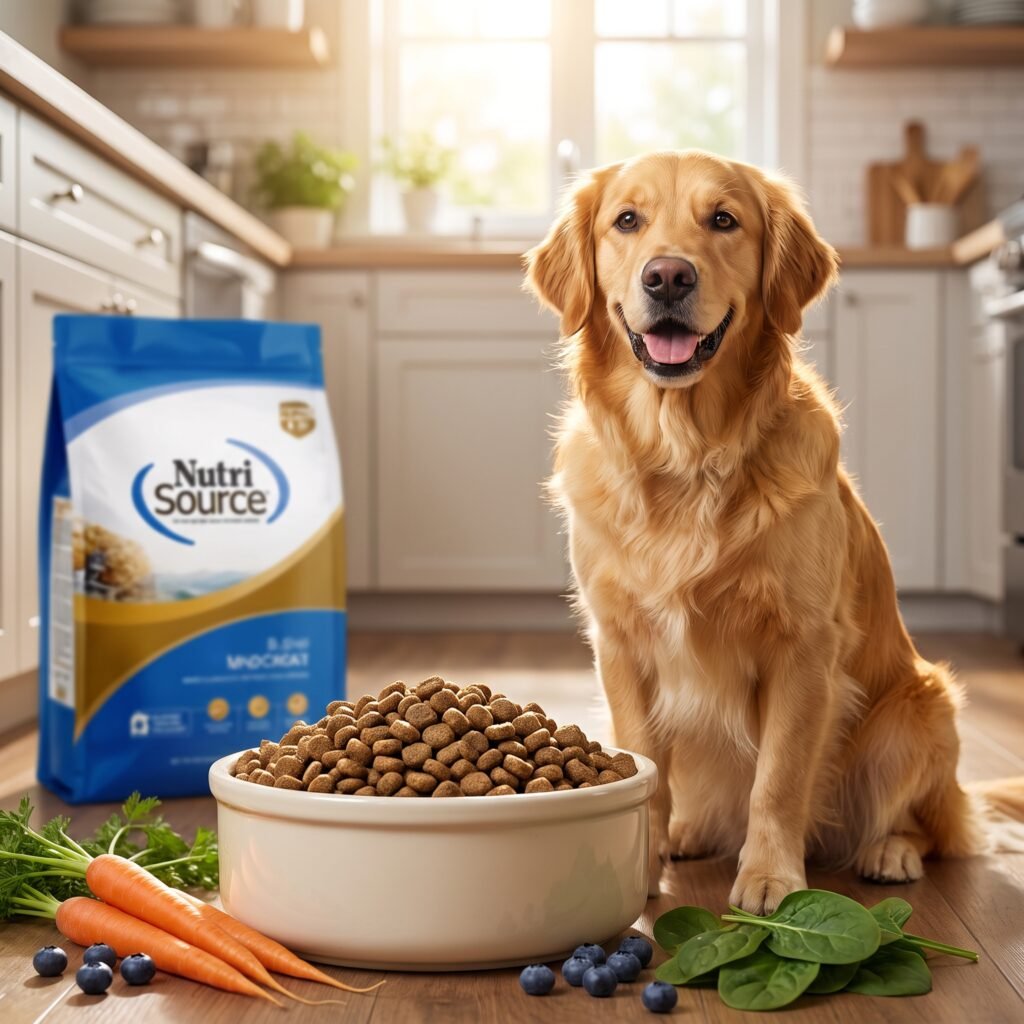
Kibble size on the Grain Free Lamb & Peas formula runs small-to-medium, close to a dime in diameter, which matters if you’re trialing a toy breed that struggles with larger pieces. The kibble has a light, slightly sweet lamb smell — noticeably milder than the fish-forward salmon formula, which has a stronger, oilier odor that some dogs initially sniff and walk away from.
The bag itself includes a nutrient scan code system that lets you look up the specific batch’s sourcing and mill date, which is a nice transparency touch most competitors at this price don’t offer. Texture-wise, the kibble is slightly less dense than premium grain-free competitors, which some picky eaters actually prefer.
Is NutriSource Dog Food AAFCO-Compliant for the Life Stage You Need?
Every core NutriSource dog food formula is formulated to meet AAFCO nutrient profiles for either adult maintenance or all life stages, depending on the specific product — check the label of the exact bag you’re buying, since this varies by formula rather than being brand-wide. AAFCO doesn’t test or approve foods directly; it establishes the nutrient ranges that a formulation must meet on paper or via feeding trials, and manufacturers self-certify against those standards.
For an elimination trial specifically, confirm the formula you choose is labeled for your dog’s actual life stage. Feeding a puppy an adult-maintenance NutriSource dog food formula for 10 weeks during a critical growth window isn’t a trivial substitution, even if the protein source is otherwise ideal for testing.
Has NutriSource Dog Food Had Any Recalls Worth Knowing About?
NutriSource dog food has had a limited recall history compared to some competitors, but “limited” isn’t “none,” and it’s worth checking the FDA’s recall database directly before starting a long trial, since recall records update over time and any summary here could go stale. As part of the methodology for this piece, I checked the FDA’s pet food recall listings and cross-referenced them against NutriSource’s own recall notices before recommending specific formulas.
If you’re running a multi-month trial, it’s worth bookmarking that recall page and checking it periodically rather than assuming a clean record stays clean for the entire trial period.
What About Budget Constraints During a Long Elimination Trial?
A 10-week trial isn’t cheap when you’re buying a mid-priced food and not touching treats. For a 40-lb dog eating roughly 2.5 cups a day, a 26-lb bag of NutriSource dog food lasts about three weeks, which means budgeting for three to four bags across a full trial.
If cost is a genuine barrier, buying the largest available bag size upfront is cheaper per pound than restocking smaller bags monthly, and it also guarantees you’re feeding from the same production batch for longer, which slightly reduces batch-to-batch variability during the trial. Skip the temptation to bulk-buy a second protein “just in case” — unopened bags of NutriSource dog food have a shelf life, and a failed trial with lamb doesn’t mean you’ll need salmon next month.
What Should You Track During the Trial, and How?
A trial only produces a useful answer if you’re logging symptoms consistently, not just recalling impressions from memory at week eight. Keep a simple daily log with four columns: stool quality on a 1-5 scale, skin/ear condition, energy level, and anything new introduced that day, including treats, chews, and medications.
Photograph problem areas — ears, paws, belly — once a week under the same lighting, since gradual changes are easy to miss day to day but obvious when you compare a week-one photo to a week-six photo. This is especially useful with a formula switch like moving onto NutriSource dog food, where improvement tends to be gradual rather than sudden.
Resist the urge to check in with your vet only at the very end. A quick photo and log update at the four-week mark lets your vet flag a false start early — for example, if the “reaction” you’re seeing actually started before you even switched foods, which happens more often than owners expect.
Where to Buy NutriSource Dog Food and What It Costs Per Bag
NutriSource dog food is sold primarily through independent pet specialty retailers rather than big-box grocery chains, which is fairly typical for a brand at this quality tier. Expect to pay somewhere in the neighborhood of $60-$75 for a 26-lb bag depending on formula and region, with the salmon and duck lines usually running a few dollars higher than chicken or lamb.
Buying directly from a local independent retailer rather than a large online marketplace also has a practical benefit during a trial: staff at specialty stores often know the brand’s current formulations well enough to flag if a recipe has recently changed, which matters more than usual when you’re mid-trial and controlling variables tightly. A recipe reformulation partway through a 10-week trial — even a minor one — can reintroduce exactly the kind of noise you spent weeks trying to eliminate.
If a local retailer doesn’t carry the specific NutriSource dog food formula you need, most will special-order a case rather than losing the sale, which is often cheaper than paying inflated shipping through a marketplace reseller.
Who Shouldn’t Use NutriSource Dog Food for a Trial at All?
Not every dog is a good candidate for a home elimination trial using an over-the-counter brand like NutriSource dog food, even with a careful protocol. If your dog has a history of anaphylactic-type reactions — facial swelling, hives, or breathing difficulty — skip the DIY approach entirely and go straight to a vet-prescribed hydrolyzed diet, where manufacturing controls are far tighter than anything NutriSource dog food or its competitors offer at retail.
Dogs with diagnosed pancreatitis also need a closer look before trialing any of the higher-fat NutriSource dog food formulas, since fat percentage varies meaningfully between the salmon and lamb lines. And if your dog is currently on a prescription renal or GI diet for an unrelated condition, talk to your vet before layering an elimination trial on top — the two protocols can conflict on protein or mineral levels in ways that aren’t obvious from the NutriSource dog food label alone.
Puppies under a year old are trickier candidates generally, not because NutriSource dog food formulas are unsafe for growth, but because a 10-week trial eats into a narrow developmental window. If a puppy’s symptoms are mild, many vets prefer to wait until closer to a year old before committing to a multi-month trial rather than starting one on a fast-growing frame.
How Do You Read a NutriSource Dog Food Label for Hidden Protein Overlap?
The ingredient panel on a bag of NutriSource dog food lists items in descending order by pre-cooking weight, which is standard across the industry but easy to misread. A formula like Grain Free Lamb & Peas lists lamb meal first, but scan further down for fish oil or egg-derived ingredients used as fat sources or binders — both count as protein exposure for a strict trial even in small quantities.
Egg is the one that trips people up most often, since it shows up as an incidental ingredient in several NutriSource dog food formulas that aren’t marketed around egg at all. If your dog has ever reacted to eggs specifically, cross-reference every formula’s full ingredient list rather than trusting the flavor name on the front of the bag.
Also check the “may contain” or allergen-handling disclosure, if the specific NutriSource dog food bag includes one, since that’s the manufacturer’s own acknowledgment of shared-line cross-contact risk discussed earlier. Not every bag print run includes this disclosure prominently, so it’s worth looking rather than assuming it isn’t there.
FAQ: Common Questions About NutriSource Dog Food
Can I mix two NutriSource dog food flavors together to save money? No — mixing formulas during a trial defeats the entire point of protein isolation, since you’d be exposing your dog to two proteins at once. Outside of a trial, mixing is fine as long as both formulas meet your dog’s life stage needs.
How long does an open bag of NutriSource dog food stay fresh? Once opened, plan to use the bag within 4-6 weeks for best freshness, storing it in an airtight container away from heat and light. The manufacturer’s freshness window is shorter than the “best by” date printed on the bag, which reflects an unopened, sealed product.
Is NutriSource dog food a good long-term food after an elimination trial ends? Yes, if the trial protein cleared symptoms and your vet confirms it as safe, that same NutriSource dog food formula can become the long-term diet rather than switching again unnecessarily. Repeated unnecessary switching after a successful trial just reintroduces variables you spent months controlling for.
Does NutriSource dog food work for cats too, or just dogs? NutriSource makes a separate cat food line with its own formulations; the dog food line discussed here is formulated specifically for canine nutrient requirements and isn’t appropriate for cats. Don’t substitute one for the other even temporarily.
Why did my dog’s stool get worse in week one of a NutriSource dog food trial? This is almost always a transition-speed issue rather than a protein reaction — see the 10-to-14-day transition schedule above rather than the standard bag instructions. True reactions typically show up as skin, ear, or chronic GI symptoms after several weeks at 100% of the new food, not within the first few days.
The Bottom Line on Using NutriSource Dog Food for a Trial
NutriSource dog food isn’t magic, and it won’t diagnose anything on its own — only a controlled trial, run patiently and without contaminating variables, does that. What NutriSource dog food offers is a rare bit of formulation consistency across five distinct proteins at a price point most households can sustain for two to three months, which is exactly the tool a home elimination trial needs.
Pick the protein your dog has seen the least, transition slower than the bag suggests, audit every treat and chew in the house, and give it the full 8 to 10 weeks before drawing conclusions. If a formula fails, that failure is useful information too — it just means the next NutriSource dog food protein in the rotation, or a step up to a prescription hydrolyzed diet, is the logical next move.