
Whole Paws Dog Food: Should It Be Your Dog's Everyday Bag, or Just a Good Bag?

Quick answer: Whole Paws dog food is a solid, clean-label private label from Whole Foods Market with no recall history under its own name. The real risk isn’t the recipe — it’s continuity. Because it’s sold through one retailer in small bags and has been reformulated before, commit only if you can guarantee steady supply for your dog.
I’ve been buying and testing store-brand dog foods for years, and Whole Paws dog food is one of the few that genuinely surprised me on the label. Chicken or lamb first. No corn, no soy, no by-products, no artificial colors or preservatives, no added sugar. That’s a better opening line than most bags twice the price.
But a good label is only half of a feeding decision. The other half is whether you can keep buying that exact bag for the next three years without a gap.
That’s the part nobody writes about, and it’s the part that actually bit me.
Recommended Products

Best Dog Food in 2026
Why the real question about Whole Paws dog food isn’t the ingredient list
Here’s the mental model I use with every store brand: an ingredient panel tells you what’s in the bag today. It tells you nothing about what’s in the bag in eighteen months.
Whole Paws dog food launched in 2013 as a 24-product line for dogs and cats, positioned as premium quality at a value price. Since then, the range has been trimmed, refreshed, and re-formulated. Whole Foods has publicly told customers that existing Whole Paws items were being discontinued and replaced with new formulations.
For a dog with a cast-iron stomach, that’s a shrug. For a dog who took six weeks to settle onto a diet, it’s a problem.
The second structural issue is sourcing transparency. Whole Foods does not disclose which manufacturer produces Whole Paws dog food, citing competitive reasons. That’s normal for private label — Kirkland, Member’s Mark, and most grocery brands do the same — but it changes how you assess risk.
You can’t check the co-packer’s recall history if you don’t know the co-packer. Whole Paws dog food itself has no recalls on record under its own name, which is a genuinely good sign after more than a decade on shelves. But “the brand has never been recalled” and “the plant has never been recalled” are two different statements, and only one of them is verifiable here.
So the decision in front of you isn’t “is this good food.” It’s “is this good food I can commit to.” Those are different questions with different answers.
What’s actually in Whole Paws dog food right now?
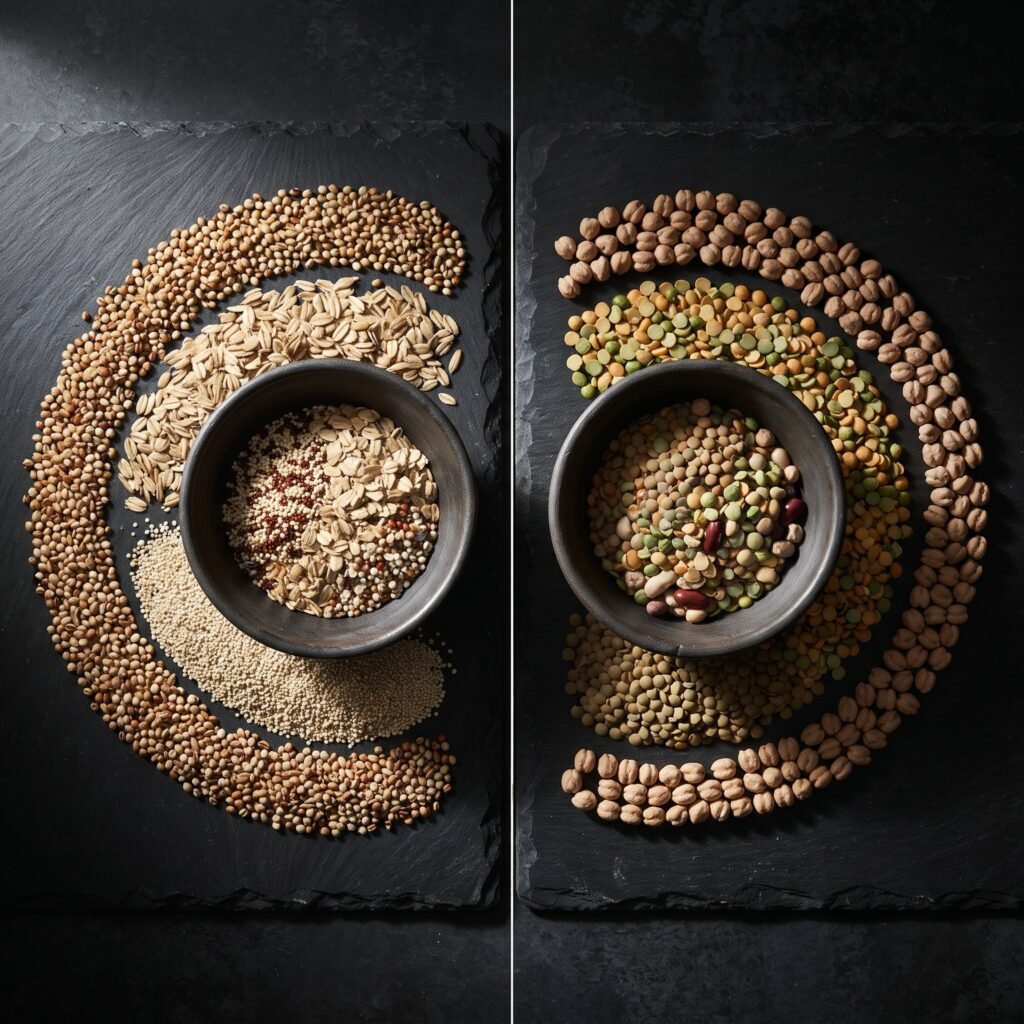
Let’s look at two current dry recipes side by side, because they represent two very different nutritional philosophies inside the same brand.
The Chicken & Quinoa recipe leads with chicken, then chicken meal, quinoa, oats, and sorghum. Dried egg product sits fifth. Chicken fat is preserved with mixed tocopherols — vitamin E, not ethoxyquin or BHA. Then beet pulp for fiber, flaxseed, pumpkin, spinach, carrots, cranberries, added taurine, and two dried fermentation products for probiotic support.
The Grain-Free Lamb with Lentils recipe reads very differently. Lamb, lamb meal, lentils, peas, garbanzo beans, pea flour, pork fat, then pea protein. Four legume-derived ingredients inside the first eight.
That legume stack is the single most important thing to notice in the grain-free side of the Whole Paws dog food range, and I’ll come back to it.
Both recipes carry an AAFCO statement for adult maintenance. Both include added taurine, which is a thoughtful inclusion for a legume-heavy formula. Both use proteinated (chelated) minerals rather than cheap oxides, which is a small but real quality tell.
| Attribute | Whole Paws Chicken & Quinoa | Whole Paws Grain-Free Lamb & Lentils | AAFCO adult maintenance minimum (dry matter) |
|---|---|---|---|
| First ingredient | Chicken | Lamb | — |
| Named meat meal included | Chicken meal (2nd) | Lamb meal (2nd) | — |
| Carbohydrate base | Quinoa, oats, sorghum | Lentils, peas, garbanzo beans, pea flour | — |
| Legume ingredients in top 8 | 0 | 4 | — |
| Crude protein | Check bag; label varies by lot | Check bag; label varies by lot | 18.0% |
| Crude fat | Check bag; label varies by lot | Check bag; label varies by lot | 5.5% |
| Calcium | Not itemized on front panel | Not itemized on front panel | 0.5% |
| Phosphorus | Not itemized on front panel | Not itemized on front panel | 0.4% |
| Added taurine | Yes | Yes | Not required for dogs |
| Fat preservative | Mixed tocopherols | Mixed tocopherols | — |
| Probiotic inclusion | E. faecium + L. acidophilus | E. faecium + L. acidophilus | — |
| AAFCO life stage | Adult maintenance | Adult maintenance | — |
| Common retail bag size | 4 lb | 4 lb | — |
I’ve deliberately left the guaranteed analysis cells as “check bag.” Whole Paws dog food has changed formulas more than once, and quoting a protein percentage I can’t verify against the bag in your hand would be exactly the kind of stale number that gets copied across the internet for five years. Photograph the panel when you buy. That habit has saved me twice.
Note the last row too. Small bags are a convenience feature for a beagle and a logistics problem for a Lab.
What the Whole Paws dog food ingredients tell you — and what they hide
Read the panel the way a formulator does, not the way marketing wants you to.
The first three Whole Paws dog food ingredients set the protein and starch architecture. Meat first plus a named meat meal second is the pattern you want, because meal is a concentrated protein source with the water already removed. A bag that leads with fresh meat and then goes straight to starch is doing something less generous.
Position four through eight tells you where the calories really come from. This is exactly where the grain-free and grain-inclusive versions diverge, and it’s the most consequential difference in the whole line.
Then there’s what the panel can’t say. Whole Paws dog food ingredients are listed by weight before cooking, which flatters fresh meat and understates dry components. Every brand plays by this rule, so it’s not a knock — but it’s why “chicken is the first ingredient” is a weaker claim than most shoppers assume.
Whole Foods publishes an exclusion list covering more than a hundred ingredients it won’t allow in its private-label products. That list is doing genuine work in these formulas: no artificial colors, no artificial preservatives, no added sugar, no by-products.
What no ingredient list will ever disclose is the plant, the lot, or the sourcing country. That’s the boundary of what any Whole Foods dog food label — or any private-label panel anywhere — can prove.
Grain-free or grain-inclusive: which Whole Paws dog food should you pick?
This is where most people choose wrong, and they choose wrong for a sensible-sounding reason.
Grain-free reads as “premium.” It isn’t inherently. Grain-free only means the starch comes from somewhere other than grain — in this case, lentils, peas, and garbanzo beans.
The FDA has publicly investigated a possible association between diets high in peas, lentils, and other pulses and cases of dilated cardiomyopathy in dogs. The agency has not established causation, and the investigation has not produced a definitive mechanism. That nuance matters: this is an open question, not a verdict.
My practical read after years of watching this play out: unless your dog has a documented grain sensitivity, the grain-inclusive Whole Paws dog food option is the lower-variable choice. Quinoa, oats, and sorghum are gentle, well-tolerated carbohydrates with no open regulatory question attached to them.
If you do choose the grain-free Whole Paws dog food, the added taurine is a point in its favor, and I’d tell you the same thing I tell friends: mention the diet at your dog’s next annual, and don’t ignore new exercise intolerance or coughing.
There’s a second, quieter reason I lean grain-inclusive here. Legume-heavy kibble tends to produce more gas in dogs that aren’t used to it. That’s not a health crisis. It is a living-room quality-of-life issue, and it shows up in the first week.
One more thing about Whole Paws grain free dog food specifically: it’s often the more visible option on the shelf, because grain-free packaging tends to get better placement. Shelf position is not nutritional advice. Read past it.
And if your dog genuinely does have a grain issue — confirmed by an elimination trial, not by a guess after one itchy summer — then Whole Paws grain free dog food with added taurine is a reasonable pick within the category. The lamb version gives you a novel-ish protein alongside it, which helps if chicken is the suspect.
Dry or canned? Choosing within the Whole Paws dog food range
The line has historically included both dry kibble and canned food, and they aren’t interchangeable decisions.
Canned food is mostly water, so cost per calorie runs several times higher than kibble. For a large dog, feeding wet exclusively is a budget decision more than a nutrition one. For a picky small dog or a senior with dental issues, it can be the difference between eating and not eating.
Check canned Whole Paws dog food labels for carrageenan specifically. It’s a common thickener across the wet pet food industry, it’s been debated for years without a settled verdict, and some owners prefer to avoid it. The point isn’t that it’s dangerous — it’s that you should know whether it’s in there before you buy a case.
My usual compromise for a fussy eater: kibble as the base, a spoonful of wet as a topper, and the calories counted rather than ignored. Toppers are where quietly overfed dogs come from.
If you’re comparing Whole Foods dog food options across the store, remember that the treats in the same line carry calories too — usually five to fifteen per piece, which adds up fast during training week.
How I tested Whole Paws dog food (and what I actually observed)
My test subject was a 41-pound mixed-breed terrier named Ruby with a genuinely temperamental gut — the kind of dog who reacts to a new treat, let alone a new bag.
First impression opening the Chicken & Quinoa bag: the smell is mild. Noticeably milder than most poultry kibbles, closer to toasted oats than to rendered chicken. If you’re sensitive to the fishmeal-and-fat smell that hangs around a lot of premium foods, this is a relief.
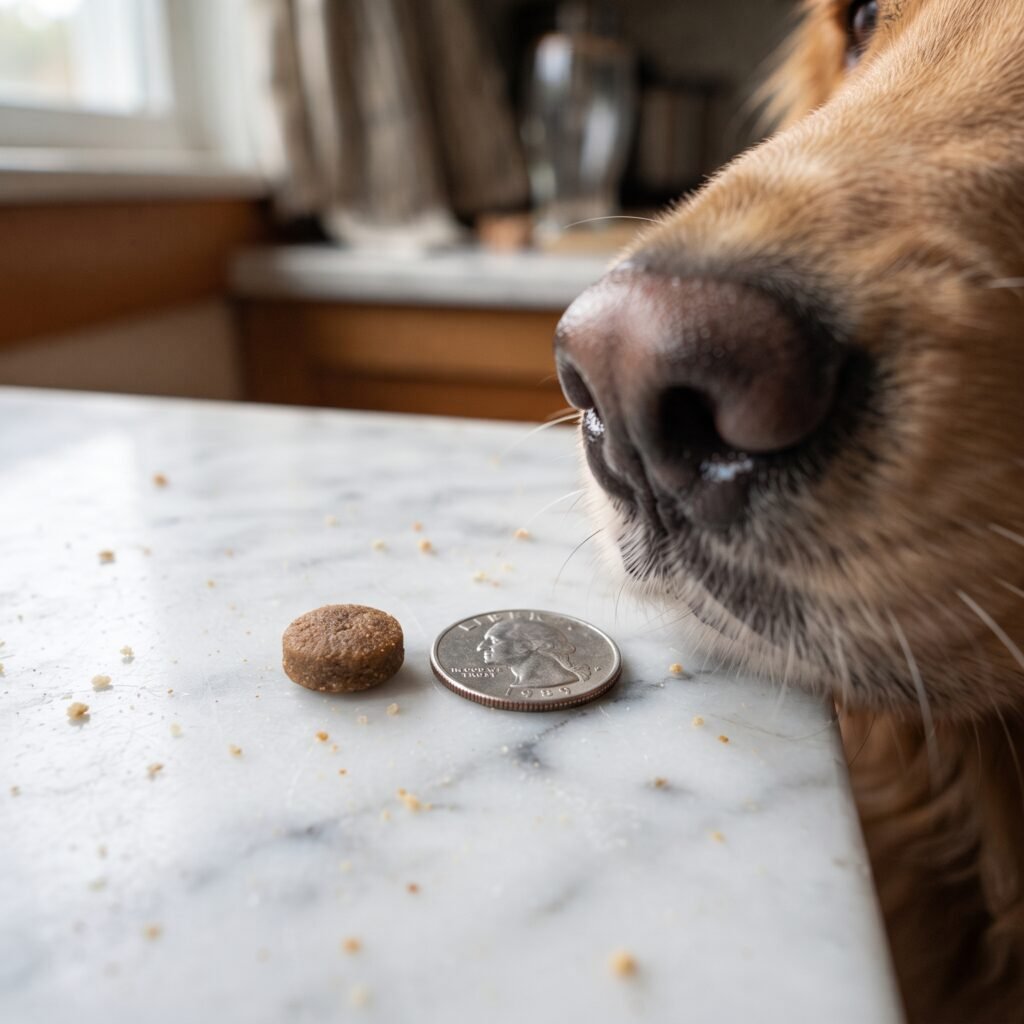
The kibble itself is small — flat, roughly 8–9 mm discs, closer to a small-breed size than a standard all-size kibble. Ruby inhaled them. For a fast eater, I’d pair this Whole Paws dog food with a slow-feeder bowl, because there’s almost no chewing resistance.
Stool quality on a proper 10-day transition was firm and consistent by day six. That’s a good result for her. Coat looked the same at week four as it had on her previous food, which is what I’d expect — coat changes take longer than a month to read honestly.
Palatability was never in question. She’d have eaten the bag.

Methodology note: For this review of Whole Paws dog food I compared the current ingredient panels and AAFCO nutritional adequacy statements against AAFCO Dog Food Nutrient Profiles for adult maintenance, checked FDA and public recall databases for entries under the brand name, reviewed the manufacturer’s published sourcing and quality claims, and ran a 30-day feeding trial with a 41-pound adult dog with a known sensitive stomach. Guaranteed analysis figures were intentionally not quoted, because private-label formulas change without announcement.
Reviewed by: [Site veterinary reviewer — DVM or credentialed canine nutritionist]. Always confirm a diet change with your own vet, especially for dogs with diagnosed conditions.
What no Whole Paws dog food review can tell you
I want to be straight about the limits of what you just read.
A single-dog feeding trial is an anecdote with good record-keeping. It tells you the food is palatable, that it didn’t cause acute GI upset in one sensitive dog, and what the kibble physically looks like. It does not establish long-term outcomes, and neither does any other Whole Paws dog food review you’ll find, including the ones with a scoring system out of ten.
Digestibility, amino acid profile, and bioavailability require feeding studies most brands don’t publish. Nobody reviewing off a bag has that data.
So treat every Whole Paws dog food review — mine included — as a screening tool for narrowing the shortlist. The actual verdict comes from your dog over eight to twelve weeks: stool, weight, coat, energy, and how they feel on a Tuesday afternoon.
Your vet has one input nobody online has. They can see your dog.
The honest failure: where Whole Paws dog food didn’t work for me
Here’s the part I’d want a friend to tell me.
Ruby did beautifully on Whole Paws dog food for about five months. Then I hit a stretch where my local store was out of the Chicken & Quinoa recipe for nine days running.
I bridged the gap with a bag of something else. Her gut disagreed, loudly, for the better part of a week.
That’s the failure mode nobody mentions: the food didn’t hurt her. The interruption did.
And this is a structural feature of Whole Paws dog food, not bad luck. It’s sold through one retail chain. It isn’t on Chewy’s autoship, it isn’t at your neighborhood pet store, and it isn’t stocked at the big-box chains. If your store is out, your options are drive further, wait, or switch.
Compound that with the 4-pound bag size. A 41-pound dog goes through a 4-pound bag in well under two weeks. That’s roughly 26 restock events a year, each one a chance for an out-of-stock to become a diet change.
For a 15-pound dog, this is a non-issue. For a 70-pound dog, buying Whole Paws dog food as a sole diet means building your grocery routine around a pet food shelf, and I’d think hard about that.
I still keep Whole Paws dog food in rotation. I just no longer treat any single-retailer private label as my only plan.
Which dogs is Whole Paws dog food genuinely wrong for?
Not every dog is a candidate, and the reasons are specific.
Puppies, especially large-breed puppies. The dry Whole Paws dog food recipes I’ve examined carry adult maintenance statements, not growth statements. A large-breed puppy needs controlled calcium and phosphorus during skeletal development — AAFCO growth profiles are a different standard, and getting this wrong has orthopedic consequences. Feed a food formulated and labeled for growth.
Dogs with a diagnosed condition needing a therapeutic diet. Renal, hepatic, urinary, and true elimination diets are prescription territory. No over-the-counter food, however clean the label, substitutes for that.
Dogs with confirmed chicken or lamb protein reactions. The Whole Paws dog food line is fairly narrow. If your dog reacts to poultry and lamb, you’ll run out of options inside the brand quickly.
Dogs in multi-dog households on tight budgets. Three dogs on 4-pound bags is a logistics and cost problem that a 30-pound bag from a widely stocked brand solves better.
Seniors needing joint support. I don’t see glucosamine or chondroitin listed in the recipes I reviewed. That’s not a flaw — most adult maintenance foods skip it — but if you were counting on the food to carry that load, plan on a separate supplement.
There’s a positive edge case too. For a small-breed adult dog with an average appetite whose owner already shops at Whole Foods weekly, this brand is close to ideal. The small kibble suits small mouths, the bag size matches the consumption rate, and the trip is already happening.
Is Whole Paws dog food worth the price?
Value here isn’t a dollar figure — it’s a comparison against what else that money buys.
Judged on label quality alone, Whole Paws dog food outperforms most grocery-aisle brands. Named meat first, named meat meal second, tocopherol preservation, chelated minerals, added taurine, and a real probiotic inclusion is a specification you’d normally find in pet-specialty retail, not next to the produce section.
Judged on cost-per-pound, it competes with mid-tier specialty brands rather than with grocery staples. You’re not saving money versus a warehouse-club premium bag. You’re paying for a shorter, cleaner ingredient deck and a trip you were making anyway.
Judged on transparency, it lands mid-pack. The published standards are meaningful and the exclusion list is real. The undisclosed manufacturer is a genuine limitation, and you should weigh it accordingly.
So, is Whole Paws dog food good value for a big dog? Less so. Once you’re buying three or four small bags a week, the per-pound math turns against you and a widely stocked large-format bag wins on both cost and reliability.
My honest verdict on value: Whole Paws dog food is worth it for the owner who is already in the store and has a dog small enough that a 4-pound bag lasts. It is worth noticeably less to someone making a special trip for it.
Convenience that requires a detour stops being convenience.
The 30-day test I’d run before committing to Whole Paws dog food
If you’re going to make this your dog’s permanent diet, prove the supply chain before you prove the food. Here’s the sequence I use now.
Days 1–3: Check stock depth, not just stock. Go to the store and count bags of the exact recipe on the shelf. One or two facings means you’re the marginal customer. Six or eight means the store carries it seriously.
Days 4–10: Run the transition properly. Twenty-five percent new food for three days, fifty percent for three days, seventy-five percent for three days, then full. Rushing a switch is the most common cause of “this Whole Paws dog food upset my dog’s stomach,” and the food usually isn’t the culprit.
Days 11–20: Watch the boring metrics. Stool consistency, energy, gas, itching, ear odor. Write it down. Memory is a terrible instrument for detecting slow change.
Days 21–30: Buy a backup bag early. Not when you’re low — when you’re at half. This single habit is what would have saved me nine days of grief.
Ongoing: Photograph the ingredient panel every third purchase. If a private label reformulates quietly, that photo is your only way to know what changed and when.
That’s it. Five habits, and they convert Whole Paws dog food from a gamble into a managed decision.
How Whole Paws dog food compares to other store brands
Store-brand dog food has gotten dramatically better in the last decade, and Whole Paws dog food sits at the upper end of that shift — but not alone.
The competitive set worth weighing it against is other retailer-exclusive private labels, not national brands. Those competitors share the same fundamental trade-off: better specs than you’d expect for the price, in exchange for single-channel availability and an undisclosed manufacturer.
Where Whole Paws dog food differentiates is its exclusion standards. The parent retailer publishes a long list of ingredients it won’t allow in its private-label products, and that list does real work here — no artificial colors, no artificial preservatives, no added sugar, no animal by-products, no corn or soy.
That exclusion standard is also why Whole Foods dog food shoppers tend to stay loyal once they start. It removes a category of worry, and that’s worth something real even if it doesn’t show up in a nutrient table.
Where it loses ground is distribution and bag size. Competing private labels from larger-footprint chains are easier to find at 10 p.m. on a Sunday, and several offer bags sized for dogs over 50 pounds.
Neither factor shows up in an ingredient comparison. Both determine whether you’re still feeding the same food a year from now.
FAQ
Is Whole Paws dog food good for dogs with sensitive stomachs? It can be, and the mild-smelling grain-inclusive recipes with added probiotics are the ones I’d start with. Transition over a full ten days rather than three. The bigger risk for sensitive dogs isn’t the formula — it’s being forced into an abrupt switch when your store runs out.
Has Whole Paws dog food ever been recalled? There are no recalls on record under the Whole Paws name, which is a strong track record for a brand that’s been on shelves since 2013. The caveat is that the manufacturer isn’t publicly disclosed, so you can’t independently check the production facility’s recall history. Check the FDA’s recall page yourself before any brand commitment.
Who makes Whole Paws dog food? Whole Foods Market does not disclose the co-packer for its private-label pet food, citing competitive reasons. It’s almost certainly one of the large US contract manufacturers, but that’s inference, not fact. If manufacturer transparency is a dealbreaker for you, this brand won’t satisfy it.
Can puppies eat Whole Paws dog food? The dry recipes I reviewed are labeled for adult maintenance, not growth, so they aren’t appropriate as a puppy’s primary diet. Large-breed puppies in particular need a food meeting AAFCO growth profiles with controlled calcium. Always read the nutritional adequacy statement on the specific bag.
Where can I buy Whole Paws dog food besides Whole Foods? It’s a retailer-exclusive brand, so availability outside Whole Foods stores and their online ordering is limited and inconsistent. It isn’t a staple on the major independent pet e-commerce sites. Confirm a reliable purchase route before you make it your dog’s only food.
The bottom line on Whole Paws dog food
The label is better than it needs to be for a grocery store brand. The recall record is clean. The probiotics and added taurine show someone was paying attention when the formula was written.
What I can’t give it is an unqualified “make this your dog’s forever food,” and the reason has nothing to do with nutrition. Single-channel distribution, small bags, an undisclosed manufacturer, and a documented history of reformulation add up to a real continuity risk.
So use the frame I use. If your dog is small to medium, if you shop there weekly anyway, and if you keep a backup bag on hand, Whole Paws dog food is an easy yes.
If you have a big dog, an inconsistent local store, or a gut that punishes every diet change, treat Whole Paws dog food as an excellent option rather than the only one — and pick something you can buy anywhere as your foundation.
One last framing, because people ask it exactly this way: is Whole Paws dog food good? Yes — on the merits of what’s in the bag, clearly yes, whether you choose the grain-inclusive recipes or the Whole Paws grain free dog food options. The asterisk is availability, not quality, and that asterisk is entirely about your circumstances rather than the food’s.