Alsatian Dog Food: The Complete Breed-Specific Feeding Guide for 2026
Updated: June 2026 · Veterinary Nutrition Informed · Breed-Specific · Calibrated for Health Conditions

Choosing the right alsatian dog food is one of the most important decisions you will make as an owner of this breed. The Alsatian — known officially as the German Shepherd Dog — is an intelligent, athletic, and deeply loyal dog that also carries a specific set of biological vulnerabilities that make generic large-breed feeding advice genuinely inadequate. Feed any quality large-breed formula and you might get away with it. Feed a formula that accounts for what this breed actually needs, and you give your Alsatian the nutritional foundation for a longer, healthier, more active life.
This guide covers everything you need to know about alsatian dog food: the four health conditions that directly shape feeding decisions, the exact nutrients that matter most for this breed, which formulas work best at every life stage, and a clear scorecard for evaluating any food you consider buying.
Navigate This Guide
- The Alsatian and the German Shepherd: The Same Dog, Different Names
- Four Health Vulnerabilities That Define Alsatian Dog Food Choices
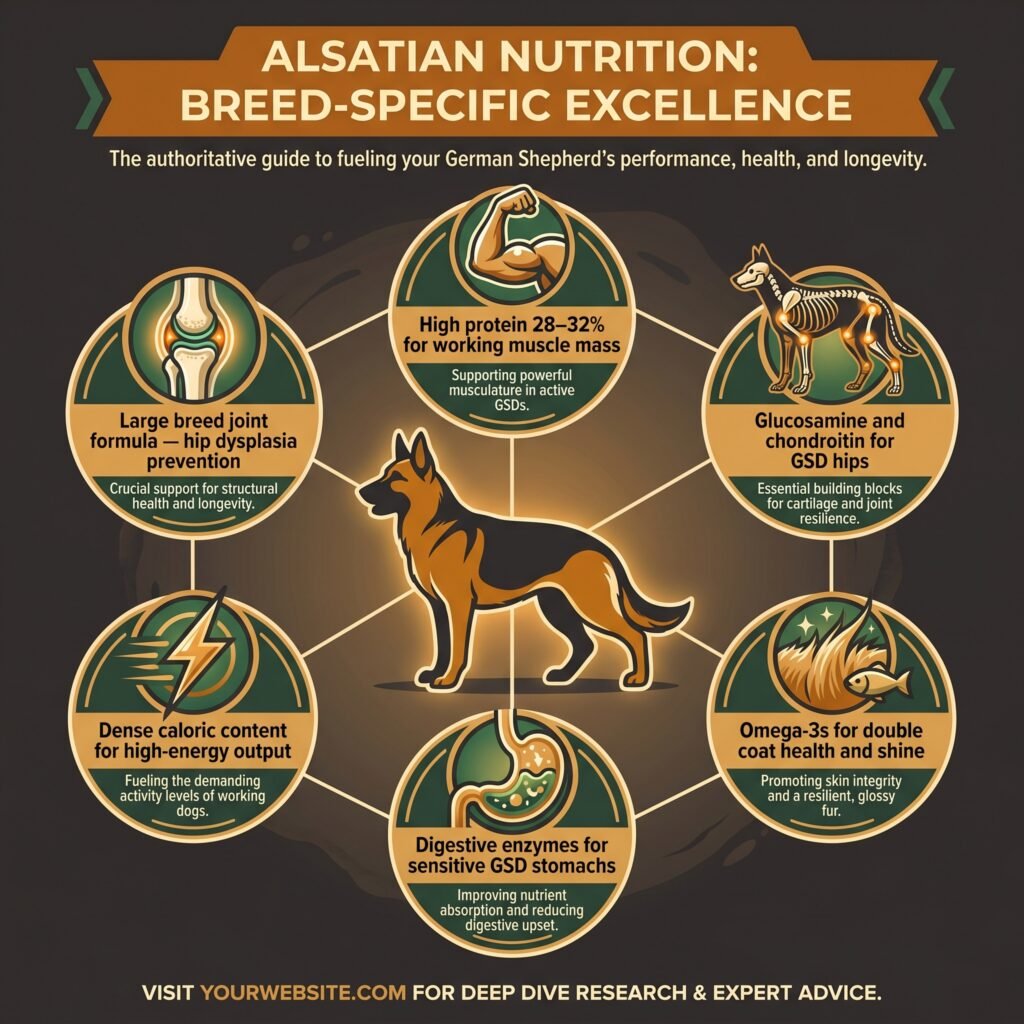
- What Alsatians Need Nutritionally: The Full Breakdown
- The Alsatian Food Scorecard: What to Check on Every Label
- Best Alsatian Dog Food: 2026 Top Picks by Life Stage
- Alsatian Puppy Food: Why Getting This Right Matters
- Adult Alsatian Dog Food: Feeding by Activity Level
- Senior Alsatian Dog Food: Key Adjustments
- Feeding Schedule and Portion Guide
- Foods and Ingredients Alsatians Should Never Eat
- Frequently Asked Questions
- Final Verdict
The Alsatian and the German Shepherd: The Same Dog, Different Names
Before diving into alsatian dog food recommendations, it is worth clarifying the naming history — because it directly explains why searches for “alsatian” and “German Shepherd” return overlapping results on every pet food platform.
The German Shepherd Dog was developed in Germany in the late 19th century by Captain Max von Stephanitz, who crossed working herding dogs from various German regions. The breed takes its name from the Alsatian region — the border area between Germany and France — which is where many of the ancestral herding dogs were found.
Whether you call them a German Shepherd or an Alsatian, this exclusive breed-specific diet is uniquely formulated to your dog with the specific nutrients to help them thrive. This is how Royal Canin phrases it on their breed-specific product pages — confirming that alsatian dog food and German Shepherd dog food are the same nutritional category with different names.
The Alsatian name was adopted in the United Kingdom and parts of Europe during and after World War I, when anti-German sentiment made “German Shepherd” an unpopular name. The Kennel Club in the UK officially used “Alsatian Wolf Dog” from 1919 until 1977, when the name reverted to German Shepherd Dog. Today both names refer to the same breed, and any quality alsatian dog food formula marketed for German Shepherds is entirely appropriate.
Four Health Vulnerabilities That Define Alsatian Dog Food Choices
The best alsatian dog food addresses four specific biological vulnerabilities that are well-documented in this breed. Understanding these conditions is not optional — it is the foundation of every informed food choice.
Vulnerability 1: Hip and Elbow Dysplasia
Hip dysplasia is one of the most prevalent health issues in German Shepherds. It is a genetic condition where the hip joint does not develop properly, leading to pain, lameness, and arthritis. According to the Canine Health Information Center, about 20% of German Shepherds have hip dysplasia — a rate significantly higher than most large breeds.
Elbow dysplasia means the elbow is developing abnormally, affecting how the joint bones fit and work together. This results in lifelong chronic pain in the forelimbs and reduces the dog’s mobility.
What this means for alsatian dog food: Every formula you consider should contain glucosamine and chondroitin for cartilage support, marine-source omega-3 fatty acids (EPA and DHA) for joint inflammation reduction, and controlled calcium-to-phosphorus ratios during puppyhood to prevent accelerated skeletal development. You can even give them early joint supplementation including glucosamine, chondroitin, and omega-3, and orthopedic dog beds that may help minimize joint pressure — but the dietary foundation must be in place first.
Vulnerability 2: Bloat (GDV — Gastric Dilatation-Volvulus)
Gastric dilation-volvulus is a sudden life-threatening condition when the stomach enlarges with gas and then twists upon itself. This happens most commonly in deep-chested, large-breed dogs — including Alsatians. According to Spot Pet Insurance internal data, bloat has the highest cost of treatment among common German Shepherd conditions, with an average treatment cost of $3,500, and is often seen in relatively young dogs around 4.6 years old.
What this means for alsatian dog food: The food you choose matters less for GDV risk than how you feed it. Preventive measures include feeding smaller, more frequent meals and avoiding vigorous exercise around feeding times. Use a slow-feeder bowl, restrict vigorous exercise for at least one to two hours before and after meals, and never feed a single large daily meal. These feeding practices must accompany your alsatian dog food choice as a non-negotiable management layer.
Vulnerability 3: Exocrine Pancreatic Insufficiency (EPI)
EPI affects digestion as the pancreas fails to produce needed digestive enzymes, resulting in weight loss despite increased appetite, diarrhea, and poor condition. Lifelong enzyme supplementation via capsules mixed into food is needed to manage symptoms and support nutrition. EPI often shows up in young adult Alsatians between one and three years of age.
What this means for alsatian dog food: Dogs with confirmed EPI need highly digestible protein sources and carbohydrates, as poorly digestible ingredients pass through unprocessed when enzyme function is compromised. If your Alsatian is losing weight despite eating well, has chronic loose stools with a grey or yellowish tint, or shows extreme hunger, request a TLI (Trypsin-like Immunoreactivity) blood test from your vet before changing food. EPI is managed with diet and enzyme supplementation together — not diet alone.
Vulnerability 4: The Short Colon and Digestive Sensitivity
The German Shepherd originated in the Alsatian region of Germany. The German Shepherd is unique because it has a very short colon compared to other breeds of the same body weight. For this reason, a high-fiber diet is required to slow food movement through this breed’s digestive tract, allowing more time for the nutrients to be drawn out.
This anatomical fact — unique to Alsatians among large breeds — makes digestive health a primary concern in every alsatian dog food decision. Highly digestible proteins and specific fibers maintain digestive health as this breed tends to have poor stool quality. Royal Canin’s breed-specific formula addresses this directly in its product formulation notes.
What this means for alsatian dog food: Fiber content and fiber type matter significantly for this breed. Prebiotic fiber sources (chicory root, beet pulp, psyllium) that slow transit and feed beneficial bacteria are more valuable in alsatian dog food than crude fiber from plant cellulose fillers. High-fat, low-fiber formulas that work well for some large breeds may produce chronic loose stools in Alsatians with sensitive digestive tracts.
What Alsatians Need Nutritionally: The Full Breakdown
With the four vulnerabilities as context, here is the complete nutritional profile of effective alsatian dog food:
Protein: The Foundation
Alsatians are athletic, muscular dogs that need adequate protein for muscle maintenance, immune function, and coat health. Named animal proteins — chicken, turkey, beef, lamb, salmon — should lead the ingredient list. Unnamed by-product meals as the sole protein source are a quality concern.
Target protein ranges by life stage:
- Puppies: 24–28% (dry matter basis)
- Active adults: 26–30%
- Senior dogs: 24–28% (maintained to prevent muscle loss)
-
Fat: Energy and Coat Quality
Alsatians have a thick double coat that requires consistent omega fatty acid intake to stay healthy, manageable, and low-shedding. The best alsatian dog food includes a named fat source (chicken fat, salmon oil, or fish oil) alongside plant-based sources like flaxseed for broader omega coverage.
Target fat range: 12–18% for most adult Alsatians. Dogs with a history of pancreatitis or EPI may require fat restriction — discuss with your vet.
Fiber: Critical for the Short Colon
Fiber is more important in alsatian dog food than in food for most other large breeds, because of the breed’s documented shorter colon and tendency toward loose stools. Look for formulas with:
- Total crude fiber: 3.5–6% (higher than average large breed formulas)
- Quality prebiotic fiber sources: dried chicory root, beet pulp, psyllium, inulin
- Avoid: excessive cellulose as the primary fiber source (used in weight loss formulas; not the right fiber type for digestive efficiency)
Key Micronutrients for Alsatians
| Nutrient | Why It Matters | Target or Source |
|---|---|---|
| Glucosamine | Joint cartilage maintenance | Min 400–500 mg/kg in food |
| Chondroitin | Joint lubrication and repair | Min 100–200 mg/kg in food |
| Omega-3 (EPA/DHA) | Joint inflammation, coat, cognition | Marine source: fish oil or salmon |
| Omega-6 (Linoleic acid) | Coat quality, skin barrier | Chicken fat, sunflower oil |
| Zinc (chelated) | Skin, coat, immune function | Zinc proteinate |
| Vitamin E | Antioxidant, immune support | Added supplement or oils |
| Calcium/Phosphorus | Bone and joint development | Controlled ratio, especially in puppies |
| Prebiotic fiber | Gut microbiome, stool quality | Chicory root, beet pulp |
| B12 (cobalamin) | Nerve function, energy metabolism | Critical if EPI present |
The Alsatian Food Scorecard: What to Check on Every Label
Use this checklist every time you evaluate a new alsatian dog food:
Look for these on the label:
- Named animal protein (chicken, turkey, beef, salmon, lamb) as the first ingredient
- Glucosamine and chondroitin listed in the guaranteed analysis
- Omega-3 source from a marine ingredient (fish oil, salmon oil, menhaden)
- Prebiotic fiber source (chicory root, beet pulp, inulin)
- Chelated minerals (zinc proteinate, manganese proteinate)
- AAFCO nutritional adequacy statement for the correct life stage
- Total crude fiber between 3.5–6%
- Probiotics or fermentation products for gut health
Avoid these on the label:
- Generic unnamed proteins (“meat meal,” “poultry by-product” as sole protein)
- Artificial colors, flavors, or preservatives (BHA, BHT, ethoxyquin)
- Corn syrup or molasses
- Very high fat content (over 20%) without veterinary reason
- Wheat or barley as primary carbohydrate sources (lower digestibility for sensitive GI tracts)
- No fiber source beyond generic cellulose

Best Alsatian Dog Food: 2026 Top Picks by Life Stage
Every formula below has been evaluated against the Alsatian scorecard: named protein first, digestive fiber support, joint nutrients, omega-3 from marine sources, and appropriate life stage AAFCO compliance.
Best Overall Alsatian Dog Food: Royal Canin German Shepherd Adult
Royal Canin’s breed-specific German Shepherd Adult formula is the most precisely targeted alsatian dog food on the commercial market. It directly addresses the breed’s documented short colon: highly digestible proteins and specific fibers maintain digestive health as this breed tends to have poor stool quality.
The formula includes:
- An exclusive fiber blend targeting Alsatian digestive transit time
- EPA and DHA for joint and coat health
- Targeted antioxidants for immune support
- Specially shaped kibble designed for the German Shepherd’s long, strong muzzle that encourages proper chewing
- L-carnitine to support lean muscle maintenance
This is the only commercially available alsatian dog food developed using breed-specific research on the German Shepherd’s unique colon length and digestive characteristics. For owners who want the most scientifically targeted formula available, this is the top recommendation.
Protein: ~25% | Fat: ~14% | Fiber: ~3% | Calories: ~373 kcal/cup
Best Value Alsatian Dog Food: Purina Pro Plan Large Breed (Chicken & Rice)
Purina Pro Plan Large Breed is the most consistently veterinarian-recommended alsatian dog food in the non-breed-specific category. It combines strong protein quality with genuine clinical backing and live probiotics — directly addressing the GI sensitivity common in Alsatians.
- Deboned chicken as the first ingredient
- Rice as the primary carbohydrate — highly digestible and gentle on sensitive digestive tracts
- Glucosamine (400 mg/kg) and EPA/DHA for joint support
- Live probiotics (Bacillus coagulans) for digestive health
- Backed by AAFCO feeding trials
- Approximately 388 kcal/cup
Best for: Most healthy adult Alsatians without confirmed digestive disorders who want a vet-trusted, widely available formula at a competitive price.
Best High-Protein Alsatian Dog Food: Orijen Original
For active working or sporting Alsatians, Orijen Original provides the highest protein-to-calorie ratio available in a widely distributed premium dry formula. The recipe uses 85% animal ingredients including fresh chicken, turkey, fish, and eggs — delivering the complete amino acid profile that hard-working Alsatians need for muscle maintenance and recovery.
- 38% protein on a dry matter basis
- Multiple named animal proteins
- WholePrey ratios including organ meats for micronutrient density
- No corn, wheat, or soy
- Omega-3 from fresh-caught fish
- Approximately 449 kcal/cup
Best for: Highly active adult Alsatians in working roles (police, military, search and rescue, sport) with elevated daily protein and calorie demands.
Best Alsatian Dog Food for Sensitive Stomachs: Hill’s Science Diet Sensitive Stomach and Skin
For Alsatians with chronic loose stools, gas, or GI sensitivity that does not have an EPI diagnosis, Hill’s Sensitive Stomach and Skin formula provides clinically proven digestibility with a prebiotic fiber blend that directly supports the microbiome changes responsible for stool quality improvement.
- Chicken as the first ingredient
- Brown rice as primary carbohydrate
- Prebiotic fiber blend for microbiome support
- Vitamin E and omega-6 for coat health
- No wheat or artificial additives
- Clinically proven for digestive sensitivity improvement
- Approximately 363 kcal/cup
Best for: Alsatians with chronic digestive issues, soft stools, or GI sensitivity that has not responded to standard premium formulas.

Best Prescription Alsatian Dog Food: Purina Pro Plan Veterinary Diets EN Gastroenteric
For Alsatians with confirmed EPI or significant gastrointestinal disease, Purina EN Gastroenteric provides the highest digestibility available in a commercial formula. EPI is diagnosed with a blood test and most dogs make a full recovery, but will require their diet to be carefully managed. This formula is designed for precisely this type of long-term management.
- Highly refined, easily digestible ingredients
- Prebiotic inulin for gut microbiome support
- Low residue formulation for dogs with absorption problems
- Available in dry and wet formats
- Requires veterinary prescription
Best for: Alsatians with diagnosed EPI or chronic pancreatitis under veterinary dietary supervision.
Alsatian Puppy Food: Why Getting This Right Matters
Alsatian puppy nutrition is arguably the most consequential feeding decision in the dog’s life. The rapid growth phase between 8 weeks and 18 months is when skeletal development is most vulnerable to nutritional error — and when the foundation for joint health throughout the dog’s life is established.
The right alsatian dog food for puppies must specifically be a large breed puppy formula. Standard puppy food formulas provide calcium levels appropriate for small breeds, which is too high for large breed development and directly increases the risk of developmental orthopedic disease.
Introduce your Alsatian puppy to the right food as early as possible to help protect against hip and elbow dysplasia. Although these are usually genetic conditions, a 2014 study by Helsinki University suggested that feeding a diet of raw food and bone showed a protective effect against canine hip dysplasia. The protective mechanism is believed to involve controlled mineral intake and appropriate growth rate — achievable with any quality large breed puppy formula that controls calcium levels appropriately.
Top puppy picks for Alsatians:
Royal Canin German Shepherd Puppy — the only breed-specific puppy formula for this breed, with an exclusive antioxidant blend that supports the developing immune system and a kibble shape specially designed for the German Shepherd’s long muzzle that encourages chewing.
Purina Pro Plan Large Breed Puppy (Chicken and Rice) — the most veterinarian-recommended large breed puppy formula, with DHA from fish oil for cognitive development, controlled calcium ratios, and live probiotics for GI health from the first meal.
Hill’s Science Diet Large Breed Puppy — clinically proven mineral balance for controlled skeletal development, wheat-free, and widely available.
Puppy feeding schedule:
- 8–12 weeks: four small meals per day
- 3–6 months: three meals per day
- 6–12 months: two to three meals per day
- 12 months and over: transition to adult alsatian dog food on a two-meal daily schedule
Adult Alsatian Dog Food: Feeding by Activity Level
Adult Alsatians (roughly 18 months to 7 years) should be fed according to their actual daily activity — not a fixed standard.
| Activity Level | Daily Calories | Protein Target | Fat Target |
|---|---|---|---|
| Low (under 1 hour exercise daily) | 1,400–1,700 kcal | 24–26% | 10–13% |
| Moderate (1–2 hours daily) | 1,700–2,100 kcal | 26–28% | 13–16% |
| High (2+ hours, working roles) | 2,100–2,500 kcal | 28–32% | 15–18% |
Body condition should be assessed monthly: ribs should be easily felt without pressing hard, but not visible. A clear waist should be visible from above; a slight abdominal tuck from the side. Any deviation from this signals a portion adjustment is needed.
Senior Alsatian Dog Food: Key Adjustments
Alsatians are generally considered senior from 7–8 years of age. Degenerative myelopathy most commonly appears between 8 and 14 years, making neurological support through diet increasingly relevant in the senior phase. Musculoskeletal disorders and an inability to stand are the most common causes of death for German Shepherds — making joint nutrition a lifelong and escalating priority.
Key adjustments when switching to senior alsatian dog food:
- Maintain or increase protein to 24–28% to counter age-related muscle loss (sarcopenia)
- Increase omega-3 content for joint inflammation management and cognitive support
- Consider partially transitioning to wet food for improved hydration and palatability
- Reduce caloric density if activity has decreased — but do not reduce protein
- Add a fish oil supplement (EPA/DHA) if not already provided at therapeutic levels in the food
- Discuss vitamin B12 supplementation if any GI issues are present
Top senior picks: Purina Pro Plan Bright Mind Adult 7+ (Large Breed), Hill’s Science Diet Adult 7+ Large Breed, Royal Canin German Shepherd Adult formula (appropriate for seniors without specific senior line).
Feeding Schedule and Portion Guide for Alsatians
Given the bloat risk, the feeding schedule for your alsatian dog food is as important as the food itself.
Non-negotiable GDV prevention rules:
- Always feed at least two meals per day — never one large meal
- Use a slow-feeder bowl to extend eating time and reduce air ingestion
- Enforce a 45–60 minute rest period before and after every meal
- Never exercise vigorously within one hour of feeding
- Avoid elevated food bowls (contrary to older advice, research has not confirmed they help and some evidence suggests they may increase GDV risk)
Approximate daily portion guide (adult, dry kibble at ~380 kcal/cup):
| Dog Weight | Low Activity | Moderate Activity | High Activity |
|---|---|---|---|
| 55 lbs | 2.5–3 cups | 3–3.5 cups | 3.5–4 cups |
| 70 lbs | 3–3.5 cups | 3.5–4 cups | 4–4.5 cups |
| 85 lbs | 3.5–4 cups | 4–4.5 cups | 4.5–5 cups |
Always use a digital kitchen scale or calibrated measuring cup. Caloric density varies significantly between formulas — recalculate portions every time you switch alsatian dog food brands.
Foods and Ingredients Alsatians Should Never Eat
Toxic to all dogs:
- Grapes and raisins (kidney failure)
- Onions, garlic, leeks, chives (red blood cell destruction)
- Chocolate (theobromine toxicity)
- Xylitol (hypoglycemia, liver failure — present in some peanut butters and sugar-free products)
- Macadamia nuts
- Raw yeast dough
- Alcohol in any form
Specifically problematic for Alsatians:
- Very high-fat single meals — dramatically increase GDV risk around the time of feeding
- Low-fiber, low-digestibility formulas — particularly problematic for the breed’s short colon
- Undercooked or raw beans and legumes — fermentation risk increases bloat probability
- Artificial preservatives in high quantities — linked to GI inflammation in sensitive dogs
Frequently Asked Questions About Alsatian Dog Food
Is alsatian dog food different from German Shepherd dog food?
No. Alsatian and German Shepherd are two names for the same breed. Any formula marketed as German Shepherd dog food is appropriate alsatian dog food. Whether you call them a German Shepherd or an Alsatian, this exclusive breed-specific diet is uniquely formulated to the breed — as Royal Canin describes their formula. The naming difference is historical and geographic, not biological.
What is the best alsatian dog food for a dog with digestive problems?
For mild digestive sensitivity, Hill’s Science Diet Sensitive Stomach and Skin or Purina Pro Plan Sensitive Skin and Stomach are strong over-the-counter options. For dogs with confirmed EPI, Purina Pro Plan Veterinary Diets EN Gastroenteric under veterinary supervision is the most appropriate alsatian dog food. For any Alsatian with chronic loose stools, soft stool, or grey-tinged feces, a veterinary workup including TLI testing should precede dietary changes.
How much should I feed my Alsatian per day?
Daily calorie needs vary from approximately 1,400 kcal for a lightly active adult to 2,500 kcal for a highly active working dog. Calculate using the RER formula: 70 x (body weight in kg to the power of 0.75), then multiply by an activity factor of 1.2–1.8 depending on exercise level. Divide the total into two equal meals. Always adjust based on monthly body condition assessment rather than following bag feeding guides alone.
Should I feed my Alsatian grain-free alsatian dog food?
Not necessarily. Alsatians do not have documented gluten sensitivity the way Irish Setters do, and grain-free formulas using high legume content carry an ongoing FDA investigation into a potential link with dilated cardiomyopathy. For most Alsatians, a high-quality grain-inclusive formula using rice, oats, or barley as digestible carbohydrates is more appropriate than a grain-free, legume-heavy alternative. If your dog has a confirmed grain allergy, discuss grain-free feeding with your veterinarian.
When should I switch my Alsatian from puppy to adult food?
Alsatians should transition from puppy alsatian dog food to an adult large breed formula at approximately 12–18 months of age, when skeletal growth is largely complete. Transition gradually over 7–10 days to avoid digestive upset. Switching too early reduces the joint-protective calcium and phosphorus ratios of the puppy formula; switching too late provides more calories and less controlled mineral ratios than a growing large breed needs.
Is raw feeding appropriate for Alsatians?
A raw diet containing vegetables and berries also provides antioxidants, which help to neutralise the free radicals that can lead to cell damage, and a 2014 University of Helsinki study suggested a raw diet showed a protective effect against canine hip dysplasia. However, raw diets require careful nutritional balancing and carry pathogen exposure risks. Any Alsatian with EPI should not be on a raw diet without veterinary supervision, as unprocessed raw food may be poorly digested. For healthy adults, a nutritionally complete raw formula or a raw-inclusion hybrid can be a valid approach — but work with a veterinary nutritionist to ensure completeness.
Final Verdict: The Right Alsatian Dog Food for Every Dog
The most important insight in this guide is that choosing the right alsatian dog food is not about finding the most expensive brand or the trendiest ingredient. It is about choosing a formula that addresses what makes this breed biologically specific — the short colon that demands digestive fiber support, the joint vulnerability that demands glucosamine and omega-3s from puppyhood, the bloat risk that demands feeding management, and the EPI predisposition that demands digestibility as a non-negotiable baseline quality.
Get those four things right in your alsatian dog food choice, pair them with a consistent two-meal-per-day feeding structure, monitor body condition monthly, and you give your Alsatian every nutritional advantage the science supports.
Top recommendations by situation:
For most healthy adult Alsatians: Royal Canin German Shepherd Adult — the most breed-targeted alsatian dog food available.
For owners who want vet-trusted without breed-specific pricing: Purina Pro Plan Large Breed Adult (Chicken and Rice).
For highly active or working Alsatians: Orijen Original or Wellness CORE Large Breed.
For puppies: Royal Canin German Shepherd Puppy or Purina Pro Plan Large Breed Puppy.
For digestive sensitivity: Hill’s Science Diet Sensitive Stomach and Skin or Purina Pro Plan EN (prescription) for diagnosed EPI.
Your Alsatian deserves food that was chosen with their specific biology in mind — not just any large breed formula pulled from a shelf. This guide gives you everything you need to make that choice well.
This guide is for educational purposes only and does not constitute veterinary medical advice. Always consult a licensed veterinarian before making significant dietary changes, especially for dogs with existing health conditions.