How Much Dog Food Should I Feed My Dog? The Complete 2026 Feeding Guide
Wondering how much dog food should I feed my dog in 2026? Get vet-approved portion guidelines by weight, age, breed, and food type — plus a full dry food feeding chart.
How Much Dog Food Should I Feed My Dog? Start Here
How much dog food should I feed my dog? It is one of the most common questions veterinarians and pet nutrition experts hear — and one of the most consequential ones a dog owner can ask. Get it right, and your dog maintains a healthy weight, strong immune function, good energy, and a long, comfortable life. Get it consistently wrong in either direction, and the consequences range from obesity-related joint disease and diabetes to muscle wasting and dangerous nutritional deficiencies.
The honest answer to how much dog food should I feed my dog is: it depends. Weight, age, breed size, activity level, reproductive status, and the specific food you are using all factor into the correct daily portion. There is no single number that works for every dog.
What this guide provides is a complete, 2026-updated framework — including weight-based feeding charts, life stage guidelines, body condition scoring, and vet-approved portion calculation methods — so you can determine the right amount for your specific dog with confidence. Whether you are asking how much dry dog food should I feed my dog, trying to figure out wet food portions, or managing a multi-dog household with different needs, this guide covers it all.
Table of Contents
- How Much Dog Food Should I Feed My Dog? Start Here
- Why Portion Size Matters More Than Most Owners Realize
- The Four Factors That Determine How Much Food to Feed Your Dog
- How Much Dry Dog Food Should I Feed My Dog? A Weight-Based Chart
- How Much Dry Food Should I Feed My Dog by Life Stage?
- How Much Food Should I Be Feeding My Dog by Breed Size?
- Feeding by Activity Level: Working Dogs vs. Couch Dogs
- How Much Food Should I Be Feeding My Dog: Wet vs. Dry vs. Mixed?
- How to Use the Dog Food Label to Calculate Portions
- The Body Condition Score: The Most Accurate Feeding Tool
- How Many Times a Day Should I Feed My Dog?
- Signs You Are Feeding Too Much or Too Little
- Special Feeding Situations
- Frequently Asked Questions
Why Portion Size Matters More Than Most Owners Realize
Before getting into the specific numbers behind how much food should I be feeding my dog, it is worth understanding why this question matters so much — because many owners dramatically underestimate its importance.
The Canine Obesity Epidemic in 2026
According to the Association for Pet Obesity Prevention (APOP), more than 56% of dogs in the United States are overweight or obese — and the primary driver is overfeeding through oversized portions and excessive treats. Canine obesity is directly linked to osteoarthritis, type 2 diabetes, cardiovascular disease, respiratory problems, and reduced life expectancy. Research consistently shows lean dogs live 1.5 to 2 years longer than overweight ones. On the other side, underfeeding causes muscle wasting, immune suppression, poor coat health, and in severe cases, organ failure.
Understanding how much dog food should I feed my dog is one of the single highest-impact health decisions you make for your pet every single day.
The Four Factors That Determine How Much Food to Feed Your Dog
When calculating how much dry dog food should I feed my dog or any other format, four core variables must be considered together — not in isolation.
1. Body Weight (Current and Target)
The most fundamental input in any feeding calculation is your dog’s weight. Feeding guidelines on dog food labels are almost always expressed as cups or grams per day based on weight ranges. However, there is an important nuance: you should feed to your dog’s ideal body weight, not their current weight.
If your dog is overweight, feeding based on their current weight will perpetuate and worsen the obesity. If your dog is underweight and recovering, feeding based only on current weight may be insufficient. Your veterinarian can help you establish an appropriate target weight to use as the basis for portion calculation.
2. Life Stage (Puppy, Adult, Senior)
A puppy’s caloric and nutritional needs are dramatically different from an adult dog’s, and a senior dog’s metabolism is different again. Puppies need more calories per pound of body weight to support rapid growth, organ development, and immune maturation. Senior dogs typically need fewer calories as their metabolic rate slows and activity decreases, while often needing higher-quality protein to maintain muscle mass.
How much food should I be feeding my dog changes at every life stage transition — and failing to adjust can lead to overweight adults (from not scaling back puppy-level portions) or undernourished seniors (from not accounting for reduced food absorption).
3. Activity Level
A 40-pound Labrador who runs five miles a day with an active owner has very different caloric needs than a 40-pound Labrador who takes two short daily walks and spends the rest of the day on the couch. Activity level can shift appropriate daily caloric intake by 20%–50% or more in extreme cases.
Working dogs — search and rescue dogs, herding dogs, sporting dogs in active training — may need two to three times the calories of sedentary dogs of the same body weight. This variable is one of the most commonly overlooked when owners ask how much dry food should I feed my dog.
4. The Specific Food’s Caloric Density
Not all dog foods provide the same number of calories per cup. A cup of a high-protein, high-fat performance food may contain 500+ kcal. A cup of a weight-management formula may contain only 270–300 kcal. Feeding the same cup quantity of two different foods to the same dog can mean a caloric difference of 200+ kcal per day — which over months translates to significant weight gain or loss.
This is why the label on your specific dog food is always the starting point for answering how much dog food should I feed my dog — not a generic chart alone.
How Much Dry Dog Food Should I Feed My Dog? A Weight-Based Chart
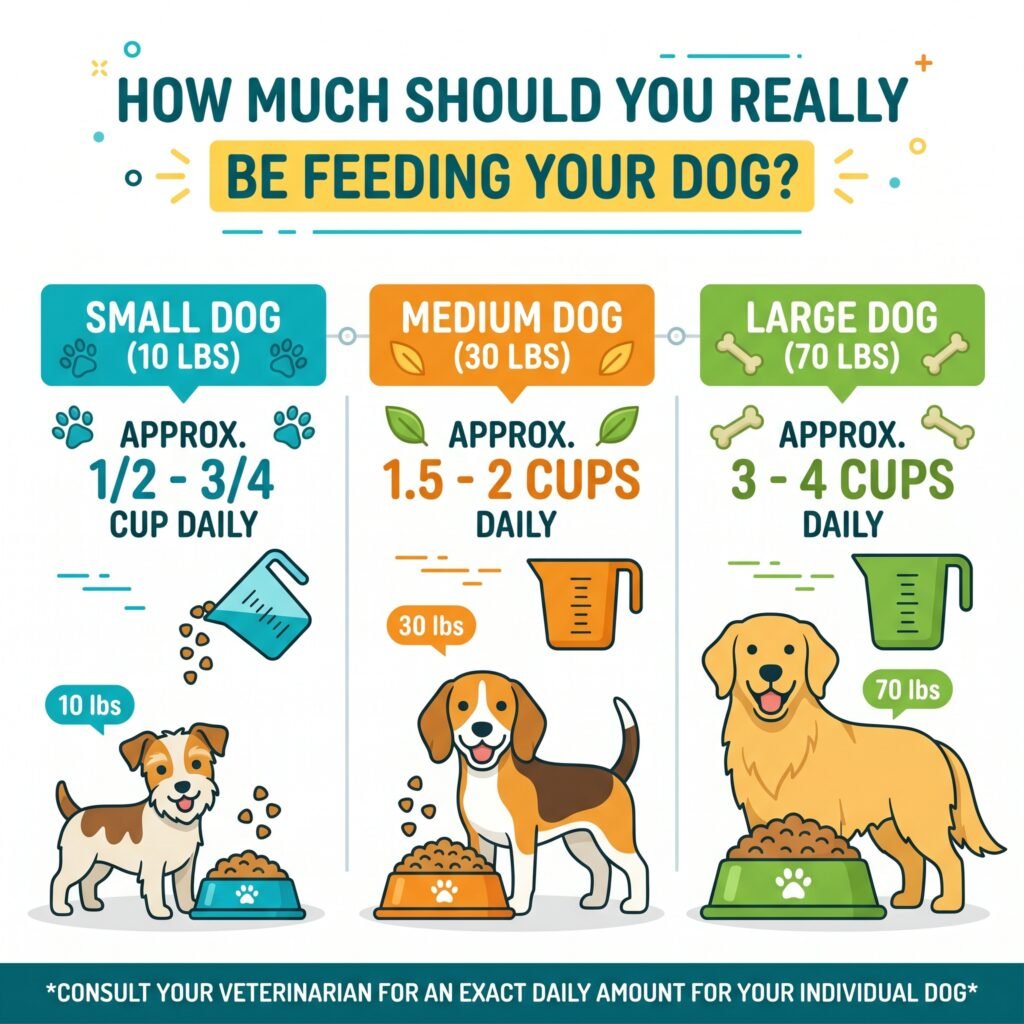
The following chart provides general daily feeding guidelines for adult dogs at maintenance (healthy weight, moderate activity level). These are based on an average caloric density of approximately 350–380 kcal per cup for mainstream dry dog foods. Always verify against your specific food’s label, as caloric density varies significantly between products.
Daily Dry Food Feeding Chart — Adult Dogs (Moderate Activity)
| Dog’s Weight | Daily Food Amount | Meals Per Day |
|---|---|---|
| 5 lbs (2.3 kg) | ⅓ – ½ cup | 2 |
| 10 lbs (4.5 kg) | ¾ – 1 cup | 2 |
| 15 lbs (6.8 kg) | 1 – 1¼ cups | 2 |
| 20 lbs (9 kg) | 1¼ – 1½ cups | 2 |
| 30 lbs (13.6 kg) | 1¾ – 2 cups | 2 |
| 40 lbs (18 kg) | 2¼ – 2½ cups | 2 |
| 50 lbs (22.7 kg) | 2½ – 3 cups | 2 |
| 60 lbs (27 kg) | 3 – 3½ cups | 2 |
| 70 lbs (31.7 kg) | 3¼ – 3¾ cups | 2 |
| 80 lbs (36 kg) | 3½ – 4 cups | 2 |
| 90 lbs (40.8 kg) | 4 – 4½ cups | 2–3 |
| 100 lbs (45.4 kg) | 4¼ – 4¾ cups | 2–3 |
| 120+ lbs (54+ kg) | 5+ cups | 2–3 |
Important notes on this chart:
- These are starting estimates only. Adjust based on your dog’s body condition score over 2–4 weeks.
- Reduce by 10–20% for low-activity or neutered/spayed dogs prone to weight gain.
- Increase by 10–25% for highly active dogs, intact dogs, or those in cold climates.
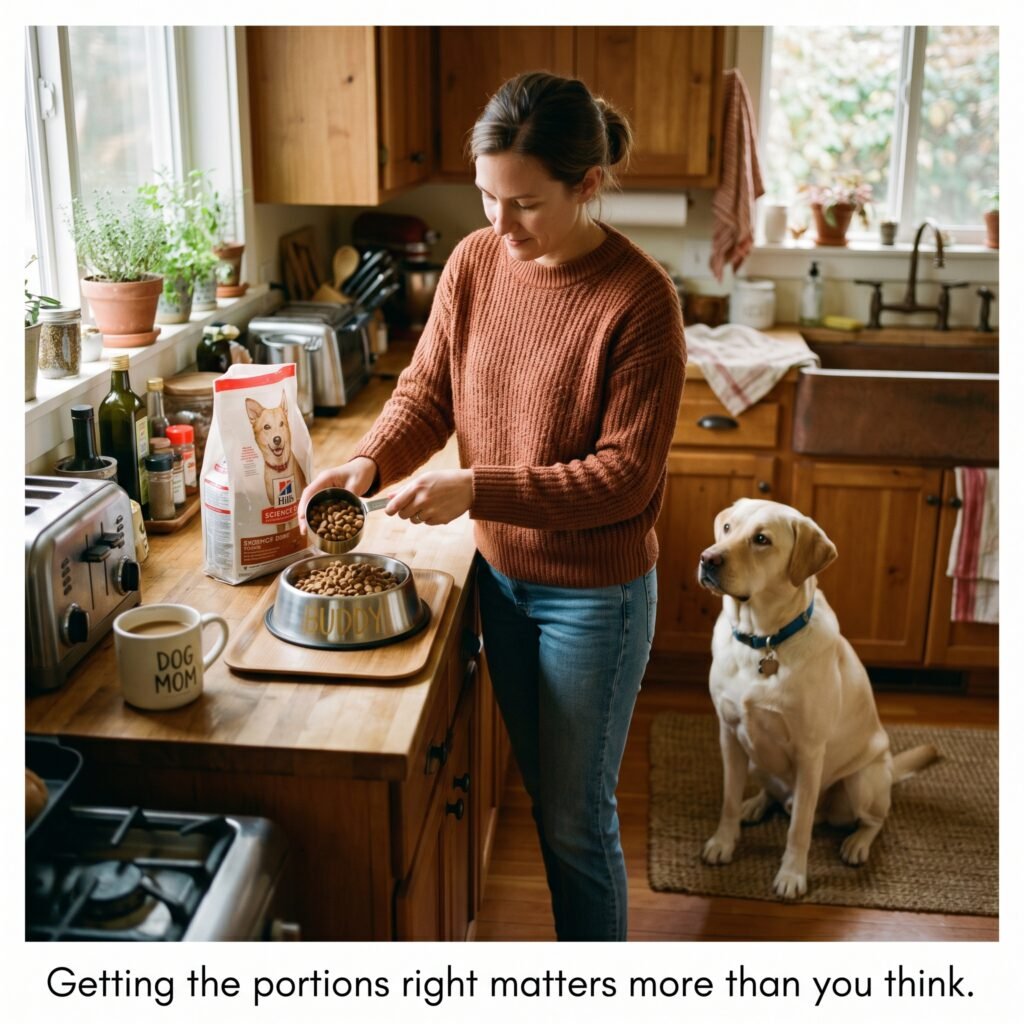
- Always use a standard measuring cup — not a coffee mug or scoop estimation.
- Divide the daily total across meals rather than feeding all at once.
How Much Dry Food Should I Feed My Dog by Life Stage?
The chart above applies to adult dogs at maintenance. Life stage dramatically changes the answer to how much dry food should I feed my dog — here is how to adjust.
Puppies (Birth to 12 Months, Varies by Breed)
Puppies need significantly more calories per pound of body weight than adult dogs — roughly twice as many calories per kilogram in early puppyhood. However, their small stomachs mean those calories must be delivered across multiple small meals rather than one or two large ones.
General puppy feeding frequency:
- 8–12 weeks: 4 meals per day
- 3–6 months: 3 meals per day
- 6–12 months: 2–3 meals per day
- 12 months+ (small breeds), 18–24 months (large breeds): transition to adult schedule
For a puppy, how much dog food should I feed my dog daily is typically calculated as: follow the puppy food bag’s weight-based guidelines using your puppy’s current weight, then increase every 2–4 weeks as the puppy grows. Weigh puppies regularly — weekly for the first several months — to keep portion sizes appropriately scaled to rapid growth.
Large-breed puppies (expected adult weight over 50 lbs) require special attention: they must not be overfed during growth. Excessive caloric intake in large-breed puppies accelerates bone growth faster than cartilage can develop, increasing the risk of developmental orthopedic diseases like hip dysplasia and osteochondrosis. Use large-breed puppy food specifically formulated with controlled calcium and calorie density.
Adult Dogs (1–7 Years, Depending on Breed)
Adult dogs at healthy weight and moderate activity are the baseline for the chart above. The adult maintenance phase is the longest, so getting this right is critical for long-term health. Most owners overestimate how much food should I be feeding my dog at this stage — the portions feel small, especially for large breeds, but meeting caloric needs without exceeding them is the goal.
Senior Dogs (7+ Years, Varies by Breed Size)
Senior dogs typically need 20–30% fewer calories due to reduced metabolism and activity, while protein needs often remain equal or increase to maintain muscle mass. When asking how much dry dog food should I feed my dog for an older pet, use a senior-formulated food and reduce portions from peak-adult levels. Monitor body condition carefully — seniors can lose weight rapidly from illness or dental issues even on appropriate portions.
How Much Food Should I Be Feeding My Dog by Breed Size?
Breed size is a key modifier when calculating how much food should I be feeding my dog, not just because larger dogs eat more but because metabolic rates differ across size categories.
Toy and Small Breeds (Under 20 lbs)
Small dogs have faster metabolisms than large dogs and burn more calories per pound of body weight. Despite their tiny size, they need calorie-dense food and consistent meal timing. Toy breeds are particularly vulnerable to hypoglycemia (low blood sugar) if meals are skipped or spaced too far apart.
When calculating how much dry food should I feed my dog for a small breed, err toward the higher end of the weight-range guidelines and feed at least twice daily. Toy breeds like Chihuahuas, Yorkshire Terriers, and Pomeranians may benefit from three small meals daily to maintain stable blood sugar levels.
Medium Breeds (20–60 lbs)
Medium-sized dogs — Beagles, Cocker Spaniels, Border Collies, Bulldogs — represent the broadest category and the most variable activity levels. The standard chart applies well to medium breeds, but activity-level adjustment is especially important. A working Border Collie at 35 lbs needs dramatically more food than a sedentary Bulldog at 35 lbs.
Large and Giant Breeds (60–100+ lbs)
Large breeds eat more absolute food but fewer calories per pound than small breeds, making overfeeding easy. Giant breeds (Great Danes, Mastiffs, Irish Wolfhounds) are prone to bloat (GDV) — a life-threatening stomach twist. For these dogs, how much dry dog food should I feed my dog per single meal matters: spread the daily total across three smaller meals and avoid exercise immediately around feeding times.
Feeding by Activity Level: Working Dogs vs. Couch Dogs
Activity level is the most variable and most frequently underestimated factor when owners ask how much food should I be feeding my dog.
Sedentary and Low-Activity Dogs
Dogs who get less than 30 minutes of moderate exercise daily — whether due to age, health conditions, owner lifestyle, or temperament — should be fed at the low end of any weight-based guideline, or 10–20% below it. Neutered and spayed dogs also tend to have lower resting metabolic rates and gain weight more easily, making portion discipline especially important.
Moderately Active Dogs (30–60 Minutes Daily Exercise)
This is the standard assumption for most feeding charts. Dogs who walk daily, play regularly, and have consistent outdoor time fall into this category. The mid-range of any weight-based guideline applies.
Highly Active Dogs (1–2+ Hours Daily Exercise)
Agility competitors, hiking companions, working farm dogs, and sporting breed dogs in active training may need 25–50% more food than the standard guideline. For these dogs, how much dry dog food should I feed my dog is best determined by monitoring body condition over 2–3 weeks rather than by chart alone — if the dog is maintaining an ideal lean body condition on increased portions, the amount is correct.
Performance and Working Dogs
Sled dogs, K9s, and herding dogs working full days may need up to twice the calories of a sedentary dog. High-fat performance formulas are more efficient than simply feeding larger volumes of standard food.
How Much Food Should I Be Feeding My Dog: Wet vs. Dry vs. Mixed?
How much food should I be feeding my dog changes significantly depending on whether you feed dry kibble, wet canned food, raw food, or a combination. This is one of the most confusing areas for owners.
Dry Food (Kibble)
Dry food is the most calorie-dense format by volume because it contains only 6–12% moisture. A cup of dry kibble delivers roughly 300–500 kcal depending on the formula. The weight-based chart earlier in this guide applies to dry food.
Wet / Canned Food
Wet food contains 70–80% moisture, meaning it delivers far fewer calories per gram than dry food. A standard 13-oz can of wet dog food typically contains 300–450 kcal — comparable to a cup of dry food but in a much larger physical volume. If you feed wet food exclusively, the portions by visual appearance will look significantly larger than dry food portions for the same caloric content.
When asking how much dog food should I feed my dog in wet food, use the calorie count on the can rather than a volume measurement, and divide the appropriate daily caloric target by the kcal per can to determine the number of cans or portions per day.
Mixed Feeding (Dry + Wet)
When mixing dry and wet food, calculate the caloric contribution of each format and portion proportionally. A common approach is replacing one-third of the dry food’s calories with wet food — adding palatability and moisture without overfeeding.
Raw and Fresh Food
Raw and fresh-food diets require portion calculation based on caloric content, just like wet food. A general starting point for raw feeding is 2–3% of ideal body weight per day for adults, but this varies widely. Work with a veterinary nutritionist when transitioning to ensure nutritional completeness.
How to Use the Dog Food Label to Calculate Portions
The dog food label is your primary tool for answering how much dry dog food should I feed my dog accurately. Here is how to use it correctly.
Step 1: Find the Feeding Guidelines
Every commercial dog food label includes a feeding guide — usually a table showing recommended daily amounts by dog weight. This is your baseline. However, these guidelines are often set on the generous side (more food sold = more revenue for the manufacturer), so most veterinary nutritionists recommend starting at the low end and adjusting based on body condition.
Step 2: Find the Caloric Content
Look for the “Caloric Content” statement, typically listed as kcal/cup (for dry food) or kcal/can (for wet food). This is the most precise tool for calculating how much food should I be feeding my dog based on their actual caloric needs.
Step 3: Calculate Your Dog’s Daily Caloric Needs
The standard formula for a dog’s resting energy requirement (RER) is:
RER (kcal/day) = 70 × (body weight in kg)^0.75
From RER, multiply by an activity/life stage factor:
| Dog Status | Multiplier |
|---|---|
| Neutered adult, low-moderate activity | RER × 1.6 |
| Intact adult, moderate activity | RER × 1.8 |
| Active adult (1+ hours/day) | RER × 2.0–3.0 |
| Puppy under 4 months | RER × 3.0 |
| Puppy 4 months to adult size | RER × 2.0 |
| Senior, low activity | RER × 1.4 |
| Weight loss | RER × 1.0 |
Example: A neutered 25 kg (55 lb) adult Labrador with moderate activity:
- RER = 70 × (25)^0.75 = 70 × 11.18 = 782 kcal/day
- Multiply by 1.6 = 1,251 kcal/day
- If the food contains 350 kcal/cup: 1,251 ÷ 350 = 3.57 cups/day
This is a significantly more precise method than simply reading the label guideline — and it directly answers how much dry food should I feed my dog for that specific animal on that specific food.
Step 4: Adjust Every 2–4 Weeks
No calculation is final. Assess body condition every two to four weeks and adjust portions by 5–10% as needed. The math is a starting point; body condition score is the ongoing feedback.
The Body Condition Score: The Most Accurate Feeding Tool
Beyond any chart or formula, the Body Condition Score (BCS) is the gold-standard tool for continuously answering whether how much food should I be feeding my dog is currently correct. It is a simple hands-on assessment that any owner can learn.
The 9-Point BCS Scale
Veterinarians use a 9-point scale, where:
- 1–3: Underweight (ribs, spine, and hip bones visible from a distance; no fat cover; muscle wasting)
- 4–5: Ideal (ribs easily felt without pressing; slight fat cover; waist visible from above; abdominal tuck visible from the side)
- 6–7: Overweight (ribs felt only with firm pressure; waist barely visible; rounding of abdomen)
- 8–9: Obese (ribs not feelable under thick fat; no waist or abdominal tuck; fat deposits on neck, limbs, and spine)
The ideal BCS for most dogs is 4–5 out of 9. At this condition, you should be able to feel your dog’s ribs easily with light pressure but not see them prominently. Your dog should have a visible waist when viewed from above and a slight abdominal tuck when viewed from the side.
How to Use BCS to Adjust Feeding
- If your dog scores 6 or above: reduce daily food by 10% and recheck in 3–4 weeks
- If your dog scores 3 or below: increase daily food by 10% and recheck in 2–3 weeks (also rule out medical causes with your vet)
- If your dog scores 4–5: maintain current portions
Incorporating regular BCS checks into your routine — monthly for adults, weekly for puppies and seniors — gives you ongoing real-world feedback on whether how much dog food should I feed my dog at any given time is right.
How Many Times a Day Should I Feed My Dog?
Portion size is only part of feeding well — frequency matters too.
Adult Dogs
Two meals per day — morning and evening — is the standard for healthy adults. It maintains steady energy, reduces hunger-driven behavior issues, and lowers bloat risk compared to one large daily meal. Free-choice feeding is discouraged as it removes monitoring ability and commonly leads to weight gain.
Puppies
As outlined earlier, puppies need 3–4 smaller meals daily to support rapid growth, maintain blood sugar, and accommodate small stomach capacity. Transition to two meals per day as they approach adult size.
Senior Dogs
Two meals daily works for most seniors. Dogs with diabetes, hypoglycemia, or liver disease may benefit from 3–4 smaller meals — your veterinarian will advise based on your dog’s specific condition.
Large and Giant Breeds
Feeding two or three smaller meals daily — rather than one large meal — significantly reduces the risk of GDV (bloat). For giant breeds especially, this meal frequency consideration is a safety measure, not just a nutritional one.
Signs You Are Feeding Too Much or Too Little
Regardless of what the chart or calculation says, your dog’s body will tell you whether how much food should I be feeding my dog is correct. Here are the clearest signals.
Signs You Are Feeding Too Much
Weight gain over weeks, a BCS of 6 or higher (ribs hard to feel, no visible waist), reduced energy, joint stiffness, and difficulty breathing are all signals the current portion is too large. A dog consistently leaving food then returning — eating out of habit rather than hunger — is another red flag.
Signs You Are Feeding Too Little
Visible ribs, hip bones, or spine without pressing, a BCS of 3 or lower, intense food-seeking and scavenging, eating non-food items, dull coat, and progressive muscle weakness all suggest portions need to increase — and a veterinary check is warranted to rule out underlying illness.
Special Feeding Situations
Pregnant and Nursing Dogs
A pregnant dog in the last trimester needs 25–50% more calories. Nursing dogs may need 2–4 times their normal intake depending on litter size — often best managed by feeding a high-calorie puppy formula free-choice during lactation. Work with your veterinarian throughout.
Dogs Recovering From Illness or Surgery
Post-surgical dogs have altered caloric needs and often reduced appetite. Never apply standard feeding charts during active recovery — follow your veterinarian’s specific guidance.
Overweight Dogs on a Weight-Loss Plan
For dogs on a weight-loss program, how much dry dog food should I feed my dog is typically set at the dog’s RER without a multiplier, using a weight-management formula. Target 1–2% body weight loss per week — faster loss risks muscle wasting. Weigh-ins every 2–4 weeks track progress.
Multi-Dog Households
Feed each dog separately — communal bowl feeding makes it impossible to manage how much food should I be feeding my dog per individual. Remove bowls after 15–20 minutes and monitor each dog’s body condition independently.
Frequently Asked Questions
How much dog food should I feed my dog per day in cups?
It depends on your dog’s weight, the specific food’s caloric density, and your dog’s activity level. A general starting guideline for a moderately active adult dog fed a standard dry kibble (approximately 350 kcal/cup): 10 lbs = about 1 cup/day; 30 lbs = about 2 cups/day; 50 lbs = about 2.75 cups/day; 70 lbs = about 3.5 cups/day. Always verify against your specific food’s label.
How much dry dog food should I feed my dog if the bag guidelines seem too high?
Bag guidelines are often set generously. If your dog is gaining weight on the recommended amount, reduce portions by 10% and monitor body condition over 3–4 weeks. The body condition score — not the bag guideline — is the most reliable indicator of whether current portions are appropriate.
Is it okay to free-feed my dog (leave food out all day)?
Free-feeding removes portion control and commonly leads to obesity. Scheduled meals — two per day for most adults — are the veterinary standard.
How do I know if I am feeding my dog the right amount?
Assess your dog’s body condition score monthly. At an ideal weight, you should easily feel your dog’s ribs with light pressure without seeing them, see a visible waist from above, and a slight abdominal tuck from the side. If your dog scores 6 or above on the 9-point scale, reduce portions. If 3 or below, increase them.
Should I feed my dog more in winter?
Dogs who spend significant time outdoors in cold weather do burn more calories maintaining body temperature. Active outdoor dogs in winter may need 10–15% more food. Indoor dogs in climate-controlled environments do not typically need more food in winter.
How much food should I be feeding my dog after spaying or neutering?
Spaying and neutering reduces metabolic rate and often increases appetite due to hormonal changes. Most veterinarians recommend reducing daily food by 10–20% following the procedure and using a neutered adult multiplier (RER × 1.6) rather than an intact adult multiplier when calculating caloric needs.
Can I use the same feeding amount for all my dogs?
No. Every dog’s caloric needs are individual. Two dogs of identical weight but different ages, activity levels, or health statuses may need significantly different portions. Feed each dog individually and monitor each one’s body condition separately.
Conclusion: Getting the Portion Right Is an Ongoing Practice
The question how much dog food should I feed my dog does not have a single, permanent answer. It is an ongoing calibration that changes with your dog’s age, activity level, health status, and the food you are using.
Start with the label guidelines or the RER calculation. Use a proper measuring cup — never eyeball. Divide the daily total into two meals for most adults. Assess body condition monthly and adjust portions by 10% when needed. Work with your veterinarian, especially for puppies, seniors, pregnant dogs, and dogs with health conditions.
When asking how much dry dog food should I feed my dog, always check the caloric content on your specific bag — not just a generic chart — because the calorie variation between brands is significant. When asking how much food should I be feeding my dog over the long term, let your dog’s body condition score be your guide more than any number on a page.
Get this right, and one of the most fundamental responsibilities of dog ownership becomes a quiet, consistent gift of good health — every single meal, every single day.
Last updated: May 2026. Consult your veterinarian for personalized feeding recommendations for your dog’s specific breed, age, health status, and caloric needs.