
Best Dog Food for Samoyeds in 2026: Top Picks for a Healthy Coat, Strong Energy & Long-Term Health
Samoyeds have unique nutritional needs — thick coats, active bodies, and sensitive stomachs. We reviewed the top dog foods for Samoyeds so your pup gets exactly what their breed demands.

The Samoyed is one of the most breathtaking dog breeds alive — a walking cloud of pristine white fur, ancient Arctic working heritage, and an expression so reliably cheerful it has earned them the nickname “the smiling Sammie.” But behind that signature smile is a breed with specific, nuanced nutritional requirements shaped by thousands of years of working in extreme Siberian conditions alongside nomadic Samoyedic peoples. Choosing the right dog food for Samoyeds is not simply a matter of picking a bag with a premium label — it requires genuine understanding of the breed’s physiology, energy demands, coat and joint health requirements, genetic health vulnerabilities, and how those needs shift across each life stage.
This comprehensive 2026 guide provides the most complete, research-backed resource available for Samoyed owners making feeding decisions. We draw on verified data from PupWiki’s March 2026 breed-specific analysis (which cross-referenced 30+ formulas against the Samoyed’s specific nutritional profile), iHeartDogs’ December 2025 Samoyed feeding guide, Canine Bible’s veterinarian-reviewed Samoyed food roundup, BreedAdvisor’s formula comparisons, Petabolix’s breed nutrition database, and ProDog Raw’s Samoyed feeding guide — giving you the most complete, current, and honest picture available.
Understanding the Samoyed Before Choosing a Food
Effective selection of dog food for Samoyeds begins with understanding what makes this breed genuinely distinctive. The Samoyed is classified as a medium-to-large breed, typically weighing between 35 and 65 pounds at healthy adult weight — males averaging 45 to 65 pounds and females 35 to 50 pounds. Their lifespan averages 12.4 years according to PupWiki’s breed database — above average for their size, which makes getting nutrition right across a long lifespan particularly impactful.
Samoyeds were bred for genuine Arctic work — pulling sleds, herding reindeer, and sleeping pressed against their nomadic owners for mutual warmth. This heritage produces a dog with high natural energy, exceptional endurance capacity, and a metabolism calibrated for cold conditions that historically required calorie-dense nutrition to sustain. The thick double coat — the outer guard coat and the dense woolen undercoat — requires sustained dietary support to maintain its health, texture, and that signature brilliant white color. PupWiki’s March 2026 breed guide identifies Samoyeds as ranking 33rd in canine intelligence — an “above average” classification that translates to active minds needing nutritional support for cognitive function alongside physical demands.
The most important practical feeding note PupWiki identifies for Samoyed owners: “Samoyeds are food-motivated.” This breed will eat enthusiastically regardless of whether they are genuinely hungry, making overfeeding one of the most common and consequential nutritional mistakes Samoyed owners make. Because the breed’s thick white coat obscures the body condition changes that owners in shorter-coated breeds notice immediately, weight gain in Samoyeds often goes undetected until it is already causing joint strain and metabolic stress. Measuring every meal with a kitchen scale — rather than eyeballing cup measurements or trusting feeding guides on packaging — is non-negotiable for this breed.
Samoyed Nutritional Requirements: What the Best Dog Food for Samoyeds Must Deliver
The nutritional profile of quality dog food for Samoyeds must address the breed’s specific physiological demands across five key dimensions:
High-Quality Animal Protein: 28–34% for Active Adults
PupWiki’s March 2026 breed analysis specifies 28% to 34% crude protein as the minimum target for active adult Samoyeds — a range that reflects the breed’s naturally active energy expenditure and their muscle mass maintenance requirements. Named animal proteins — deboned chicken, salmon, beef, lamb, or turkey listed as ingredient number one — are the non-negotiable starting point. PupWiki specifically warns against judging food by ingredient aesthetics: “A premium-looking label doesn’t equal better outcomes. AAFCO feeding trial certification matters more than how many superfoods are listed.” The first and most critical quality checkpoint for any dog food for Samoyeds is whether it carries the statement: “Animal feeding tests using AAFCO procedures substantiate that [brand] provides complete and balanced nutrition.” Without this, don’t buy it.
iHeartDogs’ December 2025 Samoyed nutrition guide echoes this emphasis, recommending that Samoyed owners “look for foods that list real meat, such as chicken, beef, or fish, as the first ingredient” while ensuring the formula is suitable for medium to large breeds and meets the nutritional needs specific to Samoyeds.
Omega-3 and Omega-6 Fatty Acids: The Coat Foundation
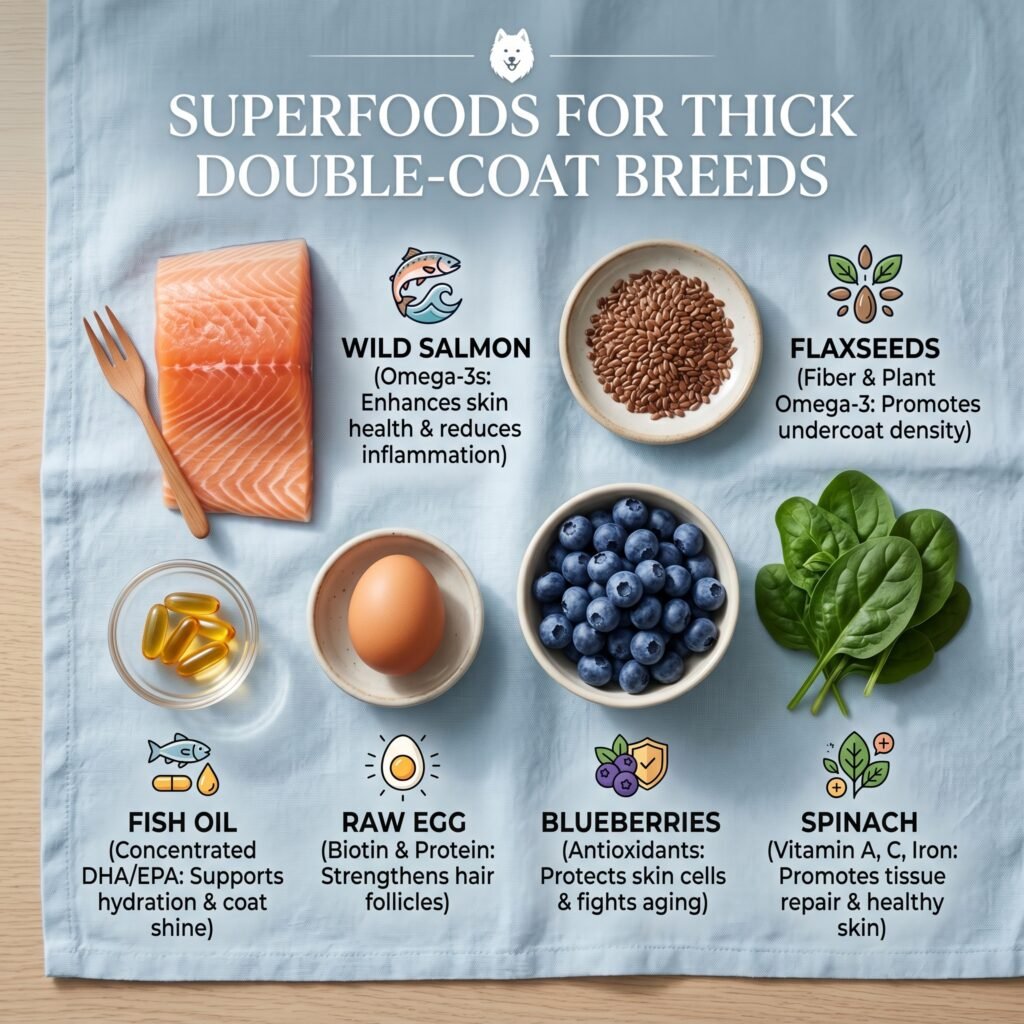
No nutritional factor is more visibly relevant to Samoyed health than omega fatty acids. The breed’s spectacular double coat — which requires significant daily nutritional investment to maintain its volume, texture, and gleaming white appearance — is one of the most omega-dependent features of any breed. Dog food for Samoyeds must include meaningful quantities of both omega-3 (from fish oil, salmon oil, or flaxseed) and omega-6 (from chicken fat, sunflower oil, or poultry sources) fatty acids to support the sebaceous glands and skin barrier that feed the coat from the inside out.
Omega-3 fatty acids from fish oil — particularly EPA and DHA — provide an additional benefit beyond coat support: they are the most clinically supported natural anti-inflammatory agents available in dog food. For a breed prone to hip dysplasia and autoimmune-adjacent thyroid conditions, the systemic anti-inflammatory support that fish oil-sourced omega-3s provide is a meaningful long-term health investment built directly into the right dog food for Samoyeds.

Glucosamine and Chondroitin: Joint Support from Day One
PupWiki’s March 2026 analysis identifies skipping joint support as one of the most common and consequential feeding mistakes Samoyed owners make — noting that “glucosamine and chondroitin should be in any formula for a medium breed.” The Samoyed’s documented predisposition to hip dysplasia makes this recommendation even more pressing: starting joint nutritional support early, before dysplasia symptoms develop, is significantly more effective at preserving cartilage integrity than beginning supplementation after degeneration is already established.
Look for dog food for Samoyeds that includes glucosamine (ideally at 300mg or more per kilogram of food) and chondroitin sulfate — either naturally derived through quality meat meal ingredients that naturally contain these compounds, or as direct additions specifically listed on the label. Petabolix’s Samoyed nutrition database specifically lists green mussel alongside glucosamine and chondroitin as joint-supportive additions worth seeking in a Samoyed formula.
Taurine: Cardiac Health Protection
Taurine is an amino acid naturally present in animal proteins but depleted by certain grain-free, legume-heavy diets — the subject of the FDA’s ongoing DCM (dilated cardiomyopathy) investigation. For Samoyeds, which Petabolix’s breed database flags as having some cardiac health considerations, taurine inclusion is a meaningful protective addition in any dog food for Samoyeds. Canine Bible’s veterinarian-reviewed Samoyed guide confirms that “the right diet not only helps manage existing health concerns but can also delay or reduce their onset, allowing your Samoyed to stay active, healthy, and full of energy” — and cardiac protective nutrition through taurine is a core component of that approach.
Antioxidants for Eye and Immune Health
Samoyeds have a documented predisposition to Progressive Retinal Atrophy (PRA) — a hereditary eye condition that leads to progressive vision loss. Petabolix’s breed nutrition database specifically lists anthocyanins, astaxanthin, beta-carotene, carotenoids, glutathione, lutein, lycopene, omega-3 essential fatty acids, phytonutrients, vitamin A, and vitamin C as the key antioxidants to seek in dog food for Samoyeds for eye health support. These compounds — delivered through natural food sources like blueberries, carrots, spinach, and sweet potato in quality formulas — cannot reverse genetic PRA but can support retinal cell integrity and slow oxidative damage that accelerates vision deterioration.
Samoyed Health Vulnerabilities and How Dog Food Can Help Manage Them
Canine Bible’s veterinarian-reviewed Samoyed article specifically identifies the breed’s “genetic predisposition to joint issues, eye conditions, thyroid disease, and kidney problems” as making nutrition “a vital part of their long-term care.” Here is how targeted dog food for Samoyeds selection addresses each vulnerability:
Hip Dysplasia
Hip dysplasia is the most commonly documented orthopedic condition in Samoyeds. Three dietary interventions are most directly supported by research: glucosamine and chondroitin for cartilage support (discussed above), omega-3 fatty acids from fish oil for anti-inflammatory joint protection, and caloric precision to maintain a healthy lean body weight — since every excess pound amplifies mechanical stress on compromised hip joints. ProDog Raw’s Samoyed guide specifically cites a University of Helsinki study showing that early-life nutrition directly influences hip dysplasia incidence — underscoring that feeding choices in puppyhood have measurable lifetime consequences for joint health. A 2013 paper from Karjalainen, Hielm-Björkman, and Sulkava at the University of Helsinki specifically confirmed this dietary-dysplasia relationship in working breeds.
Hypothyroidism and Autoimmune Thyroid Disease
Samoyeds have above-average rates of autoimmune thyroid disease — a condition that causes metabolic slowdown, weight gain, coat changes, and lethargy. Dogs with hypothyroidism gain weight readily even on normal or reduced food portions, making caloric management in their dog food for Samoyeds particularly important. A diet rich in selenium (supporting thyroid hormone metabolism), iodine from kelp, and omega-3 fatty acids (which help modulate immune responses) provides meaningful nutritional support for thyroid-affected Samoyeds alongside veterinary medical management.
Samoyed Hereditary Nephritis (SHN)
Samoyed Hereditary Nephritis is a genetic kidney disease specific to the breed — caused by a defect in collagen in the glomerular membrane that leads to progressive renal failure. For Samoyeds with confirmed SHN diagnosis, a reduced-phosphorus, kidney-supportive diet (similar to the CKD dietary management covered in our low phosphorus dog food guide) becomes necessary under veterinary supervision. For Samoyeds without SHN diagnosis, quality dog food for Samoyeds with appropriate phosphorus levels (not excessively high) and adequate hydration support provides the best long-term renal health maintenance.
Skin and Coat Sensitivities
While Samoyeds are not documented as an extremely allergy-prone breed by genetic studies, their sensitivity to poor dietary fat quality and inadequate omega supplementation shows up visibly in coat condition. Dogs on low-quality fat sources or omega-deficient formulas frequently develop a dull, coarse, or yellowing coat — the opposite of the brilliant white double coat that defines the breed. Any dog food for Samoyeds that prominently features salmon oil, fish oil, or high-quality chicken fat (preserved with mixed tocopherols) as named fat sources will visibly outperform formulas relying on generic “animal fat” for this breed’s coat requirements.
Best Dog Food for Samoyeds: Top Picks by Category (2026)
Best Overall: Ollie Fresh Dog Food
iHeartDogs’ October 2025 Samoyed food roundup places Ollie fresh dog food as a top overall recommendation for the breed — citing its clean, balanced nutrition free from by-products, fillers, artificial flavoring, and preservatives; its veterinarian-formulated USA-made recipes; and its subscription delivery model that ensures consistent freshness. Ollie’s high-protein fresh formulas deliver exceptional coat quality outcomes and digestive regularity that Samoyed owners consistently report as among the most visible improvements after switching from conventional kibble. The personalized meal plans calibrated to each individual dog’s weight and activity level also address the Samoyed’s documented weight gain risk through portion precision that standard bag feeding guides cannot achieve.
Best Premium Kibble: Muenster Pet Foods Naturals
iHeartDogs specifically recommends Muenster Pet Foods Naturals as the top premium kibble for Samoyeds — noting its AAFCO certification for all life stages including large breed puppies (providing coverage from puppyhood through adulthood in a single trusted formula), its use of high-quality proteins, and its commitment to complete and balanced nutrition without artificial additives. This is a Texas-based brand manufactured in its own facilities — the in-house manufacturing quality assurance advantage that our reviews of American Natural Premium and Pure Vita also identify as a meaningful trust marker.
Best Salmon-Based Formula: American Journey Active Life (Salmon)
BreedAdvisor’s Samoyed food analysis specifically recommends American Journey Active Life Formula as a top pick — noting its dual protein foundation of whole deboned salmon and Menhaden fish meal, both rich in vital amino acids and essential fatty acids that support coat health and healthy skin. Multiple owner reviews specifically reported decreased shedding on this formula and resolution of gastrointestinal distress — two outcomes particularly relevant for Samoyed owners. The formula includes taurine for cardiac health support and is available at an accessible price point that makes quality daily nutrition practical for a medium-large breed.
Best Fresh/Affordable Option: Spot & Tango UnKibble
PupWiki’s March 2026 Samoyed analysis specifically recommends Spot & Tango’s UnKibble as an excellent option for owners who want fresh food quality without the full premium price of services like Ollie or The Farmer’s Dog. UnKibble’s 100% fresh, whole human-grade ingredients — with no meat meals, no powdered mystery meats, and no artificial preservatives — deliver meaningfully better nutritional integrity than conventional kibble while the personalized meal plan addresses the Samoyed’s weight management requirements with the same portion precision as fully fresh subscription services.
Best for Sensitive Digestion: Raw Paws Pet Food
iHeartDogs includes Raw Paws Pet Food in their Samoyed recommendation list specifically for its sourcing from small, family farms with weekly small-batch preparation — providing the freshness guarantee that addresses one of the most common quality concerns in conventional kibble production. For Samoyeds with sensitive digestion — a documented concern in the breed according to iHeartDogs’ December 2025 feeding guide — the easily digestible protein sources and absence of heavy processing make Raw Paws a strong option alongside veterinary guidance.
Best Value: VICTOR Select Yukon River
BreedAdvisor specifically recommends VICTOR Select Yukon River as a value pick for Samoyed owners — noting owner reports of allergy improvement, coat quality enhancement, and bright, healthy eyes alongside the practicality of its fish-based formula free from corn, wheat, and soy. Taurine is specifically included in this formula for cardiac support. Multiple owners noted relief from chronic itchy skin and improved digestive regularity. The primary limitation noted in BreedAdvisor’s review is the absence of specific joint supplements — owners using this formula should consider adding a glucosamine supplement for breeds with hip dysplasia risk.
Best Dog Food for Samoyed Puppies: The Critical First Year
The puppy stage is the most nutritionally sensitive period in any Samoyed’s life, and finding the best dog food for samoyed puppies requires specific attention to growth-stage requirements that adult formulas cannot adequately provide. PupWiki’s March 2026 Samoyed guide is unambiguous: “Puppies need calorie-dense nutrition with DHA for brain development. Switch at 10–12 months for small/medium breeds.”
The key requirements for puppy-specific dog food for Samoyeds include:
- AAFCO growth certification: The formula must carry an AAFCO statement covering “growth” or “all life stages including growth of large breed dogs” — not just “adult maintenance.” PupWiki specifically warns: “Resist upgrading to a senior formula until the age range applies — unnecessary formula changes cause digestive upset,” and conversely, feeding a puppy Samoyed on adult food is an equally consequential mistake that deprives developing systems of the elevated protein, calcium, and DHA they require
- DHA from fish oil: Critical for brain and vision development through the first year. The University of Helsinki research on early-life diet and hip dysplasia incidence reinforces the principle that what a Samoyed puppy eats in their first year has measurable lifetime consequences for skeletal, neurological, and joint health
- Calibrated calcium-to-phosphorus ratio: Large and medium-large breed puppies require carefully balanced calcium-to-phosphorus ratios to prevent developmental orthopedic disease. Standard puppy formulas designed for all sizes may have calcium levels that promote accelerated growth — counterproductive in a breed already predisposed to hip dysplasia
- Caloric density for active growth without overfeeding: Petabolix’s Samoyed puppy guidance emphasizes that “it’s still important to not overfeed puppies, so make sure to portion food and keep treats to no more than 10% of their caloric intake.” Despite having significant growing to do, Samoyed puppies are at risk from the same over-enthusiastic eating habits their parents display
- Feed three times daily until 6 months, then twice daily: The recommended transition from three to two daily meals at 6 months aligns with the Samoyed puppy’s developing stomach capacity and helps establish the twice-daily adult feeding rhythm early
From a nutrition standpoint, Petabolix’s breed guide notes that “Samoyeds become adults once they reach about 90% of their expected weight” — typically around 12 to 15 months for this breed. Transition from puppy to adult dog food for Samoyeds at this physiological milestone rather than at a fixed calendar age.
Best Dog Food for Samoyeds Reddit: What the Community Actually Recommends
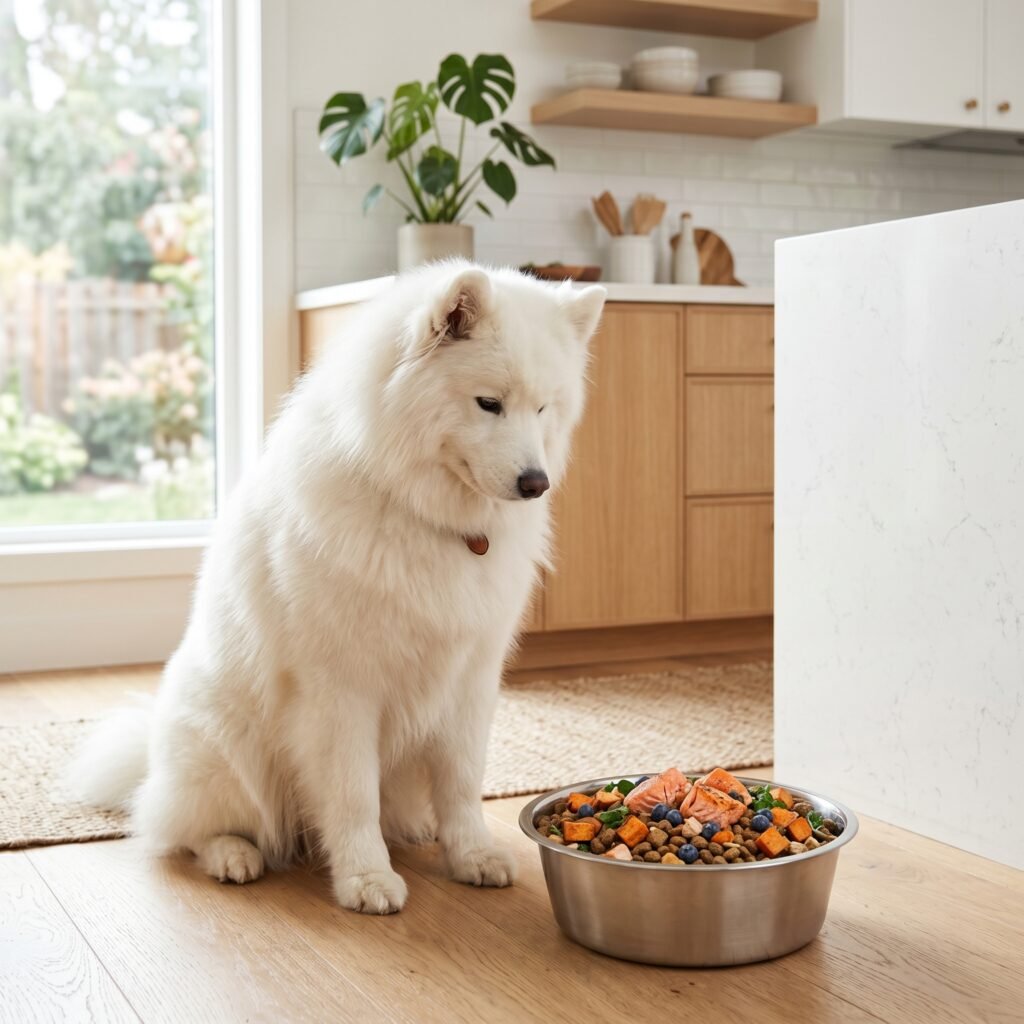
The best dog food for samoyeds reddit search reflects a real phenomenon: Samoyed owners actively trust peer recommendations from other breed-specific owners who have direct, long-term experience with the breed’s specific responses to different foods. Reddit’s r/samoyed community is one of the most active breed-specific dog communities on the platform, and the feeding discussions there converge on several consistent themes worth understanding alongside formal review data:
- Fish-based formulas consistently outperform chicken-based options for coat quality: Reddit community members who have compared multiple formulas on their Samoyeds overwhelmingly report that salmon-based or fish-primary formulas produce noticeably superior coat whiteness and texture compared to chicken-primary kibble — consistent with the omega-3 content advantage of fish proteins for this coat-dependent breed
- Grain-inclusive formulas are widely preferred over grain-free in the Samoyed community: The DCM concern has penetrated the Samoyed Reddit community deeply, with the majority of active community members recommending against grain-free formulas for long-term feeding — particularly legume-heavy ones — citing the ongoing FDA investigation and the breed’s documented cardiac vulnerability
- Portion control discussions dominate the community: The Samoyed’s tendency toward weight gain despite their active appearance is a recurring community concern. Reddit members frequently remind each other that the thickness of the breed’s coat masks body condition changes that would be immediately apparent in shorter-coated breeds — making weekly manual body condition assessment (feeling for ribs beneath the coat) a community-recommended practice
- Fresh and raw feeding has a dedicated following: A vocal minority of the Reddit community practices raw feeding for their Samoyeds — citing coat quality, digestive efficiency, and stool volume reduction as the most consistently observed benefits. ProDog Raw’s Samoyed guide notes that raw feeding “mirrors the nutrition dogs evolved with” and cites a 2022 Frontiers in Veterinary Science study by Jaffey et al. on the effects of whole food diets on immune function and inflammatory phenotype in healthy dogs as supporting evidence
Feeding Schedule and Portion Control for Samoyeds
Even the best dog food for Samoyeds cannot achieve its full potential without a consistent, precisely controlled feeding protocol. Here is the evidence-based framework that applies at every life stage:
- Feed twice daily as adults: Morning and evening meals of equal portions, never free-feeding. The Samoyed’s food motivation makes free-feeding a direct route to obesity in this breed
- Use a kitchen scale, not cup measurements: Kibble density varies significantly between formulas and brands. Weight-based portioning is the only reliable method for caloric accuracy. PupWiki specifically notes that the estimated annual food cost for a Samoyed is $710 on typical feeding rates — premium formulas running 20% to 40% higher — which underscores the practical importance of portioning correctly to avoid both over-nutrition and wastage
- Adjust for seasonal activity changes: Samoyeds are genuinely more active in cool weather and naturally reduce activity in summer heat. Adjust portions modestly (10% to 15%) downward during low-activity periods and upward during high-exercise seasons to match actual caloric expenditure
- Treats must not exceed 10% of daily caloric intake: Both iHeartDogs and Petabolix’s Samoyed guides emphasize this limit — using low-calorie, nutritious treats (baby carrots, cucumber slices, blueberries) rather than commercial biscuits which add meaningful calories without proportional nutritional value
- Assess body condition weekly: Because the Samoyed’s coat hides weight gain, physically run your hands along the ribs every week. You should be able to feel them easily under a thin fat layer. If you cannot feel ribs without pressing firmly, reduce daily food intake by 10% immediately
- Transition any new food over 7 to 10 days: PupWiki’s transition protocol: 25% new food with 75% old food for days 1 to 3; 50/50 for days 4 and 5; 75% new food for days 6 and 7; 100% new food from day 8. Sudden switches cause digestive upset even with quality food in this breed
Frequently Asked Questions About Dog Food for Samoyeds
What is the best dog food for Samoyeds to maintain coat quality?
Fish-based formulas with named salmon oil or fish oil are the strongest performers for Samoyed coat maintenance — providing high EPA and DHA omega-3 fatty acids that support skin barrier function, sebaceous gland health, and the natural oils that give the breed’s double coat its characteristic volume and gleam. Dog food for Samoyeds targeting coat quality should list salmon, salmon oil, or fish oil in the first ten ingredients and deliver at least 1% linoleic acid (an omega-6 fatty acid) in the guaranteed analysis.
How much should I feed my Samoyed per day?
Daily caloric requirements for Samoyeds vary significantly by size and activity level. A moderately active 50-pound adult Samoyed typically requires approximately 1,350 to 1,600 calories per day. Always calculate from the specific caloric density stated on your chosen dog food for Samoyeds packaging and measure portions by weight on a kitchen scale. Because the Samoyed’s coat masks weight changes, calculate from ideal body weight rather than current weight if your dog is already above optimal condition.
Should I feed my Samoyed grain-free food?
PupWiki’s March 2026 Samoyed guide includes a specific grain-free warning: “The FDA has investigated grain-free diets with legumes and dilated cardiomyopathy (DCM) in dogs. Research is ongoing. Discuss grain-free choices with your vet, especially for medium breeds.” Unless your Samoyed has a confirmed grain sensitivity or allergy, grain-inclusive dog food for Samoyeds using whole grains like brown rice, oats, and barley is the currently preferred choice from a cardiac risk management standpoint — avoiding the legume-heavy carbohydrate profile associated with the ongoing DCM concern.
When should I switch my Samoyed puppy to adult food?
Transition from puppy-specific to adult dog food for Samoyeds when your dog reaches approximately 90% of their expected adult weight — typically between 12 and 15 months for this breed. PupWiki advises switching “at 10–12 months for small/medium breeds” as the transition window. Use the 7 to 10 day gradual transition protocol and monitor closely for digestive disruption during the formula change period.
Final Thoughts: Choosing the Right Dog Food for Your Samoyed in 2026
The Samoyed is a dog of extraordinary beauty, genuine intelligence, and endearing warmth — a working breed whose thousand-year Arctic heritage is written in every aspect of their physiology. Feeding them well means respecting that heritage: providing the high-quality animal protein that sustains their muscle, the omega-rich fats that feed their spectacular coat from within, the glucosamine and chondroitin that protect their joint cartilage across their long lifespan, the taurine that supports their heart, and the antioxidants that defend their vision and immune system against the conditions their genetics put them at elevated risk for.
The best dog food for Samoyeds is one that is AAFCO feeding-trial certified, led by a named animal protein, rich in fish-sourced omega-3 fatty acids, appropriate in caloric density for their actual activity level, and fed in precisely measured portions twice daily — adjusted regularly based on hands-on body condition assessment that cuts through the camouflage of that magnificent white coat. Work with your veterinarian at every life stage. Start joint support early. Manage weight with the discipline this food-motivated breed requires. And let the coat, the energy, and the smile — always the smile — tell you whether you’ve got the food right.
Looking for more breed-specific nutrition guides, expert dog food reviews, and evidence-based feeding advice? Browse our blog for comprehensive resources designed to help every dog owner make confident, informed decisions for their dog’s health at every stage of life.